ſπϙ ✕⊢ · 1424 1112 1433 520 · prfsfns lkbfr du citron sur les quatre demi-pages blanches la monaca · Uriel · 8319 < 8340 < 8374
A survey · September 2026
Thirty favourites from the archive
Ten that made us laugh, ten that matter to history, and ten that are simply ingenious, picked from two hundred
cipher write-ups that run from 1425 to 1933
Daniel Bourdeau · posted · updated
Why this page exists. Most of the work on this site is slow: a key rebuilt symbol by symbol, a catalogue record
corrected, a letter found to be in print since 1877. Five centuries of other people’s secret mail also hold royal scandals,
clerical blunders and some clever tricks. Here are thirty of them. Each card names how the text was obtained and links to the full
write-up, with the images, the key and the measured extent of the decipherment. Each quotation animates from cipher to plaintext as it scrolls into view.
30findings
1425–1933five centuries
8languages
6never ciphers, or no message
01 Ten that made us laugh
Drunk envoys, royal gossip, catalogue clerks with the best of intentions, and one minister who could not quite work his own code.
01
1533Hungary → the Dukes of Bavariakey from adjacent plaintext
“To be spoken with in the morning, when he is sober”
DECODE filed this letter under “Augurellio”, the name on its address leaf. At the foot of two leaves it is signed, in
cipher, Iorg Weinmaister: Jörg Weinmeister, a Bavarian agent in Hungary. The key was rebuilt from contemporary glosses on
sibling letters in the same volume and on this one. Most of the letter is grim news, including the siege of
the castle of Palota and a report of fifty thousand Turks marching from Belgrade on Buda. Then the talks on relieving Palota
run into a practical problem. The magnate Török Bálint was sent to discuss the relief one evening in Vienna while well
drunk, and will have to be approached again the next morning.
the reading, in English
…one evening at Vienna well drunk, was sent to talk of the relief, and is to be spoken with in the morning when he is sober.
1580Rome → the nuncio in Parisexisting decipherment
The Pope, the King of France, and the nun
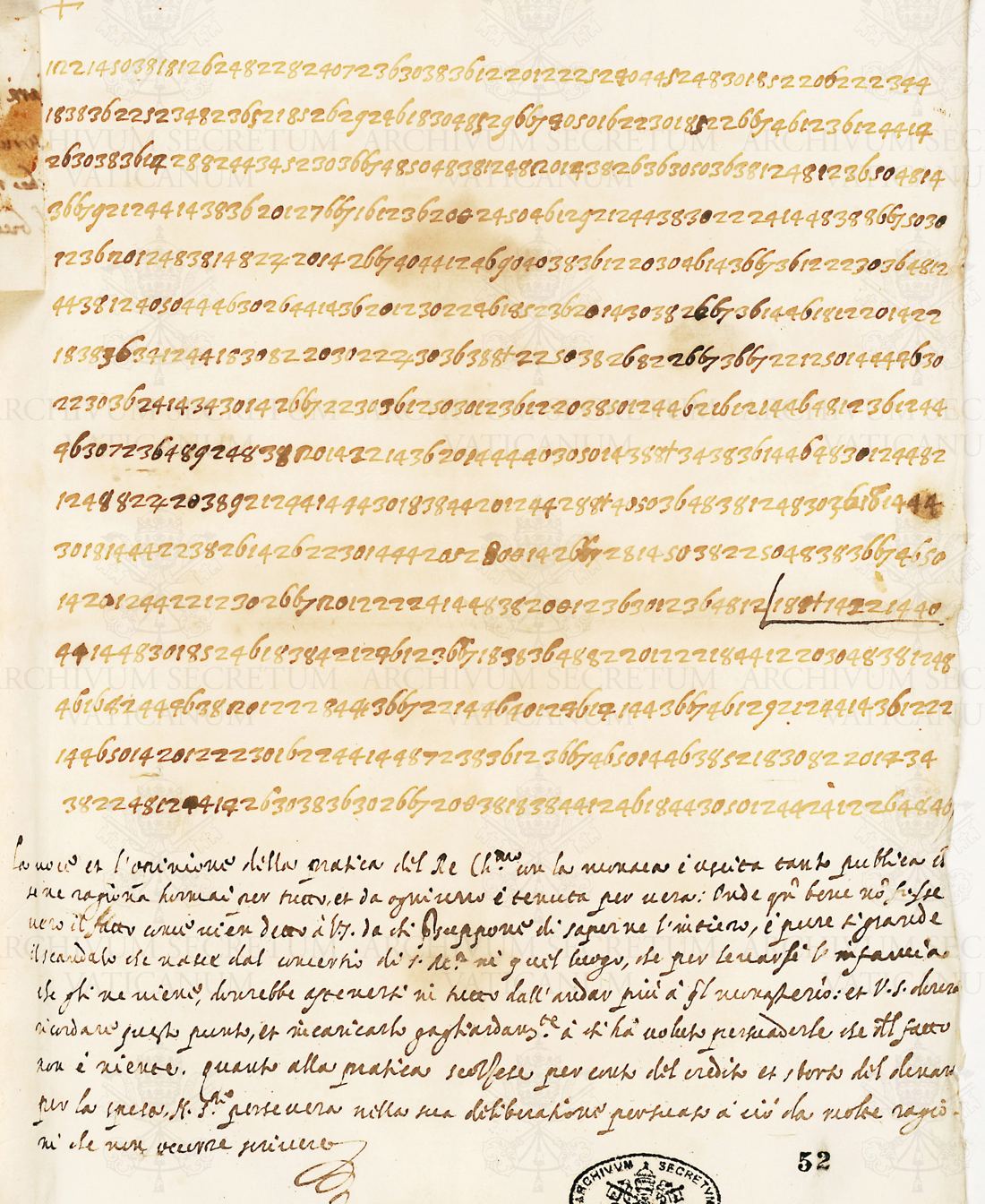
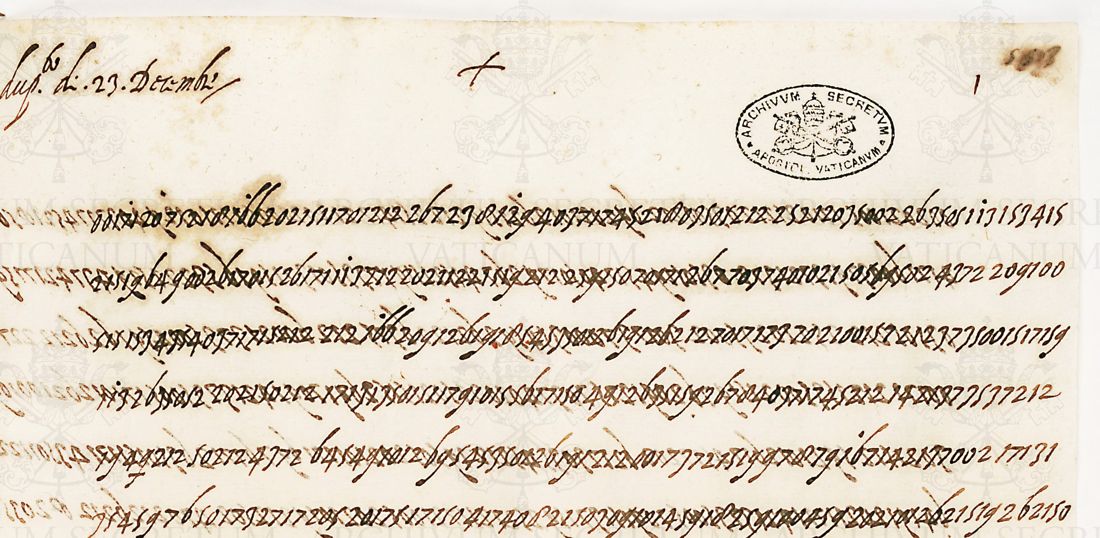
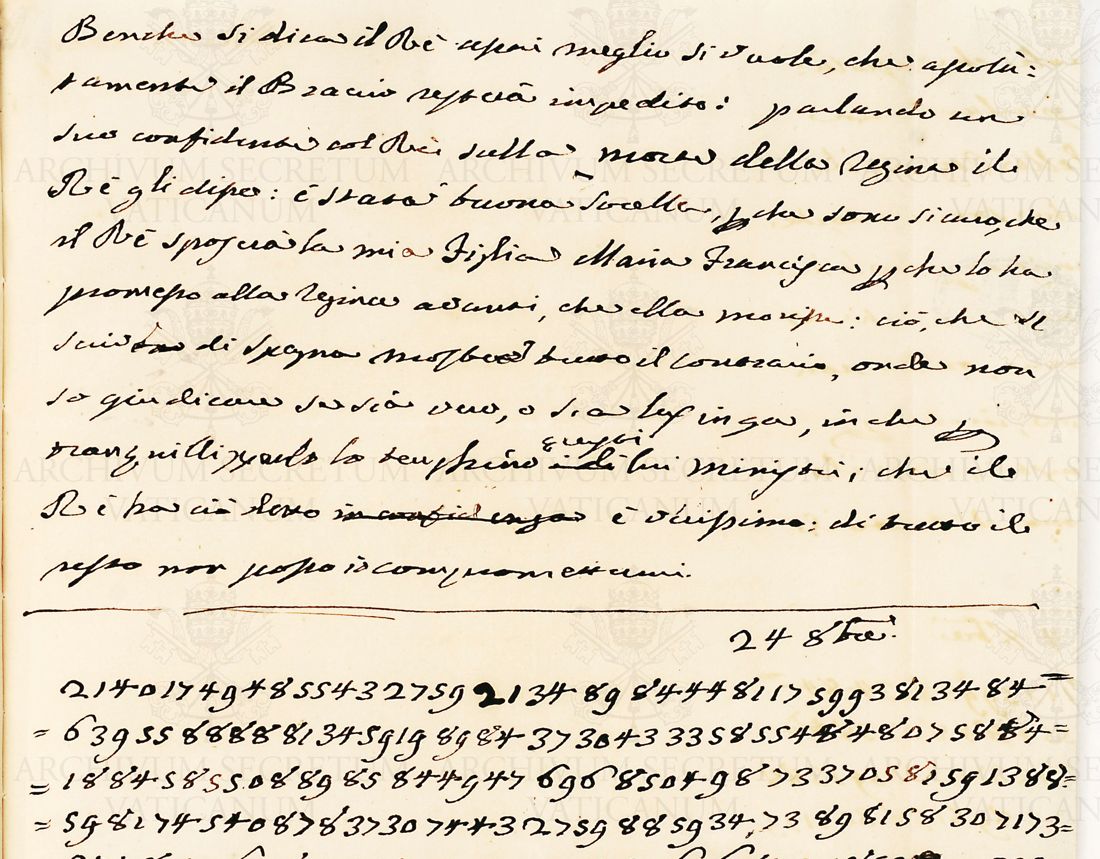
This is a cipher enclosure from the papal Secretariat of State to the nuncio Dandini, with the clerk’s decipherment written under
the figures. George Lasry decrypted its companion letter in 2020 with his reconstructed key. This one uses the same nomenclator with
different letter values, which were rebuilt here with a solver (simulated annealing) and checked against the clerk’s text. The two
agree word for word, except that the cipher has commercio where the clerk wrote concetto. What Rome wanted
kept secret was the gossip about Henri III and a nun. Whether or not it was true, the scandal was so great that the King “should stop
going to that monastery altogether”, and the nuncio is to press this on him hard. The companion letter adds that he is not to raise
the matter of the nun with the Queen.
Italian
La voce et l’opinione della pratica del Re Chr.mo con la monaca è uscita tanto publica che se ne ragiona hormai per tutto
The talk of the Most Christian King’s affair with the nun has become so public that it is discussed everywhere.
Francia 283C f. 52: the figures, and the clerk’s decipherment beneath. Image: Archivio Apostolico Vaticano, Francia 283C f. 52, via DECODE R72.
03
17th c.Sloane MS 3188not a cipher
Twenty-five “secret letters” that are notes on John Dee’s conversations with angels
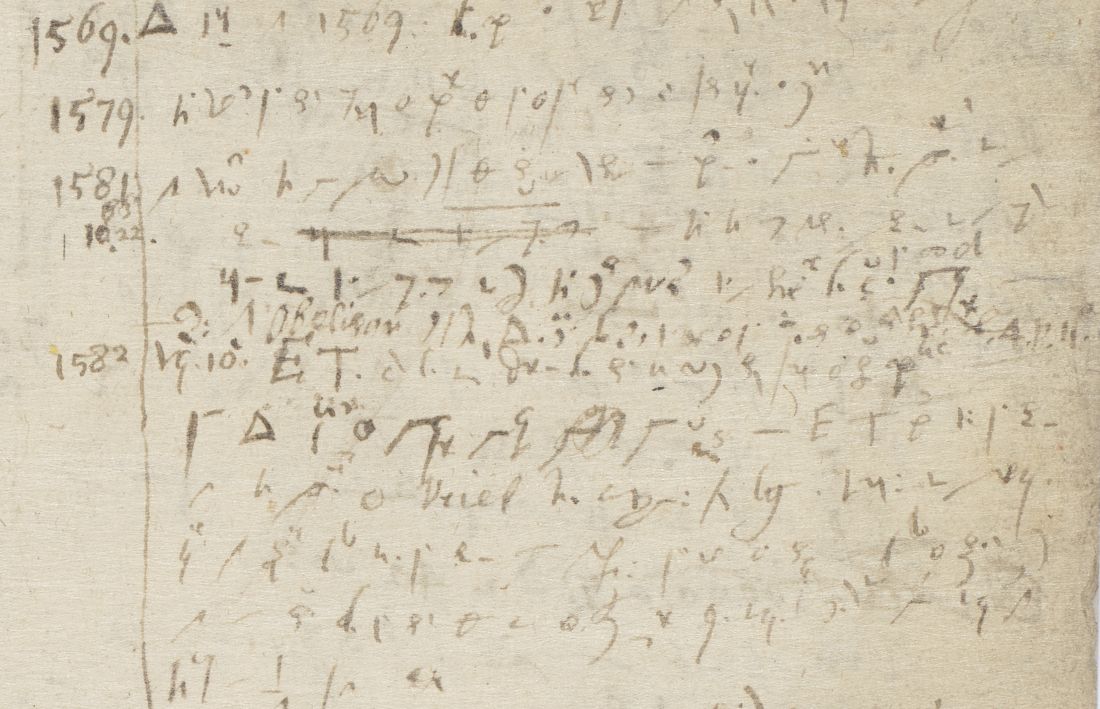
DECODE lists Sloane MS 3188 ff. 109–169 as twenty-five ciphertexts with no decipherment, sender and recipient unknown. They are bound
straight after Dee’s own diaries of his spirit “actions”. They are a later reader’s notes on those diaries, in
seventeenth-century English stroke shorthand with the names written out in longhand. The leaves hold an index of the Actions, a list of
Dee’s writings, and a note on Kelley and Prague dated 1595. There is no cipher, no letter and no correspondent in them.
f. 109r: shorthand strokes, with names written out in longhand. Image: British Library, Sloane MS 3188 f. 109r, via DECODE R8506.
04
1702–23Blenheim Papers, Add MS 61575not a cipher
A “numerical cipher” with no numbers, thanking someone for cipher lessons
DECODE catalogues folio 95 as a numerical cipher with no decipherment, by “Frederic, Re di Prussia”. There are no numbers on the page.
It is seven lines of plain French, spelled by ear and chopped into syllables, and the writer is thanking someone for showing him how to
write in cipher. Judging by the spelling, the lessons went better than the dictation.
French, as spelled
moy en me mon trant d’es cria re
…for the trouble you took with me in showing me how to write in cipher
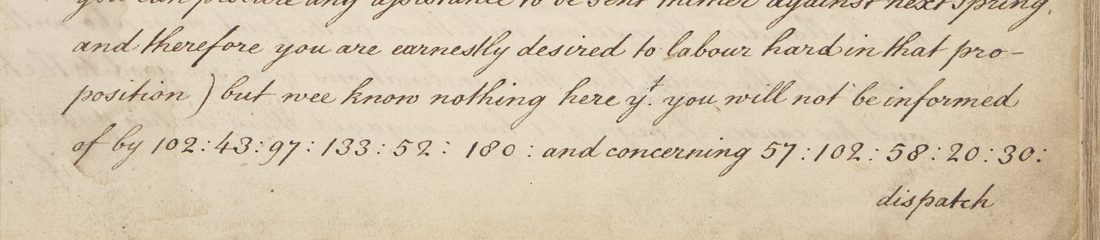
Coded addresses that meant nothing at all, on purpose
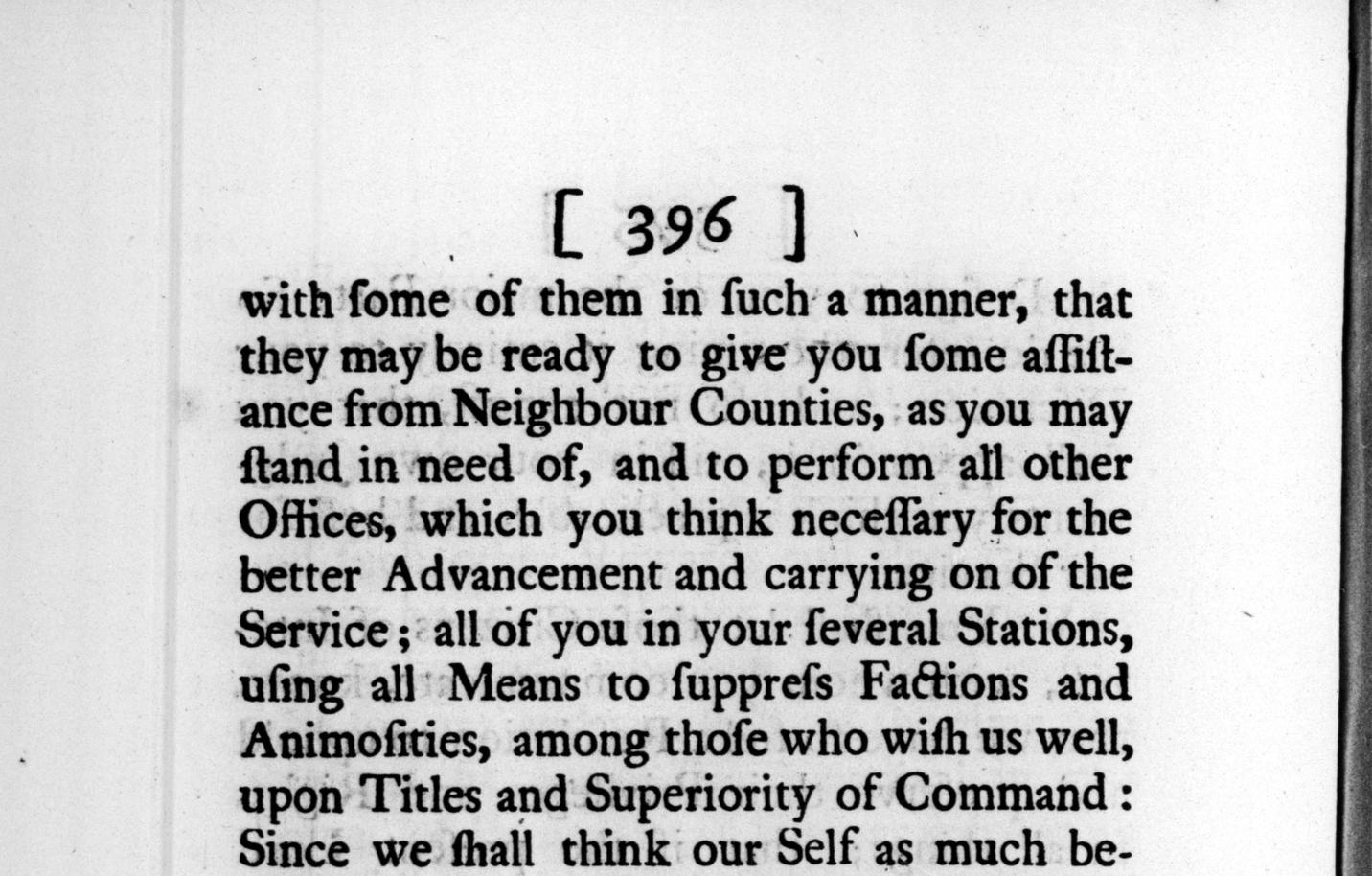
Several of the royalist letters between Edward Hyde and John Barwick carry numbered superscriptions that no key reads, including the
full Hyde–Barwick key printed in 1721. The explanation had been in print for three centuries. The editor of Barwick’s
Life, who had the papers, says the numbers were decoys.
the 1724 edition
superscribed with Numbers signifying nothing … only to puzzle the Enemy, if they should fall into their Hands
Vita Johannis Barwick (1721), p. 396. Image: P. Barwick, Vita Johannis Barwick (London, 1721), p. 396, via the Internet Archive.
06
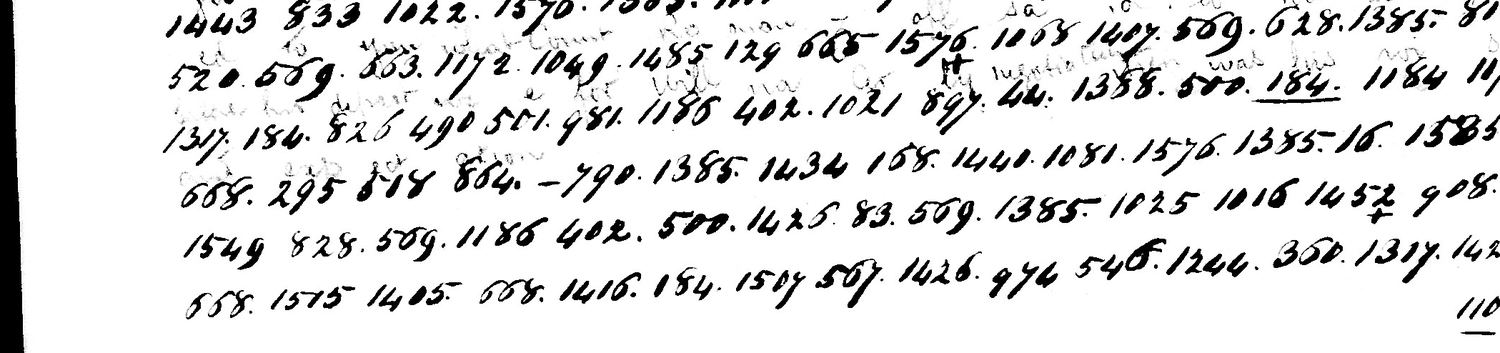
1758“Cypher from Mr Eichel”, Prussianulls only
A sheet of cipher figures that is nothing but padding
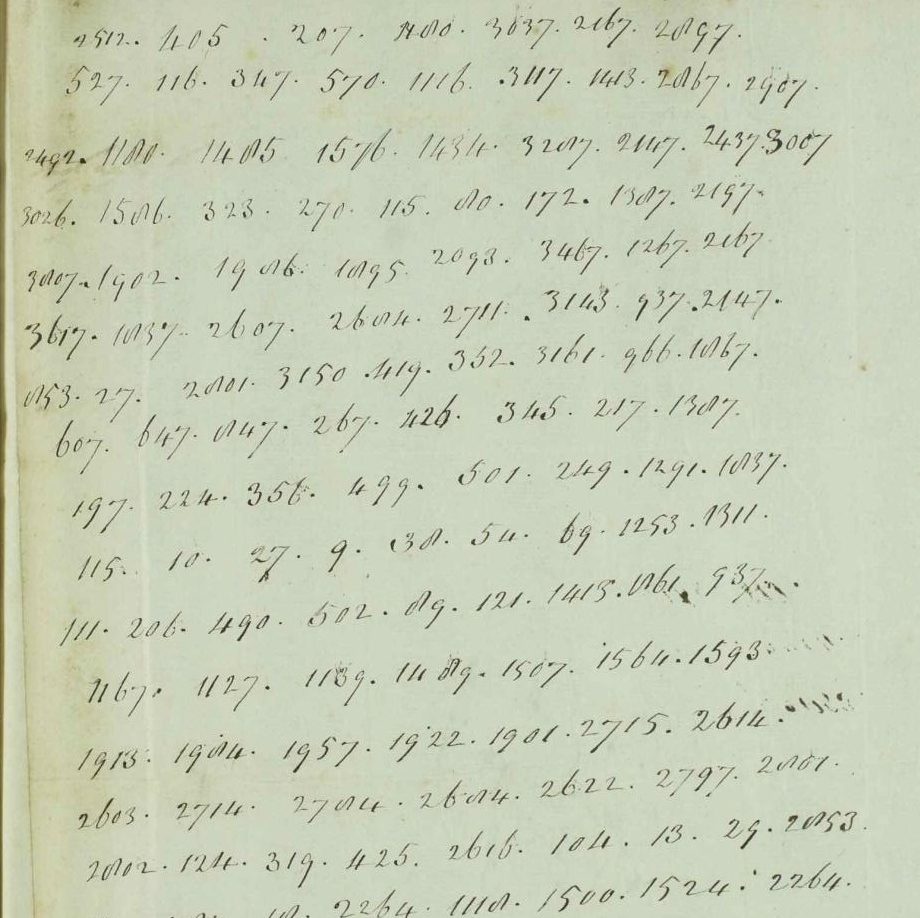
This sheet of figures sits in the Prussian papers at Kew. The key the catalogue proposed does not fit it. The key filed in the same
volume does, and it begins by declaring every number that contains a 7, plus four whole ranges, to be a null. On that rule 117 of the 139
groups are nulls, and 21 of the remaining 22 land on cells the key leaves blank. It is a dummy sheet, and there was never a message on it.
the key’s first rule
Tous les nro où je trouve un ou plusieurs 7 sont les nonvaleurs
Every number in which I find one or more 7s is a null.
The Eichel sheet: 139 groups, 117 of them declared nulls. Image: The National Archives, Kew, via DECODE R595.
07
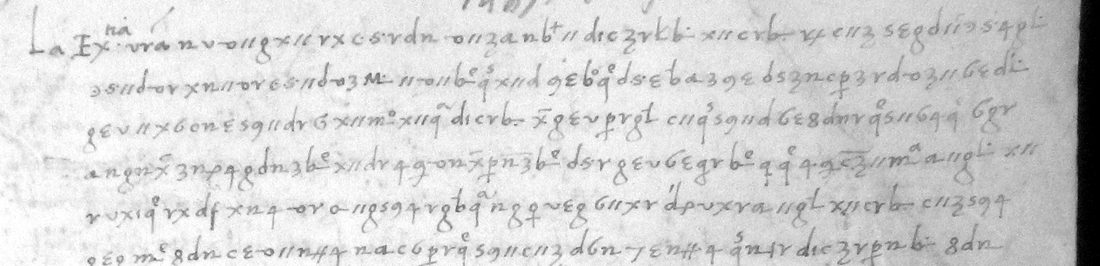
1524Rome → Charles Vkey from adjacent plaintext · partial
The oldest long cipher on the list, off by exactly a hundred years
DECODE dated two letters from Rome to “April 1424”. That would have made them the longest ciphertext before 1450, and they
were picked as a flagship target on that basis. The letter gives its own date on f. 128v: De Roma xviij de Abril 1524. The
catalogue’s “Luis Fernández” is the Duke of Sessa, Charles V’s ambassador. Eight sibling letters carry the
court’s own decipherments. The key was rebuilt from them, about 110 code groups and the alphabet, and it deciphers the passage word by
word except four code groups and one clause.
How the poet Abraham Cowley became a correspondent called “Mr. Conley”
The docket on these royalist letters reads mr Cowleys Hand. DECODE read it as “Conleys” and made that name the
author. The letters are in clear English. The only cipher in them is 23 code numbers in five short runs, too few to recover a key from,
and no key was found on DECODE or in print. The phrase below keeps its code.
English, with its code
the person that came lately from 248:88:46:47:96:52:7:57
Harley MS 7003 f. 314r. Image: British Library, Harley MS 7003 f. 314r, via DECODE R7768.
09
1812St Petersburg → Washingtonkey from adjacent plaintext
John Quincy Adams fumbles his own code: “impassioned” for “impaired”
Despatch No. 88 of June 1812 reports that the Russian Chancellor Rumyantsev had suffered a stroke. Worthington Ford printed nine of its
lines in 1914 as “not decyphered”. Adams used his own code, not the one historians assumed. Its key was rebuilt here from the
State Department clerk’s interlinear decodes on the same microfilm reel and from Ford’s printed decipherments of other despatches,
and it decodes all nine lines. Four groups, whose values are certain, spell im-pas-sion-ed where the sense wants
“impaired”, most likely Adams’s own slip at the codebook.
English, syllable by syllable
if his ac-tive in-flu-ence had not been im-pas-ion-ed before it, it can scarcely fa-il to have been af-fect-ed
No. 88, 25 June 1812, in figures. Image: National Archives and Records Administration, RG 59, M35 reel 3, frame 0206.
10
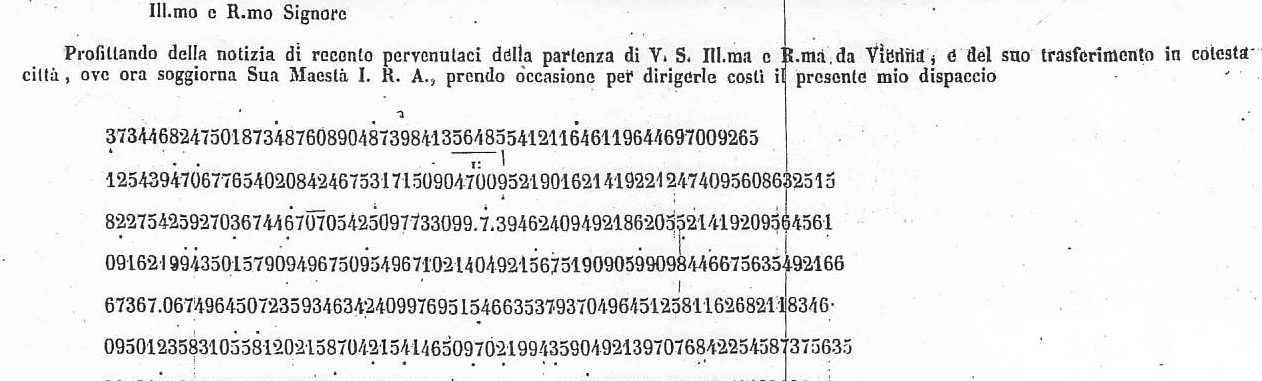
1848Rome → Innsbruckciphertext-only break
The Pope’s secret counter-order: intercepted, published with a prize, and a day late anyway
On 15 June 1848 Cardinal Soglia sent 955 digits to the nuncio at Innsbruck, where the Emperor had fled. Mazzini’s L’Italia
del Popolo intercepted the despatch, printed it, and offered “a prize of some size for the best interpreter of these figures”.
Nobody claimed it. In 2014 it was posted on Cipherbrain as an open problem, and no decipherment was found in print. The key was recovered
here from the ciphertext alone. Its code section is alphabetical: Imperatore 8319
comes before istruzione 8340, which comes before Monsignor 8374. The order tells the nuncio to stay with the Emperor
wherever he goes. According to the Dizionario Biografico, he had left Innsbruck on 14 June, the day before it was sent.
the reading, in English
…of the Holy Father that you remain at Innsbruck with the Emperor and wherever he may go
The printed block of 955 digits. Image: Tony Gaffney, via Klaus Schmeh, Cipherbrain.
02 Ten that matter to history
Sieges, assassinations, a bought crown and a king’s change of plan. In three of these the key was rebuilt here from
plaintext beside the cipher; the other seven were deciphered with keys that already existed, several of them for passages never printed in clear.
01
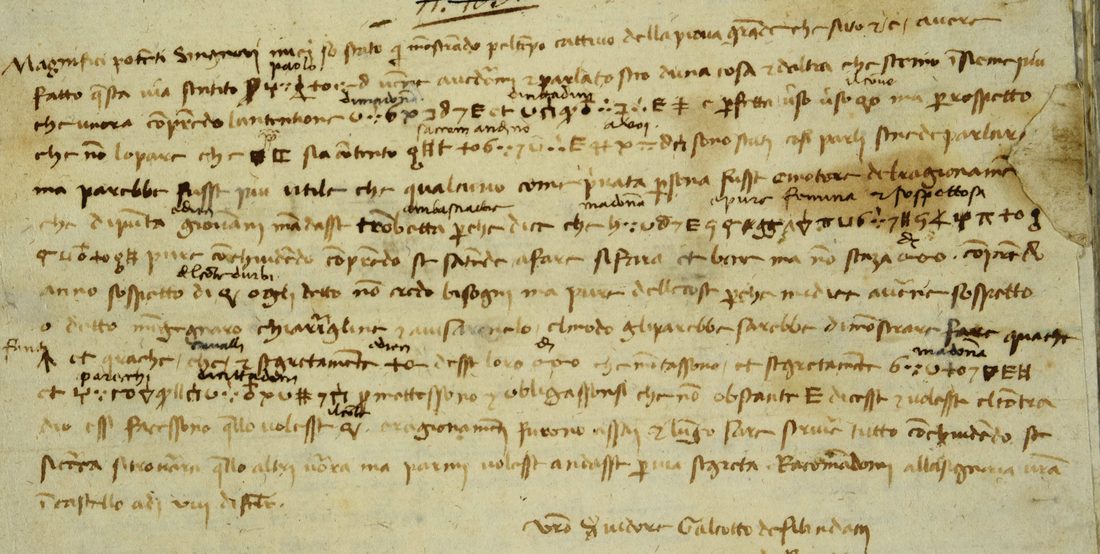
1425Urbino → Florenceknown key applied
1425: the oldest cipher deciphered on this site
Early in 1425, Galeotto da Ricasoli wrote from Urbino to Florence’s war magistracy. Gabbrielli glossed a few words and made a key
in 1863, which Meister printed in 1902, but the letter itself was never printed and no decipherment of its three long cipher runs was found.
Gabbrielli’s key, extended from his glosses on this letter and three siblings, deciphers 97 of the 99 cipher symbols.
Madonna is the Countess of Urbino, Caterina Colonna, niece of Pope Martin V.
Italian
perché dice che Madonna è pure femina e sospetosa
because he says that Madonna is, after all, a woman, and suspicious
Ricasoli to the Dieci, 1425. Image: Archivio di Stato di Firenze, via DECODE R3754.
02
1482Pozsony → Ferrarakey from adjacent plaintext · partial
Venice tries to buy the King of Hungary
In July 1482, in the first weeks of the War of Ferrara, the Este envoy at Matthias Corvinus’s court reported in cipher what Venice
was offering the king: the island of Veglia, a command at sea for his natural son, and 100,000 ducats a year. The alphabet was rebuilt from
sibling letters that survive with clear copies. This letter has no clear copy and had never been printed.
Italian
et voleva dargli Vegla, et voleva lo figlio (e bastardo) per loco capitaneo … per mare
and they wanted to give him Veglia, and wanted his son (a bastard) as their captain … at sea
Sadoleto to Ercole d’Este. Image: Archivio di Stato di Modena, via DECODE R1102.
03
1565Messina → Philip IIkey from adjacent plaintext
The relief of Malta, reported in figures during the Great Siege
García de Toledo, viceroy of Sicily, wrote to Philip II on 16 July 1565 with every sensitive word in two-digit figures. No contemporary
decipherment is known (Tomokiyo’s “undeciphered”), and whether anyone else has recovered the key is unknown. It is an easy key:
two cribs in the clear Spanish around the figures gave eleven letters, and the figures 12–43 run through the alphabet in order. Most of
the work was transcribing the 1,930 groups. The letter tells how the small relief force got into the Borgo, and how La Valette’s fire signals turned
back a second run of galleys. It also reports that Sicily could no longer pay for the war.
Spanish
el maestre les hizo las sennales del fuego clarissimas para que no entrassen
the Grand Master made them the fire signals, very clear, so that they would not come in
Estado leg. 1394 no. 247, f. 1r. Image: Archivo General de Simancas, Estado leg. 1394 no. 247 f. 1r, via PARES.
04
1573Warsaw → Pariskey from adjacent plaintext
How France bought the crown of Poland
These are the French envoys’ letters to Charles IX during the election that made Henri of Anjou King of Poland. The result is a
corrected key: Tomokiyo’s published table proved shifted, and the key was rebuilt from the court decipherer’s margin notes on
these letters, half cut away by the binder, one of them car je n’ay pas cinquante escuz. The corrected key then deciphered
three election letters. In them, the Poles can be won by money “as are the Germans, their neighbours”.
On 9 May the election is carried against the Emperor, Spain, Muscovy and Sweden.
French
d’Espaigne, du Moscovite et du Roy de Suède, qui tous estoient bandez contre vostre Majesté
of Spain, of the Muscovite and of the King of Sweden, who were all banded against Your Majesty
BnF fr. 4735 f. 124. Image: Bibliothèque nationale de France, fr. 4735 f. 124, via Gallica btv1b9060724s canvas 242.
05
1588–89Blois → Romeknown key applied
The papal legate reports the murder of the Duke of Guise
Cardinal Morosini, legate in France, sent 36 cipher enclosures to Rome, all of them written as one unbroken stream of digits. George
Lasry recovered part of the key statistically and identified it as the one Meister printed in 1906. Its homophones are one to three digits
long and unseparated, so the key cannot be applied mechanically: the stream has to be divided into units, and several divisions are possible.
The division was chosen by scoring candidates with a language model of Italian, and 34 of the 36 are deciphered in full. They cover the Estates of Blois, Saluzzo and
Henri III’s march on Paris, and they report the killing of the Guises in the King’s own chamber.
Italian
il Duca di Guisa nela camera di S. M.tà è stato per ordine di S. M.tà amazato a colpi di pugnale
the Duke of Guise has been killed with dagger blows, in His Majesty’s chamber, by His Majesty’s order
Francia 22 f. 308r: one run-on stream of digits. Image: Archivio Apostolico Vaticano, Francia 22 f. 308r, via DECODE R43.
06
1590Mantua → the duc de Neversknown key applied
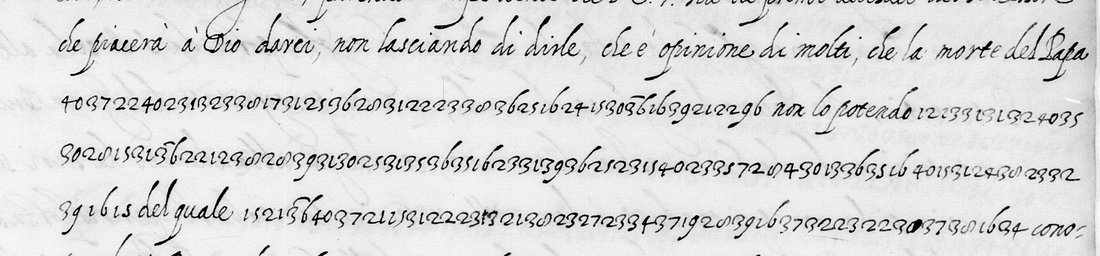
“The Pope’s death was procured with poison by the Spaniards”
Vincenzo Gonzaga, Duke of Mantua, wrote to the duc de Nevers on 17 September 1590, three weeks after the death of Sixtus V. Tomokiyo
had identified the cipher; its key sheet, filed among Nevers’s own papers, deciphers 95% of the cipher unchanged, and no earlier
decipherment was found. Mantua passes on the rumour that the Spaniards poisoned the Pope,
and welcomes Henri IV’s expected conversion.
Italian
che la morte del Papa sia stata procurata con veleno da Spagnoli
that the Pope’s death was procured with poison by the Spaniards
BnF fr. 3979 f. 92r. Image: Bibliothèque nationale de France, fr. 3979 f. 92r, via DECODE R4176.
07
1570Tutbury → the Towerknown key applied
Mary Queen of Scots writes to Norfolk in the Tower
Mary wrote this letter weeks after the murder of the Regent Moray, and it is the only one in the series with no contemporary
decipherment. Tomokiyo reconstructed the key from the deciphered letters of the series and published a partial decipherment of this one.
His key was applied here to the whole letter, all 23 lines; the work was transcription. Mary
reports that Elizabeth blames her for Moray’s death. Norfolk is to write only through the Bishop of Ross or Lady Scrope, and never
in his own hand.
English, as she spelled it
I am asured that sche … sueves me the veyt of Murray death; but God knoueth
I am assured that she lays on me the blame [Scots wyte] for Moray’s death; but God knows
Cotton MS Caligula C II f. 74r. Image: British Library, Cotton MS Caligula C II f. 74r, via the BL IIIF service.
08
1602–09Paris → Kasselknown key applied
Henri IV’s secret letters to a German prince: printed, keyed, and never put together
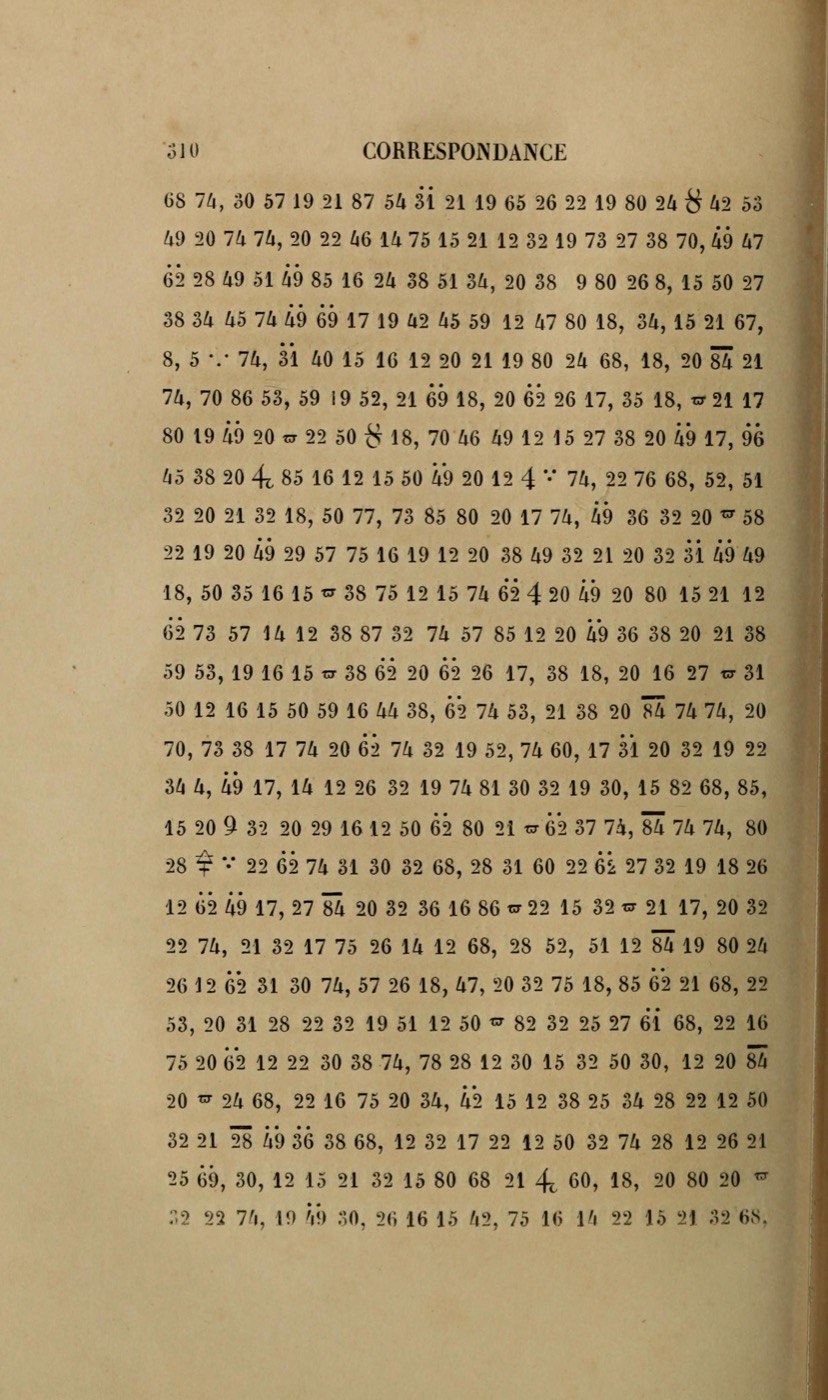
Rommel printed the ciphered passages of Henri IV’s letters to Landgrave Maurice of Hesse-Kassel in figures in 1840. Six years
later he printed the key, with a clear text of one letter only. Applied to the figures of 1840, with misplaced entries in the printed key
corrected, it deciphers all seven passages, about 4,100 groups. They cover
Bouillon and the German princes, the Gunpowder Plot, two million livres for the Dutch, and a call in 1606 to resist a Spanish King of the
Romans. This decipherment was contributed by Arya Sanketbhai Patel.
Rommel 1840, p. 310: printed in figures, without a decipherment. Image: Rommel (ed.), Correspondance inédite de Henri IV avec Maurice-le-Savant (1840), p. 310, via the Internet Archive.
09
1691Versailles → Piedmontknown key applied
Louis XIV decides to give up Piedmont, in despatches never printed in clear
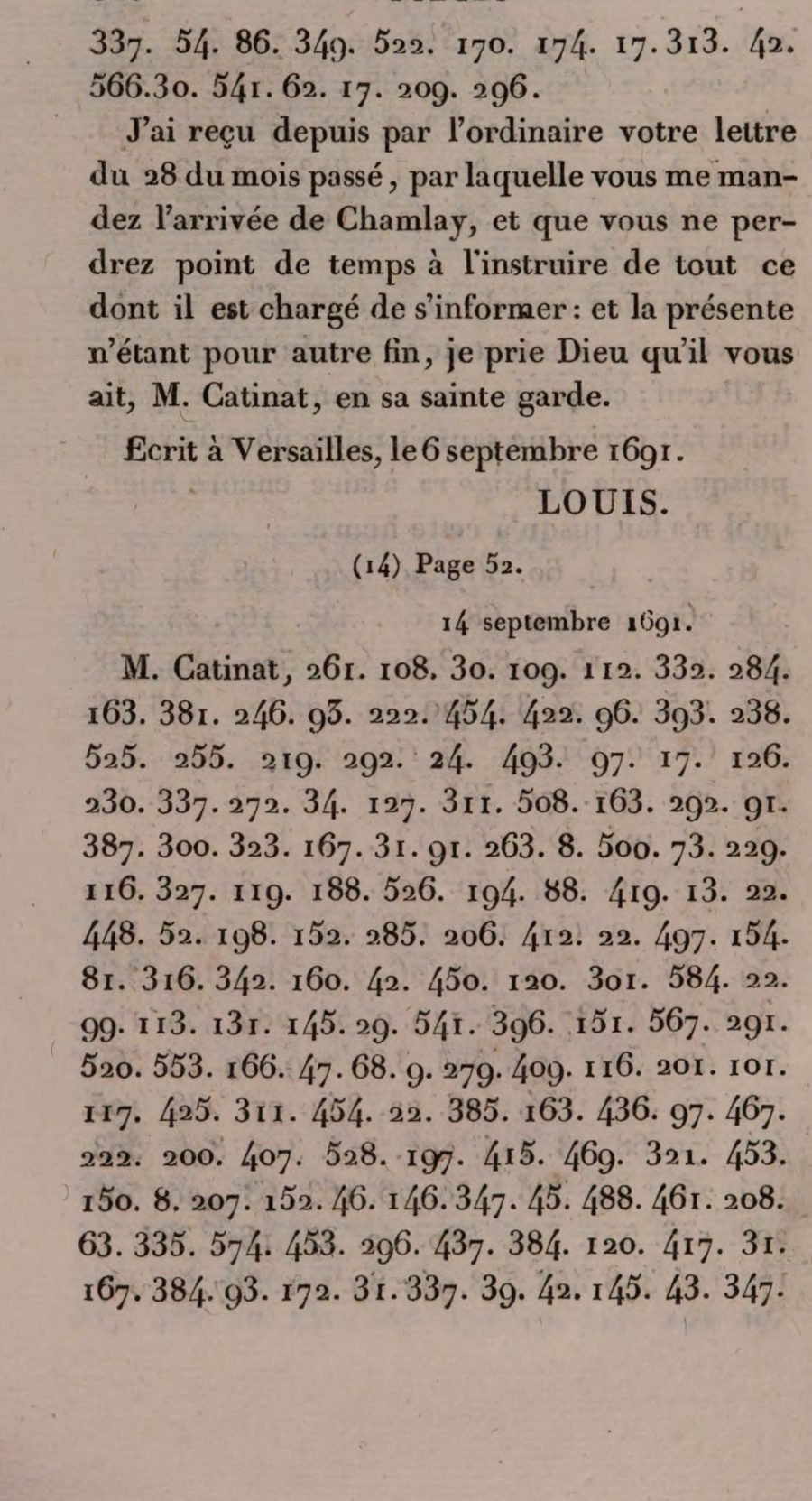
The 1819 editor of Catinat’s memoirs printed seven despatches in figures and could not decipher them. Bazeries rebuilt the code in
1893 while hunting the Man in the Iron Mask, printed two in clear and parts of two more, and stopped. His table, applied here unchanged,
decodes all seven, 12,362 groups; three had never been printed in clear. They include the
King’s twenty-page letter of 14 September: bring the army back over the Alps, hold Carmagnole as long as possible to cover the talks
with the Pope, then strip it and burn it.
French
je me suis déterminé à préférer le parti solide à l’honorable
I have resolved to prefer the solid course to the honourable one
Mémoires de Catinat (1819), p. 320. Image: Mémoires de Catinat, t. II (1819), p. 320, Bayerische Staatsbibliothek, via the MDZ.
10
1758–60Lisbon → Romeknown key applied
The nuncio’s secret account of the attempt on the King of Portugal
On the night of 3 September 1758, José I of Portugal was shot at in his carriage. The first of eight ciphers from the Lisbon nuncio
Acciaiuoli is his secret account of it. They were deciphered with George Lasry’s 2020 key, which was already on their DECODE
records; 25 code groups were added from three leaves deciphered at the time.
Italian
il Teixeira ferito a morte … il Re molto ferito del braccio destro
Teixeira mortally wounded … the King badly wounded in the right arm
Portogallo 117/6 f. 106r. Image: Archivio Apostolico Vaticano, Portogallo 117/6 f. 106r, via DECODE R199.
03 Ten that are simply ingenious
Invisible ink, decoy words, a monk’s vowel shift, and the detective work that turns a mislabelled record into a story.
01
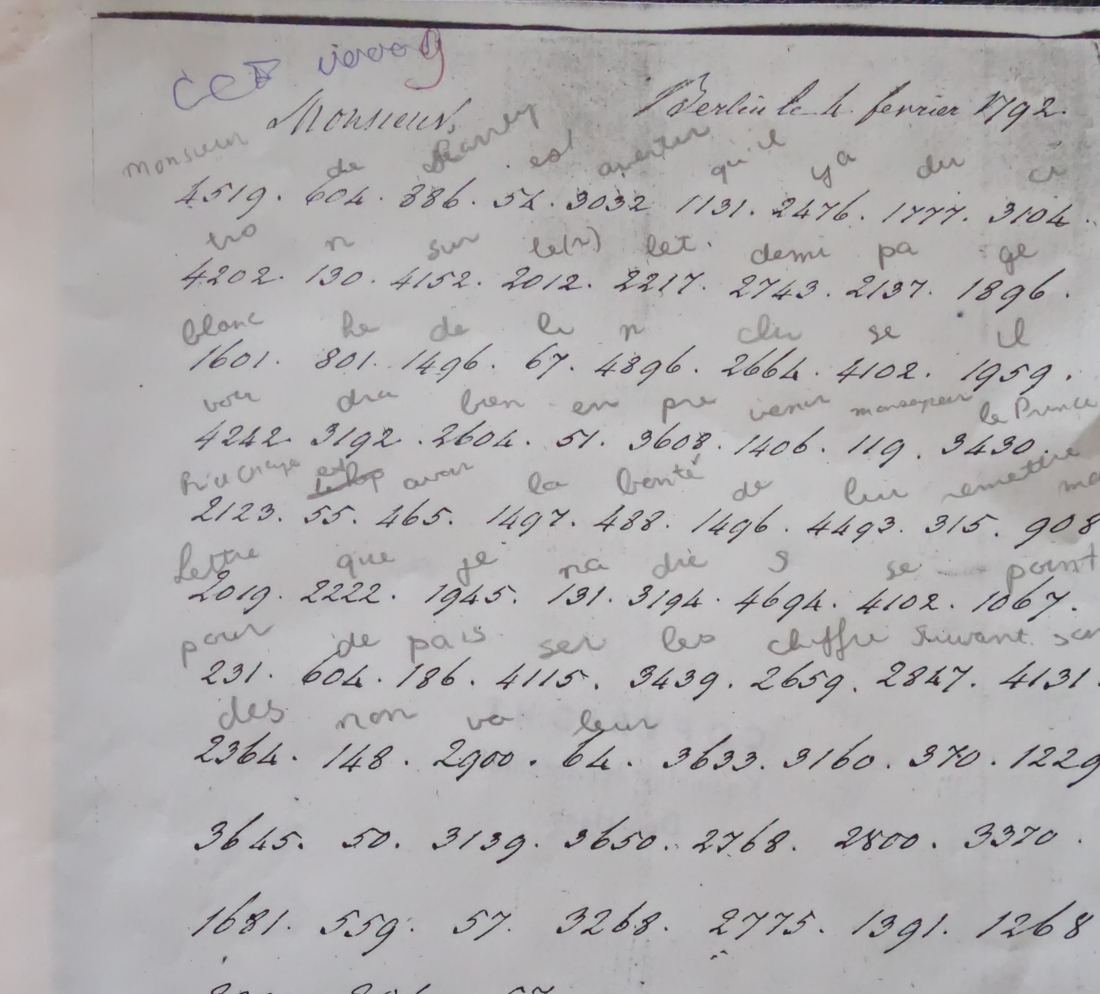
1792Berlin → The Hagueknown key applied
A cipher whose only job is to say that the real letter is in lemon juice
The Dutch envoy van Reede wrote from Berlin on 4 February 1792. Deciphered in full with the 1782 Grand Chiffre, the key of his
earlier letters to the Prince, the letter is a cover note. The four blank half-pages of its enclosure carry writing in lemon juice, the Prince of Orange is to be told, and “the following
figures are nulls”. Those 21 nulls decode to a planted jumble of Conseil d’Etat, la Russie and
Archiduc, which is bait for anyone who opens the letter.
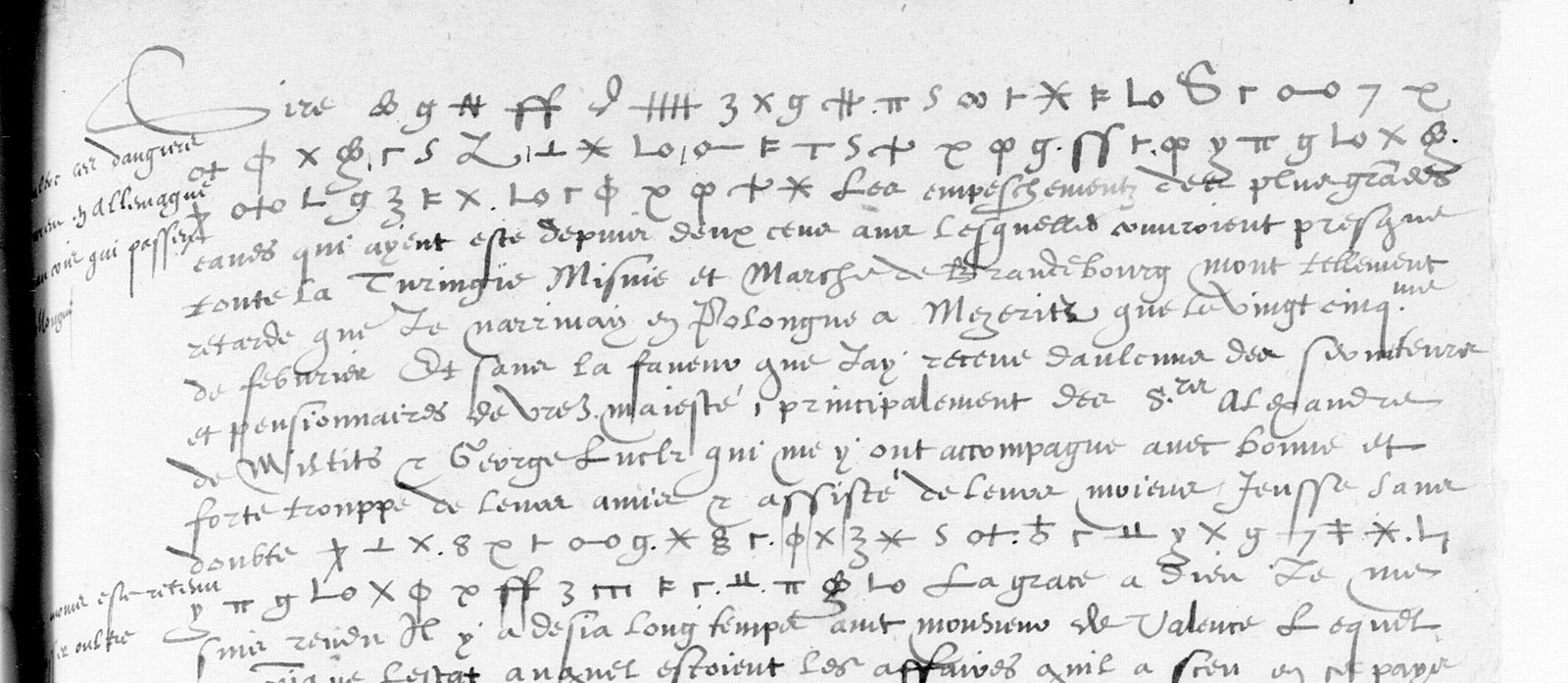
French
il y a du citron sur les quatre demi-pages blanches de l’incluse
there is lemon juice on the four blank half-pages of the enclosure
KHA, Prins Willem V inv. 205. Image: Koninklijk Huisarchief, The Hague, Prins Willem V inv. 205, via DECODE R1057 (rotated here).
02
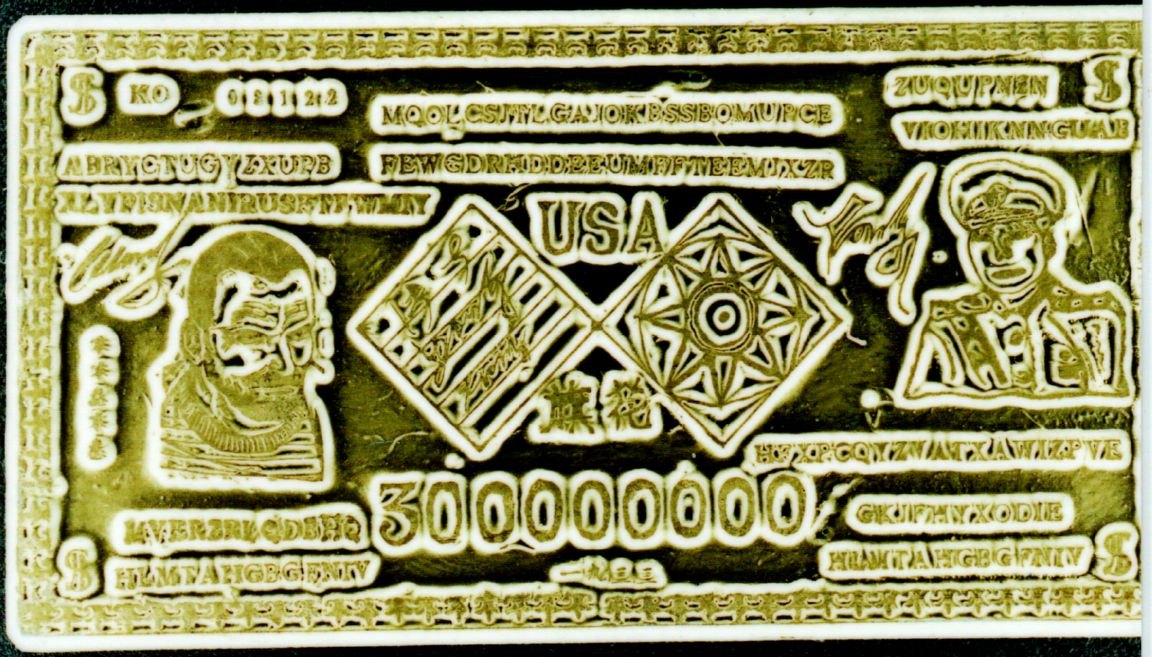
1933Shanghaino message
$300,000,000 in gold bars, and almost exactly ten of every letter
Seven gold bars, said to have been issued in Shanghai in 1933 to certify a deposit of over $300,000,000, carry sixteen strings of Latin
letters. For ninety years nobody found a message in them. Their letter counts are the problem: against a flat distribution they give a chi-squared of 1.25,
where honest random sampling gives about 25. No cipher can produce that. Substitution and transposition keep the skew of the plaintext, and
a one-time pad lands near 25. Someone counted out the letters and arranged them to look like cryptography.
the test
χ² = 1.25 on 25 degrees of freedom, where chance predicts 25
One of the bars. Image: Kevin McCurley, “Cryptograms on Gold bars from China”, IACR (1996), iacr.org/misc/china.
03
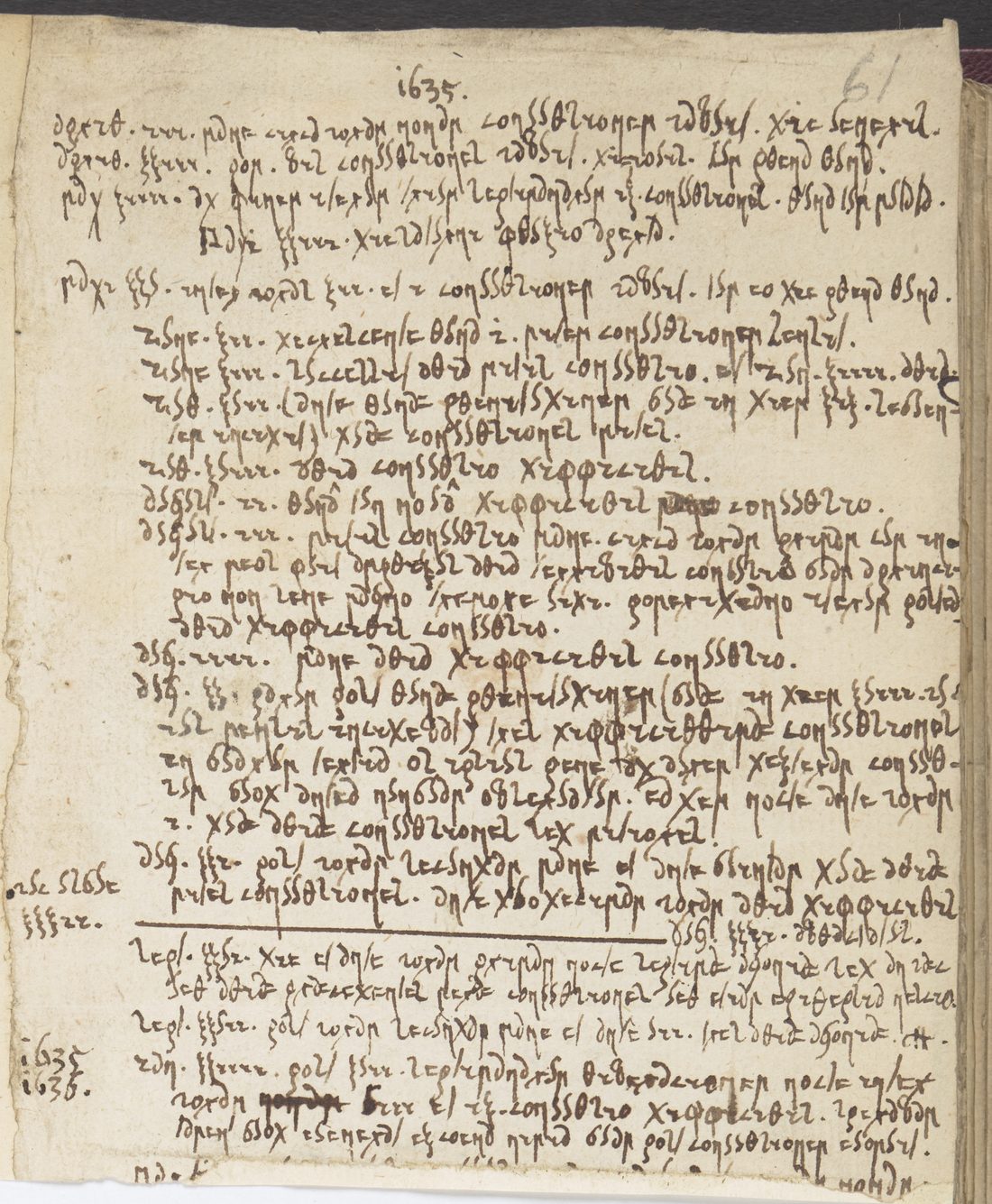
1635–36Suffolk, a private recordciphertext-only break
A father’s secret log of his baby son’s fits
DECODE has this as a letter of 1635, “unknown sender to unknown recipient”. It is Sir Simonds D’Ewes, the antiquary,
writing Latin in a private alphabet he invented at school. The page is a log, one line per convulsion, of his infant son Clopton from
3 April 1635, with the day, the hour and the phase of the moon. No plaintext of the slip exists, and no decipherment was found. The
alphabet was recovered from the ciphertext alone, starting from probable words such as convulsio and plena luna, and
96.5% of the words are deciphered. The weekdays and moons all check against the calendar. Clopton died on 9 May 1636.
Latin
in quorum tertia os ipsius pene ad aurem dextram convulsum, quod ante numquam observavi
in the third of which his mouth was drawn almost to his right ear, which I had never seen before
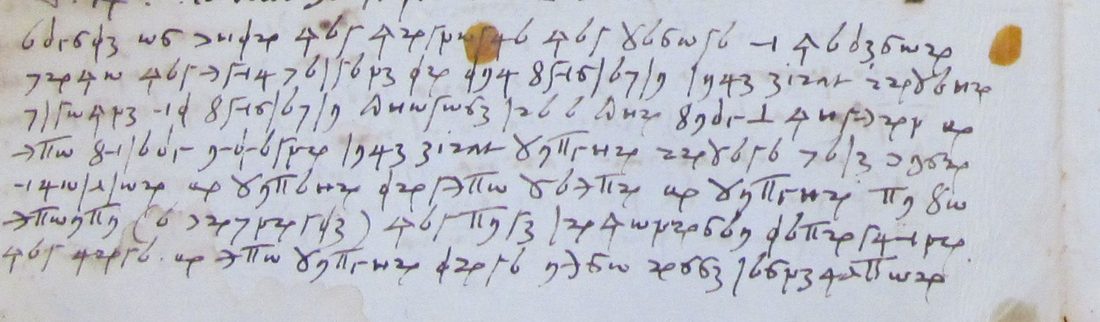
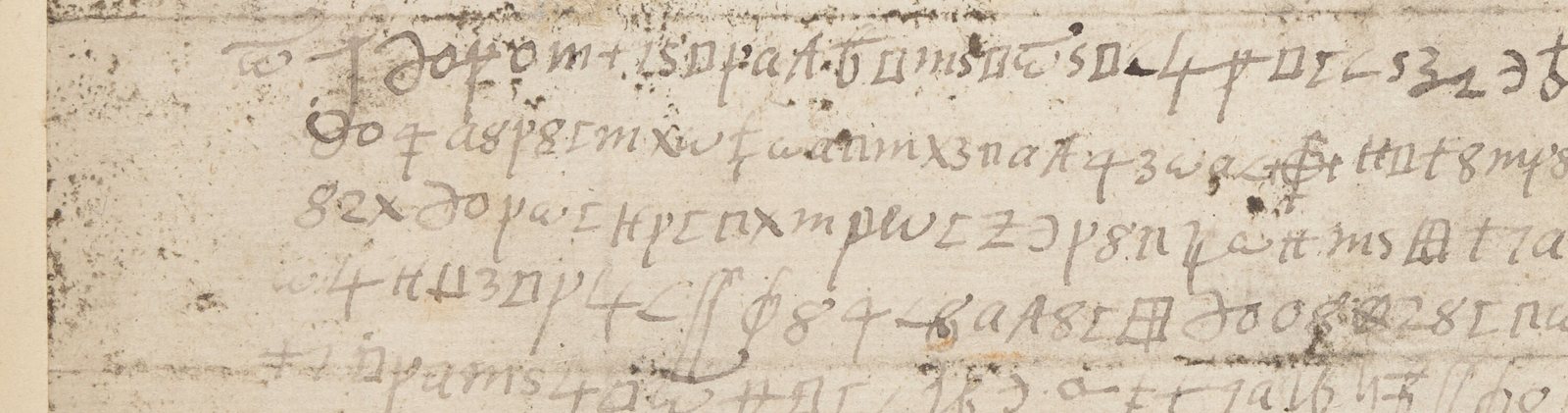
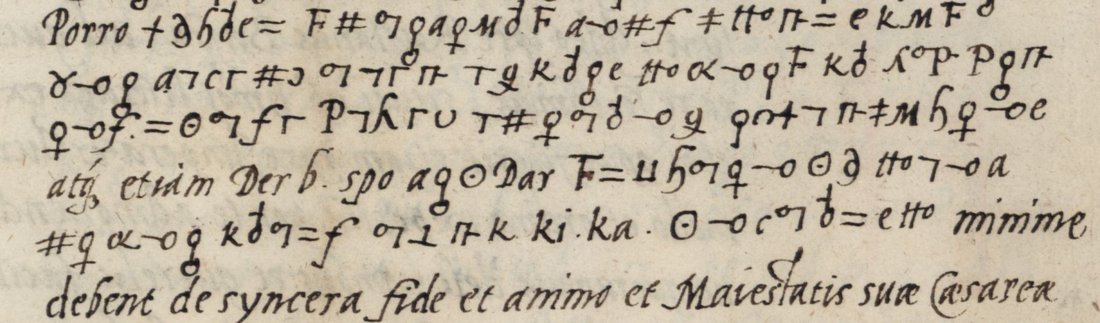
Ferdinand I wrote to Malvezzi, his resident at the Ottoman Porte, in a cipher of graphic signs padded with whole words that look like
part of the Latin: etiam, idcirco, atque, Porro. The key was already on DECODE, filed as a separate
record at the same shelfmark; applied here, it deciphers the ciphered passages in part. The letter shows the French trying to wreck the Habsburg–Ottoman peace, and Malvezzi’s pay:
4,300 ducats at once.
p. 4: the cipher hands back to clear Latin. Image: Hadtörténelmi Levéltár, Budapest, 1548/3, p. 4, via DECODE R366.
05
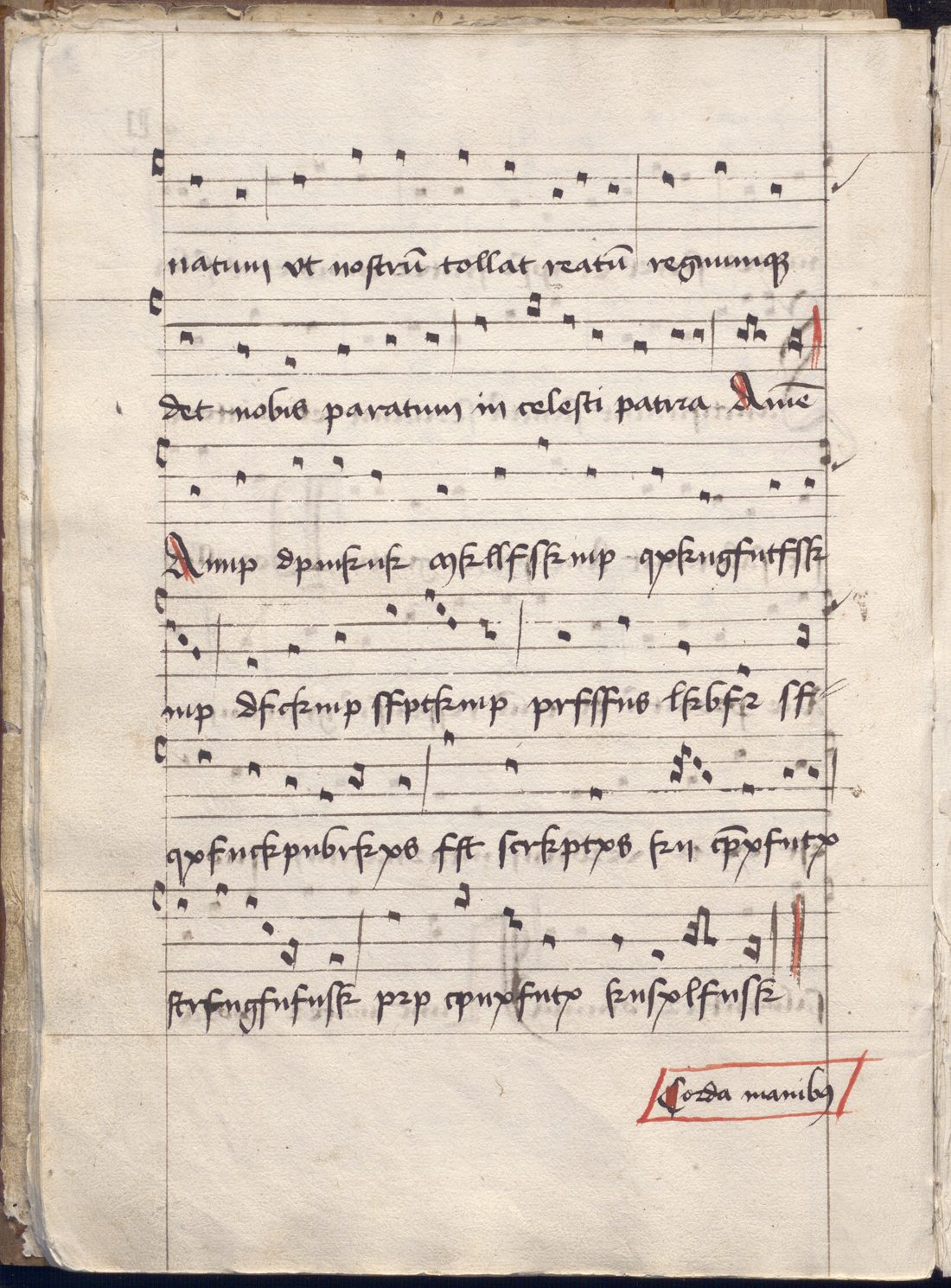
1517Strängnäsknown key applied · partial
A monk signs his chant book in code
The scribe who copied this Dominican sequentiary in 1517 dated it in a colophon where every vowel is written as the letter after it: a
becomes b, e becomes f, i becomes k, o becomes p and u becomes x. The Uppsala catalogue printed the rule and the decipherment in 1992;
the rule, applied here to a new transcription, gives the same text. The quotation below starts as the scribe wrote it.
Latin, vowels shifted
presens liber sequencionarius est scriptus in conuentu strengenensi
this sequentiary was written in the convent at Strängnäs
C 513 f. 19v: the colophon under four staves. Image: Uppsala University Library, C 513 f. 19v, via Alvin (public domain).
06
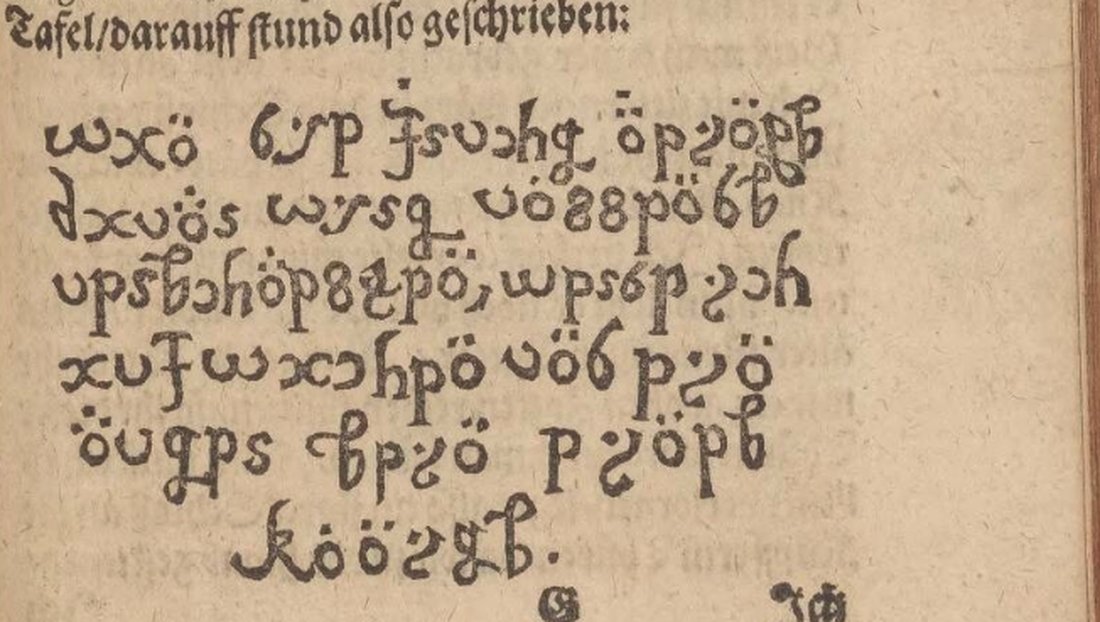
1616Strassburg, a printed bookalready in print
A “cipher letter” that is a novel, where one of the characters reads the cipher aloud
DECODE R4502, catalogued as a letter with no decipherment, is a copy of the Chymische Hochzeit Christiani Rosencreutz (Strassburg, 1616). Its four “cipher pages”
are inscriptions in the story, cut in an invented alphabet. A paragraph later the page boy reads both long ones aloud. The two lines of
signs are the dates 1378 and 1459, which Foxcroft’s English edition of 1690 already gives.
German
HIE LIGT BEGRABEN VENUS DIE SCHONE FRAW SO MANCHEN HOHEN MANN UMB GLUCK EHR SEGEN UND WOLFART GEBRACHT HATT
Here lies buried Venus, the fair lady who has cost many a great man his fortune, honour, blessing and welfare
Chymische Hochzeit (1616), p. 97. Image: Embassy of the Free Mind (Ritman Library), Amsterdam, Chymische Hochzeit (Strassburg 1616), p. 97, via DECODE R4502.
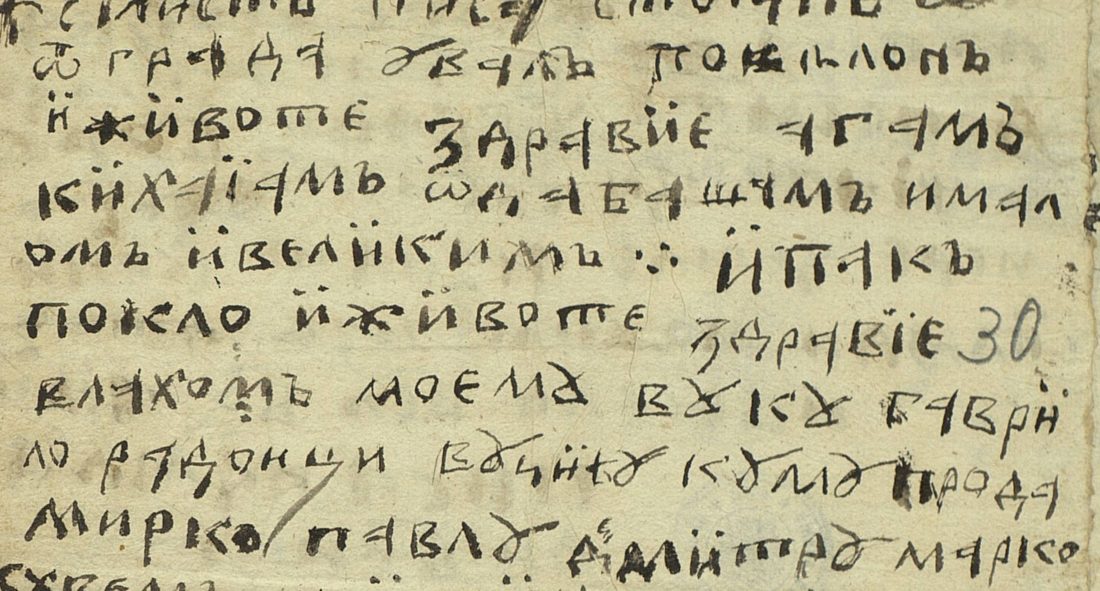
07
1664–68a Habsburg prison → his kinnot a cipher
A prisoner’s plea, filed among the state ciphers because nobody could read it
This letter was bound into the Vienna papers of the Hungarian magnates’ conspiracy, in a file headed Chiffres 1664–1668.
DECODE lists it as a simple substitution in graphic signs. The signs are Cyrillic letters and the language is Serbian. It was written by
Stojan, in prison, who greets his Vlachs by name, asks for money to be brought, and sends greetings to his wife. The clerks who filed it,
it seems, could not read it.
from the Serbian
brothers, have mercy on me: you can get me out of the German prison, and your souls out of hell
HHStA, Verschwörerakten Fasc. 327, f. 30r. Image: Österreichisches Staatsarchiv, HHStA, Verschwörerakten Fasc. 327 Konv. D f. 30r, via DECODE R688 (image 1).
08
1489–90Buda → Milanknown key applied · partial
A key published only as numbers, turned back into symbols
In 2016 Judit W. Somogyi reconstructed the Milanese ambassador’s key, but printed it only as numbers, without a picture of a single
symbol. Her numbers run in order of first appearance in the letter of 2 April 1490, which survives with its clear copy. Matching that letter
to its copy gives back every symbol’s shape, and the key can then be applied. It deciphers part of the despatch of 22 November 1489, on
peace with Frederick III, the John Corvinus marriage, and Queen Beatrice’s “insatiable wrath of Juno”. The despatch also
warns that duplicates of intercepted cipher letters had been uncovered.
Italian
Le littere in cifra che forono intercepte, le quale duplicate sono state scoperte ancora qua
the cipher letters that were intercepted, whose duplicates have been uncovered here too
Sforzesco 650, 22 November 1489. Image: Archivio di Stato di Milano, Sforzesco 650, letter of 22 November 1489, via Vestigia.
09
1586Angoumois → a League leaderexisting decipherment
The “unread” part was deciphered in 1586
Two thirds of this anonymous League letter of October 1586 were listed as having no decipherment. On the next leaf, f. 168, is a clear text of the cipher
down to a cross mark. After the cross, the decipherer had switched to writing the plaintext between the lines of cipher. The glosses confirm
Tomokiyo’s key (87 = e). The letter says that Fumé, vice-admiral of Guyenne, keeps proposing a reconciliation between
Navarre and the League leader it is written to.
French
Fumé, visadmiral de Guienne, tres confident du Roy de Navarre, bien qu’il soit catholique
Fumé, vice-admiral of Guyenne, very much in the King of Navarre’s confidence, although he is a Catholic
Clairambault 357 f. 167r, with interlinear glosses. Image: Bibliothèque nationale de France, Clairambault 357 f. 167r, via Gallica.
10
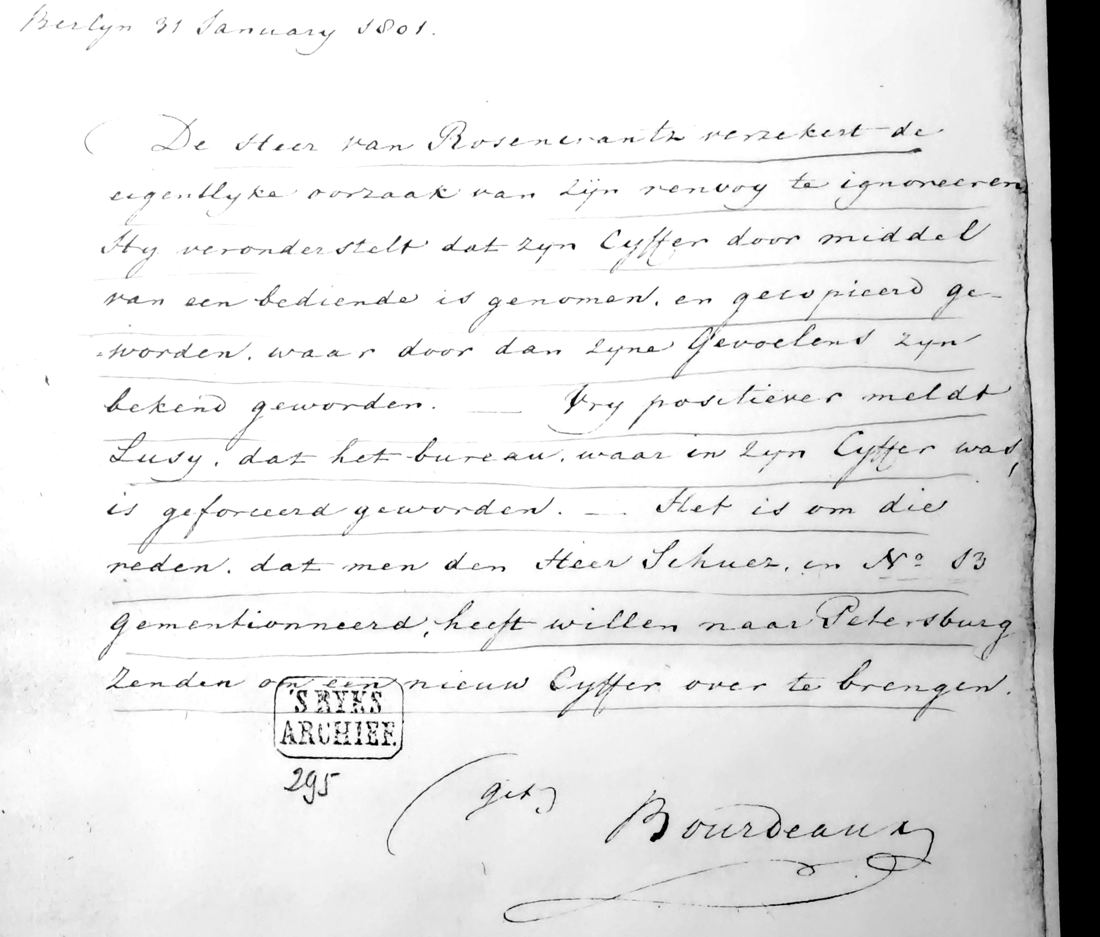
1801Berlin → The Hagueexisting decipherment
A cipher despatch about stolen ciphers, whose own clear copy was misfiled
The Batavian chargé in Berlin wrote in cipher on 31 January 1801, and DECODE lists no decipherment for the despatch. The ministry’s
contemporary clear copy is the third image of the next record; it was transcribed here. The subject is ciphers going astray. Rosenkrantz blames a servant who copied his cipher, and the envoy Lusi
says “much more definitely” that the desk his cipher was kept in had been forced.
Dutch
dat het bureau, waar in zyn Cyffer was, is geforceerd geworden
that the desk in which his cipher was kept had been forced open
The clear copy, misfiled under the next record. Image: Nationaal Archief, The Hague, 2.01.08 inv. 257 fol. 295, via DECODE R1946 (image 3).
04 How these were chosen
The thirty come from the two hundred or so write-ups on this site and the notes behind them. They were chosen for the story, and
difficulty played no part; the full list sorts by outcome, and the hardest breaks are ranked in the repository’s
solved ranking. Each badge names how
the text was obtained, in the terms of the site’s glossary. Ciphertext-only break (two of the thirty: Soglia 1848 and
D’Ewes 1635) and key from adjacent plaintext (six) mean the key was rebuilt here. Known key applied (eleven) and
existing decipherment (three) mean that a key or a decipherment already existed, and the work was transcription and decipherment.
Partial means some of the text is still open. Quotations keep the original spelling, and the translations follow the
write-ups. Six of the thirty are not ciphers at all, or hold no message; one was deciphered in print long ago, and one is too short to
decipher without a key.
Every image is credited on its card to the archive or edition that holds it. Select an image to open it full size.
05 Sources
The write-ups linked from each card, with their working notes in the repository, one folder per target.
The DECODE database (Megyesi et al.), where most of the records live, and the published keys of George Lasry, Satoshi Tomokiyo, Judit W. Somogyi and Aloys Meister.
The printed editions named on each write-up, among them Rommel 1840/1846, the Mémoires de Catinat (1819) and Barwick’s Life (1721/1724).