01 The leaves
Each DECODE record is one leaf, or a pair of conjugate leaves, of ff. 109–169 (R8506 = f. 109, … R8530 = f. 169). DECODE dates only two of them, R8509 (f. 137, 1595) and R8520 (f. 155, 1594). Those two became a separate catalogue entry (138), and the rest became entry 139. They are one set of notes in one hand.
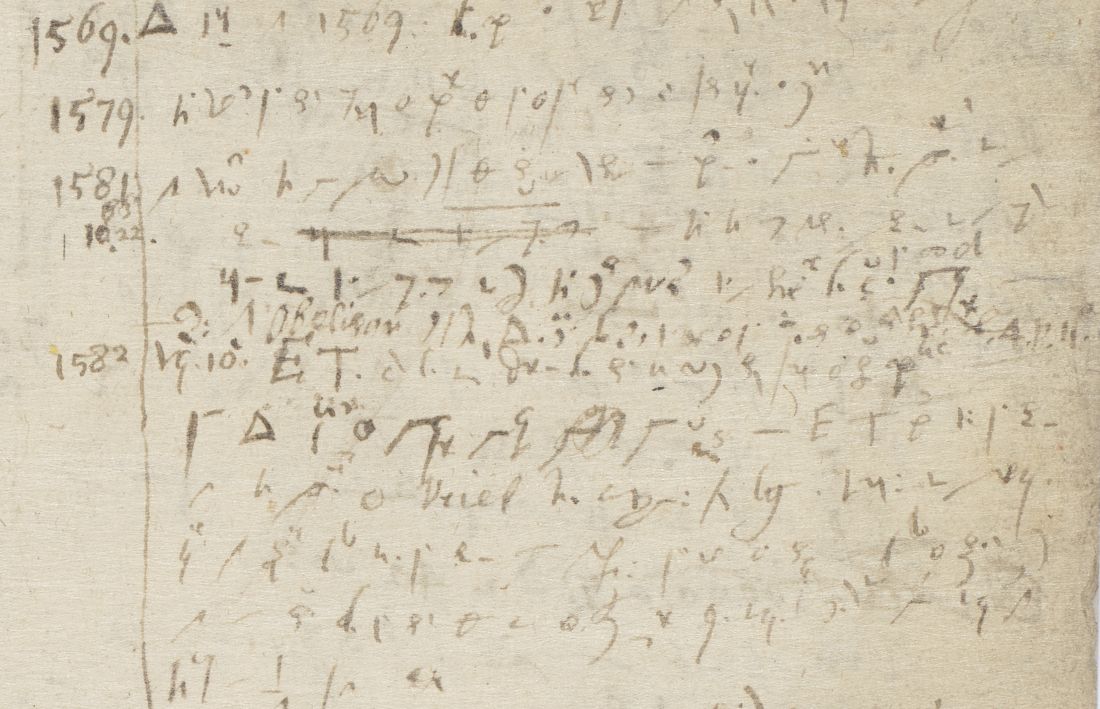
- f. 109r (R8506). An index to Dee's Actions. The left column runs "Actio 1 … Saulina p. 3, 4", "Actio 2", "Actio 3", "Actio 4 p. 10 Uriel als Nariel", "Actio 5 … 13", with "Salamian", "Raphael", "Michael" and "Sigillum Dei" in longhand. The right column is a chronology from 1569 to 1583, with "E.T." (Edward Talbot, Kelley's first name at Dee's house), "Uriel", "Reuchlin", "p. 67", "p. 181", "Reconciliatio Kelliana" and "E.K. March 22 1583".
- f. 137 (R8509). Four lines about "E.K.", Dee (Δ), "Puccius" (Francesco Pucci), "fortissima foemina", "Prage" and "1000 fl.", dated at the foot "1595 Δ".
- f. 155 (R8520). A list of Dee's writings with the years in the margin, 1547–1592. The titles are in longhand, among them Mercurius coelestis lib. 24 (1549), Monas Hieroglyphica ad Maximilianum (1564), the Math. praeface to Euclide (1570) and Parallaticae commentationis praxeosque nucleus quidam (1573). "M. Casaub." is cited at the head.
02 Why this is shorthand, not a cipher
The script is a small set of connected strokes. A dot, a comma or a tiny letter placed above, beside or below a stroke gives the vowel, and many words are a single mark. That is the mechanism of the English "character" shorthands of the 17th century: Shelton's Tachygraphy, Rich's system and their relatives, the family Pepys wrote his diary in. It fits William Shippen (1635–1693). The writer switches to longhand wherever a proper name, a Latin title or a number would be hard to recover from strokes. A cipher hides a fixed message behind a key. These strokes write the sounds of English in an abbreviated way. Transcribing them means identifying the system and learning its signs.
The notes are also secondary. They index and summarise Dee's diaries, which Whitby edited in 1982 and Casaubon printed in part in 1659, and they list Dee's own writings. Nothing is concealed that is not available in those texts.
03 What stays open
- The shorthand system. Not identified. The first step would be to compare the stroke inventory of f. 109r with Shelton's alphabet (1641 and later editions) and with Rich's.
- A transcription. Not attempted beyond the longhand. Once the system is known, the Actio index can be transcribed and checked against Whitby's edition, and the p. references checked against Casaubon's True & Faithful Relation (1659).
- The writer. Shippen, per the BL catalogue. Some descriptions give Ashmole. Not checked against either hand.
- DECODE. A correction is queued for all 25 records: shorthand notes on Dee's Actions, English, not cipher correspondence.
04 Sources
- British Library, Sloane MS 3188, ff. 109–169. Images via DECODE, records R8506–R8530 (login).
- BL catalogue description: Sloane MS 3188.
- Christopher Whitby, John Dee's Actions with Spirits, 22 December 1581 to 23 May 1583, PhD thesis, Birmingham 1982 (etheses).
Notes in the repository folder sloane3188/.