01 The documents and the keys
Francia 283C holds the Secretariat’s original letters and ciphers to the nuncio for 1580: “Corrispondenza fra il Cardinale di Como (Gallio) e Monsignore Dandini Nunzio a Parigi”. DECODE has two ciphertexts from it:
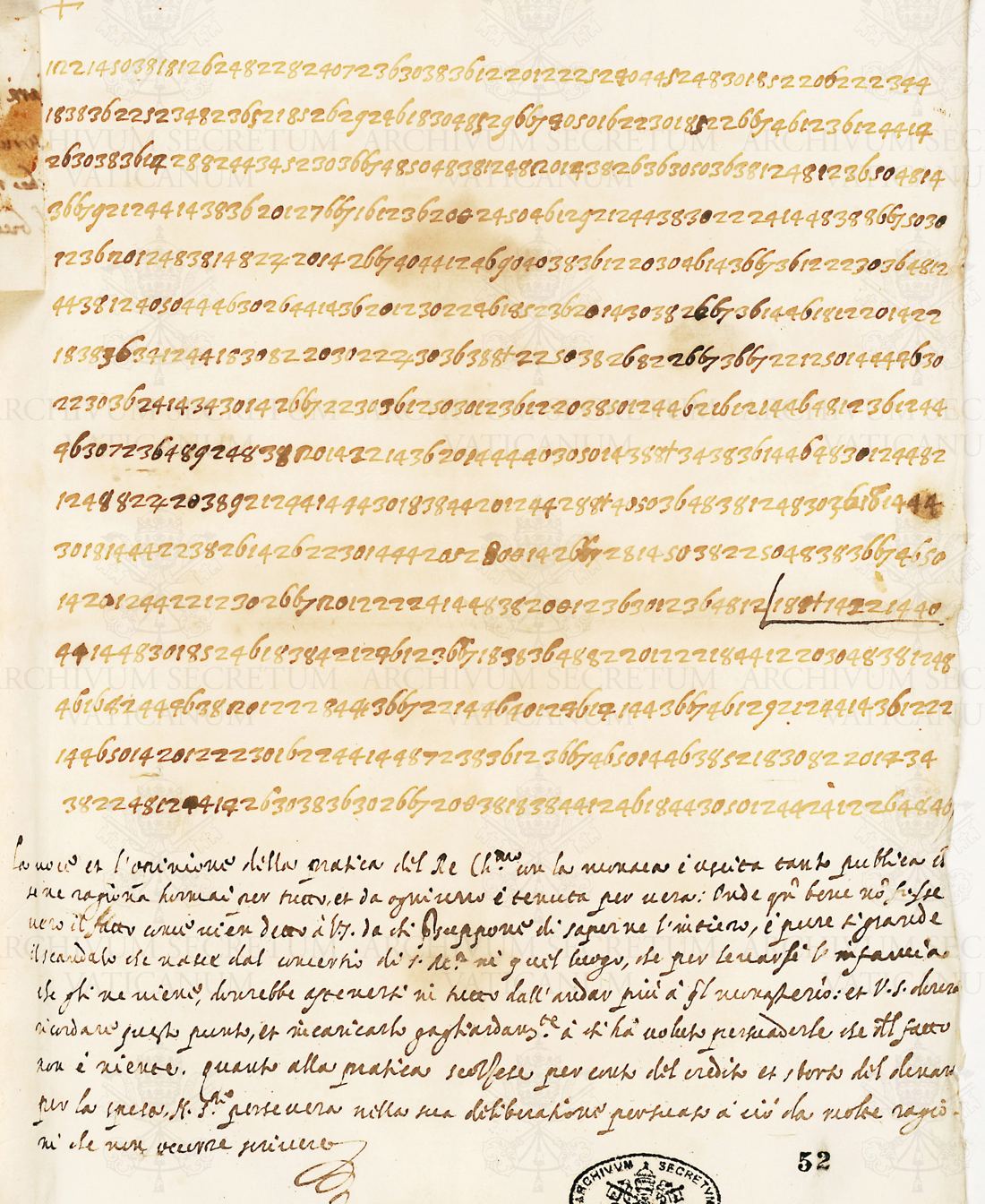
- R72, f. 52: a single page of figures, filed with Como’s clear letter from the Villa, 16 May 1580 (ff. 50–53, attached to the record). The decipherment is written in clear below the figures.
- R73, ff. 89r–90r: three pages of figures, undated, on damaged paper, with no decipherment on the leaves.
Lasry’s reconstructed key (DECODE attachment D3190, 24 October 2020) is deterministic. Letters are two digits with an even second digit, vowels have one or two homophones, and there are no nulls. Nomenclator groups are three digits followed by a special mark, for pronouns, titles and common words: 124^ S.S., 824^ N.S., 822^ V.S., 224^ S.M.tà, 266^ che, 200^ non, 800^ mente, 988^ essere. His decryption of R73 (D3191) gives the whole letter apart from illegible groups.
R72 fits the same frame. Parsed with a small dynamic program (two digits, or three digits plus the mark, which SofPe’s 2019 transcription gives as 7 or t/+), every group except 38 falls inside Lasry’s table. The nomenclator words come out right, but the letters between them are nonsense. The letter codes had been reassigned:
| letter | R72 | R73 (Lasry) |
|---|---|---|
| a | 14 52 81 | 50 92 |
| c | 18 83 | 14 |
| e | 12 62 | 18 52 |
| i | 30 72 (24) | 26 62 |
| l | 22 | 28 |
| n | 36 | 22 |
| o | 38 82 | 34 72 |
| r | 44 | 40 |
| t | 28 48 | 44 |
| u/v | 50 92 | 46 82 |
The full R72 table, with the codes seen only in the anneal marked, is in the notes.
02 R72: Como to Dandini, 16 May 1580
This is the clerk’s decipherment at the foot of f. 52. The decryption with the rebuilt key agrees with it, except that the cipher has commercio where the clerk wrote concetto:
La voce et l’opinione della pratica del Re Chr.mo con la monaca è uscita tanto publica che se ne ragiona hormai per tutto, et da ogniuno è tenuta per vera: onde quando bene non fusse vero il fatto come vien detto a V.S. da chi presuppone di saperne l’intiero, è pure sì grande il scandalo che nasce dal concetto di S. M.tà in quel luogo, che per levarsi la infamia che gli ne viene, dovrebbe astenersi in tutto dall’andar più a quel monasterio: et V.S. doverà ricordar questo punto, et incaricarlo gagliardamente, già che si ha voluto persuaderle che il fatto non è vero. Quanto alla pratica scoperta per conto del credito et sforzo del denaro per la spesa, N. S.re persevera nella sua deliberatione persuaso a ciò da molte ragioni che non occorre scrivere.
“Talk of the Most Christian King’s affair with the nun has become so public that it is discussed everywhere and taken as true by everyone. So even if the thing were not true, as Your Lordship is told by someone who claims to know the whole of it, the scandal it causes is so great that, to rid himself of the infamy, His Majesty ought to stop going to that monastery altogether. Your Lordship is to raise this point and press it on him hard, since they have tried to persuade you that it is not true. As for the scheme uncovered over the credit and the raising of money for the expense, His Holiness holds to his decision, for many reasons that need not be written.”
03 R73: the same affair, at more length
Lasry’s decryption, with its gaps, first turns to a princely marriage negotiation that “N.S. è certificato” a gentleman has raised: the Pope would take it up “con buon fondamento”. It then comes to the nun. Rome does not want Dandini to raise it with the Queen: “non lauda M.S. che V.S. tenghi proposito alcuno con la Regina nel particolare della monaca, per non pigliare occasione di far con tal coperta qualche rumore non conforme alla mente di S.S.”. The Pope has already acted through the confessor, “l’officio che N.S. ne fece con il confessore”, and the reproof is to come from him to the King, “tanto circonspettamente che non ne nasca rumore né disordine alcuno”.
04 Method
- The two records were fetched from DECODE with a session cookie: page images, the clear covering letter, SofPe’s and KaJo’s transcriptions, Lasry’s key, and his decryption of R73.
- Lasry’s key on R72 gave nonsense. A plain two-digit tokenisation, annealed as a free homophonic cipher, collapsed or failed to converge.
- R72 was parsed in Lasry’s frame instead. The letter values were annealed by swaps over a fixed letter multiset, scored with Italian 4-grams from a Renaissance corpus, with the nomenclator words kept as known plaintext. Five of six restarts agreed.
- The clear block on f. 52 was transcribed and aligned with the output. Three codes were corrected (22 l, 62 e, 72 i), and the leading stray “1” was set aside.
05 What remains uncertain
- R72: nomenclator groups 766^, 866^, 030^ and 448^ have no value yet. In context they fall at “come vien detto a V.S.” and “presuppone”. Letter codes 24, 00, 11 and 32 are graded M (from the anneal only). The text itself is grade C, from the contemporary decipherment confirmed by the key.
- R73: 32 groups illegible in the transcription. Nomenclator groups 866^, 466^, 766^, 324^ and 300^ have no value in Lasry’s file. The letter is undated.
- The monastery and the nun were not identified here.
06 Sources
- DECODE records R72 and R73: images, transcriptions (SofPe 2019, KaJo 2017), and George Lasry’s reconstructed key and R73 decryption (2020). Login required.
- Archivio Apostolico Vaticano, Segreteria di Stato, Francia 283C.
Notes, decoder and annealer: dandini1580/.