01 The object
The story, as Kevin McCurley set it down for the IACR in 1996, is that seven gold bars were issued to a “General Wang” in Shanghai in 1933, functioning as metal certificates against a deposit with an American bank. The Chinese text on them describes a transaction of more than $300,000,000 and gives the bars’ combined weight as 1.8 kilograms. A dispute over the claim was live at the time, and McCurley published the photographs in the hope that reading the cryptograms would help settle it.
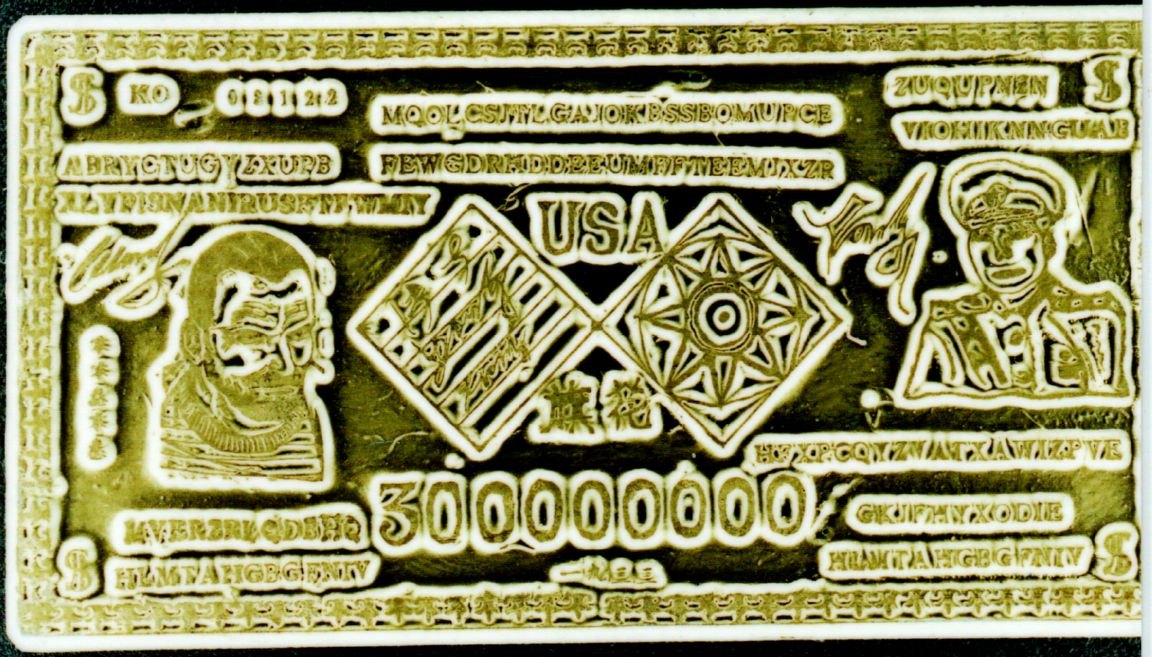
Elonka Dunin has carried the item on her list of famous unsolved codes ever since. In 2020 she reached the attorney named on the IACR page, who confirmed he had seen the bars, described them as about the size of a remote control, and said the banks had not treated the claim as legitimate; his file was closed. Others have noted that the aircraft depicted on the bars is a model that did not fly until 1934 or 1935, after the date the bars claim for themselves.
02 The sixteen cryptograms
The same strings recur across the bars, which is what first suggested they were meaningful. In full, longest first:
SKCDKJCDJCYQSZKTZJPXPWIRN
MQOLCSJTLGAJOKBSSBOMUPCE
RHZVIYQIYSXVNQXQWIOVWPJO
FEWGDRHDDEEUMFFTEEMJXZR
XLYPISNANIRUSFTFWMIY
HFXPCQYZVATXAWIZPVE
YQHUDTABGALLOWLS
UGMNCBXCFLDBEY
ABRYCTUGVZXUPB
JKGFIJPMCWSAEK
KOWVRSRKWTMLDH
HLMTAHGBGFNIV
MVERZRLQDBHQ
VIOHIKNNGUAB
GKJFHYXODIE
ZUQUPNZN
263 letters in all. McCurley noted at the time that “some of the letters are hard to read so there may be inaccuracies”, which matters below.
03 Ten of everything
Count the letters and the answer arrives immediately.
Gold is the observed count for each letter; the pale red behind it is what 263 letters of English would give. English towers at E and falls away to nothing at Z. The bars do neither. Twenty-one of the twenty-six letters occur exactly ten times, and the five that do not are off by one, except I which is off by three:
| letter | count | letter | count |
|---|---|---|---|
| E | 11 | O | 9 |
| I | 13 | T | 9 |
| S | 11 | all other 21 letters | 10 |
Ten of each would be 260 letters exactly; the transcription gives 263. Given McCurley’s warning about legibility, the most economical reading is that the bars carry precisely ten of every letter and the handful of deviations are misreadings of worn stamping.
04 Why no cipher can do that
| test | value |
|---|---|
| index of coincidence | 0.0350 (English 0.0667, random 0.0385) |
| chi-squared against uniform, 25 df | 1.251 (random sampling predicts 25) |
| P(chi-squared ≤ 1.251) | 9.3 × 10⁻¹³ about 1 in a trillion |
| chi-squared against English letter frequencies | 1488 |
| random 263-letter strings at least this uniform, out of 200,000 | 0 |
The point that does the work is not that the distribution is flat. It is that the distribution is flat beyond what randomness allows. Take the candidates in turn:
- Simple substitution renames letters but cannot change how often they occur, so it preserves the plaintext’s skew. Index of coincidence stays near 0.066.
- Any transposition reorders letters and leaves the counts completely untouched.
- A short-key Vigenère flattens partway, to roughly 0.045, and leaves periodic structure behind.
- A long key, or a one-time pad, does reach a flat expectation — but it gets there by random sampling, and random sampling is noisy. Draw 263 letters uniformly and the counts scatter with a standard deviation near 3.1, so you expect a spread from about 4 to 16 and a chi-squared near 25. Twenty-one letters landing on exactly ten is not what randomness looks like.
Only deliberate construction produces it. And once the letters were dealt out, the arrangement into sixteen strings looks unconsidered: there are 71 places where a letter repeats inside a string, against 65.6 expected when the same pool of letters is shuffled at random into the same lengths. Somebody counted out ten of each letter and distributed them.
05 What it means
The inscriptions are decorative filler, made to look like cryptography on an object whose purpose was to look like a security. That sits with everything else known about the bars: an aircraft that had not yet been built on a bar dated 1933, banks that declined the claim, and a legal file closed without resolution.
The honest conclusion is that the item should move off the unsolved-cipher lists, not because it has been read but because there is no message in it. Ninety years of failure to decipher these strings has a simple explanation, and it is the one the statistics force.
Caveat worth stating: this is an argument about the transcription published by the IACR in 1996, which its author flagged as imperfect. It would be worth re-reading the letters from the original photographs at higher resolution. But the deviations would have to be far larger than a few misread characters to disturb the result — the uniformity is not marginal, it is off the scale.
06 Sources
- Kevin McCurley, “Cryptograms on Gold bars from China”, IACR, 1996, and the compiled cryptograms. Photographs reproduced from that page.
- Elonka Dunin, list of famous unsolved codes, including her 2020 update.
- Klaus Schmeh, “The Top 50 unsolved encrypted messages: 49. The Chinese goldbar cryptogram”, 2017, where a commenter first noticed the ten-of-each pattern.
- Reproduce with
goldbar/analyse.pyin the repository.