01 The documents and the key
Francia 22 is the volume of Morosini’s originals and ciphers from 25 July 1588 to 20 September 1589 (ff. 10–583). DECODE holds 36 of its cipher enclosures, items 22/1 to 22/37 (22/29 has no record; R23–R26 and R50, inside the same run of record numbers, are other material). Most are marked dup.to, the duplicate sent by a second courier; the clear covering letters that go with them are partly transcribed on DECODE as well.
The key is Meister no. 40 (Die Geheimschrift im Dienste der päpstlichen Kurie, pp. 393–394), issued to Morosini on 8 June 1587. Each letter has two or three homophones: a 21 212 2, e 35 153 5, i 17 171 7, n 10 01 0, o 91 191 9, r 00 13 1, s 54 45 4, t 51 15 6, u 37 173 3, and so on. There are about twenty codes for clusters (cr 22, pr 33, st 47, str 49) and twenty for words (che 56, per 64, non 61 71, quando 99). A three-digit nomenclator is marked with a dot on the middle figure: 111 the Pope, 113 the King of France (“S. M.tà Christ.ma”), 116 the Queen Mother, 129 Duca di, 131 Cardinale di, 133 Arcivescovo, 227 Heretici, 232 “il già Re di Navarra”. An 8 with any following figure is a null.
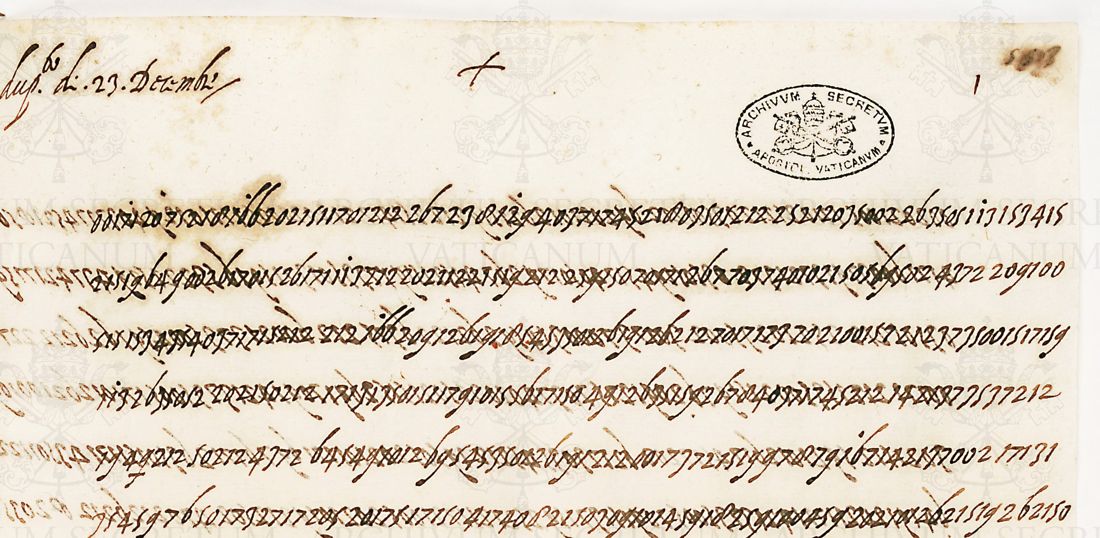
02 The murder of the Guises
The despatch of 23 December 1588 (R43) begins, once the figures are cut up:
… questa matina il Duca di Guisa nela camera di S. M.tà è stato per ordine di S. M.tà amazato a colpi di pugnale, et la sua morte è seguita a questo modo. […] domandato a chiamare il Duca di Guisa che si trovava nel consiglio di stato, venuto et entrato subito nela camera fu preso […] con molte pugnalate, et dopo havere indarno usata grandissima difesa con le mani et [co’] denti, senza però mai havere potuto metter mano ala spada […]; posti prigioni il Cardinale di Guisa, che si trovava pure in consiglio, il Duca di Nemurs, il Duca d’Elbeuf, il Principe di Gianvile, l’Arcivescovo di Lione, il prevosto de’ mercanti di Parigi […] et data guardia al Cardinale di Borbone.
(This morning the Duke of Guise was killed with daggers in His Majesty’s chamber on His Majesty’s order. Called from the council of state, he came in and was seized, and, after a great defence with his hands and teeth, without ever getting his hand to his sword, died of many dagger blows. The Cardinal de Guise, Nemours, Elbeuf, Joinville, the Archbishop of Lyon and the prévôt des marchands of Paris were arrested, and the Cardinal de Bourbon put under guard.) The duplicate of the next day (R44) adds that the Cardinal de Guise “questa matina solamente è rimasto privo di vita”. The legate, because a cardinal had been killed, leaves the answer to the Pope.
03 All thirty-six, in brief
Dates in square brackets come from the context or the series; the quotations are from the decoded text, spaced into words and lightly normalised.
| Record | Item | Date | What the cipher says | From the text |
|---|---|---|---|---|
| R18 | 22/1 | 10 Aug [1588] (duplicate) | On publishing the Council of Trent: strong resistance everywhere over Gallican liberties. In Paris Morosini lobbied the Sorbonne and the royal council, and told Henri III that a Most Christian king should accept the council without conditions. The King answered that the clergy, above all the Archbishop of Lyon, were the ones opposing it. Also: the King is set on holding the Estates General; Guise's party is manoeuvring over the deputies; the Spanish ambassador complains that the English fleet was resupplied in French ports. | si contentasse ancora di ricevere nel suo regno esto concilio liberamente, sì come è fatto negli altri regni |
| R19 | 22/2 | 24 Aug [1588] (duplicate) | The clergy's deputies appeared before the Parlement to oppose the council as against Gallican liberty. In an audience the King defended his privileges and benefice nominations. He was told that the legation's faculties must be verified by the Parlement. A Cardinal (Bourbon/Vendôme) pressed for the absolution of his brothers. Factions are gathering followers for the Estates; there is fear of a bloody clash between Catholics; a marriage is proposed between the Count of Soissons and a daughter of the Duke of Guise. | comparvero al parlamento per opporsi alla publicatione di esto concilio, dicendo che era contrario ... alla libertà della chiesa gallicana |
| R20 | 22/3 | 9 Sept [1588] | The King gave the Count of Soissons letters clearing him of his service with Navarre and the Huguenots. Paris citizens and the prévôt protested to the Parlement. Cardinal de Vendôme and the Princess of Condé were furious. Morosini advised the King and Vendôme to wait for the Pope's absolution first, and they agreed to hold the letters back until it came. | che le lettere non havessero a servire se non dopo che il conte fosse ... [assolto] da Nostro Signore |
| R21 | 22/4 | n.d. [Sept 1588] | The King dismissed his secretaries of state and the chancellor all at once, leaving the court anxious. Mons. de Nevers(?) and the Queen Mother were displeased not to have been consulted. Morosini warned the King that new men would be inexperienced and the old ones could side with his enemies. The King replied that he meant to be obeyed and feared. Also: the King sent his physician to Épernon to get him to give up Boulogne and Metz. | privandosi Sua Maestà in un istesso tempo di tutti quelli che intendono il vero stato delle cose sue |
| R22 | 22/5 | n.d. [Sept 1588] (duplicate) | Replies to Montalto. Morosini has kept pressing for the council; the Estates promise to ask for it. His faculties will not be obeyed unless the Parlement verifies them. He held back the Count of Soissons' absolution because the Count refused the prescribed form of abjuration; the Cardinals of Bourbon and Vendôme then urged the King to write to Rome. Also: a Danish ambassador has come, perhaps to draw the King into defending the Queen of England; Morosini rebuts the vice-legate's complaints and answers on Épernon and La Valette. | non volendo a modo alcuno contentare il conte di Soissons, dicendo che non si deve accusare di peccato che non ha |
| R27 | 22/6 | n.d. (fragment) | On governments for Épernon (Saintonge, Angoulême, Cognac) and on Boulogne. Épernon's side refuses to give anything back and is said to deal with the Queen of England and Navarre. Morosini hopes for peace between Guise and the others, though with little confidence. | si mostrano risolutissimi di non volere restituire alcuna cosa |
| R28 | 22/7 | [early] Oct [1588] (duplicate) | While walking in the palace garden with the King, the Queen Mother and the Cardinals of Bourbon and Vendôme, Morosini learned that the King would send Signor Girolamo Gondi to Rome about pulling Marshal Montmorency away from the Huguenots. Morosini urged the King to win Guise over with money, since Guise is heavily in debt; Guise refused the grant offered. Vendôme reports that Cardinal Joyeuse worked against the Count of Soissons in Rome. | haveva esortato Sua Maestà a fare ogni opera per ritirare dall'amicitia delli ugonotti quel signore |
| R29 | 22/8 | 10 Oct [1588] (duplicate) | A messenger is back from Florence about the Grand Duke's marriage to the Princess of Lorraine; Orazio Rucellai will conclude it, and the Queen Mother plans to escort her to Marseille. News that the Duke of Savoy has seized the whole marquisate of Saluzzo; Guise fears this will force peace with Navarre and the heretics. Morosini asks for orders; a Danish ambassador is dealing over merchants' goods. | esto accidente sarà la rovina della religione cattolica |
| R30 | 22/9 | 3 Oct [1588], Blois | Morosini took on the job of reconciling the Duke of Guise and Mons. de Nevers, who have been at odds since they married sisters; with the King's approval, both promised to follow his advice. He pressed Guise and the Cardinal of Guise on publishing the council. The clergy is split: the lower deputies want Gallican liberty reserved. He is also working against any alienation of church property. | disunione ... che era causa ... di mali officii non senza grave pregiudicio della quiete di questo regn |
| R31 | 22/10 | 23 Oct [1588], Blois | Mandelot, governor of Lyon, is ordered to arrest a man for transfer to Avignon. The Cardinal of Guise asks for the vice-legation of Avignon. The Florentine marriage contract is going forward. The King will send Gondi to Rome about Montmorency, and is embittered over Savoy and Saluzzo. The Épernon and Provence troubles continue. The Estates have sworn a fundamental law keeping only the Catholic religion; the Parlement will not accept the legation faculties. | per legge fondamentale del regno irrevocabile si è stabilito di mantener sempre la sola religione cattolica |
| R32 | 22/11 | 24 Oct [1588] | Savoy is keeping Saluzzo and is suspected of designs on Marseille. M. de Poigny is sent to the Duke to demand restitution. Morosini protests over Cardinal Lenoncourt's indult and over church revenues in the Cambrai truce, and the Queen Mother answers him. The King explains why Épernon was removed from Provence, and promises to raise publication of the council "tomorrow". | ho ancora di nuovo ricordato a Sua Maestà la publicatione del concilio di Tren |
| R33 | 22/12 | n.d. [Oct-Nov 1588] | The King referred the council to the clergy's congregation. There the chapters, bishops and others quarrelled over exemptions, and they finally asked for publication with four reservations (royal authority, Gallican liberty, chapter exemptions, particular privileges). Morosini argued that it must be published without conditions. The King answered that the Gallican church has privileges it cannot lose. Morosini asks Rome for precise orders. | si doveva fare senza alcuna eccettione |
| R34 | 22/13 | n.d. [Nov 1588] | The Spanish ambassador pressed the Queen Mother for union and good understanding between Philip II and Henri III, and showed a copy of Philip's letter. Morosini sees a real opening for the alliance and asks that it be kept secret. The ambassador blamed Savoy for the Saluzzo attack. Gondi leaves for Rome; Morosini commends the Archbishop of Lyon. There is new friction with Guise over the governor of Orléans. | introdurre una buona intelligenza et unione fra il suo et questo re |
| R35 | 22/14 | n.d. | A copy, in Spanish, of Philip II's letter to the Queen Mother (given to her by the Spanish ambassador). It urges closer union and friendship between the two crowns against the heretics, for God's service and obedience to the Roman Church. | exortando a las dos coronas a mayor unión y amistad |
| R36 | 22/15 | 10 Nov [1588] (duplicate) | A fever kept Morosini indoors. The Savoy ambassador reported the Poigny talks to the Queen Mother: the Duke will not return the Saluzzo places, and claims to have acted by the Pope's order (Carmagnola). Morosini firmly denies that the Pope had any part in it. The King is resolved on war rather than bear the insult; Morosini asks for guidance. | quello che ha fatto è di ordine di Nostro Signore |
| R37 | 22/16 | 21 Nov [1588] (duplicate) | Morosini urged the King and Queen Mother to settle Saluzzo peacefully. The Savoy ambassador had offered to restore the places if they were given to a Catholic knight, with Nemours as governor. Guise advised force instead, sending Mayenne into Bresse. The King inclined to Morosini's view and asked that a lieutenant also be named. The Spanish ambassador denies that Philip backs Savoy. | il Duca di Guisa consigliava il contrario ... bisognava attendere ad ingrossare le forze al Duca di Mayenne |
| R38 | 22/17 | n.d. [late Nov-Dec 1588] | The Savoy ambassador complained that Mayenne was ordered into Bresse. Morosini urged the King not to start a war before trying every other way, and to fight the heretics first. The King said he gave Mayenne no such order, but called the Duke of Savoy ungrateful. Also: the Cardinal of Guise and the oath for the Avignon legation; Lenoncourt's indult; a truce with the Dauphiné Huguenots is being considered. | dissuadendola a non volere principiare una guerra se prima non havesse tentata ogni altra via |
| R39 | 22/18 | 8 Dec [1588] (duplicate) | A courier from Turin came from Poigny. In the council, Nevers insisted on war with Savoy even if Saluzzo were restored; the others would forgive the Duke if he gave the places back. Munitions and artillery are to be sent to Lyon. Nevers also argued that Spain would not intervene. | ando ancora il signor Duca di Savoia restituisse il marchesato, ... di farli la guerra |
| R40 | 22/19 | dup., "li 8 X[bre]" (8 Dec 1588?), [Blois] | The King's council discusses the Duke of Savoy's artillery and troops on the borders of Bresse and Dauphiné and resolves to levy Swiss and 1,500 horse to join the Duke of Mayenne; the Duke of Guise offers 10,000 scudi, and the Estates' treasurers promise money. Morosini goes to the Capuchins hoping to find Henri III and complains that the King no longer talks openly with him. He reports that the King is tightly bound to Guise and is said to have dismissed his heads of finance. | fu risoluto di spedir subito per fare una leuata di tremilia suizeri |
| R41 | 22/20 | n.d. [Blois, Dec 1588] | The Duke of Savoy has seized the Marquisate of Saluzzo and offers to give it back once the Dauphiné is free of Huguenots, with his wife or a son as a hostage. The Duke of Guise tells Morosini he must press the King to recover Saluzzo by force, or else retire from court; the Savoyard ambassador has been refused. Mayenne asks what to do, with the Savoyard enemy so near. | egli non puo per honor suo lasciare di far ogni sforzo per uendicare l'ingiuria |
| R42 | 22/21 | n.d. [Blois, Dec 1588] | Morosini tells the King at the Capuchins that the Pope is displeased the Council of Trent has not been published; the King answers through Gondi. Guise complains that the King does not trust him, and Morosini urges the King to satisfy Guise. He also reports on the papal bull against procurers of abortion and says the Queen Mother has a fever. | nela publicatione del concilio di Trento Sua Maesta non habia ancora presa quella risolutione |
| R43 | 22/22 | Blois, 23 Dec [1588] | Guise is killed with daggers in the King's chamber on the King's order, after warnings that he meant harm to the King. The Cardinal of Guise, the Prince de Joinville, the Dukes of Nemours and Elbeuf, the Archbishop of Lyon, the prévôt des marchands and a Paris president are arrested, and the Cardinal de Bourbon is put under guard. The Queen Mother is left speechless, the city is locked down, Morosini seeks an audience in vain, and the Cardinal of Guise is feared dead too. | il Duca di Guisa nela camera del Re e stato per ordine di Sua Maesta amazato a colpi di pugnale |
| R44 | 22/23 | dup., 24 Xbre [1588], [Blois] | The Cardinal of Guise was put to death only this morning. Because he was a churchman, Morosini leaves the response to the Pope's judgment. The Cardinal de Bourbon is under guard and ill, and Joinville and the Archbishop of Lyon are to go to Amboise. Guise's secretary, under examination, said the Pope had written to Guise in favour of Savoy over Saluzzo, which angered the King. The King tells the legate he is now king and must be obeyed. | esta matina solamente e rimasto priuo di uita |
| R45 | 22/24 | n.d. [Blois, Jan 1589, after Catherine de' Medici's death] | Morosini defends his conduct. The Archbishop of Lyon refuses lay examiners because he is primate of France. The Estates' article excluding Navarre carries a clause reserving the Bourbon succession. Morosini offers condolences on the Queen Mother's death and presses the King to declare Navarre a heretic and incapable, since an envoy of Navarre is at court seeking an accord. He also urges publication of Trent without conditions. | dechiarare il Nauarro heretico et incapace ala sucessione di questo regn |
| R46 | 22/25 | Blois, 24 Jan 1589 (dup.) | The Pope rejects the clause "saluis iuribus regis et regni", and Morosini works on the King's confessor and the Keeper of the Seals, who promise to argue his case. Saluzzo is set aside for now. At length Morosini complains of the Pope's displeasure and the false reports reaching Rome, and he begs leave to come to Rome to justify himself. | non solo non accetta la clausula saluis iuribus regis et regni |
| R47 | 22/26 | n.d. [Blois, Jan 1589] | Morosini continues his defence and denies ever dealing with the English ambassador. He explains why the Council could not be forced through the parlements and the Estates. He had suggested that the King publish it at once and then send a personage to Rome to ask for his privileges. | l'Ambassadore d'Inghilterra il quale ne conosco ne so mai di hauere ued |
| R48 | 22/27 | Blois, 30 & 31 Jan 1589 | Morosini again asks for his leave. The Parisians have put themselves under Mayenne's protection, and the King is leaving for Amboise with his prisoners. Morosini protests about moving the Cardinal de Bourbon and the Archbishop of Lyon. The King says he will keep the Cardinal comfortably in a fine castle, and agrees to send letters ordering all bishops to publish the Council of Trent without conditions. | che lei accetta il sodetto concilio di Trento et che loro lo facesero publicare |
| R49 | 22/28 | n.d. (fragment) [early 1589] | The Archbishop of Lyon refuses to answer the royal commissioners or a bishop, saying he is primate of France. His relatives ask Morosini to plead with the King not to prejudice ecclesiastical dignity and to refer the case to the Pope. | egli era primate di Francia et che non poteua esser esamina |
| R51 | 22/30 | Tours, 27 March 1589 | A count's gentleman brings news that two cavalry companies of Mayenne's (under Sagona and Farlandra, who was badly wounded) have been routed and their baggage taken. Orléans and Paris are in the League's hands, and Mayenne remains in Paris. The King wants peace, while Navarre is taking places. Guards have been placed on Morosini's house. | Sua Maesta desidera grandemente la pace |
| R52 | 22/31 | Tours, 6 April 1589 | The castellan of Angers refuses the League's bribe, and Marshal d'Aumont secures the castle for the King, who writes him a letter in his own hand. The count is sent to Brittany against the Duke of Mercoeur; Alfonso Corso is in Auvergne; Épernon's command is disputed; Mayenne is still in Paris. The King keeps Holy Week and Easter devotions and touches for the scrofula. | il castelo che e riputato il piu forte di Francia |
| R53 | 22/32 | n.d. [Tours, spring 1589] | Read only in part (second key, not fully reconstructed). In the clear part, Morosini waits anxiously for letters from Rome granting his leave. The cipher part says the vice-legate of Avignon has arrived at Tours and lodged near Plessis, and that heretics and Catholics now mix at court. Something is said about Mayenne near Le Mans. | si e fata una mescolanza ala corte di heretici et di catolici |
| R54 | 22/33 | Moulins, 11 May 1589 | Read only in part (second key, not fully reconstructed). Only fragments can be read: heretics are gathering strength at court alongside the Catholics. Morosini voices personal fears and asks that something be made known. | mescolati gli heretici co i catolici ala corte |
| R55 | 22/34 | Moulins, 11 June 1589 | A gentleman of the Grand Duchess of Tuscany reports that the Comte de Soissons (?) was captured in bed by the Duke of Mercoeur, and that a League count was killed by a gunpowder explosion. The King is marching on Paris, where Mayenne is and the city is barricaded, with 4,000 horse and 17,000 foot; Swiss and Casimir's cavalry are coming, and Épernon has taken Montereau. Morosini also passes on, with doubts, a rumour of a plot to kill the King. | fu fato prigione dal Duca di Mercuri |
| R56 | 22/35 | Moulins, 16(?) June 1589 | Morosini is distressed by Montalto's letter about his secretary. The monitorium has reportedly been posted at St Peter's, and Cardinal Joyeuse and the French ambassador are leaving Rome. Morosini thinks of retiring to Lyon, but the Lyonnais will let him stay only three days. Moulins has sworn loyalty to the King before M. de la Guiche; the Archbishop of Lyon may be freed; Alfonso Corso has crossed the Rhône. | pensaria di ritirarmi a Lione per metermi in sicur |
| R57 | 22/36 | n.d. (enclosures dated "dix di giugno" [1589], Moulins) | This record holds copies of papers sent to M. de la Guiche. The first says the King's Swiss army (about 12,000 Swiss and 2,000 lansquenets, some 17–18,000 men with 12 guns) is marching, paid with money lent by Strasbourg. The second is the oath of the inhabitants of Moulins to live and die Catholic and loyal to "Henri, by the grace of God King of France and Poland". | prestato il giuramento di fedelta al Re nostro sire Henric |
| R58 | 22/37 | Moulins, 5 July 1589 (dup.) | The King has taken Jargeau ("Giorgio") and its Loire bridge, hanged a captain and pardoned the governor. Other Loire towns have surrendered, and the King is heading for Paris, where four faubourgs are said to favour him. Mayenne has taken Montereau and Nemours is raising money at Lyon for the League's Swiss. The count is said to have escaped from Nantes castle in a basket, which Morosini doubts. | si dice che il Re habia preso Giorgi |
04 Method
DECODE’s transcriptions give the figures one by one, marking a dotted figure X Y^. Z. Dotted groups were taken as
nomenclator codes. The rest of each page is a single string of digits, and each position can open a code of one, two or three figures.
The decoder (morosini1588/decrypt.py) keeps, at every position, the best-scoring reading for each four-letter context. It scores
the letters it emits with the repository’s shared Italian 5-gram model (lang/, it-cinquecento, built from
Renaissance letters and nunciature reports, without spaces). It charges a fixed cost for a null (8 and any figure) and a larger one for a figure it cannot place.
A page of 1,500 figures runs in about a second. The Spanish enclosure (R35, a copy of Philip II’s letter to the Queen Mother)
comes out in readable Spanish although the model is Italian. R53 and R54 are in a different key: syllabic, one or two figures, the dot on
the first figure of a code. For these the decoder uses Lasry’s partial reconstruction on DECODE (R53, R54 DOC_3187/3188).
05 What remains uncertain
- Nomenclator: 113 is “Il Re di Francia, S. M.tà Christ.ma” in Meister and reads as “S. M.tà” throughout (H). 165 and 166, printed “quelli” and “questi”, serve for every form of quello and questo (H), and 161 likewise for quanto (C).
- Dotted groups not in Meister’s table (162, 191, 250, 516, 617, 712, 716, 770 and a few others, about one per page) are left open. Most are probably a dot mis-set in the transcription, since undotted they read as ordinary letters.
- Letter-level slips: roughly one to three letters in a hundred come out wrong. These are transcription errors or a homophone cut the wrong way (“euisone” for Soissons). The decoded pages are given as the decoder leaves them, in
decrypt_raw.txt; the summaries above and the quotations are readings of that text (H for the sense, C for individual proper names such as Soissons, Nevers, Poigny). - R53 and R54 (22/32–33): second key, known only in part. Perhaps half of each reads (M). The rest waits for the key, which is probably among Meister’s or the Vatican’s cipher registers for 1589.
- Item 22/29 is not on DECODE and was not seen. The clear covering letters were not edited here.
06 Sources
- Archivio Apostolico Vaticano, Segreteria di Stato, Francia 22 (“Francia, card. Morosino, 1588 e 1589”), items 1–37: DECODE R18–R22, R27–R49, R51–R58. The images need a login; the digit transcriptions (by DECODE volunteers, 2016–17) and the clear transcriptions of R18/R19 are attached to the records.
- A. Meister, Die Geheimschrift im Dienste der päpstlichen Kurie von ihren Anfängen bis zum Ende des XVI. Jahrhunderts (Paderborn 1906), pp. 393–394, no. 40, from the Argenti collection.
- G. Lasry, reconstructed keys “ASV – F22” and “ASV – F22b” on DECODE (October 2020).
- No printed edition of Morosini’s legation turned up (there is no Acta Nuntiaturae Gallicae volume for 1587–89); searched 19 September 2026.
Decoder, notes, the decoded pages and the summaries: morosini1588/. Page images are not reproduced beyond the crop above.