01 The documents
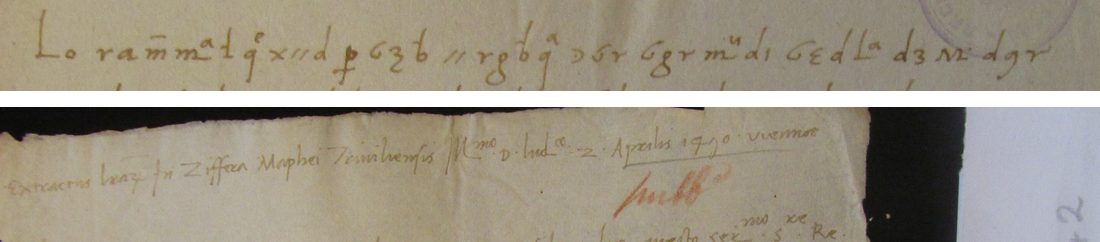
Five letters of Maffeo survive with both a ciphered original and a contemporary clear copy; Somogyi used them to build her key. Two others are cipher with no decipherment of any kind, and those are the ones read here.
| Item | Date, place | Form | Status before |
|---|---|---|---|
| Vestigia 267 / 268 · Sforzesco 642, aprile nos. 6 and 6bis | 2 April 1490, Vienna | cipher + clear copy (“Extractus litterarum in ziffra Maphei Trivilensis”) | the pair Somogyi used; the crib for this work |
| Vestigia 276/277, 249/256, 213/214, 200/201 | April–September 1490 | cipher + clear copy | Somogyi's other four pairs |
| Vestigia 2831 · Sforzesco 650, 1489 no. 8 | 22 November 1489, Buda | four pages; pp. 1–3 and the first two lines of p. 4 in cipher, the rest clear | only its first two lines had ever been deciphered (Somogyi, as a specimen) |
| DECODE R1098 · Sforzesco 642/1, 4 | 12 January 1490, Buda | p. 1 clear, then ten lines of cipher; p. 2 clear | “Partially decrypted” in DECODE; no decipherment known |
Three further DECODE records from these boxes were checked and set aside: R1155 (Paolo Lanterio to Maffeo, 14 September 1492) has a seven-page contemporary clear copy in the same archive, catalogued as Vestigia 2240; R1147 (the abbot of Forlì, 18 November 1491) has its clear “Extractus Cifare Abatis Forliviensis”, printed in Dóra Labancz's edition of the 1491 letters; and R1152 (2 April 1492) is a clear draft, not a cipher at all. R1146 and R1158 are in two other ciphers, not Maffeo's.
02 Turning Somogyi's numbers back into signs
Somogyi's appendix prints the key as a table of numbers: a = 11, 29, 39; m = 12; b = 13; and so on through five nulls, three word signs (et, in, che), five doubled-letter signs, thirty-two syllable signs and six nomenclator entries (“il vescovo varadino”, “S. V.”, “ser.mo Re de Hungaria”, “madonna Bianca”, “zo. Corvino”, “la sua Maestà”). She also prints the first two lines of the 1489 letter twice, once as numbers and once deciphered. What she does not print is any image of a sign, and her numbers are her own invention, not the fifteenth-century chancery's.
The way in is the sequence. Her numbers 11, 12, 13, 14, 15, 16 read a, m, b, sa, to, re — which is “ambasatore”, the first word of the letter of 2 April 1490. 17, 18, 19 are d, e, l (“del”), 20 to 23 t, u, r, co (“turco”). The numbering simply follows that letter word by word, so the ciphered original supplies the shapes in the same order. From there the clear copy carries the reading to the end of the letter and fixes about forty signs.
The rest came out of the two unread letters themselves, each fixed by a word that could be nothing else: the long 7-shaped stroke is f (“Fedrico”, “fosse”, “satisfare”); an n with a crossed 4 is ss (“essere”, “potesse”); x with a tick is do (“quando”, “havendo”); a with a colon is gli (“meglio”); a looped b joined to o is st (“stato”, “questo”); d with a colon is fi (“figliolo”, “iustificare”); an n with a long crossbar is tt (“littere”); and a capital with a cross stands for “Ex.tia Vostra”. Numerals are written as figures, not enciphered: “ali 8 del presente”, “ali 15”, “in 20 o 25 di”. Latin words sometimes stand in the clear inside the cipher (“etiam apud”, “Sed hoc non fallet divinam sapientiam”).
03 Buda, 12 January 1490: the king rides to Vienna
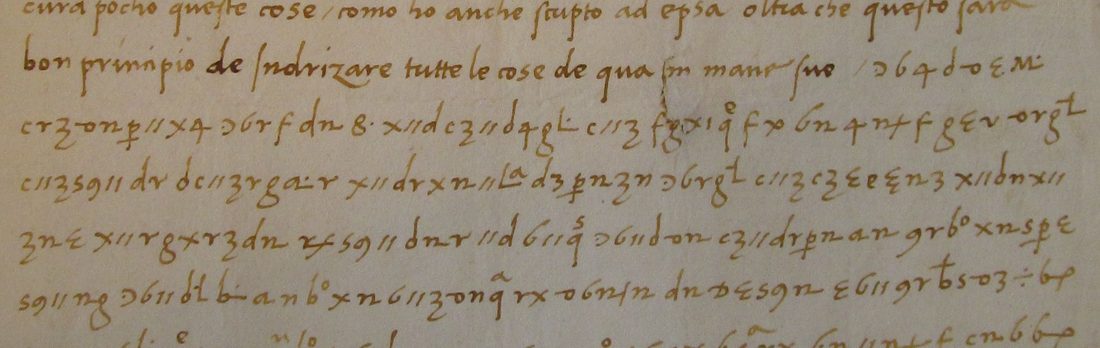
The letter's clear first page is about church appointments; the cipher begins where the news turns delicate.
Questo Ser.mo Re partite de qua ali 8 del presente per andare ad Vienna, non ta[nto] per che la speranza de la dieta lo tiri, quanto per proprio desiderio de andarli; et che sia el vero, questi prelati mi hano dicto che in questo camino divertira ad [Tu…] … che sono molti et gr[an]di, et non si conduc[ono] ad Vienna a piu … che in 20 o 25 di. Lo legato et li altri oratori hano, et io con loro havemo, deliberato partire ali 15 de questo … rimasti dreto, perche … and[aremo per la] recta via ad Vienna.
“This Most Serene King left here on the 8th of this month to go to Vienna, not so much because the hope of the Diet draws him as from his own wish to go; and in proof of it, these prelates have told me that on this journey he will turn aside to [Tulln?] … which are many and great, and they will not reach Vienna in under 20 or 25 days. The legate and the other ambassadors have decided, and I with them, to leave on the 15th of this month … having stayed behind, because … we shall go by the direct road to Vienna.”
The reading checks itself: the letter's own second page says in clear words that “lo legato et li altri oratori et io siamo insieme deliberato partire alli 15 de questo … andare per la via ad Vienna”. The cipher says the same thing in the same order, and the word “Vienna” is spelled with the same signs in lines 2, 6 and 10.
04 Buda, 22 November 1489: peace, the Diet, and two marriages
Four pages. Somogyi printed the first two lines as a specimen; the rest had never been read. Matthias Corvinus had six months to live, his war with Frederick III was in suspense, and two marriages were in play for his illegitimate son John Corvinus: Bianca Maria Sforza, Ludovico's niece, and a daughter of don Federico of Aragon, Naples's candidate. Queen Beatrice of Aragon opposed the succession of her stepson.
The reading below is close but not word-perfect: bracketed words are uncertain, ellipses mark groups not yet read. Page 1 and page 2 are read nearly throughout, page 3 in its first half and in patches thereafter.
[Page 1] La Ex.tia vostra intende ad quali termine la pratica de pace et per consequente questa dieta. Questo Ser.mo Re de Hungaria e tenero del honore suo, como ho scripto altre volte; non e dubio che lui non desidera la pace, et non tanto pero che l[a] voglia receve[re] … andare ad la dieta … perche non se gli potesse imputare che per lui fosse rotta la pratica. Gli pare anche duro andarli per non cavare niente et riceverne scorno; et pero desidera havere l[ette]re da … che lo … affirmando li essere [tanto] disposto a la pace, et con questo si contenta andarli, anchora che fosse certo che niuna conclusione ne dovesse riuscire, perche gli pare … potersi sempre iustificare et satisfare ad honore suo.
… Etiam che questo novo ambasiatore de Napoli [ha] tractare la reconciliatione de la [Maestà] con lo [Imperatore] per [dispo]nerla a la voglia, como lui dice, de la … per [beneficio] de suo figliolo; habia una altra volta tentate et facto mentione de la figliola de don … Fedrico, et gli ne ho facte quelle coniecture … le parole che ha dicto al Ser.mo Re, che … voglia havere rispecto al honore de la [sua Maestà]. … Liberamente questa aff[init]a essere facta in suo dispecto … al honore suo, stando questa affinita … la figliola de don Federico, che gli e dispiaciuto da morte quando fosse stato … apresso uno gentilhomo napolitano che e con lo dicto ambasiatore.
[Page 2] … et, respondendoli colui parerli imposibile essendo [cocto] questo de Milano, solenemente replico essere vero, dicendo che la parentata de Milano era gia [conclusa]. Sono ancora stati de cortesani li quali, havendo inteso de la deliberatione che era facta, che messere Francisco and[a]sse ad Napoli, gli hanno dicto: “Voi andarete ad disfare quello che haveti cocto!” … Io li significo liberamente a la Ex.tia Vostra quello sento … ne pigliare[a] quella parte che gli parera … che non habia restare per lei ad [fare] omne prova se possi avertere … lo Ser.mo Re da proposito … et in questo non cedera a la insaciabile ira de Iunone …
… per la experientia del passato se po iudicare del futuro. Le littere in cifra che forono intercepte, le quale duplicate sono state scoperte a[n]cora qua, hanno indicato l'animo suo … no[n] i[n]coveniente usare de quelle rotte, se co[me] usa lui … omne volta che … del adiuto de quello stato … de insolente, intolerabile … che, overo, non e da prestare fede … qua gli ne … dare … sopra la dote.
[Page 3] … quando si parera, se dica qualche parola ad la sua Maestà … Francisco ad l'andare ad Napoli, e proceduto dal[la] sua Maestà … dal signore suo, de reconciliar[e] lo re con la sua Maestà … l'andar[e] ad Napoli, mando per … et gli disse che andasse con … animo … fructo de l'andar sua … habia dicto de volerlo mandare piu presto per tentarlo che per deliberatione … et dice ancora che ad … non havera ad dimorare piu che octo di, o dece al piu, et che vole affretare el camino per trovarsi presto … la singulare observantia de questo Ser.mo Re verso la … conveniente ad questo effecto, per disponer[e] la … del Turco … il Turco, dopoi … del re Ferdinando galiardamente, et co[n] tale modest[i]a che convi[e]ne … volendo la Santita sua …
[Page 4, the last two ciphered lines] … quello che sapia et possi [fare]. Sed hoc non fallet divinam sapientiam de la. Ma se e dicto ancora che la … al Soldano.
05 The clear postscript: an ambassador's expenses
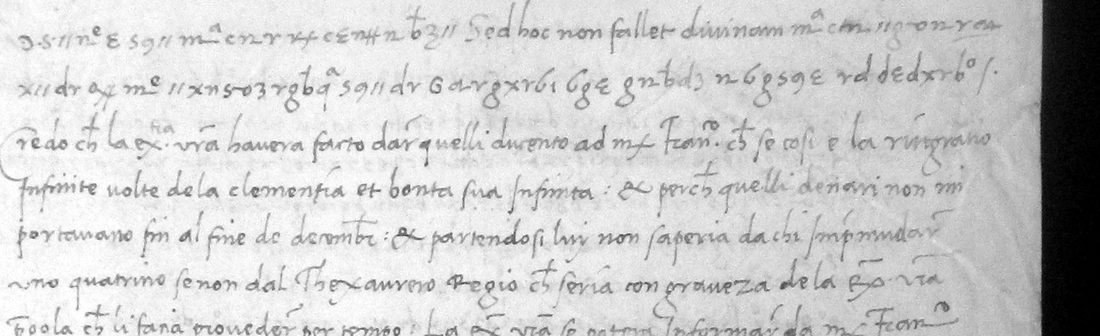
Nothing on this page is secret, and it was never enciphered. It is also the only part of the letter that is about Maffeo himself.
Credo che la Ex.tia V.ra havera facto dar quelli ducento ad m. Fran.co; che, se cosi e, la ringratio infinite volte de la clementia et bonta sua infinita. Et perche quelli denari non mi portavano fin al fine de decembre, et partendosi lui non saperia da chi imprum[ut]are uno quatrino se non dal Thexaurero Regio, che seria con graveza de la persona vostra propria … Se de questa spesa non gli ne faria honor, sonno contento che non me ne proveda; io gli posso affirmar etiam cum iuramento che, doppoi che sonno qua, ultra quello ho havuto et tolto in nome del Ill.mo S. V.ro, ho speso di mei piu de centocinquanta ducati tra mi, veste et cavalli … che la provisione che me e ordinata non mi basta, dovendo tener questo loco secundo la dignita sua. Et perche in questa novita facta de Cancelleri forse poteria esser dome[n]ticato, La supplico ordini ad chi li par che provedi sia compreso in el numero de li altri Can[cellieri] et in lassignatione facta ad la Cancellaria. A V.ra Ex. de continuo me recomando. Bude xxij Novembris 1489. E[iusdem] Ill.me D[ominationis] V[ostre] servus, Magister Trivilien[sis].
“Since I have been here, beyond what I have had in Your Lordship's name, I have spent more than a hundred and fifty ducats of my own on myself, clothes and horses … the allowance assigned me is not enough to keep this post according to its dignity. And because in this recent reshuffle of the chancery clerks I might be forgotten, I beg you to order whoever you think fit to see that I am counted among the other chancellors.” The phrase “et in lassignatione facta ad la Cancellaria” is the explicit by which the archive catalogues the letter.
06 Method
The images are the Vestigia plates (3240×4320, no login needed: the record page at vestigia.hu/documents/<id> carries the whole record as JSON, and the originals are served from /media/<file id>/<file name>) and, for R1098, the DECODE scans of the same negatives.
The working loop was: connected-component segmentation of each page into glyph boxes, line assignment by the peaks of the horizontal ink projection, merging of the two-stroke signs and of superscripts with the letter below them; then numbered strips, one line at a time, transcribed into values by hand against a sheet of sign exemplars cut from the letters themselves; then the values segmented into Italian, and any place where the Italian failed sent back to the image. The 2 April pair was aligned by dynamic programming against its clear copy to seed the key. Several rounds were needed: the first pass on the 1489 letter produced letter strings, the second, working from contrast-stretched crops of whole lines rather than from boxes, produced sentences.
Two practical notes for anyone continuing. The automatic line segmentation misassigns glyphs in the lower half of pages 2 and 3 of the 1489 letter, where the lines converge; read those from the plate with per-row crops. And the stacked line crops drift from line 18 onward on page 3, which cost one pass its accuracy.
07 What remains uncertain
- A recurring pair (ro + et by the table) occurs three times on page 3, twice directly after “ad”, in a slot that wants a place name. It is probably a nomenclator entry Somogyi's key does not list. I
- Four signs are still unvalued: a “♀”-like sign with a cross below, a capital E with three bars, a wavy horizontal null, and a stroke that may be a second null. I
- Page 3 after line 19 is read only in patches: the ink is lighter there and the plate's resolution runs out. About a third of that page's words stand unread. M
- Page 1 lines 21–26 have stain damage at the right edge; the sense carries, the last words of each line do not. M
- The letter of 12 January 1490 is read in gist throughout, but lines 5, 6 and 9 have short groups that do not yet resolve, including the word after “divertira ad”, most likely Tulln. C
- The nomenclator signs for “madonna Bianca”, “zo. Corvino” and “il vescovo varadino” are in Somogyi's list but were met only once here, as three capitals in a row on page 2 of the 1489 letter. Their shapes are not yet confirmed. C
08 Sources
- Judit W. Somogyi, “Caratteristiche strutturali di cifrari monoalfabetici italiani nei secoli XIV e XV”, Verbum 17 (2016), 195–217, §3.3 and Allegato 4 (the reconstructed key, in numeric transcription): epa.oszk.hu ↗
- Vestigia database, Pázmány Péter Catholic University (Italian sources for Hungarian history): record 2831 (the 1489 letter), 267 and 268 (the 2 April 1490 pair), 2239 and 2240 (Lanterio 1492 with its clear copy): vestigia.hu/documents/2831 ↗
- DECODE database, record R1098 (ASMi Sforzesco 642/1, 4): de-crypt.org ↗
- Dóra Labancz, Lettere su e dall'Ungheria: 1491 (Pázmány Péter Catholic University), which prints the clear “Extractus Cifare Abatis Forliviensis” of 18 November 1491, the decipherment of DECODE R1147.
- Lucia Maria Negri, Lettere dall'Ungheria di Maffeo di Treviglio: la fine del regno di Mattia Corvino (tesi di laurea, Università Cattolica del Sacro Cuore, Milan, 2007), which edits the letters to 6 September 1490. Not consulted; it may print the 12 January 1490 letter's clear pages.
- Péter E. Kovács, “Corvin János házassága és a magyar diplomácia”, Századok 137 (2003), 958–971, for the marriage politics the 1489 letter is about.
Transcriptions, the key with its sign exemplars, the segmentation and decoding scripts, and the line-by-line reading files are in buda1489/ in the repository. The archive images themselves are not redistributed here.