01 The record
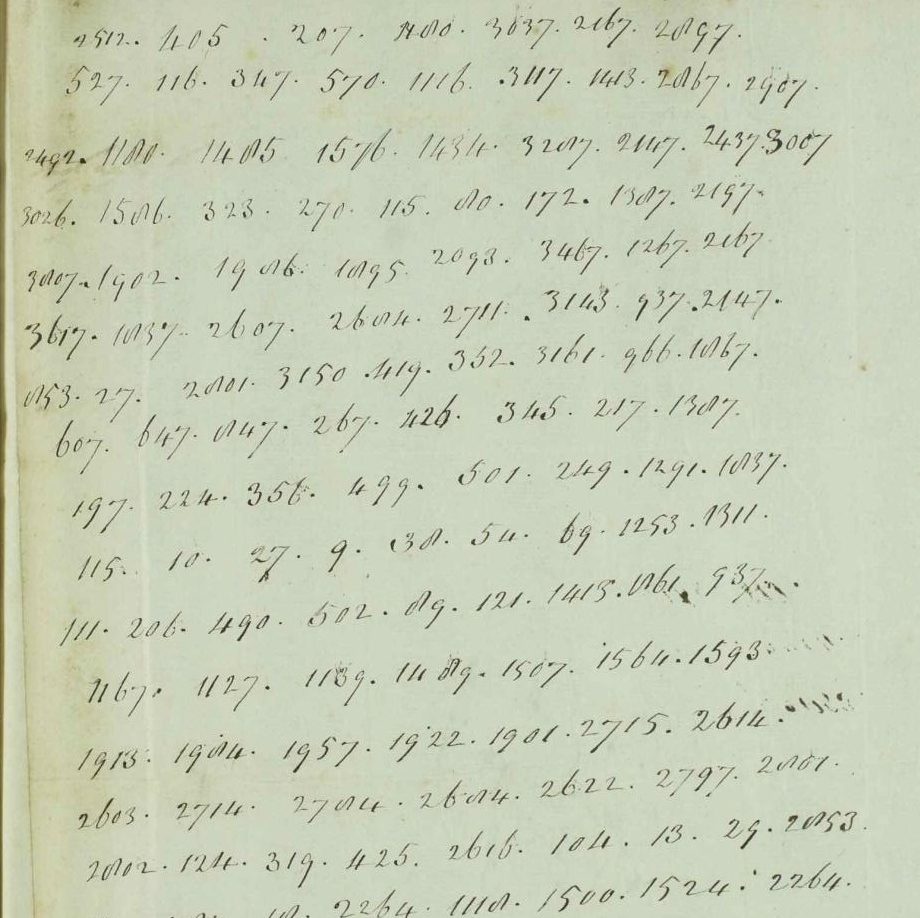
DECODE R595 (“TNA_SP106/7_Anne_(0020)”) has a single image: a bifolium opened out. The upper half is blank apart from three dockets, “Cypher from Mr Eichel 1758”, “Prussia 1758” in pencil, and “Mr Eichel”. The lower half holds eighteen lines of numbers separated by points, 139 groups in all, with no decipherment above or beside them. The DECODE date, 1 January to 31 December 1758, comes from the docket. The catalogue's “1 Jan 1758” is the first day of that span.
02 Finding the key
R594, which the DECODE note proposes, is a French nomenclator from the same box, “Russia 1758” on DECODE. It covers only 39% of the letter's groups, and what it covers decrypts to province, de Prusse, Bavière, ob-, blo, des …, which is nonsense. The transcriptions of the other key records in SP 106 boxes 6–8, and of the Prussian keys on DECODE, were each scored by coverage. Coverage alone does not decide: the large 3,000-value codes of 1750 cover almost every group and give nonsense. What decides it is a rule written on the key itself. R596 (“TNA_SP106/7_Anne_(0013-0017)”, five images, undated) opens with this heading:
Tous les nro où je trouve un ou plusieurs 7 sont les nonvaleurs dans le présent chiffre, de même que les nro depuis 1 jusqu'à 503 inclusivement et depuis 1115 jusqu'à 1198, tout comme aussi depuis 1483 jusqu'à 1999, depuis 2600 jusqu'à 2802.
The table follows the rule: no value in it contains a 7, and the values begin at 504 (un). The letter fits it closely. Its groups end in 7 far more often than chance allows (2167, 3037, 2897, 3117, 3007 …). Its closing lines run through 1901–1984 and 2603–2802, exactly the reserved ranges.
03 What is left after the nulls
With R596's rules applied, 117 of the 139 groups are nulls. A random choice of numbers from 1 to 3299 would make only about 55% of them nulls. These 22 remain:
2512 1480 1413 2492 1434 3026 2093 3143 853 3150 3161
966 1291 1253 1311 1413 861 2853 2264 2264 863 911
Twenty-one of them are numbers that R596 lists but gives no value: 2511 montrer, 2512 —, 2513 mont; 852 armement, 853 —, 854 arranger; 2263 informer, 2264 —, 2265 inopinément. The key has 107 such blanks among its 1,527 live numbers, 7%. Twenty-one blanks out of twenty-two draws would happen by chance about once in 1023 tries. The only group left with a value is 1480, écus, and the transcriber marked two of its digits as doubtful.
An alternative reading of one figure does not change this. The DECODE transcriber read a looped figure as “8?”. In this hand it is more likely a 0: compare 2001 and 2002 on the last lines. With that reading, 27 groups survive. Twenty are blanks, and the others are isolated values that make no sentence: deu, Ci, difficile, chose, françois, Clo, difficile.
04 What it is, and what remains uncertain
- No message. The sheet is written wholly in non-values of the R596 cipher, nulls by its own rule plus blank cells of its table. It needs a writer who held the key and avoided every live number. Most likely it is a specimen or trial of the cipher, or a blind meant to occupy an interceptor. It is not a despatch.
- Eichel and R596. The docket names Eichel and Prussia. R596 carries no name or date on DECODE, though its vocabulary includes Moravie, Mecklenbourg, Saxe and Hollande. That the Deciphering Branch had this key, and that the sheet uses its non-values so precisely, links the two. Whether R596 was Eichel's own cipher or a copy the Branch reconstructed is not settled here.
- Transcription. The analysis uses the DECODE transcription of the letter, checked against the image, and of the key. The key's blank cells were not each checked on the key images. The 21-in-22 coincidence does not depend on that check.
- DECODE. The note's “probably from Russia” is a misreading of the docket “Prussia”, and the key it names, R594, is the wrong one.
05 Sources
- The National Archives, Kew, SP 106/7, image 0020: DECODE R595 (image and transcription, login).
- Key: SP 106/7, images 0013–0017: DECODE R596, transcription by AKar (2020), with the null rules in its heading.
- Key proposed by DECODE and ruled out: SP 106/7, images 0021–0022: DECODE R594.
Notes and the scoring script: eichel1758/ in the repository.