01 The documents
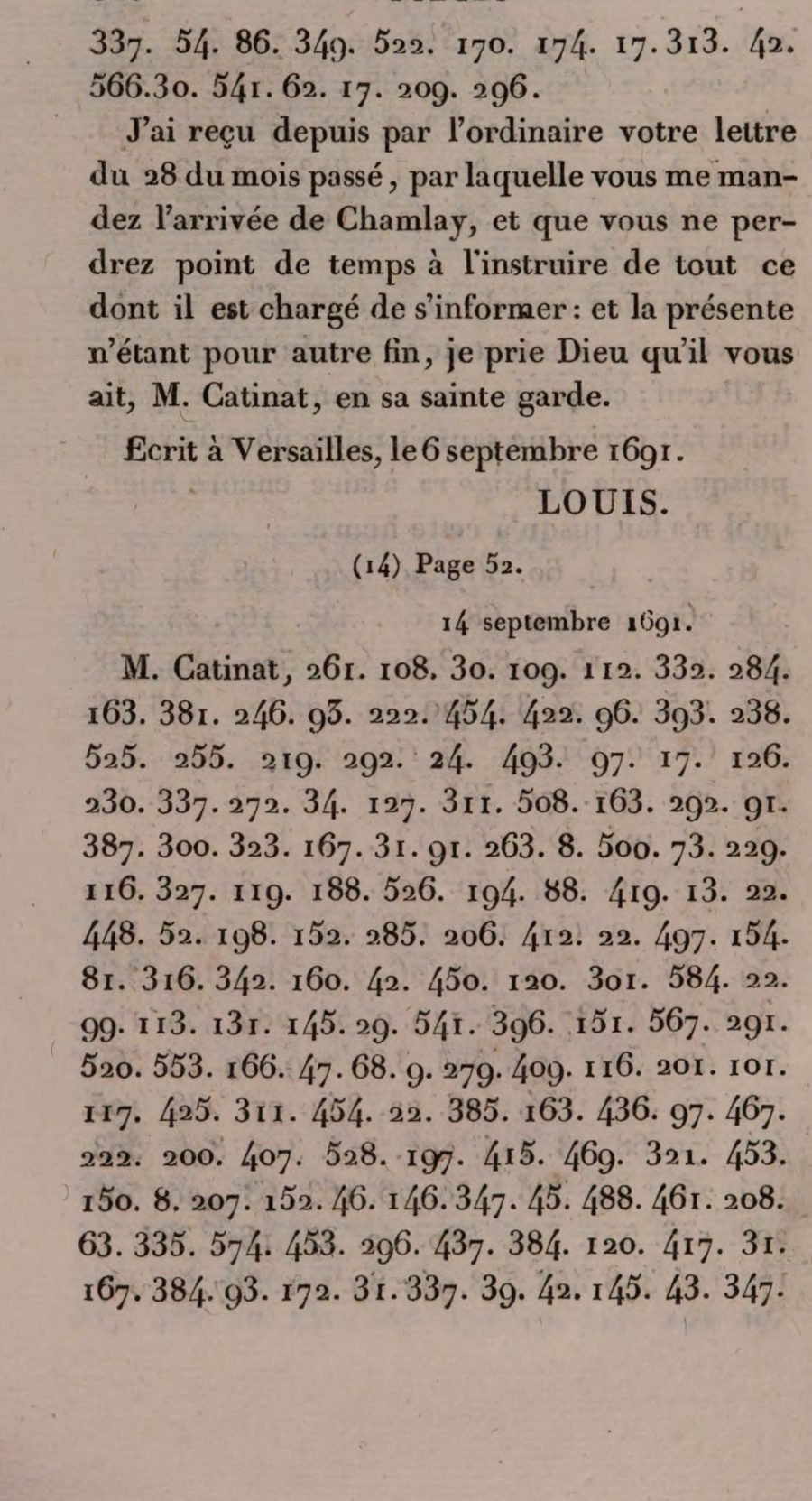
The 1691 campaign in Piedmont opened with the failed siege of Coni (Cuneo), abandoned by Bulonde on 28 June against orders, and closed with the French army still in the plain between Turin and Pignerol, unable to take Coni or to winter. Catinat commanded; Louvois, secretary of state for war, died on 16 July; his son Barbezieux succeeded him and the King wrote to Catinat himself. The court’s ciphered despatches to Catinat survived among the marshal’s papers and were printed in figures in the second volume of the 1819 Mémoires, pp. 295–342, with the clear passages the clerk had left in clear. Bazeries states that except for the 19 August letter, whose minute is at the Dépôt de la guerre, these despatches “n’ont pas été enregistrées”: if so, the 1819 print is the only text of the other six.*
| Letter | Pages | Groups | In clear before |
|---|---|---|---|
| Louvois → Catinat, Versailles, 8 July 1691 | 295–299 | 1,074 | Bazeries 1893, pp. 42–46 |
| Louvois → Catinat, Versailles, 9 July 1691 | 299–304 | 1,611 | first 130 groups, Bazeries pp. 47–48 |
| Louis XIV → Catinat, Versailles, 19 August 1691 | 305–309 | 1,259 | Bazeries pp. 292–300, from the minute |
| Louis XIV → Catinat, 24 August 1691 | 309–315 | 1,193 | one passage, Bazeries p. 266 |
| Louis XIV → Catinat, 29 August 1691 | 315–318 | 492 | no |
| Louis XIV → Catinat, Versailles, 6 September 1691 | 318–320 | 402 | no |
| Louis XIV → Catinat, Fontainebleau, 14 September 1691 | 320–342 | 6,331 | no |
02 The code and the reading
The Grand Chiffre de 1691 is a two-part code of 587 groups: two or three homophones for each letter, consonant-vowel syllables, word stems (Envoi, Trouv, Expliqu), whole words (Sa Majesté, Pignerol, Carmagnole), a dozen nulls that mark the ends of sentences, and one group that cancels the group before it. Bazeries rebuilt it from these letters over three years and printed his table, with 91 entries left blank, at the end of Le Masque de fer; that table, transcribed from the Gallica scan for the Feuquières letter, is used here unchanged.
The figures were taken from the Bavarian State Library’s hOCR of the volume, word by word with their boxes. Specks the OCR read as a stray “1” (which would decode as Passage) were dropped by box size, show-through glyphs stripped, the editor’s footnote markers and running heads removed, and the letters cut at their printed headers. Each group was looked up, the units concatenated between nulls, and the result word-segmented with a lexicon drawn from the three Catinat volumes, Rousset’s Louvois, Feuquières’ memoirs and Bazeries’ book, so that sa maj este vou loit sca voi r comes out as sa majesté vouloit scavoir. The segmentation is a reading aid; the group-level decode is what is checked.
Controls. Bazeries printed the 8 July and 19 August letters in clear. Our reading of the OCR’d figures matches his text at 2,640 of 2,690 characters (98.1 %) and 3,204 of 3,233 (99.1 %) after normalising accents and i/j, u/v. The residue is single groups the OCR misread (26 Vous as 24 Le), a few places where his clear text departs from the printed figures, and his free rendering of two table entries. Every stretch the segmenter could not resolve into words, 137 in all, was then cropped from the page image and read by eye: seven OCR errors were found and corrected, six groups turned out to be misprinted above 587 in the 1819 edition itself, and the rest were seventeenth-century spelling correctly transcribed.
03 What the King and Louvois wrote
Louvois, 9 July. The more the King reflects on Coni, the more he is touched, for the reputation of his arms and for what the place will cost the winter quarters; a siege with the whole army is no longer possible. Two tasks: fortify Carmagnole so the enemy “n’osent le regarder”, and destroy every post the enemy could hold in winter against the roads to Casale and Pignerol: Villeneuve d’Ast and Quiers “vous les devriez brusler absolument”, sparing the churches, and the castles between Turin and Asti likewise, all done “de manière qu’il ne paroisse point qu’elles vous aient esté prescrites”. Seize Bene; burn Carignan if the enemy could winter in it. Seek battle before the Germans arrive and avoid it after, to let them fall sick and desert for want of pay. Oblige the peasants to bring their grain into the King’s garrisons, with commissaries to hold the governors to it. The Duke of Savoy’s talk “mériteroit bien” two thousand bombs into Turin, and the bridge of Turin would be worth breaking, “mais ce sont des vues que Sa Majesté vous met devant les yeux et non des ordres”.
Louis XIV, 24 August. Chamlay carries the King’s thoughts on every course still open in the war. Will the enemy march into Savoy, or mass by Turin to eat the forage and force Catinat back over the mountains first? The negotiation at Rome makes it very desirable to stay beyond the Alps as long as possible. Casale: palisades, money for eighteen months, grain, more cavalry, gunners. Some at court think Villefranche fortified and Saluces, Savillan and Fossano garrisoned would let the army winter in Piedmont; the King does not tire of saying so, but Catinat is not to let the King’s wish override his judgement. Pignerol is “le premier objet” in any plan. And the King would greatly wish Coni taken at the close of the campaign.
Louis XIV, 29 August and 6 September. A treaty offered by the people of Mondovì is good but can only serve to sound them, since the army can no longer take quarters there. The resident at Geneva reports the enemy has asked the city for passage into Savoy and would go by the Valais into the Chablais. Larray has thrown an Irish battalion into Briançon for fear the Barbets would seize it. If Catinat crosses the Po, let it be before the enemy moves. Chamlay has arrived.
Louis XIV, 14 September, Fontainebleau. Chamlay has reported, and the King has seen “avec peine” that the upshot is to withdraw the army of Piedmont over the mountains at the end of the campaign and not to bring it back. He sets out both sides at length. Against withdrawal: the enemy masters of Italy, the allies and neutral princes forced to declare against him, Casale lost from view, the reputation of his arms damaged and his enemies encouraged by an appearance of weakness “quoyque fausse dans le fonds”. For it: the impossibility of subsisting in Piedmont without Turin; a country “fort estroit et extrêmement couvert”, cut by torrents that rise in hours and cannot be bridged; the distance of Casale; the sickness of the troops every campaign, with no hospitals to hold them; the enemy’s freedom to engage or refuse behind the Doire and the Po. Then Catinat’s plan for the defensive: the cols of Provence, Dauphiné and Savoy held, the heights of Saint-Pierre by Pignerol and of Suze occupied, cheaper subsistence, fewer sick, the surplus cavalry on the Saône ready to go to Germany, and the Duke of Savoy left to choose between keeping the allied army idle in his ruined country or sending it away and seeing the French return. “J’ay comparé les inconvénients et les avantages d’un parti avec ceux de l’autre … et je me suis déterminé à préférer le parti solide à l’honorable.”
The orders follow. Prolong the campaign to All Saints or even Saint-Martin, and keep Carmagnole to the last, because both cover the negotiation with the Pope and the Italian princes that might extricate him from Casale “et mesme peut-estre de la guerre de Piedmont”; the enemy must not learn that he means to quit Piedmont for good, so the works at Carmagnole go on, “avec un peu moins de vivacité et de dépense”. When the order comes, carry off what can be carried, the grain on the cavalry’s cruppers to Pignerol, throw the rest in the water, tear up the works, burn palisades, gates, hay and grain. Secure Pignerol’s magazines against a bombardment, which “me donneroit beaucoup de mortification en présence de mon armée”. Hold the valleys of Pragelas and Pérouse for the Briançon road. After recrossing, take Coni in the winter; the artillery and stores are ordered to Lyon and Grenoble. Fortify Briançon and the frontier against the valleys of Luzerne, Saint-Martin and Angrogne. Winter quarters by Catinat’s memoir. And retreat with such precaution that the enemy can attempt nothing.
The full segmented readings, with the groups as printed and page breaks, are in the repository under catinat1691/letters.
04 What remains uncertain
- Six groups stand above 587 in the 1819 print (654, 593, 855, 942, 854, 595) and one glyph on p. 326 is damaged; they are flagged and unread.
- The OCR error rate measured on the two controls is about one group in seventy. Errors that break the French were caught by the image check; a substitution that leaves plausible French (24 for 26, 8 for 587) can survive at that rate, so a passage to be quoted should be checked against the page image; every group’s box is recorded.
- About a hundred groups fall on entries Bazeries left blank and are read from context. Where his clear text of the 8 July letter departs from the figures as printed, either the 1819 compositor or his table is wrong, and only the originals at Vincennes can say which.
- Whether the minutes of the five unpublished letters survive at the Service historique de la Défense, and whether their substance was already known to Rousset and Catinat’s biographers from other papers, is not checked.*
05 Method and reproduction
python extract3.py in catinat1691/ rebuilds the readings from the stored hOCR and the corrections file; validate.py reports the
agreement with Bazeries’ two clear texts; verify_crops.py regenerates the contact sheets of doubtful groups. The table is
feuquieres/grand_chiffre_1691.tsv. Page images and hOCR come from the Bavarian State Library’s IIIF and OCR services.
06 Sources
- Mémoires et correspondance du maréchal de Catinat, ed. Bernard Le Bouyer de Saint-Gervais, 3 vols (Paris, Mongie, 1819), t. II pp. 295–342 — Bayerische Staatsbibliothek bsb10720287, scans 329–376.
- Émile Burgaud and Étienne Bazeries, Le Masque de fer, révélation de la correspondance chiffrée de Louis XIV (Paris, Firmin-Didot, 1893) — the table pp. 280–289; the 8 July letter pp. 42–46; the 19 August letter pp. 292–300 — Gallica bpt6k1523532j.
- Camille Rousset, Histoire de Louvois, t. IV (1863), for the campaign of 1691.
- Feuquières to Catinat, 25 January 1691, the companion petit chiffre, read in the previous session.
* Inference from Bazeries’ statement, not verified in the SHD inventories.