01 The letter and its listing
Cotton MS Caligula C II is a volume of Scottish state papers from Burghley’s circle. Folios 66 to 75 hold Mary’s ciphered letters to Norfolk that were intercepted or surrendered, with deciphered copies. Tomokiyo’s cryptiana page on Mary’s ciphers (mary.htm) lists them this way:
| Folio | Date on the letter | Decipherment | In print |
|---|---|---|---|
| f. 66r | “last of Januarie” [31 Jan 1570] | transcription f. 67, decipherment f. 72 | Labanoff iii p. 19 |
| f. 69 | “the xv of this instant” [15 Jan 1570] | f. 70 | Labanoff iii p. 11 |
| f. 74r | “the tventi of this instant” | none | none found |
| f. 75 | [18 Apr 1570] | clear text f. 73, roughly corresponding | Labanoff iii p. 35 |
Tomokiyo marks f. 74 “undeciphered”. He found no matching letter in Labanoff’s Lettres de Marie Stuart, vol. 3, or in Froude, and took the address my oun good lord as a sign that it too is from Mary to Norfolk. He then reconstructed the key from the deciphered letters (“Mary-Norfolk Cipher (1570)”, corrected 16 July 2023). With it he printed the first two lines as a paraphrase, “I have, my own good lord, your friendly [letter??] [with??] no [g?]entle satisfaction and for * I will never [do??] anything in hand …”, and left two further pieces of work that are not on the visible page. One is an HTML comment in the page source: a continuous transcript as far as about line 11 (… in? deliveri[n]g us of our * the Queen of England …). The other is an image, mary_CottonCaligulaCII_f74.png, with his decode written in magenta over each of the 23 lines, letter by letter. Unkeyed signs are shown as asterisks, doubtful letters as queries, and words are not divided.
That overlay is the starting point, and it has to be credited. For most lines it already has the letters, including murton is gon to, Talbo and herkebus. This page adds the reading. The letters are divided into words and made into sentences, and many of his asterisks and queries are filled. Line 8, which the comment leaves out when it runs and I shall be your sister scrup from the end of line 7 into line 9, is restored. The names are identified and the letter is dated.
The verso, f. 74v, has no address. It carries only a short note written upside down relative to the text, with a mark above it; the note reads Norffolke (or Northfolke).
02 The images
The British Library’s new viewer publishes the volume as a IIIF manifest (bl.digirati.io/iiif/ark:/81055/vdc_100162985756.0x000001, reached from the Search
Archives record for Caligula C II). The image service claims IIIF level 2 but will not return an image more than about 1,024 pixels on a side. The full leaf is 7,144 × 10,328 pixels,
so fetch.py and region.py ask for 1,024-pixel tiles and paste them back together. The text block of f. 74r is the region from x 1000 to 6500 and y 4900 to
9800, at full resolution. strips.py finds the centre of each line in five vertical bands from the ink profile and cuts 23 strips that follow the slope of each line, so a line can be
read at magnification from end to end.
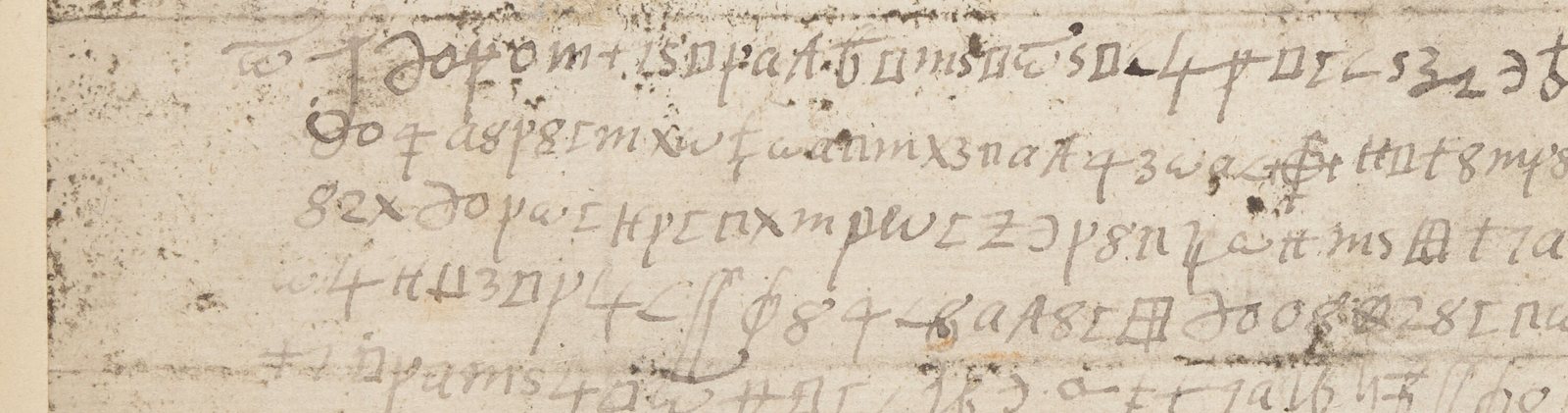
03 The key
The cipher is a simple substitution of one sign for each letter, with no homophones except f. Nulls are scattered through the text, even inside words. About twenty word signs and a handful of name signs complete it. This is Tomokiyo’s reconstruction. Before it was applied to f. 74, it was checked against f. 66r, whose contemporary transcription and decipherment survive (ff. 67, 72). The opening of f. 66r, My oun lord, I vret to you befor to knou your pleasur if I schould sik to mak an entrepryse, reads correctly with it.

| a | b | c | d | e | f | g | h | i | k | l | m |
|---|---|---|---|---|---|---|---|---|---|---|---|
| ω | φ | Ш | ∠ | 8 | 6, б | A | 3 | Π | ǂ | 4 | + |
| n | o | p | r | s | t | u/v | x | y | nulls | ||
| a | □ | 2 | ⊏ | H (#) | X | ρ | Φ | 7 | g-like, m, small s, ῶ, Σ̃, ɓ, ₱ | ||
| Word signs | Names |
|---|---|
| and ⊧ · but λ · for ⊞ · friend ♁ · have o (round) · I 9o · in ④ · is ᵻ · not ∥ · our ε · that ᵹ · the X slashed · to Z · will 4 barred · with δ · would ƀ · you ʃ · your ∂; also signs for me and my | Queen of England V · Bishop of Ross IV · Murray L · Norfolk Rp |
F. 74 adds three uses the table does not state. ǂ standing alone is and; inside a word it is still k (kan, spok, lyk, York). The pair εʃ is me. A б with a bar through it is friend, besides the ♁ form. There are no signs for j, q, w or z. The writer uses v for w (vreit, veil, vel or vo), which is Scots spelling, not a gap in the cipher.
04 The reading
Line by line as on the leaf; the writer’s spelling kept; [..] a word not read, [word] supplied or uncertain; {sign} a nomenclator sign with no value in the key, with a guess where the sense allows one
1 I have, my oun good lord, [..] your friendl[y] [..] no [g]entle satisfaction, and fore
2 I will never take anithing in hand {⊕: unless?} some ver good mey come of it to me, anithing ex-
3 -ept I var sur it var to your veil as for myn; and if I mocht be so to us both, I would be sur
4 al schould not be in denger. For I have experiance [..] that [f]avour that me oune f[riend]s [… stain …] but no[t],
5 my oun lord, that your {a—} and myn friend[s] would not believe so to use a way can nothing content
6 the Queen of England. I find be that the cardinal is with that is veil mynded to help me; [..] for find meanes that
7 our caus[e] be not [lost] for falt of solisitation: vreit to the B[ishop of Ross] of your part, and I schal
8 be the nixt to [..] friendes, would al[so], as I kan, to persuad {⊘: a person} to hest [to] find meanes.
9 Be your sister Scrup or uther to caus [..] knou your mynd, for I have no meanes that he mey be
10 sur of forces, and had al friends in hand. [..] I trust God he will help us, as he be[gan] al-
11 -redy in delyvring us of our {o—} Murray. The Queen of England hes spok[en] courtusli to the B. of Ross of
12 you [..] schued, as if I would caus schut her friend a harkebus-schut. [It] would not hurt me, God be juge,
13 betvix us. I am asured that sche [..] sueves me the veyt of Murray death {ø}; but God knoueth if
14 [..] her mynd would [..] at le[a]st you knou the treuth of this. God will, I trust, prosper us both, the
15 better that ve have som[e] [..] [..]les. That brut is that Murton is gon to[..]; but not for treuth it
16 I vreit [ane?] this: nicht to me Lord Talbot [..], not for treuth, it cometh from York. [..]
17 [..] I will end, and prey you not to constren you or hasard you to vreyt your self, but caus {⊗} but vreyt t-
18 -o ani uther in your nem, but you ar vel; and remembers your oune. I desyr no mor, for and I hear
19 nothing, I fear ever that som teales mak you ofendet at me. I schal, God veling,
20 never mak caus, but sens the last [lie?] I ever am in doubt of the lyk. I
21 prey him to preserve you from feynit friends, and send us mor confort, [and]
22 yet vi have had in this meantym in vel or vo, I schal ever remen yours feithful
23 til death. {Mary}. The tventi of this instant.

English
A paraphrase in modern English. Where the leaf is doubtful the paraphrase is too, and the brackets carry over.
I have, my own good lord, [..] your friendly [..], to my small satisfaction. I will never take anything in hand [unless?] some real good may come of it to me, and nothing at all unless I were sure it was for your good as much as mine; if it could be so for both of us, I would be sure that not everything would be put in danger. For I have learnt by experience [..] the favour that my own friends […] but not, my own lord, that your [friends?] and mine would believe it right to go a way that cannot please the Queen of England in anything. I find by this that the cardinal is among those who are well minded to help me; [..] to find means so that our cause is not [lost] for want of pressing it. Write to the Bishop of Ross on your side, and I shall be next to [..] friends, and would also, as far as I can, persuade {someone} to hurry to find means. Through your sister Scrope or someone else, let [..] know your mind. I have no means of making him sure of forces, [though] he had all his friends in hand. [..] I trust God will help us, as he has begun already by delivering us from our [enemy] Murray. The Queen of England has spoken courteously to the Bishop of Ross about you [..] showed, as if I would have her friend shot with a harquebus. [It] would not hurt me, God be judge between us. I am assured that she [..] lays the blame for Murray’s death on me; but God knows whether [..] her mind would [..]; at least you know the truth of this. God will, I trust, prosper us both, the better because we have some [..]. The rumour is that Morton has gone to [..], but it is not to be taken for truth. As I write this, [news came] to me tonight [from?] Lord Talbot [..], not for truth; it comes from York. [..] I will end, and beg you not to press yourself or risk writing in your own hand, but have [someone] write to anyone else in your name, only that you are well, and remember your own. I ask no more, for if I hear nothing I always fear that some tales have turned you against me. God willing, I shall never give cause; but since the last [lie?] I am always afraid of the like. I pray him to keep you from false friends and send us more comfort than we have had in this meantime, in good or ill. I shall ever remain yours, faithful till death. [Mary.] The twentieth of this month.
The names. The B. of Ross is John Leslie, bishop of Ross, Mary’s ambassador in London. Your sister Scrup is Norfolk’s sister Margaret Howard, wife of Henry, Lord Scrope of Bolton, who had been Mary’s keeper at Bolton in 1568. Murray is James Stewart, Earl of Moray, Regent of Scotland, and Murton is James Douglas, 4th Earl of Morton, the leading man of the King’s party after him. Lord Talbot is the courtesy title of the Earl of Shrewsbury’s eldest son, and Shrewsbury was Mary’s keeper. The cardinal is not named; her uncle Charles, Cardinal of Lorraine, is the obvious candidate but the leaf does not say so. Veyt is Scots wyte, blame, and brut is bruit, a rumour. In line 18, and means if.
05 Dating
The letter gives only the day, the tventi of this instant, without a month or place. The content fixes it closely enough:
- After Moray’s murder. The Regent was shot with a harquebus at Linlithgow on 23 January 1570 by James Hamilton of Bothwellhaugh and died the same night. The letter thanks God for delyvring us of our {o—} Murray, speaks of Murray death, and has Elizabeth talking as if I would caus schut her friend a harkebus-schut. So the 20th is not 20 January.
- Elizabeth already knows, and blames Mary. Labanoff’s chronology puts Elizabeth’s receipt of the news, and her placing of the Bishop of Ross in the Bishop of London’s custody, on 10 February.
- Norfolk in the Tower. He was there from October 1569 to August 1570, which fits the warnings about writing and the talk of forces and meanes. Mary’s letters of January to April 1570 printed by Labanoff are dated from Tutbury.
That leaves 20 February or 20 March 1570. One point leans towards February without settling it. Labanoff prints (iii, pp. 31–33) a decipherment of Mary to Norfolk dated the 19th of march which opens I have forborn this long time to write to you, in respect of the dangers of writing and grieves for Pembroke, who died on 17 March. A letter written the next day that says nothing of Pembroke would be odd. So would one written a day after she said she had not written for a long time. F. 74 says neither.
06 What remains uncertain
- Five unkeyed signs. ⊕ in line 2 (read from the sense as unless), a circle with a b inside (⊘) in line 8 (a person, perhaps a nomenclator for a name), ø after Murray death in line 13, ⊗ in line 17 (someone Norfolk might have write for him), and the two dash signs in lines 5 and 11 ({a—}, {o—}). The {o—} before Murray is read as enemy in the paraphrase only from the sense. None of these occurs on the three deciphered leaves often enough to fix it.
- Unread spots. In line 1, the two groups after your friendl[y] and the group ∠ s 3 ɹ after lord; the end of line 4 under a stain; single words in lines 6, 8, 10, 12, 14, 15, 16 and 17, marked [..] above. Line 16 is the weakest line: [ane?] this: nicht to me Lord Talbot is read letter by letter, but how it hangs together is a guess.
- Word division and sense. The signs run on without spaces and nulls stand inside words, so the division into words is an editorial choice. In lines 5–6 and 9–10 the sentences are read as closely as the words allow, and the paraphrase should be taken as one reading of them.
- The month. February or March 1570, as set out above. Nothing on the leaf decides between them.
- The hand. Tomokiyo remarks that the hand of the Norfolk ciphers looks like Mary’s own but differs in the h and in spelling from her autograph letters, and suggests comparing it with her secretary Raulet’s. That was not attempted here.
07 Sources
- British Library, Cotton MS Caligula C II, ff. 66r, 69r, 74r–v, 75r: IIIF manifest
https://bl.digirati.io/iiif/ark:/81055/vdc_100162985756.0x000001, from the Search Archives record 040-001102379. - S. Tomokiyo, “Mary Queen of Scots’ ciphers”, Cotton MS Caligula C II section (cryptiana): the key (“Mary-Norfolk Cipher (1570)”, corrected 16 July 2023), the listing of ff. 66–75, and the overlay decode of f. 74.
- A. Labanoff, Lettres, instructions et mémoires de Marie Stuart, vol. 3 (1844): the Norfolk letters of 15 and 31 January, 19 March and 18 April 1570, and the chronology of 1570. F. 74 is not among them.
- Calendar of State Papers, Scotland, vol. 3 (1903), no. 520: Cecil’s “Extract out of the lettres in ciphre 1570, 1571” with the letters of 15 January, the last of January and 18 April appended. It calendars no letter of the 20th.
The notes with the key and the reading (NOTES.md), the IIIF manifest, and the tile-stitching and line-strip scripts (fetch.py, region.py,
strips.py) are in the repository (norfolk1570/). The images are not committed and can be fetched again with the scripts.