01 The document
Fascicle 327 of the Hungarian conspiracy files in the Haus-, Hof- und Staatsarchiv holds a bundle headed Chiffres 1664–1668. DECODE catalogued its items one by one, and dated each with the bundle's span. R688 is ff. 30–31. The nearest key record, R707 (ff. 60–61), is a Latin numeric nomenclator, and it has nothing to do with this letter.
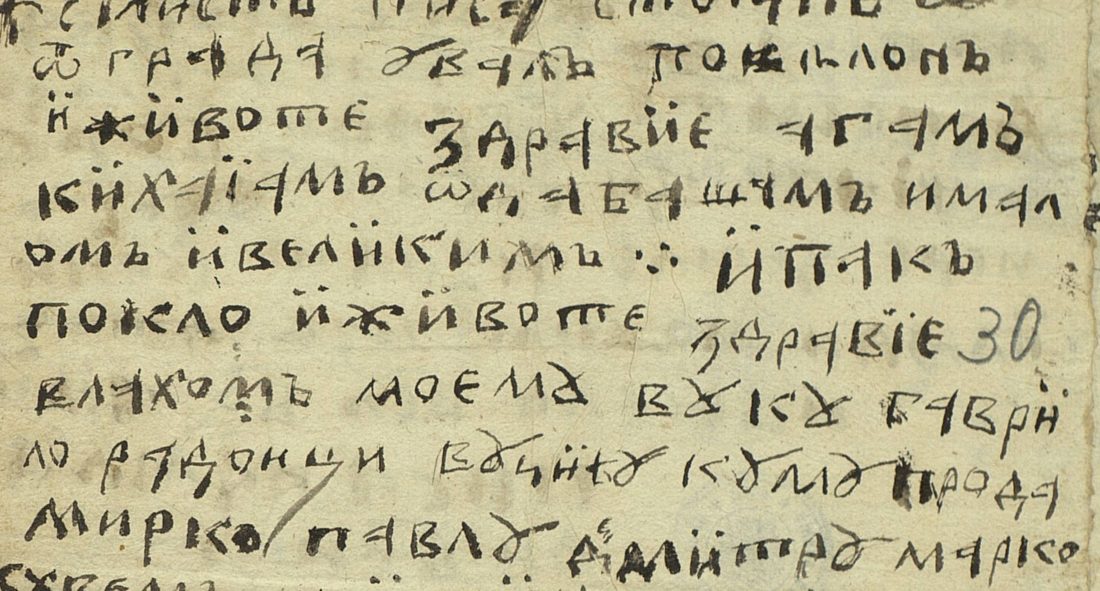
Image 1 of the record is f. 30r. Image 2 shows an opening: f. 30v on the left, and on the right a small slip mounted on f. 31, with an endorsement in Latin on its edge that begins Epistola.
02 What the letter says
The opening, with doubtful words marked [?]:
✝ Сїи листь писа Стоянь … ѿ града З[?]вачь поклонь и животе здравїе агамъ, кнезїамь, ѿдабашамъ[?] и маламъ и великимъ. И пакъ посло и животе здравїе влахомъ моема: Вуку, Гаврилу, Радонѣци[?], Вучиту[?], куму Продану, Мирку, Павлу, Димитру, Марку с всемь христианомь. … Братїа, да ми се смилуете, можите мене извадить из немачкий тамнице а ваше душе из пакле.
"This letter was written by Stojan from the town of Z[?]vač: greeting, life and health to the aghas, the knezes, the odabaše [company commanders], to small and great. And again I send life and health to my Vlachs: to Vuk, Gavrilo, Radonja, Vučeta, my kum Prodan, Mirko, Pavle, Dimitrije and Marko, with all the Christians. … Brothers, have mercy on me. You can get me out of the German prison, and your souls out of hell."
The rest of f. 30r is about groschen, money he lacks, pledges and "what is needed". The last line is struck through and blotted. On f. 30v he says to bring the money to the town of Bor[?], and "I know horses and men, we can get [me] out, and all be glad, amen". The letter was written for him by someone else: Писа намъ Младь Бакиі[?] у градъ Бор[у]. A postscript sends greetings to his wife and asks kum Prodan to go himself to the Magyar[?]. Most of this postscript stays uncertain.
The slip on f. 31 begins Сїи лисъ писа Х[?]саань[?] у Пет… and sends life and health to the writer's mother and brothers. It is too damaged to transcribe further.
03 Why it was catalogued as a cipher
A letter in Cyrillic would have been as opaque to a Vienna chancery clerk as a cipher. It was bound in the Chiffres bundle, and DECODE described it from that bundle heading as a substitution in graphic signs. The same thing has happened to other items in this project. The DECODE record should read: not a cipher, cleartext Serbian (Cyrillic). This correction is queued with the transcription.
04 What stays open
- The place names Z[?]vač and Bor[?] are uncertain readings. Settling them would help to place and date the letter.
- About a quarter of the words, mostly in the money passage and the postscript, are doubtful (grade M or I in the README Conventions scale). These are gaps in the transcription of a rough hand. A reader of early modern Serbian working from the original would close most of them.
- Why a Serb prisoner's plea sits among the conspiracy papers is not known. It may have been intercepted, or it may come from a prisoner held in the Habsburg border garrisons.
05 Sources
- ÖStA HHStA, Ung. Akt. Spec. Verschwörerakten VII, Fasc. 327, Konv. D, ff. 30–31: DECODE R688 (login; the images are not in the public domain).
- Nearest key record in the bundle: DECODE R707, ff. 60–61, Latin numeric nomenclator (not related).
Transcription, English gist and notes: r688/ in the repository.