01 Adams: the premise checked
The starting point was a note the Madison editors attach to Armstrong’s letters (Founders Madison/02-10-02-0369 and 02-12-02-0197): the code was “also used by John Quincy Adams at St. Petersburg and by Jacob Lewis at Saint-Domingue; key not found but substantially reconstructed by the editors”. On Adams to Madison, 7 January 1811 (03-03-02-0121), the editors speak of “a code provided by the State Department to John Armstrong in France and to both William Short and Adams”, citing Ford 3:328. If that held, the 580-group Armstrong table already rebuilt on this site would read Adams’s coded despatches. It does not.
- What Ford’s own text says. Secretary Smith’s instructions of 1809 (Ford 3:327–28) say that “the cypher with which you are furnished” is “the same with that of our minister at London” (William Pinkney), and tell Adams to “obtain at Paris, a copy of General Armstrong’s cypher also, for the like purpose”, that is, to correspond with Armstrong. In 1810 Adams acknowledges “the copy of General Armstrong’s cypher” (Ford 3:370). He held both. The despatches to Washington use the other one.
- What the microfilm shows. Every coded despatch checked on M35 reel 3 (1812: frames 0182, 0189–0190, 0206–0207, 0211) uses a code in which 1385 = the, 1576 = of, 1384 = that, 668 = and, 1401 = I. In Armstrong’s code the is 972 and of is 1354. Run through the Armstrong table (592 entries as it now stands), these pages come out as noise. Reel 2 frame 0155, of 1810, is in the same Adams code.
So the table already held cannot read Adams’s despatches. The editors’ note on the 7 January 1811 letter concerns a private letter to Madison, not a despatch, and was not checked against its manuscript, which is in the Forbes collection and not online; it may be right for that letter.
02 Adams’s code rebuilt
The method is the one used for Armstrong on M34 roll 13. On M35 reel 3 the Department clerk wrote the decode above the groups of several 1812 despatches; frames 0206 (No. 88) and 0189 were read pair by pair and every pair recorded with frame, page side and line, and a grade: H the clerk’s interlinear decode, M aligned but uncertain, I inferred from the code’s structure and the context. The table now has about 370 distinct groups, 252 of them with at least one clerk-attested reading.
The structure makes inference strong. The code is an alphabetical syllabary cut into blocks of about fifty numbers; the blocks are shuffled, and inside a block the order is alphabetical:
| Block | Content | Examples |
|---|---|---|
| 1–100 | whole words | 16 Emperor, 21 Minister(s), 44 negotiation, 49 U.S., 92 measures |
| 1151–1200 | w- | 1168 weeks, 1172 what, 1176 which, 1177 while, 1179 who, 1184 wish, 1188 Wil, 1190 with, 1196 word, 1199 would |
| 1301–1350 | b- | 1305 Bal, 1308 bass, 1310 be, 1317 been, 1318 before, 1331 between, 1349 both, 1350 bound |
| 1384–1399 | th- | 1384 that, 1385 the, 1388 then, 1391 there, 1393 they, 1398 thither, 1399 this |
| 1501–1550 | a- | 1501 a, 1507 ac, 1513 ad, 1516 af, 1526 agree, 1531 ain, 1535 al, 1544 am, 1549 an, 1550 ances |
A group that has not been seen decoded can therefore be pinned between its neighbours, as for Armstrong: 1186 lies between 1184 wish and 1188 Wil,
and in No. 88 it stands before na after “the Emperor Alexander to”, so it is read Wil (a homophone). A few recorded readings sit out of
alphabetical order (1304 tain in the b- block, 1395 strong among the th- words); they are either misreadings of the pencil or
irregularities of the code and are not yet explained. The pair list and a renderer are in the repository (jqa/pairs_jqa.txt, jqa/render.py).
03 No. 88, 25 June 1812: the nine lines
No. 88 was written at St Petersburg on 25 June 1812, the day after the Grande Armée crossed the Niemen, when that news had not yet reached the capital. Ford prints it at 4:355–58, addressed to James Monroe. After Adams’s account of Prince Kurakin’s passports and the French ambassador’s demand for his, the paragraph ends: “On the other side I have reported to you what Count Romanzoff said to me the day before his departure for Wilna. Certainly negotiation then was his wish and expectation. [Nine lines of this paragraph not decyphered.]” The microfilm has the triplicate (M35 reel 3, frame 0206), and on it the clerk’s pencil stops exactly where Ford’s gap begins.
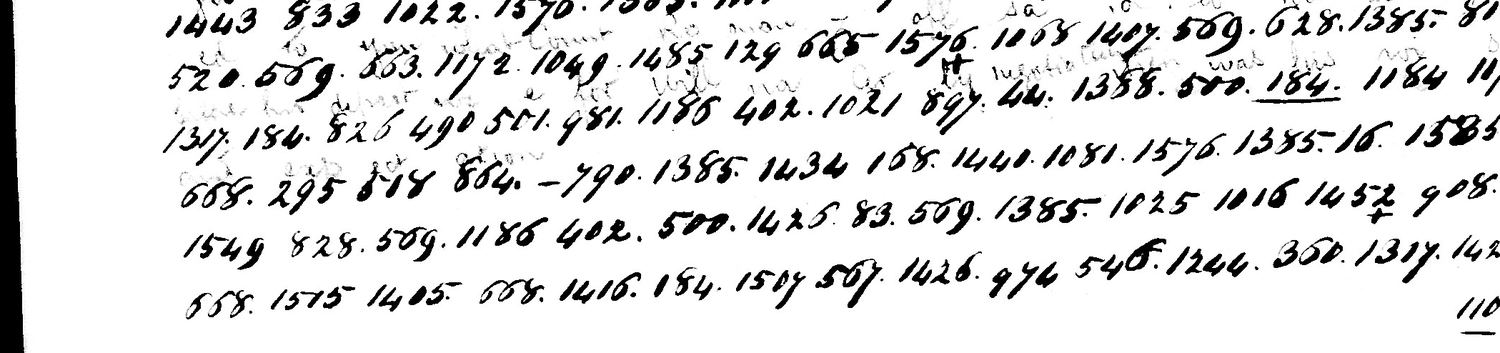
The block runs from the last four decoded groups to the end of the paragraph: 134 groups, 130 of them in Ford’s gap, with the clear words
scarcely (twice), undoubtedly and In the German Gazettes written in the line. With the rebuilt table 124 of the 134 render
(python render.py gap88.txt). In the reading below, syllables in square brackets are slot inferences that fit the block and the context but are not
attested by the clerk; groups still unread are given as {number}. The opening words in brackets are the clerk-decoded close of the sentence that Ford prints.
[Certainly negotiation then was his wish] and expectation. But the {1434} {168} it {1081} of the Emperor [Alex]an[der] to Wilna was im-{1425} {83} to the [Chan]cel[lor], and {1575} {1405}, and [if] his [active] influ[ence] had not been im[paired] {1112}-tion-ed before it, [it can] scarcely [fail] to have been [af]fected {by} his ill[ness] im[medi]ately [af]ter his ar[riv]al [thither], which was undoubtedly an apo[plec]tic {1060} s-tr-[oke]. Since then he has had a [second] and a more [seve]re one. In the German Gazettes even his [death] has been an-no-[un]ced; but that was a [mis]take. At all [events] it is scarcely possible that he should [rem]ain [much] [long]er in the department of [foreign] [affairs].
{by} is group 492, unread in the table; by is what the sentence requires.
Of the 130 groups in the gap, 81 have values attested by the clerk’s decodes elsewhere on the frames, 12 are aligned but uncertain, 27 are inferred from their slot, and 10 are unread. The skeleton rests on attested groups: his, illness, immediately, arrival, which was undoubtedly, stroke, since then he has had a, and a more, one, In the German Gazettes, even his, has been, but that was a, take, it is scarcely possible that he should, in the department of. The first sentences, where four of the ten unread groups fall, are the least certain part; the account of the strokes and of the false report of death is the most secure.
3.1 What it says
“He” is Count Nikolai Rumyantsev (Adams’s Romanzoff), Chancellor and minister for foreign affairs, who had gone to Wilna with Alexander. Adams reports that soon after arriving there Rumyantsev had an apoplectic stroke; that since then he has had a second and worse one; that the German gazettes had reported him dead, wrongly; and that he can hardly remain much longer at the head of foreign affairs. The first part of the passage, less securely read, seems to say that whatever influence the Chancellor had for negotiation was impaired by his illness.
This fits what is known: Rumyantsev had a stroke in 1812 that cost him his hearing, and he left office in 1814. It differs on the timing. Standard accounts (Britannica, Wikipedia) tie the stroke to the news of the crossing of the Niemen on 24 June. Adams, writing at St Petersburg on 25 June before that news could have reached him, places the first stroke soon after Rumyantsev reached Wilna and a second, worse one before the 25th. Ford printed none of this.
The groups (jqa/gap88.txt)
668 295 818 864 | 790 1385 1434 168 1440 1081 1576 1385 16 1585
1549 828 569 1186 402 500 1425 83 569 1385 1025 1016 1457 908
668 1575 1405 668 1416 184 1507 567 1426 974 546 1244 360 1317 1424 1102
1112 1433 520 1318 1440 1006 scarcely 502 1421 569 1259 1317 1516 322 520
492 184 1421 430 1424 632 1372 897 1520 184 680 1479 1535 1398 1176 500
undoubtedly 1549 1501 1148 1141 1060 1404 382 1586 235 1388 169 1254 1244
1501 1077 668 1501 151 1091 501 1594 | In the German Gazettes 282 184
809 1501 1382 1254 1317 1549 352 479 1017 790 1384 500 1501 134 1365
699 1535 283 1440 1436 scarcely 1157 586 1384 169 90 743 1531 162
888 1300 1426 1385 826 637 1576 68 1517
The bar marks where the clerk’s decode stops; the second bar is the end of a line where clear text follows.
04 The rest of No. 88
Ford ends the despatch with “[remainder of letter with exception of few lines undecyphered.]”. That remainder is on frame 0207, left leaf: thirteen
lines of code, then clear sentences (manifestos of both parties expected; peace with Turkey signed a third time; “It is not General Kutuzoff but Count
Rostopchin who is appointed Governor, civil and Military, of Moscow”), then five more lines of code. Of its 250 groups 210 render, which gives readable threads
and not yet a clean text: the evacuation of Prussia by the French troops as a preliminary to negotiation, Prince Kurakin’s last note, a proposition with
which “it would be dishonourable in France” to comply, taken as a demonstration that the Emperor Alexander had determined not to negotiate; and after
the Moscow sentence, an army of reserve forming there and the Emperor Napoleon’s plan to penetrate directly on the side of the Baltic. These are given as
threads only; the groups are in jqa/rem88.txt.
05 Erving 1807: the holes in Madison’s decode
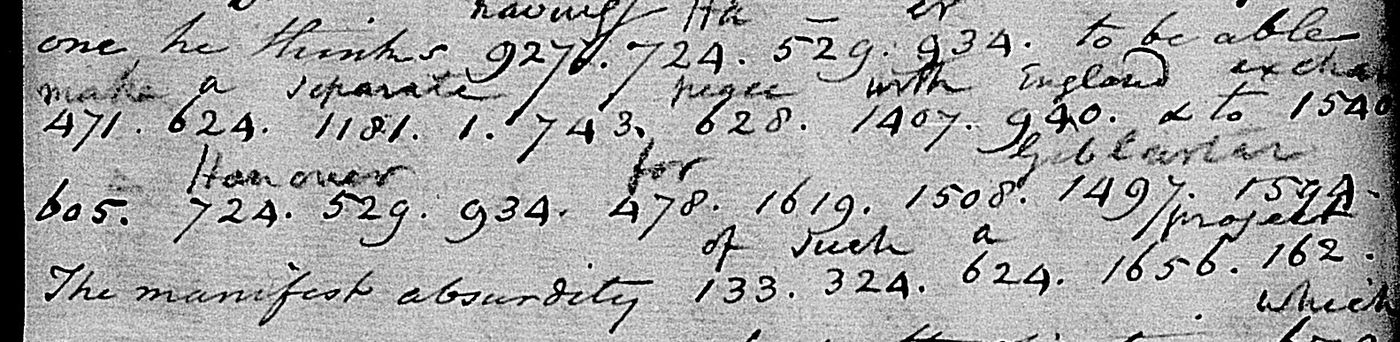
George W. Erving, chargé at Madrid, wrote privately to Madison on 24 March 1807 (No. 21) “In the Cypher of the Legation”, the code Charles Pinckney had used in Spain. He reports a secret conversation between the Prince of the Peace (Godoy) and the Prussian chargé Henry: Bonaparte has offered the Prince the Electorate of Hanover for himself, and the Prince hopes by holding Hanover to make a separate peace with England and exchange it for Gibraltar. The Madison editors (PJM-SS 13:529–31) print the letter from Madison’s interlinear decode on the first received copy and state that the key has not been found (Weber, pp. 152–53). The decode has holes: “Haweder”, “Ha——er”, “Giblartar [sic]”, “see the he was more so”, “sp[eak]”, and at note 8 “to the […]” where Madison wrote “se al e”.
Three sources were read: the first received copy with Madison’s decode (NARA RG 59, Despatches from Spain vol. 10, microfilm M31 reel 12, frames 0283–0286); the “Duplicate” in the Madison Papers at the Library of Congress (mjm014714), coded throughout and not decoded; and Pinckney’s own despatches in the same code (M31 reel 7 frames 0346–0352, 22 February 1803, one copy decoded by Jacob Wagner on frame 0348; reel 8 frames 0083–0084, January 1804). Pinckney’s pages confirm the common values: 1651 the, 133 of, 1343 and, 244 to, 1578 that, 69 in (Wagner: “the In-tend-ant” = 1651.69.1586.103), 1515 late.
| Founders prints | Groups (both copies agree) | Reading | Evidence |
|---|---|---|---|
| “to the […]” (n. 8; Madison “se al e”) | 69.1651.1183.1497.1298 | in the scale | 69 is in: Madison himself so decodes it (“his retreat in Ha—er”, “went in-cog”), as does Wagner in 1803; his “to the” is a slip. 1497 is al (Madison, and in Gibraltar). Madison reads 1183 as se (se-em-ed), and se-al-e can only be scale: “might be of importance in the scale; again, to raise up an insuperable obstacle … & lastly to get the Prince within his grasp”, the second of Erving’s three objects. Either the key’s 1183 is sc or Erving took the neighbouring group. |
| “Haweder”, “Ha——er” (n. 5) | 724.529.934 (five times) | Hanover | 724 Ha and 934 er in all five; Madison left 529 blank or guessed “wed”, but decoded the same three groups “Hanover” himself at “exchange Hanover for Gibraltar”. 529 = nov. |
| “see the he was more so” (n. 6) | 1578.926.390.720.1219 | see that he was more so | 1578 is that everywhere else, as the editors note; the code is right and Madison’s “the” is a slip. |
| “Giblartar [sic]” | 1619.1508.1497.1594 (twice) | Gibraltar | At the second occurrence Madison wrote “Gibraltar”; with 1497 = al the groups spell the name correctly. The [sic] belongs to Madison’s decode, not to Erving. |
| “sp[eak]” (n. 4) | 244.1212.133 | to sp[eak] of | 1212 is sp (gra-sp, 408.1013.1212). The rest of the word is missing in both copies, so the omission is Erving’s. It stays as the editors print it. |
| “been lately doing” (n. 7, coded only in the Duplicate) | …1164.1515.38.769.66… | been late-ly do-ing | 1515 late (Pinckney 1803), 38 ly, 66 ing: the Duplicate’s coding agrees with the clear text of the first copy. |
So every hole in the printed text closes, and the only real loss is Erving’s own dropped -eak. Madison had the key: the holes are his slips, not missing entries. The scale of this should be clear. The letter was already in print and legible; two of the corrections (that, speak) the editors had themselves suggested in their notes, and Hanover they had nearly established. What is new is in the scale, the proof that the “Haweder” and “Giblartar” forms are Madison’s and not Erving’s, and the demonstration that the Pinckney code is recoverable from the microfilm by the same method as Armstrong’s.
06 What remains open
- Erving to Madison, 10 August 1807 (M31 reel 12, frames 0362–0366): several pages in the same code with no decode on the NARA copy. Erving wrote on 22 June 1807 that the Department could not read some of his letters. This is the next target for a rebuilt Pinckney key; whether Founders prints a decode (Early Access, 99-01-02 series) has still to be checked.
- A full Pinckney key. The pairs used here come from this letter and two Pinckney pages. Pinckney’s decoded despatches of 1802–04 (Founders 02-03-02-0170, 02-03-02-0313, 02-04-02-0419, 02-04-02-0611, 02-06-02-0346 with Brent’s three-page decipherment, 02-06-02-0560, 02-07-02-0022) are on M31 reels 7 and 8 and should give a few hundred more pairs.
- Adams’s unread groups. Ten groups of the No. 88 passage ({1434}, {168}, {1081}, {1425}, {83}, {1575}, {1405}, {1112}, {492}, {1060}) and the 27 inferred syllables. More clerk-decoded pages (reel 3 frames 0182–0185, 0190, 0194–0199, 0211; reel 2 for 1810–11) should settle most of them, and the remainder page 0207.
- Ford’s other gaps. No. 51 (26 May 1811, “[One line and a half of cypher not decyphered]”) and No. 55 (22 June 1811, “[one-half line of cipher not deciphered]”), both on reel 3; and reel 2 frame 0155 (1810), a long coded passage with no decode on the NARA copy.
- The Forbes-collection letter. Adams to Madison, 7 January 1811, for which the editors name the Armstrong code, has not been checked against its manuscript.
07 Sources
- National Archives, RG 59, Despatches from U.S. Ministers to Russia, microfilm M35, reel 3, NAID 188725601, frames 0182–0211 (No. 88: frames 0206–0207); reel 2, frame 0155.
- National Archives, RG 59, Despatches from U.S. Ministers to Spain, microfilm M31, reel 12, NAID 188605361, frames 0283–0286 and 0362–0366; reel 7, frames 0346–0352; reel 8, frames 0083–0084.
- Library of Congress, James Madison Papers: George W. Erving to James Madison, 24 March 1807, “Duplicate”, mjm014714.
- Founders Online: Erving to Madison, 24 March 1807, Madison/02-13-02-0559 (Papers of James Madison, Secretary of State Series 13:529–31); editorial notes on the Armstrong code, 02-10-02-0369 and 02-12-02-0197; Adams to Madison, 7 January 1811, 03-03-02-0121.
- Worthington Chauncey Ford, ed., Writings of John Quincy Adams, vol. 3 (New York, 1914), pp. 327–28, and vol. 4 (New York, 1914), pp. 355–58.
- Ralph E. Weber, United States Diplomatic Codes and Ciphers, 1775–1938 (Chicago, 1979), pp. 152–53.
- The companion page: Armstrong’s coded postscript to Madison, 1808, and the the = 972 table.
The Adams pair list with frame references and grades (pairs_jqa.txt), the group transcriptions of No. 88 (gap88.txt,
rem88.txt), the renderer (render.py) and the notes are in the repository (jqa/); the Erving group list with Madison’s
readings (erving_groups.txt), the notes and the frame-scoring script are in erving1807/. Microfilm images are not committed.