01 The documents
Maurice of Hesse-Kassel (1572–1632) was the most learned and the most francophile of the Calvinist princes of the Empire, and Henri IV’s regular correspondent on German affairs from the Bongars mission of 1599 to the Jülich crisis of 1610. Rommel, the Hessian archivist and historian, printed 118 pieces of the exchange from the Marburg archive in 1840 (Paris, Renouard). The Landgrave’s letters are in clear; several of the King’s carry passages in figures, which Rommel set as he found them, and some of the King’s letters he printed from a contemporary decipherment with the figures omitted. The list below is what the volume prints in figures from the King’s side; nothing else on it was ciphered by him.
| Henri IV to the Landgrave | Rommel pp. | In figures | Read before |
|---|---|---|---|
| 22 November 1602 | 84 | 13 lines | no |
| 12 January 1603 | 99 | 12 lines | no; Lettres missives vi p. 12 prints the figures |
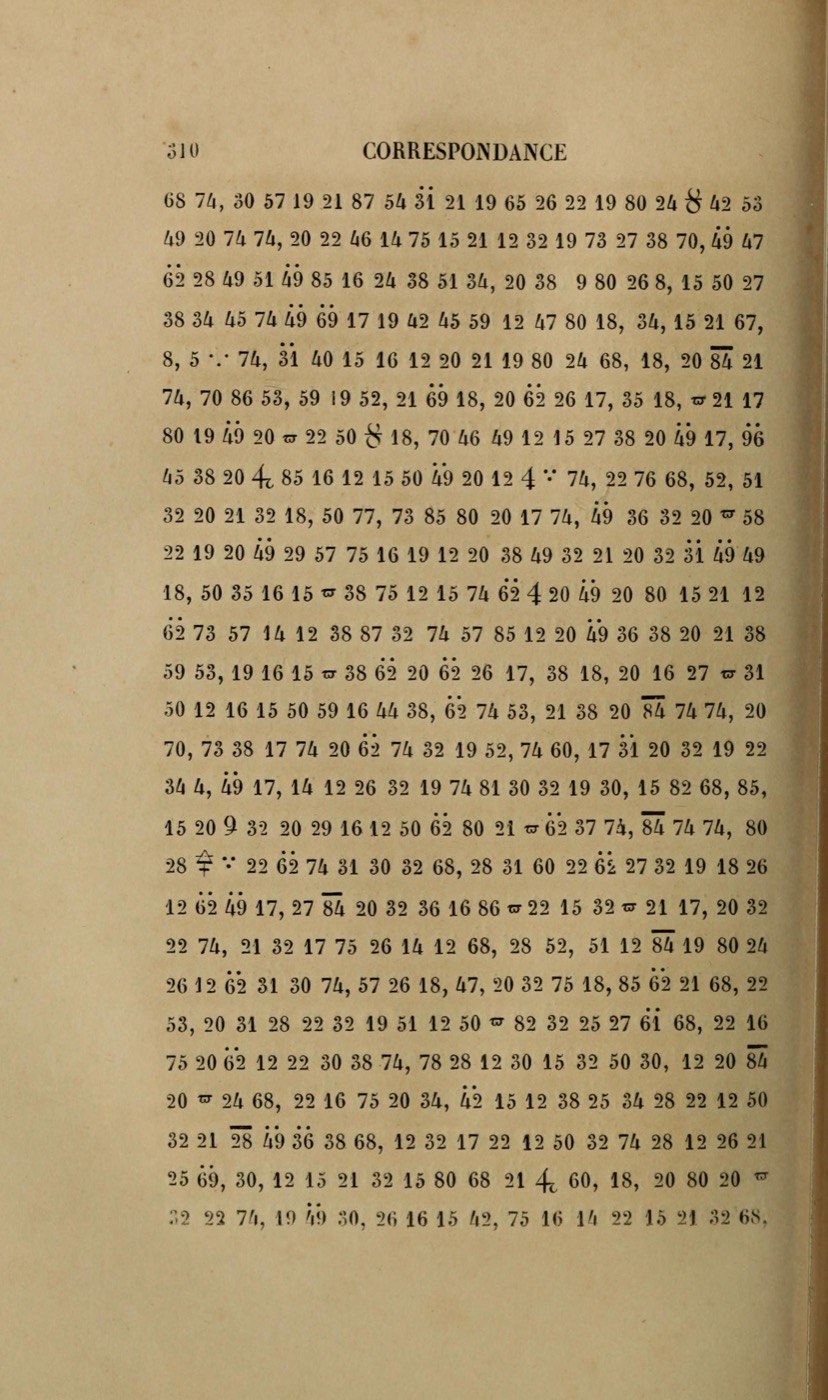
| 3 April 1604 | 170–175 | 5 pages | yes, Rommel 1846 (used here as control) |
| 27 December 1604 | 211–214 | 3 pages | no |
| 28 April 1605 | 230 | 11 lines | no; Rommel’s footnote regrets it |
| 22 December 1605 | 269–272 | 3 pages | no |
| 20 May 1606 | 307–314 | 6 pages | no |
| 24 January 1609 | 391 | 1 line | no |
The catalogue entry that set this target (“12 Jan 1603, 28 Dec 1603, 27 Dec 1604, pp. 12, 148–189, 388–393”) came from Tomokiyo’s page and was wrong about the pages: p. 12 is the Lettres missives reference, the 28 December 1603 letter is printed from a decipherment with no figures at all, and pp. 388–393 hold a single line. The passages of 1602, 1605 and 1606 were on no list.
02 The key, and what the texts corrected in it
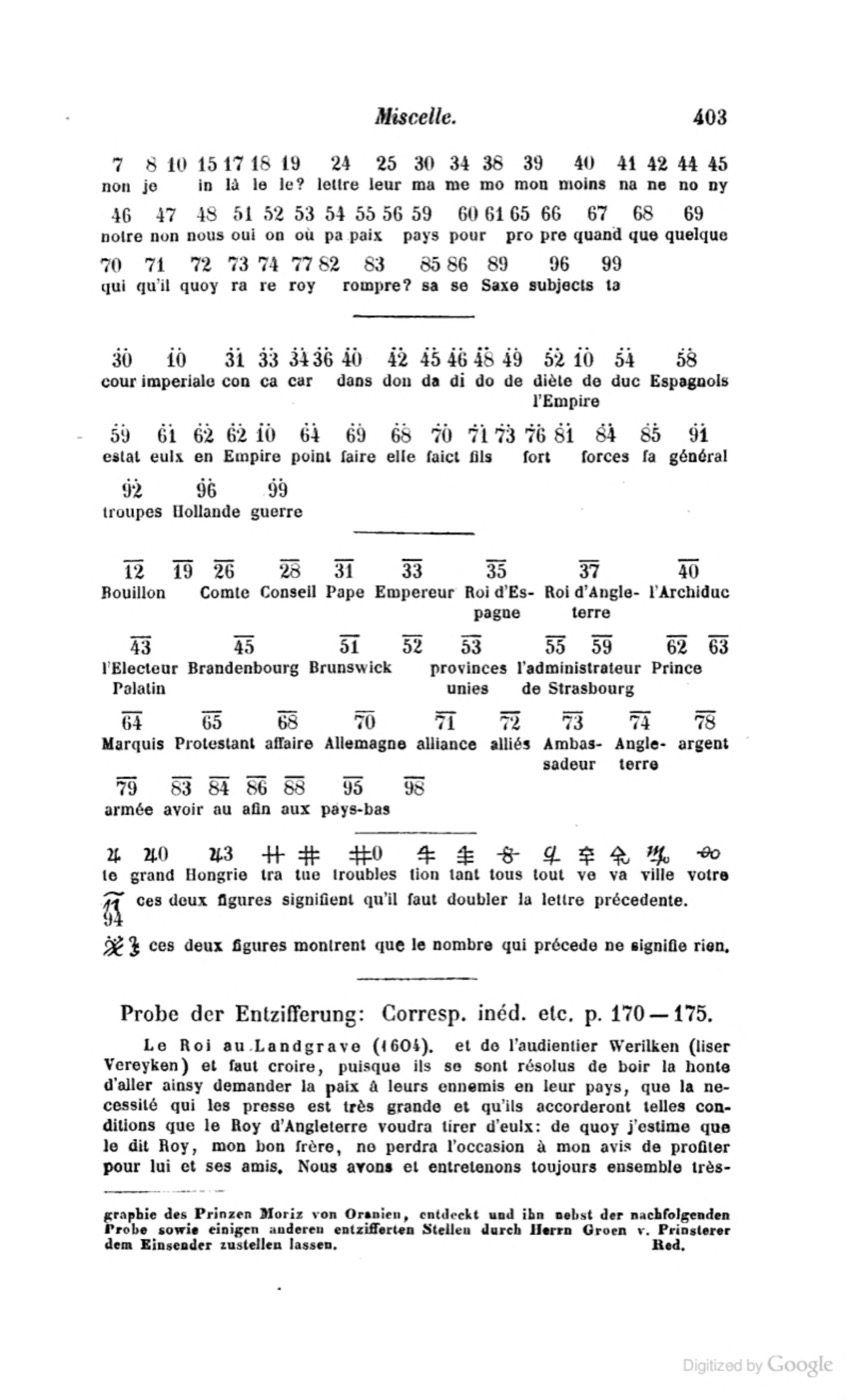
The cipher is the one Tomokiyo found as an original sheet in BnF Clairambault 360 f. 168, dated October 1602, and it served the whole correspondence to 1610. Bare two-digit figures are letters, up to four homophones each; a comma after the figure sends it to a list of small words and syllables (le, la, leur, que, qui, qu’il, pour, pro, pre, ma, me, mon, ne, ny, nous, on, où, sa, se, roy), two dots above it to a second (con, ca, car, don, da, di, do, de, en, eulx, faire, faict, point, elle, forces, troupes, guerre, cour impériale, diète de l’Empire), an overbar to names and titles (Bouillon, Comte, Conseil, Pape, Empereur, Roi d’Espagne, Roi d’Angleterre, l’Archiduc, Brandebourg, Brunswick, provinces unies, Protestant, Allemagne, Angleterre, argent, armée, alliés, ambassadeur, au, aux, afin). A dozen drawn symbols stand for te, tion, tant, tous, tout, tre, grand, va, ville, votre, Hongrie; one sign doubles the symbol before it, one cancels it, and a few flourishes are nulls.
Rommel’s print of the key is right in every letter value, but its lists are set with fewer words than figures and its fourth row of homophones is misaligned, so
the texts had to fix the rest: 70 is a fourth p missing from the table (presse, perdra, principalement); 85 is m and 83 is o
(maison, ensemble, favorisé); 17, is la and 18, 19, le; 24, lettre, 25, leur; 65, pro (profiter,
prospèrent), 66, pre; 83, rompre (cor-rompre); 70 with dots is faict, 84 with dots forces; 26 with overbar is
Comte (Rommel’s own glossary: le comte de Solms), which shifts the names one place so that 31 is Pape, 33 Empereur,
35 Roi d’Espagne and 37 Roi d’Angleterre, as the 24 January 1609 line “les ministres du Pape et du Roi d’Espagne” and the 1604 control both
require. The group Rommel set under l’administrateur de Strasbourg as 59 is le Turc (“la paix avec [59]”, December 1605); the tall 4 is
te or tion and the print does not separate them; the typesetter’s “9 +” is the doubling sign 94; and the ♀-, Ψ- and tt-like flourishes are nulls
(“ayant ♀ tt sceu que le duc de Féria…”). Every one of these is recorded in key.py with the passage that fixed it.
Controls. Rommel printed Groen van Prinsterer’s decipherment of the 3 April 1604 letter beside the key; the first lines of p. 171 decode here word for word to his text (“…ainsy demander la paix à leurs ennemis en leur pays, que la nécessité qui les presse est très grande…”). His footnotes to the Landgrave’s letter of 10 February 1603 gloss five groups (diète de l’Empire, l’Archiduc, Protestants, Empereur, cour impériale) and the key returns each; his 1840 glossary “Passages déchiffrés” agrees throughout. The strongest check is internal: every passage comes out as continuous early-seventeenth-century French that joins the clear text it interrupts.
03 What the King wrote
22 November 1602. He holds his despatch for the advice Maurice promised on the Diet: whether it will meet, what will be treated, what proposal he should make “pour le public et le particulier de mes alliés”, and whether to send his ambassador on to Saxony and Denmark, “avec votre bon conseil sur le [mémoire] et instruction que je luy doibs donner”.
12 January 1603. Since the Emperor will not appear at the Diet nothing of weight will be treated, “et principallement de l’élection d’un roy des Romains”. Bouillon has not written a word about the Administrator of Strasbourg’s coming to France nor about the bishopric: “je ne sçay comme il aura pris ce voyage, ny de quelque sorte il embrasse la cause du dit Administrateur”.
27 December 1604. Why he has not sent the embassy to the German princes that Maurice advised: “la mauvaise intelligence que j’ay recogneue entre les [princes] protestants”, and “le mescontentement et dégoust qu’aucuns d’eulx m’ont donné … depuis qu’ils ont adjousté foy aux discours du duc de Bouillon et favorisé sa cause avec moins de respect et considération à ma personne que je n’espérois d’eulx”. The Hungarian revolt is out but “la suite et conséquence en sera grande”. James I’s courtship of Spain: “il fault qu’il en face les preuves devant qu’il le croye”. The Dutch have as much courage as ever and are provided for; a newly-visited prince has given them hope of arming for them next year, and Maurice should encourage him. The Spaniards forge new plots against him daily; the comte d’Auvergne, his father-in-law and his sister are in justice “d’avoir traité avec eulx plus avant qu’ils ne devoyent”.
28 April 1605. The lines Rommel regretted: the aid the United Provinces and Geneva continue to receive from him “justifient assez la vérité de ma conduite et volonté en tels cas, et le soin que j’ay de maintenir et soubstenir ceulx de la dite religion, pour les notables intérests que j’ay à leur conservation et de la cause publicque”.
22 December 1605. Mérargues’ treason and the attempt on the King “me sont arrivés quasi au mesme temps de la conspiration d’Angleterre. Il semble aussy qu’ils ayent esté forgés sur mesme enclume”; the Spanish ambassador’s complaint is what Spanish ministers do everywhere, “seduire et corrompre les subjects des princes auprès desquels ils résident”; James I has as much cause to complain “toutesfois il le couvre et dissimule mieulx”. He has recommended the United Provinces to James “au besoin extrême qu’elles ont à présent d’estre assistées et renforcées par leurs alliés pour relever l’année prochaine la réputation de leurs armes”, and asks Maurice, who has “notable intérest à leur conservation avec les autres princes d’Allemagne”, to see them helped “tant d’argent que de troupes” as some princes have promised. He will continue “la mesme assistance d’argent et de troupes que je leur ay départie ceste-cy; elle est très notable et non moindre de deux millions de livres; mais si avec cela ils ne sont point secourus d’ailleurs, il leur sera impossible de résister”, the enemy massing money and men “pour les assaillir plus vivement et puissamment qu’ils n’ont point faict”. Get the help to them by spring, “car celuy qui pourra prévenir sa partie en cela en sera grandement avantagé”. And what does the Emperor mean by the Diet he has summoned; the Turkish peace; the Hungarian accord; the siege of Brunswick.
20 May 1606. The Emperor “ne change point de conduite” and is ill served, above all in Hungary. “Les Espagnols feront ce qu’ils pourront pour faire eslire un roy des Romains de la maison d’Austriche qui soit entièrement à leur dévotion”, and Feria goes to the Diet to promote it and to propose the pacification of the Netherlands, failing which the Empire is to make war on the States: “deux propositions de grande conséquence et auxquelles toute la chrestienté n’a moins d’intérest que l’Allemagne mesme. C’est pourquoy j’estime estre nécessaire que tous les roys et princes qui doivent avoir jalousie de l’agrandissement et prospérité de la puissance espagnole doibvent d’heure aviser et prendre conseil ensemble de ce qu’il convient faire pour empescher que les dicts Espagnols ne fassent cadrer les affaires et résolutions de la dite diète à leur souhait. Pour mon regard, j’y contribueray tousjours très volontiers ce qui dépendra de moy et me sera bienséant de faire, principalement quand je recognoistray que les autres pourront faire le semblable … pour la conservation de la liberté germanique, sans toutesfois en attendre autre advantage que d’advancer le bien de la cause commune et la seureté publique”; Maurice is to tell those he judges worthy and to advise the King what he “puis et doibs faire maintenant”. James I will not break with Spain over Owen and Baldwin, “tant il désire vivre en neutralité et en paix”, and the Spaniards ply him with “offres et ouvertures très spécieuses”; their aim is the Netherlands, “un grand effort ceste année, principallement du costé du Rhin et de Frise”, waiting only for Spinola. The States, weaker, will be forced onto the defensive, “misérable condition … en un estat composé et gouverné par plusieurs testes”; all whose interest is joined to theirs must act “devant que leur débilité et inanition soyent plus grandes, autrement les remèdes y seront trop tardifs”. His earlier request that Maurice press the German princes has had “fort peu d’effect”. The Dutch prosper in the East Indies and off Portugal, but “je doubte que ceste bonne fortune leur dure si celle de la terre leur manque”. The Spaniards will exploit the quarrel of the Pope and Venice; he will try to compose it.
24 January 1609. “Les ministres du Pape et du Roi d’Espagne” will do everything to reconcile Matthias with the Emperor.
04 What remains uncertain
- Nine groups on p. 213 give the name of the prince who visited the States (“d’un nouveau …”) and do not resolve; seven groups at the top of p. 307, the unlisted name-group 98 with overbar on p. 211 (a prince whose friendship Lorraine mediated: Bavaria is a guess*), and a line of letters and signs on p. 311 that the 1840 typesetter could not set in figures. The Marburg originals would settle them.
- The 1840 print is a transcription, and single figures are wrong in it (a 36 for 26, an 18 for 15); the readings mark supplied words in brackets.
- The tall-4 symbol is te or tion by context; 55, and 56, are both used where paix or pays is wanted.
- Whether the Landgrave’s chancery decipherments survive at Marburg is not checked; the Lettres missives reprinted the figures without reading them.
05 Method and reproduction
The Internet Archive’s hOCR of the volume located the pages with dense figures. The figures were then transcribed by eye from 900-pixel strips of the
full-resolution page images, because the OCR loses exactly what matters: the comma, the two dots, the overbar and the drawn symbols. The transcriptions in
hesse1603/ct/ keep Rommel’s line breaks and the clear text; key.py holds the key with each correction and its evidence; run.py decodes
a transcription; the hand readings are in letters/READINGS.md. No solver was used and none was needed: with the 1846 key, the work was transcription and
reading. About 4,100 groups.
06 Sources
- Chr. de Rommel (ed.), Correspondance inédite de Henri IV, roi de France et de Navarre, avec Maurice-le-Savant, landgrave de Hesse, Paris, Renouard, 1840 (Internet Archive, correspondancein00henr).
- Rommel, “La clef des chiffres dans la Correspondance inédite de Henri IV avec Maurice le Savant”, Allgemeine Zeitschrift für Geschichte V (1846), pp. 402–404 (Internet Archive, bub_gb_Zpc1AAAAMAAJ).
- S. Tomokiyo, “French Ciphers during the Reign of Henry IV of France”, section “Cipher between Henry IV and Maurice of Hesse-Cassel (1603–1610)”, cryptiana.web.fc2.com/code/henryiv.htm; the original key sheet BnF Clairambault 360 f. 168 (Oct 1602).
- Berger de Xivrey and Guadet (eds), Recueil des lettres missives de Henri IV, t. VI (1853), pp. 12 and 187 (the 12 Jan and 28 Dec 1603 letters after Rommel).
Unvalidated reading from a printed transcription; the originals were not consulted.