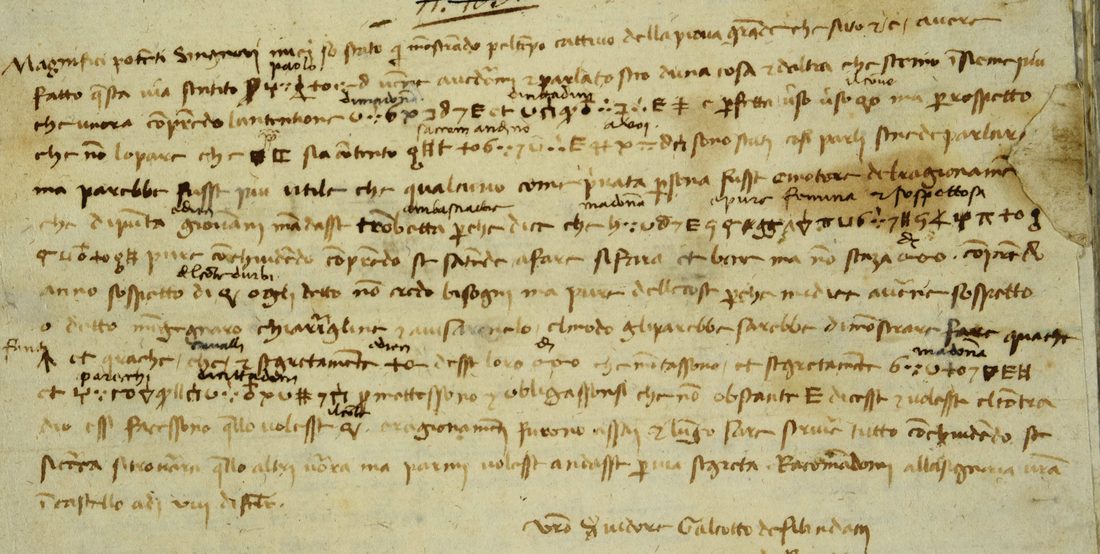
01 The letter, the key and the siblings
The letter opens “Magnifici potenti Signori miei” and is signed “Vostro servidore Galeotto de Fibindacci”. It is undated. Its siblings in the same hand, filza 3 nos. 91 and 92, are dated at Urbino on 17 and 28 February, in the Florentine year 1424, that is 1425. Guasti’s edition of the Commissioni di Rinaldo degli Albizzi shows the Dieci sending Galeotto to the Count of Urbino in September 1423, and prints a later clear letter of his from Urbino of 28 August 1425. “Madonna” is the Countess, Caterina Colonna, niece of Pope Martin V, who married Guidantonio in 1424 and reached Urbino on 4 March 1424.
The key is page 1 of Gabbrielli’s volume Chiavi delle cifre delle lettere ai Dieci di Balía dal 1424 al 1530, compiled in 1863–64. The volume is on the Ilardi microfilm at Yale, reel 58, and Meister printed page 1 in Die Anfänge der modernen diplomatischen Geheimschrift (1902), p. 50. It is headed “Cifra di Galeotto Fibindacci da Ricasoli, carteggio dei X di Balía, an. 1424”. It gives an alphabet with two or three signs for most letters, eighteen nulls, and a nomenclator of thirty word signs such as Conte d’Urbino, Duca di Milano, Malatesta, fanti and mille. It also lists six cover words written in clear: Giovanni for the Dieci, Andrea for Galeotto, trombetta for an ambassador, che for horse, con for war and tagliato for loss.
Gabbrielli marked the letters he worked from in the margin: filza 1 nos. 163 and 165, filza 2 no. 72 and filza 3 nos. 21, 91 and 92. His interlinear glosses on no. 171 cover a dozen words: paolo, di madona, cintadini, il conte, sarrem andino, a laog., ambasciatore, puro femina e sospettosa, el conte d’Urbino, cavalli, parenti and madonna. Several of these sit over runs far longer than the gloss, and two of them are misreadings.
02 The three unread runs
Each run was cut from the deskewed scan at four to five times magnification and transcribed sign by sign. The signs were then matched against Gabbrielli’s table and his gloss. Capitals are the decoded text.
“Madonna è pure femina e sospetosa”

The clear text runs: “… che disputa Giovanni [the Dieci] mandasse trombetta [an ambassador], perché dice che”. Twenty-six signs follow. MADONNA is seven signs, all in Gabbrielli’s table. PURE has P and R and E from his table and one new sign. FEMINA is six signs, all his. E is his. SOSPETOSA is nine signs. The two O signs in it stand exactly five places apart, as the two O’s of s-o-spet-o-sa do, and that fixes the alignment. Gabbrielli glossed the whole phrase but never tabulated the signs in it. The sentence reads: “because he [the Count] says that Madonna is, after all, a woman, and suspicious”.
“Parenti e citadini”

The run has seven signs and then eight. With Gabbrielli’s values for P, A, R, E and I and three new ones, they read PARENTI and CITADINI, one letter per sign. The sentence reads: “et segretamente MADONNA et PARENTI [e] CITADINI promettessono e obligassensi che, non obstante [ella] dicesse e volesse el contrario, … farebbono quello volesse [il Conte]”. In English: Madonna’s relatives and the citizens should secretly promise and bind themselves that, whatever she might say or want to the contrary, they would do what the Count wished.
“Acomandino a lui”
Gabbrielli read this run as sarrem andino and the next word as a laog. Both are misreadings. The first sign is on his own list of nulls. The next ten are A C O M A N D I N O by his table and by values proved elsewhere on the page. The last three are A L I, with one sign doubtful, and read a lui. The clause reads: “che non li pare che [the Pope?] si[a] …; acomandino a lui”, “that they put themselves in his hands”.
03 The letter
This is a working text. The clear hand is fast. Words marked (?) are doubtful. Cipher is given in capitals and word signs in brackets.
Magnifici potenti Signori miei, io sono stato qui mostrato per lettera … fatto questa mia, sentito PAOLO, … non n’averavamo e parlato però di una cosa et dell’altra, che sterino insieme più … DI MADONNA et CITADINI [il Conte] … ma prosetto(?) che non li pare che [il Papa?] si[a] … ACOMANDINO A LUI; sono stati così parecchi … parlare, ma parebbe fusse più utile che qualunque commissione portata persona fusse et motivare de’ ragionamenti, che disputa Giovanni mandasse trombetta, perché dice che MADONNA [È] PURE FEMINA E SOSPETOSA, pure vedrendosi(?) coperto, se sapesse a fare, sapere et bene; ma non staza così coperto. Anno sospetto di questo [CONTE D’URBINO], detto non credo bisogni, ma pure delle cose … avere sospetto; o detto … el modo che li parebbe farebbe dimostrare fare … [FANTI] et guache(?); che [cavalli] e segretamente … dessi loro opera che metassono, et segretamente MADONNA et PARENTI [E] CITADINI promettessono e obligassensi che, non obstante [ella] dicesse e volesse el contrario, dico essi farebbono quello volesse [il Conte]. E ragionamenti furono assai e lunghi … ma parmi volesse andasse più segreta. Racomandomi alla Signoria vostra. Vostro servidore Galeotto de Fibindacci.
In short: Galeotto reports long talks at Urbino about the Countess. Some party, probably under the Pope’s protection, should put itself in the Count’s hands. He advises the Dieci to send an ambassador, because the Count distrusts his wife: “Madonna is after all a woman, and suspicious”. Foot and horse are to be engaged quietly. Her relatives and the citizens are to bind themselves, in secret, to follow the Count whatever she says. He ends that the business should be kept more secret.
04 The key corrected and extended
Gabbrielli’s table fixed about two-thirds of the signs in the three runs. The rest were set by alignment with his glosses and then checked. Signs he listed as nulls were tested against his null row, reread from the Yale film.
- q is a null, as Gabbrielli has it. Taking it for S, as his gloss sarrem implies, was his own misreading. Without it the run reads ACOMANDINO.
- ɣ, a looped v, is not a null. It stands where an A is needed three times in this letter, and in no. 91 it spells mandato under his own gloss: M ɣ N D A T O. He misfiled a variant A.
- His null “o+” is a different sign from +o. His is a circle then a cross. The cross-then-circle sign is O three times here, and in no. 21 it ends the run he glossed andarono.
| Sign | Value | Where it holds | Grade |
|---|---|---|---|
| ɣ | A | no. 171 three times; no. 91 mandato | H |
| +o | O | no. 171 three times; no. 21 andarono | H |
| 9 | N | no. 171 parenti; no. 21 ne andarono | H |
| ô, o with a cross above | T | no. 171 sospetosa; no. 21 tante e tali twice | H |
| ‖ | T | no. 171 parenti only | C |
| # | I | no. 171 citadini only | C |
| ᴗ as C | C | no. 171 citadini only; the same shape is D elsewhere | M |
| π as S | S | no. 171 sospetosa only; Gabbrielli and FEMINA give F | M |
| ʓ | S | no. 171 sospetosa only; close to a Gabbrielli null | M |
05 What remains uncertain
- Two heavy word signs before “sia” are not in Gabbrielli’s nomenclator. He wrote over them a small p with a looped flourish, the usual abbreviation for Papa. The Countess is the Pope’s niece, so “the Pope” fits. Grade M.
- Two single word signs are read from context alone. One, before “dicesse”, is read as ella. The other, over which Gabbrielli wrote il conte, is read as the Count. Grade M.
- Three signs before SOSPETOSA, after the E, are unexplained. They may be nulls or a short word Gabbrielli did not have. The word sospetosa is not affected.
- PAOLO reads cleanly, but who he is stays open. He may be messer Paolo da Capranica, whom a Florentine cover list of 1424 calls “Capra”.
- The clear text of lines 2, 4, 8, 10, 11 and 13 has doubtful words, marked (?) above. A second reader of the cursive would settle most of them.
- The five values graded C and M above rest on this letter alone. A systematic harvest of Gabbrielli’s glosses on nos. 21, 91 and 92 would test them and extend his table. The glossed runs there number in the hundreds.
06 Sources
- Archivio di Stato di Firenze, Dieci di Balía, Responsive 2 no. 171: DECODE R3754. Siblings: Responsive 3 nos. 21, 91, 92 (R3755, R3756, R3757); Responsive 2 no. 72 (R3753). Uploaded by Mark Knowles, 2022; login required.
- P. D. Gabbrielli, Chiavi delle cifre delle lettere ai Dieci di Balía dal 1424 al 1530, vol. 1 (1863–64), ASF; Ilardi microfilm collection reel 58, Yale Dataverse doi:10.60600/YU/XKVOWE, page 1.
- A. Meister, Die Anfänge der modernen diplomatischen Geheimschrift (Paderborn 1902), pp. 43–50, “Cifra di Galiotto Fibindacci da Ricasoli 1424”: ULB Münster. Reprinted as “Fi2” in J. W. Somogyi, Verbum 2016/1–2, pp. 195–217.
- C. Guasti (ed.), Commissioni di Rinaldo degli Albizzi per il Comune di Firenze (1867–73), vol. 1 pp. 402, 487, 492; vol. 2 pp. 215 n. 1, 385–386.
- “Montefeltro, Guidantonio”, Dizionario Biografico degli Italiani (Treccani), for Caterina Colonna.
Sign-by-sign alignments, the working transcription, the null-row check and the sibling tests are in the repository (florence1429/). Page images are not committed; the crops on this page are for study.