At a glanceLanguage not solved · 41.8% of tokens give sense without it
- The texts
- About 1,400 Minoan inscriptions from Crete and the Aegean, c. 1800–1450 BC: accounting tablets, sealings, and offerings inscribed on stone vessels. The working corpus has 1,722 records.
- Where
- Mostly the Heraklion Archaeological Museum. Edited in GORILA (Godart and Olivier 1976–85). The digital texts used here are Robert Hogan’s lineara.xyz and the SigLA database.
- The script
- About 90 syllabic signs, the ancestor of Linear B, plus logograms for commodities, numerals and fraction signs. It writes an unknown language. It is not a cipher: nobody was hiding anything.
- How it was worked
- Linear B sound values were tested for carry-over against a random null. Every token was then given a function, all 35 totals were rechecked with fractions, and the libation formula was aligned across sites.
- What it says
- Lists of men, grain, wine, oil, olives and figs by name and place, with totals and deficits. Three places are identified: Phaistos, Sybrita and Setoija. There is also a fixed dedication formula on offering vessels.
- What is new
- Three findings, set out in section 09. Tablet HT 34 contradicts the published values of two fraction signs. The proposed Semitic and Luwian relatives match Linear A no better than Hawaiian or Yoruba do. The Linear A words that reappear in Linear B are names, all of them at Knossos.
- Best guess
- The working accounts of a regional centre: staples collected from and issued to named people and work teams, with shortfalls tracked (section 06, interpretation).
- Still open
- The language, and the newly found Knossos sceptre, which is not yet transcribed in print. The meaning of every word that is not a number, commodity, total or place name, which is 40.5% of tokens. The unidentified signs, and the fraction signs H and A.
01 What Linear A is, and what reading it can mean
Linear A was the script of Minoan Crete. The Mycenaean Greeks adapted it into Linear B, which Michael Ventris deciphered in 1952. That worked because Linear B turned out to write Greek, a language already known. Linear A shares most of its signs with Linear B, so its sound values can be carried over. The result reads aloud but does not translate: the language behind it has no known relative, and no text gives the same words in a known language.
So this is not a cipher problem, and the project’s usual measure of a complete result (95% of the text giving sense) cannot be reached by any method. What can be done is narrower, and it can be checked:
- test whether the carried-over sound values are real;
- read everything whose meaning does not depend on the language, namely numbers, fractions, commodity pictograms and the bookkeeping terms;
- check the arithmetic;
- describe the structure of what is left.
This page reports those four steps over the whole corpus, with a measure for each.
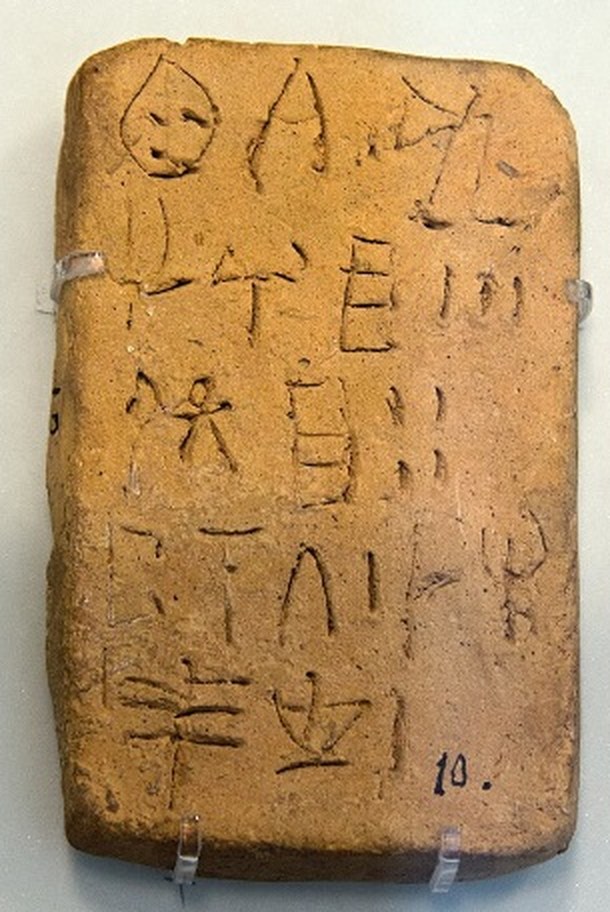
02 The sound values carry over, and Minoan names survive at Knossos
If the Linear B values were arbitrary labels on Linear A, Linear A words would match Linear B words only by chance. The test takes all 491 Linear A word types of three or more signs and compares them with 919 Linear B words that have Greek cognates, including place names (the NeuroDecipher list, Luo et al. 2019). It counts exact matches. The values are then shuffled among Linear A signs of similar frequency, 2,000 times, and the matches recounted.
| Linear A | Linear B / Greek | Where in Linear A |
|---|---|---|
| PA-I-TO | pa-i-to, Phaistos | HT 97a, HT 120 |
| SU-KI-RI-TA | su-ki-ri-ta, Sybrita | PH Wa 32 |
| SE-TO-I-JA | se-to-i-ja, Setoija | PR Za 1 |
| A-RU-RA | ἄρουρα, arable land (?) | HT 11a |
| I-JA-TE | i-ja-te, physician (?) | PH Zb 4 |
| DA-MA-TE | da-ma-te, Demeter (?) | KY Za 2 |
Six real matches against a random mean of 0.49; only one shuffle in 2,000 reached six (p ≈ 0.001). The values carry over. Loosening the test to words that share a stem but differ in the last sign gives 35 matches against 25.4 expected (p 0.09): nothing. Three of the six are place names on Crete, which any language would share. Only three ordinary words match in 491, so Linear A is not Greek, which is the accepted view.
The consonant rows are real. A second test of the sound values needs no known word at all. Signs that Linear B puts in the same consonant row (NA, NE, NI, NU; RA, RE, RI, RO, RU) keep more similar company in Linear A words than signs from different rows (p = 0.0005), and the effect is as large as in Linear B itself. It holds with consonant harmony and word-initial vowels taken out of the comparison, and at Haghia Triada and the other sites separately. The Q, N and R rows hold together most clearly. The one row that does not is Z (ZA, ZU), which is also the least certain series in Linear B, so that is where a different Minoan value is most likely. The same method recovers a hidden sign’s vowel from context (42% against 20% by chance) but not its consonant, so it cannot yet assign values to the unread signs. A nearest-neighbour method that recovers 27% of consonants in Linear B gets only chance in Linear A: the row signal is real on average but too weak, on this corpus, to place any single sign.
A lead on the vowels. In Linear B, the e- and i-signs of one row (TE and TI, KE and KI) are clearly unlike each other in context, and so are the o- and u-signs. In Linear A they lean the other way, and the difference between the scripts is marked (p = 0.003 for e/i, 0.014 for o/u). That fits a Minoan vowel system in which e and o were marginal, as the scarcity of o-signs already suggests. It is an exploratory comparison, and part of the Linear B contrast comes from Greek case endings. Later tests on fresh data found the vowels rare rather than interchangeable (see the names section).
Minoan names at Knossos. The same test against the whole Linear B vocabulary uses 4,164 word types from the linearb.xyz corpus, each with its category in Chadwick and Ventris’s glossary. It finds 13 matches against 2.8 expected (p 0.0005), and they divide cleanly by kind:
- Names, all on Crete. Every Linear A word that matches a Linear B name is a word attested only on Crete, at Knossos. The place names are PA-I-TO, SU-KI-RI-TA and SE-TO-I-JA. The personal names are DA-I-PI-TA (Zakros), I-TA-JA (HT 28a) and KI-DA-RO (HT 47a, HT 117a). Half the Linear B names (51.3%) are Crete-only, so six of six by chance has p = 0.018.
- Two more Knossos words behave like names in Linear A lists. TA-NA-TI appears on four tablets, including the HT 7a list of men shown above, and PA-RA-NE on HT 115.
- Common words, on the mainland. The Linear B words found only on the mainland are Greek common words at Pylos, such as ma-te-re “mother” and i-ja-te “physician”. They are chance look-alikes of the kind section 07 measures.
What survives of Minoan vocabulary in the Linear B record is names, and only at Knossos. The Oslo database DAMOS, queried independently, gives the same result: 12 of the 13 matches, and the same split between Knossos and the mainland. It also shows the names doing the same job in both scripts, as entries in lists of individuals. TA-NA-TI stands with 1 in the HT 7a list of men, and at Knossos it appears as “ta-na-ti, DA 1” (KN Uf 311). Likewise I-TA-JA appears as “i-ta-ja MUL 1”, one woman (KN Ap 769), and PA-RA-NE as “pa-ra-ne 1” (KN Vc 7616). One caution: SigLA reads the Phaistos sherd PH Wa 32 as SU-KI-RA-TA, not SU-KI-RI-TA, so the Sybrita match rests on the GORILA reading of one sign.
Beyond exact matches. The whole stock of Knossos personal names is Minoan in shape. Compared syllable by syllable, the 637 Linear B personal names attested only at Knossos are much closer to the 358 Linear A list names than the 339 attested only at Pylos are (p = 0.0002 for all, first and last syllables). The result holds with the exactly shared names removed, and for the Linear A names of Haghia Triada, Zakros and Khania taken separately. Ordinary vocabulary shows no such difference between Knossos and Pylos, so this is a feature of the names, not of Knossian spelling. The Knossos scribes whose names are most Minoan-shaped also use the Linear B signs with no agreed value most (rho = 0.48 across 23 scribes). A second sign points the same way. Linear A uses very few o-syllables (under 3%), and inside the word Knossos names use fewer of them than Pylos names do (12% against 17%). The same holds for e: Linear A uses few e-syllables (10%), and Knossos names use fewer than Pylos names (16% against 26%, p = 0.0005), with no such gap in the ordinary vocabulary. Minoan names at Knossos carry both of Linear A’s vowel shortages, and so do Cretan place names: with the Greek ending removed, place names attested only at Knossos use e or o in 21% of syllables, against 42% at Pylos (p = 0.0005). In Linear A itself, e and o sit mostly in word endings (NE, ME and TE are word-final two times in three), as if Minoan used them mainly in suffixes. They also depend on the consonant: e and o follow Q, R, T and S far more often than P or J, and never W or Z, a dependence four times stronger than in Linear B. Taken together, the coronal consonants (T, D, N, R, S, Z) are followed by e or o in 22.5% of syllables and the others in 12.4%, even inside the word. The rule holds for e on its own, outside Haghia Triada and in list names, and it is the consonant of the same syllable that counts, not the next one. It survives dropping its strongest sign (RE), holds in words written only once and in first syllables, so it is not a matter of a few words or of endings. Consonant by consonant, though, it is narrower than “dentals”: e and o are commonest after Q (half the time), R (37%) and T (28%), then S and N, while D stays low and W and Z never take them. In practice, Minoan e and o stand mainly after R and T, where other syllables have i and u. After R and T, Linear A spreads its syllables over all five vowels. After other consonants it uses a narrower set, closer to three vowels (a, i, u). Linear B shows no such difference. Consonant by consonant, T, R, S, N and the labiovelar Q take e and o, while K, P, M, J and W avoid them. Minoan words, as Linear A spells them, were also strings of plain consonant-vowel syllables: two vowel signs never stand together, few words end in a pure vowel sign (4%, against 10% in Linear B), and QA, QE and QI start words (57–62%, against 28% in Linear B). Neighbouring syllables also tend to share a consonant (TA-TI, KU-KA), more than in Linear B, at every site and in the list names. All of this holds on both transcriptions, and the Q and final-vowel habits show up again in Knossos names. The vowel pattern replicates on SigLA’s transcription and holds at Zakros, but not at Khania, which stands apart in its signs and ligatures too. The rule holds in the religious dedications as well as the tablets. It holds at every site with enough words (Haghia Triada, Khania, Knossos, Palaikastro, Phaistos, Zakros), and on SigLA’s independent transcription as well as on lineara.xyz, as do the consonant rows. A lead that Greek scribes turned Minoan names in -u into -os (DI-DE-RU and di-de-ro) did not hold up when tested on its own: Linear A words in -u find Knossos names in -o no more often than words in -a do. Religious words end in -TE twice as often as administrative ones (A-DI-KI-TE, I-DA-MA-TE, with the mountain names Dikte and Ida). Beyond Linear A, the Pre-Greek substrate words of Greek share the profile, with fewer e and o in their stems than ordinary Greek words (p = 0.0005), and Eteocretan has little o. The Pre-Greek words do not, however, share the coronal pattern or Linear A’s consonant profile, so the parallel is in the vowel shortage only. A shortage of e and o is common among the world’s languages, though, so it describes Minoan without identifying its family. The spellings do not, however, swap e for i or o for u more than chance, so the evidence is that Minoan e and o were rare, not that they merged with i and u.
How unusual the vowel rule is. The rule was set against 104 Eurasian languages (NorthEuraLex, Dellert et al. 2020), each respelled with the rules Linear B uses for Greek: consonants folded into the Linear A rows, clusters broken up, final consonants dropped. None of the 104 ties e and o to the preceding consonant as strongly as Linear A (log-odds 1.22 for T, R, S, N and Q against K, P, M, J and W). The nearest is Lak, a language of the Caucasus (0.99), and Lak passes Linear A when only R and T are counted. The result holds with every language cut to Linear A’s sample size and under a second spelling rule. So the rule is extreme but found in a natural language, and it need not be a scribal habit; Linear B’s spelling of Greek does not produce it. The comparison points to no family or region: Linear A’s nearest profiles are scattered (Lak, Estonian, Mansi, Evenki, Manchu), and nearness does not follow distance from Crete. The method is coarse: given the Linear B spelling of Greek, it ranks Modern Greek only fifth of 104.
The trace goes beyond names. Knossos Linear B as a whole uses syllables at rates closer to Linear A than Pylos does. Words containing the Linear B signs with no agreed value (*18, *47, *56 and others) are about three times as common at Knossos. Linear A’s religious words, not only its names, look more like Knossos names than Pylos names, and still do with the libation-formula words taken out. Each of these survives a correction for testing 50 hypotheses together. The name result also predicts out of sample: a model that never saw a Knossos name, tested on Pylos names it was not trained on, still picks out the Knossos names as the more Minoan (AUC 0.59, p = 0.0025), and does not separate ordinary words at the two sites. This does not depend on where the Linear A words come from. A model trained only on names from sites other than Haghia Triada does as well (AUC 0.61), and so does one trained only on religious words, with no names at all (AUC 0.60). Words spelled with the signs of no agreed value are Minoan-shaped in their other syllables too.
The contrast is not only with Pylos. Scored on the stem, with the ending removed, and with a model that never saw a Pylos name, Knossos names are also more Minoan than the 46 names of Thebes, Mycenae and Tiryns (AUC 0.63, p = 0.0025), and Knossos-only names more Minoan than Knossos names also found on the mainland. One limit: the earliest Knossos archive, the Room of Chariot Tablets, does not have more Minoan names than the later deposits; if anything it has fewer.
Many Knossos words look like Minoan stems with Greek endings. Knossos-only words are a Linear A word plus one extra syllable more than twice as often as Pylos words (7.8% against 3.4%). Among personal names the added syllables are typical Greek endings, as in a-da-ra-ro on Linear A A-DA-RA. The Minoan signal sits in these stems, not the endings: Knossos names actually end in -o more often than Pylos names. Two cautions. The stems are ordinary Linear A words, not especially Linear A names. Against Thebes, Mycenae and Tiryns the Knossos excess is small and not significant (7.8% against 6.4%), so part of the contrast is Pylos being low.
03 Reading the accounts
A script (lineara/reading/build_reading.py) gives each of the 5,339 tokens in the corpus one class, not counting dividers and damage marks. Glosses are kept to those with a stated basis:
- Commodity pictograms: the GORILA labels (grain, wine, oil, olives, figs, men, goats, cyperus), which rest on the same signs’ meaning in Linear B.
- Fraction values: Corazza et al. 2021, except the two that section 04 disputes.
- KU-RO: “total”, tested here.
- PO-TO-KU-RO: “grand total”.
- KI-RO: “deficit”. It heads lists that KU-RO then totals (HT 88, 94b, 117a). On HT 34 it follows a subtraction: 100 − 70 = 30.
| Class | Tokens | Share |
|---|---|---|
| Read as sense: numbers, fractions, commodities, KU-RO / PO-TO-KU-RO / KI-RO, three place names | 2,232 | 41.8% |
| Read as sound, with a function only: list entries, headings, formula words, sealing marks | 2,164 | 40.5% |
| Unread: unidentified signs and ligatures (*301, *308…), words containing one, disputed or unvalued fractions | 943 | 17.7% |
Measured on signs instead of tokens, 32.1% read as sense. HT 88 shows what a reading looks like at this level:
A-DU [heading], VIR+KA [men] 20: RE-ZA 6, KI-KI-NA 7. KI-RO [deficit]: KU-PA3-PA3 1, KA-JU 1, KU-PA3-NU 1, PA-JA-RE 1, SA-MA-RO 1, DA-TA-RE 1. KU-RO [total] 6.
Sixty-six entries like these, short words each with a small number of men, are tagged as probable personal names. A word that recurs as an entry on several tablets is written by the same scribe 18% of the time, against 4% by chance, so scribes kept their own people or sections. Scribes also specialise in commodities and in transaction terms (SA-RA2, KA-PA, A-DU), so the Haghia Triada archive was divided by hand and subject. Each scribe also had a list style (list length, whether to add a total, the size of amounts within one commodity), and tablets with several commodities list them in a fixed order, grain first and wine last, and different scribes follow the same order. Figs have a place in it too. Linear A has no separate fig sign: it writes figs with the syllable NI, which Linear B later used as its fig logogram. NI entries take fractions like other measured goods (45%, against 6% for men), stand after grain, cyperus and oil and before wine, and appear with grain more than chance. Linear B kept these habits. Its fig logogram, the same NI sign, follows grain on all 37 Linear B tablets that record both, and takes sub-units as often as NI takes fractions in Linear A (44% against 45%). Linear B also lists grain first, puts the largest amount first and orders lists of goods largest-first. Wine last is the one Linear A habit it did not keep. The other difference is in notation: a Linear A list states its commodity sign once, at its head, and leaves it understood (38% of entries carry it). Linear B repeats the logogram on nearly every line of a list of goods (Knossos 82%, Pylos 86%, no real difference); the lower Knossos figure for lists of people comes from its women-and-children tablets, where the girls and boys lines carry their own word instead of MUL, and from two long name lists (hands 102 and 105) that state VIR once or twice for a dozen names, the Linear A way. Linear B tablets also put grain first, but beyond grain their order does not match the Linear A one. Written totals were a Haghia Triada habit: 18% of its tablets end in KU-RO, against 3% at Phaistos and Zakros and none elsewhere. The same persons recur on tablets of the same commodity. The syllables attached to commodity signs were regional: Haghia Triada and Tylissos share one set of oil ligatures (OLE+U, OLE+KI, OLE+MI), while Khania writes OLE+TA and Zakros GRA+PA. Tylissos shares Haghia Triada’s oil ligatures but none of its words, so the link was one of notation. Some unread signs are local too (*411, *409 and *311 occur only at Khania), and typical amounts of the same commodity differ by site: grain entries are large at Haghia Triada and small at Khania and Zakros, while wine entries are the reverse. Counts of men do not differ between sites, so the likelier explanation is that the sites measured grain and wine in different units. Two sets of tablets repeat whole groups of entries, HT 86 with HT 95 and ZA 4 with ZA 15: lists that were written twice. Three recurrent words get a function but no meaning:
- SA-RA2: a transaction term used only at Haghia Triada, with grain and cyperus, in 20 records.
- A-DU and KA-PA: heading terms.
The full reading of every record (reading/edition.txt, built by lineara/reading/build_reading.py) is not in the public repository, because the digital texts it is built from carry no licence. It is available on request.
The totals. All 35 KU-RO and PO-TO-KU-RO totals were rechecked with exact fractions. For each, the entries were summed over several windows: from the start of the tablet, from the last rule, after a KI-RO heading, over both faces of the object, and by commodity.
- Ten balance. HT 123a’s olive total balances only when its olive entries are summed apart from the other commodities on the tablet, 31 + 31½ + 16 + 15 = 93½. The figure below replays that tablet.
- The rest do not, because of damage or because of slips that are long known. HT 9a is out by ¾, HT 13 by ½, HT 94a and HT 119 by 1. On HT 122 the grand total is 97, where the two faces give 31 + 65 = 96.
- Arithmetic restorations. Where a total is intact and the list above it is damaged, the missing amount follows: 4 on HT 11a, 4 on HT 100, 9 on HT 122a, 13 on HT 27a. Five totals cannot be reconciled in any window, and only the tablets themselves can decide those.
- A correction to the digital texts. They give HT 34’s KI-RO as 37, where Younger and GORILA have 30 with the 7 erased.
Across tablets. The same entry words recur on different tablets far more often than chance allows. Four pairs of records share three or more names, against 0.1 expected. Three findings follow:
- A-KA-RU and A-DU are transaction categories. Five men (DA-ME, DI-DE-RU, KU-NI-SU, MI-NU-TE, SA-RU) receive grain on HT 86 and HT 95, split between the headings A-KA-RU and A-DU. On HT 86a they get 20 each. On HT 95b all five stand under A-DU at 10 each, exactly half. The two words are applied to the same people, so they are neither persons nor places.
- PA3 marks the part delivered. HT 9 lists a wine account on its front (total 31¾) and repeats the same names on its back under PA3 (total 24). Every shared amount on the back is equal to or smaller than the one on the front: 5¾ → 3, 10 → 8, 4 → 4, 2 → 2, 2½ → 2, 2½ → 2. HT 34 has the same shape: 100, PA3 70, KI-RO 30. This supports Younger’s suggestion, now on two tablets.
- KI-RO lists count individuals. Every name in a KI-RO section (HT 88, 94b, 117a) carries exactly 1, whatever the same name carries elsewhere: KU-PA3-NU has 109 on HT 1, and SA-RU 20 of grain.
These are functions, not translations.
Across sites the picture reverses. Only 10 entry words appear at more than one site, against 33 expected by chance (p = 0.0005). Each archive has its own names. The few words that do travel are mostly administrative ones: A-DU at Haghia Triada and Tylissos, and DA-RE at Haghia Triada, Palaikastro and Khania. That suggests DA-RE, too, is a term rather than a person.
04 The fraction signs, and HT 34
Linear A writes fractions with special signs, conventionally J, E, F, K, L2, B, D, H, A and a few rarer ones. Their values are a small cipher problem in their own right. Only one tablet fixes a value cleanly: HT 104, where 45 J + 20 J + 29 = 95, so J = ½. The largest study, Corazza, Ferrara, Montecchi, Tamburini and Valério (2021), proposes J ½, E ¼, F ⅛, H 1/16, A 1/24, B ⅕, D ⅙, K 1/10 and L2 1/20. They reached these by constraint search and optimality.
Compound fractions are written largest first. Before reading that paper, this project collected every run of fraction signs within one entry of the corpus, 296 runs, and recorded the order in which pairs are written. It then scored the published values against those pairs. The older values (B = ⅓) fail on KH 9. The 2021 values fail on one firm case:
- HT 34, line 3 gives an amount written 2 H K. Three sources agree on that order: the GORILA drawing, the lineara.xyz text and SigLA. Written largest first, H must exceed K. The 2021 paper allows H only 1/16 or less (its 28 best solutions give 1/16 to 1/84), and K is 1/10.
- No value of H fixes it within that system. The other values are held at the paper’s figures, and its own rule that one value has one notation is applied. The only typologically attested values that would put H above K are ⅓, ⅖, 3/20 and 3/10, and each is already written by an attested compound (D D, B B, K L2, E L2).
- A second, weaker tension. Younger reads HT 34’s last lines as settling earlier items, with PU F settling the item written A. On that reading F (⅛) is at most A, but A is 1/24.
The authors themselves say optimality did not fix H and A, and chose those two values on structural grounds. HT 34 is a counterexample to those two values, not an alternative system: with 29 order pairs, the evidence is too thin for one. None of the 18 works citing the 2021 paper revises the values. The team’s own later account, Corazza’s Computational methods for undeciphered scripts (2024), repeats “A = 1/24?, H = 1/16?”, still marked tentative, and does not discuss HT 34. As far as the sources reachable online show, the conflict has not been raised before. Salgarella’s 2025 book is closed access and was not checked. It is the one item left before the point can be called new with confidence. Tagging each fraction pair with its commodity does not rescue the published values either: the three exceptions fall under three different commodities, and HT 34’s is the only pair in the corpus with both H and K.
New evidence is on its way. The ivory handle KN Zg 58, found at Knossos in 2024, carries six different fraction signs in a row. Its excavators say the sequence orders the values differently from every published proposal (Kanta, Nakassis, Palaima and Perna 2025), but they reserve it for the final edition. That sequence, and a good photograph of HT 34 line 3 (Heraklion Museum, HM 22), would settle the question. A two-page note setting out the HT 34 argument is drafted in lineara/note_HT34/.
05 The libation formula
Offering vessels from peak sanctuaries across Crete carry a recurring sequence of words. Across 14 inscriptions from 7 sites, the order of its slots holds in 77 of 78 pairs:
A-TA-I-*301-WA-JA · [place word] · JA-SA-SA-RA-ME · U-NA-KA-NA-SI · I-PI-NA-MA · SI-RU-TE · TA-NA-…-U-TI-NU
The one reversal is on IO Za 6. The variation sits in a prefix that is JA-, A- or nothing, and it moves between slots:
- the place word is JA-DI-KI-TU at Iouktas but A-DI-KI-TE at Palaikastro;
- JA-SA-SA-RA-ME alternates with A-SA-SA-RA-ME and SA-SA-RA-ME;
- PK Za 8 has JA-SA-U-NA-KA-NA-SI.
A-DI-KI-TE is written at Palaikastro, the later centre of the cult of Diktaean Zeus. That fits the published reading “Dikte”, but it is context, not proof. The slot order and the prefix are the formula’s grammar as far as it can be seen. What the words mean is unknown: JA-SA-SA-RA-ME is usually taken for a divine name, and that is as far as the evidence goes. The measurement confirms what Davis (2014) and others describe.
06 What the tablets probably say: an informed guess
Everything else on this page is measured. This section is interpretation. It sets out the most likely picture that the measured results support, and says what each part rests on. No word is translated here; what is guessed is what the entries were for.
What the archive was. Most tablets come from Haghia Triada and survive because the building burned, around 1450 BC, and baked clay that was never meant to be fired. Unfired tablets were working records, kept for the current accounting period and then smoothed over or thrown away. They probably cover the last months before the fire: current business, not history. The amounts are small, from single units to a few hundred. Each site has its own names (only 10 entry words occur at two sites, against 33 expected by chance), and each measures grain and wine at its own scale. The likeliest setting is a regional centre running its own district, not one Crete-wide bureau.
Goods coming in and going out. The goods are the staples of a Bronze Age Aegean economy: grain in the largest amounts, then wine, oil in several kinds marked by the syllables attached to the oil sign, olives and figs. There is also cyperus, an aromatic plant that Linear B records use for perfumed oil. Most entries pair a word, probably a person or a work-group leader, with an amount. Some are likely allocations to dependants and workers. Others are likely contributions due from local households. No word on the tablets that has been glossed marks which way the goods moved, so the direction is inferred from the few terms whose job is clear.
Debts and deliveries. The clearest terms are about obligations. KU-RO is the total and KI-RO the shortfall still owed. PA3 probably marks the part actually delivered: on HT 34, 100 was due, 70 came in and 30 is owed. KI-RO probably worked like Linear B’s o-pe-ro at Pylos, “owed, lacking”, and was used both for goods not delivered and for people who did not turn up. Every name in a KI-RO section carries exactly 1, whatever the same name carries elsewhere. That fits a list of absent individuals better than a list of small debts.
Two tablets retold in plain words. These are paraphrases. The numbers and the terms KU-RO, KI-RO and PA3 are as the tablets give them; the roles of the people are the guess.
HT 88. Account A-DU: men, twenty. With RE-ZA six, with KI-KI-NA seven. Short: KU-PA3-PA3, KA-JU, KU-PA3-NU, PA-JA-RE, SA-MA-RO, DA-TA-RE, one each. Total short: six.
Probably a labour roster: a levy of twenty men, part supplied through two team leaders, with six named men missing or still owed.
HT 9. Front: wine against each name, 31¾ in all. Back, under PA3: the same names with the same or smaller amounts, 24 in all.
Probably a collection sheet: the wine each person owed, then what each actually delivered.
The kinds of account. A-DU and A-KA-RU are applied to the same five men, who receive 20 of grain each under the first on HT 86 and 10 each under A-DU on HT 95, exactly half. They are probably two kinds of allocation or obligation: a regular issue and a special one, or two instalments or seasons. SA-RA2, used only at Haghia Triada with grain and cyperus, is another transaction term. Earlier scholars have compared it with Akkadian šarāku, “to allocate”. The language tests in section 07 found no Semitic signal, so that comparison stays unsupported. DA-RE, which travels between sites as names do not, is probably a term too.
Receipts and tags. Roundels and nodules carry a seal impression and one or two signs. The likely reading is receipts and labels: a roundel records a single transaction witnessed by the seal holder, and nodules sealed parcels or documents written on perishable material. Their signs differ by site and differ from the tablets’ own single signs, so each centre kept its own local receipting system.
The offerings. The stone vessels carry what looks like a dedication, perhaps “[the dedicator] offered this at [the sanctuary] to [the deity]”, with titles or requests after it. The place slot changes with the sanctuary (Dikte, Iouktas) and the rest stays fixed, which is how a formula behaves. JA-SA-SA-RA-ME is usually taken as a divine name, and some have compared it with a Luwian phrase meaning “my lady”. The tests here give that comparison no support either.
The picture as a whole. The most likely picture is a mid-sized Minoan centre running a redistribution economy for its district. It collected grain, wine and oil from local households and producers, issued goods to named people and work teams, and kept careful track of what was still owed. Its scribes split the work by section and by commodity. Its practices differed from the neighbouring centres’, and alongside the accounts the same society made formal offerings at mountain sanctuaries. When the Mycenaean Greeks took over Knossos they kept much of this bookkeeping: grain first, figs after grain, largest amounts first.
Where the guess is weakest. The weakest points are which way the goods moved and who the named people were: stewards, farmers, foremen or dependants. KU-PA3-NU is a real person who handled 109 units of something on HT 1, but whether that was a payment, a debt or a stock held is inference. A bilingual text would test these guesses, and so would a Linear A term that turns up with a known meaning in Linear B.
07 Testing the proposed languages against chance
Minoan has been called Semitic, Luwian, Hurrian, Etruscan-like and more, usually on the strength of look-alike words: KU-RO “total” beside Semitic kull “all”, and so on. The test here asks whether a proposed relative matches Linear A better than languages that cannot be related to it.
Method. Each lexicon’s words are spelled the way Linear B spells words: open syllables, final consonants dropped, l = r, voicing ignored. These rules were fixed before any result was seen, and they turn Knossos into ko-no-so and Phaistos into pa-i-to. Exact matches with the 491 Linear A word types of three or more signs are counted. Each language is also scored against its own syllables shuffled across its words.
| Lexicon | Kind | Forms | Matches | Ratio to own-syllable null |
|---|---|---|---|---|
| Luwian (Melchert 1993) | proposed | 540 | 1 | 0.5 |
| Hurrian (Laroche 1980) | proposed | 294 | 1 | 1.1 |
| Akkadian | proposed | 336 | 3 | 2.1 |
| Ugaritic | proposed | 288 | 4 | 3.3 |
| Etruscan | proposed | 27 | 0 | too few words |
| Ancient Greek | not proposed | 28,606 | 27 | 2.3 |
| Hawaiian, Māori, Yoruba | controls | 1,106 / 1,484 / 2,447 | 4 / 4 / 7 | 2.1 / 1.4 / 2.1 |
Real words beat the shuffled null even in unrelated languages, so what counts is whether a proposed family beats it by more than the controls do. None does:
- Semitic: 2.7× against the controls’ 1.7×, p = 0.22 (0.86 after correcting for four families).
- Luwian: below chance.
- Etruscan: the open lexicon is too small to test.
- Hurrian: tested with Laroche’s Glossaire de la langue hourrite (1980), 1 match against 0.9 expected (p = 0.6). The result holds however the lexicon’s ḫ is spelled.
The individual matches look like evidence until the controls are set beside them. E-KU-RU is Akkadian eqlum “field”, and also Yoruba eguru “sandstone”. A-KA-TA is Greek akantha and Yoruba akata “panther”. For the three words whose sense the arithmetic fixes (KU-RO, KI-RO, PO-TO-KU-RO), no candidate language offers a same-spelled word of fitting meaning, while controls offer look-alikes of the wrong one (Yoruba kuro, Hawaiian kilo).
The method itself is the problem. Applied to the one case where the answer is known, Greek against Linear B, it gives 13 matches per 1,000 Greek words. Yoruba gets 22 per 1,000 against the same Linear B list. At the size of the candidate lexicons, a relationship as close as Greek to Linear B would yield under one exact match. Matched word shapes cannot identify Minoan’s relatives. They could not even identify Greek as the language of Linear B. Decipherments built on them are not evidence either way.
Eteocretan, the likely descendant. Five inscriptions from Praisos and Dreros (7th–3rd century BC) record a non-Greek language in Greek letters, often thought to descend from Minoan. Its sounds are known, but most of it has no word division, so Linear A words were sought inside the text once both were spelled the Linear B way. Not one Linear A word of three or more signs occurs in it. Random word lists from Hawaiian, Māori or Yoruba of the same size produce one to three such hits. The design is barely sensitive: Linear B words turn up only two or three times in the same length of Greek. So the result weakly disfavours a close identity between Minoan and Eteocretan, and cannot test a distant one.
The Pre-Greek substrate. Greek kept many words from the languages spoken before it, and Wiktionary marks about 1,600 of them. Against ordinary Greek words of the same length, these match Linear A slightly more often: 6 against 2.6, among them ákantha “thorn plant” beside A-KA-TA and kídalon “onion” beside KI-DA-RO. The excess vanishes without the one shared place name, Phaistos (p = 0.10). The Linear A words are personal names in lists, not plants or vessels. By syllable distribution, Pre-Greek is no closer to Linear A than ordinary Greek.
Cretan Hieroglyphic, the earlier Cretan script. Its sign groups (Younger’s lexicon, 365 groups) were given the values CHIC assigns by sign shape. Only 20 groups can be fully read that way, and they match Linear A no more than chance (3 against 2.2). Younger’s fuller value grid does produce matches (17 against 11). But that grid was partly built by matching Hieroglyphic groups to Linear A words, so the excess proves nothing. Continuity in vocabulary between the two scripts needs the values of the signs fixed independently.
Every comparison open to this project has now been run under the same rules with controls: four proposed families, the likely descendant and the known contact vocabulary. None identifies the language.
08 Word structure
An earlier pass here collated the lineara.xyz texts with SigLA. It found more pairs of words that differ by one added sign than two randomised models predict (42 against about 23 and 26, adjusted p ≈ 0.01). Examples are PA-RA-NE / A-PA-RA-NE and DA-KU-SE-NE / DA-KU-SE-NE-TI. So Linear A words have ordered structure, affixes or compounds. No preference for suffixes over prefixes survives the test. The idea that A- marks a heading fails on ZA 10a, where TA-NA-TE and A-TA-NA-TE are both ordinary entries. These are constraints on any future decipherment, not meanings.
Alice Kober found Linear B’s inflection by lining up one stem with different endings in different grammatical slots. The same test here asks whether, within a family of words sharing a stem, the ending predicts the word’s position (heading, list entry, formula, sealing). It does not, beyond chance (p = 0.20, 49 families). The initial A-/JA- leans toward headings, as in A-KA-RU, A-PA-RA-NE and A-RI-JA against the bare forms in entries, but not significantly (p = 0.07, 12 families). No family has more than nine attestations, and Kober’s method needs many more per stem than Linear A provides.
09 What this adds, and what it does not
- A counterexample to the published fraction values. HT 34 contradicts H = 1/16 and A = 1/24 under the system’s own rules. Nothing in the literature reachable online discusses it (section 04).
- A calibrated test of the language proposals. Semitic, Luwian, Hurrian and the rest do no better than Hawaiian or Yoruba, and neither Eteocretan nor the Pre-Greek substrate shows a reliable link. The positive control shows that look-alike matching cannot identify a language at this scale (section 07).
- Minoan names at Knossos. The Linear A words that survive into Linear B are names, significantly more than chance, and all of them Knossian, among them TA-NA-TI, KI-DA-RO, DA-I-PI-TA and I-TA-JA. Beyond these, the Knossos personal names as a whole are Minoan in shape, while the Pylos names are not (section 02).
- Accounting functions across tablets. A-KA-RU and A-DU are categories over the same persons. PA3 marks a delivered part, and KI-RO lists count persons one each (section 03).
- Corrections to the digital texts: HT 34’s KI-RO is 30, not 37. A field in a third-party SigLA decoder was mislabelled; it holds sign position and word index, not boundary states. A word-by-word comparison of the two digital editions lists 44 disagreements for their editors (
lineara/ERRATA.md). Among them are a systematic JA/PA3 confusion and three readings that affect results here: SU-KI-RA-TA, PA-RI-NE and DA-ZA in SigLA. - Replication, now measured over the whole corpus: the Linear B carry-over (argued before by Packard, and by Steele and Meissner); KU-RO, KI-RO and PO-TO-KU-RO; the place names; the name lists; the formula order. The share of the corpus that can be read without the language (41.8% of tokens) is measured here; no earlier measure of it was found. It contains no new reading.
- Nothing on the language itself. No word is given a new meaning, and no language family is supported.
10 What remains open
- The meanings of the 2,164 tokens read only as sound (names, transaction terms, formula words). Blocked: the language is unidentified and no bilingual exists.
- 632 unidentified signs and ligatures (*301, *304, *308, QA2+…, MI+JA+…). They have no Linear B counterpart and no context fixes them.
- The fraction signs H and A, and the rare L, W, X, Y and DD. Too few attestations.
- Damaged entries and totals. Restorations are proposed in
lineara/reading/restorations.json. - 631 single-sign marks on sealings. One sign per object, no syntax.
- Five totals that no window reconciles: HT 13, HT 25b, HT 102, HT 122b and PH(?) 31a. Only examining the tablets can say whether the scribe or the transcription erred.
- A fuller Etruscan test. It waits on a larger open lexicon.
- Salgarella, Writing in Bronze Age Crete (2025). It is closed access. A library copy would settle whether HT 34 is discussed there.
- The Anetaki sceptre (KN Zg 57–58), about 119 signs, the longest Linear A text. It has no published transcription yet (Kanta, forthcoming).
- A photograph of HT 34 line 3. Only the Heraklion Museum can supply one.
Beyond these, progress needs new material: a bilingual text, or a much larger corpus.
11 Sources
- L. Godart and J.-P. Olivier, Recueil des inscriptions en linéaire A (GORILA), 5 vols, Paris 1976–85.
- R. Hogan, Linear A Explorer (lineara.xyz), commit 43fe7cf, with J. Younger’s commentaries and G. Douros’s tabulation; and Linear B Explorer (linearb.xyz), commit 84e0b00.
- E. Salgarella and S. Castellan, SigLA: the signs of Linear A, CC BY-NC-SA 4.0.
- M. Corazza, S. Ferrara, B. Montecchi, F. Tamburini and M. Valério, “The mathematical values of fraction signs in the Linear A script”, Journal of Archaeological Science 125 (2021), 105214; M. Corazza, Computational methods for undeciphered scripts (Bologna 2024).
- E. Salgarella, “Linear A”, Oxford Classical Dictionary (2022), and Writing in Bronze Age Crete (2025).
- P. M. Steele, Exploring Writing Systems and Practices in the Bronze Age Aegean (2023).
- B. Davis, Minoan Stone Vessels with Linear A Inscriptions (Aegaeum 36, 2014).
- J. Chadwick and M. Ventris, Documents in Mycenaean Greek, 2nd ed. (1973), glossary categories as carried by the tiripode lexicon (MIT licence).
- J. Luo, Y. Cao and R. Barzilay, “Neural decipherment via minimum-cost flow” (2019): the Linear B word list used in section 02.
- A. Kanta, D. Nakassis, T. G. Palaima and M. Perna, “An archaeological and epigraphical overview of some inscriptions found in the Cult Center of the city of Knossos (Anetaki plot)”, Ariadne (2025) 27–43, doi.
- DAMOS, Database of Mycenaean at Oslo (damos.hf.uio.no), CC BY-NC-SA 4.0; J. Younger, Cretan Hieroglyphic lexicon and sign grids (archived pages, 2007–2012), after J.-P. Olivier and L. Godart, Corpus Hieroglyphicarum Inscriptionum Cretae (1996).
- R. A. Brown, transcriptions of the Eteocretan inscriptions (Dreros 1–2, Praisos 1–3), archived from his Eteocretan pages; Y. Duhoux, L’Étéocrétois: les textes, la langue (Amsterdam 1982).
- Pre-Greek list: Ancient Greek entries derived from Pre-Greek in Wiktionary (via Kaikki), mostly after R. Beekes and E. J. Furnée.
- E. Laroche, Glossaire de la langue hourrite (Paris 1980); OCR text on the Internet Archive, used for counting only.
- H. C. Melchert, Cuneiform Luvian Lexicon (1993). Akkadian, Ugaritic, Etruscan, Ancient Greek and control lexicons from Wiktionary via Kaikki.
Scripts, results and notes are in lineara/. The reading script is lineara/reading/build_reading.py, and lineara/FRACTIONS_REPORT.md gives the full fraction analysis, and lineara/LEADS_REPORT.md the language and names tests.