01 The documents
BnF fr. 4735 is the second of the volumes of “pièces originales et de copies concernant l’histoire de France, 1569–1588” and, from no. 5 to no. 80, the Court’s file of the Polish election embassy: Monluc’s letters from Konin and Warsaw, the Polish memoranda on St Bartholomew, the King’s replies, and the letters of Lanssac and Gilles de Noailles from Warsaw and Płock in April and May 1573. The catalogue marks “avec chiffre et déchiffrement” against Lanssac’s letters of 24 April (nos. 60–61), 1 May (63, 65) and 9 May (70), and “avec chiffre” alone against no. 51 of 26 April. Gallica has the whole volume as a microfilm scan (btv1b9060724s, 614 unlabelled canvases); the folio of no. 51 is 124, canvas 242, not the 126 the catalogue entry here first gave.
What the catalogue calls the siblings’ decipherments turns out to be this same marginal gloss, line by line beside the cipher, on ff. 154, 154v, 156 and 157. The microfilm keeps only the last centimetre or two of each gloss line, but on f. 154v the first line of cipher stands beside “Car je n’ay pas cinquante escuz”, and the cipher line is exactly long enough for it.
02 The cipher
- Homophonic letters. Separate graphic signs (crosses, bars, figures, letter-like forms) written continuously, with points, commas and short bars as word separators. Common letters have two or three signs: e ✕ ✱ Γ Δ, a ⊤ π H, r ϕ ⊨, s 9 Lo IIII, i ⊢ ϙ, n ſ o-o, u/v o+ ff o+o, m 8 ᥙ, l 3 ⊥, o ꞔ L, t ʓ ттт, p y N, d ‡, c 7 ⋔, g ∞, f o-, h +, qu ꞗ.
- Syllable and word signs. et ♁, nt ꝸ, st 8 with a dot, de ᒐ, ou ᛏ, ns Λ, car Z, pour †, and Allemagne as a Z with a lower curl. Over the 741 signs transcribed from f. 124 and the first blocks of ff. 154 and 156, the merged frequencies are French: e-signs 17.6 %, then r, a, s, n, u, t, o.
- Tomokiyo’s table. His “Lansac’s Cipher” (cryptiana, French Ciphers during the Reigns of Charles IX and Henry III) has the right signs but its first row is
displaced by one letter from m onward (his ſ m, L n, б p, ⊨ q, 9 r, ʓ s, o+ t read n, o, qu, r, s, t, u), his Γ = i is e, his ‡ = h is d, and the
“pour” cross is the letter h in one of its two shapes. The corrected table with the evidence for each sign is
lanssac/key.tsv.
03 The key, and how it was found
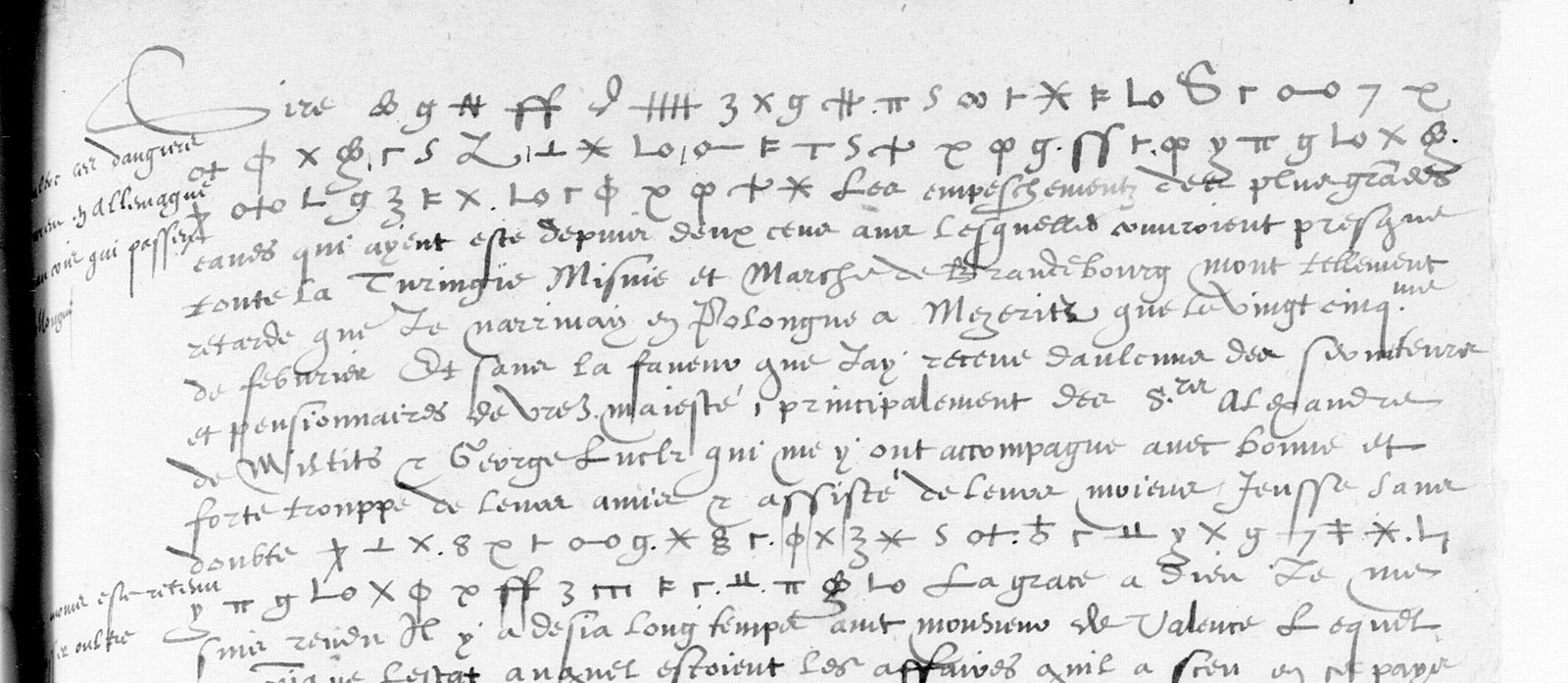
- The glossed crib. f. 154v line 1, Z ⊢✕ | ſπϙ | y⊤9 | 7⊢ſꞗπſʓ✕, beside “Car je n’ay pas cinquante escuz”, reads car ie nai pas cinquante and fixes eleven signs at once, including car = Z, qu = ꞗ and the shift in Tomokiyo’s row.
- Passage two by hand against its gloss “moins esté retenu … ou oultre”: † ⊥ ✕ · 8 ꞔ ⊢ o-o 9 · ✱ 8̣ Γ · ϕ ✕ ʓ ✱ ſ o+ = pour le moins esté retenu, then ᛏ Γ ᥙ y ✕ 9 7 + ✱ · ᒐ = ou empesché de, y π 9 Lo ✕ ϕ ꞔ ff 3 ттт ⊨ Γ = passer oultre, ᥙ · π ꟿ Lo = mais. Each new sign was checked in the siblings before it was kept.
- Annealer over the whole transcription (French 5-gram model, symbol to letter or short code, the crib letters pinned). The free signs come out the same across seeds and read words in the siblings that the cribs never touched and the glosses confirm: les dangiers, causé, l’autre, beaucoup, grant seigniur, du monde, changement, sur la teste, recommandé, doubte ou vous mettre.
- Lattice decode of f. 124: each sign given its candidate values, beam search on the same model. Passage one falls out as despuis les dangiers qu’encontrent en Allemagne les françois qui passent et vostre ser…, matching the three marginal fragments “…es dangier”, “…d’Allemagne”, “qui passent”.
- Controls. The pinned key scores −2193 to −2198 on the real sign order and −2924 to −3009 on three shufflings of the same signs. A blind run with nothing pinned reaches a higher score (−2033) but recovers only 6 of the 21 crib letters: on a transcription this noisy the language model alone does not find the key; the cribs and the glosses do, and the model then fills the rest consistently.
04 Reading
Cipher passages in brackets; sixteenth-century spelling kept; ? marks an uncertain sign, braces an unread run
Lanssac to Charles IX, Warsaw, 26 April 1573. Sire, [despuis? les dangiers qu’encontrent en Allemagne les françois qui passent, et vostre ser{o r h e}] Les empeschementz et les plus grandes causes qui ayent esté depuis deux {ans} … toute la Turinge, Misnie et Marche de Brandebourg m’ont tellement retardé que je n’arrivay en Polongne à Mezeritz que le vingt-cinquiesme de febvrier. Et sans la faveur que j’ay receue d’aulcuns des serviteurs et pensionnaires de vostre Majesté, principalement des Sieurs Alexandre de Militiz et George Luelz(?), qui me y ont accompagné avec bonne et forte troupe de leurs amis et assisté de leurs moyens, j’eusse sans doubte [pour le moins esté retenu ou empesché de passer oultre. Mais], la grace à Dieu, je me suis rendu il y a desjà long temps avec Monsieur de Valence, lequel m’a enseigné l’estat auquel estoient les affaires qu’il a bien et dignement commencées et continuées jusques icy, et dont j’ay faict ung recueil ensemble de ce que j’ay peu juger, lequel j’envoye à vostre Majesté. Et ne sçachant à présent rien digne d’escrire oultre le contenu audict recueil, sinon que j’ay receu la lettre qu’il a pleu à vostre Majesté m’escrire du xxiii(?) de febvrier, en obéissant à laquelle je me fauldray(?) à me comporter de sorte que j’espère que le bien de vostre service et les affaires qui sont à promouvoir par deçà en demeureront advancez. Je priray le Créateur vous donner, Sire, en très parfaicte santé très contente et longue vie. De Warsauvia, le xxvie d’avril 1573.
English translation
Sire, [since the dangers that the French who pass through meet in Germany, and your ser{vice?}…] The hindrances, and the greatest causes there have been these two {years} … all through Thuringia, Meissen and the Mark of Brandenburg, delayed me so much that I did not reach Poland, at Mezeritz, until the twenty-fifth of February. And without the favour I received from some of your Majesty’s servants and pensioners, chiefly the Sieurs Alexander von Miltitz and Georg Luelz(?), who accompanied me there with a good strong troop of their friends and helped me with their means, I should without doubt [at the least have been detained or prevented from passing on. But], thank God, I joined Monsieur de Valence a good while ago, who has told me the state in which the affairs stood that he has so well and worthily begun and carried on until now, and of which I have made a summary, together with what I have been able to judge, which I send to your Majesty. And knowing nothing at present worth writing beyond what that summary contains, except that I have received the letter your Majesty was pleased to write me on the 23rd(?) of February, in obedience to which I shall not fail to conduct myself so that I hope your service and the affairs to be advanced here will profit by it, I pray the Creator to give you, Sire, in most perfect health a most contented and long life. From Warsaw, the 26th of April 1573.
The Miltitz were Saxon nobles in French pay; Mezeritz (Międzyrzecz) is the first Polish town on the road from Frankfurt an der Oder to Poznań. The “dangers” are the hostility to Frenchmen in Protestant Germany after St Bartholomew’s Day, which is why this passage is in cipher and the itinerary is not. Lanssac reached Monluc at Warsaw in time for the election Diet, which had opened on 5 April; Anjou was elected on 11 May. The recueil he announces is no. 52 in the volume, “Estat des affaires de Pollongne selon que le Sr de Lanssac y a peu aprendre”, in clear.
05 The election letters, read with the same key
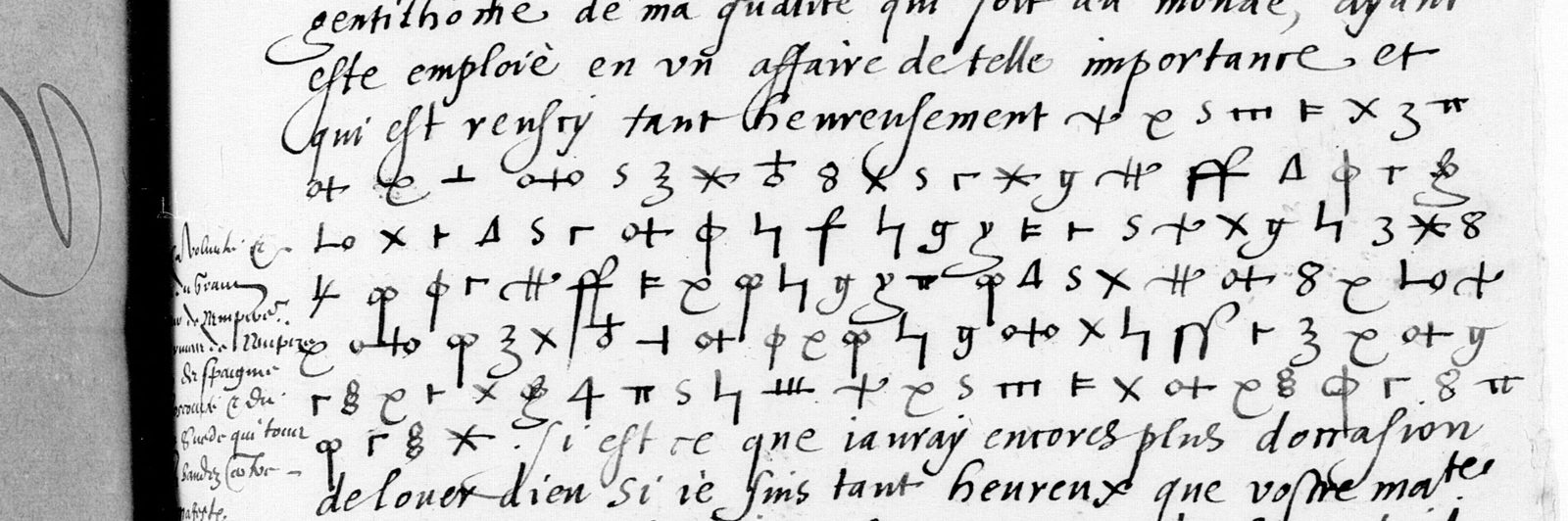
The catalogue credits Lanssac’s letters of 24 April, 1 May and 9 May with a “déchiffrement”. It is the Court decipherer’s note in the outer margin, and the microfilm keeps
only the last word or two of each of its lines; the cipher passages themselves had never been readable from the scan. With the key they read in substance. Transcriptions and sign-by-sign
choices are in lanssac/reading_siblings.txt; unread runs are in braces, and words read from the gloss and the sign count rather than sign by sign carry a query.
To Charles IX, Warsaw, 1 May 1573 (f. 160). … que pour en envoyer devant selon que les occasions des affaires premièrement surviennent. [Car je veoy que ceste nation est autant vénale et? sujette à se laisser gaigner par argent comme sont les Allemans leurs voisins.] Ce jourd’huy ilz mettent en délibération s’ilz doibvent prendre pour Roy ung Piaste ou ung prince estrangier, mais on sçait bien quelle en doibt estre la résolution.
To the duc d’Anjou, Warsaw, 1 May 1573 (f. 164). … c’est de latin et d’argent, et à bonne quantité, car il y aura de quoy l’employer [à vostre désir]. … les traverses de nos contraires qui n’y espargnent rien pour nous empescher, [{5 signs} a despendu {4 signs} ensemble {7 signs}. C’est en ceste négotiation; l’Empereur en y a despendu plus de trois cens mil {3 signs}, si faict {5} {5}, riens qu’il vaille pour ser{…}. Seulement il le trouble {7 signs}, desseing faisant le pis qu’il peult contre vous.] Encores ne veulx-je faillir, Monseigneur, de vous ramentevoir … que vous fassiez donner ordre que les navires soient prestz pour l’embarquement.
To Charles IX, Płock, 9 May 1573 (f. 174). … ayant esté employé en un affaire de telle importance et qui est reüssy tant heureusement [contre la volunté et menées? du Grand? Seigneur, de l’Empereur, des princes de l’Empire?, du Roy d’Espaigne, du Moscovite, {3 signs} et du Roy de Suède, qui tous estoient? bandez contre vo[st]re Majesté]. Si est-ce que j’auray encores plus d’occasion de louer Dieu si je suis tant heureux que vostre Majesté me juge digne d’estre employé en ce second …
English
1 May, to the King. For I see that this nation is as venal and as ready to let itself be won by money as are the Germans, their neighbours. — 1 May, to Anjou. … has spent … together …. It is in this negotiation; the Emperor has spent more than three hundred thousand in it … and done nothing worth the name …; he can only trouble the design, doing the worst he can against you. — 9 May, to the King. … an affair of such weight, which has succeeded so happily against the will and the intrigues of the Grand Seigneur, of the Emperor, of the princes of the Empire, of the King of Spain, of the Muscovite and of the King of Sweden, who were all leagued against your Majesty.
The 9 May list is the field of the 1573 election as the French embassy saw it: Archduke Ernest for the Emperor and Spain, Ivan IV, John III of Sweden, and a Habsburg-leaning party among the German princes. The “Grand Seigneur” (the Sultan) is the surprise, since the Porte was generally reckoned to favour the French candidate, and that group is read from the gloss (“du Grand”) and the sign count rather than sign by sign. The 300,000 of f. 164 is the Habsburg outlay as Lanssac reckoned it; the unit sits in an unread group. New sign values from these leaves — 4 = b, three strokes = z as well as t, the tailed 4 = p, Λ = ns, the hooked C = qu, the 6-like sign = o, Δ = g, the o with cross below = et — are listed in the notes; the last makes f. 124’s “retenu ou empesché” rather “retenu et empesché”.
06 What remains uncertain
- Despuis rests on two signs read once each (ꝛ as de, N as p); the gloss fragment “…es dangier” is compatible with “…uis les dangiers” but the gutter takes the start of the line.
- François: the signs give fran-c-o-r-s; the seventh sign must be the i sign ϙ, which this hand writes close to the r sign ϕ, or the word is another. Qui rests on the gloss; the cipher has ꟿ Γ, and ꟿ reads i in mais.
- Et vostre ser is followed by four signs that read o r h e under the key; service with one misread sign is the likely word and is left in braces.
- Two forms of the et sign (et and nt) and of the cross (h and pour) are told apart by context, not by shape, in the present transcription.
- The sibling readings of section 05 are first readings from the microfilm: f. 160 is sign by sign, f. 164 has four unread runs and one word-sign (l’Empereur) fixed only by the f. 174 gloss, and in f. 174 “Grand”, “de l’Empire”, “estoient” and “vostre” rest on the gloss and the sign count. Ff. 156v–157, the rest of f. 154 and the 9 May letters to Anjou, Catherine and Brulart (ff. 182 ff.) are not read. Tomokiyo’s “f. 331” is not a Lanssac item in the BnF notice.
07 Method
- Folio located on the unlabelled microfilm from thumbnails of the pencil foliation (canvas ≈ 1.76 × folio); full-size pages fetched one at a time through the IIIF image API.
- Blocks deskewed by maximising the contrast of the row-ink profile and cut into one strip per line for transcription; 741 signs typed as glyph labels, with separators dropped.
- Crib letters fixed from the glossed line of f. 154v and from passage two of f. 124 against its own gloss.
- Simulated annealing of the remaining signs on a French 5-gram model with the crib letters pinned; blind and shuffled-order controls run on the same data.
- Beam-search lattice decode of the five f. 124 lines with per-sign candidate sets; readings checked against the marginal fragments and the clear text.
08 Sources
- BnF, Français 4735, ff. 124, 126–127, 154–157: Gallica btv1b9060724s; notice BnF Archives et manuscrits.
- S. Tomokiyo, “French Ciphers during the Reigns of Charles IX and Henry III”, section “Ciphers of Monluc and Lansac, Sent to Poland (1573)” (cryptiana), with the table henryiii_Lansac.png.
- E.-H.-V. de Noailles, Henri de Valois et la Pologne en 1572, 3 vols (Paris, 1867), vol. III for the printed embassy correspondence (Internet Archive); the 26 April letter is not in it.
Transcription, key, reading, solver, controls and the fetch and strip scripts are in the repository (lanssac/). Page images are not committed.