01 The documents and the key
The volume is “Lettere di mons. Acciaiuoli, nunzio in Portugallo, e dell’abbate Testa, 1757–1761”, ff. 2–585. DECODE dates all eight records 18 January 1757, which is the first date in the volume. The cipher leaves themselves run from 12 September 1758 to 1760:
| Item | DECODE | Folio | Date | Digits | Clear on the leaf |
|---|---|---|---|---|---|
| 117/1 | R25 | 95r–v | 12 Sept 1758 | 1918 | no |
| 117/2 | R195 | 98r | [Sept 1758] | 860 | no |
| 117/3 | R196 | 101r | 26 Sept [1758] | 492 | no |
| 117/4 | R197 | 103r | 10 Oct [1758] | 190 | decipherment |
| 117/5 | R198 | 104r | 31 Oct [1758] | 577 | decipherment |
| 117/6 | R199 | 106r | 24 Oct [1758] | 791 | decipherment |
| 117/7 | R200 | 115r–v | 28 [Nov?] 1758 | 1999 | no |
| 117/8 | R201 | 280r | Lisbon, 12 [?] 1760 | 1499 | no |
The key is Lasry’s reconstruction (DECODE, 24 October 2020). Letters and common syllables have fixed two-digit homophones: a 04 38 55, e 84, i 08 53, o 81, s 88, il 43 91, che 39, non 14, de 71 78, qu 70 87 90. The digit 6 is a null, scattered freely, and the code words are four digits beginning with 2. No two-digit element begins with 2 or contains a 6, so the figures cut up only one way.
02 The code words
Lasry left every four-digit group open. The decipherments on 117/4–6 give them word for word:
| Code | Reading | Code | Reading |
|---|---|---|---|
| 2759, 2774 | Re | 2777 | Re (of Spain) |
| 2778 | Regina | 2813 | Spagna |
| 2300, 2845 | tutto | 2899 | giorno |
| 2171 | molto | 2510 | lettere |
| 2538 | ministri | 2799 | ministro |
| 2354 | Camera | 2138 | avuto |
| 2533 | materia | 2153 | fatto |
| 2315 | altri | 2518 | maggiore |
| 2188 | quello | 2140 | benché |
| 2134 | assai | 2178 | e che |
| 2395 | contrario | 2177 | onde |
| 2189 | egli | 2407 | detto |
A few more come from context only (grade C): 2740 prim- (“delle prime famiglie”, “figlio primogenito”), 2530 chirurgo, 2394 conte (“il conte d’Oeiras”, Carvalho’s title from 1759), 2743 principessa (the Princess of Brazil).
03 The attempt on the king, 12 September 1758
The first leaf (117/1, R25) is the longest. Code words resolved above are in plain type and open ones are given as numbers; the spelling is the cipher’s, which often drops double consonants.
… e si racconta che venendo il Re da una [visita] di una dama della <2183> … Pietro Teixeira, suo assai domestico
favorito … fussero sparate contro il calesse <2908> schioppettate; restò ferito malamente il cavalcante e la mula del
bilancino che egli montava; il Teixeira ferito a morte, <2149> si <2981> che lo avevano sagramentato; il Re molto ferito del
braccio destro … il detto chirurgo portò il Re alla Real Baracca. Non <2195> molto rumore: la materia è delicata, ma diventa
<2754> in bocca di ogni popolare. Ho creduto doverne avvisare … La dama è delle prime famiglie … Si pensa che venga il colpo
da di lei parenti; che venga da nemici del Teixeira … Il fatto non si mette in dubbio. … L’Infante don Manuel me ne parlò con il
sospetto … né più posso per ora riferire.
“…and it is said that as the King was coming back from [a visit to] a lady… Pedro Teixeira, his very intimate favourite… shots were fired at the calesse; the postilion was badly wounded, and so was the mule of the lead pair he rode; Teixeira wounded to death, so that they had given him the sacrament; the King badly wounded in the right arm… the said surgeon took the King to the Real Barraca. Little noise is made: the matter is delicate, but it is on every common man’s lips… The lady is of one of the first families… The blow is thought to come from her relatives, or from Teixeira’s enemies… The fact is not in doubt.” This is the attempt of the night of 3 September 1758, which Carvalho turned two months later into the arrest of the Távoras and the Duke of Aveiro and, in 1759, their execution at Belém.
04 The wound, September–October 1758
117/2 (R195). The illness is the public story. The arm is said to be broken, and the fleets and merchant ships are held back “con danno del Re, de’ mercanti e de’ poveri”. 117/3 (R196, 26 Sept). “Continua la voce sulla causa del male del Re, che da nessuno più si dubitò … restò tutto il giorno a letto … nessuno vede il braccio che [è] fasciato … si vuole che il braccio resterà impedito.”
117/4 (R197, 10 Oct). Deciphered at the time: “Il Rè si è levato, ma [non esce] tutto il giorno. Vogliono i più, che sia molto guasto nel Braccio, e che almeno resterà perpetuamente impedito.”
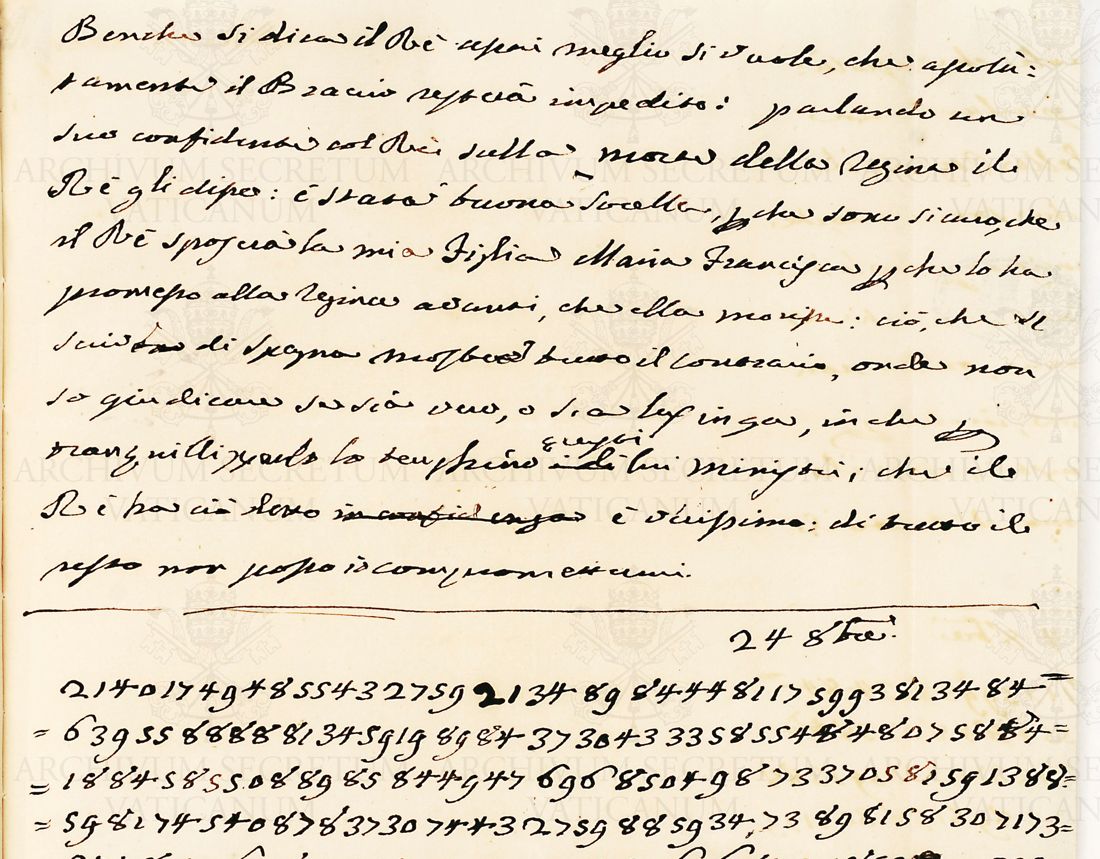
117/6 (R199, 24 Oct), deciphered at the time: “Benché si dica il Re assai meglio si vuole, che assolutamente il Braccio resterà impedito: parlando un suo confidente col Re sulla morte della Regina [di Spagna] il Re gli disse: è stata buona Sorella, e che sono sicuro, che il Re sposerà la mia Figlia Maria Francisca, e che lo ha promesso alla Regina avanti, che ella morisse: ciò, che il Ministro di Spagna mostra è tutto il contrario … di tutto il resto non posso io compromettermi.” Barbara of Braganza, Queen of Spain and José’s sister, had died on 27 August 1758. The widowed Ferdinand VI did not marry Maria Francisca.
117/5 (R198, 31 Oct), deciphered at the time: the king has not had erysipelas, “ma un sacco di materia, che ha fatto la piaga”, with fever as a result. The king is very apprehensive; “il credere il male maggiore di quello, che si dice” is universal.
05 Carvalho, November 1758, and the marriage question, 1760
117/7 (R200) is the longest leaf and the most damaged by transcription slips. Its drift is clear: Carvalho is “dispotico”, “si dice che il Re ne ha paura”, and the Infantes and the court do not dare oppose him. The leaf touches on confessors and preachers, on a lay brother “cacciato nella Compagnia” and on “l’espulsione”. The nuncio notes that he himself is met with “diffidenza”. A companion “sta tutto il giorno da Carvalho”.
117/8 (R201, 1760) is about the succession. The Princess of Brazil might marry the Infante Don Luis of Spain, and there are frequent conferences between the Conde d’Oeiras (Carvalho) and others. The court of London “è molto allarmata” and fears for its trade from “uno della casa di Spagna e di Borbone sul trono di Portogallo”. The letter ends: “Il paese freme, che vorrebbe la [principessa] unita coll’Infante don Pietro.” She married her uncle Pedro on 6 June 1760. Acciaiuoli was expelled from Portugal nine days later.
06 Method
The DECODE records were fetched with a logged-in session: images, the NiLan/Midas digit transcriptions, Lasry’s key and his
decryption, which is one file attached to every record. The decryption was flattened into one letter string per leaf and split
into Italian words by hand. Code words were fixed by aligning the three clear decipherments with the cipher below them, and
then checked for consistency wherever the same code recurs in the other five leaves (2759 Re 11 times, 2300 tutto 12).
The full working text, leaf by leaf, is acciaiuoli1757/READING.md.
07 What remains open
- About 80 of the 107 distinct code groups that occur once or twice (2183, 2481, 2754, 2823, 2398, 2159, 2413, 2817, 2803 and others), with no crib. Where the sense can be guessed, it is marked C in READING.md.
- Transcription slips produce unassigned pairs (82, 92, 42, 12, 32, 72, 02) and garbled stretches, above all in 117/7 and 117/8. A fresh transcription of those two leaves from the images would recover most of them.
- Grades: the 25 codes in the table in section 02 are H (contemporary decipherment on the leaf); 2740, 2530, 2394 and 2743 are C; the word division of the five leaves with no contemporary decipherment is H where a phrase is quoted above, M in the stretches marked … in READING.md.
- The rest of Portogallo 117 (ff. 2–585) has more cipher than these eight leaves. It is not on DECODE and was not seen.
08 Sources
- DECODE records R25, R195, R196, R197, R198, R199, R200, R201 (images: login).
- George Lasry, reconstructed key “ASV – P117” and decryption, DECODE, October 2020.
- Digit transcriptions by NiLan (Dec 2016 – Mar 2017) and Midas (May 2017), DECODE.
- No edition of these despatches was found (search of 19 September 2026).
Working files, the transcriptions and the full reading are in acciaiuoli1757/.