At a glanceNot solved · text not obtained
- The letter
- A long Italian despatch to the “Officiales Balie” of Siena from an orator at Milan, who names messer Lionardo Benvoglienti and the Duke of Milan; 1450s. The signature and date line are torn.
- Where
- Archivio di Stato di Siena, Concistoro 2308, fasc. 2 “Lettere in cifra”, no. 7; DECODE R4796 (
Concistoro_2308_50, 2 pp.), catalogued “1500–1599” with no status. - The cipher
- Eleven lines of digits, letters and signs near the foot of page 1, with clear words between the runs. The faint glosses show a homophonic cipher: o has at least two signs.
- How it was tried
- The 1454 key of the Milan ambassadors (R4750) and five other filed keys were tested sign by sign against the gloss, and all fail it. Homophonic annealing, with the gloss values fixed or free, does not converge.
- Why it resists
- 363 signs over at least 45 sign types are too few for a ciphertext-only break, and no key in the busta fits.
- Credit
- George Lasry’s report of 17 October 2026 lists no. 7 as not yet deciphered: “c. 330 symbols, a few words with interlinear plaintext”.
The other pieces of the Sienese cipher file are listed by key on the Concistoro 2308 index. No. 8, of about 1440–41, is a different cipher with its own page; its key does not fit no. 7.
01The letter and its cipher
The despatch fills about 45 lines of page 1 and a postscript on page 2. It is addressed to the “Magnifici et excelsi domini Officiales Balie”, names “messer Lionardo Benvoglienti” in the third person, speaks of the Duke of Milan, and in the postscript of the “conte Iacomo” (Jacopo Piccinino?), Genoa and Bologna. Benvoglienti was Siena’s ambassador at Milan in 1454, and fascicle 1 of the busta holds the key made for that embassy (R4750, “a messer Leonardo e messer Antonio, ambasciatori a Milano, 1454”), so the letter is placed in the 1450s. The writer signs “Servitor vester Orator” and a name that cannot be read with confidence.
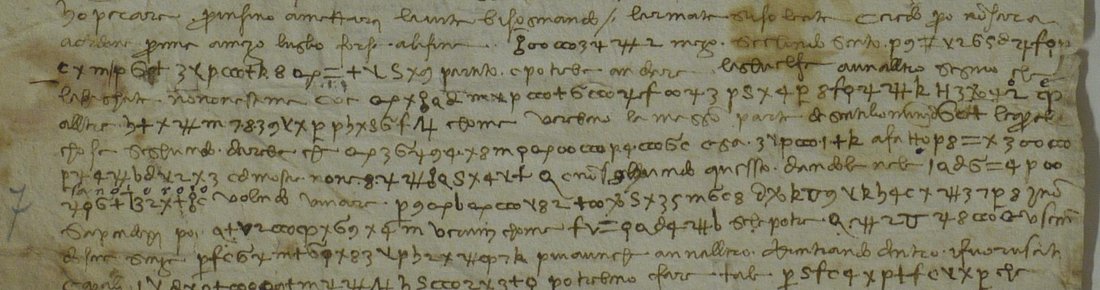
A reader has written single letters over some signs: over line 8, l a n o t e r o i o above ten signs. The alignment gives 7 = l, q = a, 6 = n, + = o, a barred 3 = t, 2 = e, x = r, a ringed 8 = i, c = o (sign names from the transcription in targets/siena7/transcripts/).
02How it was tried
- The embassy’s key, R4750 (24 September 2026), tested sign by sign on the image: the gloss contradicts it (R4750 makes 7 = o, 6 = i, + = s, 2 = f where the gloss has l, n, o, e), a fifth of the letter’s signs are not in it, and its only sign for e would be 2.5% of the text. A “milano” reported early on came from free signs in a solver run and was withdrawn.
- Five more filed keys, R4753, R4754, R4756, R4757 and R4762, transcribed and tested against the gloss: none fits. The others of fascicle 1 were compared by eye.
- Homophonic annealing (the solver that gave the keys of nos. 14, 18 and 25), first free, then on 18 October 2026 with the nine gloss values fixed (twelve restarts, Italian n-grams of the period): the restarts disagree and none reads, at about −2.04 per sign.
- The key of no. 8, rebuilt on 18 October 2026 from its contemporary decipherment: a different key (7 = d, + = c, 2 = a there).
03What remains
- The whole cipher block, 363 signs by this transcription (George Lasry counts c. 330; the difference is in how joined and look-alike signs are split). Without a key, it is too short for the number of signs.
- A fresh transcription in CTTS, as George Lasry made for the fascicle’s solved pieces, may change the sign count enough for a new solver run with the gloss values fixed.
04Sources
- Archivio di Stato di Siena, Concistoro 2308 fasc. 2 no. 7: DECODE R4796; key R4750 in fasc. 1, DECODE R4750.
- George Lasry, “The cipher documents of Concistoro 2308, fasc. 2”, report of 17 October 2026, contents p. 3.
- A. Meister, Die Anfänge der modernen diplomatischen Geheimschrift (Paderborn 1902), pp. 50–51.
Manuscript rights: Archivio di Stato di Siena.
Transcription, key test and profile: targets/siena7/; filed keys and solvers in research/siena2308/.