At a glanceCiphertext-only break · complete
- The letter
- A slip from Sienese envoys to the Signoria, all in cipher, unsigned and undated.
- Where
- Archivio di Stato di Siena, Concistoro 2308, fasc. 2 “Lettere in cifra”, no. 25; DECODE R4813, catalogued “1500–1599” (a placeholder) with no status.
- The cipher
- One sign per letter, 22 signs built on a running horizontal stroke, words divided by points; u and v share two signs.
- How it was deciphered
- None of the 43 keys filed in the same bundle fits. A staged annealing search with an Italian language model gave the key with no crib; two look-alike signs were then separated on the image.
- What it says
- A lord will leave by Lajatico, be at Radicondoli the next day and come on by Casole; Siena should provide “pane, viada, vituagia”.
- Still open
- Two words (18 signs) not understood and one code sign; the lord and the year.
This slip was filed on this site until 14 October 2026 with the rest of the Sienese bundle of cipher letters, in which each letter has its own key. The other letters whose keys were found are different ciphers, each with its own page: no. 18, no. 14, no. 4 (Borghesi, 1456) and nos. 6 and 24 (deciphered by George Lasry); the unread pieces and the 43 filed keys are described on the bundle’s page.
01The slip and its key
A slip of eleven lines, 496 signs in 65 words divided by points, all in cipher. Its 22 signs are built on a running horizontal stroke: uprights with one, two or three bars, crosses, a Greek-looking π. The transcription was made from the DECODE photograph; a staged annealing search over the words with an Italian language model gave the key with no crib, and a check of every doubtful word on the image separated two look-alike signs (a plain y is m, a hooked χ is r). 477 of the 496 signs (96.2%) fall in words that make Italian sense; 18 are in two words not yet understood and one sign, standing alone, is unread.
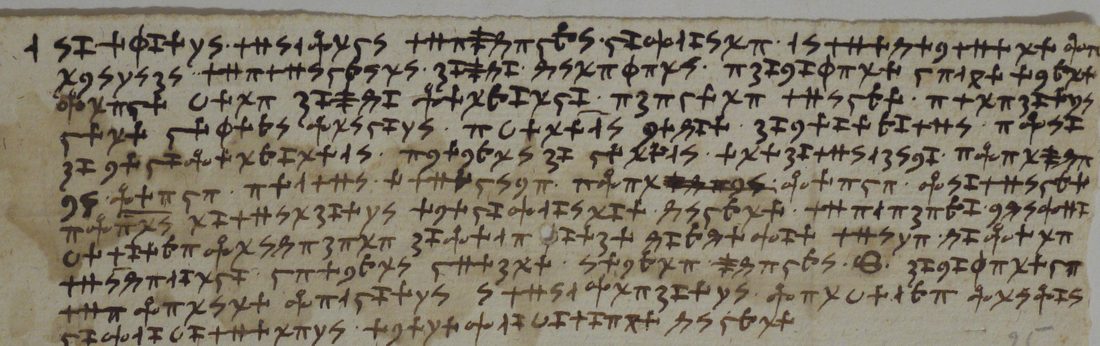
02What it says
Noi aviamo chompr(e)so che questo signiore no chavalcharà per lo modo che chostoro di qui vorevero, e diliverà senza altra presa fare di qui partirsi e d’esare chostà; e crediamo sarà sabato prossimo; e farano la via di Laiaticho, e poi di là si partirano, e l’altro dì sarano a Radichondoli, e per quello paese e ancho a Chasole, e per paese poi chostà. E però richordiamo a la signioria vostra che ne’ detti luoghi faciate provedere di pane, viada, vituagia, chome vi pare chovenirsi … per fante propio significharemo a la magnificie(n)za vostra.
“We have understood that this lord will not ride in the way those here would like, and has decided, without further delay, to leave here and come there; we think it will be next Saturday. They will take the road by Lajatico, leave from there, and the day after be at Radicondoli, and through that country and Casole on to you. So we remind your lordship to have bread, fodder and victuals laid in at those places as you think fit.” The envoys write from the Volterra side, on the road that enters the Sienese state at Radicondoli and Casole. The slip is undated and the lord is not named.
The word presa (“senza altra presa fare”) was checked again on the full-resolution image on 30 September 2026: its second sign is the hooked χ (r), which rules out spesa.
03What remains
- Two words, 18 signs, not understood (read provisionally s’hadra and o chon grediamo), and one sign standing alone between points, probably a code; each occurs once.
- The lord, the date and the place of writing.
Full texts
The transcription and the decryption of every document on this page, so that the reading can be used and checked. Short files are shown here; all are in the repository.
Siena, Concistoro 2308 fasc. 2 no. 25 (DECODE R4813), undated
An undated, unsigned slip: a lord will not ride as the people there wished but will leave without further halt, by Lajatico, then Radicondoli and Casole, probably next Saturday; the Signoria of Siena is asked to provide bread, wine and fodder in those places. Key recovered ciphertext-only; 477 of 496 signs in words read as Italian.
Transcription
No. 25 (DECODE R4813) -- transcription by agent E, 24 Sept 2026
=================================================================
Image: decode/img/IMG_R4813_I27979_P.jpg (4000x2248), one side only.
What it is: a small slip (landscape), entirely in cipher, 11 lines (not 12: row-profile and line crops agree),
  written x ~ 8%-96%, y ~ 26%-72%.  No clear text, address, date or signature on the photographed side.
Crops: crops/agentE/n25_L<line>_<k>.png (3x, 560-px windows, step 440, following the sloping lines),
  v25_L<line>_<k>.png (4x, 440-px windows, step 400 = second full pass), z25_*.png (5-7x zooms of doubtful
  signs), sheet_q.png (Q comparison sheet).  Line-baseline model in crops/agentE/mk25.py.
Rev. 2 (same day, after the coordinator's decipherment): doubtful signs re-checked on the image, see
  transcripts/no25_reading.txt; comparison sheets crops/agentE/ycomp.png, q*.png, r*.png.

SYSTEM AS SEEN: word-divided.  Words are separated by a point (sometimes a gap only); ' / ' in the text.
The hand draws a running horizontal stroke at x-height through most uprights, so many signs are "uprights on
the line".  Segmentation rule used: each separate upright (with its own head/foot/crossing shape) = one sign;
the running stroke itself is not a sign.

SIGN LEGEND (21 names after rev. 2)
----------------------
  I     "⌶": upright with a serif bar at the top AND a serif bar at the foot (I with serifs)
  J     upright with a short spur to the LEFT at mid-height, joined to the running stroke ("⊣", a 4 without loop)
  +     plain cross: upright crossed once by the running stroke
  H     two short uprights side by side hanging on the running stroke ("ǁ" on the bar).  19 of the 21 H follow
        "+" directly ("+ H" = the "+ǁ" / "+++" group of three uprights on one bar); 2 do not (L07 "PH2 H I",
        L09 "HL H F").  Kept as separate tokens; an analyst may test "+ H" as ONE sign.
  F     cross whose bar runs on to the right and ends in a short second upright ("+ı" joined; the bar is held
        between a crossed upright and a short right upright)
  X3    "ǂ": upright crossed twice (running stroke + a second, lower bar)
  PI    "π": bar with two legs (left leg often slanting)
  HL    "Γ"/"ʃ": top stroke to the right from a long left stem that descends below the line, often curved
        (a large ʃ); distinct from S by size and the descent below the line
  S     "ς/ϛ": small zigzag on the line (short top stroke, diagonal down-left, foot turned right)
  Q     upright with a small closed loop at the head, crossed by the running stroke (looped-top cross)
  R     angular hooked sign: stem slanting down-left from a loop/hook at the top right ("ρ"/"9"-like but
        angular, open), usually attached to the running stroke
  9     figure 9: round closed bowl with a curved tail below
  B     "б/6": stem coming down from above the line, curling into a closed bowl on the line, stem continuing
        below the line
  X     "χ": x whose upper-left arm is curved/hooked and crosses to a foot at lower right.  The foot is sometimes
        very short, and then X looks like Y; 7 signs first read as Y were changed to X on re-check (rev. 2)
  XB    x whose upper arms close into a loop ("8"-like x); 2 cases only (L02, L11)
  Y     y: open V, the RIGHT arm running on as a long descender to lower left; no hook, no foot (rev. 2: 10 left)
  3     figure 3 / ʒ, descending below the line
  U     u/v open bowl
  PHI   "φ": closed bowl crossed by a long vertical
  PH2   φ with an extra open hook drawn on its LEFT ("ɕφ"): a distinct sign, not a variant of PHI in this hand
  TH    "Θ": circle with a horizontal bar (1 case, standing alone as a word, L09)
Marks: '?' uncertain reading, '??' illegible.  Notes in {braces} are not text.

TRANSCRIPTION (one manuscript line per text line; rev. 2)
-------------------------------------------------
L01 J S I F PHI I F Y S / + H S J Q X? HL S / + H PI X3 R PI HL B S / HL I PH2 J I S X PI / J S + H F R F 9 + H F X F Q PI
L02 X 9 S Y S 3 S / + H PI + H S HL B S X S / 3 I X3 R I / R S X PI PHI PI X S / PI 3 I 9 I PHI PI X F / HL PI J XB F / F 9 B X F   {word 1 closed by a double point ":"/".."; the last word gap has no point}
L03 Q? X PI HL F / U F X PI / 3 I X3 R I / Q F X B I X HL I / PI 3 PI HL F X PI / + H S HL B F / PI + X PI 3 I F Y S   {first sign blotted: bowl-and-stem, read Q? (p); the earlier PH2? reading withdrawn}
L04 HL F X F / HL F PHI F B S / Q X S HL I Y S / PI U F X F J S / 9 F R I F / 3 I 9 F I F B I + H S / PI Q S I   {a small arc is drawn above "F J" of word 4}
L05 3 I 9 F HL I Q F X B I X F J S / PI 9 F 9 B X S 3 I / HL F X F J S / F X F 3 I + H S J 3 S 9 I / PI Q PI X X3 R PI
L06 9 S? / Q F PI HL PI / PI F J + H S / F + H F? HL S 9 PI / PI Q PI X / Q F PI HL PI / Q S I + H S HL B F   {after word 5 "PI Q PI X" a group of ~5 signs is struck through (read as "X3 R PI 9 S" = "quelo", cancelled; not transcribed as text); a long stroke underlines "Q F PI" of word 2; F? in word 4 is blotted}
L07 PI Q PI X S / X I + H S X 3 I F Y S / F 9 F HL I PH2 J I S X I F / R S HL B X F / + H PI J PI 3 PI B I / 9 R S PH2 H I
L08 U F + I F B PI / Q X S R PI 3 PI X PI / 3 I Q F J PI PHI? I F 3 F / R I B R F / PH2 I F / + H S Y PI / R I Q F X PI   {PHI? in word 3 is written round a small hole in the paper}
L09 + H S R PI J I X HL I / HL PI F? 9 B X S / HL H F 3 X F / S F 9 B X PI / X3 R PI HL B S / TH / 3 I 9 I PHI PI X F HL PI   {small arc over "S R" of word 1; TH stands alone between two points}
L10 + H PI Q PI X S X F / Q PI J HL I F Y S / S + H S J PH2 X PI 3 I F Y S / Q PI X U F J B PI Q X S Q I S   {a faint dot low inside the last word between "U F" and "J", probably not a divider}
L11 HL I PH2 J I U I + H F X PI Y S / F 9? F Y F PH2 J I U I + I PI XB F / R S HL B X F

COUNTS AND OBSERVATIONS
-----------------------
Tokens (rev. 2): 496 signs in 65 words (11 lines); 21 sign names.  Frequencies:
  F 68, PI 57, S 54, I 52, X 45, HL 28, + 22, H 21, Q 21, J 19, B 19, 3 19, 9 18, R 16, Y 10, PH2 7, PHI 6,
  U 6, X3 5, XB 2, TH 1.   (Pass-1 figures in the first version: X 38, Y 17, + 24, G 1.)
Word lengths (signs): 1:1, 2:1, 3:1, 4:4, 5:11, 6:11, 7:7, 8:6, 9:9, 10:2, 11:4, 12:1, 13:2, 14:2, 15:3.
  Long "words" (11-15 signs) are probably several words run together or points missed.
Repeated whole words: "3 I X3 R I" (L02, L03), "Q F PI HL PI" (L06 twice), "R S HL B X F" (L07, L11).
Recurring sequences inside words: "I F Y S" x4, "I + H S" x4, "PI Q PI X" x4 (L05 end, L06, L07 start, L10),
  "HL I PH2 J I" x3, "+ H S HL B" x3, "F 9 B X" x3, "X F J S" x3.
Word finals are almost only S (23), F (17), PI (14), I (9) -> strong word-ending signs (Italian -e/-o/-a/-i?).
~22 distinct signs, flat-ish top frequencies (F, PI, S, I ~11% each): consistent with a simple (mostly
  monoalphabetic) substitution of an Italian/Latin plaintext; "+ H" may be one sign (then 21 sign types).
Marks: arcs above/below a few groups (L04, L09), an underline (L06), one struck-out group (L06).
Transcription: no25_signs.tok
Decryption
No. 25 (DECODE R4813) -- reading, agent E, 24 Sept 2026
=========================================================
Transcription: transcripts/no25.txt (rev. 2, corrected against the image for this reading).
Key: the coordinator's ciphertext-only key, applied unchanged except that XB = z (senza, magnificieza), not t.
System: simple monoalphabetic substitution, one sign per letter, with word division (points).  Italian,
Sienese spelling ('ch' for hard c, single consonants: prosimo, farano, sarano; 'u' for v; sauato = sabato).

KEY (sign -> letter), as confirmed by the reading
  F a   B t   + c   3 d   PI e   U f   PH2 g   H h   I i   9 l   Y m   J n   S o   Q p   X3 q   X r
  HL s   R u/v   PHI u/v/b   XB z   TH = unread (a single sign standing as a word)
  (No sign found for b, which is written u/v: sauato, diliuera, uiada; none for k, x, y, j.)

WHAT THE RE-CHECK CHANGED (rev. 1 -> rev. 2, all checked on 4x-6x crops)
  1. Y vs X ("sama", "chostomo", "sealtmo", "cheperoma", "pemfantepmopio", "chonpmso").  There are two
     glyphs.  Y = "y": open V whose RIGHT arm runs on as the long descender, no hook, no foot (10 cases, all
     m: aviamo, modo, crediamo, prossimo, richordiamo, chome, pensiamo, grediamo, significharemo,
     magnificieza).  The 7 "r" cases are X ("χ"): the upper-left arm is hooked and crosses to a foot at lower
     right, but the foot is short, so I misread them as Y.  Changed to X: L01 w2 (X?), L02 w2, L04 w1,
     L09 w2, L10 w1, L10 w4 (twice).  Y is therefore only m; X is only r.  (ycomp.png, q04a/q04c/q10b.png)
  2. G (L10 w3) was misread: it is S (o).  "o chon..." (r10d.png).  The name G is withdrawn.
  3. "ecredic?mo" (L03 w7): the doubtful sign is F (cross + bar to a short right upright): "e crediamo".
  4. "secltmo" (L09 w2): the doubtful plain cross is F? and the 6th sign X: "se altro".
  5. "g?resa" (L03 w1): the 2nd sign is X (r), so "spesa" is excluded.  The 1st sign is blotted,
     a bowl on a stem; it fits Q (looped cross, p) better than PH2: "presa" (q03a.png).
  6. Struck group in L06 after "PI Q PI X" (e per): X3 R PI 9 S = "quelo", cancelled by a line through it; the
     scribe then wrote "paese".  So he first wrote "e per quelo" and changed it to "e per paese".
     Not counted in the text.
  7. TH (L09): a circle with a horizontal bar, alone between two points: "o altre, questo [TH] diliverase".
     It is not a letter of the key (it occurs once).  It is probably a code sign or an abbreviation, e.g. "si"/"se"
     ("questo si deliberasse") or a name; left unread.
  Checked and unchanged (they read correctly as Italian once split right):
     "nochaualcharape|rlomodo" = no chavalcharà pe|r lo modo (word runs over the line end);
     "uoreuero" = voreve(r)o (the last r is X; Sienese vorrebbero); "sauato" = sabato (u for b);
     "prosimo" = prossimo; "lauia / dilaiaticho" = la via di Laiatico (no fault: the earlier suspicion came
     from reading "lauia dilaiaticho" as one word); "chenedeti" = che ne' detti; "uitua / gia" = vittuagia
     (vettovaglia) with a point inside the word; "pemfantepmopio" = per fante propio (after fix 1).
     "chonprso" (L01 w2): the image has c h o n p r s o; no e is written, a slip for chonpreso
     (compreso).

PER LINE (corrected signs -> Italian)
L01 J S I F PHI I F Y S / + H S J Q X? HL S / + H PI X3 R PI HL B S / HL I PH2 J I S X PI / J S + H F R F 9 + H F X F Q PI
    noi auiamo / chonpr(e)so / che questo / signiore / no chaualcharà pe-
L02 X 9 S Y S 3 S / + H PI + H S HL B S X S / 3 I X3 R I / R S X PI PHI PI X S / PI 3 I 9 I PHI PI X F / HL PI J XB F / F 9 B X F
    -r lo modo / che chostoro / di qui / uoreuero / e diliuera / senza / altra
L03 Q? X PI HL F / U F X PI / 3 I X3 R I / Q F X B I X HL I / PI 3 PI HL F X PI / + H S HL B F / PI + X PI 3 I F Y S
    presa(?) / fare / di qui / partirsi / e d'esare / chostà / e crediamo
L04 HL F X F / HL F PHI F B S / Q X S HL I Y S / PI U F X F J S / 9 F R I F / 3 I 9 F I F B I + H S / PI Q S I
    sarà / sauato / prosimo / e farano / la uia / di Laiaticho / e poi
L05 3 I 9 F HL I Q F X B I X F J S / PI 9 F 9 B X S 3 I / HL F X F J S / F X F 3 I + H S J 3 S 9 I / PI Q PI X X3 R PI
    di là si partirano / e l'altro dì / sarano / a Radichondoli / e per que-
L06 9 S? / Q F PI HL PI / PI F J + H S / F + H F? HL S 9 PI / PI Q PI X [struck: quelo] / Q F PI HL PI / Q S I + H S HL B F
    -lo / paese / e ancho / a Chasole / e per / paese / poi chostà
L07 PI Q PI X S / X I + H S X 3 I F Y S / F 9 F HL I PH2 J I S X I F / R S HL B X F / + H PI J PI 3 PI B I / 9 R S PH2 H I
    e però / richordiamo / a la signioria / uostra / che ne' deti / luoghi
L08 U F + I F B PI / Q X S R PI 3 PI X PI / 3 I Q F J PI PHI? I F 3 F / R I B R F / PH2 I F / + H S Y PI / R I Q F X PI
    faciate / prouedere / di pane uiada / uitua- / -gia / chome / ui pare
L09 + H S R PI J I X HL I / HL PI F? 9 B X S / HL H F 3 X F / S F 9 B X PI / X3 R PI HL B S / TH / 3 I 9 I PHI PI X F HL PI
    chouenirsi / se altro / s'hadra(?) / o altre / questo / [TH] / diliuerase
L10 + H PI Q PI X S X F / Q PI J HL I F Y S / S + H S J PH2 X PI 3 I F Y S / Q PI X U F J B PI Q X S Q I S
    che per ora / pensiamo / o chon grediamo(?) / per fante propio
L11 HL I PH2 J I U I + H F X PI Y S / F 9? F Y F PH2 J I U I + I PI XB F / R S HL B X F
    significharemo / a la magnificie(n)za / uostra

RUNNING TEXT (normalised punctuation only)
  Noi aviamo chonpr(e)so che questo signiore no chavalcharà per lo modo che chostoro di qui voreve(r)o, e
  diliverà senza altra presa(?) fare di qui partirsi e d'esare chostà; e crediamo sarà sabato prossimo; e
  farano la via di Laiaticho, e poi di là si partirano, e l'altro dì sarano a Radichondoli, e per quello
  paese e ancho a Chasole, e per paese poi chostà.  E però richordiamo a la signioria vostra che ne' detti
  luoghi faciate provedere di pane, viada (biada), vituagia, chome vi pare chovenirsi, se altro s'hadra(?),
  o altre.  Questo [TH] diliverase, che per ora pensiamo, o chon grediamo(?), per fante propio
  significharemo a la magnificie(n)za vostra.

SUMMARY
  Sienese envoys (writing "noi") warn the Signoria that a lord ("questo signiore") will not ride the way
  "those here" would like: he has decided, without stopping(?) here, to leave and go to Siena's territory
  ("d'esare chostà").  They expect him on Saturday next, by way of Laiatico (Volterra country), then
  Radicondoli and Casole (Sienese Val d'Elsa / Colline Metallifere) and so towards Siena.  They ask the
  Signoria to have bread, fodder (biada) and victuals made ready in those places as it sees fit, and promise
  to report further by a messenger of their own ("per fante propio").  Undated; the route Laiatico ->
  Radicondoli -> Casole suggests a lord and his escort passing from Pisan/Volterran territory into the
  Sienese state.  No names except places; the lord is probably behind the TH sign or unnamed on purpose.

COUNTS
  cipher tokens (text, struck group excluded)          496  (65 cipher words, 11 lines)
  tokens in words read as sense                       477  (96.2 %)
     includes chonpr(e)so (8, e missing in the cipher) and presa (5, first sign blotted, read Q?)
  doubtful: signs read, sense unclear                   18  (3.6 %): s'hadra (6), o chon grediamo (12)
  unread                                                  1  (TH, L09)
  struck group (not counted)                              5  (X3 R PI 9 S = "quelo")
  Sign inventory after rev. 2: 21 names (G withdrawn); Y = m only, X = r only.

OPEN POINTS
  - L09 "HL H F 3 X F" = s h a d r a: the signs are clear on the image (Γ, ǁ on the bar, F, 3, χ, F).
    Possibly "s'harà" with d as a slip, or "s'hadrà" for s'avrà; not settled.
  - L10 "S + H S J PH2 X PI 3 I F Y S" = o chon grediamo: signs clear.  "chon" + "grediamo" (crediamo with
    g?) or a slip.  Not settled.
  - TH: single code sign, unread.

30 SEPT 2026 CHECK (quotation list)
  L03 w1 re-examined on the 4000-px DECODE image: X (r) certain, so 'spesa' is excluded; the blotted first sign is
  a loop crossing a stem, as Q (p) in 'prosimo' L04 and 'pensiamo' L10, not PHI.  'presa' is kept: p graded M
  (blotted), r-e-s-a H.  'senza altra presa fare' = without making any further halt (or seizure) before leaving.
Translation
<!-- English translation of the RUNNING TEXT in transcripts/no25_reading.txt (Claude Opus 5.5, 23 Oct 2026): Siena, Concistoro 2308 fasc. 2 no. 25 (R4813), deciphered with the key recovered ciphertext-only. Same doubts: (?) doubtful, [TH] an unread single code sign; "o chon grediamo" (signs clear, sense unclear) kept as [?o chon grediamo]. -->

# Siena, Concistoro 2308 fasc. 2 no. 25 (DECODE R4813), undated: English translation

We have understood that this lord will not ride in the way that these people here would like, and he will decide,
without making any further halt(?) here, to leave and to be there with you; and we believe it will be next Saturday;
and they will take the road of Laiatico, and then from there they will leave, and the next day they will be at
Radicondoli, and through that country and also at Casole, and through the country then to you. And therefore we remind
Your Lordship to have provision made in the said places of bread, fodder and victuals, as seems fitting to you, if
anything else s'hadra(?), or other things. This [TH] will decide, which for now we think, [?o chon grediamo], we shall
signify to Your Magnificence by a messenger of our own.
Key: no25_key.txt
04Sources
- Archivio di Stato di Siena, Concistoro 2308 fasc. 2 no. 25: DECODE R4813.
- A. Meister, Die Anfänge der modernen diplomatischen Geheimschrift (Paderborn 1902), pp. 50–51, on the bundle.
Manuscript rights: Archivio di Stato di Siena.
Transcription, key, reading and validation: targets/siena25/; the solver is in targets/siena1421/.