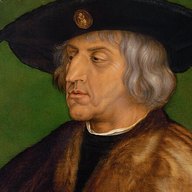
At a glanceCiphertext-only break · complete
- The document
- Three written pages of articles: the first and second demands of Maximilian I, King of the Romans, and the Sienese orators’ counter-demands, subscribed by the royal secretary Niklas Ziegler; Pisa, November 1496 (undated; dated by George Lasry).
- Where
- Archivio di Stato di Siena, Concistoro 2308, fasc. 2, no. 18; DECODE R4806, catalogued “1500–1599” with no sender, receiver or status.
- The cipher
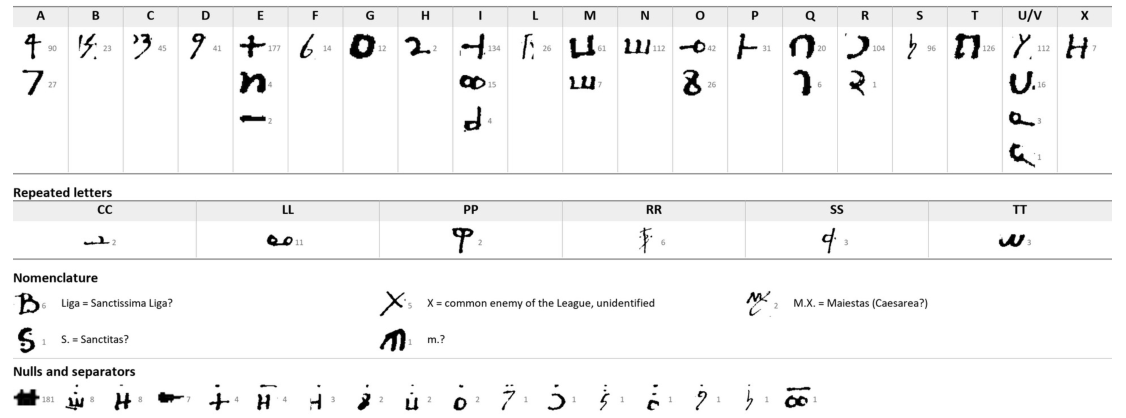
- Homophonic substitution on 60 signs: letter signs with homophones, signs for doubled letters (rr, pp, ss, ll, cc, tt), dotted or barred signs as nulls, and a few code capitals (B., X., M.X.) left in clear.
- How it was deciphered
- Twice from the ciphertext alone. Here on 24 September 2026 (annealing with a Latin model, 87.1% read); independently by George Lasry with CTTS and Claude on 15–17 October 2026, from cribs in the clear Latin around the cipher words. His key agrees with ours on 35 of his 38 letter signs.
- What it says
- Siena is to join the Holy League at half the Pope’s quota, lend the King 5,000 ducats, ready its artillery and open war on the enemy at Ponte a Valiano; the orators ask for every place taken within five miles of their border.
- Still open
- Six single signs; what B., X., S., M.X. and m. stand for.
- Credit
- George Lasry: independent solution, the complete reading and translation, the parties and the date (report of 17 October 2026). The project: the first key (24 September 2026) and the comparison.
These articles were filed here until 14 October 2026 with the rest of the Sienese bundle of cipher letters, in which nearly every piece has its own key. The other pieces are different ciphers, each with its own page; the bundle is listed on the collection’s page.
01The articles and their key
Three written pages (P4, P3, P1 in DECODE’s numbering; P2 is blank) carry 1,469 cipher signs in point-separated words inside the running Latin, by George Lasry’s count. P4 opens “Primo loco petita per Cesaream Maiestatem ab oratoribus Senensibus”; P1 carries the subscription “Niccolaus Ziegler, Regis Secretarius” and the King’s second demands.
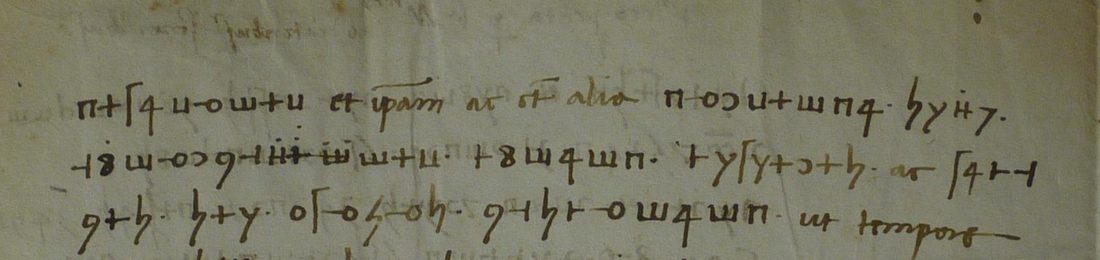
The project’s key (24 September 2026) came from the annealing search with a Latin model on a transcription of 30 sign names; a check on the images split three look-alike pairs and showed that dotted signs are nulls. It read 1,271 of 1,459 signs (87.1%). George Lasry’s key, recovered without ours, names 60 signs, because his transcription separates glyphs ours had merged. Matched sign by sign, 35 of his 38 letter and doubled-letter signs carry the same value in ours (3 of them as glyphs our transcription had merged with a look-alike); one differs (a sign he reads cc, we c), and two signs that occur once each are not in ours. The one passage printed on his web page (restituerentur, ita tamen quod ipsi Senenses … stare iuri coram) is our own reading of it word for word, cipher and clear words falling the same way.
02What they say
George Lasry’s reading, quoted from his report; abbreviations expanded in square brackets, the code capitals in brackets, ÷ and ✱ single unread signs. The full Latin and translation are in lasry_report.md.
Item q[uod] pro bono rei p[ublice] Sen[ensis] ÷ et [B]. illico manus apponerent ut saltem medietas illor[um] castrorum et arcium, ad que ipsi Senensib[us] ius competit, eis restituerentur, ita t[ame]n q[uod] ipsi Senenses ad requisitionem Florentinorum sint contenti de stando iuri coram Cesare, dummodo Florentini etiam de illis que ipsi occupant sint contenti stare iuri coram ÷
“That, for the good of the Sienese republic, [the League] should at once put its hand to it, so that at least half of the castles and fortresses to which the Sienese have a right are restored to them; on condition that the Sienese, at the Florentines’ request, be content to stand to law before Caesar, provided that the Florentines likewise be content to stand to law before [Caesar] over the places they occupy.” (his translation)
P4, the King’s first demands. Siena is to state its grievances against Florence and the places the Florentines hold; accept Caesar as ordinary and supreme judge; join the Most Holy League at a quota set by Caesar, half the Pope’s; and supply passage, victuals, 100 men-at-arms and 60 light horse.
P3, the Sienese counter-demands. Every town, fortress and castle within five miles of the Sienese border taken in the war goes to Siena, and the “diligentia” and the tower at the Valiano bridge are to be handed over before any peace with the enemy.
P1, the King’s second demands. Talamone and the artillery are to be put in order; Siena lends the King 5,000 ducats, which [M.X.] will repay within two months; Siena enters the League, which will protect its present regime, and opens war on the enemy around Ponte a Valiano. Subscribed by Niklas Ziegler.
Date. The articles are undated. George Lasry places them at Pisa in November 1496, during Maximilian I’s Italian expedition with the forces of the Holy League of 1495, whose treaty set the Pope’s quota at half the others’: Ziegler is attested as the King’s secretary from 1494 and was with the court on 25 November 1496 (Regesta Imperii XIV,2 n. 4508), Pecci’s Balìa deliberations of September–October 1496 record the same demands, and the Sienese attacks on the Florentine bastion at Ponte a Valiano in 1496 were made at the League’s urging (Guicciardini III.8). This page earlier gave “1510s–1520s”; his dating replaces it.
03The two solutions compared
His reading covers the words ours left open or doubtful. Graded against our transcription and key (H read from the key, M uncertain), in ten places his readings are H: in ordinem (where we saw a struck word), ponant, pulveres, que after B., cum, armature, defendat (ours defendam), quote (ours quoti), imponitur, ius competit, habeat; three are M: Telamonem (the damaged first word), pax (ours passo?) and his own query s[anctissima]?. In six places of the clear Latin his readings are the grammatical ones. The table, sign by sign and word by word, is in lasry_comparison.md.
The statistical test on the project’s own key (docs/_validate.py, Latin letter model) gave underdetermined: our transcription kept look-alike pairs under one sign name, so a one-value-per-sign key scored below the annealer. George Lasry’s key, which separates those glyphs, explains why.
04What remains
- Six single signs unread in his text: ÷ four times, ✱ twice.
- The code capitals, written in clear: B. (the League?), X. (the common enemy), S., m. and M.X. (a League member guaranteeing the loan, the King himself or Milan?); George Lasry leaves M.X. unidentified.
Full texts
The transcription and the decryption of every document on this page, so that the reading can be used and checked. Short files are shown here; all are in the repository.
No. 18 (R4806), treaty articles subscribed by Niccolo Ziegler, [Pisa, Oct-Nov 1496]: George Lasry's reading and this project's independent one
Latin articles negotiated by Sienese orators with Maximilian I's side, subscribed by his secretary Niklas Ziegler, dated by George Lasry to Pisa, October-November 1496: Siena to ready artillery and lend the King 5,000 ducats repayable in two months, open war near Ponte a Valiano against the Florentines with passage, victuals, 100 men-at-arms and 60 light horse, and have its claims against Florence judged by the Emperor. Two independent ciphertext-only readings: Lasry's complete one (decryption and translation in lasry_report.md, adopted) and this project's of 24 Sept 2026 (transcripts/no18_reading.txt, 87.1%), compared in lasry_comparison.md.
Transcription
No. 18 (DECODE R4806, ASSi Concistoro 2308 fasc. 2) -- VERIFIED transcription by agent L, 24 Sept 2026
=====================================================================================================
Checked line by line against decode/img/IMG_R4806_I27963_P1..P4.jpg (2248x4000).  Every page crop was viewed
and displayed correctly (crops/agentL/o18p*.png overviews; s18p<page>_y<ycentre>.png = one text line cut in
three overlapping thirds at full resolution, enlarged 3x and stacked; z18*.png = 4x zooms of doubtful spots).
Helpers: crops/agentL/strip.py, z.py, lines.py.
Base file: transcripts/no18.txt (agent K).  Its legend is kept unchanged (same sign names); only tokens that
differ from the image were changed.  Changes against no18.txt are listed after each line as  <<chg: ...>>.

WHAT IT IS (unchanged from no18.txt, context corrected where marked): Latin articles negotiated between the
  Sienese orators and the King (Ser.mus Rex) / Caesarea Maiestas; cipher words inside the running Latin,
  separated by points like the clear words.  P1 ends a first set of articles with the subscription
  "Niccolaus Zieglerr(?) Regis Secretarius ss." (probably Niklas Ziegler); P1 then "Secundo loco petita per
  Ce(saream) M(aiesta)tem //" (not "petit ... Ce. M.ti": the verb is "petita", struck through with a long
  line-filler, then "ꝑ Ce. M.tem").  P2 blank verso (bleed-through only, checked).  P3 articles continued,
  heading "petita ab oratoribus Senensibus".  P4 heading "P(rim)o loco petita per Ce(saream) M(aies)tatem ab
  oratoribus Senensibus".

SIGN LEGEND: as in no18.txt (N П, n ∩, U ᴜ/ц, +, W ш, o, c, D ɔ, Y γ, h ɧ, HX struck h, H, T ⊣, L ⊢, F Γ,
  S ʂ, Q ɋ, 4, 9, 3 ʒ, 6, 7, 8, OO ∞, PX ✱-on-stem, PHI φ, a, d, TRI).  Notes from this check:
  - U: on P1 the sign is written both ц-like (with a lead-out stroke) and υ-like (rounded); treated as one sign.
  - n (round ∩) vs N (square П) are distinct on P1 where written carefully (L1.5 "W N n h", L1.7, L1.9).
  - H usually carries one or two dots above; the dots are not recorded as separate tokens.
  - PX (✱ on a stem) occurs only between points, standing before a clear word or a cipher word (L1.24
    "· PX aliquid", L1.26 "que PX T W 6 ..."); it looks like a separate sign, not part of the cipher word.
ENTRIES: clear text in [ ]; cipher words separated by " / "; signs inside a word by spaces.

  - W: a rounded "ω" form occurs beside the square "ш" (L1.6, L1.7, L3.1, L4.29).  Kept as W (not counted as a
    change) except at L4.29, where agent K had split the ω into "U T".
  - n vs 7: the round-topped n with a short left leg (start of L4.1, L4.3, L4.7, L1.9 last word) was read "7" by
    agent K in four places; 7 in this hand is angular with a long descender.  Corrected where clear.

PAGE 1
L1.1  N + F 4 U o W + U [et ipsam ac et alia] N o D U + W N 4 / h Y H 7
L1.2  T 8 W o D 9 T H + W W + U / + 8 W 4 W N / + Y F Y + D + h [ac] F 4 L T
      (a long horizontal stroke runs from T through H + into the next W: deletion or pen-slip; H has two dots)
      <<chg: "H {struck: H +}" -> "H +": one H too many (-1 token)>>
L1.3  9 + h / h + Y / o F o S o h / 9 T h L o W 4 W N [ut tempore]
L1.4  W + 3 + Q T N 7 N o o h [valeant] Y H N T        ("o o" joined, could be OO)
L1.5  [Item quod] o + W N n h / h Y 7 h / 4 D U o D Y U [prout melius potuimus]
L1.6  T W 8 D 9 T W + U / U T W 4 W N [adque suam Ma(iesta)tem etiam]     (2nd word: 3rd sign is the ω-form W)
L1.7  4 F T n Y 7 h [de] h Y T h [incorp(orare)] h Y S h T 9 T Y U / W T W + D + [in-]
      <<chg: 4th sign N -> n>>
L1.8  [-tendit]  (followed by a line-filler, not a strike-through)
L1.9  [Item quod Senenses] W Y N U + W N [Ser.mo d(omino) Regi] n Y T W n U +
      <<chg: first sign of last word 7 -> n>>
L1.10 U T F 4 / 9 Y 3 4 N o D Y U / L D 8 n Y T S Y h [Mx.] h + / 8 S F T o 4 S T N
L1.11 9 + D + h N T N Y + W 9 8 / + o h 9 + U / T W N + D U T W 8 / 9 Y o D Y U
L1.12 U + W h T U U
      <<chg: last sign N -> U (open-topped)>>
      [subscription:] Niccolaus Ziegler(?) Regis / Secretarius ss.
L1.13 [Secundo loco petita ——— per Ce(saream) M(aiesta)tem //]
L1.14 [Inprimis quod d(omi)ni Senenses] T W o D + 9 T 4 W N Y D [B.] n + Y + H
L1.15 [ipsos] 3 T Y T N 4 N + U / L D + h + W N + U / h N 7 N Y U / 3 Y H U
L1.16 o U W T / + T Y h / T Y D o o h 9 T N T 8 W + / N Y + D T / + o H N / 9 + 6 + W
L1.17 9 + D + / N + W + 4 N Y D / 4 n Y T S Y h 3 Y U n U +
L1.18 [Jt(em) q(uod) R. p. d(omi)ni Senenses] 4 9 L + N T N OO o W + U [B. & de-]
L1.19 [÷ -cani quo eius sufficientes presidiis probatur teneant(ur)]
L1.20 D Y U L + D + / o Y + HX 4 U / 3 o W N D 4 [X.] T W n U 4 3 Y U n U +
L1.21 [parte] + T h / Y T 9 + S T N Y D
L1.22 [Jt(em) q(uod) ad petitionem Ser.mi Reg(is) & Ce(saree) M(aiesta)tis teneant(ur) d(omi)ni Sen(ens)es]
L1.23 D Y W U L + D - / S + OO U U / 3 8 W N D 4 [X.] OO W L 4 D N T S Y h
L1.24 L o W N T h / Y 4 F T 7 W T [absque eo quod eis] 4 Y H T F T U W / PX [aliquid]
      (PX here in the paler ink of the clear words and joined to "aliquid": probably clear ꝑ, "per aliquid")
L1.25 [prebeant(ur)]
L1.26 [Item quod om(n)ia que] PX T W 6 + HX + N Y D / S + OO Y U / 6 F o D + W N T W T h
      (PX here dark and joined to the cipher word; L1.13 writes clear "ꝑ Ce. M.tem" with the same shape)

PAGE 2: verso, blank (bleed-through of P1/P3 only; overview o18p2.png viewed).

PAGE 3
L3.1  T W L 4 D N T S Y h / N + HX T N o D W T o o [Senensis d(omi)ni Senenses]
      <<chg: 3rd sign + -> L (cf. L1.23 "W L 4 D N T S Y h", same ending)>>
L3.2  [teneantur et sint obligati] 9 4 D H W + / D + 3 + L Y U / N D 4 W h T N Y U
L3.3  o + H N / Y T 3 N Y 4 F T 7 [&] T W h N D Y W + U + W N 4 [que ipsi d(omi)ni]
L3.4  [-herent] 4 9 S + OO Y U / W + 3 + Q 7 D T 7 [utrumque opus fuerit]
L3.5  [Item quod om(n)i quo fuerit ꝑ S. ligam(en)] L 4 h H o / 6 + 9 Y h [Item aliq(ui)-]
L3.6  T W N + OO T o + W N T 7 / 3 + Y U [X.] [ita quod d(omi)ni Senenses essent]
L3.7  4 S + T h / h + 3 Y D T [q(uod) h(oc) deo(?) cum d(omi)ni Senenses teneantur]
L3.8  3 o W 3 + 9 + D + / h Y T h / + H L + W h T h / 3 + I? U N Y U / 2 8
      <<chg: "U U?" -> "I? U": a short upright then a u (possibly one ц-shaped U with a lead-in)>>
L3.9  U T W + h / 4 D U T o + D o h [et] h + H 4 o T W N 4 / + n U o h
L3.10 F + Y T h / 7 2? W 4 N Y D +
L3.11 [heading: petita ab oratoribus Senensibus]
L3.12 [Inprimis fuit replicatum primum cap(itulu)m quod S. contine(tur) 12o loco princip(ali)]
L3.13 [Item quod om(n)i quo per S.mas ligam(en) {one word inked out}] U 8 Y + D + N Y D / S + OO Y U
L3.14 3 o W N D 4 [X.] [om(n)ia] o PHI T 9 4 {one word inked out} 4 D 3 + h [et] 3 7 h N +
L3.15 OO 7 / + H T h N + W N T 4 / T W 6 D 4 / n U T W n Y + / U T F T 4 D T 7
L3.16 L D 8 L + / 6 T W + h / h + W + W 6 + 6 / n Y + / 3 4 L + D + W N Y D
      <<chg: "7 Y +" -> "n Y +" (faint left leg, right leg stands on the line)>>
L3.17 [vel] Y H D T [vel] L 4 3 N o [cum omnibus] + o D Y U / 3 Y D OO T h
L3.18 [et] L + D N T W + W N T T h / T W N + OO T o 4 W N Y D [et sint]
L3.19 n U + h T N 4 [d(omi)nis Senensibus et eis per B.] N D 4 9 T / 9 +
L3.20 S + 4 W N / F T S + D 7 [et] + H L + 9 T N 7
L3.21 [Item quod diligentia et] N Y HX T h [vel] Y H T [vel] L 4 3 N o [&]
L3.22 [omnes] 3 4 L T 7 {W inserted above with caret} N Y D [et d(omi)nis Senensibus] N D 4 9 7 W N Y D
      <<chg: 3rd sign + -> L (upright with a right bar only; cf. L3.16 "3 4 L + D + W N Y D")>>
L3.23 [et cum quo aliquo inveniretur foedus pax vel intelligentia fieret]
L3.24 [per B. cum X. non alter fieri possit nisi {2 words struck} prius]
L3.25 [supradicti diligentia et] N Y HX T / N D 4 9 7 W N Y D / 9 o W T W T h
      (a dot stands at the end of the 4's bar in "N D 4 9 7 W N Y D", here and in L3.22: possibly a word point,
       i.e. "N D 4 / 9 7 W N Y D"; kept as one word as in no18.txt)
L3.26 h + W + W h T S Y h [libera(m) disp(ositionem) p(re)dicto(rum) ———]

PAGE 4
L4.0  [heading: P(rim)o loco petita per Ce(saream) M(aies)tatem ab oratoribus Senensibus]
L4.1  n Y T 7 F + h H [et] n Y 8 W N / n Y + D n F 4 h / 9 8 U OO W d a W U / h + W 7 D Y U
      (between "n Y 8 W N" and "n Y + D n F 4 h" there is a space but no point)
L4.2  2 OO 7 S + 4 N / 3 T o W N D 4 / 6 F o D + W N d W 8 h
L4.3  n Y T + [et] n U o N / 7 D 3 + h / 3 4 h N D 7 / N + HX 4 h / 3 4 h N - OO 7 / h + Y U
      <<chg: "7 U o N" -> "n U o N" (same word as L4.15 / L4.18 / L4.19)>>
L4.4  F o 3 4 / 8 o TRI Y L + W N / 6 F o D + W N T W OO / n Y + / 4 9 / 9 8 U T W OO Y U
L4.5  h + W n W h + / L + D N OO W + 4 W N [de iure et adque] h + W + W h T S
L4.6  [-ius] 3 8 W L + N 4 N
L4.7  [Item si super prefatis] n Y + D + F T h [et iure capitanei(?)] h Y L + D / 3 4 h N D T h
      <<chg: first sign 7 -> n>>
L4.8  4 D 3 T S Y h [et] 3 4 h N + OO T h [dominiis Senens(ibus) pati posset quod ÷]
L4.9  9 + h Y L + D / N 4 U n Y 4 U / 8 D 9 T W 4 D T Y h [et supremus] T Y 9 + H / 3 8 W (runs on)
L4.10 o W 8 h 3 + D + N [et] T Y h N T N OO 4 U / 4 9 U T W OO h N D 4 D + N
L4.11 [Item si Senenses] T W N + OO OO o + W N T 4 U [et] Y W T 8 W + U [cum]
      (the "OO OO o" is written "a o ∞ o"; kept in agent K's notation)
L4.12 h [B.] 6 4 3 + D + / Y + F T W N [ita videlicet quod B. ipsos incorp(orare)-]
L4.13 W + 3 + Q T N 7 N T S Y h / 4 9 T Y a + N / N Y + 4 N Y D [atque] 9 + 6 + W 9 4 U?
      <<chg: added "U?", a small raised sign squeezed in at the margin after the 4 (+1)>>
L4.14 [et quod ipsi vestra(?) vice etiam alia membra] F T o + / Y + F T W N / 4 9 T Y a 4 D +
L4.15 [iuxta] n U o N 4 U [ipsis pro eorum facultatibus impendendas. Quae]
L4.16 I? U 8 N 4 [iudicio] 3 + h 4 D T h [respectu aliorum potentatuum ita]
      (the small circled "u" with a dot stands BELOW the 3, in the line under; probably a later mark)
L4.17 [-venirent moderando quod in omnibus impositionibus. Videl(icet)] U + 9 T Y U
L4.18 [illius] n U o N T / h 8 F Y + D + N [que] T W + o W + D + N Y D [pape]
L4.19 [sicut S.] U 9 + 9 T Y U / OO OO OO Y h / n U o N + [solvit quod imponent(ur)]
L4.20 [n. et Mx.]
L4.21 [Item quod pro bono rei p(ublice) Sen(ensis) ÷ & B. illico manus] 4 PHI 8
L4.22 W + D + W N [ut saltem medietas illorum] 3 4 h N D o D Y U [et] 4 D 3 T
L4.23 Y U [adque ipsis Senensibus] T H Y 7 h / 3 o W L + N T N [eis]
L4.24 D + h N T N Y + D + W N Y D [ita tamen quod ipsi Senenses ad requisitionem]
L4.25 6 F 8 D + W N T W 8 D a W U [sint] 3 o W N + W N T [de stando]
L4.26 d Y D T / 3 o D 4 U / 3 + h 4 D n [dummodo] 6 F o D + W N T W d [etiam]
L4.27 [de illis que ipsi] 8 TRI Y L 4 W N [sint contenti] h N W 4 D +
L4.28 T Y D T / 3 o D 4 U ÷
L4.29 [Item quod] h + W + W h + h / D + W T W 4 W N [pro] S S o W S 4 D 9 7 [suo]
      <<chg: 2nd word "D + W T U T W 4 W N" -> "D + W T W 4 W N" (the "U T" is one ω-form W; -2 tokens);
        3rd word first sign h -> S (two dots above; no ascender, same shape as the S after it)>>

CHANGE COUNT against no18.txt (token level): P1 4 (1 deletion, 3 substitutions), P3 4 (substitutions, one of
  them "U U?" -> "I? U"), P4 6 (3 substitutions, 1 addition, 2 deletions) = 14 tokens changed out of c. 1450.
  No cipher word was missing and none was invented; word division unchanged (the "/" separators follow the
  points of no18.txt).  Clear-text context corrected at L1.13 ("petita ... per Ce. M.tem"), L1.8 ("-tendit",
  not struck), L1.18 ("& de-"), L3.19 ("d(omi)nis"), L4.16 (position of the circled mark).
  Verdict: no18.txt is reliable at the sign level.

CRIB CANDIDATES (clear Latin touching cipher words; agent L)
  - "3 o W N D 4 [X.]" (L1.20, L3.14) and "3 8 W N D 4 [X.]" (L1.23): the same word, with o/8 alternating,
    always right before the abbreviation X.; o and 8 may be homophones.
  - "[vel] Y H D T [vel] L 4 3 N o" (L3.17) and "[vel] Y H T [vel] L 4 3 N o" (L3.21): items of a list joined
    by "vel", after "diligentia et N Y HX T(h)": nouns in the same case.
  - "N D 4 9 7 W N Y D" after "[et d(omi)nis Senensibus]" (L3.22) and after "diligentia et N Y HX T" (L3.25);
    "N D 4 9 T" after "per B." (L3.19).
  - Endings: "... N Y D" closes 13 words, "... Y U" 20, "... T S Y h" 6 (counted on this file: c. 210 cipher words, c. 1450 tokens).  In Latin
    articles these are likely inflectional endings (-ntur/-atur, -ibus, -orum, -ere ...).
  - L4.5-4.6: "[de iure et adque] h + W + W h T S / [-ius]": a cipher stem continued by a clear "-ius" on the
    next line (not re-examined in detail); compare "h + W + W h T S Y h" (L3.26) and "h + W + W h + h" (L4.29).
  - (Corrected after the reading, no18_reading.txt: cipher words ARE split at line ends, e.g. L1.2-3
    "F 4 L T / 9 + h" = lapi-des, L3.8-9 ho-mines, L4.21-22 appo-nerent.)
Transcription
No. 18 (DECODE R4806, ASSi Concistoro 2308 fasc. 2) -- transcription by agent K, 24 Sept 2026
=============================================================================================
Images: decode/img/IMG_R4806_I27963_P1.jpg ... _P4.jpg (2248x4000).  Crops: crops/agentK/p18_*.png (overviews),
  t18p<page>_<band><a|b>.png (2x tiles, left/right halves, 300-px bands), z18*.png (zooms).  Helper tile.py.

WHAT IT IS: Latin articles/petitions ("Item quod ...", "Secundo loco petit ...", "petita ab oratoribus
  Senensibus"), i.e. a negotiated text between Siena and a royal/imperial chancery, with the substantive words
  written in cipher in the running text.  Word-divided: cipher words are separated by a point (" · ") or space,
  exactly like the clear words, so each cipher group is one plaintext word.
  - P1: end of a first set of articles, signed "Niccolo Zieglog(?)(r.) Regis Secretarius ss." (subscription in the
    same hand: probably Niklas Ziegler, secretary of Maximilian I / Charles V as King, i.e. before 1520/21?; the
    reading of the surname is uncertain) -- then "Secundo loco petit [..] Ce(saree) M(aiesta)ti //" and articles.
  - P2: verso, blank (only bleed-through of P1/P3 visible).
  - P3: articles continued; heading "petita ab oratoribus Senensibus".
  - P4: heading "[..] loco petita per Ce(saream) M(aiesta)tem ab oratoribus Senensibus"; pencil folio no. "18"
    at the foot.
  No date, no address found on the four images.  Hand: one scribe for clear and cipher, brown ink.
  Contains the clear words "Ser.mo d(omino) Regi", "Ce. M.tas", "Senenses", "d(omi)ni Senenses", "B.", "X.",
  "Mx." -- B., X. and Mx. stand alone between points and look like abbreviations/code letters, not cipher words.

SIGN LEGEND (the cipher is a set of ~30 simple pen signs, most of them letter- or digit-like)
  N    square-topped n, "П" (bar with two legs)
  n    round-topped n, "∩" (smaller, round head; distinct from N where legible; merge if in doubt)
  U    u, "ᴜ" (two uprights joined at the foot)
  +    plus / cross
  W    "ш" (three uprights on a foot bar)
  o    small o; often written with a lead-in stroke from the left ("-o"); the stroke is ignored
  c    c                 D  reversed c, "ɔ"
  Y    γ / y (V-fork with a curved tail below the line)
  h    h-like sign with the right leg descending in a tail ("ɧ")
  HX   h crossed by a long slanting stroke (looks like a deletion, but recurs, so kept as a sign)
  H    capital H (often with a dot above "Ḣ")
  T    "⊣": horizontal stroke from the left meeting an upright (like -|)
  L    "⊢": upright with a stroke to the right (|-), also "r"-like
  F    "Γ" / "ſ": tall upright with a hook/bar to the right at the top
  S    "ʃ"/"ς": slanting s-curve descending below the line
  Q    q-like: bowl on the left, stem on the right going through above and below ("ɖ"/"ф")
  4    figure 4 with a descender (open 4)
  9    figure 9 / g: bowl with a long slanting descender
  3    ʒ (figure 3 with the tail below the line)
  6    figure 6          7  figure 7 (angular "ᒣ")          8  figure 8
  OO   "∞" (two joined loops), also written "ao"
  PX   upright crossed by a star/asterisk-like stroke (✱ on a stem); may be clear "pro/per" abbreviation
  -    a dash inside a word
  ENTRIES: clear text in [ ]; cipher words separated by " · " as on the page; signs inside a word by spaces.

PAGE 1
L1.1  [..]  N + F 4 U o W + U [et ipsam ac et alia] N o D U + W N 4 · h Y H 7 ·
L1.2  T 8 W o D 9 T H {struck: H + (a long horizontal stroke strikes through H H +)} W{2 dots above} W + U · + 8 W 4 W N · + Y F Y + D + h · [ac] F 4 L T
      (L1.2 end: "L T" = two uprights joined by a broken bar; could be one wide H)
L1.3  9 + h · h + Y · o F o S o h · 9 T h L o W 4 W N · [ut tempore]
L1.4  W + 3 + Q T N 7 N o o h · [valeant] · Y H N T ·
L1.5  [Item quod] o + W N n h · h Y 7 h · 4 D U o D Y U · [prout(?) melius potuimus(?)]
L1.6  T W 8 D 9 T W + U · U T W 4 W N · [adque suam Ma(iesta)tem etiam]
L1.7  4 F T N Y 7 h · [de] · h Y T h [incorp(orare)?] · h Y S h T 9 T Y U · W T W + D + [in-]
L1.8  [-tender(e)] (struck through)
L1.9  [Item quod Senenses ·] W Y N U + W N · [Ser.mo d(omino) Regi ·] 7 Y T W n U + ·
L1.10 U T F{dot} 4 · 9 Y 3 4 N o D Y U · L D 8 n Y T S Y h · [Mx.] · h + · 8 S F T o 4 S T N
L1.11 9 + D + h N T N Y + W 9 8 · + o h 9 + U · T W N + D U T W 8 · 9 Y o D Y U ·
L1.12 U + W h T U N ·
      [subscription:] Niccolo Zieglog(?)(r.) Regis / Secretarius ss.
L1.13 [Secundo loco petit [.] Ce(saree) M(aiesta)ti //]
L1.14 [Inprimis quod d(omi)ni Senenses ·] T W o D + 9 T 4 W N Y D · [B.] · n + Y + H{dot}
L1.15 [ipsos ·] 3 T Y T N 4 N + U · L D + h + W N + U · h N 7 N Y U · 3 Y H U ·
L1.16 o U W T · + T Y h · T Y D o o h 9 T N T 8 W + · N Y + D T · + o{dot} H N · 9 + 6 + W
L1.17 9 + D + · N + W + 4 N Y D · 4 n Y T S Y h 3 Y U n U + ·
L1.18 [Jt(em) q(uod) · k · p(?) · d(omi)ni Senenses] 4 9 L + N T N OO o W + U · [B. d(omi)n(u)s(?) de-]
L1.19 [-cani(?) quo eius sufficientes presidiis(?) probatur teneant(ur)]
L1.20 D Y U L + D + · o Y + HX 4 U · 3 o W N D 4 · [X.] · T W n U 4 3 Y U n U +
L1.21 [parte ·] + T h · Y T 9 + S T N Y D
L1.22 [Jt(em) q(uod) ad petitionem Ser.mi Reg(is) & Ce(saree) M(aiesta)tis teneant(ur) d(omi)ni Sen(ens)es]
L1.23 D Y W U{dot} L + D - · S + OO U U · 3 8 W N D 4 · [X.] · OO W L 4 D N T S Y h ·
L1.24 L o W N T h · Y 4 F T 7 W T [absque eo quod eis ·] 4 Y H T F T U W · PX [aliquid]
L1.25 [prebeant(ur)]
L1.26 [Item quod om(n)ia que] PX T W 6 + HX + N Y D · S + OO Y U · 6 F o D + W N T W T h

PAGE 2: verso, no writing of its own (bleed-through of P1/P3 only).

PAGE 3
L3.1  T W + 4 D N T S Y h · N + HX T N o D W{dot} T o o · [Senensis(?) d(omi)ni Senenses]
L3.2  [teneantur et sint obligati] 9 4 D H{dot} W{2 dots} + · D + 3 + L Y U · N D 4 W h T N Y U
L3.3  o{dot} + H{bar above} N · Y T 3 N Y 4 F T 7 [&] T W h N D Y W{dots} + U + W N 4 [que ipsi d(omi)ni]
L3.4  [-herent(?) (haberent?)] 4 9 S + OO Y U · W + 3 + Q 7 D T 7 [utrumque(?) opus fuerit ·]
L3.5  [Item quod om(n)i(?) quo fuerit per(ꝑ) · S · ligam(en)(?) ·] L 4 h H{dot} o{dot} · 6 + 9 Y h · [Item aliq(ui)-]
L3.6  T W N + OO T o + W N T 7 · 3 + Y U · [X.] · [ita quod d(omi)ni Senenses essent]
L3.7  4 S + T h · h + 3 Y D T · [q(uod) h(oc?) deo(?) · cum d(omi)ni Senenses teneantur]
L3.8  3 o W 3 + 9 + D + · h Y T h · + H L + W h T h · 3 + U U? N Y U · 2 8
      (L3.8: "2 8" = two digit-shaped signs after a point; cipher group or the number 28)
L3.9  U T W + h · 4 D U T o + D o h · [et] · h + H 4 o T W N 4 · + n U o h
L3.10 F + Y T h · 7 2? W 4 N Y D + ·   (the "2?" = a 2/ꝛ-shaped sign, on a paper flaw)
L3.11 [heading:] [petita ab oratoribus Senensibus]
L3.12 [Inprimis fuit replicatum primum cap(itulu)m quod S. contine(tur) 12o loco princip(aliter?)]
L3.13 [Item quod om(n)i(?) quo per S.mas ligam(en) {one word inked out}] U 8 Y + D + N Y D · S + OO Y U
L3.14 3 o W N D 4 · [X.] · [om(n)ia(?)] · o PHI T 9 4 {one word inked out} 4 D 3 + h [et] 3 7 h N +
L3.15 OO 7 · + H T h N + W N T 4 · T W 6 D 4 · n U T W n Y + · U T F T 4 D T 7
L3.16 L D 8 L + · 6 T W + h · h + W + W 6 + 6 · 7 Y + · 3 4 L + D + W N Y D ·
L3.17 [vel] Y H{dots} D T · [vel] · L 4 3 N o · [cum omnibus] + o D Y U · 3 Y D OO T h
L3.18 [et] L + D N T W + W N T T h · T W N + OO T o 4 W N Y D [et sint]
L3.19 n U + h T N 4 · [d(omi)nus(?) Senensibus et eis · per(ꝑ) B. ·] N D 4 9 T · 9 + ·
L3.20 S + 4 W N · F T S + D 7 · [et] + H L + 9 T N 7 ·
L3.21 [Item quod diligentia et] N Y HX T h · [vel] Y H T · [vel] · L 4 3 N o [&]
L3.22 [omnes] 3 4 + T 7 {gloss: W written above with an insertion caret below, between 7 and N} N Y D · [et d(omi)ni Senensibus] N D 4 9 7 W N Y D
L3.23 [et cum quo aliquo inveniretur(?) foedus pax(?) vel intelligentia fieret]
L3.24 [per(ꝑ) B. cum X. non alter fieri possit nisi {struck: 2 words} prius]
L3.25 [supradicti diligentia et] N Y HX T · N D 4 9 7 W N Y D · 9 o W T W T h
L3.26 h + W + W h T S Y h [liberam(?) disp(ositionem)(?) predict(orum)(?) ———]

PAGE 4
L4.0  [heading:] [P(rim)o loco petita per Ce(saream) M(aies)tatem ab oratoribus Senensibus ·]
L4.1  n Y T{dot} 7 F + h H{bar} [et] n Y 8 W{dot} N · n Y + D n F 4{dot} h · 9 8 U OO W d a W{2 dots} U · h + W 7 D Y U ·
L4.2  2 OO{bar above} 7 S + 4 N · 3 T{dot} o W N D 4 · 6 F o D + W N d W 8 h ·
L4.3  n Y T{dot} + · [et] 7 U o N · 7 D 3 + h · 3 4 h N D 7 · N + HX 4 h · 3 4 h N - OO 7 · h + Y U
L4.4  F o 3 4 · 8{dot} o TRI Y L + W N · 6 F o D + W N T W OO · n Y + · 4 9 · 9 8 U T W OO Y U ·
L4.5  h + W n W h + · L + D N OO W + 4 W N · [de iure et adque] h + W + W h T S
L4.6  [-ius(?) (clear ending?)] · 3 8 W L + N 4 N
L4.7  [Item si super prefatis] 7 Y + D + F T h [et iur(e)(?) capitanei(?)] h Y L + D · 3 4 h N D T h
L4.8  4 D 3 T S Y h [et] 3 4 h N + OO T h [dominiis(?) Senens(ibus)(?) pati posset quod ÷]
L4.9  9 + h Y L + D · N 4 U n Y 4 U · 8 D 9 T W 4 D T Y h [et supremus(?)] T Y 9 + H · 3 8 W (word runs on:)
L4.10 o W 8 h 3 + D + N [et] T Y h N T N OO 4 U · 4 9 U T W OO h N D 4 D + N
L4.11 [Item si Senenses ·] T W N + OO OO o? + W N T 4 U · [et] Y W T 8 W + U [cum]
L4.12 h · [B.] · 6 4 3 + D + · Y + F T W N · [ita videlicet quod · B. · ipsos · incorp(orare)-]
L4.13 W + 3 + Q T N 7 N T S Y h · 4 9 T Y a + N · N Y + 4 N Y D · [atque] · 9 + 6 + W 9 4
      (NB L4.13 "W + 3 + Q T N 7 N ..." repeats the start of L1.4 "W + 3 + Q T N 7 N o o h": same stem, two endings)
L4.14 [et quod ipsi vestra(?) vice(?) etiam alia membra(?) ·] F T o + · Y + F T W N · 4 9 T Y a 4 D +
L4.15 [iuxta ·] n U o N 4 U · [ipsis pro eorum facultatibus impendendas · Quae(?)]
L4.16 I? U 8 N 4 [iudicio ·] 3 + h 4 D T h {gloss: small circled mark "u(?)" written above 3 + h} [respectu aliorum potentatuum ita]
L4.17 [-venirent(?) · moderando quod in omnibus impositionibus · Vide(licet)(?) ·] U + 9 T Y U
L4.18 [illius] n U o N T · h 8 F Y + D + N [que ·] T W + o W + D + N Y D · [pape(?)]
L4.19 [sicut · S ·] U 9 + 9 T Y U · OO OO OO? Y h · n U o N + · [solvit(?) quod imponent(ur)]
L4.20 [n. et Mx. ·]
L4.21 [Item quod pro bono rei p(ublice) Sen(ensis) · ÷ & B. illico manus ·] 4 PHI 8
L4.22 W + D + W N [ut saltem medietas illorum ·] 3 4 h N D o D Y U · [et] · 4 D 3 T
L4.23 Y U · [adque ipsis Senensibus] T H{dot} Y 7{2 dots} h · 3 o W L + N T N · [eis]
L4.24 D + h N T N Y + D + W N Y D · [ita tamen quod ipsi Senenses ad requisitionem]
L4.25 6 F 8 D + W N T W 8 D a W{2 dots} U · [sint] 3 o W N + W N T · [de sta(n)do(?)]
L4.26 d Y D T · 3 o D 4 U · 3 + h 4 D n · [dummodo] 6 F o D + W N T W d [etiam(?)]
L4.27 [de illis que ipsi] 8 TRI Y L 4 W N · [sint contenti] h N W{2 dots} 4 D +
L4.28 T Y D T · 3 o D 4 U · ÷
L4.29 [Item quod ·] h + W + W h + h · D + W T U T W 4 W N [pro ·] h{2 dots} S o W S 4 D 9 7 [suo]  (foot of page; text continues on a missing leaf)

LEGEND ADDITIONS (signs first met on P3/P4):
  PHI  φ: circle crossed by a vertical stem
  a    a-like round sign (single-compartment a)
  d    d-like sign (bowl with ascender curving left)
  TRI  small triangle/Λ with a foot stroke ("⍙"), P4 L4.4 and L4.27 only
  I?   short upright (P4 L4.16, maybe clear "i")
  PX   = clear "ꝑ" (per), confirmed by P3 L3.5/L3.13/L3.24 ("per S.mas ligam.", "per B."); not a cipher sign.
  Dots/bars over signs are recorded as {dot}/{bar}; they may be diacritics or pen accidents.

COUNTS (approx.): P1 ~55 cipher words, P3 ~60, P4 ~70 -> about 185 cipher words, ~1100 signs; ~35 distinct signs.
Repeated words useful as cribs: "3 o W N D 4" (L1.20, L1.23, L3.14) always right before "X." ;
  "N D 4 9 7 W N Y D" (L3.22, L3.25) after "Senensibus"/"diligentia et N Y HX T";
  "S + OO Y U" (L1.26, L3.13); "n U o N (+/4 U/T)" (L4.15, L4.18, L4.19); "6 F o D + W N T W" (L1.26, L4.2, L4.4, L4.26);
  "h + W + W h T S Y h" (L3.26, L4.5, L4.29); "L 4 3 N o" (L3.17, L3.21) after "vel".

DATE/KEY NOTES: the subscription "Niccolo Zieg..(r) Regis Secretarius" points to Niklas Ziegler (secretary to
  Maximilian I and Charles V, d. 1526), and "Ser.mi Reg(is) & Ce(saree) M(aiesta)tis" to c. 1515-20.  No key in
  fasc. 1 seen by eye with the characteristic ш / П / γ / ɧ / ⊣ set.  R4760 (1536, "Cifra con m. ...") is also a
  letter-like simple substitution (n p r s 7 g h l m x ... with + 4 0 2 6 7 as doubles) but its sign set differs
  (no ш, П, γ); not a match on sight.  15th-c. / c. 1500 keys R4770-R4782 not compared sign by sign.
  The cipher is word-divided simple (or lightly homophonic) substitution; 35 signs; ~185 words: solvable
  ciphertext-only with a Latin model (repeated words listed above).
Decryption
# George Lasry, "The cipher documents of Concistoro 2308, fasc. 2" (17 Oct 2026): no. 18 (R4806)

Quoted verbatim from the report sent by email to Daniel Bourdeau on 17 Oct 2026 (text extracted page by page from the PDF;
the key figure, the manuscript crop and the bold marking of cipher words are images or formatting and are not
reproduced in this text). Do not edit the readings below; corrections and comparisons go in NOTES.md.

```
[Contents list]
F. The imperial chancery cipher of 1496
• No. 18 = R4806

  — Maximilian I and the Sienese orators, Pisa, November 1496 (Latin), 1,469 symbols —
solved ciphertext-only by Lasry with CTTS and Claude (15–17 October 2026)

No. 18 (R4806): League articles of Maximilian I and the Sienese orators,
Pisa, Oct–Nov 1496
Status. Solved: all cipher passages read; parties and date identified. 15–17 October 2026, by George Lasry
with CTTS and Claude: transcription by Claude, refined by the author in CTTS; key recovered by Claude from
cribs taken from the surrounding clear text.
References
• Archivio di Stato di Siena, Concistoro 2308 (series XII, Cifrari: lettere in cifra di provenienze diverse, 1952
inventory p. 366), fasc. 2 (Lettere in cifra), no. 18; three written pages, numbered 18 at the foot of P4.
• DECODE record R4806, name Concistoro_2308_60,
https://de-crypt.org/decrypt-web/RecordsView/4806 (DECODE date 1500–1599 is a placeholder; the
record carries no sender, receiver or description).
Ciphertext
1,469 cipher signs on three pages (P4, P3, P1), 181 word-separator dots, interleaved with 144 clear-text
stretches.
Key
60 distinct signs. Homophonic substitution with double-letter signs (rr, pp, ss, ll, cc, tt), dotted or barred signs
as nulls and a few code capitals (B = the League, X = the enemy, M.X.).
Signs as cut from the manuscript, with their number of occurrences; homophones stand under their letter.
Decryption
Lines 25–29 of R4806_I27963_P4:

restituerentur, ita t[ame]n q[uod] ipsi Senenses ad requisitionem Florentinorum sint contenti de stando iuri
coram Cesare, dummodo Florentini etiam de illis que ipsi occupant sint contenti stare iuri coram ÷
… provided, however, that the Sienese, at the request of the Florentines, be content to stand to law before
Caesar, so long as the Florentines too be content to stand to law before [Caesar] about the places they
occupy.
The full decryption and translation follow at the end of this section.
Contents
From: Maximilian I, King of the Romans (royal chancery; subscribed by the secretary Niklas Ziegler)
To: the orators of Siena (with their counter-demands)
Place: Pisa
Date: November 1496 — undated; fixed by Maximilian’s stay at Pisa, Ziegler’s secretaryship and the Valiano
fighting (see context)
A record of a negotiation in three parts. The King’s first demands (P4): Siena is to state its grievances against
Florence and the places the Florentines hold, accept Caesar as supreme judge, join the Most Holy League at
a quota set by Caesar (half the Pope’s), and supply passage, victuals, 100 men-at-arms and 60 light horse.
The Sienese counter-demands (P3): places taken within five miles of Siena’s borders go to Siena, and the
“diligentia” and the tower at the Valiano bridge are handed over before any peace with the enemy. The
King’s second demands (P1): Talamone and the artillery to be put in order, a loan of 5,000 ducats to the King
repayable in two months, Siena to enter the League, which will protect its present regime, and to open war
on the enemy around Ponte a Valiano; subscribed by the royal secretary Niklas Ziegler.
Historical context and dating
The articles belong to Maximilian I’s Italian expedition of autumn 1496, when the King of the Romans lay at
Pisa and before Livorno with the forces of the Holy League of 1495 (whose treaty set the Pope’s quota at half
the other members’) and summoned Siena to join the war on Florence. Niklas Ziegler is attested as his
secretary from 1494 and was with the court on the Pontremoli pass on 25 November 1496 [Regesta Imperii
XIV,2 n. 4508]; Maximilian signed “Maximilianus rex” at Pisa on 13 November 1496 while Italians called him
“la cesarea maestà” [RI XIV,2 n. 4485; Sanudo, Diarii I]; Pecci’s Balìa deliberations of September–October
1496 record the same demands (orators to the King, bombards shipped from Talamone to Livorno, men-at-
arms, no accord with Florence) [Pecci, Memorie storico-critiche]; and the Sienese attacks on the Florentine
bastion at the Ponte a Valiano in 1496 were made at the League’s urging [Guicciardini, Storia d’Italia III.8].
The DECODE date “1500–1599” is a placeholder.
Open points. The code [M.X.] — a full-quota League member guaranteeing the loan, the King himself or
Milan — is unidentified.
Sources
Regesta Imperii XIV (Maximilian I.), vols. 1–2, RI Online, https://www.regesta-imperii.de (entries n. 626, 2448, 3694, 4393,
4439, 4443, 4468, 4484, 4485, 4508, 6100).
Calendar of State Papers, Spain, I (1862), no. 96, pp. 55–56, https://www.british-history.ac.uk/node/79568 (Holy League of 31
March 1495).
G. A. Pecci, Memorie storico-critiche ... Pandolfo Petrucci, I, Siena 1755, Ann. 1495–1496, pp. 174–175 (archive.org
memoriestoricocr01peccuoft).
M. Sanudo, I Diarii, I (archive.org idiariidimarinos01sanu), entries of January, March and November 1496.
F. Guicciardini, Storia d'Italia III.8, https://it.wikisource.org/wiki/Storia_d%27Italia/Libro_III/Capitolo_VIII
H. Ulmann, Kaiser Maximilian I., I, 1884, pp. 504–505 (archive.org).
Deutsche Biographie, index entry Ziegler von Ziegelberg, Nikolaus, https://www.deutsche-biographie.de/sfz97983.html;
de.wikipedia, Paul Ziegler (Bischof) and Reichsvizekanzler.

en.wikipedia, Maximilian I, Holy Roman Emperor; it.wikipedia, Valiano; L. Banchi, I porti della Maremma senese durante la
Repubblica, ch. VII (Wikisource).
Full decryption and translation
Cipher passages in bold, clear text plain, abbreviations expanded in square brackets; the code capitals [B], [X], [M.X.], [S.] and
[m.] stand unenciphered in the cipher stream;   marks the scribe's slips, deletions and the paraph; ÷ and
 mark single
⟨⟩
✱
unread signs.
P4 — Primo loco petita per Cesaream Maiestatem
P[rim]o loco petita p[er] Ce[saream] M[aiesta]tem ab oratoribus Senensibus. Quales et quot querelas dominium
Senarum habeat contra Florentinos, que et quot arces, castra, terras, castella seu loca occupent Florentini, que
ad dominium Senense pertineant de iure et ad que Senensib[us] ius competat.
Item si sup[er] prefatis querelis et iure co[m]petenti super castris, arcibus et castellis dominium Senense pati
possit q[uod] ÷ desuper tamquam ordinarius et supremus iudex congnosceret et iustitiam administraret.
Item si Senenses intelligentiam et unionem cu[m] s[anctissima]? [B]. facere velint, ita videlicet q[uod] [B]. ipsos in
eor[um] necessitatibus adiuvet, tueatur atq[ue] defendat, et q[uod] ipsi v[er]sa vice etiam alia me[m]bra lige
velint adiuvare iuxta quotam ipsis pro eor[um] facultatibus imponenda[m]. Que quota iudicio Cesaris respectu
alior[um] potentatuu[m] ita veniret moderanda q[uod] in om[n]ib[us] impositionibus, vid[elicet], medium illius
quote solveret que inponeretur pape, sicut [S.] medium illius quote solvit q[uod] imponit[ur] [m.] et [M.X.]
Item q[uod] pro bono rei p[ublice] Sen[ensis] ÷ et [B]. illico manus apponerent ut saltem medietas illor[um]
castrorum et arcium, ad que ipsi Senensibus ius competit, eis restituerentur, ita t[ame]n q[uod] ipsi Senenses ad
requisitionem Florentinorum sint contenti de stando iuri coram Cesare, dummodo Florentini etiam de illis que
ipsi occupant sint contenti stare iuri coram ÷
It[em] q[uod] Senenses remittant pro bombarda suo
⟨
⟩
P3 — continuation; Petita ab oratoribus Senensibus
in partibus territorii Senensis d[omi]ni Senenses teneant[ur] et sint obligati dare rece[p]tum, transitum et
victualia et instrumenta que ipsi d[omi]ni h[abe]nt ad bellum necessaria, utrumq[ue] opus fu[er]it.
It[em] q[uod] cu[m] quo fieret p[er] S[anctissimam] ligam pax, fedus seu aliq[ua] intelligentia cum [X]., ita q[uod]
d[omi]ni Senenses essent ab eis securi, q[uod] t[ame]n deo cu[m] d[omi]ni Senenses teneant[ur]
⟨
⟩
concedere suis
expensis centum homines armigeros et sexaginta equos levis armature. Petita ab oratoribus Senensibus.
Inp[ri]mis fuit replicatu[m] p[ri]mo cap[itul]o q[uod] s[upra?] continet[ur] 12° loco petitis.
It[em] q[uod] cu[m] quo p[er] S[anctissi]mam ligam word deleted
⟨
⟩moveretur bellum contra [X]. om[n]ia oppida
word deleted
⟨
⟩arces et castella existentia infra quinque miliaria prope fines Senenfef [= Senenses] que
⟨
⟩
caperentur vel vi vel pacto, cu[m] om[n]ib[us] eorum curiis et pertinentiis intelligantur et sint quesita d[omi]nis
Senensibus et eis p[er] [B]. tradi debeant libera et expedita.
It[em] q[uod] diligentia et turris vel vi vel pacto et om[n]ia capia[n]tur et d[omi]nis Se[nen]sibus tradantur, et
cu[m] quo aliqua co[n]ventio, foedus, pax vel intelligentia fieret p[er] [B]. cu[m] [X]. no[n] al[ite]r fieri possit nisi
words deleted prius sup[ra]dicti diligentia et
⟨
⟩
turri tradantur dominis Senensibus libera expedita.
P1 — continuation; subscription; Secundo loco petita per Cesaream Maiestatem
Telamonem et ipsam ac et alia tormenta sua in ordinem ponant, pulveres ac lapides seu globos disponant, ut
tempore necessitatis valeant uti.
Item q[uod] gentes suas armorum p[ro]ut melius poterint in ordinem mittant, ad quas Sua M[aies]tas etiam
aliquas de suis incorp.
⟨
⟩subsidium mittere intendit.
Item q[uod] Senenses mutuent Ser[enissi]mo d[omino] Regi quinque milia ducatorum, pro quibus [M.X.] se
obligabit de restituendo eosdem in termino duorum mensium. Niccolaus Ziegler[us], Regis Secretarius paraph
⟨
⟩
Secundo loco petita p[er] Ce[saream] M[aiesta]te[m].
Inp[ri]mis q[uod] d[omi]ni Senenses ingrediantur [B]. que ipsos civitatem, presentem statum cum omni eius
iurisditione tueri et defendere teneatur a quibuscumque.

It[em] q[uod] R[es] p[ublica] et d[omi]ni Senenses ad petitionem [B]. et de÷ cu[m] quo eis sufficiens p[re]sidiu[m]
prebeat[ur] teneant[ur] rumpere guerram contra [X]. in quacumque parte eis videbitur.
It[em] q[uod] ad petitione[m] S[anctissi]me lige et Ce[saree] M[aiesta]tis teneant[ur] d[omi]ni Sen[en]ses rumpere
bellum contra [X]. in partibus Pontis Valiani, absq[ue] eo q[uod] eis auxilium
 aliq[ui]d prebeant[ur].
✱
Item q[uod] cu[m] que

✱inferretur bellum Florentinis
Translation
P4
Asked in the first place by His Imperial Majesty from the Sienese orators.
What complaints, and how many, the dominion of Siena has against the Florentines; which fortresses, castles,
lands, strongholds or places the Florentines occupy, and how many, that belong by right to the Sienese
dominion and to which the Sienese have a claim.
Whether, on these complaints and on the right pertaining over the castles, fortresses and strongholds, the
Sienese dominion could accept that [the Emperor], as ordinary and supreme judge, should hear the case and
administer justice.
Whether the Sienese wish to make an understanding and union with the Most Holy [League], namely so that [the
League] helps, protects and defends them in their needs, and so that they in turn also help the other members of
the League according to a quota to be imposed on them in proportion to their means. That quota, by the
judgement of Caesar and with regard to the other powers, would be moderated so that in all levies they would
pay, for instance, half of the quota that would be imposed on the Pope, as [S.] pays half of the quota that is
imposed on [m.] and [M.X.].
That, for the good of the Sienese republic, [the League] should at once put its hand to it, so that at least half of the
castles and fortresses to which the Sienese have a right are restored to them; on condition that the Sienese, at
the Florentines' request, be content to stand to law before Caesar, provided that the Florentines likewise be
content to stand to law before [Caesar] over the places they occupy.
That the Sienese send ... for the bombard ...
P3
... in the territory of Siena the lords of Siena be bound and obliged to give lodging, passage and victuals, and the
instruments the lords have that are needed for war, whichever is required.
That whenever the Most Holy League makes peace, a treaty or any understanding with [X], so that the lords of
Siena are safe from them, ... the lords of Siena be bound to provide at their own expense one hundred men-at-
arms and sixty light horse.
Asked by the Sienese orators.
First, it was replied to the first chapter that it is contained in the twelfth of the demands [above].
That whenever the Most Holy League makes war on [X], all towns, fortresses and castles lying within five miles
of the Sienese borders that are taken, by force or by agreement, with all their courts and appurtenances, be
understood as and be acquired for the lords of Siena, and that [the League] must hand them over to them free
and unencumbered.
That the 'diligentia' and the tower, by force or by agreement, and all [the places above], be taken and handed
over to the lords of Siena; and that whenever any convention, treaty, peace or understanding is made by [the
League] with [X], it may not be made unless the said 'diligentia' and tower have first been handed over to the
lords of Siena free and unencumbered.
P1
... Talamone itself and their other artillery be put in order, and powder and stone shot or balls be made ready,
so that they can be used in time of need.
That they muster their troops as well as they can; His Majesty also intends to send some of his own [troops] to
them as support.

That the Sienese lend the Most Serene Lord King five thousand ducats, for which [M.X.] will bind himself to repay
the same within two months.
Niccolaus Ziegler, the King's secretary.
Asked in the second place by His Imperial Majesty.
First, that the lords of Siena enter [the League], which shall be bound to protect and defend them, the city and
the present regime with all its jurisdiction, against anyone.
That the Republic and the lords of Siena, at the request of [the League] and provided that a sufficient garrison is
given them, be bound to open war against [X] wherever it seems fit to them.
That, at the request of the Most Holy League and of the Imperial Majesty, the lords of Siena be bound to make
war on [X] around the Ponte a Valiano, without any help being given them.
That whenever war is made on the Florentines ... [the text breaks off].

```
Decryption: no18_reading.txt
Decryption
# No. 18 (R4806): the project's key (24 Sept 2026) against George Lasry's (17 Oct 2026)

Two independent ciphertext-only solutions of one key. Ours: `transcripts/no18v.txt` (signs), `keys/no18_key.txt`
(solver output) and the final key at the end of `transcripts/no18_reading.txt`. His: the key figure in
`lasry_report.md` (signs cut from the manuscript, `docs/siena18_key.png`). The comparison below was made on 18 Oct
2026 by matching his cut signs by eye to our sign names (legend in `no18v.txt`); his figure has no sign names, so
the pairing of shapes is ours.

## Sign by sign

His key has 60 signs: 32 letter signs, 6 doubled-letter signs, 5 code capitals, 17 nulls and separators.
Our transcription has 30 sign names plus the dotted variants, which we treated as nulls.

| letter | his sign (occurrences) | our sign name | our value | agreement |
|---|---|---|---|---|
| a | 4 (90) | 4 | a | same |
| a | 7 (27) | 7 | a | same |
| b | long s with a dot (23) | S | b | same |
| c | 3-shape (45) | 3 | c | same |
| d | 9 (41) | 9 | d | same |
| e | + (177) | + | e | same |
| e | n, plain (4) | n (plain form) | e | same (we split it from the hooked n on the images) |
| e | dash (2) | - | e | same |
| f | 6 (14) | 6 | f | same |
| g | O, plain (12) | o (plain form) | g | same (split on the images) |
| h | 2 (2) | 2 | h | same |
| i | ⊣ (134) | T | i | same |
| i | open double loop (15) | OO (open) | i | same (split on the images) |
| i | d (4) | d | i | same |
| l | Γ (26) | F | l | same |
| m | ᴜ-shape (61) | U | m | same |
| m | small ш (7) | W | n / m | value same in the words we read with m; we did not separate the glyph from W |
| n | ш (112) | W | n | same |
| o | o with lead-in (42) | o ("-o" form) | o | same |
| o | 8 (26) | 8 | o | same |
| p | ⊢ (31) | L | p | same |
| q | hooked ∩ (20) | n (hooked form) | q | same |
| q | hooked 7-like form (6) | transcribed 7, corrected to n | q | value same (quot, querelis, quinque); we merged the glyph with n |
| r | ɔ (104) | D | r | same |
| r | 2-like form (1) | "2?" in armature | unread | ours open, his r |
| s | ɧ (96) | h | s | same |
| t | П (126) | N | t | same |
| u | γ (112) | Y | u | same |
| u | U with a dot (16) | U after q | u | value same; we kept it under U (m) and read u after q |
| u | a (3) | a | u | same |
| u | hooked a (1) | (not separated) | - | not in ours |
| x | H (7) | H | x (dotted H a null) | same |
| cc | low hook (2) | TRI | c | differs: his cc, our single c |
| ll | closed double loop (11) | OO (closed) | ll | same |
| pp | φ (2) | PHI | pp | same |
| rr | struck h (6) | HX | rr | same |
| ss | ꝗ-like (3) | Q | ss | same |
| tt | rounded ω (3) | ω (rounded W) | tt (doubtful) | same |

**Letter and doubled-letter signs: 38 in his key. Same value in ours: 35 of 38** (32 as signs we had named
separately, 3 as glyphs our transcription merged with a look-alike but read with his value from context). Differs:
1 (cc, which we read as c). Not in ours: 2 single-occurrence signs (his second r, which sits on the paper flaw of
*armature* that we left unread, and the hooked a).

Nulls: both keys treat dotted or barred signs as nulls (his 16 kinds, 47 occurrences, counted off his figure; ours "dotted signs are mostly
nulls"). The separator dot (his 181) is our point between words. Code capitals: both leave B., X., S. and M.X. in
clear and unresolved; his m. is our n.; his conjectures (B = Sanctissima Liga, M.X. = Maiestas) are new.

## Reading: where his text covers what ours left open

Grades (README Conventions): **H** read from a key, **C** from a known plaintext, **M** uncertain, **I** inferred
from context. His readings below are graded as they stand against our transcription and key; nothing was re-read on
the images for this comparison.

| place (ours) | ours (24 Sept) | his (17 Oct) | grade of his reading |
|---|---|---|---|
| P1 L1.1 | [.. telamonem?] unread | Telamonem | M (first word of the page, damaged) |
| P1 L1.2 | struck word "ionordi[..]nem" | in ordinem (not struck) | H; the key gives it, the stroke is the scribe's |
| P1 L1.2 | ponant?, pulueres? | ponant, pulveres | H (both read the + as p) |
| P1 L1.14 | [B.] [..] queue(x)? | [B]. que | H with a null; ours unread |
| P1 L1.24, L1.26 | [PX] unread | ✱ unread | both open |
| P3 L3.5 | PASSO? FEDUS | pax, fedus seu aliqua intelligentia | M; better sense than ours (pax beside fedus, intelligentia) |
| P3 L3.6 | c(e)um? | cum | H |
| P3 L3.10 | armature? | armature | H (his second r sign) |
| P4 L4.13 | defendam | defendat | H; ours a misread final sign |
| P4 L4.11 | cum [..] B. | cum s[anctissima]? [B]. | M (his own query) |
| P4 L4.19 | quoti solueret | quote solveret | H |
| P4 L4.20 | imponentur n. et Mx. | imponitur [m.] et [M.X.] | H for the cipher word; m./n. unresolved in both |
| P4 L4.27 | Senensibus [..] competit | Senensibus ius competit | H; ours unread |
| P4 L4.29, 4.30 | coram ÷; ÷ & B. | coram ÷; ÷ et [B]. | both open |
| P4 L4.2 | habeat? | habeat | H |

Clear-text differences (not cipher, so not counted): his *poterint* for our *potuimus*, *ad quas Sua Maiestas*
for *adque suam Maiestatem*, *competenti* for *capitanei(?)*, *veniret moderanda* for *venirent moderando*, *tamen
deo* for *hoc deo*, *cum quo* for *omni quo*. His readings make the Latin grammatical where ours did not.

## Dating and order

Ours: 1510s-1520s, not fixed (Ziegler, a King and an Emperor as two parties, Ponte a Valiano). His: Pisa, November
1496, fixed by Maximilian I's stay at Pisa, Ziegler's secretaryship from 1494, the Holy League of 1495 (the Pope's
half quota) and the Sienese attacks on the Florentine bastion at Ponte a Valiano in 1496, with Regesta Imperii XIV,
Pecci and Sanudo cited. His dating replaces ours. His page order is P4, P3, P1 (P4 carries "Primo loco petita");
ours ran P1, P3, P4. His order is the order of the negotiation.

## Counts

His: 1,469 cipher signs, 181 separator dots, 144 clear stretches. Ours: 1,459 tokens (reading file count), 1,456
(prep script). His full decryption leaves six single signs unread (÷ four times, ✱ twice) and one query
(s[anctissima]?).
Translation
# George Lasry, "The cipher documents of Concistoro 2308, fasc. 2" (17 Oct 2026): no. 18 (R4806)

Quoted verbatim from the report sent by email to Daniel Bourdeau on 17 Oct 2026 (text extracted page by page from the PDF;
the key figure, the manuscript crop and the bold marking of cipher words are images or formatting and are not
reproduced in this text). Do not edit the readings below; corrections and comparisons go in NOTES.md.

```
[Contents list]
F. The imperial chancery cipher of 1496
• No. 18 = R4806

  — Maximilian I and the Sienese orators, Pisa, November 1496 (Latin), 1,469 symbols —
solved ciphertext-only by Lasry with CTTS and Claude (15–17 October 2026)

No. 18 (R4806): League articles of Maximilian I and the Sienese orators,
Pisa, Oct–Nov 1496
Status. Solved: all cipher passages read; parties and date identified. 15–17 October 2026, by George Lasry
with CTTS and Claude: transcription by Claude, refined by the author in CTTS; key recovered by Claude from
cribs taken from the surrounding clear text.
References
• Archivio di Stato di Siena, Concistoro 2308 (series XII, Cifrari: lettere in cifra di provenienze diverse, 1952
inventory p. 366), fasc. 2 (Lettere in cifra), no. 18; three written pages, numbered 18 at the foot of P4.
• DECODE record R4806, name Concistoro_2308_60,
https://de-crypt.org/decrypt-web/RecordsView/4806 (DECODE date 1500–1599 is a placeholder; the
record carries no sender, receiver or description).
Ciphertext
1,469 cipher signs on three pages (P4, P3, P1), 181 word-separator dots, interleaved with 144 clear-text
stretches.
Key
60 distinct signs. Homophonic substitution with double-letter signs (rr, pp, ss, ll, cc, tt), dotted or barred signs
as nulls and a few code capitals (B = the League, X = the enemy, M.X.).
Signs as cut from the manuscript, with their number of occurrences; homophones stand under their letter.
Decryption
Lines 25–29 of R4806_I27963_P4:

restituerentur, ita t[ame]n q[uod] ipsi Senenses ad requisitionem Florentinorum sint contenti de stando iuri
coram Cesare, dummodo Florentini etiam de illis que ipsi occupant sint contenti stare iuri coram ÷
… provided, however, that the Sienese, at the request of the Florentines, be content to stand to law before
Caesar, so long as the Florentines too be content to stand to law before [Caesar] about the places they
occupy.
The full decryption and translation follow at the end of this section.
Contents
From: Maximilian I, King of the Romans (royal chancery; subscribed by the secretary Niklas Ziegler)
To: the orators of Siena (with their counter-demands)
Place: Pisa
Date: November 1496 — undated; fixed by Maximilian’s stay at Pisa, Ziegler’s secretaryship and the Valiano
fighting (see context)
A record of a negotiation in three parts. The King’s first demands (P4): Siena is to state its grievances against
Florence and the places the Florentines hold, accept Caesar as supreme judge, join the Most Holy League at
a quota set by Caesar (half the Pope’s), and supply passage, victuals, 100 men-at-arms and 60 light horse.
The Sienese counter-demands (P3): places taken within five miles of Siena’s borders go to Siena, and the
“diligentia” and the tower at the Valiano bridge are handed over before any peace with the enemy. The
King’s second demands (P1): Talamone and the artillery to be put in order, a loan of 5,000 ducats to the King
repayable in two months, Siena to enter the League, which will protect its present regime, and to open war
on the enemy around Ponte a Valiano; subscribed by the royal secretary Niklas Ziegler.
Historical context and dating
The articles belong to Maximilian I’s Italian expedition of autumn 1496, when the King of the Romans lay at
Pisa and before Livorno with the forces of the Holy League of 1495 (whose treaty set the Pope’s quota at half
the other members’) and summoned Siena to join the war on Florence. Niklas Ziegler is attested as his
secretary from 1494 and was with the court on the Pontremoli pass on 25 November 1496 [Regesta Imperii
XIV,2 n. 4508]; Maximilian signed “Maximilianus rex” at Pisa on 13 November 1496 while Italians called him
“la cesarea maestà” [RI XIV,2 n. 4485; Sanudo, Diarii I]; Pecci’s Balìa deliberations of September–October
1496 record the same demands (orators to the King, bombards shipped from Talamone to Livorno, men-at-
arms, no accord with Florence) [Pecci, Memorie storico-critiche]; and the Sienese attacks on the Florentine
bastion at the Ponte a Valiano in 1496 were made at the League’s urging [Guicciardini, Storia d’Italia III.8].
The DECODE date “1500–1599” is a placeholder.
Open points. The code [M.X.] — a full-quota League member guaranteeing the loan, the King himself or
Milan — is unidentified.
Sources
Regesta Imperii XIV (Maximilian I.), vols. 1–2, RI Online, https://www.regesta-imperii.de (entries n. 626, 2448, 3694, 4393,
4439, 4443, 4468, 4484, 4485, 4508, 6100).
Calendar of State Papers, Spain, I (1862), no. 96, pp. 55–56, https://www.british-history.ac.uk/node/79568 (Holy League of 31
March 1495).
G. A. Pecci, Memorie storico-critiche ... Pandolfo Petrucci, I, Siena 1755, Ann. 1495–1496, pp. 174–175 (archive.org
memoriestoricocr01peccuoft).
M. Sanudo, I Diarii, I (archive.org idiariidimarinos01sanu), entries of January, March and November 1496.
F. Guicciardini, Storia d'Italia III.8, https://it.wikisource.org/wiki/Storia_d%27Italia/Libro_III/Capitolo_VIII
H. Ulmann, Kaiser Maximilian I., I, 1884, pp. 504–505 (archive.org).
Deutsche Biographie, index entry Ziegler von Ziegelberg, Nikolaus, https://www.deutsche-biographie.de/sfz97983.html;
de.wikipedia, Paul Ziegler (Bischof) and Reichsvizekanzler.

en.wikipedia, Maximilian I, Holy Roman Emperor; it.wikipedia, Valiano; L. Banchi, I porti della Maremma senese durante la
Repubblica, ch. VII (Wikisource).
Full decryption and translation
Cipher passages in bold, clear text plain, abbreviations expanded in square brackets; the code capitals [B], [X], [M.X.], [S.] and
[m.] stand unenciphered in the cipher stream;   marks the scribe's slips, deletions and the paraph; ÷ and
 mark single
⟨⟩
✱
unread signs.
P4 — Primo loco petita per Cesaream Maiestatem
P[rim]o loco petita p[er] Ce[saream] M[aiesta]tem ab oratoribus Senensibus. Quales et quot querelas dominium
Senarum habeat contra Florentinos, que et quot arces, castra, terras, castella seu loca occupent Florentini, que
ad dominium Senense pertineant de iure et ad que Senensib[us] ius competat.
Item si sup[er] prefatis querelis et iure co[m]petenti super castris, arcibus et castellis dominium Senense pati
possit q[uod] ÷ desuper tamquam ordinarius et supremus iudex congnosceret et iustitiam administraret.
Item si Senenses intelligentiam et unionem cu[m] s[anctissima]? [B]. facere velint, ita videlicet q[uod] [B]. ipsos in
eor[um] necessitatibus adiuvet, tueatur atq[ue] defendat, et q[uod] ipsi v[er]sa vice etiam alia me[m]bra lige
velint adiuvare iuxta quotam ipsis pro eor[um] facultatibus imponenda[m]. Que quota iudicio Cesaris respectu
alior[um] potentatuu[m] ita veniret moderanda q[uod] in om[n]ib[us] impositionibus, vid[elicet], medium illius
quote solveret que inponeretur pape, sicut [S.] medium illius quote solvit q[uod] imponit[ur] [m.] et [M.X.]
Item q[uod] pro bono rei p[ublice] Sen[ensis] ÷ et [B]. illico manus apponerent ut saltem medietas illor[um]
castrorum et arcium, ad que ipsi Senensibus ius competit, eis restituerentur, ita t[ame]n q[uod] ipsi Senenses ad
requisitionem Florentinorum sint contenti de stando iuri coram Cesare, dummodo Florentini etiam de illis que
ipsi occupant sint contenti stare iuri coram ÷
It[em] q[uod] Senenses remittant pro bombarda suo
⟨
⟩
P3 — continuation; Petita ab oratoribus Senensibus
in partibus territorii Senensis d[omi]ni Senenses teneant[ur] et sint obligati dare rece[p]tum, transitum et
victualia et instrumenta que ipsi d[omi]ni h[abe]nt ad bellum necessaria, utrumq[ue] opus fu[er]it.
It[em] q[uod] cu[m] quo fieret p[er] S[anctissimam] ligam pax, fedus seu aliq[ua] intelligentia cum [X]., ita q[uod]
d[omi]ni Senenses essent ab eis securi, q[uod] t[ame]n deo cu[m] d[omi]ni Senenses teneant[ur]
⟨
⟩
concedere suis
expensis centum homines armigeros et sexaginta equos levis armature. Petita ab oratoribus Senensibus.
Inp[ri]mis fuit replicatu[m] p[ri]mo cap[itul]o q[uod] s[upra?] continet[ur] 12° loco petitis.
It[em] q[uod] cu[m] quo p[er] S[anctissi]mam ligam word deleted
⟨
⟩moveretur bellum contra [X]. om[n]ia oppida
word deleted
⟨
⟩arces et castella existentia infra quinque miliaria prope fines Senenfef [= Senenses] que
⟨
⟩
caperentur vel vi vel pacto, cu[m] om[n]ib[us] eorum curiis et pertinentiis intelligantur et sint quesita d[omi]nis
Senensibus et eis p[er] [B]. tradi debeant libera et expedita.
It[em] q[uod] diligentia et turris vel vi vel pacto et om[n]ia capia[n]tur et d[omi]nis Se[nen]sibus tradantur, et
cu[m] quo aliqua co[n]ventio, foedus, pax vel intelligentia fieret p[er] [B]. cu[m] [X]. no[n] al[ite]r fieri possit nisi
words deleted prius sup[ra]dicti diligentia et
⟨
⟩
turri tradantur dominis Senensibus libera expedita.
P1 — continuation; subscription; Secundo loco petita per Cesaream Maiestatem
Telamonem et ipsam ac et alia tormenta sua in ordinem ponant, pulveres ac lapides seu globos disponant, ut
tempore necessitatis valeant uti.
Item q[uod] gentes suas armorum p[ro]ut melius poterint in ordinem mittant, ad quas Sua M[aies]tas etiam
aliquas de suis incorp.
⟨
⟩subsidium mittere intendit.
Item q[uod] Senenses mutuent Ser[enissi]mo d[omino] Regi quinque milia ducatorum, pro quibus [M.X.] se
obligabit de restituendo eosdem in termino duorum mensium. Niccolaus Ziegler[us], Regis Secretarius paraph
⟨
⟩
Secundo loco petita p[er] Ce[saream] M[aiesta]te[m].
Inp[ri]mis q[uod] d[omi]ni Senenses ingrediantur [B]. que ipsos civitatem, presentem statum cum omni eius
iurisditione tueri et defendere teneatur a quibuscumque.

It[em] q[uod] R[es] p[ublica] et d[omi]ni Senenses ad petitionem [B]. et de÷ cu[m] quo eis sufficiens p[re]sidiu[m]
prebeat[ur] teneant[ur] rumpere guerram contra [X]. in quacumque parte eis videbitur.
It[em] q[uod] ad petitione[m] S[anctissi]me lige et Ce[saree] M[aiesta]tis teneant[ur] d[omi]ni Sen[en]ses rumpere
bellum contra [X]. in partibus Pontis Valiani, absq[ue] eo q[uod] eis auxilium
 aliq[ui]d prebeant[ur].
✱
Item q[uod] cu[m] que

✱inferretur bellum Florentinis
Translation
P4
Asked in the first place by His Imperial Majesty from the Sienese orators.
What complaints, and how many, the dominion of Siena has against the Florentines; which fortresses, castles,
lands, strongholds or places the Florentines occupy, and how many, that belong by right to the Sienese
dominion and to which the Sienese have a claim.
Whether, on these complaints and on the right pertaining over the castles, fortresses and strongholds, the
Sienese dominion could accept that [the Emperor], as ordinary and supreme judge, should hear the case and
administer justice.
Whether the Sienese wish to make an understanding and union with the Most Holy [League], namely so that [the
League] helps, protects and defends them in their needs, and so that they in turn also help the other members of
the League according to a quota to be imposed on them in proportion to their means. That quota, by the
judgement of Caesar and with regard to the other powers, would be moderated so that in all levies they would
pay, for instance, half of the quota that would be imposed on the Pope, as [S.] pays half of the quota that is
imposed on [m.] and [M.X.].
That, for the good of the Sienese republic, [the League] should at once put its hand to it, so that at least half of the
castles and fortresses to which the Sienese have a right are restored to them; on condition that the Sienese, at
the Florentines' request, be content to stand to law before Caesar, provided that the Florentines likewise be
content to stand to law before [Caesar] over the places they occupy.
That the Sienese send ... for the bombard ...
P3
... in the territory of Siena the lords of Siena be bound and obliged to give lodging, passage and victuals, and the
instruments the lords have that are needed for war, whichever is required.
That whenever the Most Holy League makes peace, a treaty or any understanding with [X], so that the lords of
Siena are safe from them, ... the lords of Siena be bound to provide at their own expense one hundred men-at-
arms and sixty light horse.
Asked by the Sienese orators.
First, it was replied to the first chapter that it is contained in the twelfth of the demands [above].
That whenever the Most Holy League makes war on [X], all towns, fortresses and castles lying within five miles
of the Sienese borders that are taken, by force or by agreement, with all their courts and appurtenances, be
understood as and be acquired for the lords of Siena, and that [the League] must hand them over to them free
and unencumbered.
That the 'diligentia' and the tower, by force or by agreement, and all [the places above], be taken and handed
over to the lords of Siena; and that whenever any convention, treaty, peace or understanding is made by [the
League] with [X], it may not be made unless the said 'diligentia' and tower have first been handed over to the
lords of Siena free and unencumbered.
P1
... Talamone itself and their other artillery be put in order, and powder and stone shot or balls be made ready,
so that they can be used in time of need.
That they muster their troops as well as they can; His Majesty also intends to send some of his own [troops] to
them as support.

That the Sienese lend the Most Serene Lord King five thousand ducats, for which [M.X.] will bind himself to repay
the same within two months.
Niccolaus Ziegler, the King's secretary.
Asked in the second place by His Imperial Majesty.
First, that the lords of Siena enter [the League], which shall be bound to protect and defend them, the city and
the present regime with all its jurisdiction, against anyone.
That the Republic and the lords of Siena, at the request of [the League] and provided that a sufficient garrison is
given them, be bound to open war against [X] wherever it seems fit to them.
That, at the request of the Most Holy League and of the Imperial Majesty, the lords of Siena be bound to make
war on [X] around the Ponte a Valiano, without any help being given them.
That whenever war is made on the Florentines ... [the text breaks off].

```
Key: no18_key.txt
05Sources
- Archivio di Stato di Siena, Concistoro 2308 fasc. 2 no. 18: DECODE R4806.
- George Lasry, “The cipher documents of Concistoro 2308, fasc. 2”, report sent to Daniel Bourdeau, 17 October 2026, section F (decipherment, key, translation, context and dating).
- Regesta Imperii XIV (Maximilian I.), RI Online; G. A. Pecci, Memorie storico-critiche I (Siena 1755); M. Sanudo, I Diarii I; F. Guicciardini, Storia d’Italia III.8; H. Ulmann, Kaiser Maximilian I. (1884); as cited by George Lasry.
- A. Meister, Die Anfänge der modernen diplomatischen Geheimschrift (Paderborn 1902), pp. 50–51, on the bundle.
Manuscript rights: Archivio di Stato di Siena.
Transcriptions, the project’s key and reading, George Lasry’s report and the comparison: targets/siena18/.