At a glanceNot solved · text not obtained
- The telegrams
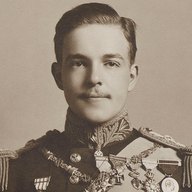
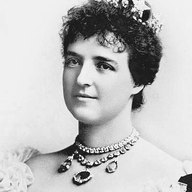
- King Manuel II to his mother, Queen Amélie, at the Pena palace in Sintra: two telegrams of 2 August 1910 and one of 8 August, sent from Bussaco. Each opens and closes in clear (“Querida mãe … Tudo bem … Beijo mão Manuel”) with code groups between.
- Where
- Arquivo Nacional Torre do Tombo, Documentos de D. Carlos, D. Amélia e D. Manuel II, maço 13 (PT/TT/CAM/M13), images m0015–m0022, via DigitArq. Catalogue entry 408, which gave “1908–1910” and an unknown place.
- The cipher
- A code of five-figure groups, with short items “05” and “06” between them. The two long telegrams share four groups and open with a parallel run after the same clear words, so they use one code.
- How it was tried
- All three telegrams transcribed from the receiving forms and the item counts checked against the word count on each form. Repeats and shared groups listed, with a chance control. Count Sabugosa’s code of 1903–1910 was tested and does not fit.
- Why it resists
- No decode of these telegrams is in M13 and no codebook was found, so no group has a value to start from.
- Still open
- All 93 items. One decoded telegram in this code, perhaps in another CAM unit of Manuel II’s papers, would make the shared opening a crib.
- Credit
- Transcription, dating and the group analysis by WAINUT (contributed 27 October 2026), done with AI language-model agents; the transcriptions were made with a vision-capable language model from the DigitArq images, and the first sheet of m0021 was transcribed a second time by another agent.
01 The unit
Maço 13 of the papers of King Carlos, Queen Amélie and King Manuel II at the Torre do Tombo has 22 images on DigitArq. Only the three telegrams are in code: the letters and cards (m0001–m0014) are in clear. One of them, m0001–m0002, is a pencil text in telegram style signed Manuel (“Confidencialíssimo. Realisou-se hoje jantar no Paço offerecido Rainha Viuva …”), which may be the decode of a London telegram of May 1910. Its coded form is not in M13, and it does not match these three telegrams.
02 The telegrams
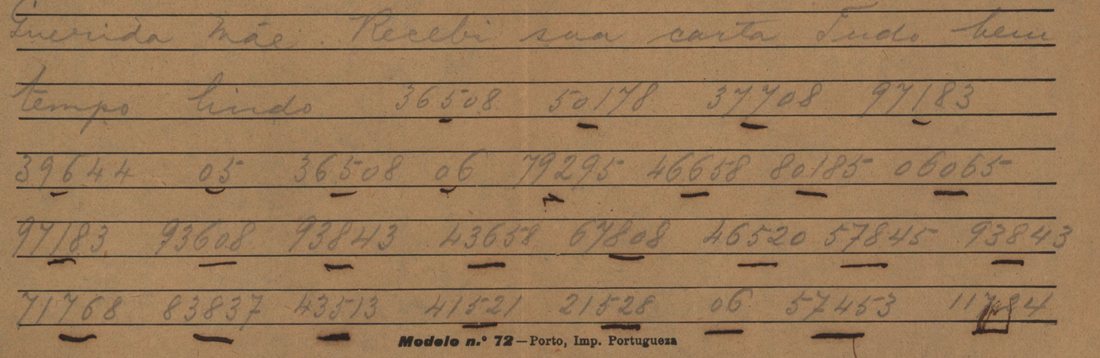
All three are receiving forms (Modelo 72) of the telegraph office of the Real Paço da Pena, stamped 2 AGO 10 and 8 AGO 10, with the groups written out by hand by the receiving clerk.
| images | route and date | items | clear words |
|---|---|---|---|
| m0019 | Bussaco → Pena, 2 Aug 1910, no. 62 | 3 groups | “Resposta A 22/2” (reading uncertain) |
| m0021 + m0022 | Bussaco → Pena, 2 Aug 1910, no. 55, “urgente” | 54 (49 groups, five “06”) | “Querida mãe Tudo bem Tempo lindo veio Sabugosa hoje” … “Beijo mão Manoel” |
| m0015 + m0017 | Bussaco → Pena (Cintra), 8 Aug 1910 | 36 (31 groups, one “05”, four “06”) | “Querida Mãe. Recebi sua carta Tudo bem tempo lindo” … “Beijo mão Manuel” |
In English the clear words say “Dear Mother, all well, lovely weather, Sabugosa came today … I kiss your hand, Manuel” and “Dear Mother, I received your letter, all well, lovely weather … I kiss your hand, Manuel”. On both long telegrams the word count on the form (72 and 54) equals the code items plus the clear and address words, which checks the number of items.
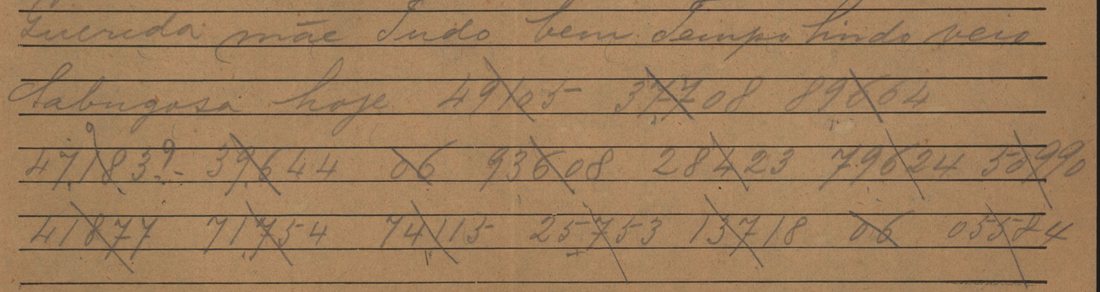
A first pass listed 15 groups of m0021 starting at 37708. The sheet has two more groups before it, the group read 37644 is 39644 (as in m0015 and m0022), and the telegram goes on for 37 items on m0022, marked as sheet 2.
03 What the groups show
- One code. m0021–22 and m0015 share 37708, 39644, 93608 and 97183. Two random telegrams of 36 and 54 groups drawn from 00000–99999 share two groups in about 1 trial in 10,000.
- A stock phrase. After the same clear words “Tudo bem tempo lindo” both open with a parallel run: 36508 50178 37708 97183 39644 05 36508 06 on 8 August, and 4965 37708 89864 97183 39644 06 93608 on 2 August (after “veio Sabugosa hoje”).
- Repeats. Within m0015: 36508, 97183 and 93843 twice each. Within m0021–22: 39644, 41877 and 71394 twice each.
- The short telegram. m0019 consists of the three groups of m0022 that are underlined in brown (57710 29134 70790). It is probably a service repetition of doubtful groups; that is an inference.
- Short items. “05” and “06” stand between groups, as “03” does in King Carlos’s telegrams of 1903.
04 What was tried
- Known keys. Count Sabugosa’s alphabetical code of 1903–1910 (52 values known) does not fit: no group matches, as written or with the struck third figure dropped, and 7 of 79 groups would then fall beyond its last known value (veio, 9019). King Carlos’s 1903 code has no values to test.
- Clear pages. The clear openings and closings are transcribed; the letters of M13 hold no decode of these telegrams.
- Print. One web search found no printed decipherment. The days fit the King’s stay at Bussaco in August 1910, which was not checked against the literature.
- Key rebuilding. Not possible without one decoded telegram in the code.
05 What remains open
- All 93 items of the three telegrams have no value: m0021–22, 54 items; m0015–17, 36 items; m0019, 3 groups.
- Doubtful figures, mostly under the receiver’s stroke: 4965 (read as four figures), 89864, 47183 (corrected to 97183 by the receiver), 29773, 09774, 07124, 65554, 61538, 20078 in no. 55, and 11784 in the telegram of 8 August. Telegrams m0015–17 and m0022 have had one reading only.
- The clear line of m0019, “Resposta A 22/2”, is an uncertain reading.
- What the receiver’s strokes through the third figure (m0021–22) and his dashes (m0015) mean is not known.
- What would finish it: a decode of any telegram in this code. The pencil text on m0001–m0002 and the telegram behind Sabugosa’s decode of 22 May 1910 may have coded forms in another CAM unit; either would be a crib.
06 Sources
- Arquivo Nacional Torre do Tombo, Documentos de D. Carlos, D. Amélia e D. Manuel II, maço 13, PT/TT/CAM/M13, DigitArq record: images m0015 and m0017 (telegram of 8 August 1910; backs m0016, m0018), m0019 (no. 62 of 2 August; back m0020), m0021 and m0022 (no. 55 of 2 August).
- Count Sabugosa’s telegrams and code: targets/sabugosa1910/ (ANTT PT/TT/CAM/M14).
Files: targets/manuel1910/ (notes, the three transcriptions, groups.py with its output). Contributed by WAINUT; reviewed for the site on 27 October 2026.