At a glanceExisting decipherment · 400 of 409 code items
- The telegrams
- Venceslau de Lima, head of the government, to King Manuel II during the King’s state visit of November–December 1909: one to Madrid (12 November) and seven to Paris (27 November – 2 December). Nine telegrams on eleven forms; eight carry code.
- Where
- Arquivo Nacional Torre do Tombo, Documentos de D. Carlos, D. Amélia e D. Manuel II, maço 9, PT/TT/CAM/M09, 21 images on DigitArq. Catalogue entry 409.
- The cipher
- A Portuguese two-part (randomised) code of five-figure groups, with 06 for the full stop and 04 for the comma. Words not in the book are spelled in syllables: Bri-and, Medi-na, chega-ria.
- How it was deciphered
- The receiver wrote the meaning in pencil above nearly every group. The texts are transcribed from those decodes; a review against the full-resolution scans corrected five readings of the first pass. Pairing the glosses with the groups gives 261 code values.
- What it says
- The return route by night train to Medina del Campo and a special train to Lisbon, to avoid a stop at Luso, “incommoda e de mau effeito”; edits to the King’s toast in Paris; the Legion of Honour; the reception in Lisbon.
- Still open
- Nine code items: three groups with no gloss (two of them garbled), six whose pencil is too faint to read.
- Credit
- Transcription, dating, the code values and the controls by WAINUT (27 October 2026), done with AI language-model agents; the transcriptions were made with a vision-capable model from the DigitArq images and reviewed by a second agent. The decodes are the receiver’s of 1909.
01 The telegrams
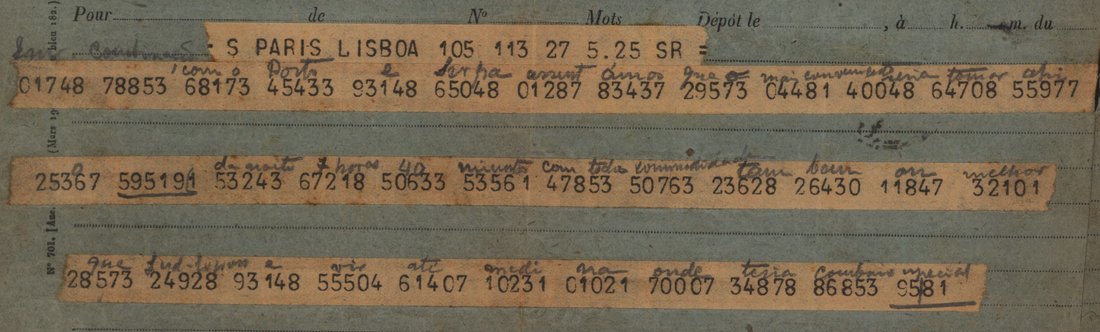
Maço 9 holds nine telegrams on eleven forms; the even-numbered images are mostly backs. Two are on Spanish palace forms (“Real Palacio”, Lisbon to Madrid, by hand): m0001, a clear text with four code groups, and m0003–m0004, all in clear. Seven are on French receiving forms with printed strips, Lisbon to Paris, Hotel Bristol; two of them run over two forms (m0011 + m0012, m0018 + m0016).
| images | route and date | code items | state |
|---|---|---|---|
| m0001 | Lisbon → Madrid, no. 6625, 12 Nov 1909 | 4, in a clear text | complete |
| m0011 + m0012 | Lisbon → Paris, no. 105, 27 Nov | 101 | 97 of 101 |
| m0018 + m0016 | Lisbon → Paris, no. 24, 28 Nov | 91 | 90 of 91 |
| m0014 | Lisbon → Paris, no. 25, 28 Nov | 31 | complete |
| m0009 | Lisbon → Paris, no. 141, 30 Nov, via Eastern | 47 | 45 of 47 |
| m0005 | Lisbon → Paris, no. 425, 30 Nov | 30 | complete |
| m0020 | Lisbon → Paris, no. 325, 30 Nov | 65 | 64 of 65 |
| m0007 | Lisbon → Paris, no. 43, 2 Dec, via Eastern | 40, among clear text | 39 of 40 |
The French form says that the first number after the place of origin is the serial number and the second the taxed words, so every Paris strip runs Lisbon to Paris. The year is not on the strips; the stamps read 27 NOV 09, and the dates fit together: m0011 is dated the 27th, a Saturday in 1909; m0009 (30th) complains of no answer to “Saturday’s telegram” and says the King leaves “the day after tomorrow”; m0007 (2 December) thanks him for agreeing.
The word count checks the transcription. On four of the seven Paris forms (m0005, m0007, m0011, m0014), code items + clear words + a constant 9 for the address equal the taxed count of the header. m0020 gives 83, the figure the receiver pencilled over the header’s 93. m0009 is one short, and the office noted “(Correction suivra pour mot qui manque)”; m0018 is one short although its 91 groups were checked one by one.
02 The decodes of 1909
The receiver wrote the meaning above nearly every group, and marked his doubts: a circled group with “(? uma palavra indecifravel)” in m0007, and underlined groups that came through garbled. A reviewing agent re-read six of the eight coded telegrams against the full-resolution scans and corrected five readings of the first pass:
- m0011 opens “Em combinação [?] com o Porto e Serpa assentámos”, not “Em Coimbra, como Porto e Serpa”: the margin gloss “Em combina[ção]” stands over 01748 78853, and 68173 is “com o”.
- m0014: 93186 is “G.C. Legião”.
- m0018: 69958 + 66931 are “tend-” + “-es”, i.e. “tendes feito”, the words of the King’s draft.
- m0020: 51443 is “contar com” and 19864 “isso” (one value, not two); 05068 “inconveniencia” and 19313 “posso” or “pouco” are doubtful.
- m0011: 48696 is “Hen..” (Hendaye?), and 43243 is left open there.
One addition of this pass: 10231 + 01021 are glossed “medi” + “na” and spell Medi-na in both places, so m0011 has “vir até Medina, onde” and “em Medina para o trem especial”.
03 The code
Pairing the glosses with the groups gives 261 distinct groups for 409 code items (groups.py, code_values.tsv). They are words, phrases (“com toda urgencia”, “depois de amanhã”, “dar ordens”, “resposta ao telegramma”), and syllables or endings for words not in the book (insis- / -to, Bri- / -and, estreit- / -amento, chega- / -ria, tornar- / -á).
The code is two-part. Over 227 cleanly glossed groups, the rank correlation between group number and the alphabetical order of the value is 0.068, which 30% of 2000 random shuffles reach, and every first figure carries values from almost the whole alphabet. So an open group cannot be bracketed between its neighbours. Repeated groups agree: seven recur with two forms of one word or phrase (Em/em, teve/tem, terá/teria, comboio/comboios, relação/relações, 1 hora/uma hora). The one exception is 43243, “da” four times but glossed something like “dep..” in m0011.
It is not the code of the neighbouring folders. No group is shared with King Carlos’s code of 1903, the Count of Sabugosa’s, Manuel II’s of August 1910 or Hintze Ribeiro’s of 1903. In this unit 38% of a telegram’s groups recur in the other seven, so a telegram of 54–106 groups in the same code would share some by chance; the chance of sharing none is below 2×10⁻⁶ for each folder.
04 What they say
Telegram no. 105 of 27 November (m0011 + m0012), in the receiver’s decode; [?] marks a group not read or doubtful:
Em combinação [?] com o Porto e Serpa assentámos que o mais conveniente seria tomar ahi o [?] da noite, 7 horas 40 minutos, com toda commodidade, tam bem ou melhor que [o] Sud-Express, e vir até Medina, onde teria comboio especial que chegaria a Lisbôa ás 11 horas [da] manhã ou mais tarde, se assim convier. Supprimia-se d’esta forma [a] paragem no caminho em Luso, incommoda e de mau effeito. […] Aguardando [?] Vossa Magestade para dar ordens, que são urgentes. W. de Lima.
“In agreement with Porto and Serpa we settled that the best course would be to take there the [?] night train at 7.40 pm, in full comfort, as well as or better than the Sud-Express, and come as far as Medina [del Campo], where a special train would wait that would reach Lisbon at 11 in the morning, or later if preferred. This would cut out the stop on the way at Luso, which is awkward and makes a bad impression.”
The other seven:
- m0001 (12 November, to Madrid): thanks for the welcome in Spain; “Tudo continua sem novidade. Escrevo Windsor.”
- m0018 (28 November): Lima edits the King’s reply toast for the President’s dinner: “e amizade” after “sympathia”, thanks for the welcome “na sua intellectual Paris”, “maior estreitamento das suas relações”.
- m0014 (28 November): since the President has given the Grand Cross of the Legion of Honour to Bocage, the King should be friendly to Briand, with no inequality against what was done in England and Spain.
- m0009 and m0005 (30 November): no answer yet about the return trains; departure is the day after tomorrow; a stop at Bussaco would be awkward; Vasconcellos Porto presses for an answer.
- m0020 (30 November): the King should go only to São Carlos on the evening of his arrival and receive at the station.
- m0007 (2 December): arrival in Lisbon at 1.15 pm; greetings at Vilar Formoso; lunch between Santarém and Lisbon.
05 What remains uncertain
Nine of 409 code items are open; each telegram is at 95.7% or above.
- m0007: 50667, circled by the receiver, who wrote “uma palavra indecifravel”. One occurrence, and a two-part code cannot be bracketed.
- m0011: 595191, a garbled six-figure group, underlined, with no gloss.
- m0018: 33125, underlined, no gloss, one occurrence.
- m0011, line 7: 85178 and 70706 (“Tratando”, “rendoso” [?]) and the gloss of 43243 (“dep..” [?]): the pencil is too faint on the scan. 48696 “Hen..” (Hendaye?) is doubtful.
- m0009: 18703 and 10586, faint pencil (“comp..são”, “Th..” [?]).
- m0020: 83636, gloss “o Rojo”, “o Rozo” or “o Bojo”; 05068 and 19313 doubtful.
- m0001 and m0007 have had one reading only; the other six were re-read against the scans.
- The word counts of m0009 and m0018 are each one short; m0009’s word was probably lost in transmission, m0018’s is not found.
Full texts
The transcription and the decryption of every document on this page, so that the reading can be used and checked. Short files are shown here; all are in the repository.
m0001, Lisbon -> Madrid (Palacio Real), 12 Nov 1909
At the start of the King's state visit, Lima repeats his congratulations on the welcome in Madrid; coded: all continues without news, he is writing to Windsor.
Transcription
# ANTT PT/TT/CAM/M09, image m0001 (back m0002). Spanish palace telegraph form "Real Palacio", by hand.
# Despacho de Lisboa, Num. 6625; Expedido el 12 a las 2.50 t[arde]; Recibido el 12 de N[oviem]bre a las 4.20 t [?].
# Address: Sua Magestade el Rei de Portugal - Palacio Real Madrid. The year (1909) is not on the form; it follows
# from the content and the other telegrams of the unit.
# The text is in clear; four code groups stand before the closing, each with a pencil gloss above it (decode of the
# time). Accents as far as legible; "amais" as written.
Reitero minhas felicitações á Vossa Magestade pelo caloroso acolhimento ahi recebido e que entre nos tem produzido os amais grata impressão 05764 21269 80054 99924 beijo as mãos a Vossa Magestade. Wenceslau de Lima.
Decryption
# m0001: group by group with the pencil gloss of the time (Lisbon -> Madrid, 12 Nov 1909).
# Code groups with the gloss written above them; clear words of the telegram in capitals as (clear).
# Hyphens mark our split of one glossed word over two groups. [?] = no usable gloss; ? = doubtful.
# Notes in brackets are ours.
(clear) Reitero minhas felicitações á Vossa Magestade pelo caloroso acolhimento ahi recebido e que entre nos tem produzido os amais grata impressão
05764   Tudo ?   [first figure may be read s or 0]
21269   continua sem novidade
80054   Escrevo ?   [fourth figure unclear]
99924   Windsor
(clear) beijo as mãos a Vossa Magestade. Wenceslau de Lima.
Reading
# m0001: Venceslau de Lima to King Manuel II, Lisbon -> Madrid (Palacio Real), 12 Nov 1909

Reitero minhas felicitações a Vossa Magestade pelo caloroso acolhimento ahi recebido e que entre nós tem produzido
a mais grata impressão. Tudo continua sem novidade. Escrevo [para] Windsor. Beijo as mãos a Vossa Magestade.
Wenceslau de Lima.
Translation
# m0001: English translation

I again congratulate Your Majesty on the warm welcome received there, which has made the happiest impression among
us. Everything continues without news. I am writing to Windsor. I kiss Your Majesty's hands. Wenceslau de Lima.

Notes. From the pencil decode of the time above the groups; in the reading [ ] marks our addition and [?] a group not read or doubtful. Only "Tudo continua sem novidade. Escrevo Windsor" is coded (four groups); the rest is in clear on the form. The King
was in Madrid on the first leg of his state visit of November 1909 (Madrid, Paris, London); Windsor is a later stop.
The first figure of 05764 and the fourth of 80054 are not sure; the glosses are clear.
m0005, Lisbon -> Paris, 30 Nov 1909
Confidential: a stop at Bussaco would be awkward, so the King should come straight by the night express; Vasconcellos Porto presses for an answer.
Transcription
# ANTT PT/TT/CAM/M09, image m0005 (back m0006). French receiving form; printed strips.
# Header strip: LISBCA 425,-48 30 12.30 M .= (origin Lisboa, no. 425, 48 taxed words, day 30, 12.30 am).
# Stamp CENTRAL PARIS with day 30 (month and year faint). Pencil gloss above every group (decode of the time).
# The last group of line 1 is cut at the strip edge (781..); the third figure of 94794 is overwritten.
# The closing strip ends at DE; LIMA is not on it (torn or cut), restored as [LIMA]: with it the word count fits.
=33453 10887 63900 40848 41024 04 10353 52854 98828 94794 57624 50808 66266 781??
94243 36467 41966 43243 42277 06 89274 45433 01794 46523 79456 28573 99211 75137
00327 25584 BEIJO AS MAOS DE VOSSA NAGESTADE .= WENCESLAU DE [LIMA]
Decryption
# m0005: group by group with the pencil gloss of the time (Lisbon -> Paris, 30 Nov 1909).
# Code groups with the gloss written above them; clear words of the telegram in capitals as (clear).
# Hyphens mark our split of one glossed word over two groups. [?] = no usable gloss; ? = doubtful.
# Notes in brackets are ours.
33453   Confidencial
10887   paragem
63900   Bussaco
40848   teve
41024   inconveniente
04      ,
10353   por isso
52854   insis-
98828   -to
94794   vantagem ?   [third figure overwritten]
57624   vinda
50808   directa
66266   sah-
781??   -indo ?   [group cut at the strip edge]
94243   d'ahi
36467   no
41966   rapido
43243   da
42277   noite
06      .
89274   Vasconcellos
45433   Porto
01794   insta
46523   pela
79456   resposta
28573   que
99211   muito
75137   peço
00327   a
25584   V. M.
(clear) BEIJO AS MAOS DE VOSSA NAGESTADE .= WENCESLAU DE [LIMA]
Reading
# m0005: Venceslau de Lima to King Manuel II, Lisbon -> Paris, 30 Nov 1909, 12.30 am

Confidencial. Paragem Bussaco teve inconveniente, por isso insisto [na] vantagem [da] vinda directa, sahindo d'ahi no
rapido da noite. Vasconcellos Porto insta pela resposta, que muito peço a Vossa Magestade Beijo as mãos de Vossa Magestade.
Wenceslau de [Lima].
Translation
# m0005: English translation

Confidential. A stop at Bussaco would have been awkward, so I insist on the advantage of coming straight through,
leaving there [Paris] by the night express. Vasconcellos Porto is pressing for the answer, which I earnestly ask of Your
Majesty. I kiss Your Majesty's hands. Wenceslau de [Lima].

Notes. From the pencil decode of the time above the groups; in the reading [ ] marks our addition and [?] a group not read or doubtful. "teve" (had) is the gloss; the sense is conditional. Vasconcellos Porto is presumably the minister in charge of the
King's return journey [our identification, not checked].
m0007, Lisbon -> Paris, 2 Dec 1909
The return journey settled: arrival in Lisbon at 1.15 pm, greetings at Vilar Formoso, rest as far as Pampilhosa, lunch between Santarém and Lisbon.
Transcription
# ANTT PT/TT/CAM/M09, image m0007 (back m0008). French receiving form; printed strips.
# Header strip: SSS LISBOA 43 122 2 12.55 M = EASTERN = (no. 43, 122 taxed words, day 2 [Dec], 12.55 am, via Eastern).
# Pencil gloss above the groups (decode of the time), a lighter hand over line 3. The receiver circled 50667 and
# wrote under the strips "(? uma palavra indecifravel)". The first letter of line 5 is torn: [M]E.
= AGRADECO O TELEGRAMMA DE VOSSA MAJESTADE E SUA CONCORDANCIA COM
OS ALVITRES PROPOSTOS 70606 28140 91731 80124 93148 64124 82633 43243 11598 06
03481 34878 41024 46523 73027 01748 06777 93148 49113 49600 05123 99251 06
20481 58538 28787 47841 41024 67031 35184 06 MUITO AGRADECERIA VOSSA MAJESTADE
[M]E DISSESSE SE SE DIGNA RECEBER COMPRIMENTOS A ENTRADA EM PORTUGAL EM VILLAR
FORMOSO ONDE MUITO DESEJAM PRESTAR LH OS DEPOIS NENHUNS OUTROS TERA POR SER DE
NOITE E PARA PODER DESCANCAR ATE A PAMPILHOSA ONDE CHEGA AS 8 HORAS DA MANHA
ALMOCO ENTRE SANTAREM E LISBOA 02183 50667 93148 87231 18507 80124 93148
64124 82633 BEIJO AS MAOS DE VOSSA MAGESTADE = WENCESLAU DE LIMA
Decryption
# m0007: group by group with the pencil gloss of the time (Lisbon -> Paris, 2 Dec 1909).
# Code groups with the gloss written above them; clear words of the telegram in capitals as (clear).
# Hyphens mark our split of one glossed word over two groups. [?] = no usable gloss; ? = doubtful.
# Notes in brackets are ours.
(clear) = AGRADECO O TELEGRAMMA DE VOSSA MAJESTADE E SUA CONCORDANCIA COM
(clear) OS ALVITRES PROPOSTOS
70606   hora
28140   chegada
91731   Lisbôa
80124   1 hora
93148   e
64124   um
82633   quarto
43243   da
11598   tarde
06      .
03481   mais cêdo ?   [light pencil]
34878   terá   [light pencil]
41024   inconveniente   [light pencil]
46523   pela
73027   passagem
01748   em
06777   Pampilhosa
93148   e
49113   Coimbra
49600   cêdo
05123   de
99251   mais
06      .
20481   mais tarde
58538   torna-   [gloss 'tornaria' spans 58538 and 28787]
28787   -ria   [same split as chega-ria in m0011]
47841   a marcha
41024   inconveniente-
67031   -mente
35184   lenta
06      .
(clear) MUITO AGRADECERIA VOSSA MAJESTADE
(clear) [M]E DISSESSE SE SE DIGNA RECEBER COMPRIMENTOS A ENTRADA EM PORTUGAL EM VILLAR
(clear) FORMOSO ONDE MUITO DESEJAM PRESTAR LH OS DEPOIS NENHUNS OUTROS TERA POR SER DE
(clear) NOITE E PARA PODER DESCANCAR ATE A PAMPILHOSA ONDE CHEGA AS 8 HORAS DA MANHA
(clear) ALMOCO ENTRE SANTAREM E LISBOA
02183   Das
50667   [?]   [circled; the receiver wrote '(? uma palavra indecifravel)']
93148   e
87231   meia
18507   ás
80124   uma hora
93148   e
64124   um
82633   quarto
(clear) BEIJO AS MAOS DE VOSSA MAGESTADE = WENCESLAU DE LIMA
Reading
# m0007: Venceslau de Lima to King Manuel II, Lisbon -> Paris, 2 Dec 1909, 12.55 am

Agradeço o telegramma de Vossa Majestade e sua concordancia com os alvitres propostos. Hora [de] chegada [a] Lisbôa
1 hora e um quarto da tarde. Mais cêdo terá inconveniente pela passagem em Pampilhosa e Coimbra cêdo de mais; mais
tarde tornaria a marcha inconvenientemente lenta. Muito agradeceria Vossa Majestade me dissesse se se digna receber
comprimentos á entrada em Portugal em Villar Formoso, onde muito desejam prestar-lh'os. Depois nenhuns outros terá,
por ser de noite e para poder descançar até á Pampilhosa, onde chega ás 8 horas da manhã. Almoço entre Santarem e
Lisboa, das [?] e meia ás uma hora e um quarto. Beijo as mãos de Vossa Magestade. Wenceslau de Lima.
Translation
# m0007: English translation

I thank Your Majesty for your telegram and for agreeing to the proposals. Arrival time in Lisbon a quarter past one
in the afternoon. Any earlier would be awkward, because the train would pass Pampilhosa and Coimbra too early; any
later would make the journey needlessly slow. I should be most grateful if Your Majesty would tell me whether you will
receive greetings on entering Portugal at Vilar Formoso, where they very much wish to offer them. After that there
will be none, because it will be night, so that you can rest as far as Pampilhosa, which you reach at 8 in the
morning. Lunch between Santarém and Lisbon, from half past [?] to a quarter past one. I kiss Your Majesty's hands.
Wenceslau de Lima.

Notes. From the pencil decode of the time above the groups; in the reading [ ] marks our addition and [?] a group not read or doubtful. Mostly in clear. 50667 is circled on the form; the receiver wrote "uma palavra indecifravel" (one undecipherable
word), so the hole is his as well as ours. The decoder wrote "tornaria" over 58538 28787; 28787 is "-ria" also in
"chega-ria" (m0011).
m0009, Lisbon -> Paris, 30 Nov 1909
No answer yet to Saturday's telegram about the return trains; the departure is the day after tomorrow and nothing is fixed; Lima asks for a decision most urgently.
Transcription
# ANTT PT/TT/CAM/M09, image m0009 (back m0010). French receiving form; printed strips.
# Header strip: SS LISBON 141 68 30 10H30 M VOIE EASTERN = (no. 141, 68 taxed words, day 30, 10.30 am, via Eastern).
# Pencil gloss above the groups (decode of the time). The office added after the signature
# "(Correction suivra pour mot qui manque)". BEIJM for BEIJO as printed.
13341 84456 05123 19586 84656 86853 05123 22596 68520 48367
63178 04184 28573 01953 07658 25367 20768 43243 88117 05123
25584 93148 62021 94201 56911 70283 10341 60201 76224 28573
99211 75137 45853 06 89274 45433 40848 02848 18703 10586
01021 24686 41966 24357 15771 10341 91033 DE VOSSA MAGESTADE A
QUEM BEIJM AS MAOS .= WENCESLAU DE LIMA .=
Decryption
# m0009: group by group with the pencil gloss of the time (Lisbon -> Paris, 30 Nov 1909).
# Code groups with the gloss written above them; clear words of the telegram in capitals as (clear).
# Hyphens mark our split of one glossed word over two groups. [?] = no usable gloss; ? = doubtful.
# Notes in brackets are ours.
13341   Falta de ?   [perhaps a garbled 10341 falta]
84456   resposta ao telegramma
05123   de
19586   sabbado
84656   relativo
86853   comboios
05123   de
22596   regresso
68520   causa
48367   o maior
63178   transtorno
04184   Lembro
28573   que
01953   depois de amanhã
07658   é
25367   o
20768   dia
43243   da
88117   partida
05123   de
25584   V. M.
93148   e
62021   nada
94201   está
56911   fixado
70283   por ?
10341   falta
60201   essa
76224   indicação
28573   que
99211   muito
75137   peço
45853   com toda urgencia
06      .
89274   Vasconcellos
45433   Porto
40848   tem
02848   telegraphado
18703   [comp..são?]   [gloss unclear]
10586   [Th..?]   [gloss unclear]
01021   na
24686   hypothese
41966   rapido
24357   Norte
15771   mas ?
10341   falta
91033   decisão
(clear) DE VOSSA MAGESTADE A
(clear) QUEM BEIJM AS MAOS .= WENCESLAU DE LIMA .=
Reading
# m0009: Venceslau de Lima to King Manuel II, Lisbon -> Paris, 30 Nov 1909, 10.30 am

Falta de resposta ao telegramma de sabbado relativo [a] comboios de regresso causa o maior transtorno. Lembro que
depois de amanhã é o dia da partida de Vossa Magestade e nada está fixado por falta [d']essa indicação, que muito peço com toda
urgencia. Vasconcellos Porto tem telegraphado [?] [?]. Na hypothese [do] rapido Norte, mas falta decisão de Vossa
Magestade, a quem beijo as mãos. Wenceslau de Lima.
Translation
# m0009: English translation

The lack of an answer to Saturday's telegram about the return trains is causing the greatest trouble. I remind you
that the day after tomorrow is the day of Your Majesty's departure, and nothing is fixed for want of that instruction,
which I ask for most urgently. Vasconcellos Porto has telegraphed [two groups unread]. [We are working] on the
assumption of the Northern express, but Your Majesty's decision is missing. I kiss Your Majesty's hands. Wenceslau de
Lima.

Notes. From the pencil decode of the time above the groups; in the reading [ ] marks our addition and [?] a group not read or doubtful. "Saturday's telegram" is m0011 of 27 Nov 1909, a Saturday. The glosses over 18703 and 10586 are too faint to read
("comp..são", "Th.." [?]). The office noted that a correction would follow for a missing word; the word count is one
short.
m0011, Lisbon -> Paris, 27 Nov 1909
Lima proposes the return route: the 7.40 pm night train from Paris to Medina del Campo and a special train to Lisbon, cutting out the stop at Luso.
Transcription
# ANTT PT/TT/CAM/M09, images m0011 (lines 1-3) and m0012 (lines 4-9, stamp CENTRAL PARIS 27 NOV 09).
# French receiving forms; printed strips. Header strip: S PARIS LISBOA 105 113 27 5.25 SR = (destination Paris,
# origin Lisboa, no. 105, 113 taxed words, day 27, 5.25 pm). Pencil gloss above the groups (decode of the time);
# the gloss of line 1 starts in the left margin ("Em combina[ção]"). 595191 (six figures) and 9581 (four figures)
# are underlined by the receiver.
# m0011
01748 78853 68173 45433 93148 65048 01287 83437 29573 04481 40048 64708 55977
25367 595191 53243 67218 50633 53561 47853 50763 23628 26430 11847 32101
28573 24928 93148 55504 61407 10231 01021 70007 34878 86853 9581
# m0012
28573 26140 28787 00327 91731 36347 50167 87311 11847 20481 70836 22503
06 53558 18166 61836 32288 91941 10887 36467 34470 01748 30301
87054 93148 05123 38951 06 93048 46523 9194? 28573 95224 99251 26430 79853
06 85178 70706 52763 01748 48696 43243 95940 36347 79057 93148 64628 93148
01748 10231 01021 45967 75098 95181 73693 67218 53243 06 19977 25584
76777 80063 74573 93094 = W . DE LIMA ,-
Decryption
# m0011: group by group with the pencil gloss of the time (Lisbon -> Paris, 27 Nov 1909).
# Code groups with the gloss written above them; clear words of the telegram in capitals as (clear).
# Hyphens mark our split of one glossed word over two groups. [?] = no usable gloss; ? = doubtful.
# Notes in brackets are ours.
01748   Em ?   [margin gloss 'Em combina[ção]' over 01748 and 78853]
78853   combinação ?   [end of the margin gloss faint]
68173   com o
45433   Porto
93148   e
65048   Serpa
01287   assent-
83437   -ámos
29573   que o ?   [28573 que, garbled?]
04481   mais conveniente ?
40048   seria
64708   tomar
55977   ahi
25367   o
595191  [?]   [six figures, underlined, no gloss: garbled]
53243   da noite
67218   7 horas
50633   40
53561   minutos
47853   com toda
50763   commodidade
23628   tam
26430   bem
11847   ou
32101   melhor
28573   que
24928   Sud-Express
93148   e
55504   vir
61407   até
10231   Medi-   [gloss 'medi']
01021   -na   [gloss 'na': Medi-na]
70007   onde
34878   teria
86853   comboio
9581    especial ?   [four figures, underlined: 95181 mutilated]
28573   que
26140   chega-
28787   -ria
00327   a
91731   Lisbôa
36347   ás
50167   11 horas
87311   manhã
11847   ou
20481   mais tarde
70836   se assim
22503   convier
06      .
53558   Supprim-
18166   -ia
61836   se
32288   d'esta
91941   forma
10887   paragem
36467   no
34470   caminho
01748   em
30301   Luso
87054   incommoda
93148   e
05123   de
38951   mau effeito
06      .
93048   serviço
46523   pela
9194?   forma ?   [last figure under a struck gloss; 91941?]
28573   que
95224   indico
99251   mais
26430   bem
79853   combinado
06      .
85178   [Tratando?]   [gloss faint]
70706   [rendoso?]   [gloss faint]
52763   commodo
01748   em
48696   Hen[daya?] ?   [gloss 'Hen..', most likely Hendaye on the Paris-Medina line]
43243   [dep..?]   [gloss looks like 'dep..'; 43243 is 'da' four times elsewhere]
95940   já
36347   ás
79057   8 horas
93148   e
64628   tanto ?
93148   e
01748   em
10231   Medi-
01021   -na
45967   para o
75098   trem
95181   especial
73693   perto
67218   7 horas
53243   da noite
06      .
19977   aguardando ?   [gloss partly faint]
25584   V. M.
76777   para
80063   dar ordens
74573   que são
93094   urgentes
(clear) = W . DE LIMA ,-
Reading
# m0011: Venceslau de Lima to King Manuel II, Lisbon -> Paris, 27 Nov 1909, 5.25 pm

Em combinação [?] com o Porto e Serpa assentámos que o mais conveniente seria tomar ahi o [?] da noite, 7 horas 40
minutos, com toda commodidade, tam bem ou melhor que [o] Sud-Express, e vir até Medina, onde teria comboio especial que
chegaria a Lisbôa ás 11 horas [da] manhã ou mais tarde, se assim convier. Supprimia-se d'esta forma [a] paragem no
caminho em Luso, incommoda e de mau effeito. Serviço pela forma que indico mais bem combinado. [?] [?] commodo em
Hen[daya?] [?] já ás 8 horas e tanto, e em Medina para o trem especial perto [das] 7 horas da noite. Aguardando [?]
Vossa Magestade para dar ordens, que são urgentes. W. de Lima.
Translation
# m0011: English translation

In agreement [?] with Porto and Serpa we settled that the best course would be to take there [in Paris] the [?] night
[train] at 7.40 pm, in full comfort, as well as or better than the Sud-Express, and come as far as Medina [del Campo],
where a special train would wait that would reach Lisbon at 11 in the morning, or later if preferred. This would cut
out the stop on the way at Luso, which is awkward and makes a bad impression. The service is better arranged in the
way I indicate. [...] comfortable at Hen[daye?] [...] already at 8-something, and at Medina for the special train at
about 7 in the evening. Awaiting [the orders of] Your Majesty, so as to give the orders, which are urgent. W. de Lima.

Notes. From the pencil decode of the time above the groups; in the reading [ ] marks our addition and [?] a group not read or doubtful. The first pass read the margin gloss as "Em Coimbra"; it reads "Em combina[ção]" over 01748 78853, and 68173 is
"com o", so the opening is "In agreement with Porto and Serpa". 10231 is glossed "medi" and 01021 "na" (01021 is "na"
everywhere), so the two groups spell Medi-na: our split. 595191 is a garbled six-figure group with no gloss; m0005 calls
this train "o rapido da noite". In line 7, 85178 and 70706 are faint ("Tratando", "rendoso" [?]); 48696 reads "Hen.."
(Hendaye, the frontier station on the Paris-Medina line [?]); 43243, "da" four times elsewhere, here looks glossed
"dep.." and is left open.
m0014, Lisbon -> Paris, 28 Nov 1909
Since the French President has given the Grand Cross of the Legion of Honour to Bocage, the King should be friendly to Briand, with no inequality against England and Spain.
Transcription
# ANTT PT/TT/CAM/M09, image m0014 (back m0015). French receiving form; printed strips.
# Header strip: S PARIS LISBOA 25,-49-28-12./30 SR (destination Paris, origin Lisboa, no. 25, 49 taxed words,
# day 28, 12.30 pm). Stamp CENTRAL PARIS. Pencil gloss above every group (decode of the time). VCSSA as printed.
=04184 00327 25584 28573 76958 19073 85243 93186 00327 35530 64156 31158
48627 86083 06930 88667 93148 29153 82291 28428 71171 14478 01748 62656
28997 61836 96791 01748 15164 93148 14556 BEIJO AS MAOS DE VCSSA MAGESTADE
. = WENCESLAU DE LIMA
Decryption
# m0014: group by group with the pencil gloss of the time (Lisbon -> Paris, 28 Nov 1909).
# Code groups with the gloss written above them; clear words of the telegram in capitals as (clear).
# Hyphens mark our split of one glossed word over two groups. [?] = no usable gloss; ? = doubtful.
# Notes in brackets are ours.
04184   Lembro
00327   a
25584   V. M.
28573   que
76958   tendo
19073   Pres. Republica
85243   dado
93186   G. C. Legião   [Grã-Cruz da Legião [de Honra]]
00327   a
35530   Bocage
64156   importar
31158   ser
48627   amavel
86083   com
06930   Bri-
88667   -and
93148   e
29153   não deixar
82291   má impressão
28428   sobretudo   [gloss 'sobre tudo']
71171   não haver
14478   desigualdade
01748   em
62656   relação
28997   ao que
61836   se
96791   fez
01748   em
15164   Inglaterra
93148   e
14556   Hespanha
(clear) BEIJO AS MAOS DE VCSSA MAGESTADE
(clear) . = WENCESLAU DE LIMA
Reading
# m0014: Venceslau de Lima to King Manuel II, Lisbon -> Paris, 28 Nov 1909, 12.30 pm

Lembro a Vossa Magestade que, tendo [o] Pres[idente da] Republica dado [a] G[rã-]C[ruz da] Legião [de Honra] a Bocage, importa
ser amavel com Briand e não deixar má impressão, sobretudo não haver desigualdade em relação ao que se fez em
Inglaterra e Hespanha. Beijo as mãos de Vossa Magestade. Wenceslau de Lima.
Translation
# m0014: English translation

I remind Your Majesty that, since the President of the Republic has given the Grand Cross of the Legion of Honour to
Bocage, it matters to be friendly to Briand and leave no bad impression; above all there must be no inequality with
what was done in England and Spain. I kiss Your Majesty's hands. Wenceslau de Lima.

Notes. From the pencil decode of the time above the groups; in the reading [ ] marks our addition and [?] a group not read or doubtful. Bocage is presumably Carlos du Bocage, Portuguese foreign minister in 1909, and Briand the French premier [our
identifications, not checked]. The point is a Portuguese decoration for Briand in return. 93186 is glossed
"G.C. Legião" (the first pass had "a decoration, gloss unclear").
m0018, Lisbon -> Paris, 28 Nov 1909
Lima edits the King's reply toast for the President's dinner, adding friendship, thanks for the welcome in "intellectual Paris" and the tightening of relations.
Transcription
# ANTT PT/TT/CAM/M09, images m0018 (lines 1-5) and m0016 (lines 6-8 and the signature strip).
# French receiving forms; printed strips. Header strip: S S DE LISBOA 24,-110-28-12./25 SR (origin Lisboa, no. 24,
# 110 taxed words, day 28, 12.25 pm). Pencil gloss above the groups (decode of the time); 62656 and 33125
# underlined by the receiver, 33125 without a gloss.
# m0018
=81958 76628 45187 76204 93397 01748 75896 55887 52483 65538 45930 21344
99251 47050 06 29967 79373 36467 88163 23553 00327 38806 00327 37608
34737 93148 38437 36467 70806 23553 00327 38806 00327 69958 66931 78401
44118 95523 93397 63573 72998 00327 36021 78896 01021 84798 02256 93148
11430 32410 01021 84798 55974 96887 06 96047 18878 23553 00327 38806
# m0016
14761 67433 93148 00327 75896 90974 93148 90977 95523 76251 33511 05437
19183 62656 87836 36467 45930 19073 14723 95583 95181 82381 01021 79456
00327 12838 62587 33125 39998 93148 18803 BEIJO AS MAOS DE VOSSA MAJESTADE
= WENCESLAU DE LIMA ,-
Decryption
# m0018: group by group with the pencil gloss of the time (Lisbon -> Paris, 28 Nov 1909).
# Code groups with the gloss written above them; clear words of the telegram in capitals as (clear).
# Hyphens mark our split of one glossed word over two groups. [?] = no usable gloss; ? = doubtful.
# Notes in brackets are ours.
81958   Tendo sido
76628   tão
45187   affect[uoso]
76204   nosso
93397   acolhimento
01748   em
75896   França
55887   parece
52483   conveniente
65538   tornar
45930   brinde
21344   jantar ?   [gloss unclear]
99251   mais
47050   caloroso
06      .
29967   Por isso
79373   convem
36467   no
88163   primeiro
23553   periodo
00327   a
38806   seguir
00327   a
37608   sympathia
34737   accrescentar
93148   e
38437   amizade
36467   no
70806   segundo
23553   periodo
00327   a
38806   seguir
00327   a
69958   tend-   [gloss 'tend']
66931   -es   [gloss 'es']
78401   feito
44118   dizer
95523   pelo
93397   acolhimento
63573   que nos
72998   dispensa
00327   a
36021   nação
78896   franceza
01021   na
84798   sua
02256   grande
93148   e
11430   bella
32410   capital
01021   na
84798   sua
55974   intellectual
96887   Paris
06      .
96047   ao
18878   3º
23553   periodo
00327   a
38806   seguir
14761   entre
67433   Portugal
93148   e
00327   a
75896   França
90974   intercalar
93148   e
90977   ainda
95523   pelo
76251   maior
33511   estreit-
05437   -amento
19183   das suas
62656   relações
87836   se houver
36467   no
45930   brinde
19073   do P. Republica
14723   qualquer
95583   cousa
95181   especial
82381   fazer
01021   na
79456   resposta
00327   a
12838   devida
62587   allusão
33125   [?]   [underlined, no gloss]
39998   discreta
93148   e
18803   prudente
(clear) BEIJO AS MAOS DE VOSSA MAJESTADE
(clear) = WENCESLAU DE LIMA ,-
Reading
# m0018: Venceslau de Lima to King Manuel II, Lisbon -> Paris, 28 Nov 1909, 12.25 pm

Tendo sido tão affectuoso nosso acolhimento em França, parece conveniente tornar [o] brinde [do] jantar [?] mais
caloroso. Por isso convem no primeiro periodo, a seguir a "sympathia", accrescentar "e amizade"; no segundo periodo,
a seguir a "tendes feito", dizer "pelo acolhimento que nos dispensa a nação franceza na sua grande e bella capital, na
sua intellectual Paris". Ao 3º periodo, a seguir [a] "entre Portugal e a França", intercalar "e ainda pelo maior
estreitamento das suas relações". Se houver no brinde do P[residente da] Republica qualquer cousa especial, fazer na
resposta a devida allusão [?] discreta e prudente. Beijo as mãos de Vossa Majestade. Wenceslau de Lima.
Translation
# m0018: English translation

Since our welcome in France has been so affectionate, it seems right to make the [dinner?] toast warmer. In the first
section, after "sympathy", add "and friendship"; in the second, after "you have done", say "for the welcome the French
nation gives us in its great and beautiful capital, its intellectual Paris". In the third section, after "between
Portugal and France", insert "and also for the closer tightening of their relations". If the President of the
Republic's toast contains anything special, make the due allusion in the reply, [?] discreet and prudent. I kiss Your
Majesty's hands. Wenceslau de Lima.

Notes. From the pencil decode of the time above the groups; in the reading [ ] marks our addition and [?] a group not read or doubtful. The minister edits the King's reply toast for the dinner given by the President of the Republic. 69958 and 66931 are
glossed "tend" and "es": "tendes feito", the words of the King's draft. 33125 is underlined and not glossed; 21344
"jantar" is a faint gloss [?].
m0020, Lisbon -> Paris, 30 Nov 1909
Confidential: the King should go only to São Carlos on the night of his arrival and hold the reception at the station; Lima asks for an answer.
Transcription
# ANTT PT/TT/CAM/M09, image m0020 (back m0021). French receiving form; printed strips.
# Header strip: SS DE LISBOA 325,-93,-30-12./30 M (origin Lisboa, no. 325, 93 taxed words, day 30, 12.30 pm);
# the receiver pencilled "83" above the 93. Pencil gloss above every group (decode of the time); "conveniente"
# of the first line is written in the margin above. VCSSA as printed.
=33453 57887 28573 25584 97904 00327 08396 50380 01021 42277 00228 43243 29140
06 83636 71881 86898 05068 19313 51443 19864 06 28628 55887 99251 02274
28573 25584 84123 12036 01021 84161 55967 72296 07486 68483 07053 19864 65538
40817 12036 99251 66271 93148 32101 93148 55478 40817 93048 29140 01021 04053
10977 45418 25584 99211 75137 25584 84798 79456 46523 84727 05123 70857 93048
BEIJO AS MAOS DE VCSSA MAGESTADE .= WENCESLAU DE LIMA +
Decryption
# m0020: group by group with the pencil gloss of the time (Lisbon -> Paris, 30 Nov 1909).
# Code groups with the gloss written above them; clear words of the telegram in capitals as (clear).
# Hyphens mark our split of one glossed word over two groups. [?] = no usable gloss; ? = doubtful.
# Notes in brackets are ours.
33453   Confidencial
57887   Parece conveniente ?   ['conveniente' in the margin; 55887 = parece]
28573   que
25584   V. M.
97904   só
00327   a
08396   São
50380   Carlos
01021   na
42277   noite
00228   do dia
43243   da
29140   chegada   [28140 chegada in m0007]
06      .
83636   [o Rojo?]   [gloss read 'o Rojo', 'o Rozo' or 'o Bojo']
71881   me
86898   disse se
05068   inconveniencia ?   [gloss faint]
19313   posso ?   [gloss 'posso' or 'pouco']
51443   contar com
19864   isso
06      .
28628   Tambem
55887   parece
99251   mais
02274   vantajoso ?
28573   que
25584   V. M.
84123   dê
12036   recepção
01021   na
84161   estação
55967   para o que
72296   haverá
07486   sala
68483   conveniente-
07053   preparada   [gloss 'convenientemente preparada' over 68483 07053]
19864   isso
65538   tornar-
40817   -á
12036   recepção
99251   mais
66271   facil
93148   e
32101   melhor
93148   e
55478   desembaraçar-
40817   -á
93048   serviço
29140   chegada
01021   na
04053   preparação
10977   Aguardo ?   [19977 aguardando in m0011?]
45418   determinação ?
25584   V. M.
99211   muito
75137   peço
25584   V. M.
84798   sua
79456   resposta
46523   pela
84727   necessidade
05123   de
70857   ordenar
93048   serviço
(clear) BEIJO AS MAOS DE VCSSA MAGESTADE .= WENCESLAU DE LIMA +
Reading
# m0020: Venceslau de Lima to King Manuel II, Lisbon -> Paris, 30 Nov 1909, 12.30 pm

Confidencial. Parece conveniente que Vossa Magestade só [vá] a São Carlos na noite do dia da chegada. [?] me disse se
inconveniencia [?] posso [?] contar com isso. Tambem parece mais vantajoso que Vossa Magestade dê [a] recepção na estação, para o
que haverá sala convenientemente preparada. Isso tornará [a] recepção mais facil e melhor e desembaraçará [o] serviço
[da] chegada na preparação. Aguardo determinação [de] Vossa Magestade Muito peço [a] Vossa Magestade sua resposta pela necessidade de
ordenar [o] serviço. Beijo as mãos de Vossa Magestade. Wenceslau de Lima.
Translation
# m0020: English translation

Confidential. It seems best that Your Majesty go only to [the theatre of] São Carlos on the night of the day of
arrival. [Someone] told me whether [...] I can count on that [the clause is not clear]. It also seems better that Your
Majesty hold the reception at the station, where a suitably prepared room will be ready. That will make the reception
easier and better and will free the arrival arrangements in the preparation. I await Your Majesty's decision. I
earnestly ask Your Majesty for an answer, because the arrangements have to be ordered. I kiss Your Majesty's hands.
Wenceslau de Lima.

Notes. From the pencil decode of the time above the groups; in the reading [ ] marks our addition and [?] a group not read or doubtful. Line 2 is read with the corrected glosses: 51443 "contar com", 19864 "isso" (as in line 3), 05068 "inconveniencia"
[?], 19313 "posso" or "pouco" [?]. 83636 is glossed "o Rojo", "o Rozo" or "o Bojo" and is not identified. The header
says 93 words; the receiver pencilled 83, which is the count of the strips.
Key: code_values.tsv
06 Sources
- Arquivo Nacional Torre do Tombo, Documentos de D. Carlos, D. Amélia e D. Manuel II, maço 9, PT/TT/CAM/M09, DigitArq record, 21 images (m0001–m0021).
- No printed decipherment was found in one web search; the published papers of Manuel II and of Venceslau de Lima were not searched. The decodes on the forms are the receiver’s; what is new is the transcription, the dating and direction, the word-count check, the 261 code values and the corrected readings.
Files: targets/lima1909/ (notes, transcriptions, group-by-group decryptions, readings and translations, groups.py with its output, code_values.tsv). Contributed by WAINUT; reviewed for the site on 27 October 2026.