At a glanceKey recovered from the ciphertext alone · partial · no. 6 95.4% (after a key correction, 14 Oct), no. 24 79.6% of decrypted letters understood (revised 14 Oct from 72.7%)
- The letters
- Two reports to the Signori of Siena from a Cristofano writing on the Milanese side of the war over Lucca. No. 6 is dated 19 February with no year. No. 24 has no date, and its signature is on the back.
- Where
- Archivio di Stato di Siena, Concistoro 2308, fasc. 2, nos. 6 and 24, photographed on DECODE as R4795 and R4812 (catalogued “1500–1599”, no transcription). The key is in fasc. 1 of the same busta, DECODE R4755.
- The cipher
- Homophonic substitution. There are 36 signs for 21 letters, four each for a, e, i, o and u. The key also has 7 nulls and 18 signs for whole words, five of which occur here (Lucca, Piccinino, Duca di Milano, Viniziani, Fiorentini). There is no word division.
- How it was deciphered
- George Lasry, working with Claude and with the help of ChatGPT Astra, recovered the key from the ciphertext alone. He then matched it to the filed key sheet R4755. Here, our own transcription of 24 September was decoded with that key. With the key read off the sheet by eye, it gives the same letters as his reading at 69% of positions. After fitting our sign labels, the figure is 88–91%.
- What it says
- Piccinino “cominciò a mandare quatrocento per fare aprire la via per andare a Lucca”. No. 24 reports that the marquis of Mantua and Taliano have come to terms with the Duke of Milan, and that the Emperor will not come.
- Still open
- About a quarter of no. 24 decrypts to letters that make no sense, probably from misread signs on a small photograph. The back of no. 24 is decoded here only in stretches. The writer’s surname is unread.
- Credit
- Solution by George Lasry, with Claude and ChatGPT Astra, sent to Daniel Bourdeau on 14 October 2026. The verification, the decoding of no. 24’s back, its signature and the dating check were done here.
01 The letters and the key
The two letters belong to fascicle 2, “Lettere in cifra”, of Concistoro 2308 in the Siena state archive. Our survey of the busta (siena1421) transcribed both on 24 September 2026. It found that they share one system, but no filed key fitted and every ciphertext-only solver failed on them. Each opens with a clear salutation, “Magnifici et potentes domini domini mei singularissimi”, and continues in cipher to the end.
- No. 6 (DECODE R4795): 15 lines, 1,051 signs in our transcription (1,007 in the solver’s count). It is dated 19 February and signed “Cristofano de Mont[…] si racomanda”.
- No. 24 (DECODE R4812): 38 lines on the text side, 2,638 signs in our transcription (2,559 in his). Eight more cipher lines run over onto the back, above the address “Magnifici et potenti signiori e … Capitano di popolo della citta di Siena”.
The key, R4755, is a single sheet in fascicle 1 headed “Cifra cum Christofano” followed by a surname that is hard to read. DECODE reads it “Ghinucci[?]”. The signature of no. 6, “Mont‹vccia›” in the solver’s reading, suggests something like Montucci instead. That is left as a question. Our own survey had listed this sheet on 24 September but never tried it on these two letters.
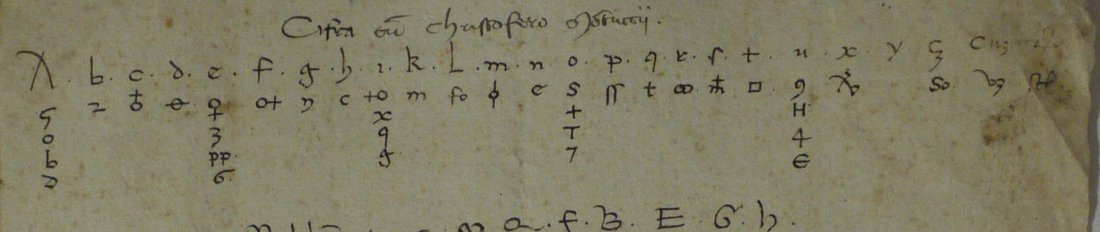
On the DECODE photograph the sheet gives 36 letter signs (k, h and x included, nothing for y), 7 nulls and 18 word signs. The word signs are Papa, Fiorentini, Viniziani, Duca di Milano, Nicholo Piccinino, Conte Francesco, Luccha, Pisa, Pistoia, Siena, Pontremoli, Parma, Pietrasanta, Genova, Bologna, Messer Thomaso, Cavagli and Fanti. This matches the solver’s description. His count of word signs that occur also holds: five of the 18. Our transcription had already marked the same point-framed signs as “probable name codes”.
02 No. 6: Piccinino opens the road to Lucca
This is the solver’s reading. Square brackets mark letters he supplied; ‹…› marks letters that decrypt but make no sense.
… e crede di certo lui s[t]a aconcio co’ Viniziani … [se] avete bis[o]gnio di gente d’arme, qua se n’ trovarebbe degli uomeni valenti, e ven[i]r{d}e a dì quatordici di questo Piccinino cominc[i]ò a mandare {eo} quatrocento per fare [e] [a]prire la via per andare a Lucca; e à mandato i tronbetti per le brigate, {v} che sieno q[u]i per questa semana; e se ’l tenpo sarà mai più buono, se partiranno per tucto questo mese. … E data a dì dicenove di Febrai[o]. Cristofano de Mont‹vccia› ‹·› si rac[o]manda. E il ea non s’achordarà col Duca di Milano, perché vuole troppe cose.
A man has settled his accounts with the Venetians and is thought to have taken service with them. Men-at-arms could be had for Siena. On the 14th Piccinino began sending four hundred men to open the road to Lucca, and trumpeters have gone to call up the companies. The chancellor of messer Antonio Petrucci has come back from Milan. A postscript says someone will not come to terms with the Duke of Milan “because he wants too many things”.
In this reading 62 of the 941 decrypted letters (6.6%) stand in ‹…›, scattered single words. Three of them come from one sign. The key writes z as a compound, an S with a small o attached (“So”), while a plain S is o; read as two signs, the z disappears. Restored, it gives “d’avere buona aduertenza” (good care), “per facti di Vincenzo da Camerino”, and “tornò da Milano senza avere fact[o] nula”: Petrucci’s chancellor came back from Milan without having done anything, where the reading above has him going “to Siena” (the last word needs the key’s 4 = u). All three places were checked on the photograph. With them no. 6 reads 896 of 939 decrypted letters as sense (95.4%). The revised reading is kept beside the submitted one in the repository.
03 No. 24: Mantua and Taliano go over to Milan
… e Lucca tiene de certo il {e}r[e] s’achordarà con lui … e q[u]i à man{n}dato uno ‹svvfai›‹iglioatire› a Lucca che no[n] t[i] besogniarà ‹lvinaoa› a sochorare Lucca … il marchese di Manto{·}[v]a è acordato col Duca di Milano … e certo si tiene lo ’npe[r]adore non ver{e}rà; e Lucca dice che Taliano [s]’è aconcio col Duca di Milano …
Ambassadors of Lucca, Camerino and the Florentines are present. The castles of the countryside have been ordered to bring in provisions. Lucca is confident that “the king” will come to terms with it and that no relief will be needed. Duke Albert, the King of Hungary and the Council of Basel are named. A company has stopped ninety miles away.
No. 24 is much harder to read than no. 6: 623 of its 2,286 decrypted letters (27.3%) stand in ‹…›, in runs of up to 24 letters. The photograph gives only 20–25 pixels per sign, half the resolution of no. 6. Our own transcription of this page flagged c/ĉ/e, a/□ and 0/θ as unsafe there, and the key separates exactly those signs.
The same correction, then a pass run by run against our transcription and the photograph, turns 23 of these gaps into words. Seven are settled on the image, among them “e grandi ghiacciate” (great frosts), “lo a Chamerino”, and three word signs the reading above had dropped (two Viniziani and a Duca di Milano, each framed by points). Three follow from the z and u of the key: “perché e’ or ’l tenpo si cominca a dirizare” (the weather begins to mend) and “senza fallo il marchese di Mantova è acordato col Duca di Milano”. Thirteen more are fixed by the sense around them, such as “uno suo famiglio a dire a Lucca” and “il ducha Alberto, duca d’Isterlic, che è a facto re d’Ongnaria”. No. 24 now reads 1,815 of 2,279 decrypted letters as sense (79.6%; 75.2% counting only the changes checked on the image). The longest runs still do not read: on the photograph their signs are as transcribed, or too small to tell apart.
The back, decoded here. The solver’s reading stops at the foot of the text side, but the letter runs on for eight lines on the back. Our first-pass transcription of those lines (637 signs), mapped onto the key, gives these stretches among unread runs:
- “… cose sono … segrete …”
- “… umilemente mi racoma[ndo] …”
- “… a la uostra … Signoria …”
- and at the end “… Signioria. Crist[ofa]no … si racoman[d]a”.
So no. 24 is not unsigned. It is by the same Cristofano as no. 6 (graded C, probable).
04 How the solution was checked
As the solver tells it, the key was first recovered by cryptanalysis from the ciphertext only, by Claude with the help of Astra. The matching key sheet was found afterwards, by Astra, among the 43 filed keys of fascicle 1. His PDF gives the reading and the key, but not his sign-by-sign transcription. The test here therefore uses ours: made on 24 September by three transcribers working from the DECODE photographs, before any key was known, with its own names for the signs.
| Test | No. 6 | No. 24 |
|---|---|---|
| Our transcription, key read off the sheet by eye (31 sign labels, no fitting): same letter as his reading | 650/941 = 69.1% | 1,586/2,286 = 69.4% |
| Same, sign labels fitted by alignment, one value per label | 751/941 = 79.8% | 1,743/2,286 = 76.2% |
| Same, labels that our transcribers used for two key signs counted for both | 852/941 = 90.5% | 2,017/2,286 = 88.2% |
| Italian n-gram score of our decode, per letter (key by eye / fitted) | −3.53 / −3.06 | −3.62 / −3.34 |
| Shuffled-key control, mean of 20 (best) | −4.77 (−4.22) / −4.03 (−3.63) | −4.77 (−4.19) / −4.04 (−3.56) |
| His reading, same model | −2.42 | −2.69 |
The language model is the project’s Renaissance Italian model (it-cinquecento, order 5, without spaces). Where our decode and his reading differ, the cause is our transcription, not his key. Our label t covers three key signs: + (o), t (q) and an o+t ligature (f). Our c covers h and an e-like n. Our 0 sometimes stands for the i-sign “+o” with its cross unseen. Our d and u are one a-sign. The circle we called CIRC is both Lucca and Piccinino. No key value had to change. The doubled p p that our notes had flagged as a unit is the key’s fourth sign for e.
05 The date
The PDF dates both letters to about 1431–1432, during the war of Florence against Lucca (1429–1433). It reasons from Piccinino, from Sigismund in Italy (1431–1433), from the Council of Basel (1431) and from the marquis of Mantua. That fits no. 6. No. 24 fits a second campaign at least as well.
- Sigismund made Gianfrancesco Gonzaga marquis of Mantua in September 1433, after the peace of Ferrara had ended that war in April.
- Gonzaga left Venetian service for Filippo Maria Visconti in 1438, when Florence was again at war with Lucca.
- Albert of Austria became King of Hungary in December 1437; the revised reading of no. 24 has “il ducha Alberto, duca d’Isterlic, che è a facto re d’Ongnaria”, made king.
- No. 24 also has “a Fer[r]ara pe[r] lo presente”: the Council moved from Basel to Ferrara in January 1438. No. 24 therefore belongs to early 1438.
- Sigismund died the same month, and “the Emperor will not come” fits either period.
So the range here is c. 1431–1438. No. 6 falls in February 1431 or February 1437/38 (1430 or 1436/37 in Sienese style). This is graded M: it comes from the decrypted content, and the archive dates neither letter.
06 What remains uncertain
- No. 24, text side: 623 decrypted letters in ‹…›, in runs (‹carpelaelotecednelgnnpei›, ‹vannoafonatificas›, ‹eqnleodiaferraerapeo› …). The key is complete for every sign that occurs, so these are reading problems. They need a sharper image than DECODE’s, from the reading room in Siena.
- No. 6: 62 decrypted letters in ‹…›, in scattered single words.
- No. 24, back: only the closing formula and the forename decode. The rest of the 637-sign first pass is not yet sense, and the first sign of two lines is lost in the fold.
- The writer’s surname: Mont‹vccia› in no. 6 and a cursive surname on the key heading.
- Grades: the two quoted passages are H; no. 24’s signature is C; the date range is M. The solver’s editorial letters [x] and {x} are his.
07 Sources
- Archivio di Stato di Siena, Concistoro 2308, fasc. 2, nos. 6 and 24: DECODE R4795 (
Concistoro_2308_49) and R4812 (Concistoro_2308_66). Key: fasc. 1, DECODE R4755 (Concistoro_2308_10). The images are not in the public domain; the crops here are credited to the archive. - George Lasry, “Siena, two ciphered letters to the Signori (Concistoro 2308, nos. 6 and 24)”, 7 pp., sent to Daniel Bourdeau on 14 October 2026 (with Claude and ChatGPT Astra). His reading is filed verbatim in the repository.
- A. Meister, Die Anfänge der modernen diplomatischen Geheimschrift (Paderborn 1902), pp. 50–53: three Sienese keys of the 1430s with the same repertoire of signs and other values.
- J. W. Somogyi, “Caratteristiche strutturali di cifrari monoalfabetici italiani nei secoli XIV e XV”, Verbum 2016/1–2, pp. 195–217.
- Our survey of the busta: The cipher letters of the Concistoro of Siena.
Readings, key table, transcriptions and the verification scripts (verify.py, dorse24.py): targets/siena1431/.