At a glanceKey from adjacent plaintext · partial (82% of the cipher)
- The document
- A slip, not a full letter, to a “V. S.”: four hurried clear lines, two cipher passages, and below them their decipherment in a second hand. Unsigned and undated.
- Where
- Archivio di Stato di Siena, Concistoro 2308, fasc. 2, no. 9; DECODE R4798, catalogued “1500–1599” with no status.
- The cipher
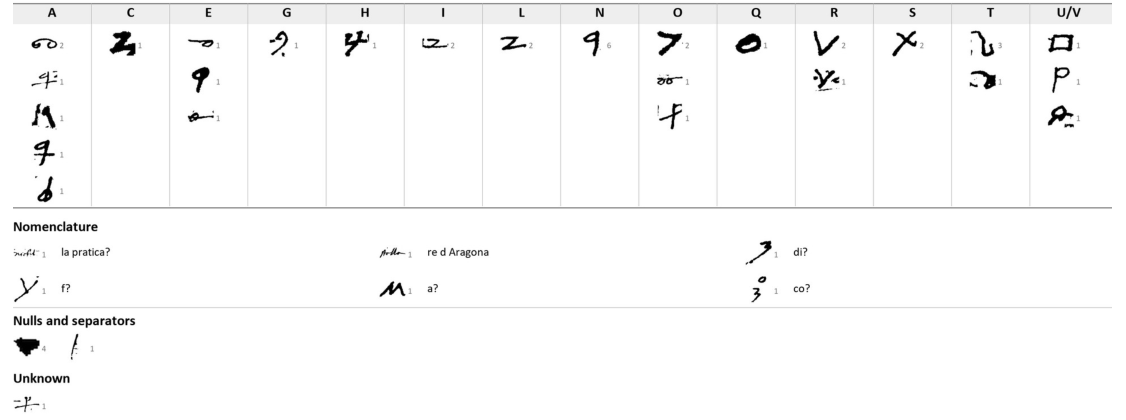
- Homophonic substitution of single letters on 33 signs (five for a), words set apart by spaces and separators, with two clear code words: Stella for the King of Aragon and nichil.
- How it was deciphered
- George Lasry with CTTS and Claude, 15–17 October 2026: the second hand’s lines (“Chastiglone questa vernata”, “uno altro anno”) fix the two passages sign for sign.
- What it says
- “Chastiglone questa vernata con lo sentimento di [re d’Aragona] e nutrire questa guerra uno altro anno”: Castiglione this winter, and the war sustained another year.
- Still open
- The final cipher group (Francesco?), one sign before Chastiglone, the code word nichil, and the date.
- Credit
- George Lasry: transcription, key, reading, translation and context (report of 17 October 2026).
The Sienese cipher file Concistoro 2308 holds pieces in many different keys; this slip has a key of its own, with its own page. The other pieces are listed on the collection’s page.
01The slip and its key
Four clear lines open the slip: the writer has a headache (“doglia di testa”) and has not written more, addresses “la V. S.” and speaks of “questa via de accordo”. The cipher follows in two passages, in manuscript lines 5 and 6, with a last group at the right end of line 8; 53 cipher symbols in all. Below, a second hand wrote out the decipherment, resolving Stella as “del re d’Aragona” and nichil as “la pr…”.

02What it says
George Lasry’s reading, quoted from his report (cipher in bold; clear code words and uncertain readings in brackets with ?):
[la pratica?] [di?] Chastiglone questa vernata con lo sentimento di [re d’Aragona] e nutrire questa guerra uno altro anno Francesco? i?
“[the negotiation?] [of?] Castiglione this winter with the assent of [the King of Aragon]; and to sustain this war one more year. Francesco? i?” (his translation)
Context and date (George Lasry, unverified). Castiglione, perhaps Castiglione della Pescaia, was the Aragonese foothold on the Tuscan coast: Alfonso V took it in 1447 and held it for more than a decade; his army wintered in the Sienese Maremma in 1447–48 before the failed siege of Piombino, and in the war of 1452–54 the Neapolitan army operated from there again, with Siena as Alfonso’s ally. A report that Castiglione is to be held “this winter” with the king’s assent, and the war sustained another year, fits either campaign; the winter of 1447–48 fits best.
03How it was deciphered
George Lasry, with CTTS and Claude: Claude transcribed the slip and recovered the key from the second hand’s decipherment, which fixes the two passages sign for sign and confirms every value it covers. Counted here on his reading, 36 of the 44 letters in the cipher passages stand without a query (81.8%): the three words of line 5 and the three of line 6. The sign before Chastiglone and the last group are outside what the decipherment covers.
The project transcribed the slip on 24 September 2026 (46 cipher tokens under 28 sign names) and closed it as too short for a ciphertext-only attack. That transcription took the second hand’s lines for ordinary clear text, noting only that they might be a decipherment, and dated the slip c. 1495–1516 from the persons in the clear lines. The report’s reading replaces both.
04What remains
- The final cipher group at the right of line 8, Francesco? i? (grade M; signs that occur once, outside the decipherment).
- The sign read [di?] before Chastiglone (M) and the code word nichil, perhaps la pratica (M).
- The writer, the addressee, the persons in the clear lines (a Guido and someone “da Rimino”) and the date.
Full texts
The transcription and the decryption of every document on this page, so that the reading can be used and checked. Short files are shown here; all are in the repository.
No. 9 (R4798), a slip on Castiglione this winter, [1447-48?] (George Lasry)
A slip in Italian clear text with two cipher passages, deciphered in a second hand below them: '[la pratica?] [di?] Chastiglone questa vernata con lo sentimento di [re d'Aragona] e nutrire questa guerra uno altro anno', with a final group read 'Francesco? i?'. George Lasry dates it to the 1440s-1450s (Castiglione held by Alfonso V from 1447; the winter of 1447-48 fits best), unverified. Decryption and translation are his (lasry_report.md); the transcription linked is this project's independent one of 24 Sept 2026, since his CTTS transcription is not in the repository.
Transcription
No. 9 (ASSi Concistoro 2308, fasc. 2) - DECODE R4798
Images: decode/img/IMG_R4798_I27941_P1.jpg (text side, slip c. 3000x700 px in a 4000x2248 photo);
        _P2.jpg (dorse)
Transcriber: agent J, 24 Sept 2026, from the photographs (clear lines 1.7x, cipher lines 3x in 4
overlapping segments, doubtful signs 4-5x; crops/agentJ/p9_*.png)

WHAT IT IS
- A narrow slip (poliza) of 8 lines, no salutation, no date, no address: an enclosure to a letter.
  Lines L01-L06 in one fast cursive hand; L07-L08 in a second, more upright hand (or the same writer
  writing slower), with a short cipher group at the right of L07-L08 that may be a cipher signature.
- Content (clear, many readings uncertain): the writer has not written until now; "quelli da Coreggio
  ano sollevati ... loro parenti como sono quelli di Carpi" (the lords of Correggio have raised ...
  their kinsmen of Carpi), "Guido [surname struck through] e ab. S. g. da Remino (Rimini)"; a "fuoruscito";
  L07 "... questa vernata ... del re di Ragona(?)" (this winter ... the King of Aragon); L08 "... questa
  guerra ...". Correggio + Carpi + Rimini + King of Aragon point to the Italian wars, c. 1495-1530 (the
  second hand's "re di Ragona" suggests before 1516, when Ferdinand of Aragon died, or else the
  Neapolitan king of Aragon, before 1501). Not settled.
- Sender: not named in clear. The last group "Y V m 9 3 . 2" at the foot right (L08), in larger signs,
  looks like a ciphered signature or name.
- Dorse (P2): blank apart from a trace of red wax seal, a large cursive sign like "g"/"ρ" and "vv"
  near the middle (address remnant?), and show-through. No cipher.
- Pencil "9" at right of L07-L08 (the Meister number).

SIGN LEGEND (letters/digits as themselves; clear words in [ ])
  2      z-shaped 2 (flat top, diagonal, long flat foot)
  3      3 with descender (ʒ)
  4      4 with open triangular head (ɥ-like), in L05 joined to the 3 before it
  6      round 6
  7      7
  8      8 with a long tail to the right (ꝸ / δ-like)
  9      9 (closed bowl, straight stem)
  o      small closed circle
  -o     small circle with a long flat stroke leading into it from the left (L05, before "/"); = o?
  OC     a large oval drawn round "6 o" (the two signs enclosed in a circle); written "OC 6 o" (OC = the oval, then the two enclosed signs)
  DEL    heavy closed bowl with a stroke rising from the top to the left (∂); in L05 the bowl is
         filled with ink (smudge?) and joined to the following 2
  x      slanted cross
  BOX    open square □
  PHI    closed circle on a straight descender (φ / q with no tail)
  LU     hook-topped upright curving into a u-shaped bowl (ʅ + u, "ᒐ"-like; long top hook to the left)
  1      upright stroke with a hooked top (ı / 1), L05
  a      a with a long flat stroke to the right and a tick above (á-), L05
  y      y (long descender to the lower left), with a dot above right in L05 ("y'")
  Y      large Y/y with a long descender to the lower left (L08 signature)
  V      v
  q      q (closed bowl, straight stem); q_ = q with a horizontal bar across the stem (ꝗ)
  P_     p with a horizontal stroke through the descender (ꝑ = the usual "per" abbreviation); the L06
         one has a small superscript tick. Possibly clear "per" left in the cipher.
  P      capital P (upright stem, closed bowl), L06
  7'     small raised 7 after "P 9" (L06), perhaps a superscript
  OO     two open-topped bowls under one long overbar (ʊʊ with a lid), L06
  6~     6 whose top stroke continues as a long arc over the next sign (L06 "6~ o")
  m      m (L08)
  .      a point placed between signs by the scribe
  /      a vertical stroke / gap between cipher groups (L05)

TRANSCRIPTION (P1; the slip has 8 lines)

L01 [P(er)ch'(?) io ho oggi dogla di tutto(?) no(n) ho scripto insino(?) e pure voglo p(er) atto(?) chiarire]
L02 [la V.S. q(ue)lli da Coreggio ano sollevati a Cesari(?) di X.S.(?) loro parenti como sono q(ue)lli di Carpi]
L03 [Guido <struck: Rangone?/Vaina?> e ab. S. g. da Remino e a(n)cho so' stati <struck word> cho homo recapito d'uno a no(n) riposo(?)]
L04 [sto e p(er)ch'io ho messo lo patto p(er)(?) q(ue)sto fuoruscito(?) e stati(?) ?igliano(?) q(ue)sta via di Chiaccaso(?) di m(on)te(?) ...]
L05 [nichil] . 3 4 OC 6 o x DEL 2 9 2 7 9 -o / o BOX PHI x LU 1 . 8 a y q q_ LU DEL [coloro(?) sentimento di Stella(?)]
L06 [e subrino(?)/intrino(?) q(ue)sto guidone(?)] P_ P 9 7' q_ 2 LU V OO 6~ o q q P_
L07 [la . pri(ma)(?) ch'a s(?) L? glone questa uernata(?) co(n) g(ente)(?) st(anti)(?) ... d(e)l re (d')Ragona(?)]
L08 [e mutui(?) q(ue)sta guerra uno asse(dio)(?) o anno(?)]   Y V m 9 3{sup: o, above 3/point, uncertain} . 2

NOTES
- The two cipher runs are L05 (after clear "nichil") and L06 (after the clear words, to the line end);
  a third short group closes L08 (probable cipher signature). Each run is written with care, in
  separated signs, unlike the fast clear cursive around it.
- L05 "OC 6 o": a single large oval surrounds a 6 and a small o. Counted below as one token OC plus
  the 6 and o inside (3 tokens). It may be one compound sign.
- L05 "DEL 2": the ∂-sign and the following 2 are joined by the 2's flat foot; the ∂ bowl is blotted.
- LU occurs 3x (L05 twice, L06 once); q/q_ pairs (L05 "q q_", L06 "q q") and a closing P_ in L06
  and "DEL" in L05; both runs end LU DEL / q q P_ - possibly word-final patterns.
- Digits 2, 7, 9 cluster in L05 ("2 9 2 7 9").
- L07-L08: the second hand writes clear Italian; "la . pri" and "L glone" might instead be a partial
  decipherment (letters over the cipher), but they are on their own line and read as ordinary words;
  taken as clear.

COUNTS (cipher tokens only; OC counted as one token, its contents separately)
total 46
per line L05 26 L06 14 L08 6
distinct 28
2 4, 9 4, o 3, LU 3, q 3, 3 2, x 2, DEL 2, q_ 2, P_ 2, V 2, 4 1, OC 1, 6 1, 7 1, -o 1, BOX 1, PHI 1, 1 1, 8 1, a 1, y 1, P 1, 7' 1, OO 1, 6~ 1, Y 1, m 1
Decryption
# George Lasry, "The cipher documents of Concistoro 2308, fasc. 2" (17 Oct 2026): no. 9 (R4798)

Quoted verbatim from the report sent by email to Daniel Bourdeau on 17 Oct 2026 (text extracted page by page from the PDF;
the key figure, the manuscript crop and the bold marking of cipher words are images or formatting and are not
reproduced in this text). Do not edit the readings below; corrections and comparisons go in NOTES.md.

```
[Contents list]
H. Pieces with an interlinear or separate plaintext
• No. 9 = R4798

  — Castiglione and the King of Aragon, 1440s–50s, 53 symbols — solved from the
interlinear plaintext by Lasry with CTTS and Claude (15–17 October 2026)

No. 9 (R4798): Castiglione this winter, with the King of Aragon's assent
Status. Solved (the two cipher passages). 15–17 October 2026, by George Lasry with CTTS and Claude:
transcription by Claude, held in CTTS; key recovered by Claude from the interlinear plaintext written on the
slip in a second hand (“uno altro anno”, “Chastiglone questa vernata”), which fixes the two passages sign for
sign.
References
• Archivio di Stato di Siena, Concistoro 2308, fasc. 2 (Lettere in cifra), no. 9
• DECODE record R4798 (Concistoro_2308_52), https://de-crypt.org/decrypt-web/RecordsView/4798
Ciphertext
53 cipher symbols in 3 lines on one page (manuscript lines 5, 6 and the right end of 8), set inside Italian clear
text.
Key
33 distinct signs (31 letter signs and two separators). Homophonic substitution of single letters: five signs for
a, three each for e and o, two each for r, t and u, one for the rest; words are set apart by spaces and dot or
slash separators, one sign is probably a null, and two clear code words (Stella = the King of Aragon, nichil = ?)
serve as a small nomenclator.
Signs as cut from the manuscript, with their number of occurrences; homophones stand under their letter.
Decryption
Cipher in bold, clear text plain, clear code words and uncertain readings in [brackets] with ?, lost sign = ?.
[la pratica?] [di?] Chastiglone questa vernata con lo sentimento di [re d'Aragona] e nutrire questa guerra
uno altro anno Francesco? i?
[the negotiation?] [of?] Castiglione this winter with the assent of [the King of Aragon]; and to sustain this
war one more year. Francesco? i?

Contents
From: unknown
To: unknown — the clear text addresses a 'V. S.' (Vostra Signoria?)
Place: unknown
Date: 1440s–1450s? — Castiglione and the King of Aragon (Alfonso V) point to the Tuscan wars of 1447–48
or 1452–54; unverified
A slip of paper, not a full letter. Four hurried clear lines open it: the writer excuses himself (he has a
headache, 'doglia di testa', and has not written more), addresses 'la V. S.', and speaks of 'questa via de
accordo', this way of agreement. The sensitive part follows in cipher, with the key words disguised: [the
negotiation?] [of?] Castiglione this winter, with the assent of 'Stella' (the King of Aragon), and 'to sustain this
war one more year'. Below, a second hand has written out the decipherment line for line, resolving Stella as
'del re d'Aragona' and nichil as 'la pr...' (la pratica?); this contemporary solution confirms every locked value
of the key. A last cipher group at the right may read 'Francesco'.
Historical context and dating
Castiglione (della Pescaia?) was the Aragonese foothold on the Tuscan coast: Alfonso V of Aragon and Naples
took it in 1447 and held it for more than a decade; his army wintered in the Sienese Maremma in 1447–48
before the failed siege of Piombino in summer 1448, and in the war of 1452–54 the Neapolitan army sent
against Florence again operated from there, with Siena as Alfonso's ally [Ryder, Alfonso the Magnanimous,
1990]. A report that Castiglione is to be held 'this winter' with the king's assent, and the war sustained
'another year', fits either campaign; the winter of 1447–48, when the king himself lay on that coast, fits best.
Nothing on the slip dates it, sender and addressee are unnamed, and the identification of Castiglione with
Castiglione della Pescaia is a conjecture; the date remains unverified.
Open points. The clear code word nichil (la pratica?), the final cipher group 'Francesco?', and the persons
mentioned in the clear lines (a Guido and someone 'da Rimino'?) remain unidentified.
Sources
Alan Ryder, Alfonso the Magnanimous: King of Aragon, Naples and Sicily, 1396–1458 (Oxford: Clarendon Press, 1990)

```
Translation
# George Lasry, "The cipher documents of Concistoro 2308, fasc. 2" (17 Oct 2026): no. 9 (R4798)

Quoted verbatim from the report sent by email to Daniel Bourdeau on 17 Oct 2026 (text extracted page by page from the PDF;
the key figure, the manuscript crop and the bold marking of cipher words are images or formatting and are not
reproduced in this text). Do not edit the readings below; corrections and comparisons go in NOTES.md.

```
[Contents list]
H. Pieces with an interlinear or separate plaintext
• No. 9 = R4798

  — Castiglione and the King of Aragon, 1440s–50s, 53 symbols — solved from the
interlinear plaintext by Lasry with CTTS and Claude (15–17 October 2026)

No. 9 (R4798): Castiglione this winter, with the King of Aragon's assent
Status. Solved (the two cipher passages). 15–17 October 2026, by George Lasry with CTTS and Claude:
transcription by Claude, held in CTTS; key recovered by Claude from the interlinear plaintext written on the
slip in a second hand (“uno altro anno”, “Chastiglone questa vernata”), which fixes the two passages sign for
sign.
References
• Archivio di Stato di Siena, Concistoro 2308, fasc. 2 (Lettere in cifra), no. 9
• DECODE record R4798 (Concistoro_2308_52), https://de-crypt.org/decrypt-web/RecordsView/4798
Ciphertext
53 cipher symbols in 3 lines on one page (manuscript lines 5, 6 and the right end of 8), set inside Italian clear
text.
Key
33 distinct signs (31 letter signs and two separators). Homophonic substitution of single letters: five signs for
a, three each for e and o, two each for r, t and u, one for the rest; words are set apart by spaces and dot or
slash separators, one sign is probably a null, and two clear code words (Stella = the King of Aragon, nichil = ?)
serve as a small nomenclator.
Signs as cut from the manuscript, with their number of occurrences; homophones stand under their letter.
Decryption
Cipher in bold, clear text plain, clear code words and uncertain readings in [brackets] with ?, lost sign = ?.
[la pratica?] [di?] Chastiglone questa vernata con lo sentimento di [re d'Aragona] e nutrire questa guerra
uno altro anno Francesco? i?
[the negotiation?] [of?] Castiglione this winter with the assent of [the King of Aragon]; and to sustain this
war one more year. Francesco? i?

Contents
From: unknown
To: unknown — the clear text addresses a 'V. S.' (Vostra Signoria?)
Place: unknown
Date: 1440s–1450s? — Castiglione and the King of Aragon (Alfonso V) point to the Tuscan wars of 1447–48
or 1452–54; unverified
A slip of paper, not a full letter. Four hurried clear lines open it: the writer excuses himself (he has a
headache, 'doglia di testa', and has not written more), addresses 'la V. S.', and speaks of 'questa via de
accordo', this way of agreement. The sensitive part follows in cipher, with the key words disguised: [the
negotiation?] [of?] Castiglione this winter, with the assent of 'Stella' (the King of Aragon), and 'to sustain this
war one more year'. Below, a second hand has written out the decipherment line for line, resolving Stella as
'del re d'Aragona' and nichil as 'la pr...' (la pratica?); this contemporary solution confirms every locked value
of the key. A last cipher group at the right may read 'Francesco'.
Historical context and dating
Castiglione (della Pescaia?) was the Aragonese foothold on the Tuscan coast: Alfonso V of Aragon and Naples
took it in 1447 and held it for more than a decade; his army wintered in the Sienese Maremma in 1447–48
before the failed siege of Piombino in summer 1448, and in the war of 1452–54 the Neapolitan army sent
against Florence again operated from there, with Siena as Alfonso's ally [Ryder, Alfonso the Magnanimous,
1990]. A report that Castiglione is to be held 'this winter' with the king's assent, and the war sustained
'another year', fits either campaign; the winter of 1447–48, when the king himself lay on that coast, fits best.
Nothing on the slip dates it, sender and addressee are unnamed, and the identification of Castiglione with
Castiglione della Pescaia is a conjecture; the date remains unverified.
Open points. The clear code word nichil (la pratica?), the final cipher group 'Francesco?', and the persons
mentioned in the clear lines (a Guido and someone 'da Rimino'?) remain unidentified.
Sources
Alan Ryder, Alfonso the Magnanimous: King of Aragon, Naples and Sicily, 1396–1458 (Oxford: Clarendon Press, 1990)

```
Key: key.md
05Sources
- Archivio di Stato di Siena, Concistoro 2308 fasc. 2 no. 9: DECODE R4798.
- George Lasry, “The cipher documents of Concistoro 2308, fasc. 2”, report sent to Daniel Bourdeau, 17 October 2026, section H (decipherment, key, translation, context).
- A. Ryder, Alfonso the Magnanimous (Oxford 1990), as cited by George Lasry.
Manuscript rights: Archivio di Stato di Siena.
George Lasry’s report section, the project’s transcription and the notes: targets/siena9/.