
At a glanceCiphertext-only break · complete
- The letter
- Unsigned and unaddressed, dated in clear 30 January 1586. Tomokiyo attributes the hand to François d’Espinay de Saint-Luc, governor of Brouage. The volume holds despatches to Henri III and to his secretary of state Villeroy.
- Where
- Bibliothèque nationale de France, Français 15572, f. 43 (Gallica). Not on DECODE.
- The cipher
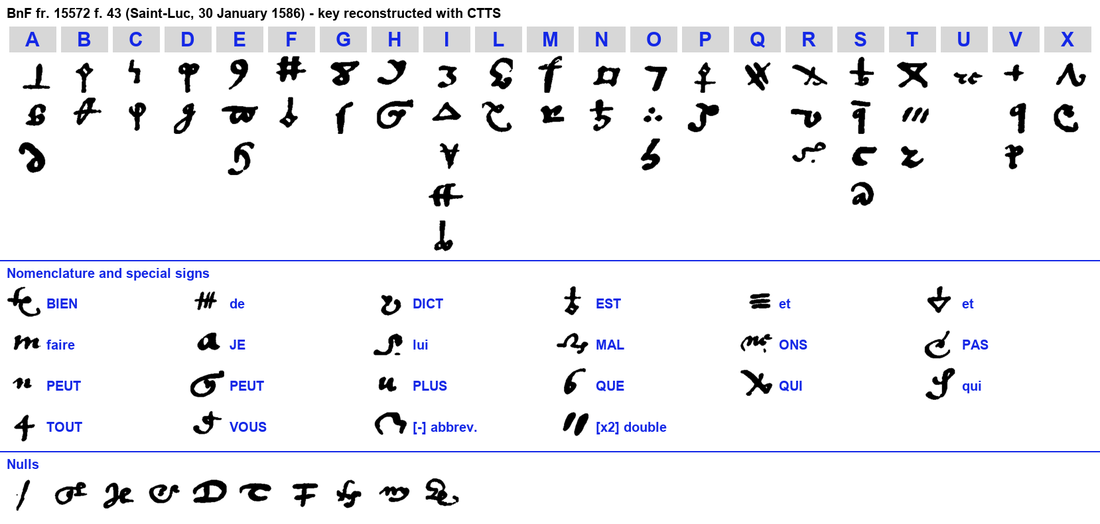
- Invented symbols: two to five for each letter, 20 signs for common words and syllables (que, est, tout, faire, vous, peut …), a sign that doubles the letter before it, and 10 nulls.
- How it was solved
- George Lasry transcribed the leaf in CTTS and recovered the letter table with its built-in cryptanalysis in 2022; in 2026 he resolved the last signs from context with Claude Opus 5.5 and edited the French. Re-checked here mechanically and statistically.
- What it says
- “Monsieur” has sent an agent to work on the concierge’s household. The writer proposes to win over the gardener, spoil a marriage the concierge wants, and spread a rumour to frighten her: “fear holds the old as often as reason does”.
- Credit
- Key, transcription, edition and translation by George Lasry (pull request 76). Description and attribution of the leaf by S. Tomokiyo.
- Still open
- Who the cover names stand for, and the recipient. Four doubtful words and two tentative symbol values.
01The leaf and the key
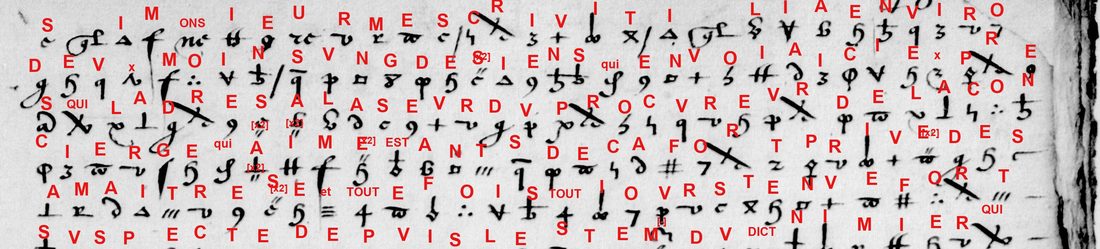
Folio 43 of Français 15572 is two pages entirely in cipher except the date line, Du xxxe Janvier 1586. It names neither its writer nor its recipient. Tomokiyo recognised the hand of Saint-Luc’s clear letter at f. 35, and Saint-Luc wrote another letter, f. 42, on the same day. Saint-Luc’s other ciphered letters in the volume (ff. 245 and 260) use a different table (a different cipher, with its own page), and so do the Mayenne and Matignon despatches around it: Cipher-1, Cipher-2 and Cipher-3.
The key is a homophonic substitution. Twenty letters plus x have 51 symbols between them, two or three for most letters, five for i and four for s. Twenty more signs stand for 17 words and syllables: que, qui, est, de, et, dict, tout, faire, je, vous, lui, bien, plus, peut, pas, mal and ons (as in m-ons-ieur). One sign doubles the letter before it, one marks an abbreviation, and ten are nulls.
02The letter
In the French, bold marks a word or syllable written with a single sign. Spelling is as deciphered; [?] marks an uncertain reading and [ ] an editorial addition.
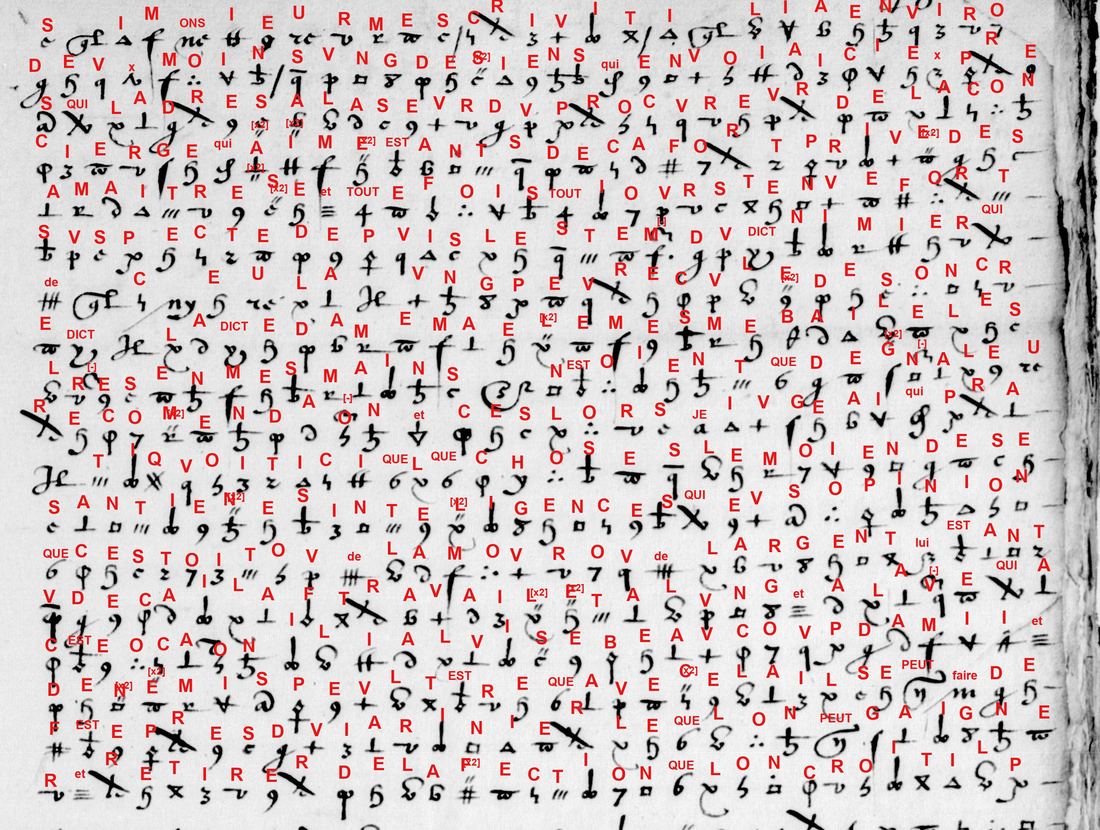
Si monsieur m'escrivit il y a environ deux mois ung des siens, qui envoya ici exprès, qui l'adressa à la seur du procureur de la concierge, qui a aimée, estant deça, fort privée de sa maistresse et toutefois toutjours tenue fort suspecte depuis l'esté du dict Nimier, qui de cela [?] ung peu reculée de son credict. La dicte dame m'a elle mesme baillé les lettres en mes mains : n'estoient que de generale recommendation ; et ces lors je jugeai qui [qu'il] pratiquoit ici quelque chose, le moyen de ses antiennes intelligences, qui [que j'] eus opinion que c'estoit ou de l'amour ou de l'argent. Lui estant venu deça, il a fort travaillé et à l'ung et à l'aultre, qui à ceste occasion il y a luise [?] beaucoup d'amis et d'ennemis. Peult estre que avec cela il se peut faire de feste près du jardinier, lequel on peut gaigner et retirer de l'affection que l'on croit il porte aux tailleurs de pierre.
Sur tout le concierge a fort à coeur le mariage d'entre la petite et le demi frère de St Suplice, qui mena là encores dimanche ; et si ces ouvertures restent proposées desast [?], c'en est que de rompre le coup à l'aure [?], ayant adjousté cellui de la soeur du courrier avec le fils du chef des armes de St Suplice, de seullement bailler le goust et en faire venir l'envie. Je vous asseure que l'on craint ici fort Sermelles, et M[onsieu]r Lue craindroit bien plus si l'on pensoit que Jugan se joignist avec lui, qui vous dirai que peut estre ne seroit il pas mal à propos d'en faire courir le bruit à bon esciant, de retenir la concierge, estant ainsi que la crainte retient aussi souvent les vieux comme la raison. Toutefois le gouverneur jugera mieulx cela que le planteur. Commence à estre assés bien avec la concierge, qui se perd petit à petit ceste première opinion conceue, sinon de le estimer trop catholique, à tout le moins de ne le penser pas trompeur ni aimant les choses mauvaises.
Du xxxe Janvier 1586 [date line in clear, after Tomokiyo]
English translation (George Lasry)
Monsieur wrote to me about two months ago that one of his men, whom he sent here on purpose, was to be addressed to the sister of the concierge's procurator. She was loved and, being on this side, very close to her mistress, and yet always held very suspect since the summer of the said Nimier, and for that [?] fallen somewhat back in her favour. The said lady herself put the letters into my hands: they were only of general recommendation. And from then on I judged that he was intriguing at something here, by means of his old contacts, and I believed that it was either for love or for money. He, having come over, has worked hard on both the one and the other, so that on this occasion he has made [?] many friends and enemies. Perhaps with that he can make himself welcome with the gardener, whom one can win over and draw away from the attachment that he is thought to bear the stonecutters.
Above all, the concierge has much at heart the marriage between the little one and the half-brother of Saint-Sulpice, who brought [him?] there again on Sunday. And if these overtures remain on the table [?], it is only to break the blow to the other [?], having added that of the courier's sister with the son of the chief of arms of Saint-Sulpice, just to give a taste of it and make them want it. I assure you that Sermelles is much feared here, and Monsieur Lue would fear much more if it were thought that Jugan was joining him. So I will tell you that perhaps it would not be amiss to have the rumour spread on purpose, to hold the concierge, since fear holds the old as often as reason does. However, the governor will judge this better than the planter. [He] begins to be on quite good terms with the concierge, who is little by little losing that first opinion she had formed: if not to think him too Catholic, at least not to think him a deceiver or one who loves bad things.
The 30th of January 1586 [date line in clear]
03Context
François d’Espinay de Saint-Luc (1554–1597) was one of Henri III’s favourites. He fell from favour in 1580 and withdrew to Brouage, the salt port of Saintonge facing Huguenot La Rochelle, which he governed and fortified. By 1586 he was again serving the King in the war against Henri of Navarre that followed the Treaty of Nemours, and that year he took the island of Oléron from Agrippa d’Aubigné. Français 15572 gathers the despatches of January to July 1586 from the King’s commanders in the west.
The letter is written in cover names: the concierge and her mistress, the gardener, the stonecutters, the governor, the planter, the little one. Who they stand for is not known. A few real names come through in the cipher: Nimier, Saint-Sulpice, Sermelles, Jugan, and a “Monsieur Lue” who may be one of the Daillon, comtes du Lude, governors of Poitou.
04How the key was found
George Lasry transcribed the three photographs of the leaf in CTTS (CrypTool Transcriber and Solver) and recovered the letter symbols with its built-in cryptanalysis in 2022. Tomokiyo published the key image on his page of Lasry’s solutions, without a plaintext. In 2026 the thirteen signs still unassigned were resolved from context with Claude Opus 5.5: ons in m-ons-ieur, je, vous in “je vous asseure”, peut in “peut estre”, bien and plus in “craindroit bien plus”, pas and mal in “ne seroit il pas mal à propos”.
Checked here on 22 October 2026:
- Mechanically.
decode.pyapplies George’s key file to his transcription and gives his counts: 1,315 signs, of which 1,168 letters, 77 word signs, 44 doubling and abbreviation signs and 26 nulls. None is left without a value. - Statistically (
docs/_validate.py, French letter model). The reading scores −2.09 per letter; random keys of the same shape score −4.72 (9.9 standard deviations lower), and a key fitted to the same signs shuffled scores −3.01 (25.7 lower). Verdict: pass. - Earlier readings. Only George’s own key image on Tomokiyo’s page; no plaintext had been published, and none was found in print.
05What remains
- Four doubtful words: “de cela [?]” and “il y a luise [?]” on the first image, “desast [?]” and “à l’aure [?]” on the second.
- Two tentative values: sign 36 as et and sign 84 as lui.
- The cover names and the recipient. The letter says who no one is; only an outside key to this correspondence would.
Full texts
The transcription and the decryption of every document on this page, so that the reading can be used and checked. Short files are shown here; all are in the repository.
BnF fr. 15572 f. 43, 30 Jan 1586
'Monsieur' has sent an agent to work on the concierge's household; the writer proposes to win over the gardener, spoil a marriage the concierge wants and frighten her with a rumour.
Transcription
# f43a.jpg
60;_80;13;40;71;25;09;64;67;65;38;60;_16;04;26;03;15;32;11;_16;13;_80;44;14;45;41;39;42;03;67;07;
46;41;42;85;40;17;14;39;_16;48;43;12;08;31;41;60;";13;09;39;29;56;09;12;15;49;25;52;03;30;14;41;86;34;26;09;
81;19;50;10;46;26;09;60;";45;";44;52;60;09;15;67;46;43;51;26;49;04;42;67;41;43;26;31;38;50;10;04;17;39;
30;03;38;67;47;41;56;10;";25;40;41;";33;45;12;21;48;31;38;04;52;20;07;26;66;34;67;32;15;38;";46;41;60;
10;65;52;13;21;67;09;60;";41;22;05;38;35;17;14;29;05;32;07;43;67;60;11;41;12;15;38;20;17;26;21;
29;43;60;51;41;04;66;38;31;09;34;42;13;60;50;41;48;21;38;40;~;46;43;53;39;32;65;25;41;67;19;
24;_80;04;98;41;64;50;10;82;15;39;08;51;38;42;26;41;30;43;44;09;";31;41;60;17;12;04;67;
38;53;82;50;52;53;41;31;45;65;38;40;10;41;50;";38;40;09;29;65;41;55;52;13;44;";38;50;41;60;
44;67;~;09;60;38;39;40;41;29;65;10;32;39;60;83;12;33;17;32;41;39;21;06;46;38;47;12;~;10;50;09;64;
26;41;30;07;65;";38;39;31;52;49;~;39;36;30;41;60;50;17;67;60;68;13;15;47;41;45;14;56;51;26;10;
82;21;32;23;42;49;03;66;13;04;25;06;50;06;30;54;17;29;38;48;44;41;65;07;14;09;12;46;38;60;41;
60;10;12;21;32;09;39;";41;29;03;12;21;09;50;";32;08;41;12;04;09;29;19;09;15;81;17;34;32;39;13;49;12;
06;30;41;60;66;07;03;21;49;43;24;44;52;40;17;15;67;07;42;24;50;45;67;08;41;12;11;84;33;10;12;66;
43;46;09;30;52;32;50;10;35;11;26;45;15;52;03;50;";41;";21;10;44;43;12;08;22;52;50;10;42;~;38;19;10;
30;33;09;17;04;";10;94;49;39;32;44;25;52;50;15;32;60;09;37;41;10;15;30;07;42;51;46;52;40;14;25;22;
31;41;12;";38;65;14;81;34;09;15;44;11;33;67;41;06;10;43;38;04;";09;44;10;03;50;60;41;89;69;46;41;
20;33;09;34;26;09;60;46;15;03;10;67;32;12;13;38;26;50;41;06;44;17;39;89;47;10;32;08;39;38;
67;22;26;41;11;03;67;09;26;31;41;44;45;20;";38;04;21;32;07;12;06;50;49;12;30;67;49;32;11;13;44;51;

# f43b.jpg
49;67;66;09;10;15;86;21;52;03;44;";41;42;67;60;46;41;51;32;09;67;";41;60;15;26;05;50;38;04;17;12;
30;32;41;67;08;09;10;20;49;26;21;52;04;17;38;42;67;44;41;40;10;26;32;45;47;09;46;38;39;11;
26;09;44;10;34;41;11;03;21;38;22;50;41;31;09;65;14;35;67;~;09;46;41;60;21;60;15;34;44;32;04;09;19;
40;41;39;48;50;10;38;12;04;07;26;09;29;46;32;40;52;12;30;93;09;22;29;03;04;41;60;17;43;";41;
67;11;15;26;09;60;26;33;41;51;67;49;34;07;29;41;";60;46;09;29;10;48;21;30;09;12;33;06;24;
96;67;17;40;34;26;41;50;38;04;17;15;51;10;50;52;42;67;38;45;25;52;39;21;10;46;32;07;42;60;
11;41;04;09;50;";15;14;46;41;44;10;60;49;38;43;67;31;43;30;07;15;26;";32;41;67;52;43;38;30;
44;41;35;32;44;81;31;15;04;54;38;20;46;41;60;10;26;65;41;29;46;09;29;11;60;43;34;44;32;04;09;
24;29;09;15;44;";38;65;~;37;10;32;50;";09;26;44;41;08;07;42;60;11;22;38;39;69;15;41;12;03;67;
50;41;12;43;14;09;68;101;52;60;";38;42;67;41;06;44;17;12;30;26;10;32;12;21;32;04;25;20;
17;67;66;29;41;26;40;09;44;";41;60;36;82;40;97;90;50;64;41;30;98;26;10;32;12;99;
46;26;17;03;21;91;100;29;13;50;07;12;34;41;39;60;17;03;11;06;32;15;47;10;12;60;09;03;49;32;
08;39;03;60;11;10;43;41;04;44;42;25;19;101;94;83;31;32;26;10;14;06;70;33;67;09;82;
39;41;29;09;26;07;03;11;32;44;102;103;10;34;26;49;51;17;60;31;41;39;69;30;07;15;
67;03;26;50;41;37;67;43;13;21;10;55;49;12;41;60;04;32;52;39;21;24;26;41;11;09;12;03;67;44;
52;30;17;39;04;32;09;67;08;38;";60;66;10;39;21;45;03;39;60;25;06;44;10;04;26;10;32;12;21;41;
26;38;11;32;41;12;66;10;15;60;";14;60;17;15;";38;12;11;50;41;29;43;32;09;42;85;04;17;~;38;

# f43c.jpg
50;10;26;82;52;94;32;90;29;83;07;95;39;05;09;20;49;25;29;44;41;47;17;
15;";38;67;12;41;43;67;03;43;08;41;26;10;65;32;41;15;44;85;30;38;50;52;06;44;38;34;
44;10;12;21;09;15;26;83;04;17;40;";38;39;30;09;10;33;67;41;52;29;";41;81;91;45;43;41;
04;44;52;30;07;39;04;32;41;26;47;38;19;60;09;51;38;26;46;34;41;21;03;11;52;34;09;66;13;
21;30;33;09;51;26;41;65;32;09;67;38;17;34;13;12;32;07;39;04;17;39;04;41;15;09;60;03;12;17;
39;46;38;44;41;33;32;40;38;26;21;67;49;51;30;10;11;54;17;44;13;06;52;05;50;41;65;49;03;
12;60;24;12;09;44;38;51;41;12;29;09;67;34;52;60;21;26;07;40;34;41;15;26;39;14;10;25;
40;10;12;11;44;41;60;04;93;49;60;38;60;65;52;42;";45;32;29;41;60;
Decryption
# Saint-Luc(?) to Henri III or Villeroy(?), 30 Jan 1586, BnF fr. 15572 f. 43: George Lasry's edited French (PR 76, lasry2022/CONTRIBUTION.md)
# [?] uncertain; [ ] editorial addition; the date line is in clear

Si monsieur m'escrivit il y a environ deux mois ung des siens, qui envoya ici exprès, qui l'adressa à la seur du procureur de la concierge, qui a aimée, estant deça, fort privée de sa maistresse et toutefois toutjours tenue fort suspecte depuis l'esté du dict Nimier, qui de cela [?] ung peu reculée de son credict. La dicte dame m'a elle mesme baillé les lettres en mes mains : n'estoient que de generale recommendation ; et ces lors je jugeai qui [qu'il] pratiquoit ici quelque chose, le moyen de ses antiennes intelligences, qui [que j'] eus opinion que c'estoit ou de l'amour ou de l'argent. Lui estant venu deça, il a fort travaillé et à l'ung et à l'aultre, qui à ceste occasion il y a luise [?] beaucoup d'amis et d'ennemis. Peult estre que avec cela il se peut faire de feste près du jardinier, lequel on peut gaigner et retirer de l'affection que l'on croit il porte aux tailleurs de pierre.

Sur tout le concierge a fort à coeur le mariage d'entre la petite et le demi frère de St Suplice, qui mena là encores dimanche ; et si ces ouvertures restent proposées desast [?], c'en est que de rompre le coup à l'aure [?], ayant adjousté cellui de la soeur du courrier avec le fils du chef des armes de St Suplice, de seullement bailler le goust et en faire venir l'envie. Je vous asseure que l'on craint ici fort Sermelles, et M[onsieu]r Lue craindroit bien plus si l'on pensoit que Jugan se joignist avec lui, qui vous dirai que peut estre ne seroit il pas mal à propos d'en faire courir le bruit à bon esciant, de retenir la concierge, estant ainsi que la crainte retient aussi souvent les vieux comme la raison. Toutefois le gouverneur jugera mieulx cela que le planteur. Commence à estre assés bien avec la concierge, qui se perd petit à petit ceste première opinion conceue, sinon de le estimer trop catholique, à tout le moins de ne le penser pas trompeur ni aimant les choses mauvaises.

Du xxxe Janvier 1586 [date line in clear, after Tomokiyo]
Translation
**Reference.** Bibliothèque nationale de France, Français 15572, f. 43 ([Gallica](https://gallica.bnf.fr/ark:/12148/btv1b9061879d/f1.image)); three images (f43a, f43b, f43c). New cyphersolver target `saintluc1586`. **Solved by George Lasry with CTTS in 2022 and its built-in cryptanalysis.** The remaining nomenclator signs and the clear-text reading were completed in 2026 with Claude Opus 5.5. S. Tomokiyo (Cryptiana) lists the folio as two pages "entirely in cipher, undeciphered, except for the date line *Du xxxe Janvier 1586*", in the same hand as Saint-Luc's letter in clear at f. 35, and dated the same day as Saint-Luc's letter at f. 42. He records that George Lasry solved it in 2022. All three images are read here: 1,315 cipher signs (1,168 letter homophones, 77 code signs, 44 doubling and abbreviation signs, 26 nulls), with every sign assigned. | | | |---|---| | **From** | François d'Espinay, seigneur de Saint-Luc, governor of Brouage (attributed from the hand by Tomokiyo; the letter is unsigned) | | **To** | Not named in the letter; the volume holds letters to Henri III and to his secretary of state Villeroy | | **Date** | 30 January 1586 (date line in clear) | | **Content** | An intelligence report on an agent of "Monsieur", sent to work on the household of "the concierge", in which the people are given cover names (the concierge, the gardener, the stonecutters, the governor, the planter). | ## Summary of contents About two months earlier, "Monsieur" sent one of his men to the writer's area with letters of recommendation, addressed to the sister of the concierge's procurator. That woman had been close to her mistress but has been under suspicion since the summer of "the said Nimier". The lady herself handed the letters to the writer. He concluded that the man was intriguing to revive old contacts, either for love or for money, and had made friends and enemies doing so. The writer suggests ways to use the household. The gardener could be won over and turned from his attachment to "the stonecutters". The concierge is set on a marriage between "the little one" and the half-brother of Saint-Sulpice, and the writer wants to spoil it by putting forward a second match: the courier's sister with the son of the chief of arms of Saint-Sulpice. Sermelles is much feared, and Monsieur Lue [du Lude?] would be feared more if Jugan were thought to have joined him. The writer proposes to spread that rumour on purpose to hold the concierge, since fear holds the old as often as reason does. He leaves the decision to "the governor". He says "the planter" is now on good terms with the concierge, who no longer thinks him a deceiver. ## The key A homophonic substitution of 20 letters plus *x*, with 51 symbols. Most letters have two or three homophones; *i* has five and *s* four. A small nomenclator of 20 signs stands for 17 words and syllables (*que, qui, est, de, et, dict, tout, faire, je, vous, lui, bien, plus, peut, pas, mal, ons*). There is one sign for a doubled letter, one abbreviation sign, and 10 nulls. 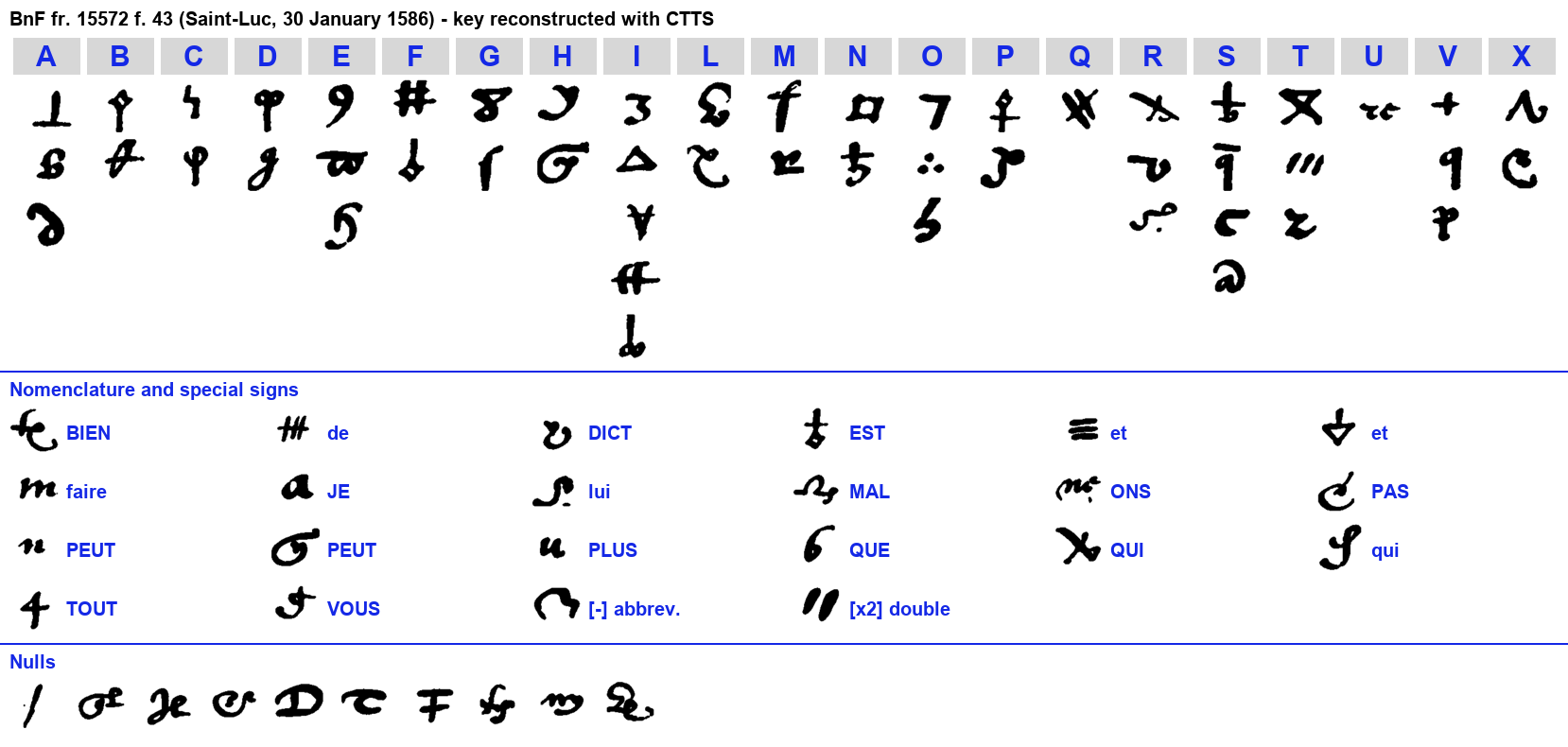 ## Reading conventions The whole letter is enciphered except the date line. **Bold** marks words and syllables written with a single nomenclator sign. Spelling is kept as deciphered. [x?] marks an uncertain reading and [ ] an editorial addition. ## The letter: BnF fr. 15572 f. 43 (images f43a, f43b, f43c; 30 January 1586) 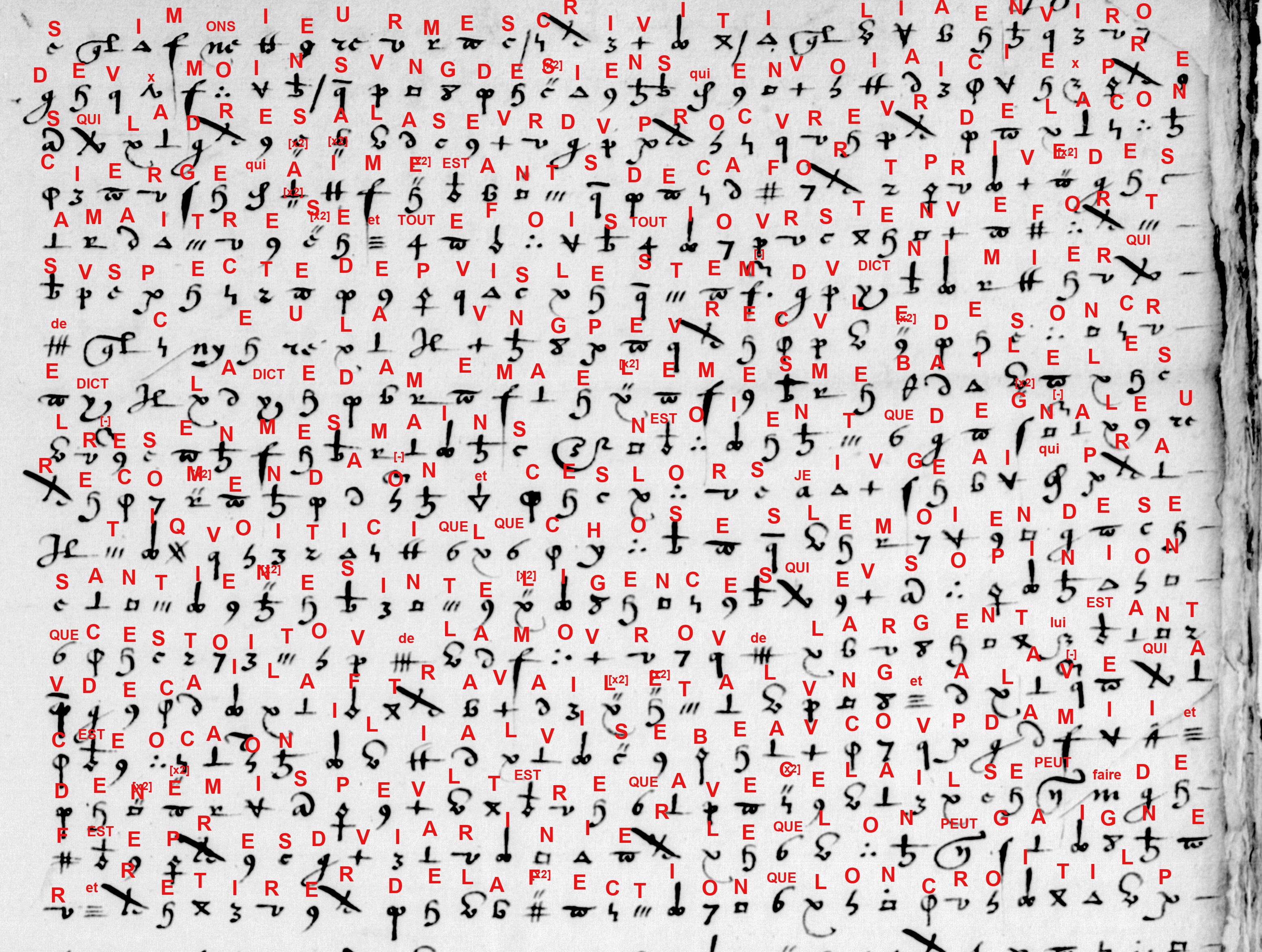 ### French Si m**ons**ieur m'escrivit il y a environ deux mois ung des siens, **qui** envoya ici exprès, **qui** l'adressa à la seur du procureur de la concierge, **qui** a aimée, **est**ant deça, fort privée de sa maistresse **et** **tout**efois **tout**jours tenue fort suspecte depuis l'esté du **dict** Nimier, **qui** **de** cela [?] ung peu reculée de son credict. La **dict**e dame m'a elle mesme baillé les lettres en mes mains : n'**est**oient **que** de generale recommendation ; **et** ces lors **je** jugeai **qui** [qu'il] pratiquoit ici **que**l**que** chose, le moyen de ses antiennes intelligences, **qui** [que j'] eus opinion **que** c'estoit ou **de** l'amour ou **de** l'argent. **Lui** **est**ant venu deça, il a fort travaillé et à l'ung **et** à l'aultre, **qui** à c**est**e occasion il y a luise [?] beaucoup d'amis **et** d'ennemis. Peult **est**re **que** avec cela il se **peut** **faire** **de** f**est**e près du jardinier, le**que**l on **peut** gaigner **et** retirer de l'affection **que** l'on croit il porte aux tailleurs de pierre. Sur **tout** le concierge a fort à coeur le mariage d'entre la petite **et** le demi frère de St Suplice, **qui** mena là encores dimanche ; **et** si ces ouvertures r**est**ent proposées desast [?], c'en **est** **que** **de** rompre le coup à l'aure [?], ayant adjousté cellui de la soeur du courrier avec le fils du chef des armes de St Suplice, **de** seullement bailler le goust **et** en **faire** venir l'envie. **Je** **vous** asseure **que** l'on craint ici fort Sermelles, **et** M[onsieu]r Lue craindroit **bien** **plus** si l'on pensoit **que** Jugan se joignist avec lui, **qui** **vous** dirai **que** **peut** **est**re ne seroit il **pas** **mal** à propos d'en **faire** courir le bruit à bon esciant, **de** retenir la concierge, estant ainsi **que** la crainte retient aussi souvent les vieux comme la raison. **Tout**efois le gouverneur jugera mieulx cela **que** le planteur. Commence à **est**re assés **bien** avec la concierge, **qui** se perd petit à petit c**est**e première opinion conceue, sinon de le **est**imer trop catholi**que**, à **tout** le moins **de** ne le penser pas trompeur ni aimant les choses mauvaises. Du xxx<sup>e</sup> Janvier 1586 [date line in clear, after Tomokiyo] ### English translation Monsieur wrote to me about two months ago that one of his men, whom he sent here on purpose, **was** to be addressed to the sister of the concierge's procurator. She **was** loved and, being on this side, very close to her mistress, **and** **yet** **always** held very suspect since the summer of the **said** Nimier, and **for** that [?] fallen somewhat back in her favour. The **said** lady herself put the letters into my hands: they **were** **only** of general recommendation. **And** from then on **I** judged that he was intriguing at something here, by means of his old contacts, and I believed **that** it was either **for** love or **for** money. **He**, **having** come over, has worked hard on both the one **and** the other, so that on this occasion he has made [?] many friends **and** enemies. Perhaps with that he **can** **make** himself welcome with the gardener, whom one **can** win over **and** draw away from the attachment **that** he is thought to bear the stonecutters. Above **all**, the concierge has much at heart the marriage between the little one **and** the half-brother of Saint-Sulpice, **who** brought [him?] there again on Sunday. **And** if these overtures **remain** on the table [?], it **is** **only** **to** break the blow to the other [?], having added that of the courier's sister with the son of the chief of arms of Saint-Sulpice, **just** to give a taste of it **and** **make** them want it. **I** assure **you** **that** Sermelles is much feared here, **and** Monsieur Lue would fear **much** **more** if it were thought **that** Jugan was joining him. **So** **I** will tell **you** **that** **perhaps** it would **not** be **amiss** to **have** the rumour spread on purpose, **to** hold the concierge, since fear holds the old as often as reason does. **However**, the governor will judge this better **than** the planter. [He] begins to **be** on quite **good** terms with the concierge, **who** is little by little losing **that** first opinion she had formed: if not to **think** him too Catholic, at **least** **not** to think him a deceiver or one who loves bad things. The 30th of January 1586 [date line in clear] ## Historical context François d'Espinay de Saint-Luc (1554–1597) was one of Henri III's favourites (*mignons*). He fell from favour in 1580 and withdrew to Brouage, the salt port of Saintonge across from Huguenot La Rochelle, which he governed and fortified. By 1586 he was again serving the King in the war against Henri of Navarre that followed the Treaty of Nemours (July 1585). That year he took the island of Oléron from Agrippa d'Aubigné, whom he captured (Tomokiyo). BnF fr. 15572 gathers the ciphered and clear despatches of January–July 1586 from the King's commanders and agents in the west: Mayenne, Matignon, Biron, Malicorne and Saint-Luc. Most are addressed to Henri III or to Villeroy. Saint-Luc's other ciphered letters in the volume (f. 245, deciphered in the margin; f. 260) use a different table (Tomokiyo, "StLuc's Cipher"). The letter is written in cover names: the concierge, her mistress, the gardener, the stonecutters, the governor, the planter, the little one. The real people behind them are not identified here. Its subject is a familiar one for a governor facing La Rochelle: a party's agent working on a household through its servants, its marriages and its fears, and how to counter him. "Monsieur Lue" may stand for a member of the Daillon family, comtes du Lude and governors of Poitou (see Open points). ## How the key was obtained The three images were transcribed in CTTS (CrypTool Transcriber and Solver), and the homophones were recovered with CTTS's built-in cryptanalysis (George Lasry, 2022). In 2026 the thirteen signs still unassigned were resolved from context with Claude Opus 5.5: - 71 = *ons*, as in m-ons-ieur. - 23 = *q*, as in prati-q-uoit. - 68 = *je*. - 101 = *vous*, in "je vous asseure" and "vous dirai". - 89 and 70 = *peut*, in "il se peut faire", "on peut gaigner" and "peut estre". - 91 = *bien* and 100 = *plus*, in "asses bien" and "craindroit bien plus". - 102 = *pas* and 103 = *mal*, in "ne seroit il pas mal à propos". - 36 = *et* and 84 = *lui*, both tentative. - 97 = a raised abbreviation *r* on M, for M[onsieu]r, checked on the image. The full reading was checked against the CTTS overlays of all three images. ## Open points - 36 = *et* and 84 = *lui* fit their contexts but are tentative. - "Lue" (f43b line 11) follows a sign listed as a null; "du Lude" is possible but not established. - Unclear passages: "de cela [?]" (f43a line 7), "il y a luise [?]" (f43a line 15), "desast [?]" and "à l'aure [?]" (f43b lines 5–6). - The writer, the recipient and the people behind the cover names are not identified from the text alone; the attribution to Saint-Luc rests on Tomokiyo's comparison of hands. - The date line in clear is quoted from Tomokiyo; it is not in the transcribed images. ## Sources - BnF, Français 15572 (letters to Henri III and Villeroy, January–July 1586), f. 43: [Gallica](https://gallica.bnf.fr/ark:/12148/btv1b9061879d/f1.image). - S. Tomokiyo, *Cryptiana*, ["French Ciphers during the Reigns of Charles IX and Henry III"](http://cryptiana.web.fc2.com/code/henryiii.htm), section BnF fr. 15572, f. 43 and St. Luc: description, date line, attribution of the hand, Saint-Luc's other ciphers. - S. Tomokiyo, *Cryptiana*, ["Ciphers Solved by George Lasry"](http://cryptiana.web.fc2.com/code/GL.htm), "An Unsigned Letter in BnF fr.15572 (1586)": Lasry's 2022 solution images. - D. Bourdeau, cyphersolver target [`matignon1586`](https://github.com/dbourdeau/cyphersolver/blob/main/targets/matignon1586/NOTES.md): records that f. 43 belongs to none of the Mayenne–Forget or Matignon ciphers and was solved by Lasry in 2022.
Key: key.txt
06Sources
- Bibliothèque nationale de France, Français 15572, f. 43: Gallica.
- George Lasry, key, transcription, French edition and translation: pull request 76, with the CTTS project in targets/saintluc1586/lasry2022/.
- S. Tomokiyo, Cryptiana: French Ciphers during the Reigns of Charles IX and Henry III (f. 43 and Saint-Luc’s ciphers) and Ciphers Solved by George Lasry (the 2022 key).
Notes: targets/saintluc1586/.