
At a glanceKnown key applied · partial (40% of the cipher)
- The letters
- Marshal Matignon to Henri III from the camp before Monségur, May 1586. Two letters of autumn 1586 from the Duke of Mayenne’s side, sender not named; the cover of f. 120 (f. 121v) is addressed to Villeroy.
- Where
- Bibliothèque nationale de France, fr. 15572 ff. 218–219 and fr. 15573 ff. 120 and 385, on Gallica. ff. 218–219 were catalogue item 12 here; the other two were not in the ledger.
- The cipher
- Mayenne–Forget’s Cipher-2: invented signs and figures for letters, signs for syllables and common words, and a slash between some words. It is not the Cipher-1 of the other Mayenne–Forget despatches.
- How it was deciphered
- Satoshi Tomokiyo published a table of the key. Brett Burford checked it on six letters in the same cipher that were deciphered at the time and added code values from them. Claude named the signs from the images, and the key was applied mechanically.
- What it says
- Twelve hundred shots against the wall of Monségur, three breaches, Sacramore de Birague wounded, an army short of everything and Mayenne in a fever. In the autumn, money that never comes and an army breaking up at the start of winter.
- Still open
- About 22 code signs, short stretches in all three letters (ff. 218–219 read at 92.2% of their words, measured 24 October 2026), and a check of the transcriptions by a person. In f. 120 and f. 385 the open stretches fall in most sentences, so those two letters are decoded, not read (reading audit, 22 October 2026).
- Credit
- The readings are Harumi-Matsuba’s (ff. 218–219 and f. 120, issues 49 and 51) and Brett Burford’s (f. 385, issue 46), October 2026, with Tomokiyo’s key. They were reviewed, spot-checked on the images and re-measured here.
01 The three letters
Satoshi Tomokiyo (cryptiana, Henry III’s Cipher with Ambassadors) distinguishes several ciphers in the papers of the Guyenne war of 1585–86 in BnF fr. 15572–15573. He lists these three letters as having no known decipherment and as written in the cipher he calls Mayenne–Forget’s Cipher-2, and he publishes a reconstruction of its key. The project keeps one entry per key. These three letters are in Cipher-2, so they form this entry. The Mayenne–Forget despatches in Cipher-1 and Matignon’s slips in Cipher-3 have their own entries, and their code numbers mean different things.
| Letter | Gallica | Lines | Signs | In runs of French | Deciphered by |
|---|---|---|---|---|---|
| fr. 15572 ff. 218r–219r, Matignon to the King, Monségur, May 1586 | btv1b9061879d, views 225–226 | 79 | 2,138 | 1,856 (86.8%) | Harumi-Matsuba |
| fr. 15573 f. 120r–v, autumn 1586 | btv1b90618780, views 246–247 | 39 | 1,103 | 1,002 (90.8%) | Harumi-Matsuba |
| fr. 15573 f. 385r–v, autumn 1586 | btv1b90618780, views 752–753 | 68 | 2,052 | 1,702 (82.9%) | Brett Burford |
02 The key
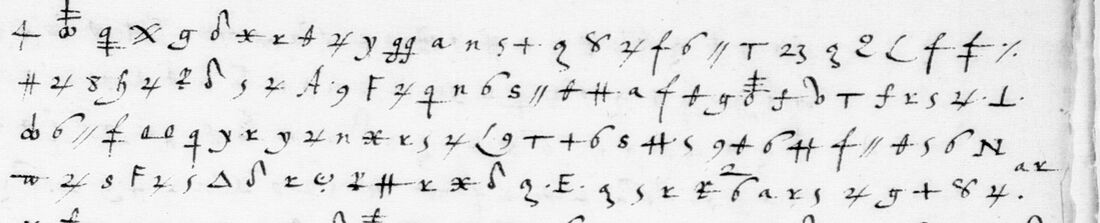
Tomokiyo’s table is a homophonic substitution: several invented signs and figures stand for each common letter. Other signs stand for syllables and short words such as de, la, que, est, pour and monsieur, and some figures for words, for example 23 apres, 24 peu and 31 pas. A slash marks some word ends.
Burford checked the table on Mayenne’s letter to the King from the camp of Libourne, September 1586 (fr. 15573 ff. 103v–104r), whose decipherment of the time is written in the margins. He then read five more letters in the same volume that carry their decipherment (ff. 7v–8r, 32r–33r, 97r, 149r–150r). From them he took values for code signs: armée, tout, the ending -ée and 17 tant, and two more that he marks doubtful. Harumi-Matsuba used Tomokiyo’s table for ff. 218–219 and Burford’s key for f. 120.
Two readings of the key still conflict between the contributors. For Harumi-Matsuba a barred h is armée, while Burford separates two similar signs, one tout and the other armée. A sign the table gives as q also stands where the decipherments of the time have pour.
03 Monségur, May 1586
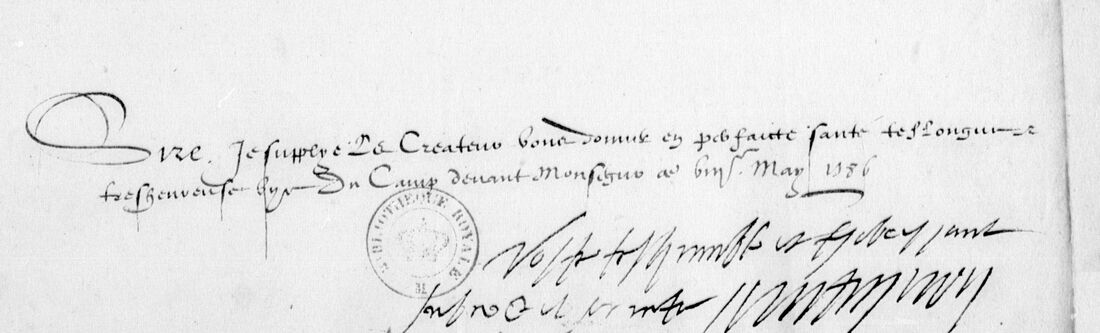
Matignon wrote to the King from the siege of Monségur, which Mayenne’s army took in May 1586. The despatch opens in clear (the battery began at first light and lasted until sunset), and the cipher continues the story. Harumi-Matsuba’s reading begins:
Et y ayant esté tiré pres de douze cens coups, mais ne feirent pas toutesfois tant d’effect que l’on s’estoit promis, parce que la muraille se trouva aussi beaucoup meilleure que l’on ne cuidoit.
Three breaches were made, meant for a lodgement on one of them. The sieur Sacramore de Birague, on guard on that side, tried for it that evening, was badly wounded and had to fall back. Matignon held back the young nobles and now means to advance step by step. The army needs relief, as the sieur de Sailly has already reported. Something the cipher hides behind code 36 will have to come from Brittany to last until the harvest. The forces shrink every day, and pay matters most of all. The letter closes on Mayenne’s fever, which the physicians judge free of danger.
This reading rests on a single pass by Claude over the signs. On six lines of another Cipher-2 letter with a known answer, the same method agreed with the decipherment on 74.8% of letters. A second transcription by OpenAI’s Codex, made without the first, agrees with it on 72–86% of values per page. The gist is secure, but individual words are not.
04 Autumn 1586
f. 120 has no clear text in the cipher, but its cover survives as f. 121v, addressed “Pour Monseigneur de Villeroy” and docketed 1586 (found on the images, 23 October 2026), so the letter went to the secretary of state Villeroy. It is decoded, not read: the partial reading below rests on the decode, and its open stretches fall in most sentences. In Harumi-Matsuba’s partial reading, “this prince” is more vexed than ever. The treasurer Bilart has had thirty thousand écus in gold ready for ten days, and the Cardinal of Guise writes that five thousand are on the way. But “not five thousand but a hundred and five thousand” would not set the army right. The Marshal of Biron cannot be kept, deputies of the army have come, and papers of the secretary La Marsilière have fallen into “our” hands. The transcription was checked against an independent one by Codex (92% and 90% agreement on values), but not by a person. A word-by-word check of the reading against the decode (23 October 2026) restored the cipher’s own spelling and bracketed words only partly carried by the signs; recto lines 15–19 and 24–31 and verso lines 3–5 still do not hold, and one line checked on the image shows that finances rests on a look-alike sign.
f. 385, in Burford’s reading, describes the royal army in Guyenne breaking up as winter begins. Fewer than a thousand foot are left, men ask for leave, and there is no powder. The writer weighs what to do over the winter with the regiments and the foreign troops. He considers sending the landsknechts who were in Champagne and keeping a company of light horse, and he names Monsieur d’Halincourt, Monsieur de Matignon, La Roche and probably the young Aubeterre. Five passes of Claude were voted sign by sign, and on known text the voted reader got 93% of signs right. Burford’s v0.2 is itself a partial, unspaced decode; divided and punctuated here on 23 October 2026, it still has holes in most sentences, so f. 385 too is decoded, not read, and the account above is of its readable stretches only.
05 How it was checked
- One measure for all three. Both contributors’ files were put in one format (
to_read.py) and measured with the rule used for the Cipher-1 and Cipher-3 entries. A sign counts only inside a run of at least three words of a period lexicon (fr-1600-letters) totalling ten letters or more. The result is 1,856 of 2,138 signs for ff. 218–219, 1,002 of 1,103 for f. 120 and 1,702 of 2,052 for f. 385. - Shuffled keys. With the letter values shuffled, 20 keys give medians of 10–16% per letter and at most 31%.
- Sense is not correctness. The measure shows the key turns the transcriptions into French. It does not show that each sign was named right, and the calibrations put that at 75–93% per sign.
- On the images. Here the line counts and layout of ff. 218v–219r, f. 120r and f. 385r were compared with the contributors’ files, and the clear closing and signature of f. 219r were transcribed. All three letters show the same signs (barred crosses, three dots, double slashes, figures). f. 120r also has a few small superscript marks over some signs, which neither contributor mentions; examined on 23 October 2026, they are cipher signs, not glosses.
06 What stays open
- About 22 code signs without a value, most used once: on f. 385 the figures 14, 15 and 30 and a sign that probably stands for vostre majesté; on ff. 218–219 code 36 (perhaps victuals) and eight others; on f. 120 thirteen kinds of sign.
- Short stretches that do not read in all three letters. In ff. 218r–219r, which had one reading pass only, they are scattered; in f. 120 (recto lines 15–19, 24–31, verso 3–5) and f. 385 (36 stretches) they fall in most sentences, which is why those two letters are decoded, not read. The next step is a sign-by-sign re-reading of those lines on the images (Gallica views 246–247 and 752–753).
- A check of the transcriptions by a person, and the conflicting key values above.
- Whether George Lasry, whom Tomokiyo credits with identifying f. 385 and with its opening fragment, read more of it.
Full texts
The transcription and the decryption of every document on this page, so that the reading can be used and checked. Short files are shown here; all are in the repository.
fr. 15572 ff. 218r-219r, Matignon to Henri III, camp before Monségur, May 1586 (Harumi-Matsuba) read in part
Matignon reports the battery before Monségur: about twelve hundred shots with less effect than hoped, three breaches, Sacramore de Birague badly wounded trying for the lodgement. The army is in need, the forces shrink daily and the pay is what matters most; Mayenne has a fever, but the physicians see no danger.
Builds coherent sentences, but under the read bar of 95% of words read as sense (92% here); the holes are marked in the reading.
Transcription
# EN: Sign-by-sign transcription of the cipher of BnF fr. 15572 f. 218r (Gallica view 225, right page), read by eye on 19-20 Oct 2026; not final. Sign names are those of data/key.tsv; | = a divider stroke in the manuscript; a trailing ? = shape uncertain; <...> = a sign not yet named.
# BnF fr.15572 f.218r 暗号部分の書き起こし(2026-10-19、目視。確定ではない)
# 画像:Gallica ark:/12148/btv1b9061879d の225コマ(右ページ)。https://gallica.bnf.fr/ark:/12148/btv1b9061879d/f225.item
# 記号名は key.tsv。| は原本の縦線(区切り)。末尾の ? は形の読みに自信がないもの。<…> は名前を付けていない記号。
# 1行目の前は平文「…du jour, fut continue jusques a soleil couche.」
c01: oo8 y2 | 4 Ry + 6 8? | =est dl | a n r5 r |
c02: pl? # 4H sp .3. | 9 o3 x J | r | s dl 6 sp | cd // th rp? f | .20. | fn dl | m dl n r5 r 6 a |
c03: .31. | Th dl | .16. | .17. | .3. box dl s 8 | =que | lq // 6 | f r sp a // fi 8 | pl r5 // 2 fi sp |
c04: .25. | =la | gam th # 4 n H dl | J dl a X2 // Id 4 | + th xs n | .21. | 2 dl n H dl th r5 r
c05: =que | lq o3 6 fn dl | s T n 9 o3 fi a | y o3 6 | y2 | 6b dl fi s 8 | f T fi x 4 fn 8 |
c06: y r | .12. sp dl n 6 g2 | =qui | en2 4 x // fi 8 | =est dl | 6b 4 fi s 8 | a r5 o3 fi sp | pi #
c07: r sp s F r J | =la | fi 6 a dl 6 8 n // fn | .3. | cd | lq // tri dl r5 | f x # lq 4? 6 r |
c08: J dl x lq r | .3. | =et | sp dl | J x fi x n # | .12. | 9 4H T sp | 4 th .13. | =pour | th dl o3 n
c09: r5 | =les | dl nd r 2 n J | 27 4 6 J | lq r x # f | rh 4H 8 # 4 fn s F r =ment | J +
c10: par2 | 9 dl rx n r # 4H | <beta> | .3. | =les? | 4H 2 lq? dl J s F r # | .3. | 9 dl box r 6 27
c11: dl | =la | 9 fi s 8 4H | 4H | pi r5 dl f s F 4H | J T J | =qui | =que | H r | =par | rp # dl 8 r
c12: 6 9 fi // fn f | =par | lq // tri r r5 | <f+> | <m_> | =qui | <oo> | x | f x r5 | lq 4H | J o3 n r5 | y dl
c13: J .r5. | f 4 s # + 2 o3 rh dl | .3. | pi fi rh 4 tri x r | =qui | =est // n 8 | en2 | cd? 4 r5 9
c14: r | dy T s // sp a r | .3. | =la | 9 fi s 8 dl | pi r5 r f s F 4H | th // T lq th 8 | tri
c15: 4 n g2 6 r # | lq dl 9 fi s oc | y od g2 n sp | =et | y2 | 4 H + | 6b // r5 8 | s o3 T
c16: # 4 tri r T sp dl =ment | =et | =bien | 4 nu? // 2 rp? 4 fi g2 6 dl | 2 od | y r | =la 4 y
c17: F dl T rh | T // x y th 8 | =que | 9 4H | sl | lq x | r 6 s 4H =ment | =il | Ry | m T 8 |
c18: 6b // r5 a | pi y dl * 4H | =et | m T a | cd | o3 6 8 r5 4 fi 6 a | .3. | rh 4H a o3 T
c19: rh r5 6 r # | s dl lq 4 | =et | 4 T * f | =que | =la | 4 9 fi s 8 dl | pi # dl f s F
c20: r | =est o3 fi 8 | 6b // rh 8 | 9 dl box r 6 9 T #? | 9 4 | 27 r rx n dl r5 # | .3.
c21: .8-. | .24. | .3. | 2 T r5 4 n H dl | =que | lq <Fdot> | 6 4 T o3 n 8 | .24. | 4 D + psi r5 r | m
c22: od s 4 + sp dl | =que | =par | 6 + th // 6 J | .24. | + th // n r5 | lq r 9 fi a | y // tri
c23: J | =il | =est | s dl r5 r5? 4 n fn | =que | cd | # th v3 | .3. | .3. 9 4 6 sp | rp dl r5 9 n #
c24: r 6 8 | s 4H | fi // T # =la | .12. | 2 dl n H r T # | rp? | F o3 nd dl rp? | =qui | lq J y2
c25: dl T xs dl 6 8 | x | =il | sp dl 6 =est | + T xs y2 rp r r5 9 T | .12. | <dot-th-dot> <dot-J-dot> 9 fi 3bar
c26: // T 27 <b6> th sp dl | J // lq 9 4 8 J | =et | .8-. | T fi 6 tri 8 4 n 6 r | .3. | pi
# f.218v に続く(未着手)
Transcription
# EN: Sign-by-sign transcription of the cipher of BnF fr. 15572 f. 218v (Gallica view 226, left page), read by eye on 20 Oct 2026; not final. Sign names are those of data/key.tsv; | = a divider stroke; a trailing ? = shape uncertain; <...> = a sign not yet named.
# BnF fr.15572 f.218v 暗号部分の書き起こし(2026-10-19、目視。確定ではない)
# 画像:Gallica ark:/12148/btv1b9061879d の226コマ(左ページ)。https://gallica.bnf.fr/ark:/12148/btv1b9061879d/f226.item
# 記号名は key.tsv。| は原本の縦線(区切り)。末尾の ? は形の読みに自信がないもの。<…> は名前を付けていない記号。
# f.218r の最後(… et .8-. vingtaine de pi)から続く。
c01: r xs 4H sp | =il | y2 | en2 | r T sp 8 | r th | =bien | 9 + T 4 6 a + fi g2 r | cd .10. |
c02: 6 r T xs r | m 4 n s a | r5 4H a n # dl rh | Th dl | <theta> | fi dl T 6 r | fn o3
c03: pi y r xs 4H | =qui | =est o3 n a | 6b o3 r5 8 | 9 n sp zk // J N | 9 y2 | 4 H dl #
c04: .3. phi | par2 | 6 4 T // 6 sp | F n dl r5 | =et | + th n o3 x # 9 F th y2 | 6b 4 n s 8 |
c05: a n r5 dl # | =que | .8-.? | f | T // lq N J | .3. | s 4 6 // f | curl T | .9.? | 4 T // 6 sp
c06: th dl x | =qui | lq J | m 4 n sp o3 fi r 6 8 | a r5 4 th + fi H r r5 | A< y2 4
c07: 6 * oc =est n 2 dl | =qui lq | =est // n a | 2 dl n H r T # | .3. | tri + fi dl tri
c08: fn dl r5 | lq r 9 n s 8 | y o3 g2 fi f | =et | .3. | =la zk n dl 9 + | pl fi r 27 | =que .3.
c09: F 4 f + r5 9 dl r5 | 27 + T 4 6 8 4 n tri dl | s r f | fi # g2? r en2 xo r5
c10: 4 =est # 4H T 6 .24. =plus lq o3 6 tri | .20. =il | en2 | sp dl rh 4 + T xs fi 2 o3
c11: n 6 sp | fi 6 s // 40 // 9 r | =et | zk dl # fi H r T 3bar | 4 y2 + 6 8 | s =est dl y?
c12: Qh | pi 4H sp // n 6 tri | 9 =est # T fn .24. J // x lq + tri N | .10. | 6 r | =vous | 9 n
c13: r5 4 y2 .15. | .3. | =la | fn 4H s r xs fi oc r | en2 | =la =que H r | .10. | y 4 y2 a # // Id
c14: N xo T 4 cd | .3. | Th | dl sp | s F // f dl J | .25. | fi 4 Ry | f s dl x | =que | s dl lq 4
c15: =vous | 4 | =est r | r5 4H zk 6 8 dl | par2 =les | pl # dl cd r 9 4H 6 8 r sp 27 dl zk r
c16: sp s F 4H J | =et | rC? | par2 | lq r sr .3. J + H y2 | =qui | 4 =est dl | r 3bar zk r5 dl
c17: xs 4H =ment | .3. zk r J s F dl | T dl # f | phi | xo | s =est dl box 4H s 8 | .10. | 9 n
c18: r5 4 y2 | J dl T y r =ment | =que | =si zk r5 o3 2 zk 8 4H =ment | dl H r | 6 =est | J dl
c19: s // th # T x | =et | =qui lq 6 | =vous | zk lq 4 fi f 4H | Ry | xo x dl o3 n r5 | xo
c20: y + 9 T dl 6 fi rh | =que | .10. | zk rh 4H th r o3 y2 | =que | y o3 6 y2 fi 8 n rh dl
c21: 4H 4 .31. | tri rh 4 f 9 | f 4H rh T n r5 dl u3? | =pour? o3 40 4H f | 4 zk #
c22: 6 9 + 6 8 9 | F 4H th rh r 3bar | A< 4 T y 8 # r | =que | H r en2 4H r5 4 Qh # dl
c23: J o3 lq T 8 n // 6 | .3. | s dl =que | =vous | T o3 th y 9 r5 dl f | r Ln zk lq o3 y2 4H #
c24: y + 9 f s a dl Qh | A< | x | par2 8 n r5 | .3. | cd dl | f n dl tri r | J th y2 T 4
c25: 6 8 | =les | zk r5 o3 pl // J | n a fi // 6 f | =que | 2 // 6 9 n s 8 | sr | 9 T | 2 4 y2 6
c26: dl | 2 4 | 9 n s 8 | =vous | en2 | + T // n r5 | m + fi s a | dl f .17. | par2 | rC dl J | 9 r
c27: pl 4H rC s F dl f | =que | par2 | lq r 9 fi s 8 | sr .3. | J 4 n H y2 | lq T 6 dl .12.
c28: + | tri r5 4 6 .12. | 9 n box fi cd th y a r rC | =que | .10. | r5 dl s o3 Ln // n rC | r fn s =est
c29: 4H Qh | =est xo =les .36. | =qui | lq J | r5 4 | .13. | 2 + y | 4 y2 f 4H | .3. | # r s o3
c30: Id rh 4H # | en2 | cd =est r | zk r5 o3 T n 6 s dl | J T box fi f 4 2 =ment | xo | y2 | m
c31: // T # fn n r5 | =et | cd rh // y2 | =qui y | J dl r5 + | 6 4H s r xs A< fi # r | 9 en2 | m
c32: A< n # r | th 4H 6 fi rh | .3. | =la | pi r5 r a 4 n tri fn 4H | xo | 4 psi + n 6 9 r5 dl
c33: =la | rh 4H | s o3 y 8 dl | xo T 4 6 oc | + | T rC | Bf co # s r f | dl H x J | 9 n
c34: gam fi 6 T dl 6 8 | Th f | =les | fi o3 T # f | =et | T dl // y2 | =que | s r | J dl r5 4 | .yy.
Transcription
# EN: Sign-by-sign transcription of the cipher of BnF fr. 15572 f. 219r (Gallica view 226, right page), read by eye on 20 Oct 2026; not final. Sign names are those of data/key.tsv; | = a divider stroke; a trailing ? = shape uncertain.
# BnF fr.15572 f.219r 暗号部分の書き起こし(2026-10-19、目視。確定ではない)
# 画像:Gallica ark:/12148/btv1b9061879d の226コマ(右ページ)。https://gallica.bnf.fr/ark:/12148/btv1b9061879d/f226.item
# 記号名は key.tsv。| は原本の縦線(区切り)。末尾の ? は形の読みに自信がないもの。
# f.218v の最後(… veoy que ce sera .yy.)から続く。
c01: zk n rC | 4 T | par2 8 fi r5 | .3. | s r f n r tri 4H | .26. | =les | .xo. rC | .3. | 3? + | =qui 6
c02: dl f o3 fn a 9 T | pl 4 fi J | f J fi x | T 4H x H dl 6 8 | rh dl rC | # 4H 8 fi r5 r rh
c03: =et | s dl | H r f | .3. | .VMa. | =qui | fn dl | f o3 6 8 | tri T dl r5 r J | m // rh 8 r f
c04: J 4 box // n pi lq fi # // 6 a | .yy. | 9 + T 4 fn a + n tri dl | =et | f r fi H
c05: y2 4H r5 o3 6 8 | par2 | 2 y2 | s dl H r f | .3. | g2 4H 6 9 | 4 # 2 r f | .3. | rC // r5 8 dl
c06: =qui y f dl rh o3 fi 8 =bien | 6 dl cd 4H? xs 4 n # dl | .3. | rh dl m # 4 n rC
c07: s F fi # | =les | th 6 f | =et | =les | 4 T 8 r5 dl f | xo | s o3 6 8 n 6 x dl # | =la
c08: tri T dl Lb r en2 | s 4H | zk 4 y2 f | .20. | cd r | =qui | =est | lq r | =plus | fi 2 zk o3 # 8
c09: + 6 a | s dl f 8 | lq r | pl + y2 4H =ment | .26. | .32. | s 4H y 4 | =est 4 6 f | rC | // #
c10: 9 n 6 4 fi r5 r =ment | 4 T 3bar | f n 4H tri r J | .12. | th n H dl J | =il | 6 4H
c11: Bf A< th lq 8 | .31. | 4H J pl r? r5 4H rh | 27 y2 | zk // Id o3 fi | rh =les | J // lq 9 + a
# c11 の上に点で挟んだ行間の書き込みがある(s δ a r δ n #)。読めていない
c12: rC | .K. | .10. | J s dl T | =que | .E. | =vous | rC A< f // Id dl 6 8 | cd | y2 | 9 dl T 4 f 8
c13: + 9 x r r5 8 rh | =qui | 2 dl | tri 4 r5 9 dl #? + | 27 en2 | en2 T y2 dl r5 | rect | y
c14: 4 T A< 6 oc + n g2 .K. | phi | .19. | 4 | =la | 27 fi rC zk o3 | f n 8 n o3 6 | 9 x 27
c15: f s a rC | 27 T 2 4 y2 6 r | =il | 6 4 | divd | A< J o3 | f f a | .30. | .yy. | 9 n 6 r
c16: r J 2 fi xs n // fn | 4 | J A< | m n dl T rh dl | Th dl .16. | =les | 2 dl 9 4H?
c17: s fi 6 f | en2 | o3 fn 8 | m // r5 8 | pi o3 Ln u1? u2? r fi fn n // 6 | =et | 6 y2
c18: A< | 9 fi dl T | 2 dl # s zk? | 4 T s th fn | fi 6 9 n s 4H | .3. | zk r r5 n lq
c19: .20. | Re? | 2-? | .3. | lq o3 6 tri 4H T rh
# この後に平文の結び(Sire, …)と日付・署名が続く
Decryption
# Reading (the enciphered parts of BnF fr. 15572 ff. 218r–219r)

[日本語](READING.md)

- The spelling is kept close to the sixteenth-century spelling that comes out of the decoding (u and v, i and j are not distinguished). Punctuation and capitals were added for reading.
- [ ] = letters or words supplied. [?] = a sign with no value. [?word] = a reading guessed from shape or context, not checked.
- The line-by-line mechanical decode is in `data/decoded_*.txt`; the sign-by-sign transcription in `data/transcription_*.txt`.
- The transcription was read by eye. On six lines of the same cipher that have a decipherment of the time, letter agreement was 74.8% ([METHOD.en.md](METHOD.en.md), "Calibration"). This reading may contain errors at a similar rate.

The French text of the reading is the same as in [READING.md](READING.md); it is repeated here so that this page stands on its own.

## f. 218r (clear text before the cipher)
Clear text: « Le lendemain je la feis commancer a la pointe du jour, [et] fut continuée jusques a soleil couché. »

> Et y ayant esté tiré pres de douze cens coups, mais ne feirent pas toutesfois tant d'effect que l'on s'estoit promis, parce que la muraille se trouva aussi beaucoup meilleure que l'on ne cuidoit. L'on y feict, suivant le dessein qui en avoit esté faict, trois bresches, l'intention de se loger sur l'une seule de[s trois], et se suivir des deux autre[s] pour veoir les ennemis dans leurs retranchement[s] [?sa] par derriere [?] de les empescher de defendre ladicte bresche, sus qui que le par[?] pretendions [nous] loger [? ? qui ? u] sur le soir. Le s[ieu]r Sacramore de Birague, qui estoit en garde du costé de ladicte bresche, voulut gaigner ledict logis, et y alla fort courageusement et bien accompaigné ; [mais] le malheur voulut que des [?le commencement] il y fut fort blessé, et fut contraint de se retourner. Cela, et aussi que ladicte bresche estoit fort defendue de derriere d'un peu de muraille que l'on n'avoit peu abatre, [?f ocaase] que par [là] n'avons peu avoir ledit logis. Il est certain que c[eux] de dedans perdirent ce jour là des meilleurs hommes qu'ils y eussent ; [où] il s'en est aussy perdu des [?] soldats et une vingtaine de b…

## f. 218v
> …[?bl]essés. Il y en eust eu bien davantaige si je n'eusse faict retirer toute [la] jeune noblesse, qui estoit fort disposée d'y aler. De [ϕ] par[quoy] n'avons hier et aujourd'huy faict tirer que une s[eule] volée de canons pour [?…], avons veu qu'ils faisoient travailler, ayant estimé qu'il estoit meilleur de gaigner ledict logis et de là pied à pied, que de hasarder davantaige ces [?…] un peu plus long, mais il en sera aussi moins incommode et perilleux. Ayant c[est]e armée besoing d'estre un peu soulagée, je ne vous diray [?15] de la necessité en laquelle je l'ay trouvée quant [?] de toutes choses, parce que j'ay sceu que cela vous a esté representé par les precedentes depesches et par le sieur de Saly, qui a esté expressement despesché vers [ϕ] pour cest effect. Je diray seulement que si promptement elle n'est secourue, et qu'il ne vous plaise y pourveoir pour l'advenir, je preveoy que l'on y tirera pas grand service [?] pour [?d']hommes, aprendant d'heure a aultre que le[?] resolution de ce que vous vouldrez enployer ladicte armée au partir de ce siege, suyvant les propositions que mondict sieur du Mayne m'a dict vous en avoir faictes, tant par ses depesches que par ledict sieur de Saily. L'une des grandes difficultez que je recognois en ceste armée, est que les [?36] qu'il sera tres mal aysé de recouvrer en ceste province suffisamment pour y fournir, et croy qu'il sera necessaire d'en faire venir de la Bretaigne pour attaindre la recolte. Quant a v[o]s forces, el[le]s diminuent tous les jours, et veoy que ce sera encore

## f. 219r (after the cipher: the clear closing « Sire, je supplie le Createur … Du camp devant Monsegur ce [?] May 1586 » and the signature Matignon)
> pis au partir de ce siege, car les [?…] qui ne sont du pais [?…] veulent se retirer, et celles de Vostre Majesté, qui ne sont gueres fortes, s'afoibliront encore davantaige, et [?…] par moy celles de gendarmes ; de sorte qu'il seroit bien necessaire de refraischir les uns et les autres pour continuer la guerre en ce pays. Mais ce qui est le plus important, c'est le payement, car sans cela, [?estant] ordinairement aux sieges des villes, il ne fault pas esperer d'y pouvoir [retenir] les soldats. [?…] je sceu que [?…] vous [?…] souvent [?…] adverty, qui me gardera d'en ennuyer icy [V. M.] davantaige. [?Quant] a la disposition dudict s[ieu]r du Mayne, il n'a [?…] encore [?…] a sa fievre ; toutesfois les medecins en ont fort bonne opinion, et n'y a, Dieu mercy, aucun indice de peril, mais [?…] de longueur.

## Summary
From the camp before Monségur to the King (May 1586).
- A battery from dawn to sunset, of about 1,200 shots, did less than hoped: the wall proved stronger than expected. Three breaches were made, the plan being to lodge on one of them.
- In the evening the sieur Sacramore de Birague, on guard on the side of the breach, went for the lodgement, was badly wounded and had to withdraw. The breach was defended from behind by a piece of wall that the guns had not brought down, and the lodgement was not taken. The defenders lost many of their best men; on this side some soldiers were lost and about twenty "b…" (with "…essés" at the head of f. 218v, read as blessés, the wounded: an inference).
- The young nobles were held back. From now on, less firing and a step-by-step approach by lodgements.
- The army is worn out and needs relief and provision for the future. The writer awaits the King's decision on how to use the army after the siege, on the Duke of Mayenne's proposals.
- Something (sign 36, value unknown; guessed to be victuals, since it must last until the harvest) will be hard to find in sufficient quantity in the province and must be brought from Brittany. The forces shrink every day, and the troops not from the region want to leave. Most important of all is the payment of the troops.
- The Duke of Mayenne has a fever, but the physicians are hopeful and there is no sign of danger.
Decryption
c01 ET y ayant EST e tire
c02 pres DE dous e cens coups MAIS ne feirent
c03 PAS TOUT e FOIS TANT DE fect QUE lon sestoit promis
c04 PARCEQUE LA muraile setroua ausi BEAUCOUP meileure
c05 QUE lonne cuidoit lon y feict suiuant
c06 le DES seing QUI EN auoit EST e faict trois br
c07 esches LA intention DE c loger surlane
c08 seule DE ET se suiuir DES deus au TRE POUR ueoi
c09 r LES enemis dans leurs retranche MENT sa
c10 PAR deriere [?] DE LES emlescher DE defend
c11 e LA dicte e bresche sus QUI QUE le PAR prete
c12 ndions PAR loger [?] [?] QUI [?] u sur le soir le
c13 s[?] sacramore DE birague QUI EST oit EN card
c14 e ducoste DE LA dicte bresche uoulut g
c15 aigner ledict logis ET y ala fort cou
c16 rageuse MENT ET BIEN aiompaigne mo le LA al
c17 heur uoulut QUE de s lu ence MENT IL y fut
c18 fort blese ET fut c ontraint DE retou
c19 rrner cela ET auss QUE LA adicte bresch
c20 e EST oit fort defendur da derierr DE
c21 UN PEU DE muraile QUE l[?] nauoit PEU abatre f
c22 ocaase QUE PAR nauons PEU auoir ledit log
c23 s IL EST cerrain QUE c ruu DE DE dans perdir
c24 ent ce iour LA DES meileur p honep QUI lsy
c25 eusent u IL sen EST ausyperdu DES [?][?]dix
c26 oud[?]use soldats ET UN uingtaine DE b
# 記号 713 個のうち、表と推定を合わせて値が付いたもの 704 個(98.7%)
# 704 of 713 signs (98.7%) given a value by table and inferred values
Decryption
c01 eses IL y EN eust eu BIEN dauantaige c JE
c02 neuse faict retirer TOUT e [?] ieune no
c03 blese QUI EST oit fort dispos EE dy aler
c04 DE EN PAR nauons hier ET auiourdhuy faict
c05 tirer QUE UN s uol EE s DE canos POUR u [?] auons
c06 ueu QUI ls faisoient trauailer aya
c07 nst EST ime QUI l EST oit meileur DE gaieg
c08 ner ledict logis ET DE LA pieda pied QUE DE
c09 hasarder dauantaige ces irge EN qr
c10 a EST reun PEU PLUS long MAIS IL EN seraausimo
c11 ins incomode ET perileux ayant c EST el
c12 ARMEE besoing d EST run PEU soulag EE JE ne VOUS di
c13 ray ? DE LA necesite EN LA QUE le JE laytrou
c14 EE quac DE TOUT es choses PARCEQUE iay sceu QUE cela
c15 VOUS a EST e repnte PAR LES precedentesdepe
c16 sches ET s PAR le SIEUR DE saly QUI a EST e expre
c17 se MENT DE pesche uers EN q c EST efect JE di
c18 ray seule MENT QUE SI prompte MENT ele n EST se
c19 couruu ET QUI ln VOUS plaise y queoir q
c20 laduenir QUE JE preueoy QUE lonyitire
c21 ea PAS grasd seruire[?] POUR omes apr
c22 ndantd heurex aaultre QUE le EN era ARMEE re
c23 solution DE ce QUE VOUS uouldres enployer
c24 ladscte ARMEE a u PAR tir DE ce siege suyua
c25 nt LES propos itions QUE mondict SIEUR du mayn
c26 e ma dict VOUS EN auoir faict es TANT PAR ses de
c27 pesches QUE PAR ledict SIEUR DE saily lune DES
c28 a gran DES dificultes QUE JE reconois enc EST
c29 e ARMEE EST q LES ? QUI ls ra TRE mal ayse DE reco
c30 urer EN c EST e prouince sufisam MENT q y f
c31 ournir ET croy QUI l sera necesaire d EN f
c32 aire uenir DE LA bretaigne q ataindre
c33 LA re colte quant a us forces elus di
c34 minuent TOUT s LES iours ET ueoy QUE ce sera ENCORE
# 記号 926 個のうち、表と推定を合わせて値が付いたもの 921 個(99.5%)
# 921 of 926 signs (99.5%) given a value by table and inferred values
Decryption
c01 pis au PAR tir DE cesiege CAR LES [?]s DE [?]a QUI n
c02 esontdu pais ssiu ueulent res retirer
c03 ET ce les DE VOSTRE MAJESTE QUI ne sont gueres fortes
c04 safoibliront ENCORE dauantaige ET seil
c05 yeront PAR my celes DE gend armes DE sorte
c06 QUI lseroit BIEN necesaire DE refrais
c07 chir LES uns ET LES autres q continuer LA
c08 gue?e EN ce pays MAIS ce QUI EST le PLUS import
c09 ant cest le paye MENT CAR SANS cela EST ans s or
c10 dinaire MENT aux sieges DES uiles IL ne
c11 fault PAS esperer dy pouoi r LES soldat
c12 s ? JE sceu QUE ? VOUS sasouent c y deuast
c13 aduertr QUI me gardera d EN EN uyer ICY l
c14 auantaig ? EN ? a LA dispo sition dud
c15 scts dumayne IL na ? aso sst ? ENCORE dine
c16 esmision a sa fieure TOUT e FOIS LES mede
c17 cins EN ont fort bon[?][?]einion ET ny
c18 a dieu mercp aucun indice DE peril
c19 MAIS [?] [?] DE longeur
# 記号 498 個のうち、表と推定を合わせて値が付いたもの 485 個(97.4%)
# 485 of 498 signs (97.4%) given a value by table and inferred values
Reading
# Matignon to Henri III, camp before Monségur, May 1586 (BnF fr. 15572 ff. 218r-219r): reading

The French reading of the enciphered parts in `f218_219_harumi/READING.en.md` (Harumi-Matsuba's contribution),
copied here alone 23 Oct 2026 (translation wave v7) so that it is scored and translated without the summary and
notes. Their marks: `[ ]` letters or words supplied; `[?]` a sign with no value; `[?word]` a reading guessed from shape
or context; `[ϕ]`, `[?15]`, `[?36]` code signs without a value; `…` an unread run. Spelling as the decode gives it
(u/v, i/j not distinguished); punctuation and capitals theirs. French.

## Reading

### f. 218r (clear text before the cipher)
Clear text: « Le lendemain je la feis commancer a la pointe du jour, [et] fut continuée jusques a soleil couché. »

Et y ayant esté tiré pres de douze cens coups, mais ne feirent pas toutesfois tant d'effect que l'on s'estoit promis, parce que la muraille se trouva aussi beaucoup meilleure que l'on ne cuidoit. L'on y feict, suivant le dessein qui en avoit esté faict, trois bresches, l'intention de se loger sur l'une seule de[s trois], et se suivir des deux autre[s] pour veoir les ennemis dans leurs retranchement[s] [?sa] par derriere [?] de les empescher de defendre ladicte bresche, sus qui que le par[?] pretendions [nous] loger [? ? qui ? u] sur le soir. Le s[ieu]r Sacramore de Birague, qui estoit en garde du costé de ladicte bresche, voulut gaigner ledict logis, et y alla fort courageusement et bien accompaigné ; [mais] le malheur voulut que des [?le commencement] il y fut fort blessé, et fut contraint de se retourner. Cela, et aussi que ladicte bresche estoit fort defendue de derriere d'un peu de muraille que l'on n'avoit peu abatre, [?f ocaase] que par [là] n'avons peu avoir ledit logis. Il est certain que c[eux] de dedans perdirent ce jour là des meilleurs hommes qu'ils y eussent ; [où] il s'en est aussy perdu des [?] soldats et une vingtaine de b…

### f. 218v
…[?bl]essés. Il y en eust eu bien davantaige si je n'eusse faict retirer toute [la] jeune noblesse, qui estoit fort disposée d'y aler. De [ϕ] par[quoy] n'avons hier et aujourd'huy faict tirer que une s[eule] volée de canons pour [?…], avons veu qu'ils faisoient travailler, ayant estimé qu'il estoit meilleur de gaigner ledict logis et de là pied à pied, que de hasarder davantaige ces [?…] un peu plus long, mais il en sera aussi moins incommode et perilleux. Ayant c[est]e armée besoing d'estre un peu soulagée, je ne vous diray [?15] de la necessité en laquelle je l'ay trouvée quant [?] de toutes choses, parce que j'ay sceu que cela vous a esté representé par les precedentes depesches et par le sieur de Saly, qui a esté expressement despesché vers [ϕ] pour cest effect. Je diray seulement que si promptement elle n'est secourue, et qu'il ne vous plaise y pourveoir pour l'advenir, je preveoy que l'on y tirera pas grand service [?] pour [?d']hommes, aprendant d'heure a aultre que le[?] resolution de ce que vous vouldrez enployer ladicte armée au partir de ce siege, suyvant les propositions que mondict sieur du Mayne m'a dict vous en avoir faictes, tant par ses depesches que par ledict sieur de Saily. L'une des grandes difficultez que je recognois en ceste armée, est que les [?36] qu'il sera tres mal aysé de recouvrer en ceste province suffisamment pour y fournir, et croy qu'il sera necessaire d'en faire venir de la Bretaigne pour attaindre la recolte. Quant a v[o]s forces, el[le]s diminuent tous les jours, et veoy que ce sera encore

### f. 219r (after the cipher: the clear closing « Sire, je supplie le Createur … Du camp devant Monsegur ce [?] May 1586 » and the signature Matignon)
pis au partir de ce siege, car les [?…] qui ne sont du pais [?…] veulent se retirer, et celles de Vostre Majesté, qui ne sont gueres fortes, s'afoibliront encore davantaige, et [?…] par moy celles de gendarmes ; de sorte qu'il seroit bien necessaire de refraischir les uns et les autres pour continuer la guerre en ce pays. Mais ce qui est le plus important, c'est le payement, car sans cela, [?estant] ordinairement aux sieges des villes, il ne fault pas esperer d'y pouvoir [retenir] les soldats. [?…] je sceu que [?…] vous [?…] souvent [?…] adverty, qui me gardera d'en ennuyer icy [V. M.] davantaige. [?Quant] a la disposition dudict s[ieu]r du Mayne, il n'a [?…] encore [?…] a sa fievre ; toutesfois les medecins en ont fort bonne opinion, et n'y a, Dieu mercy, aucun indice de peril, mais [?…] de longueur.
Translation
# Matignon to Henri III, camp before Monségur, May 1586 (BnF fr. 15572 ff. 218r-219r): English translation

Translation (Claude Opus 5.5, 23 Oct 2026) of `f218_219_harumi/f218_219_reading.md`, the reading of the enciphered
parts (Harumi-Matsuba), with the clear words before and after them. Same holes: `[x]` supplied, `[?]` a sign with no
value, `[?word]` a guessed reading, `[ϕ]`, `[?15]`, `[?36]` code signs without a value, `…` unread. Where the French is
broken the English follows its words without supplying the syntax.

## f. 218r

Clear text: "The next day I had it begun at daybreak, [and] it was continued until sunset."

And nearly twelve hundred shots having been fired, they did not however have as much effect as had been promised,
because the wall was also found to be much better than had been thought. Following the design that had been made of
it, three breaches were made, the intention being to lodge on one only of [the three], and to follow up from the two
others so as to see the enemies in their entrenchment[s] [?sa] from behind [?], to prevent them from defending the
said breach, on which, which the par[?], we intended to lodge [ourselves] [? ? who ? u] towards evening. The Sieur
Sacramore de Birague, who was on guard on the side of the said breach, wanted to win the said lodgement, and went
there very courageously and well accompanied; [but] misfortune willed that from [?the beginning] he was badly wounded
there, and was forced to turn back. That, and also that the said breach was strongly defended from behind by a little
piece of wall which could not be knocked down, [?f ocaase] that by [that way] we have not been able to have the said
lodgement. It is certain that th[ose] inside lost that day some of the best men they had there; [where] some [?]
soldiers were also lost, and some twenty w…

## f. 218v

…[?ound]ed. There would have been many more if I had not had all [the] young nobility withdrawn, who were very eager
to go there. Of [ϕ], where[fore] yesterday and today we have had only a s[ingle] volley of cannon fired, for [?…];
we saw that they were having work done, having judged that it was better to win the said lodgement and from there foot
by foot than to hazard these [?…] any further, a little longer, but it will also be less troublesome and perilous. This
army needing to be relieved a little, I shall not tell you [?15] of the necessity in which I found it as [?] in all
things, because I have learned that this was represented to you by the preceding despatches and by the Sieur de Saly,
who was expressly despatched to [ϕ] for this purpose. I shall only say that if it is not promptly succoured, and if
it does not please you to provide for it for the future, I foresee that not much service will be drawn from it [?]
for [?] men, learning from hour to hour that the[?] resolution of how you will wish to employ the said army on leaving
this siege, following the proposals which my said Lord of Mayenne told me he had made to you, both by his despatches
and by the said Sieur de Saily. One of the great difficulties I recognise in this army is that the [?36], which it
will be very hard to obtain in this province in sufficient quantity to supply it; and I believe it will be necessary
to have them brought from Brittany to reach the harvest. As for your forces, they diminish every day, and I see that
it will be still

## f. 219r

Clear after the cipher: "Sire, I pray the Creator … From the camp before Monségur, this [?] May 1586", signed Matignon.

worse on leaving this siege, for the [?…] which are not of the country [?…] want to withdraw, and those of Your
Majesty, which are hardly strong, will grow weaker still, and [?…] by me those of the men-at-arms; so that it would
be very necessary to refresh both the one and the other to continue the war in this country. But what is most
important is the pay, for without that, [?being] ordinarily at the sieges of towns, one must not hope to be able to
[keep] the soldiers there. [?…] I knew that [?…] you [?…] often [?…] informed, which will keep me from wearying [Your
Majesty] further with it here. [?As] to the condition of the said Sieur de Mayenne, he has not [?…] yet [?…] to his
fever; however, the physicians have a very good opinion of it, and there is, thank God, no sign of danger, but [?…]
of length.
fr. 15573 f. 120r-v, autumn 1586, sender and recipient unknown (Harumi-Matsuba) decoded, not read
"This prince" is more vexed than ever; the treasurer Bilart wrote that thirty thousand écus in gold have been ready for ten days, the Cardinal of Guise writes that five thousand are coming, but not even a hundred and five thousand would set the army right. Biron cannot be kept; deputies of the army have come; papers of the secretary La Marsilière have fallen into "our" hands.
A mechanical decode with holes in most sentences: shown so that the transcription and the key can be checked and improved, not as a reading.
Transcription
# BnF fr.15573 f.120r 暗号の書き起こし(2026-10-20、目視。確定ではない)
# 画像:Gallica ark:/12148/btv1b90618780 の246コマ(f. 120r)。画像はこのリポジトリに含めていない
# 記号名は Brett Burford 氏の見本表 v3(BravoBravoIX/mayenne-forget-1586-cipher-reading の method/sheet-v3.png、CC BY 4.0)に合わせた。見本にない記号は data/key.tsv に名前を足した。
# ^(…) は行間の書き込み(解読と採点には使わない)
# 数字の単語記号は .10. の形で書く。末尾の ? は形の読みに自信がないもの。/ は原本の区切りの斜線。
c01: thb + 7 I Sbar .10. Gamma 4 xbar delta th ls r Q S delta zk # n 6 dsi+ 4t w / Tl r L T dbar delta
c02: % m + rC S R 4t Q f 4 .20. % 6 Lp 4 // ls 9 # delta z9 q+ r 9 n xbar th 4 z9 # 9 delta
c03: S hs : f ls delta Q Ee 6 r S delta xbar n a r 2o q+ g curlo th box hs r 6 delta rC // n a 4 .12.
c04: f r? f 6 tri .26. w S : 6 g n z9 # delta Q tt delta box r S a g 6 r rC delta # 4 Lbar curlo
c05: ls a delta 6 8 .30. 4 th xd 4 9 x n g Q q+ // 6 z9 4 9 : L delta rC q+ delta 8 ls delta
c06: g : # f r hs pi n H 4 ls 8 delta g S # f th n a gg Ee z9 # 6 f delta hs r
c07: z9 zk r g S F delta 9 th x f 6 tri a T f2 ^(8 delta) 9 T .31. g r 2o q+ dbar 4 th : f a
c08: Tl? z9 9 n xd f : T # f 2o q+ 4 th : n a 8 # ooC alpha r 2 n y ooo ooC : #
c09: % 2o q+ 6 4 dbar ooC 9 : n a lambda th 6 r 6 z9 eps curl tt oo th : dbar r ls q+ delta
c10: .26. 9 f f2 + y 9 d th Lp g 4t r g S # n a 9 T 9 r th xd ^(8 delta) Q S r rC
c11: f // th # gg a : n r 6 8 S f 6 xo ^(a r) 8s n q+ ooo curl th delta 6 n # rect %
c12: hb .16. w2 6 phi w yy 4 th S T 6 r f2 // ^(H r) .20. .10. Gamma pdot 9 n ls delta Q nous?
c13: g // 40 r g ooC a r q+ w 4 a Q 6 // f2 .31. S n 6 xo ^(a r) 8s f y .20. S r
c14: 6 8 dsi+ f 6 xo 8s n q+ ooo 6 r hsb g 4 th # : n r f2 a # r q+ delta th #
c15: hs % 4 th hs w delta Q Esign w hb # r g : q+ T Q q+ Q r 6 z9 eps % S : f2 n th
c16: ls 4 a f : 6 Q Gamma g pdot f n delta g m + f ls r z9 rC ooC 4 H r # %
c17: gg a n ls dsi Om 2o q+ g 4 th # 4 S r Q 9 // f th delta 6 a z9 T delta 6 n ls
c18: tt w ls 4 6 tri r # f 2o q+ 6 r m + th q+ a Tl 4 th xbar f delta g zk delta ls
c19: r # z9 Lbar // Id : n # ls r 8 delta 6 n # y 4t 8s 4 ls ^(+ q+) z9 pi n ls : 6 Ee 4
c20: delta g S # n a Q g delta ls r a n # 4 6 a S F r f Ee w2 g delta # : n a fe
c21: 4 dbar g r z9 y delta th r : n # ooC .31. f 4 6 8 % w n 2 r Q 9 4 6 f
c22: 9 lambda f // th # g w q+ g f delta th r 2c : 6 a 4 pi q+ 4 dbar r .10. S ls :
c23: dbar Q invTl 6 r dsi a ls // Id r # 4 .31. % .10. g th n f yy f 6 S r ls a 4
c24: n 6 dsi .10. n ls 4 Lp f 4 dbar ooC 9 ls 4 dbar S r Q q+ : 6 8s ooC 9 f ls 4 hsb
c25: 4 th curlo 6 g z9 S r f : f ls rect tt z9 pdots T a r g z9 Qh 2o g th n r
c26: L r 6 a 4 pdots q+ delta # % m : 6 a 8 g curlo box ls r g .20. nous g // 40 r g
c27: r th 6 S curlo ls zk f dsi z9 pi n q+ delta 2o 6 r .24. a + m 4 n # delta zk # :
c28: m f a z9 f2 .15. w 2 w a // 8s pi delta phi a # delta tt 2 4 n 6 g th 6 r
c29: .u. 9 th g r S # delta a 4 n # delta Ee 8s 4 ls g n q+ f r # r 2o nous y delta
c30: B : hs alpha gg a n S th q+ n r # r eps .12. 4 box + f ls r g z9 4d g zk r
c31: 4 9 r eps .12. curlo n 6 4 f2 S delta g % g r 8s pi q+ r 2o q+ f m + dsi+ r 6 a
Transcription
# BnF fr.15573 f.120v 暗号の書き起こし(2026-10-20、目視。確定ではない)
# 画像:Gallica ark:/12148/btv1b90618780 の247コマ(f. 120v)。画像はこのリポジトリに含めていない
# 記号名は transcription_f120r.txt と同じ。{x} は原本で線を引いて消してある記号(採点に入れない)
c01: Tl z9 6b // 6 z9 eps g th # 0 zk 4 Id hs delta a r Q g th # Ee T delta 6 x r {struck}
c02: q+ qx th # g w # 4 6 d r hs f 2o q+ 9 n S a w hs delta {yy} # r 8s n g r
c03: curl th a r 2 zk f q+ : 6 f2 r rC 4 th ls : n a S : 8s Lp # phi 9 hs delta q+ lambda
c04: a : # 8 Q Ee # th zk 8 T ls r z9 S w delta Qh m 4 n S a L th g r #
c05: f ls delta 9 th I .26. {pi} w S r # a 4 n 6 Q dsi r H r g th pi dsi n g a :
c06: n 8 yy g n xd f r zk 8s 4 n 6 r g Q H r zk // I : n a 6b 4 n # delta rect
c07: z9 tri ls 4 6 9 g r box delta S a f .26. tt r L delta 8s f g 6 r m th ls r 6
c08: f 4 .20. dsi w // L r g xbar dbar oo oo Dsign delta 4t ud R
Decryption
# Reading (cipher of BnF fr. 15573 f. 120r–v)

[日本語](READING.md)

- The spelling is kept close to the 16th-century spelling as decoded (u and v, i and j are not distinguished). Punctuation and capitals are added for readability.
- [ ] marks added letters or words. [?] is a sign with no value. [?word] is a reading guessed from form or context and not checked. [escus] is the three-loop sign (ooo) read as escus by inference (it fits all three places after mil). [∞] is the two-loop sign (oo), with no value.
- The line-by-line mechanical decoding is in `data/decoded_*.txt`, the sign-by-sign transcription in `data/transcription_*.txt`. Line numbers (c01 etc.) are those of those files.
- Based on the first transcription (`data/`, corrected in seven places after looking at differences with the transcriptions used for checking on the image). No person has checked the transcription. Details may be wrong ([METHOD.en.md](METHOD.en.md)). Word divisions were added afterwards to the decoded letters.

## f. 120r (cipher throughout, 31 lines)
> c01–c05: [?][a][?][u][?] Je vous asseure que ce prince est plus ennuyé et fasché que jamais, et n'y a ordre de le dissuader de croire que la necessité qu'il souffre ne soit a desseing ; car c'est considéré que les effects ne se raportent [?30] aux advis que l'on de[?]a donne[?s].

> c05–c08: Le tresorier Bilart escrivit par la derniere depesche du vingt un du passé qu'il y avoit plus de dix jours qu'il avoit trente mil [escus] en or,

> c09–c12: et qu'il n'y en doit qu'un[?e] [?n de ment] pour les [∞]voyer[?]. Le cardinal de Guise escrit du deux que ces jours [?partoient] cinq mil [escus] pour venir icy, et toutesfois il n'en est encore aucune no[uvelle].

> c12–c15: Mais je vous puis dire que nous sommes en tel estat que non pas cinq mil, mais [?cent] cinq mil [escus] ne [nous] sauroient relever.

> c15–c19: Et au reste, que [?E] est tout resolu, que quelque [?…]ment et conjuration que vous s[?] puis [?…] faire de s[?en] aler, et partir si [?] qu'il saura ce que doivent devenir les estrangers ; qu'il ne fault plus aussi esperer de pouvoir retenir le mar[eschal] de Biron ;

> c19–c22: [?La] a escrit que, se retirant chez [?la], il seroit bien aysé de le veoir en passant, et estime que dans d[i]x jours est le s[?ieu]r [?M]ontablaye.

> c22–c24: Je croy que [?] ne s'y trouvera pas, et je suis encore incertain si je irai[s], [?s'ay en dray], ce que l'on m'en dira.

> c24–c27: [Nous] avons de ce soir icy les deputés de l'armée qui sui[?vent] [?…] et font [?] offres ; mais nous sommes [en] un corps si debile qui ne peut a faire profit

> c28–c31: de n[?] [?15] [?…] tombé entre les mains un[e] [?] du secretaire La Marsilière, qui nous le [?s]ort particulierement des affaires de [?]spe[?…]ment, des [?f]inances, et semble qu'il y facent

## f. 120v (8 lines of cipher)
> c01–c02: plus de fondement sur [?] pauvreté que sur la venue [de] l[?]urs estrangers, qu'il dict estre remise

> c03–c05: pour [?u] temps. L'on ne sauroit [?…] rendre l[?…] tort que la rupture de ceste armée faict [?a user …].

> c05–c08: Car c'est certain que, si elle subsistoit encore six sepmaines, que le pouvoit faire icy de grands effects, car les ennemis ne furent jamais si estonnés y [?∞ ∞ D …].

## Summary
The summary is under "Content" in [README.en.md](../README.en.md). The sender and the date are not known. Persons are given as spelt (le cardinal de Guise, le mareschal de Biron, le secretaire La Marsilière, le tresorier Bilart, le sieur [M]ontablaye); who they are was not checked.
Decryption
c01 [?]a[?]u[?] IE VOUS a(s|ss)eure QUE ceprince EST PLUS e(a|n)uye
c02 ET fa(s|z)che QUE (i|s)a MAIS ET niaordre DE ledi(s|ss)ua DE rde
c03 cro(i|s)re QUE LA nece(s|ss)ite QUI lsoufrene(s|z)oita DES
c04 (i|s)e(i|s)ng CAR EST consi DE re QUE LES efectsne(s|z)erapo
c05 rtent[?]auxaduis QUE lon DE ado(a|n)e(s|z)letre
c06 sor(i|s)erbilartescr(i|s)uit PAR LA DE rn(i|s)ere
c07 DE pescheduu(i|s)ngtundu PAS se QUI lyauo(i|s)t
c08 PLUS DE dix(i|s)our(i|s) QUI lauoittr EN temil ESCUS EN or
c09 ET QUI lnay EN doit(q|x)unen DE MENT POUR LES [?]uoyerle
c10 CAR d(i|s)naldguiseescritdudeux QUE ce(s|z)
c11 (i|s)our PAR toientc(i|s)nqmil ESCUS POUR uenir ICY ET
c12 TOUT FOIS IL n EN EST ENCORE aucuneno MAIS IE VOUS PUIS dire QUE NOUS
c13 somes EN tel EST at QUE non PAS cinqm(i|s)l MAIS ce
c14 ntc(i|s)nqmil ESCUS ne NOUS sauroientreleur
c15 r ET aur EST e QUE [?] EST TOUT resolu QUE l QUE en DE MENT ET coniu
c16 rat(i|s)on QUE VOUS s PUIS (i|s)iesfa(i|s)re DE (s|z) EN aler ET
c17 PAR tir SI [?] QUI lsaurace QUE do(i|s)uent DE uenir
c18 LES EST ranger(i|s) QUI lnefault PLUS au(s|ss)(i|s)esper
c19 er DE pouoirretenirlemar DE biron LA a
c20 escrit QUE seretirantche(i|s) LA IL seroit BIEN
c21 ayse DE leueoir EN PAS (i|s)ant ET EST ime QUE dan(i|s)
c22 d(q|x)(i|s)ours EST ls(i|s)euemontablaye IE cro
c23 y QUE [?]ne SI trouera PAS ET IE sui(i|s) ENCORE (i|s)ncerta
c24 in SI IE irai(i|s)ay EN drayce QUE lonm EN d(i|s)ra NOUS
c25 auons DE ce(i|s)o(i|s)r ICY LES DE putes DE ARMEE QUI suie
c26 (a|n)entapler ET fonttsofres MAIS NOUS somes
c27 euncorp(i|s) SI DE bile QUI ne PEU tafairepro
c28 f(i|s)t DE n[?] EST m EST tombe EN tre LES mainsune
c29 [?]dusecretaire LA marsil(i|s)ere QUI NOUS le
c30 sort PAR ticuliere MENT DES afa(i|s)res DE [?]spe
c31 ade MENT DES oinances ET semble QUI l(i|s)facent
# 記号 885 個のうち、表・Burford・推定を合わせて値が付いたもの 874 個(98.8%)
# 874 of 885 signs (98.8%) given a value by the table, Burford and inferred values
Decryption
c01 PLUS DE fon DE MENT suripaurete QUE sur LA uenue
c02 l[?]urs EST ranger(i|s) QUI ldict EST reremise
c03 POUR utemp(i|s)lonne(s|z)auroitcomir EN drel(q|x)
c04 tort QUE LA rupture DE c EST e ARMEE faict(a|n)user
c05 (i|s)reduu CAR EST certain QUE SI elesub SI isto
c06 it ENCORE six(i|s)epmaines QUE lepouoitfaire ICY
c07 DE grandsefect(i|s) CAR LES e(a|n)em(i|s)snefuren
c08 (i|s)a MAIS SI EST o(a|n)es(s|ss)y[?][?][?]eeuh
# 記号 218 個のうち、表・Burford・推定を合わせて値が付いたもの 214 個(98.2%)
# 214 of 218 signs (98.2%) given a value by the table, Burford and inferred values
Reading
# fr. 15573 f. 120r-v, autumn 1586, sender and recipient unknown: partial reading (not read)

Re-read 23 Oct 2026 (Claude Opus 5.5; REREAD_BRIEF, batch b21) from Harumi-Matsuba's reading (`READING.en.md`), checked
word by word against his letter decode (`decoded_f120r.txt`, `decoded_f120v.txt`; `research/reading_audit/b21_may_check.py`:
every plain word carried by the decode letters, apart from the choice between the two values of a two-valued sign).
Changes: the figures' spelling restored where the reading had normalised it (enuyé, soufre, efects, somes, pouoir,
trouera, ofres, afaires, paureté, ele, pouoit, enemis, estonés, ches); letters and words the figures do not give
bracketed ([c']est, tout[es]fois, relev[e]r, [l']armée, l[e], furen[t]); words the figures give whole unbracketed
(partoient, Montablaye, sort, cent, nous); partly carried words written whole as [?word] ([?qu'une], [?sieur],
[?s'en], [?suivent], [?leurs], [?donnés], [?deça], [?finances], [?un]). [escus] is the three-loop sign read as escus
from context (three places after 'mil'). ‖ marks the turn of the leaf (f. 120v). Status: decoded, not read (see
`f120_reread_log.md`).

## Reading

[?][a][?][u][?] Je vous asseure que ce prince est plus enuyé et fasché que jamais, et n'y a ordre de le dissuader de croire que la necessité qu'il soufre ne soit a desseing ; car [c']est consideré que les efects ne se raportent [?30] aux advis que l'on [?deça] [?donnés]. Le tresorier Bilart escrivit par la derniere depesche du vingt un du passé qu'il y avoit plus de dix jours qu'il avoit trente mil [escus] en or, et qu'il n'y en doit [?qu'une] [?n de ment] pour les [∞]voyer[?]. Le cardinal de Guise escrit du deux que ces jours partoient cinq mil [escus] pour venir icy, et tout[es]fois il n'en est encore aucune no[uvelle]. Mais je vous puis dire que nous somes en tel estat que non pas cinq mil, mais cent cinq mil [escus] ne nous sauroient relev[e]r. Et au reste, que [?E] est tout resolu, que quelque [?…]ment et conjuration que vous s[?] puis [?…] faire de [?s'en] aler, et partir si [?] qu'il saura ce que doivent devenir les estrangers ; qu'il ne fault plus aussi esperer de pouoir retenir le mar[eschal] de Biron ; [?La] a escrit que, se retirant ches [?la], il seroit bien aysé de le veoir en passant, et estime que dans d[i]x jours est l[e] [?sieur] Montablaye. Je croy que [?] ne s'y trouera pas, et je suis encore incertain si je irai[s], [?s'ay en dray], ce que l'on m'en dira. Nous avons de ce soir icy les deputés de [l']armée qui [?suivent] [?…] et font [?] ofres ; mais nous somes [en] un corps si debile qui ne peut a faire profit de n[?] [?15] [?…] tombé entre les mains un[e] [?] du secretaire La Marsilière, qui nous le sort particulierement des afaires de [?]spe[?…]ment, des [?finances], et semble qu'il y facent ‖ plus de fondement sur [?] paureté que sur la venue [de] [?leurs] estrangers, qu'il dict estre remise pour [?un] temps. L'on ne sauroit [?…] rendre l[?…] tort que la rupture de ceste armée faict [?a user …]. Car [c']est certain que, si ele subsistoit encore six sepmaines, que le pouoit faire icy de grands efects, car les enemis ne furen[t] jamais si estonés y [?∞ ∞ D …].
fr. 15573 f. 385r-v, from Mayenne's side, autumn 1586 (Brett Burford, v0.2) decoded, not read
The army in Guyenne is breaking up at the start of winter 1586: not a thousand foot left, men asking for leave, no powder. The letter asks what to do with the regiments and the foreigners over the winter, and names the landsknechts from Champagne, a company of light horse, Monsieur d'Halincourt, Monsieur de Matignon and La Roche.
A mechanical decode with holes in most sentences: shown so that the transcription and the key can be checked and improved, not as a reading.
Transcription
# BnF fr. 15573 f. 385r (Gallica view 752): sign names as read (five passes voted, image-checked corrections applied, decoder switches applied), one manuscript line per row: line number, a tab, the signs. Names are those of the reference sheet (method/). A slash (/) is a word divider: it carries no letter and is not counted as a sign.
1	+ dsi q+ x g delta xbar r th 4 y gg a n ls + z9 8s 4 f 6 // T 23 z9 2u L f f2 %
2	# 4 8 hs 4 zk delta ls 2x A 9 F 4 q+ n 6 S // th # a f th g Q f curl T f r ls 2x invT
3	dsi 6 // f2 a 0 q+ y r y 4 n xbar r ls 4 L 9 T + 6 S 4t ls 9 th 6 4t f // th ls 6 N
4	w 2x S F 4 ls tri delta r rC zk # r xbar delta z9 x? z9 ls r zk 6 a r ls 4 g + 8s 4
5	2x hb r q+ m a z9 S w delta Qh w 12 pi 4 6 z9 r z9 g // ls a delta 2o q+ 6 r ls w delta
6	31 Q Q n q+ F // r g z9 zk n r 9 2o 9 f 8s n 6 T r f2 8 y hb g tt n : th
7	ls g z9 hb g tt 8s r g z9 S 4 8s Id w 6 r ls w delta Tl rect Q g 4 S # + 8s : ls r
8	a 2o g ooC th 4 + x : pi 4 n 6 g % q+ r g z9 Ee ls dots S F delta Q g f tt 4 th r
9	g f r rC dots 6 a ls 4t a n ls r g n 6 S dots 6 8 n 6 4 f2 8s 2 z9 S r rC n r tri delta
10	Q g delta Ee 3 q+ g w 4 th xbar n ls delta 8 n ls N Q tt zk g // 6 a # delta g dots q+ th g
11	z9 g ooC 4 H r ls tt 8s z9 rC 4 dbar 4 6 g 12 zk delta g S F r z9 th delta ls f invT
12	q+ r g z9 Ee m 4 dbar delta curl z9 B + 6 z9 ls y r th ls S : 6 tri delta 2o q+ 6 dbar 4
13	box L z9 zk dots th q+ g ls r % gg S // 6 g r Q 6 a tt S F dots g delta th ooC a r q+
14	w 4 a a 0 q+ 6 r g delta 24 a ls ooC a # r zk hs ooC 9 ls delta xo th 2x 6 9
15	2x Lbar f2 a Q q+ delta 8 4 ls q+ a n r 6 8 g f dots th ls g q+ ooC th dots dbar z9 S r
16	f delta S : th ls rC ooC q+ dots 6 tri r th ls % 2o q+ zk + ls dots n g a 2o q+ rC ooC z9 Id
17	2x T q+ 8 n a 8s 4 q+ T // q+ curl 6 a n r ls g 4 th ls w delta 2o q+ w 8 r ls a 4
18	th 6 Q f S r 2o q+ 24 8 ooC T dots dbar r ls 6 w 30 Tl z9 8 n 6 xo dsi r 6 f F //
19	g 8 F q+ r z9 : zk f r 9 % z9 : S r 6 a // th f f ooC T n 6 tri 8 g S F + ooC Q
20	S r q+ 4 % S delta a ls w r ls 4 ooC : Qh 6 w 31 0 4 q+ + Q ls 4 th S T 6 delta
21	pi // L r rC y 4 S 4t rC g th ls q+ r r 6 S delta eps z9 q+ F dbar th r ls 2 ls Q q+
22	Q g r S // th # f 2o q+ 4 2u n th delta 8 w delta Qh alpha q+ w 4 a Q H r w
23	6 r f S 4 T # : n a ls delta gg a f ls z9 g n ooC f delta zk 8s 4 n 6 r ooC curl S
24	r rC S // 6 dsi z9 ls 4 // 6 th z9 g th % q+ dbar r ls invT z9 Ee 9 // L r ls S : 6
25	d r 4 th Q q+ tt w 13 ls r g // q+ th 8 g r 8s pi q+ 4 6 a Q tt delta box r
26	S a rC Q 24 a m + f ls delta S w delta Qh 9 th ls 4 6 a S w F dbar th r ls 6 delta
27	8s r ls n a 4t 6 8 30 g 4 zk f2 S delta % w S r ls a 4 n 6 Q 32 Q q+ // 6
28	z9 4 ls delta 8s : 6 g a ls delta Q g ooC 4 H + 6 a zk 6 a r 8s delta 6 a tt Ee //
29	ooC q+ 4t th xbar delta 6 a f 6 m 4 H n pi q+ r eps g th dbar x L S delta Q invT r th g a
30	24 a ls // Id r # 8s 4 Id + n g w r th g a zk ls n 6 f2 g // 6 S : 6 tri delta
31	12 S w F r th ls delta w m 4 n S a w 4 a 9 2x H r # ub a ls // Id r #
32	f2 4 8 4 : dsi r H delta Ee 4 tri ls r + pi q+ r % g delta a r 6 f ls zk ls r f 9 r H delta
33	17 2o q+ 3 zk q+ 4 n 2u + // th dsi Ee tri th delta zk r 9 // n pi a S // 6 a f 6 th
34	r ls % Q q+ : 6 y delta T r th n H delta ls ooC th : dbar r ls rect 9 dbar ls r th delta 6 n #
Transcription
# BnF fr. 15573 f. 385v (Gallica view 753): sign names as read (five passes voted, image-checked corrections applied, decoder switches applied), one manuscript line per row: line number, a tab, the signs. Names are those of the reference sheet (method/). A slash (/) is a word divider: it carries no letter and is not counted as a sign.
1	2o 9 dbar z9 8s // th ls r # 9 th ls 4 6 a S w F dbar th r ls 10 q+ delta th r // dbar
2	# delta g // q+ th z9 6 r q+ r 31 m 4 n ls r Gamma 4 th r f 4 S // 6 dsi z9 ls delta #
3	Q z9 th n ooC 9 ls dots 6 8 17 z9 ls delta tri n Ee th z9 2 g // q+ 9 4 8 f Q z9 th
4	n ooC 9 ls : 6 a 4 th xbar f tt w ls 4 6 tri n r # g 2 6 z9 tt S // 6 a r
5	6 n ls ooC tri 4 ls 6 n g dots 6 S delta g delta ls dots n a th 6 r d ls 4 6 z9 12 zk ooC
6	S delta % xo th 4 g n f 6 th a n H r w rC r 8s pi q+ delta Q dsi q+ 9 // n pi a
7	z9 8s // th ls r # th 6 4 Qh ooC S w delta zk ls // th n 6 S r 9 th ls 4 6 a
8	S w F dbar th r ls r 10 th r // dbar alpha q+ w 6 r S delta xbar 4 n # delta 0 q+ Ee
9	B 4 th q+ ub # delta m ls 4 n g S F f # % 4 th q+ n r th z9 f x? dbar
10	dsi th // dbar r # tt y 4 6 f Q 6 r a f f a w // n r f2 8 ooC S F 4 8s zk
11	+ n tri 6 r 4 th q+ n r th 12 alpha dbar a r 6 f hs th f2 S F q+ ud q+ r tri n
12	delta # g w ls 4 6 d r # rC dsi q+ w // n a Lbar // xbar n pi q+ delta % # delta a n
13	# delta hs tt m ls 4 6 S dots f rC ooC 4 6 a f r 6 g ls delta tri n Ee g dsi xo g delta /
14	hs r B 4 n # delta q+ 4 n xbar delta ls rect g r x q+ r eps S lambda 9 // ls 4 n g : 6
15	z9 Ee ls // S F r 12 S q+ th rC r 4 x x? 9 th n r th 6 r L th pi r a delta 2u
16	delta z9 zk th dbar m r 2x 4 a 4 th r S dsi r Ee A z9 8s 4 a n tri 6 dots f2
17	gg hb 9 delta zk ls // 2u r 6 delta # gg Ee zk ls // th n 6 S r % phi 9 // 40 4 n tri
18	r ls hb n dots th ls f q+ phi 6 r 2u dbar S delta a 9 // n pi a Lbar ls // th r 6 f #
19	ooC S delta zk 4 n g 9 th S q+ r # d delta x ls // n a g r ls th n # 8s th 6 4
20	gg a n delta z9 q+ ooC a ls delta 8 delta 6 r eps % 4 th delta S 24 z9 g delta S // th ls g
21	w Ee curl ls // n a S // 6 a delta 6 f # a # : dbar g uC g 9 th ls 4 6 a
22	zk ooC 9 4 6 8 tt Q q+ g q+ // 6 4 y // dbar g n ls z9 zk ooC g r # 2x y 2x
23	9 x delta 6 f # Ee curl th dsi x? dbar 9 // n pi a z9 8s : th # r hs S r g delta ls 4
24	hb g n : th ls f th 6 r z9 g zk phi S r z9 S r 6 a 8s n q+ dsi gg uC g
25	2x q+ r uC 6 g a 0 xo ls // n r 6 8 fe g r ls th f ls 4 th S F // f delta
26	z9 8s n lambda rC dsi tt ooC 9 // n th r 6 a ooC a ls r # L w g q+ delta zk th
27	pi q+ n r 6 a box g th pdots q+ dbar 4 6 a 6 r ls delta S r th // f ls S delta Q 12 g th
28	f Q gg 4 9 th n f 9 + 6 a 6 dbar 4 tri th 2x ls delta g z9 f th tri r eps
29	0 m // n pi q+ r xbar delta w a delta H 4t Q g 6 r zk // I dots 6 g 4 q+ 4 S
30	Q ls 8s dots 6 a # L x r q+ 6 dbar 9 lambda // th a ls dots dbar g 8s delta g S F 4 6 f
31	zk r a f 8 f m // ls a g a 0 6 r x 4 q+ r 6 a 15 % a 0 14 // pdots S n
32	eps Lbar // ls a q+ r Lbar 4 n g 2o 9 f g 6 : g 8 4 th q+ ooC th 6 r S delta xbar n a delta
33	% Q S r Q g 4 th : 6 f r th 6 2x n 4 2o w delta m // th ls 6 dbar 4 Lbar ls dots zk curl f
34	phi x // 6 a Ee g r th q+ r S 4 th g delta Id delta Qh dsi 0 0 4t curl dots I
Decryption
# BnF fr. 15573 f. 385r–v (Mayenne–Forget Cipher-2, 1586): French text, literal and normalised

**Status: partial reading (v0.2). Not solved.** The evidence weighs toward French plaintext produced by the key; many stretches are unresolved (see `unresolved-v02.md`). Literal = what key.json gives for signs.txt (`data/f385r`, `data/f385v`); `[?name]` = a sign with no value. Normalised = the same letters with word breaks chosen by the decoder; `[..]` = letters that make no dictionary word; `=` = a word that runs on to the next line. Nothing has been emended. Source of the images: gallica.bnf.fr / BnF.

## f. 385r

| line | literal | normalised |
|---|---|---|
| 1 | asiluseseualpartirademainouapresdedensnet | a sil use se ual partira demain ou apres dedens net |
| 2 | ratraperamonsieurdhalincourtiusquespourusera[?invT] | ratrapera monsieur dha lin court iusques pour usera [·] |
| 3 | sinontillelaisseraaduancerduneiournee | sinon til le laissera aduancer dune iournee |
| 4 | estachargeespressede[?x?]derepnterasama | est a chargees presse de [·] de re [p] [n] te rasa ma |
| 5 | atoutelftdecestearmeeestdesbandeedesortequilnereste | a tout el [f] [t] de ceste armee est desbandee de sorte quil ne reste |
| 6 | pasquequeilhoesdepiedquidiminuentltoutslesiou | pas que que il ho es de pied qui diminuent [l] tout [s] les iou= |
| 7 | rsdetoutslesmesdecamuestneresteplusicyquesacramore | rs de tout [s] les mes de ca mu est ne reste plus [icy] que sacra mor e= |
| 8 | tquisenuaauobainsetlesdelarochequesilesaue | t qui sen ua au o bains et les de la roche que si les aue= |
| 9 | siesontretiresincontinanmmdecesiege | s ie sont retire sin con tin an mm de ce siege |
| 10 | queseladelsestaussiretireequelespsontresolus | que se la del sest aussi retiree que les [p] sont resolus |
| 11 | desenalerlesmdesayansdespeschedeuers[?invT] | de sen aler les [m] de say ans despesche deuers [·] |
| 12 | lesdelafayepourdesanderleurcongequilnya | les de la [f] aye pour de san der leur conge quil ny a |
| 13 | fadepoulsreetparconsequentleschoseuentel | fade pouls re et par consequent les chose uente l= |
| 14 | estattilnesepeutrentreprendrequand | estat til ne se peut rentre prendre quand |
| 15 | apntqueletarltientsiourslenuoydece | a [p] [n] [t] que let ar [l] tient si ours len uoy de ce |
| 16 | secoursenlongeuretquilparoistquilsendeu | secours en long eu [r] et quil parois [t] quil sen de u= |
| 17 | aultitmaluolpourntiersaurestequilestterta | ault [i] [t] mal uol pour [n] tiers au reste quil est ter ta |
| 18 | unquescequilpeutenuoyernest[?30]plusdetinqsiensho | un ques ce quil peut enuoyer nest [·] plus de tin [q] sien sho= |
| 19 | sthledeopiedetdeocentoussenuingtschaenque | st [h] le de o pied et de o cen tous sen uingts cha en que |
| 20 | celaetcetresteraenoarmeenestpasialaqueraucune | cela et cet restera en o armee nest pas ia la quer aucune |
| 21 | boneslacessurleencementdelhyuermrquel | bon es la ces sur le en ce [ment] de lhyuer [m] [r] quel= |
| 22 | quesecoursquiladeiuetestearmeetlestatqueleest | que secours qui la de iu et este armee [t] lestat que le est |
| 23 | nescauroitrepartirdesiensepmaineenpourc | ne scauroit repartir de sien sepmaine en pour c= |
| 24 | esconsideraonudesuetlyer[?invT]deladonercon | es considera on [u] de su et ly er [·] de la doner con= |
| 25 | geauquellesesttreresolutsemblantquelesefe | ge auquel les est [tre] resolut semblant que les [e] [f] [e] |
| 26 | ctsquepeutfairecestearmeedurantcesthyuerne | [c] [t] [s] que peut faire ceste armee durant cest hyuer ne |
| 27 | meritent[?30]sapnceetestcertainquesansquelon | meritent [·] sa [p] [n] ce et est certain que sans que lon |
| 28 | dearemonstrequesenalantpntementleslao | de a remonstre que sen alant [p] [n] te ment les la o |
| 29 | enleussentinfaliblementsuyunceque[?invT]eust | en leussent infaliblement suy un ce que [·] eust |
| 30 | peutrouermauaisesteustprinnsonconge | peu trouer mauais est eust pri [n] [n] son conge |
| 31 | descestheureestfaictestatdalerdroittrouer | des cest heure est faict estat daler droit trouer |
| 32 | nataosielelaagreableetsetenirpresdele | na ta o si [e] le la agreable et se tenir pres de le |
| 33 | tantquildeplaideaousilaguepedoibtcontinu | tant quil de plaide a ou si la guepe doibt continu= |
| 34 | eretquelonleueuilerenuoyericydyreuenir | er et que lon le ueu ile renuoyer [icy] dy reuenir |

## f. 385v

| line | literal | normalised |
|---|---|---|
| 1 | quidydemourerdurantcesthyuerieleueoy | qui dy demourer durant cest hyuer ie leue oy |
| 2 | resoludenelepasfairevousauesaconsiderer | resolu de ne le pas faire vous aues a considerer |
| 3 | quedeuiendronttantderegilaudemsoldatsquedeu | que deuiendront tant de regi lau dem soldats que deu= |
| 4 | iendrontaussilesestrangiersmndelesconte | iendront aussi les estrangiers [m] [n] de les conte= |
| 5 | nirengarnisonceseroitunegrandedespen | nir en garnison ce seroit une grande despen= |
| 6 | ceetquasiinutileestsemblequesildoibt | ce et qua si inutile est semble que sil doibt |
| 7 | demourerunaarmeeencesteprouincedurant | demourer un a armee en ceste prouince durant |
| 8 | cesthyuereieueoytlestnecessaireilla | cest hyuer [e] ie ue oyt lest necessaire il la |
| 9 | sauldroitrefraischiretaulieudes[?x?]y | saul droit re frais chi [r] et au lieu des [·] y |
| 10 | siuoyerleslansquenetsitestoientenchamp | si uoye [r] les lansquenet si testoient en champ= |
| 11 | aigneaulieudestytenirunchlulegi | aigne au lieu dest y tenir un ch lu legi= |
| 12 | ersestrangerssilestoitpossibleetreti | ers estrangers sil estoit possible et reti= |
| 13 | rerlesfrancoisenantiensregilassiqse | rer les francois en an tiens regi las si [q] se= |
| 14 | resairelaissericyseulementcxdoraison | res aire laisser [icy] seulement [c] [x] doraison |
| 15 | delarochedescluseau[?x?]duieuneaubetede | de la roche descluse au [·] du ieune au bete de |
| 16 | edepuyfeaatauecsielamonsieurdematignon | [e] de puy [f] [e] a a tauec si [e] la monsieur de matignon |
| 17 | partoutdeprodeenerparlaprouinceetendomaig | partout de pro de en er par la prouince et en do maig= |
| 18 | ertoutiourslennedeycetdoibtprouenir | e [r] tout iours len ne de y cet doibt pro uenir |
| 19 | encepaisduclergeuroitseruirmuna | en cepais du cler geu roit seruir mun a |
| 20 | partiedelentretenementetauecpeudesecours | partie de lentretenement et auec peu de secours |
| 21 | estlapourroitcontenirtroysmoysdurant | est la pourroit contenir troys moys durant |
| 22 | pendantlesquelslonaloysirdepenserala | pendant lesquels lon a loysir de pensera la= |
| 23 | duenirlapourusi[?x?]ydoibtdemourercesera | duenir la pour [u] si [·] y doibt demourer ce sera |
| 24 | toutsioursunedespencedecentmilsiparmoys | tout si ours une despence de cent mil si par moy s= |
| 25 | alemoynstiqroientbienseruirauchose | a le moy [n] [s] ti [q] roi ent bien seruir au chose |
| 26 | demixssilesendoiuententrernestslepu | de mix [s] si les en doiuent entrer nest [s] le pu= |
| 27 | blientfsuplyantnereceuoircequedessu | blie [n] [t] [f] su [p] ly ant ne receuoir ce que dessu= |
| 28 | squeparaduisdantnyaguaresdeiugement | s que par aduis dant ny a [g] ua res de iugement |
| 29 | ifoiblesseesttelequesnepouonsalac | [i] foiblesse est te le ques ne pouons a lac |
| 30 | quermontrauelnydxoutroysmeschani | quer mon trau el ny [d] [x] ou troys mes cha ni |
| 31 | petitsfortstineualent[?15]etti[?14]opci | petits forts ti ne ualent [·] et ti [·] o [p] ci= |
| 32 | mentportlepaisquidisnostaulenunecessite | ment port le pais qui dis nos tau len [u] necessite |
| 33 | etquecequesauonseunaiaquiestefournyaproppours | et que ce que sauons eu nai a qui este four ny a pro [p] pour s= |
| 34 | enuontlaseulecauseuearmeesiiiepourou | en uont la seule cau seue armee si [i] ie pour ou |

Letters of literal and normalised agree on every line: True.
Decryption
  1 asiluseseualpartirademainouapresdedensnet
  2 ratraperamonsieurdhalincourtiusquespourusera·
  3 sinontillelaisseraaduancerduneiournee
  4 estachargeespressede·derepnterasama
  5 atoutelftdecestearmeeestdesbandeedesortequilnereste
  6 pasquequeilhoesdepiedquidiminuentltoutslesiou
  7 rsdetoutslesmesdecamuestneresteplusicyquesacramore
  8 tquisenuaauobainsetlesdelarochequesilesaue
  9 siesontretiresincontinanmmdecesiege
 10 queseladelsestaussiretireequelespsontresolus
 11 desenalerlesmdesayansdespeschedeuers·
 12 lesdelafayepourdesanderleurcongequilnya
 13 fadepoulsreetparconsequentleschoseuentel
 14 estattilnesepeutrentreprendrequand
 15 apntqueletarltientsiourslenuoydece
 16 secoursenlongeuretquilparoistquilsendeu
 17 aultitmaluolpourntiersaurestequilestterta
 18 unquescequilpeutenuoyernest·plusdetinqsiensho
 19 sthledeopiedetdeocentoussenuingtschaenque
 20 celaetcetresteraenoarmeenestpasialaqueraucune
 21 boneslacessurleencementdelhyuermrquel
 22 quesecoursquiladeiuetestearmeetlestatqueleest
 23 nescauroitrepartirdesiensepmaineenpourc
 24 esconsideraonudesuetlyer·deladonercon
 25 geauquellesesttreresolutsemblantquelesefe
 26 ctsquepeutfairecestearmeedurantcesthyuerne
 27 meritent·sapnceetestcertainquesansquelon
 28 dearemonstrequesenalantpntementleslao
 29 enleussentinfaliblementsuyunceque·eust
 30 peutrouermauaisesteustprinnsonconge
 31 descestheureestfaictestatdalerdroittrouer
 32 nataosielelaagreableetsetenirpresdele
 33 tantquildeplaideaousilaguepedoibtcontinu
 34 eretquelonleueuilerenuoyericydyreuenir
Decryption
  1 quidydemourerdurantcesthyuerieleueoy
  2 resoludenelepasfairevousauesaconsiderer
  3 quedeuiendronttantderegilaudemsoldatsquedeu
  4 iendrontaussilesestrangiersmndelesconte
  5 nirengarnisonceseroitunegrandedespen
  6 ceetquasiinutileestsemblequesildoibt
  7 demourerunaarmeeencesteprouincedurant
  8 cesthyuereieueoytlestnecessaireilla
  9 sauldroitrefraischiretaulieudes·y
 10 siuoyerleslansquenetsitestoientenchamp
 11 aigneaulieudestytenirunchlulegi
 12 ersestrangerssilestoitpossibleetreti
 13 rerlesfrancoisenantiensregilassiqse
 14 resairelaissericyseulementcxdoraison
 15 delarochedescluseau·duieuneaubetede
 16 edepuyfeaatauecsielamonsieurdematignon
 17 partoutdeprodeenerparlaprouinceetendomaig
 18 ertoutiourslennedeycetdoibtprouenir
 19 encepaisduclergeuroitseruirmuna
 20 partiedelentretenementetauecpeudesecours
 21 estlapourroitcontenirtroysmoysdurant
 22 pendantlesquelslonaloysirdepenserala
 23 duenirlapourusi·ydoibtdemourercesera
 24 toutsioursunedespencedecentmilsiparmoys
 25 alemoynstiqroientbienseruirauchose
 26 demixssilesendoiuententrernestslepu
 27 blientfsuplyantnereceuoircequedessu
 28 squeparaduisdantnyaguaresdeiugement
 29 ifoiblesseesttelequesnepouonsalac
 30 quermontrauelnydxoutroysmeschani
 31 petitsfortstineualent·etti·opci
 32 mentportlepaisquidisnostaulenunecessite
 33 etquecequesauonseunaiaquiestefournyaproppours
 34 enuontlaseulecauseuearmeesiiiepourou
Reading
# fr. 15573 f. 385r-v, from Mayenne's side, autumn 1586: partial reading (not read)

Re-read 23 Oct 2026 (Claude Opus 5.5; REREAD_BRIEF, batch b21): a punctuated, word-divided partial reading of Brett
Burford's literal decode (v0.2, `f385-french.md`, letters unchanged), in the figures' spelling. [?word] = partly carried
(a letter or two of the word is unread or doubtful, or a code sign is taken at Burford's doubtful value); [?…] = an
unread stretch; [?] = a code sign with no value (invT, x?, 30, 15, 14); [word] = supplied. Letters are not re-read
on the image here. Status: decoded, not read (see `f385_reread_log.md`).

## Reading

[?…] s'il [?…] partira demain ou apres, dedens [?…] ratrapera Monsieur d'Halincourt iusques [?…] [?], sinon t'il le
laissera advancer d'une iournee. [?…] de ceste armee est desbandee, de sorte qu'il ne reste pas que [?mil] [?hommes]
de pied, qui diminuent tout[s] les iours; de tout[s] les [?mestres] de [?camp] [?…] ne reste plus icy que Sacramore,
et [?…] qui s'en va au[x] bains, et les de La Roche, que si les [?…] sont retires [?incontinant] [?…] de ce siege; que
[?…] s'est aussi retiree; que les [?…] sont resolus de s'en aler, les [?…] ayans despesche devers [?] les de La Faye
pour [?demander] leur congé. Qu'il n'y a [?faute] de [?poudre], et par consequent les chose[s] [?…] en tel estat t'il ne
se peut [?rien] entreprendre. Quand a [?present], que [?…] tient [?…] l'envoy de ce secours en [?longeur], et qu'il
paroist qu'il s'en devault [?…] mal [?…] pour [?…]. Au reste, qu'il est [?…] que ce qu'il peut envoyer n'est [?]
plus de [?cinq] [?…] et de [?…] cent [?…] [?…] que cela et ce [?…] restera en [?…] armee n'est pas ia [?…] aucune
bon[n]es [?…] sur le [?commencement] de l'hyver [?…], quelque secours qu'il a [?…] ceste armee, l'estat que le est ne
scauroit repartir de [?six] sepmaine[s]. Pour ces consideraon[s] [?…] [?] de la doner congé, auquel il est [?tres]
resolu, semblant que les [?efects] que peut faire ceste armee durant cest hyver ne meritent [?] sa [?presence]; et
est certain que, sans que l'on [?…] a remonstre que s'en alant [?presentement] les [?…] l'eussent infaliblement [?suyvi],
ce que [?] eust peu trouer mauais, [?…] eust [?prins] son congé des cest heure, est faict estat d'aler droit trouer
[?…] si [?…] l'a agreable, et se tenir pres de [?…] tant qu'il [?…] ou si la [?guerre] doibt continuer, et que l'on le
[?veuille] renvoyer icy d'y revenir ‖ qui d'y demourer durant cest hyver, ie le veoy resolu de ne le pas faire. Vous
aves a considerer que deviendront tant de [?regimens] [?…] soldats, que deviendront aussi les estrangiers; [?…] de les
contenir en garnison ce seroit une grande despence et quasi inutile. [?Et] semble que s'il doibt demourer una armee en
ceste province durant cest hyver [?…], ie veoy [?qu'il] est necessaire [?…] la [?faudroit] refraischir, et au lieu des [?]
y [?envoyer] les lansquenets [?qui] estoient en Champaigne, au lieu d'y tenir un [?…] [?…] legiers estrangers s'il estoit
possible, et retirer les François [?…] [?regimens] [?…], laisser icy seulement [?…] d'Oraison, de La Roche, Descluseau,
[?] du ieune [?Aubeterre], de [?…] [?…] avec [?…] Monsieur de Matignon partout [?…] par la province, et endomaiger
toutiours [?…]. [?…] doibt provenir en ce pais du clergé [?pourroit] servir [?…] partie de l'entretenement,
et avec peu de secours [?…] la pourroit contenir troys moys, durant lesquels l'on a loysir de penser a l'advenir. La [?…]
si [?] y doibt demourer, ce sera toutsiours une despence de cent mil [?…] par moys [?…] bien servir [?…] si les [?…]
doivent entrer [?…] [?…] [?…] ne recevoir ce que dessus que par advis [?…] n'y a [?…] de iugement. [?…] foiblesse est tele
que [?nous] ne pouons [?attaquer] [?…] n'y [?…] ou troys [?meschans] petits forts [?qui] ne valent [?] et [?…] [?…] le pais
qui [?…] necessite, et que ce que [?…] eu [?…] a qui este fourny [?…] pour s'en vont la seule cause [?…] armee [?…].
Translation
# BnF fr. 15573 f. 385r–v: English gist of the readable stretches (a translation, not the plaintext)

**This is a translation by Claude of the stretches of `f385-french.md` that read as French.** It is not the literal plaintext, and it is not a full text. "…" marks unresolved stretches. Words in [brackets] are supplied or doubtful readings from `unresolved-v02.md`; *(?)* marks doubtful sense. Nothing is solved; the reading is partial (v0.2).

Version 0.2 reads four code signs that v0.1 left open, learnt from other letters in this cipher deciphered at the time (stage F): *armée* (army), *tout* (all), *tant* (so much, so many) and the ending *-ée*; a fifth, *droit*, and a sixth, *tre*, are doubtful. The places they unlock are marked ⁺ below.

The writer is probably the Duke of Mayenne, or someone in his camp, writing to the King or to Villeroy. The cipher is the one Mayenne and Forget used. The letter is about the royal army in Guyenne at the start of winter 1586: it is breaking up, and someone must decide what to do with the foreign troops over the winter.

## f. 385r

- (l. 1–3) … will leave tomorrow or the day after … and will catch up with Monsieur d'Halincourt as far as … unless he lets him go a day's march (*journée*⁺) ahead …
- (l. 4–6) … this army⁺ is disbanded, so that there remain not [a thousand] foot soldiers, which are dwindling every day⁺ …
- (l. 7–8) … of all⁺ the [mestres de camp] *(?)* … there remain [no more] here than … who is going to the baths, and those of La Roche …
- (l. 9–11) … they have withdrawn … from this siege … has also withdrawn⁺, and the … are resolved to go away; the … having sent to [Your Majesty] those of La Faye *(?)* to ask for their leave.
- (l. 12–14) There is a lack of [powder] *(?)*, and consequently things are in such a state that nothing can be undertaken. As for [the present] …
- (l. 15–19) … the help sent will be long in coming, and it appears that … all that he can send is … of foot and … horse *(?)* …
- (l. 20–22) … that will remain in the army⁺ is not yet at the … any good … at the [beginning] of winter … some help that … this army⁺ …
- (l. 22–25) … could not set out again within a week … consideration … to [beg Your Majesty] to give leave, to which … is [very] resolved, since the effects that this army⁺ can produce during this winter …
- (l. 26–30) … do not deserve … and it is certain that, unless he had been shown that by going away [at present] … they would infallibly have followed him, which [Your Majesty] might have taken amiss, he would have taken his leave …
- (l. 30–34) … from this hour he plans to go straight⁺ *(?)* to find … if it is agreeable, and to stay near … so long as⁺ … whether he must continue, and that he may be sent back here to return.

## f. 385v

- (l. 1–2) … to stay [here] during this winter, I see him resolved not to do it. You have to consider
- (l. 2–5) what will become of so many⁺ regiments and soldiers, and what will become of the foreigners; [the means] to keep them in garrison: it would be a great expense and almost useless.
- (l. 5–8) It seems that if an army⁺ must stay in this province during this winter … I see that it is necessary … it would have⁺ *(?)* to be refreshed, and instead of the … to send the landsknechts who were in Champagne,
- (l. 10–12) instead of keeping there a [company of] light horse, foreigners if possible, and to withdraw the French … old regiments …
- (l. 13–16) … to leave here only … d'Oraison *(?)*, La Roche, Descluse *(?)*, … the young Aubeterre *(?)*, … de Puy… *(?)* … with … Monsieur de Matignon
- (l. 16–18) … throughout⁺ the province and … damage … always⁺ … that he must provide … this country …
- (l. 18–21) … could serve … part of the upkeep, and with a little help he could hold for three months, during which there would be leisure to think about
- (l. 21–24) the future. As for … if he must stay, it will always⁺ be an expense of a hundred thousand … a month *(?)* …
- (l. 24–28) … could well serve … if they must come in … they publish … [begging] not to receive what is above, but by advice … there is hardly any judgement
- (l. 28–30) … weakness is such that we cannot attack … there are [only two] or three wretched *(?)* small forts that are worth nothing …
- (l. 31–34) … the country, which … necessity, and that what we have … supplied … for them to go away, the only cause … the army⁺ …
Key: key-cipher2.json, key.tsv, key.tsv
07 Sources
- Bibliothèque nationale de France, fr. 15572 ff. 218–219 (Gallica
btv1b9061879d, views 225–226) and fr. 15573 ff. 120 and 385 (btv1b90618780, views 246–247, 752–753). - Satoshi Tomokiyo, cryptiana, Henry III’s Cipher with Ambassadors: the list of the letters, the Cipher-2 table, and the f. 385 fragment, credited to George Lasry.
- Brett Burford, issue 46 and BravoBravoIX/mayenne-forget-1586-cipher-reading (v0.2, 19 October 2026; Zenodo doi:10.5281/zenodo.23470961; data CC BY 4.0).
- Harumi-Matsuba, issue 49 with Harumi-Matsuba/matignon1586-public, and issue 51 with Harumi-Matsuba/mayenne1586f120-public (October 2026; data CC BY 4.0).
- Other entries for these papers: Matignon’s Cipher-3, a different cipher with its own page, and the Mayenne–Forget Cipher-1 despatches (
targets/matignon1586/, in progress).
Notes, profile and the contributors’ data in targets/mayenne1586c2/.