

01 The documents
Add MS 32657 is a volume of Walsingham’s Scottish correspondence (DECODE gives the span of the volume, 1547–1590, as the records’ date). DECODE imaged four pages each of three items:
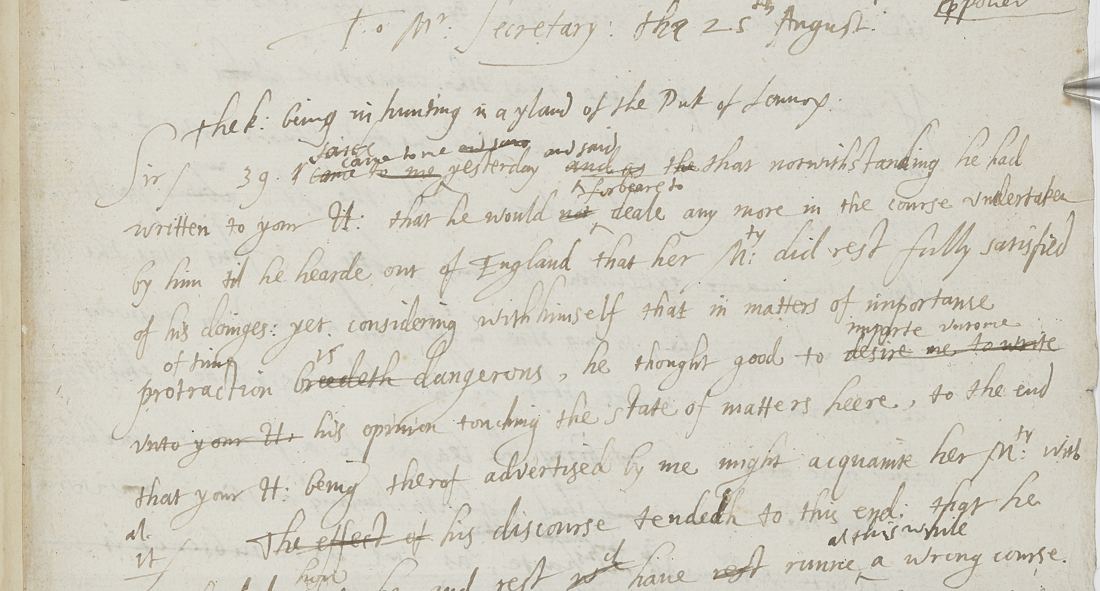
- R4841, ff. 167–168: “To Mr Secretary the 25th August”. The top of f. 167 carries the end of an earlier draft and jotted notes (“Maxwel”, “1000”, “Sterling”).
- R4842, ff. 173–174: “To Mr Secretary the 30th of August 1585”.
- R4843, ff. 175–176: “To Mr Secretary the first of September”.
All three are working drafts in Wotton’s hand, with deletions and interlinear additions. The code numbers are written inline, usually followed by a point, where a name would stand. The drafts also write “the K.” and “her Mtie” in clear in places, so the code was applied unevenly.
02 The code numbers
| No. | Reading | Grade | Evidence in the drafts |
|---|---|---|---|
| 19 | James Stewart, Earl of Arran | H | “the enlargement of 19” (Arran was warded after Lord Russell’s killing on the Border, 27 July 1585); “19 yet remaineth at Kinneil”, Arran’s house; “the Arranistes”. |
| 39 | Patrick, Master of Gray | H | Wotton’s informant, pushing for Arran’s fall; “complained to his friend in England” of Wotton’s coldness; charged by the King to take the Jesuits Hay and Dury. |
| 10 | King James VI | H | “possess themselves of 10 and 19”; “the 10 house”; “hold the 10 from Stirling”; “his reconciliation with 10”. |
| 9 | Queen Elizabeth, or England | C | “the K. … very desirous of the 9 friendship”. |
| 20 | John, Lord Maxwell | C | A disaffected lord seeking terms with the King through Arran; “20 make some incursion upon the L. of Johnstone with whom he hath a quarrel” (the Maxwell–Johnstone feud). “Maxwel” is also jotted on f. 167. |
| 24 | Sir Thomas Kerr of Ferniehirst (CSP Scotland viii glosses “Farnyhurst”; first identified here as Huntly) | H | A Catholic lord suspected of a secret agreement with Arran and of a plan to carry the King to France, paying his men in French crowns (the Jesuits’ 6,000 crowns). |
| 3 | France, or the Guise party | C | “divert him from 3”; “convey him towards 3 … into France”. |
| 27 | unidentified | I | One of Gray’s associates at court (“39. 40. 27. [cannot] live safely in the court”); “was greatly hers [Mary’s] and is a great favourer of the Hamiltons”. Candidates: Secretary Maitland, Justice Clerk Bellenden. |
| 40 | Sir Lewis Bellenden, the Justice Clerk (CSP Scotland viii) | H | Another of Gray’s associates at court. |
| 32 | unidentified | I | A place, probably a castle, into which Arran might “convey himself”. |
| 36 | unidentified | I | The source of money for 39’s hundred men (“money out of 36”); perhaps the Queen’s treasure. |
03 What the despatches say
25 August 1585 (R4841)
The King is hunting in a land of the Duke of Lennox. Gray (39) came to Wotton “yesterday”: although he had written that he would forbear to deal further until he heard that the Queen was satisfied with his doings, he judged delay dangerous. His discourse: he and the rest have run a wrong course “in seeking to disgrace 19 with 10”, whose love toward Arran is so extreme that he will not suffer a hair of his head to fall; as long as Arran continues in favour it is impossible to bring home the banished lords, and the league “cannot be sure”. Arran will be able to divert the King from England and toward France (3). To obviate this, the Queen should furnish the lords to take Arran and seize the King’s person. There are rumours that Arran and 24 are agreed, and that 24 may carry the King to France.
30 August 1585 (R4842)
Wotton answers Walsingham’s letter of the 21st about Gray’s complaint to “his friend in England”. Gray, 40 and 27 cannot live safely at court while Arran may return; 27 “was greatly hers and is a great favourer of the Hamiltons”. Arran still remains at Kinneil under guard. Bothwell has come to court, “to the great grief of the Arranistes”. The Jesuits Hay and Dury are in the country, and the King has charged Gray to take them.
1 September 1585 (R4843)
The device of Gray and the Prior of Blantyre: the lords are to join with 20 under colour of his feud with Johnstone, and send 500 men to seize the King and Arran. Gray asks for money to keep a hundred men and hold the King’s house; the commissioners are to meet on the Borders. This is the plan that became the return of the banished lords and the fall of Arran at Stirling in November 1585.
04 Method
The twelve images were fetched from DECODE with a logged-in session and transcribed directly; there was no cipher to break, only a hand to read. Each code number was identified by collecting every sentence it occurs in across the three drafts and matching it to the persons and events of August 1585 (Arran’s warding after the Russell affair, Gray’s intrigue with England, the Maxwell–Johnstone feud, the Jesuit mission). A number counts as certain (H) where two or more independent contexts fit only one person; probable (C) where one context points to one person or to a small set.
05 What remains open
- 27, 40: two of Gray’s associates at court. The calendar gives 40 as Bellenden (below); 27 is untested, with Maitland a candidate.
- 32: a place of refuge for Arran. 36: a source of money.
- 9, 20, 24, 3: probable only (grade C); for 20 and 24 see the calendar below.
- Prior identification, checked later the same day. CSP Scotland vol. 8 (1914) was consulted afterwards through the HathiTrust text view for the companion page on Walsingham’s side of this correspondence. The calendar glosses the numbers in Wotton’s sent despatches: Arran [“19”], the Master of Gray [“39”], the Justice Clerk [“40”] and Farnyhurst [“24”]. So 40 is Sir Lewis Bellenden, and 24 is Sir Thomas Kerr of Ferniehirst, not Huntly. Its no. 106 calendars the despatch of 1 September with “Morton” for 20 (Lord Maxwell, styled Earl of Morton).
06 Sources
- British Library, Add MS 32657, ff. 167–168, 173–174, 175–176. DECODE records R4841, R4842, R4843 (images behind login).
- Calendar of State Papers, Scotland, vol. 8 (1585–1586), ed. W. K. Boyd (Edinburgh, 1914): consulted after the identifications were made (see What remains open).
Notes and profile in the repository folder wotton1585/. The page images are British Library copyright and are not in the repository.