01 The documents and the keys
The three records share the shelfmark Francia 18 and a catalogue line, but not a date or a key.
- R15, Francia 18/1 ff. 7r–v. Deciphered by George Lasry (DECODE document D3102), with his reconstruction of the key (D3103): two-digit homophones with the second digit odd, 8 a null, marked two- and three-digit nomenclator codes. Nothing is added here.
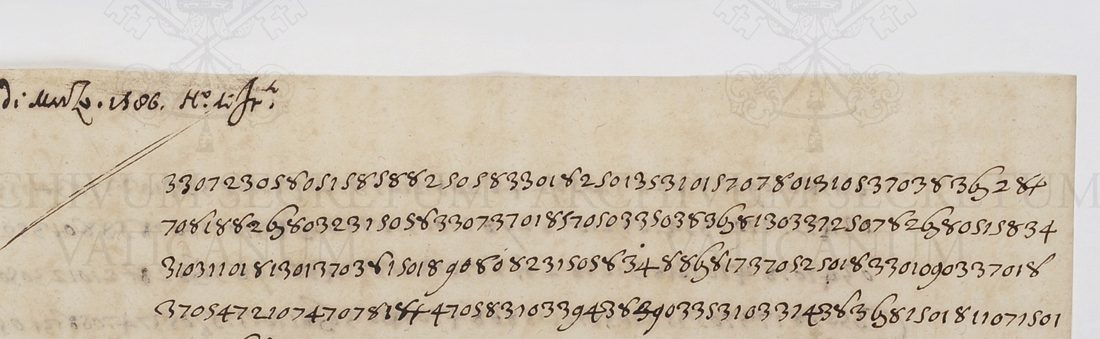
- R16, Francia 18/2 f. 206r–v, headed in clear 3. di Marzo 1586. DECODE shows a decryption (D3104). Its MD5 is that of R15’s decryption, and its text is R15’s. The same key file (D3105) is attached, so the letter was one run of a decoder away from a decryption.
- R17, Francia 18/3 ff. 233r–235v. DECODE attaches an incomplete key (D3186, catalogued as F22: one-, two- and three-digit elements, not deterministic) with the note that the full key is Meister p. 393 no. 40. Its “decryption” file is the error trace of a Java program.
02 R16: Guise, Metz and the sale of church property, 3 March 1586
The despatch belongs to the quarrel over the bull of 1586 that let Henri III raise money by selling church property. The nuncio reports what the Duke of Guise has sent to tell him, what a well-placed informant heard, and the mood of the clergy’s assembly. Decoded text, word breaks added, doubled consonants as the writer spelled them:
hoggi il [Duca di Guisa] mi ha mandato a dire … che egli hora tiene per fermo che il [Re Christianissimo] debba fare la […] … prima havera riscosso quanti si deve vendere per la bolla, ma che esso [Duca di Guisa] non vi acconsentira mai … che esso [Duca di Guisa] non poteva ne voleva acconsentire a detta […] … mi viene … riferito da personaggio di molta autorita havere inteso da un gentilhuomo … che egli si potrebbe contentar … si facesse quando se gli desse Metz, e una buona somma di […] … che con li […] che ricevessero hora potrebbero poi prepararsi a nuova impresa … nondimeno il cuore di […] non corrisponde all’estrinseco … li ecclesiastici della citta … restano molto mal contenti della concessione della bolla per l’alienatione … detta congregatione inclina ad appellarsi ad futurum concilium, se vedera di non potere ottenere … che essa congregatione habbia molta speranza di essere esaudita da [Nostro Signore] …
In paraphrase, Guise tells the nuncio he will never consent to the King’s sale of church goods under the bull; others say he would consent if he were given Metz and a large sum, money he could turn to a new enterprise; the King shows him confidence but his heart does not match; the Paris clergy are angry at the concession and their assembly leans towards an appeal to a future council, while hoping the Pope will hear them.
03 R17: Lorraine, the Guises and the reiters, 1587
With Meister’s key no. 40 (“Con monsig. Moresino nuntio in Francia, 8 Giugno 1587”) the transcription decrypts to Italian on all five pages. It is therefore a Morosini-period despatch of 1587, not a Bergamo or Nazareth letter. The subject is the German reiter army and the Catholic princes:
… era stata grande l’allegrezza che tutti i buoni haveano sentito della risolutione fatta dal [Sua Maesta] di chiamare il [Duca di] Loreno e quello di Guisa, et le loro forze ad unirsi con la [Sua Maesta], tanto anco e stato maggiore il dispiacere che si e sentito della mutatione fatta da [Sua Maesta] … la [Regina Madre] sta con molto travaglio temendo che non segua qualche inconveniente irremediabile … il [Duca di] Loreno a voler venire innanzi …
04 Method
R16: DECODE’s transcription D1610 (volunteer TimB) was decoded with Lasry’s key file as it stands, reading pairs and treating 8 as the null. That left 66 unknown groups, most of them marked nomenclator codes. Meister p. 324 no. 2 prints Ragazzoni’s key of 1583 for the Paris nunciature: the same letter alphabet, with a table of names and of marked words. In the OCR the names sit in a clean two-column list; the marked words are in one run with each code after its word, an alignment checked against R16 (26¸ che, 36¸ per, 28+ questi, 98+ essere, 20− non, 0̇ con). Where one digit is missing in the transcription the pairing slips; the decoder drops one digit when that restores known pairs. Unknowns fell to 18.
R17: the decoder written for Morosini’s despatches, which divides the running figures into units in the ways Meister’s key no. 40 allows and keeps the division an Italian language model scores best, was run unchanged on DECODE’s transcription D1611.
Both decryptions rest on the volunteer transcriptions; the scans were not checked figure by figure.
05 What remains uncertain
- R16, name codes. 58 Duca di Guisa and 34 Re Christianissimo are H (they fit every occurrence; Guise asks for Metz); 14 Nostro Signore C. Meister’s 18 Duca di Ferrara and 48 Duca di Parma occur where no duke fits and are marked I: the 1586 table may have moved them.
- R16, open: 70 (three times, a person), 90− (twice, the thing the King must do, probably the sale or the alienatione), 4+ (twice, “una buona somma di …”, probably denari), 22+, 8+, 12+, 30−, 60−, 0−, and about ten single slips of the transcription.
- R17, five open groups (519, 911, 556, 722, 561, most likely transcription slips) and the spellings where the language model chose the division of the figures; the date within 1587 is not fixed.
06 Sources
- Archivio Apostolico Vaticano, Segreteria di Stato, Francia 18: DECODE records R15, R16, R17 (images on login), with the volunteer transcriptions D1610 and D1611 and George Lasry’s keys D3103/D3105 and D3186.
- Aloys Meister, Die Geheimschrift im Dienste der päpstlichen Kurie (Paderborn 1906), p. 324 no. 2 (Ragazzoni, 1583) and pp. 393–394 no. 40 (Morosini, 1587).
- The companion checks of the other Paris-nunciature records on DECODE are in
damiata1624/.
Decoder, keys, transcriptions and both decryptions: bergamo1585/. Page images are not reproduced beyond the crop above.