At a glanceNot solved · text not obtained
- The text
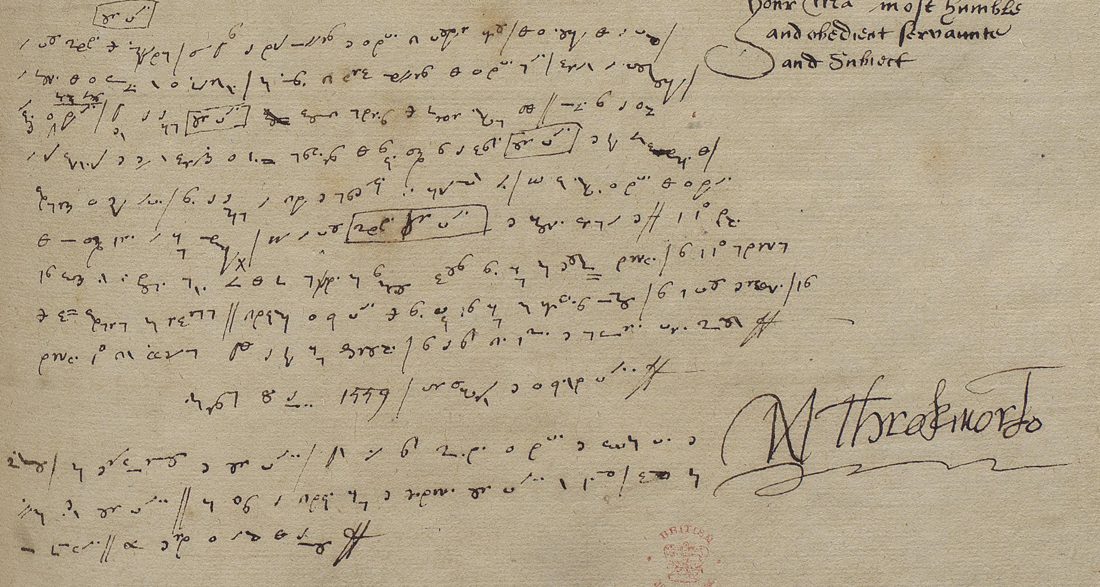
- About twelve lines of small cursive signs below and beside the subscription of Throckmorton’s letter of 10 July 1559, with a date line “… 8 … 1559” and a three-line block keyed by a star to the letter.
- Where
- British Library, Add MS 4136 f. 32 (old f. 9), in the Forbes Papers; DECODE R2988 (catalogue item 97). Tomokiyo lists it as a cipher “yet unidentified”.
- The cipher
- Small letter-like signs whose value changes with the position of their dots, in groups of one to four signs: a word-sign code or shorthand, like the dotted-letter word codes of Thomas Smith (1563) and the Cecil–Norris table.
- How it was tried
- Transcribed sign by sign (about 405 signs in 222 groups) and measured against English; tested as mirrored and inverted script; the known keys of the volume and the period tried.
- Why it resists
- Each group is a word, and 113 of the 222 tokens are signs used only once. A sign seen once carries no evidence of its own value, so no method that works from the ciphertext alone can reach half of the text.
- What would finish it
- Its key, or the originals of the 8 July 1559 despatches it probably copies (TNA SP 70/5; CSP Foreign I nos. 947, 950) as a crib.
- Other ciphers
- Throckmorton’s letter above it is in his Cipher 1, deciphered in part on its own page; John Wood’s 1568 line on the next leaf has its own page.
01 The text
Transcribed sign by sign (margin_transcription.txt, first pass): about 405 signs in 222 groups, about 29 base shapes (22 frequent) and about 80 shape-and-dot combinations. Groups average 1.9 signs; 106 are single signs. One boxed group occurs four times and is probably a name. Written left to right, with “/” and “//” as clause marks; not Hebrew, not mirrored or inverted Latin.
What it probably is. The date line reads “… 8 … 1559”, and the letter above it says Throckmorton wrote twice on the 8th. The margin is likely his copy of the 8 July despatches (CSP Foreign I nos. 947, 950: Lord Grey’s ransom, the French King’s fever, forces for Scotland, Ruy Gomez, Arran at Geneva, Anne du Bourg), sent again with the letter of the 10th. Lord Grey, who recurs in both abstracts, is the best candidate for the boxed group. The calendar gives only abstracts, and the originals (SP 70/5) are only in the subscription State Papers Online.
02 A word code
Taking each group as a word: 222 tokens give 141 types and 113 once-only types. The same measure on 222-word stretches of Bain’s calendar gives a median of 140 and 107 (margin_stats.py). Letter-for-letter English would give groups of about 4.3 signs with few single letters. The signs change value with the position of their dots, like the dotted-letter word codes of the period. 51% of the tokens are signs used once, which the ciphertext alone cannot determine, so no ciphertext-only method can reach half of the text, let alone the 95% the project asks of a full reading.
The key leaves bound in the same volume (ff. 173–185, DECODE R9258–R9262) hold Throckmorton’s and Smith’s letter ciphers, not this code; Tomokiyo’s Ciphers 1–3, Smith’s 1563 cipher, the Cecil–Norris table and the Moray–Wood signs give nothing on it.
03 What would finish it
A photograph of SP 70/5 nos. 947 and 950 with their deciphered passages, aligned against a full transcription of the margin, or the code’s key. Attempted, not solved.
04 Sources
- DECODE R2988 (image).
- S. Tomokiyo, Cryptiana, “Unsolved” and “Ciphers of Elizabethan diplomats”.
- Calendar of State Papers Foreign, Elizabeth I, July 1559, 6–10.
- J. Bain, Calendar of State Papers relating to Scotland II (1900), used as the English comparison text.
Transcription and statistics: targets/throck1559margin/ in the repository. Split on 14 October 2026 from the page it shared with Throckmorton’s letter and Wood’s line (one cipher per entry).