01 The document
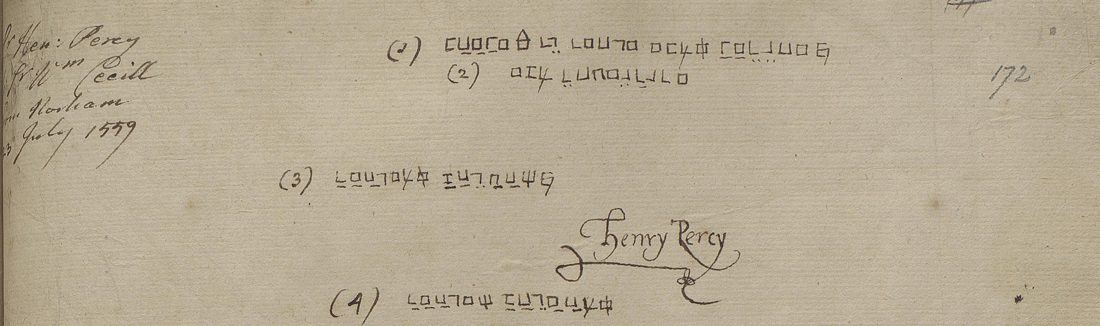
The heading reads “Sr Hen: Percy to Sr Wm Cecill from Norham 23 July 1559”. A second heading on the same page, “from Norham 22 July 1559 · A”, has only the signature under it. Below a rule is “Sturmius’s Cipher, 4 March 1562”, an alphabet with name codes and nulls. Its signs are Greek-like letters, not boxes, so it is not Percy’s key.
The passages are transcribed one sign at a time. Each sign is a box shape (⅃ ⊔ L □ ⊏ 7 ⊓ Γ, and a barred I) with or without a mark beneath: an underline, one dot or two dots. Five other signs appear: a crossed 4, a boxed cross, a trident, a tailed 6 and a house. In all there are 13 words, 63 signs and 19 distinct sign-and-mark combinations. The transcription is in percy1559/transcription.txt. Passages (3) and (4), on either side of the signature, begin with the same five signs and share their second word’s first three signs.
02 What the letter says, and what was in cipher
Bain’s calendar (no. 501) summarises the letter. Percy has had Knox’s answer by word of mouth. Whytlaw is fully instructed, so his journey is at an end. Percy has conveyed a letter to the Lord Prior and encloses the Prior’s unsigned answer. Lord Hume has put off the border meeting at Lady Kirk. The Merse and Teviotdale go to the Dowager tomorrow, and the Congregation towards Haddington. The note on the manuscript is “A few words in cipher, deciphered by Cecill”. On 22 July Percy had written Knox’s name as a cipher sign (CSP Foreign I no. 1045). On 4 August he told Cecil he had sent the Lord Prior “a cipher” (Laing, Works of John Knox VI, p. 61).
Percy’s cipher could spell out whole sentences as well as names. Bain (no. 480) records a postscript Percy added in cipher to Kirkcaldy’s letter of 1 July and deciphered himself. Laing (VI, pp. 33–35) prints it in clear: “The letter that Knoxe wrythe to you is by the meanes of the hole Congregatione, the names of whome I sende yowe here inclosed.” Its ciphered form is on the original only.
03 What was tried
- Word patterns. Each cipher word was matched against a vocabulary from Sadler’s State Papers and the Forbes volumes, with the calendar’s names added. Many words fit on their own. The repeated five-sign word fits prior or merse, for example.
- Rosicrucian pigpen. This tested each box shape as a cell of three consecutive letters, with the mark choosing among them. Every cell layout and mark order was tried, with 24- and 26-letter alphabets. None produces a single dictionary word, so this system is ruled out.
- One alphabet for all thirteen words. A constraint search looked for one alphabet that makes all thirteen words real words. It was run with the marks counted as distinct letters, with dots ignored, with underlines ignored, with all marks ignored, and with homophones allowed. It found no solution. The same search on the words read right to left also found none. A version that left up to six words free as name codes timed out without producing a candidate.
- Statistical search. The search scored letter triples, and then whole words from a vocabulary of the period. It gave only fluent-looking nonsense, as expected for 63 signs.
- Guessed names. Prior, Lord Prior, Knox, Whytlaw and Norham Castle were placed on the repeated words. None gives an alphabet that holds across all four passages.
04 What remains open
None of the four passages is deciphered. They may be name signs rather than spelled-out words, or the tracing may have miscopied some marks; a tracing cannot settle either question. Two documents would: the original of 23 July in TNA SP 52/1 with Cecil’s interlined decipherment, or the ciphered original of the 1 July postscript, which would give a sentence of known plaintext. Neither is online.
05 Sources
- British Library, Add MS 4136 f. 172 (Forbes Papers), DECODE R9256; the Sturmius key on the same page is R9257.
- J. Stevenson (ed.), Calendar of State Papers, Foreign, Elizabeth I (1863), nos. 1045, 1051: British History Online.
- J. Bain (ed.), Calendar of State Papers relating to Scotland I (1898), nos. 480, 498, 501: archive.org.
- D. Laing (ed.), The Works of John Knox VI (1864), pp. 33–35, 60–61: archive.org.
Transcription, scripts and notes: percy1559/.