

01 The leaves

f. 32 (old 9) is Throckmorton’s holograph letter to Elizabeth, signed, 16 lines of cipher in his first alphabet. Below and beside the subscription are about 12 lines of small cursive signs, a date line, and a three-line block marked “*” that keys to a star in line 13 of the letter. f. 33 (old 10) is Throckmorton to Cecil, 8 August 1559 (deciphered by Tomokiyo, Cipher 3; Forbes p. 195). At its foot is one line docketed “Mr John Wod to Secretary Cecil, 6 Sept 1568” with a traced signature.
02 The letter of 10 July 1559
Key: Tomokiyo’s reconstruction of Cipher 1 (DECODE R2988 attachment), with these corrections: x and υ = i; y = f or h; z = m; ρ = d or t; ∫t and a flat-topped 6 = w; the looped Q = be; ξ and dotted q = your Majesty; a doubled sign and ζ inside a word are nulls. Code words are in square brackets; [..] marks undecrypted signs.
It may please [your Majesty] to be advertised that whereas I sent [letters] to the same by Maister Gray of the eight of [this] [month] [at] five of the clock [in] the afternoon, and [by] Carew [letters] of the same date written [at] midnight touching the [French King]’s state, I judge [your Majesty] will be desirous to be further enformed thereof. [..] convenient to put in to writing the whole discourse of [..] [which is known?] to [my] knowledge; of considering the present [..], [I judged it best?] to dispatch [this] gentleman, to whom [..] enforme the same [..] of the state [..] length, to whom it [may please your Majesty] to give credit. [..] Since [his] coming on [this] side [he hath] done [the] diverse and sundry ways [good] and painful service, [whereby he hath] deserved to be well considered and rewarded; beseeching [your Majesty] to be much [..] and gracious [lord] to him when [your Majesty] perceive [his] service [..] accepted, whereof I [have had] experience, as I shall be able to declare more plainly* and particularly to [..] when [it] shall please the same to command me to attend [..]. And [so I] humbly beseech [God] to preserve [your Majesty in] health, wealth and [all] felicity. [At] Paris the tenth of Julii.
Grades (README Conventions): lines 1–4 H; lines 5–15 C where the key gives the letters, M for the bracketed guesses. About 470 of 550 signs in lines 5–15 are decrypted with confidence. The two despatches of the 8th that it mentions are CSP Foreign I nos. 947 and 950; the bearer is not named in the decrypted part.
03 The marginal text on f. 32
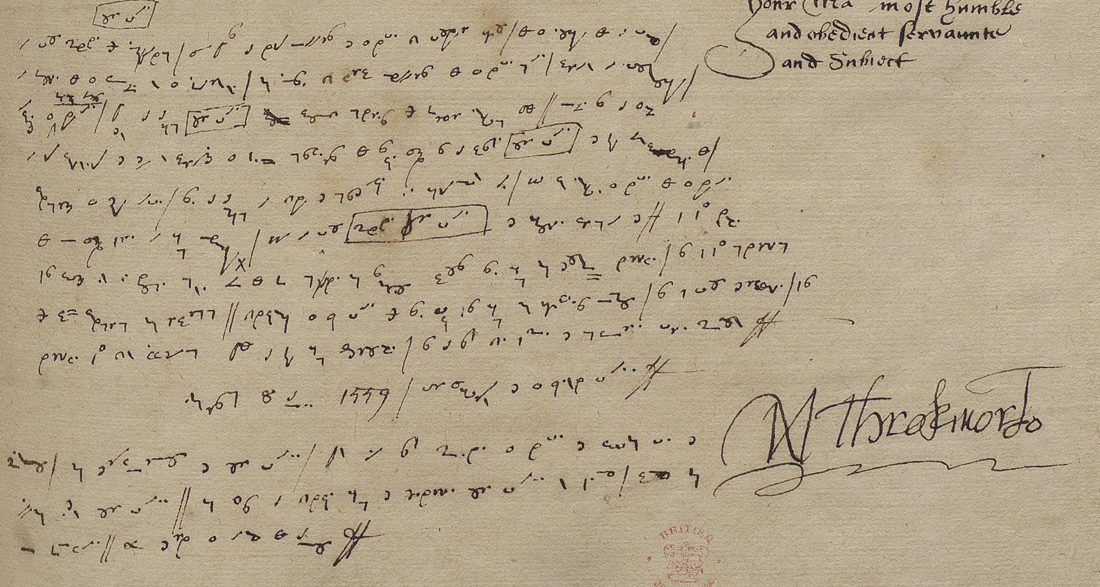
Transcribed sign by sign (margin_transcription.txt, first pass): about 405 signs in 222 groups, about 29 base shapes (22 frequent) and about 80 shape-and-dot combinations. Groups average 1.9 signs; 106 are single signs. One boxed group occurs four times and is probably a name. Written left to right, with “/” and “//” as clause marks; not Hebrew, not mirrored or inverted Latin.
A word code. Taking each group as a word: 222 tokens give 141 types and 113 once-only types. The same measure on 222-word stretches of Bain’s calendar gives a median of 140 and 107 (margin_stats.py). Letter-for-letter English would give groups of about 4.3 signs with few single letters. The signs change value with the position of their dots, like the dotted-letter word codes of Thomas Smith (1563) and the Cecil–Norris table. 51% of the tokens are signs used once, which the ciphertext alone cannot determine, so no ciphertext-only method can reach half of the text.
What it probably is. The date line reads “… 8 … 1559”, and the letter says Throckmorton wrote twice on the 8th. The margin is likely his copy of the 8 July despatches (CSP Foreign I nos. 947, 950: Lord Grey’s ransom, the French King’s fever, forces for Scotland, Ruy Gomez, Arran at Geneva, Anne du Bourg). The calendar gives only abstracts, and the originals (SP 70/5) are only in the subscription State Papers Online.
04 John Wood to Cecil, 6 September 1568 (f. 33)
39 signs, 16 distinct, in the symbol family of Moray’s cipher to Wood of July 1568 (wood_line.txt). Bain, CSP Scotland II no. 804, prints the letter from the Hatfield original and marks one phrase as cipher: “and says he must neidis haif it be on meinis or uthir”. An exhaustive alignment (letters, nulls, syllable signs, reversed, all substrings) fails. HMC Salisbury I has no entry for the letter.
No unique solution. A solver (simulated annealing) fitted a one-letter-per-sign key against quadgram statistics of Bain’s calendar from 200 random starts; 185 end above the median score of real 39-letter text, and 92 differ from each other in more than a third of their letters, all gibberish (nonunique.py). The line is undetermined by its own text; only the Hatfield original, with whatever decipherment it carries, can settle it.
05 What remains open
- 10 July letter: twelve code signs (1k̲, ρ̲, g̲, δ̄, δ̲, ō, ⊓̄, q̄, r̄, π̄, ƒ̇, ʋ̲) and the spans marked [..]; the starred marginal note keyed to line 13.
- Margin: needs its key, or a photograph of SP 70/5 nos. 947 and 950 with their deciphered passages as a crib.
- Wood line: needs Hatfield, Cecil Papers vol. 1.
06 Sources
- DECODE R2988 and R2989 (images and Tomokiyo’s key attachment).
- S. Tomokiyo, Cryptiana, “Ciphers of Elizabethan diplomats” and “Unsolved”.
- Calendar of State Papers Foreign, Elizabeth I, July 1559, 6–10.
- P. Forbes, A Full View of the Public Transactions in the Reign of Q. Elizabeth (1740), vol. I.
- J. Bain, Calendar of State Papers relating to Scotland II (1900), no. 804; HMC, Calendar of the Manuscripts of the Marquis of Salisbury I (1883).
Transcriptions, decryptions and scripts: wod1568/ in the repository.