

At a glanceExisting decipherment · complete
- The letter
- Beatrice d’Aragona to Eleonora d’Aragona, Buda, 2 May 1486: three written pages and the address side, in six photographs.
- Where
- Archivio di Stato di Modena, Carteggio Principi Esteri, 1623, b. 2/2, 2, 18; DECODE R1143. Catalogue item 160.
- The cipher
- A graphic substitution alphabet inside clear Italian; possibly the new cipher sent in March 1486, not established.
- How it was deciphered
- Not here: handwritten slips laid over the cipher give the decipherment, and MDE III (1877) no. 75 prints it. Both were matched to the photographs.
- What it says
- Milan and Bari support Ippolito, against the account of Cardinal Ascanio’s envoy; Andriolo should come.
- Still open
- The date and hand of the slips.
Catalogue item 160 grouped five letters of Beatrice d’Aragona, Queen of Hungary, to Ferrara; since 14 October 2026 each cipher, and the plain letter, has its own page: the 1482 letters, 8 March 1486, 2 May 1486 and the plain letter of 1505. This letter was written two months after the March letter that enclosed a new cipher, so the two are not shown to share a key.
01 Decipherment slips on the leaves
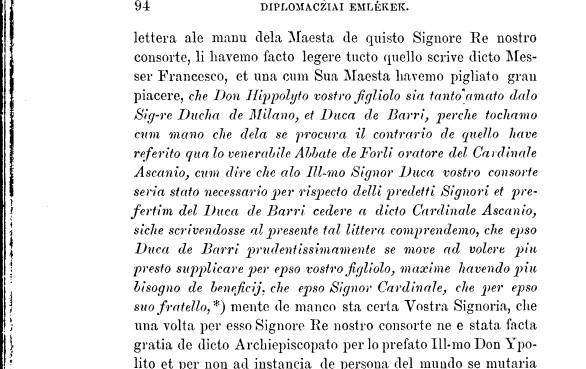
The first cipher block discusses Milanese support for Ippolito and the contrary account given by Cardinal Ascanio’s envoy. A separate handwritten slip over the block begins “che don hippolyto vostro figliolo…”. The next photograph shows the same page with the slip moved aside. A later slip reads:
che quello Andriolo se conferisca qua
The corresponding request appears in MDE III no. 75 in the same context. Both the manuscript slips and the printed edition give earlier decipherments. The precise date and scribe of the slips were not established here.
02 What was verified
The evidence is the agreement of dates, salutations, clear passages, cipher boundaries and the decipherment slips with the edition. No transcription of the symbols was made, no key was recovered and no percentage was measured; the letter-by-letter accuracy of the older decipherment has not been tested. Archive photographs stay local because DECODE states that their publication requires the archive’s permission; the figure is a crop of the public-domain edition.
Full texts
The transcription and the decryption of every document on this page, so that the reading can be used and checked. Short files are shown here; all are in the repository.
Buda, 2 May 1486
Beatrice of Aragon to her sister Eleonora of Ferrara: the Duke of Milan and the Duke of Bari support Ippolito d'Este, against the account of Cardinal Ascanio's envoy, the abbot of Forlì, and Andriolo is asked to come to Hungary. Contemporary decipherment slips are photographed over the cipher; the decryption here is the uncorrected OCR of the reading printed in MDE III (1877) no. 75.
Decryption
# MDE III (1877), no. 75, pp. 93-96; PDF pages 125-128.
# MACHINE-EXTRACTED SOURCE TEXT; not a corrected diplomatic transcription.
# Italics distinguishing cipher may be lost; consult source PDF.
1486. Beatrix királyné Eleonóra ferrárai herczegnét a Hippo-
lit esztergomi érsekségét illető ügyekről s a nápolyi király Fer-
dinánd segítségére küldött magyar segédcsapatokról értesíti, s
felkéri a herczegnét, hogy ama bizonyos ügyben*) And riólót
mihamarább küldje Magyarországba, hogy vele az illető fontos
tárgyban végezni lehessen.
Ill-ma et Excell-ma Ducissa, Domina et soror nostra
carissima. Per Benedicto de Leyra nostro correri, quale nova-
mente e passato per la venendo da Spagna, havemo recepute
tre lettere de Vostra Ill-ma Signoria con una copia de una
lettera seripta ad quella da Pitigliano Dabisbal, per la quale
simo facta certa de alcíme bone nove, tucte favorebile ala
paterna Maesta. Responderemo doncha per questa ad tucte le
parte necessarie de dicte lettere, et primo dicemo: che ne e
stata carissima la contiuencia dela lettera delo Magnifico Mes-
ser Francesco Fontana, quale Vostra Signoria ce have man-
data in cifra et non essendo ancora pervenuta la originale
*) Dsem ügyében.

=== PDF PAGE 126 ===
lettera ale manu dela Maesta de quisto Signore Re nostro
consorte, li liavemo facto legere tucto quello serive dicto Mes-
ser Francesco, et una cum Sua Maesta liavemo pigliato gran
piacere, clie Don Hippolyto vostro figliolo sia tanto"amato dalo
Sig-re Ducha de Milano, et Duca de Barri, perche tocliamo
cum manó clie dela se procurci il contrario de quello liave
referito qua lo venerabile Abbate de Forli oratore del Cardinale
Ascanio, cum dire che alo Ill-mo Signor Duca vostro consorte
seria stato necessario per rispecto delli predetti Signori et pre-
fertim del Duca de Barri cedere a dicto Cardinale Ascanio,
siche serivendosse cd presente tol littera comprendemo, che epso
Duca de Barri priidentissimamente se move ad volere piu
presto supplicare per epso vostro figliolo, maximé havendo piu
bisogno de beneficij. che epso Signor Cardinale, che per epso
suo fratello,*) mente de manco sta certa Yostra Signoria, clie
una volta per esso Signore Re nostro consorte ne e stata facta
gratia de dicto Archiepiscopato per lo prefato Ill-mo Don Ypo-
lito et per non ad instancia de persona del mundo se mutaria
de farene altro, et ad cioche Yostra Signoria ne possa stare
piu secura, li havemo mandate le lettere dela donatione per
Donato nostro Correri. Resta solum, che se faza instancia in
corte de Roma dalo canto de loro, che se habia la coufirma-
tione, perche da qua per lo prefato Signor Re nostro marito:
et per nui sono state seripte lettere caldissime alo oratore
nostro in Roma, che debia sollicitare et procurare la confir-
matione per esso Don Ypolito nostro nepote.
Ancora che quella parte ne serive Y. S. dela indisposi-
tione del predetto Ill-mo Don Ypolito, ce sia dispiaciuta, tamen
perche quella dice presto sera restaurato, et etiam quisto
Benedicto correri e retornato da loco ne dice liaverelo visto
sano et cavalcare, ne havemo pigliato piacere incredibile, per-
che cognoscemo presto se ne porra venire qua, dove lo aspe-
ctamo con lo maiore desiderio del mundo, et ad 1' bora de mo,
Bartholomeo Brissiano, quale Yostra Signoria aspectava, deve
essere la, et li havera explicato tucto quello li e stato per esso
Signor Re nostro marito et per nuj commesso, et ancora che
luj havesse portate alcune nostre comissione dele gente vole-

=== PDF PAGE 127 ===
ámo se mandassero con esso nostro nepote. Tamen da poi
ce ne e recordata unaltra, quale e che ne piaceria, che Vostra
Signoria li mandasse alcuna donna, che sapesse la natura et
prattica sua, et che lo sapesse gobernare, quando Dio guar-
dando fosse indisposto, et de questo pregamo quella quanto
sapemo et possemo.
Quello ne significa, clie per la guerra facta contra quisto
stato li foro totti duj castelli ale confine de Regno, et che al
presente essendo stati quelli depositati impotere delo stato de
Milano, lo Signor Lodovico suo genero li havea mandati li
contrasigni ad farenceli restituire etc. Ce e stato tanto caris-
simo et ne havemo pigliato quello piacere, che pegliaymo de
la conquista deVienna, et tanto piu ne e piaciuto, che secundo
quella ne serive dicti castelli importano multo ala conserva-
tione delo stato vostro, et havemo speranza ancora, che per
la justitia grandissima havemo le Signorie Vostre in quello li
e stato tolto, presto li sera restituito tucto.
Nui cognoscemo, che orane di prosperendo le cose in
favore de la paterna Maesta, procede dala divina providenza,
perche non vole comportare che tanta iniquita et malignita de
baroni rebelli, quali senza causa haveno macchinato, che nostro
Signor Dio como justo Judice dara tanta victoria ad esso Signor
Re nostro patre, che castigara dicti baronij et tucti li soi ini-
mici, et la ambitione et malignita del Pontifice et deli Cardi-
nali non andare senza punitione, et per nuj non se mancara
de fare omne opera con nostro Marito, che habia da mandare
li subsidij de le gente necessarii, et sin mo, la Sua Maesta liave
facta donare prestaneza per sei mesi ad seicento cavalli tra
hominij darme et cavalli legeri, et ad seicento fanti, le quale
gente tucte se sono adviate ala via de Segna per imbarcliarse
et passare in Puglia ali favori de essa paterna Maesta, la quale
seripse essereli necessario dicto numero de gente et non piu et
ebe se mandassero in diéta provincia, et appresso bisognando
piu gente, sencene mandaranno tante, quante ne vorranno.
Pregamo strictissimamente. la Signoria Vostra che sempre
havera nove ce ne voglia fare parte, perche non se ne porria
credere, quanto piacere ne pigliamo, et al presente havemo

=== PDF PAGE 128 ===
pigliato lo maiore piacere del mundo dela dicta copia de
Bisbal.
Noi pregamo ancora quella, che voglia fare omne instan-
cia che quello Andriolo se conferisca qua *), accioche se possa
pigliare alcuna hona conclusione ad quella facenda, per la
quale luj have de venire qua, et lo piu presto sia possibile se
mande, et lo Signor Duca prefato vostro consorte et Yostra
Signoria 11011 porriauo fare maiore piacere ad nostro marito,
perche sta multo desideruso intendere lo predetto Andriolo *)
accio se possa dare ordene alo eífecto, perche se desidera la
sua venuta.
Li veli, che Yostra Signoria ce ha mandati sono stati si
delicati, et belli che ce sono summamente piaciuti; et ne li ren-
dimo infinite gratie, et per amore suo li volimo portare, per
fareli quello bonore meritano, et a lei ne recomandamo. Dátum
in cast.ro nostro Buden. II. Maij MCCCCLXXXYI.
Di Yostra Signoria obediente Sore la
Regina de Hungaria.
Ill-me Domine Helionore de Aragónia, Ducisse Ferrarie
ect. Domine et Sorori Colendissime.
Ferrarie.
(Modénai államltár)
Reading
<!-- Reading of DECODE R1143 (Claude Opus 5.5, 23 Oct 2026): the letter as printed in Magyar Diplomácziai Emlékek III (1877) no. 75, pp. 93-96 (readings/r1143_mde3_ocr.txt), with the OCR's misread letters restored to the printed word (e.g. seripta = scripta, alcíme = alcune, contiuencia = continentia, liavemo = havemo, clie = che, tocliamo = tochamo, Yostra = Vostra, cd presente tol littera = al presente tal littera, 11011 porriauo = non porriano, ebe = che, bora = hora); a word whose printed form the OCR does not let me restore is [?word]. Spelling otherwise kept; "Ill-ma" etc. expanded (Illustrissima). The print sets the ciphered words in italics; the OCR has lost them, so cipher and clear are not distinguished here. The Hungarian heading and the editor's footnotes (Dsem ügyében = in the Djem affair) are left out. -->

# R1143, Beatrice of Aragon to Eleonora, Duchess of Ferrara, Buda, 2 May 1486

## Reading

Illustrissima et Excellentissima Ducissa, Domina et soror nostra carissima. Per Benedicto de Leyra, nostro correri, quale
novamente e passato per la venendo da Spagna, havemo recepute tre lettere de Vostra Illustrissima Signoria con una copia
de una lettera scripta ad quella da Pitigliano Dabisbal, per la quale simo facta certa de alcune bone nove, tucte
favorebile ala paterna Maesta. Responderemo doncha per questa ad tucte le parte necessarie de dicte lettere, et primo
dicemo che ne e stata carissima la continencia dela lettera delo Magnifico Messer Francesco Fontana, quale Vostra Signoria
ce have mandata in cifra; et non essendo ancora pervenuta la originale lettera ale manu dela Maesta de quisto Signore Re
nostro consorte, li havemo facto legere tucto quello scrive dicto Messer Francesco, et una cum Sua Maesta havemo pigliato
gran piacere che Don Hippolyto vostro figliolo sia tanto amato dalo Signore Ducha de Milano et Duca de Barri, perche
tochamo cum mano che de la se procura il contrario de quello have referito qua lo venerabile Abbate de Forli, oratore del
Cardinale Ascanio, cum dire che alo Illustrissimo Signor Duca vostro consorte seria stato necessario, per rispecto delli
predetti Signori et presertim del Duca de Barri, cedere a dicto Cardinale Ascanio; siche, scrivendosse al presente tal
littera, comprendemo che epso Duca de Barri prudentissimamente se move ad volere piu presto supplicare per epso vostro
figliolo, maxime havendo piu bisogno de beneficij, che epso Signor Cardinale, che per epso suo fratello; niente de manco
sta certa Vostra Signoria che una volta per esso Signore Re nostro consorte ne e stata facta gratia de dicto
Archiepiscopato per lo prefato Illustrissimo Don Ypolito, et per non ad instancia de persona del mundo se mutaria de
farene altro; et ad cio che Vostra Signoria ne possa stare piu secura, li havemo mandate le lettere dela donatione per
Donato nostro Correri. Resta solum che se faza instancia in corte de Roma dalo canto de loro che se habia la
confirmatione, perche da qua per lo prefato Signor Re nostro marito et per nui sono state scripte lettere caldissime alo
oratore nostro in Roma, che debia sollicitare et procurare la confirmatione per esso Don Ypolito nostro nepote.

Ancora che quella parte ne scrive Vostra Signoria dela indispositione del predetto Illustrissimo Don Ypolito ce sia
dispiaciuta, tamen, perche quella dice presto sera restaurato, et etiam quisto Benedicto correri e retornato da loco [et]
ne dice haverelo visto sano et cavalcare, ne havemo pigliato piacere incredibile, perche cognoscemo presto se ne porra
venire qua, dove lo aspectamo con lo maiore desiderio del mundo. Et ad l'hora de mo Bartholomeo Brissiano, quale Vostra
Signoria aspectava, deve essere la, et li havera explicato tucto quello li e stato per esso Signor Re nostro marito et per
nuj commesso; et ancora che luj havesse portate alcune nostre comissione dele gente voleamo se mandassero con esso nostro
nepote, tamen da poi ce ne e recordata unaltra, quale e che ne piaceria che Vostra Signoria li mandasse alcuna donna che
sapesse la natura et prattica sua, et che lo sapesse gobernare quando, Dio guardando, fosse indisposto; et de questo
pregamo quella quanto sapemo et possemo.

Quello ne significa, che per la guerra facta contra quisto stato li foro tolti duj castelli ale confine de Regno, et che
al presente, essendo stati quelli depositati in potere delo stato de Milano, lo Signor Lodovico suo genero li havea
mandati li contrasigni ad farenceli restituire etc., ce e stato tanto carissimo, et ne havemo pigliato quello piacere che
pegliaymo de la conquista de Vienna; et tanto piu ne e piaciuto, che secundo quella ne scrive dicti castelli importano
multo ala conservatione delo stato vostro; et havemo speranza ancora che, per la justitia grandissima havemo le Signorie
Vostre in quello li e stato tolto, presto li sera restituito tucto.

Nui cognoscemo che omne di prosperendo le cose in favore de la paterna Maesta procede dala divina providenza, perche non
vole comportare che tanta iniquita et malignita de baroni rebelli, quali senza causa haveno macchinato; che nostro
Signor Dio, como justo Judice, dara tanta victoria ad esso Signor Re nostro patre che castigara dicti baronij et tucti li
soi inimici, et la ambitione et malignita del Pontifice et deli Cardinali non andare senza punitione; et per nuj non se
mancara de fare omne opera con nostro Marito che habia da mandare li subsidij de le gente necessarii. Et sin mo la Sua
Maesta have facta donare prestaneza per sei mesi ad seicento cavalli, tra homini d'arme et cavalli legeri, et ad seicento
fanti, le quale gente tucte se sono adviate ala via de Segna per imbarcharse et passare in Puglia ali favori de essa
paterna Maesta, la quale scripse essereli necessario dicto numero de gente et non piu, et che se mandassero in dicta
provincia; et appresso, bisognando piu gente, sencene mandaranno tante quante ne vorranno. Pregamo strictissimamente la
Signoria Vostra che sempre havera nove ce ne voglia fare parte, perche non se ne porria credere quanto piacere ne
pigliamo; et al presente havemo pigliato lo maiore piacere del mundo dela dicta copia de Bisbal.

Noi pregamo ancora quella che voglia fare omne instancia che quello Andriolo se conferisca qua, accioche se possa pigliare
alcuna bona conclusione ad quella facenda per la quale luj have de venire qua, et lo piu presto sia possibile se mande;
et lo Signor Duca prefato vostro consorte et Vostra Signoria non porriano fare maiore piacere ad nostro marito, perche sta
multo desideruso intendere lo predetto Andriolo, accio se possa dare ordene alo effecto, perche se desidera la sua venuta.

Li veli che Vostra Signoria ce ha mandati sono stati si delicati et belli che ce sono summamente piaciuti; et ne li
rendimo infinite gratie, et per amore suo li volimo portare, per fareli quello honore meritano, et a lei ne recomandamo.
Datum in castro nostro Buden. II Maij MCCCCLXXXVI.

Di Vostra Signoria obediente Sore la Regina de Hungaria.

Illustrissime Domine Helionore de Aragonia, Ducisse Ferrarie etc., Domine et Sorori Colendissime. Ferrarie.
Translation
<!-- English translation of readings/R1143_reading.md (Claude Opus 5.5, 23 Oct 2026): the letter as printed in MDE III (1877) no. 75, cipher and clear not distinguished (the print's italics are lost in the OCR). -->

# R1143, Beatrice of Aragon to Eleonora, Duchess of Ferrara, Buda, 2 May 1486: English translation

Most Illustrious and Most Excellent Duchess, our dearest Lady and sister. Through Benedicto de Leyra, our courier, who
lately passed through there coming from Spain, we have received three letters from Your Most Illustrious Ladyship, with
a copy of a letter written to you by Pitigliano Dabisbal, by which we have been made certain of some good news, all
favourable to our father's Majesty. We shall therefore answer by this letter all the necessary parts of the said
letters; and first we say that the contents of the letter of the Magnificent Messer Francesco Fontana, which Your Ladyship
sent us in cipher, have been most welcome to us; and the original letter not having yet reached the hands of His Majesty
our Lord King and consort, we have had read to him everything that the said Messer Francesco writes, and together with
His Majesty we have taken great pleasure that Don Ippolito your son is so loved by the Lord Duke of Milan and the Duke of
Bari, because we touch with our hands that there they are working for the opposite of what the venerable Abbot of Forlì,
ambassador of Cardinal Ascanio, reported here, saying that out of regard for the said lords, and especially the Duke of
Bari, it would have been necessary for the Most Illustrious Lord Duke your consort to give way to the said Cardinal
Ascanio. So, this letter being written now, we understand that the said Duke of Bari most prudently is moved to wish
rather to plead for your said son, especially since he has more need of benefices than the said Lord Cardinal, than for
his said brother. Nevertheless Your Ladyship may be sure that once the grace of the said archbishopric has been granted
by the said Lord King our consort to the said Most Illustrious Don Ippolito, he would not change to do otherwise at the
request of anyone in the world; and so that Your Ladyship may be more secure of it, we have sent you the letters of the
donation by Donato our courier. It remains only that on their side instance be made at the court of Rome to obtain the
confirmation, because from here, by the said Lord King our husband and by us, most pressing letters have been written to
our ambassador in Rome to solicit and procure the confirmation for the said Don Ippolito our nephew.

Although the part in which Your Ladyship writes to us of the indisposition of the said Most Illustrious Don Ippolito
displeased us, yet because you say he will soon be restored, and also this courier Benedicto has returned from there and
tells us he saw him well and riding, we have taken incredible pleasure in it, because we know that he will soon be able
to come here, where we await him with the greatest desire in the world. And by now Bartholomeo Bresciano, whom Your
Ladyship was expecting, must be there, and will have explained to you everything that was entrusted to him by the said
Lord King our husband and by us; and although he carried some commissions of ours about the people we wished to be sent
with our said nephew, yet afterwards another came to our mind, which is that we should like Your Ladyship to send with
him some woman who knows his nature and habits, and who could look after him should he, God forbid, be unwell; and of
this we beg you as much as we know and can.

What you tell us — that in the war made against that state two castles on the borders of the kingdom were taken from
you, and that now, these having been deposited in the power of the state of Milan, the Lord Ludovico, your son-in-law, had
sent you the countersigns to have them restored to you, etc. — has been so very welcome to us, and we have taken from it
the pleasure we took from the conquest of Vienna; and it pleased us all the more since, as you write, the said castles
matter much for the preservation of your state; and we also hope that, given the very great justice Your Lordships have
in what was taken from you, all will soon be restored to you.

We know that the daily prospering of affairs in favour of our father's Majesty proceeds from divine providence, which
will not suffer such iniquity and malice of rebel barons, who have plotted without cause; [and we trust] that our Lord
God, as a just judge, will give such victory to the said Lord King our father that he will punish the said barons and all
his enemies, and that the ambition and malice of the Pope and of the cardinals will not go unpunished; and for our part
we shall not fail to do everything with our husband that he may send the necessary auxiliary troops. And so far His
Majesty has had an advance for six months given to six hundred horse, men-at-arms and light horse, and to six hundred
foot, all of which troops have set off by way of Senj to embark and cross to Apulia in the service of our father's
Majesty, who wrote that he needed that number of men and no more, and that they should be sent to that province; and
later, if more men are needed, as many will be sent as he wants. We most earnestly beg Your Ladyship always to share any
news you have with us, for one could not believe how much pleasure we take in it; and at present we have taken the
greatest pleasure in the world in the said copy from Bisbal.

We also beg you to press in every way that that Andriolo come here, so that some good conclusion may be reached in that
business for which he is to come here, and that he be sent as soon as possible; and the said Lord Duke your consort and
Your Ladyship could not give our husband greater pleasure, for he is very desirous to hear the said Andriolo, so that
order may be given for the execution, because his coming is desired.

The veils that Your Ladyship has sent us were so delicate and beautiful that they pleased us exceedingly; and we give you
infinite thanks for them, and for love of you we mean to wear them, to do them the honour they deserve; and we commend
ourselves to you. Given in our castle of Buda, 2 May 1486.

Your Ladyship's obedient sister, the Queen of Hungary.

To the Most Illustrious Lady Eleonora of Aragon, Duchess of Ferrara etc., Lady and most honoured sister. Ferrara.
03 Sources
- Iván Nagy and Albert Nyáry, eds., Magyar Diplómacziai Emlékek Mátyás király korából, III (1877), no. 75, pp. 93–96.
- Archivio di Stato di Modena, Carteggio Principi Esteri, via DECODE R1143; photographs downloaded for private research.
OCR extract of the printed source: targets/beatrice1486b/; the research report on all five letters is in targets/beatrice1482/.