

At a glanceExisting decipherment · complete
- The letter
- Beatrice d’Aragona, Queen of Hungary, to her sister Eleonora d’Aragona, Duchess of Ferrara, Buda, 8 March 1486; five photographs, cipher on the first written page only.
- Where
- Archivio di Stato di Modena, Carteggio Principi Esteri, 1623, b. 2/2, 2, 10; DECODE R1142. Catalogue item 160.
- The cipher
- A graphic substitution alphabet; the closing says it is the old cipher of the two sisters, and a new one is enclosed.
- How it was deciphered
- Not here: the decipherment is printed in MDE IV (1878) supplement no. 45, the closing in MDE III (1877) no. 54 and the plain body in Berzeviczy (1914) no. LVI. They were matched to the photographs.
- What it says
- Andriolo is to be brought to Hungary at the king’s expense; the editor ties it to the Djem affair.
- Still open
- The printed Virtus, Fortis and M.; which cipher “the old cipher” was.
Catalogue item 160 grouped five letters of Beatrice d’Aragona, Queen of Hungary, to Ferrara; since 14 October 2026 each cipher, and the plain letter, has its own page: the 1482 letters, 8 March 1486, 2 May 1486 and the plain letter of 1505. This letter’s alphabet looks different from the 1482 one, and it announces a change of cipher, so it stands alone.
01 The letter, split by its editors
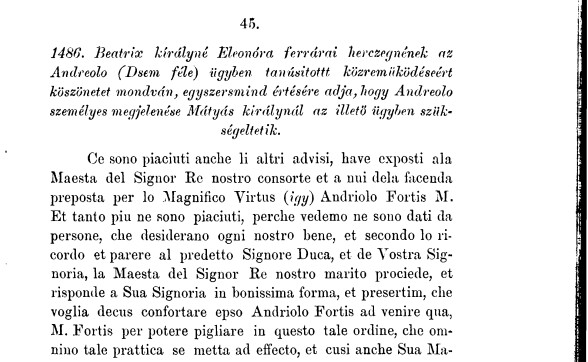
The first written page contains cipher passages about bringing Andriolo to Hungary, paying his expenses and honoring the king’s promises. They appear in MDE IV, supplement no. 45. The editor associates the negotiation with the Djem/Cem affair; that identification is the editor’s.
The intervening plain pages concern Ippolito’s appointment to Esztergom and opposition from Cardinal Ascanio. Berzeviczy printed them in 1914, explicitly omitting material already published in MDE III p. 67 and IV p. 367. The final paragraph of the physical letter matches MDE III no. 54:
Con la cyfra havemo antiquamente con Vostra Signoria … ne li mandamo qui alligata un altra nova
She is using the old cipher and sending a new one for subsequent correspondence. The printed no. 54 is therefore the closing part of this letter and adds no further ciphertext to the set. The related same-date letter printed as no. 53 should not be substituted for this manuscript.
Limit: the 1878 decipherment keeps Virtus, Fortis and repeated M. in awkward positions. They are on the printed page and are not OCR errors. Their role in the cipher is not established. They are not deleted here as supposed nulls, and the printed text is not claimed to be flawless.
02 What was verified
The evidence is the agreement of dates, salutations, clear passages, cipher boundaries with the edition. No transcription of the symbols was made, no key was recovered and no percentage was measured; the letter-by-letter accuracy of the older decipherment has not been tested. Archive photographs stay local because DECODE states that their publication requires the archive’s permission; the figure is a crop of the public-domain edition.
Full texts
The transcription and the decryption of every document on this page, so that the reading can be used and checked. Short files are shown here; all are in the repository.
Buda, 8 March 1486
Beatrice of Aragon to her sister Eleonora of Ferrara: the cipher passages concern bringing Andriolo to Hungary, paying his travel and honouring the king's promises (the 1878 editor ties the negotiation to the Djem affair); the plain body is on Ippolito d'Este's appointment to Esztergom and Cardinal Ascanio's opposition, and the closing says the letter uses the old cipher and encloses a new one. Decryptions: uncorrected OCR of MDE IV (1878) suppl. no. 45 (cipher passages), MDE III (1877) no. 54 (closing) and Berzeviczy (1914) no. LVI (plain body).
Decryption
# MDE IV (1878), supplement no. 45, pp. 367-368; PDF pages 403-404.
# MACHINE-EXTRACTED SOURCE TEXT; not a corrected diplomatic transcription.
# Italics distinguishing cipher may be lost; consult source PDF.
1486. Beatrix királyné Eleonóra ferrárai berezegnének az
Andreolo (Dsem féle) ügyben tanúsitottt közreműködéséért
köszönetet mondván, egyszersmind értésére adja, hogy Andreolo
személyes megjelenése Mátyás királynál az illető ügyben szük-
ségeltetik.
Ce sono piaciuti ancbe li altri advisi, bave exposti ala
Maesta del Signor Re nostro consorte et a nui dela facentla
preposta per lo Magniíico Virtus (így) Andriolo Fortis M.
Et tanto piu ne sono piaciuti, perche vedemo ne sono dati da
persone, che desiderano ogni nostro bene, et secondo lo ri-
cordo et parere al predetto Signore Duca, et de Yostra Sig-
noria, la Maesta del Signor Re nostro marito prociede, et
risponde a Sua Signoria iu bonissima forma, et presertim, che
voglia decus confortare epso Andriolo Fortis ad venire qua,
M. Fortis per potere pigliare in questo tale ordine, che om-
nino tale prattica se metta ad effecto, et cusi anche Sua Ma-
esta M. serive ad Andriolo Fortis prefato M. che ad cou-
templatione de Sua Maesta se voglia trausferire fin qua, che
parlato, che gli havera, lo fara partire, et li M. pagara tutta
quella spexa iu lo venire et ritornare Virtus. Et percio bi-
sogna, che Vostra Illustrissima Signoria per lo amore, che
ce porta exliorti et conforti suo consorte ad fare ogni opera

=== PDF PAGE 404 ===
possibile, ebe Virtus Andriolo de contiuente se ponga iu cá*
miuo, et se ue veuga qua M. M. Fortis, ebe pigliato bavera
apunctamento supra dicta prattica, se ne retornara, et oltra,
ebe gli serano pagate le spexe, fara se pote tenere certo, che
cio, che per epso Signor Re nostro marito ge sera promesso,
et cum epso sera capitulato, li sera observato ad unguem. Et
questo Vostra Signoria lo potera bene certific.are secundo piu
amplamente e stato risposto ad epso Bartholomeo.
Regina Hungaria ad Ducissa.
(Modénai államltár.)
Decryption
# MDE III (1877), no. 54, p. 67; PDF page 99.
# MACHINE-EXTRACTED SOURCE TEXT; not a corrected diplomatic transcription.
# Italics distinguishing cipher may be lost; consult source PDF.
54.
1846. Beatrix királyné Eleonora ferrárai lierezegnének új tit-
kos hetüket küld.
Con la cyfra havemo antiquamente con Yostra Signoria
con la quale la fara cavare, et accioche cla qua avante Yostra
Signoria et suo consorte possa serivere ala Maesta de nostro
marito et ad nuj, ne li mandamo qui alligata un altra nova,
con la quale le Signorie Yostre potrano serivere, che cossi fara
nostro marito, et nuj ancora con essa medesimo seriveremo ad
Yostra Ill-ma Signoria, ala quale le ce recommandamo, et si
dignara Yostra Signoria da parte nostra basarerre tutti soi
Ill-mi figlioli, li quali tutti salutamo. Dátum in castro nostro
Budensi, YIII. Marcij MCCCCLXXXVI.
Ala lettera de manu de Yostra Signoria ala retornata
de Bartholomeo faremo resposta de manu nostra.
Di Yostra Ill-ma Signoria ohediente Sore
La Regina de Hungaria.
Illustrissime et Potentissime Domine Elionore de Ara-
gónia, Ducisse Ferrarie etc. Sorori nostre Colendissime.
Ferrarie.
(Modénai állarnltár.)
Decryption
# Berzeviczy (1914), no. LVI, pp. 81-84.
# MACHINE-EXTRACTED SOURCE TEXT; not a corrected diplomatic transcription.
# Italics distinguishing cipher may be lost; consult source PDF.
1486.  márczius  8.

Beatrix  királyné  levele  Budáról,  nővéréhez,  Eleonóra  ferrarai  herczeg-
néhez,  melyben  közli  azokat  a  nehézségeket,  a  mclj'ekct  le  kellett  küzdenie,
hogy  az  esztergomi  érsekséget  Eleonóra  fia,  Hipoht  részére  biztosítsa.
(A  levélből  mellőzzük  azokat  a  részeket,  melyek  a  Mátyás  korab.  Dipl.
Emlékek  III.  kötetének  67.  lapján  és  IV.  kötetének  367.  lapján  közölt
szöveggel  azonosak.)

Modenái  áll.  levéltár.  Cárt.  di  Princ.  Est.,  Ungheria,  Ba  2.

Per  lo  Magn"^"  Bartholomeo/  mandato  qua  per  I1P°
Sig""^  Dúca  consorte  de  V.  111"'^  Sig"**  et  V.  Iir^  Sig"%
havendo  inteso  principalmente  la  bona  sanitá  de  S.  Sig"*  et
V,,  et  de  tucti  li  loro  figlioli  nostri  nepoti :  del  che  havemo

piglialo  incredibile  piacere Ala  parte  dela  domanda  ne

have  comunamente  facta  delo  archiepiscopato  de  Strigonio
per  Don  Ypolito,  figliolo  de  V.  IIP*  Sig'"'^  et  nostro  nepote,
non  bisogna  ne  allargano  multo,  perché  per  lo  Magn'^^  Pesotto  ^
é  stato  scripto  ad  V.  IIP'*  Sig"*  quanto  nui  havemo  facto :
et  anco^  al  presente,  per  lettere  de  esso  Bartholomeo
intenderá  puro,'^  con  quanta  liberalitate  per  amore  nostro
la  M*^  prefata  se  é  contentata  eh'  el  archiepiscopato  prefato
se  conferisia  et  dona  ad  esso  Don  Ypolito,  figliolo  de  V.  S.
Et  nui  el  secundo  di  poi  la  cruda  nova  dela  morte  dela
felice  memória  del  Sig*"^  Cardinale,  comune  fratello,^  la  cui
anima  Dio  habia,  havendolo  optenuto  per  esso  nostro
nepote,  ne  scripsimo  ala  M*^  del  Sig'*^  Re,  nostro  comune
patre  et  Sig""^,  che  poi  che  S.  M^  non  possea  proponere
a  dicta  dignitá  persona  che  piü  li  obtinesse  del  figliolo  de
V.  S.,  perché  ali  figlioli  legitimi  como  so[no]  li  IIP'  Sig"  Don
Federico  et  Don  Francesco®  non  ne  porrá  ragionevoie  se
donasse,  né  menő  ali  figlioli  delo  I1P°  Sig""®  Dúca  de  Calabria,

^  B.  Bresciano.

-  Helyesebben  Perotto.   Vesach  vagy  Versach.

■''  =  ancora.

*  =  pure.

*  Aragóniái  János.

"  Eleonóra  és  Beatrix  testvérei.

Aragóniái  Beatrix.  "


—     82      —

per  non  ne  havere  si  non  dui,  havesse  facta  opera  con  la
S*^  del  Papa,  una  cum  lo  prefato  Sig''®  Dúca,  consorte  de
V.  S.,  del  optenere  dicto  archiepiscopato  cum  curatore.
Et  per  ciö  bisogna  che  esso  Sig''®  Dúca  et  V.  Ill'"^  Sig"*  per
tucte  quelle  vie  possibile  fara  instantia  con  la  S*^  prefata,
che  se  contente  dare  el  curatore,  perché  da  qua  é  stato
electo  esso  figliolo  de  V.  S.  et  con  la  M*^  del  Sig"^^  Re  N.  P.
se  fara  instancia  che  habia  da  procurata  per  esso  figliolo
de  V.  S.,  poi  che  non  lo  póté  cercase  per  figüoli  legitimi,
perché  ali  naturali  quando  ce  posse  lo  desiderio  de  S.  M*^,
nostro  marito  et  li  Baroni  non  se  ne  contentariano :  et
tanto  piü  bisogna  che  esso  Sig""®  Dúca  et  V.  S.  se  aiutano,
perché  lo  Rev'"^  Sig*"®  Cardinale  Ascanio^  multi  di  avante
che  dicto  Bertholomeo  arrivasse  qua,  mandao  uno  suo
ambassatore  qua  ad  nostro  marito  et  ad  nui  ad  cercare
dicto  archiepiscopato.  Et  essendoli  stato  referito  et  resposto
che  del  dicto  archiepiscopato  era  stato  facto  exito,  et  dona-
tolo  ad  uno  figliolo  de  \^  IIP*  Sig""*  et  nostro  nepote :
credemo  fara  tucti  quilli  obstaculi  [che]  porrá  [faré],  per
impedire  questa  electione ;  perché  dicto  ambassatore  dixe
che  lui  se  persuadeva  che  la  M*'^  del  Sig""®  Re,  nostro  comune
padre,  et  lo  Sig'''^  Dúca  vostro  consorte,  per  rispecto  de  esso
cardinale  Ascanio,  cedevano,  perché  non  vorriano  preponere
uno  puctino  ad  S.  Sig'"^,  per  la  auctoritá,  che  havea  in
corte  de  Roma;  et  ancora  che  de  questa  lo  havessemo
facto  faré  certa  che  questo  non  stava  ala  M*^  del  Sig'"^  Re
N.  P.  et  ad  vostro  consorte,  ma  stava  ad  nostro  marito  et
ad  nui,  et  che  per  ciö  non  bisognava  pensarence,  et
quando  ben  da  loro  se  cedesse  el  che  non  credevamo,  nui
non  se  ne  haveriamo  contentata.  Né  lo  regno  de  Hungária
consenteria  che  tale  archiepiscopato,  né  altro  qualesevole
benefitio  se  habia  da  dare  ad  Cardinali,  perché  non  delibe-
rano  ponere  tale  consuetudine  in  quisto  Regno,  dove  non
é  stata  mai.  Et  allegando  esso  ambassatore  lo  Cardinale
de  Agria,'^  et  la  bona  memória  del  Cardinale,  nostro  comune

'  Sforza.

^  Veronai  Gábor.


—     83     —

fratello  :  li  declaraimo  che  quando  fo  donato  lo  episcopato
de  Agria  a  lo  Cardinale,  non  era  si  non  simplice  monaco
et  servitore  de  nostro  marito,  et  havea  da  faré  la  vita  sua
in  Hungária.  Et  similiter  quando  fo  donato  lo  archiepisco-
pato  de  Strigonio  ala  dicta  bona  memória  del  Cardinale  de
Aragónia,  non  era  Cardinale ;  et  ancora  che  ce  fosse
fratello,  alo  quale  se  li  devea  havere  rispecto  ;  et  se  ne
deveano  rompere  tucte  consuetudine,  puro  ^  ne  fu  mur-
murato.  Et  per  questo  simo^  certi  per  essereli  stata  aperta
la  mente  del  Sig''®  Re,  nostro  marito,  eí  nostra  et  che  qua
non  póté  havere  né  archiepiscopato  né  abbatia.  Dicto  Sig'"^  Car-
dinale Ascanio  se  opponerá  con  omne  sforzo  che  questa
cosa  non  habia  ad  havere  effecto,  et  quando  se  viderá
vinto,  —  perché  questo  Sig""*^  Re  nostro  consorte  avante  se
delibera  lassare  el  segno  che  consentire  dicto  archiepisco-
pato sia  donato  ad  sua  Rev™^  Sig"^  —  cercará  de  forese  bono
de  quello  che  non  poterá  vendere,  et  vorrá  che  lo  prefato
Sig*"®  Dúca  et  V.  Ili™*  Sig"^  li  farano  donatione  de  qualche
bona  benefitia  in  quisto  stato  o  in  lo  stato  de  N.  P.
Et  perché  quando  tale  permissione  se  li  facesse,  offenderia
grandemente  la  mente  del  Sig''®  Re  nostro  consorte,  perché
pareria  che  in  lo  archiepiscopato  lui  havesse  havuta  alcuna
ragione,  et  che  ce  cedesse  per  havere  lo  scambio  loro.
Peró  bisogna  che  V.  S.  exorta  da  nostra  parte  lo  prefato
Sig*"®  Dúca  che  per  non  turbare  la  mente  de  S.  M^^  et
nostra,  voglia  recusare  omne  partito  dicto  Sig''^  Cardinale  li
facesse  preponere  ;  perché,  quando  la  M*^  S.  sentesse  che
se  li  promettesse  alcuno  beneíitio,  dubitamo  non  darria  lo
archiepiscopato  ad  dicto  Don  Ypolito  íigliolo  de  V.  111"'-''
Sig"*,  la  quale  bisogna  che  constantemente  soUicite  in  corte
de  Roma  per  tucte  quelle  vie  [che]  porrá  et  saperá  che
se  confirme  el  figliolo  cum  curatore,  poi  che  é  stato  electo ;
et  non  se  cure  de  faré  altro,  perché  in  li  benefitii  de  quisto
Regno  se  eligono  le  persune  per  lo  Sig""^  Re  nostro  con-
sorte et  per  lo  Papa  se  confirmano.  Et  quando  al  presente


=  pero.
=  siamo.


^-     84     -

se  volessero  innovare  cose  nőve  per  li  favori  deli  Cardinali,
la  M*^  S.  non  é  per  consentirele  :  né  mai  ne  daria  la  pos-
sessione,  benché  credemo  tucto  queste  allegationi  cessarano,
percbe  la  S.  S^^  non  vorria  turbare  le  antique  consuetu-
dini  de  questo  Regno  et  de  la  S.  M*-^,  ma  tucto  lo  havemo
scripto  ad  effecto  :  che  V.  S.  ne  sia  informata  et  creda
ancora  ad  quanto  dicto  Bartholomeo  al  presente  ne  li
serive,  la  quale  se  é  portato  et  porta  cum  grandissima
modestia  et  virtü.  Et  certamente  V.  S.  lU'"^  non  ce  possette
mandare  homo,  che  piü  ce  havesse  possuto  satisfare,  perché
Jo  cognoscemo,  et  non  menő  lo  reputamo  per  servitore
nostro  che  de  V.  lU™^,  la  quale  pregamo  lo  voglia  tenere
per  carissimo  et  fidato  servitore  perché  lo  merita ;  et  ne  é
passo  finché  habiamo  resposta  da  Napoli,  la  quale  da  di
in  di  aspectamo,  tenerelo  qua,  et  quella  havuta  ne  lo
mandaremo   .....

Dátum  in  castro  nostro  Budensi  VIII  Marcii
MCCCCLXXVI.  Ala  lettera  de  manu  de  V.  S.  a  la  retornata
de  Bartholomeo  faremo  resposta  de  manu  nostra.

Di  V.  111™^  S.  obediente  soré
la  Regina  de  Hungária  etc.

Czím:  lUustrissimae  et  potenti  dominae  Elionorae  de
Aragónia  ducissae  Ferrariae  etc.  sorori  nostrae  colendissimae

Ferrariae.
Reading
<!-- Reading of DECODE R1142 (Claude Opus 5.5, 23 Oct 2026): Beatrice of Aragon to Eleonora of Ferrara, Buda, 8 March 1486, assembled from the three printed texts the repository holds as OCR: (1) the body in clear, Berzeviczy, Aragoniai Beatrix magyar királyné életére vonatkozó okiratok (1914) no. LVI pp. 81-84 (readings/r1142_body_berzeviczy_ocr.txt), who left out the parts printed in MDE; (2) the ciphered passages, printed as deciphered in MDE IV (1878) suppl. no. 45 pp. 367-368 (readings/r1142_mde4_ocr.txt), where the print sets the cipher in italics (lost in the OCR); (3) the closing on the cipher, MDE III (1877) no. 54 p. 67 (readings/r1142_closing_mde3_ocr.txt). Where in the letter (2) stood is not stated in the prints; it is given after the body. OCR letters restored to the printed word; the printed abbreviations (Sig.ria, Ill.ma, M.ta, S.ta, N. P.) expanded (Signoria, Illustrissima, Maesta, Santita; N. P. = nostro padre); Berzeviczy's footnotes and the Hungarian headings left out; [che], [fare] are Berzeviczy's own supplements. "M." and "Virtus" in (2) stand in the MDE print (the editor marks "Virtus" with "(így)", sic) and look like decoded nulls or signs; they are kept as printed. A word the OCR does not let me restore is [?word]; "....." is Berzeviczy's omission. -->

# R1142, Beatrice of Aragon to Eleonora, Duchess of Ferrara, Buda, 8 March 1486

## Reading

Per lo Magnifico Bartholomeo, mandato qua per lo Illustrissimo Signore Duca consorte de Vostra Illustrissima Signoria, et
Vostra Illustrissima Signoria, havendo inteso principalmente la bona sanita de Sua Signoria et Vostra, et de tucti li
loro figlioli nostri nepoti, del che havemo pigliato incredibile piacere ..... Ala parte dela domanda ne have comunamente
facta delo archiepiscopato de Strigonio per Don Ypolito, figliolo de Vostra Illustrissima Signoria et nostro nepote, non
bisogna ne allargano multo, perche per lo Magnifico Pesotto e stato scripto ad Vostra Illustrissima Signoria quanto nui
havemo facto; et anco al presente, per lettere de esso Bartholomeo, intendera puro con quanta liberalitate per amore
nostro la Maesta prefata se e contentata ch'el archiepiscopato prefato se conferisia et dona ad esso Don Ypolito,
figliolo de Vostra Signoria. Et nui, el secundo di poi la cruda nova dela morte dela felice memoria del Signore
Cardinale, comune fratello, la cui anima Dio habia, havendolo optenuto per esso nostro nepote, ne scripsimo ala Maesta
del Signore Re, nostro comune patre et Signore, che, poi che Sua Maesta non possea proponere a dicta dignita persona che
piu li obtinesse del figliolo de Vostra Signoria, perche ali figlioli legitimi, como sono li Illustrissimi Signori Don
Federico et Don Francesco, non ne porra ragionevole se donasse, ne meno ali figlioli delo Illustrissimo Signore Duca de
Calabria, per non ne havere si non dui, havesse facta opera con la Santita del Papa, una cum lo prefato Signore Duca,
consorte de Vostra Signoria, del optenere dicto archiepiscopato cum curatore. Et per cio bisogna che esso Signore Duca et
Vostra Illustrissima Signoria per tucte quelle vie possibile fara instantia con la Santita prefata che se contente dare el
curatore, perche da qua e stato electo esso figliolo de Vostra Signoria; et con la Maesta del Signore Re nostro padre se
fara instancia che habia da procurata per esso figliolo de Vostra Signoria, poi che non lo pote cercase per figlioli
legitimi, perche ali naturali, quando ce posse lo desiderio de Sua Maesta, nostro marito et li Baroni non se ne
contentariano. Et tanto piu bisogna che esso Signore Duca et Vostra Signoria se aiutano, perche lo Reverendissimo Signore
Cardinale Ascanio, multi di avante che dicto Bertholomeo arrivasse qua, mandao uno suo ambassatore qua ad nostro marito
et ad nui ad cercare dicto archiepiscopato. Et essendoli stato referito et resposto che del dicto archiepiscopato era
stato facto exito, et donatolo ad uno figliolo de Vostra Illustrissima Signoria et nostro nepote, credemo fara tucti quilli
obstaculi [che] porra [fare] per impedire questa electione; perche dicto ambassatore dixe che lui se persuadeva che la
Maesta del Signore Re, nostro comune padre, et lo Signore Duca vostro consorte, per rispecto de esso cardinale Ascanio,
cedevano, perche non vorriano preponere uno puctino ad Sua Signoria, per la auctorita che havea in corte de Roma; et
ancora che de questa lo havessemo facto fare certa che questo non stava ala Maesta del Signore Re nostro padre et ad
vostro consorte, ma stava ad nostro marito et ad nui, et che per cio non bisognava pensarence, et quando ben da loro se
cedesse, el che non credevamo, nui non se ne haveriamo contentata. Ne lo regno de Hungaria consenteria che tale
archiepiscopato, ne altro qualesevole benefitio, se habia da dare ad Cardinali, perche non deliberano ponere tale
consuetudine in quisto Regno, dove non e stata mai. Et allegando esso ambassatore lo Cardinale de Agria et la bona memoria
del Cardinale, nostro comune fratello, li declaraimo che quando fo donato lo episcopato de Agria a lo Cardinale, non era
si non simplice monaco et servitore de nostro marito, et havea da fare la vita sua in Hungaria; et similiter quando fo
donato lo archiepiscopato de Strigonio ala dicta bona memoria del Cardinale de Aragonia, non era Cardinale; et ancora che
ce fosse fratello, alo quale se li devea havere rispecto, et se ne deveano rompere tucte consuetudine, puro ne fu
murmurato. Et per questo simo certi, per essereli stata aperta la mente del Signore Re nostro marito et nostra, et che qua
non pote havere ne archiepiscopato ne abbatia, dicto Signore Cardinale Ascanio se opponera con omne sforzo che questa
cosa non habia ad havere effecto; et quando se videra vinto (perche questo Signore Re nostro consorte avante se delibera
lassare el segno che consentire dicto archiepiscopato sia donato ad sua Reverendissima Signoria), cercara de [?farse]
bono de quello che non potera vendere, et vorra che lo prefato Signore Duca et Vostra Illustrissima Signoria li farano
donatione de qualche bona benefitia in quisto stato o in lo stato de nostro padre. Et perche, quando tale permissione se
li facesse, offenderia grandemente la mente del Signore Re nostro consorte, perche pareria che in lo archiepiscopato lui
havesse havuta alcuna ragione, et che ce cedesse per havere lo scambio loro, pero bisogna che Vostra Signoria exorta da
nostra parte lo prefato Signore Duca che, per non turbare la mente de Sua Maesta et nostra, voglia recusare omne partito
dicto Signore Cardinale li facesse preponere; perche, quando la Maesta Sua sentesse che se li promettesse alcuno
benefitio, dubitamo non darria lo archiepiscopato ad dicto Don Ypolito, figliolo de Vostra Illustrissima Signoria, la
quale bisogna che constantemente sollicite in corte de Roma per tucte quelle vie [che] porra et sapera che se confirme el
figliolo cum curatore, poi che e stato electo; et non se cure de fare altro, perche in li benefitii de quisto Regno se
eligono le persune per lo Signore Re nostro consorte et per lo Papa se confirmano. Et quando al presente se volessero
innovare cose nove per li favori deli Cardinali, la Maesta Sua non e per consentirele, ne mai ne daria la possessione;
bench[e] credemo tucto queste allegationi cessarano, perche la Sua Santita non vorria turbare le antique consuetudini de
questo Regno et de la Sua Maesta. Ma tucto lo havemo scripto ad effecto che Vostra Signoria ne sia informata, et creda
ancora ad quanto dicto Bartholomeo al presente ne li scrive, la quale se e portato et porta cum grandissima modestia et
virtu. Et certamente Vostra Signoria Illustrissima non ce possette mandare homo che piu ce havesse possuto satisfare,
perche lo cognoscemo, et non meno lo reputamo per servitore nostro che de Vostra Illustrissima, la quale pregamo lo voglia
tenere per carissimo et fidato servitore, perche lo merita; et ne e passo, finche habiamo resposta da Napoli, la quale da
di in di aspectamo, tenerelo qua, et quella havuta ne lo mandaremo .....

Ce sono piaciuti anche li altri advisi have exposti ala Maesta del Signor Re nostro consorte et a nui dela facenda
preposta per lo Magnifico Virtus Andriolo Fortis M. Et tanto piu ne sono piaciuti, perche vedemo ne sono dati da persone
che desiderano ogni nostro bene; et secondo lo ricordo et parere al predetto Signore Duca et de Vostra Signoria, la
Maesta del Signor Re nostro marito prociede, et risponde a Sua Signoria in bonissima forma, et presertim che voglia
[?decus] confortare epso Andriolo Fortis ad venire qua, M. Fortis per potere pigliare in questo tale ordine che omnino
tale prattica se metta ad effecto; et cusi anche Sua Maesta M. scrive ad Andriolo Fortis prefato M. che ad contemplatione
de Sua Maesta se voglia transferire fin qua, che, parlato che gli havera, lo fara partire, et li M. pagara tutta quella
spexa in lo venire et ritornare Virtus. Et percio bisogna che Vostra Illustrissima Signoria, per lo amore che ce porta,
exhorti et conforti suo consorte ad fare ogni opera possibile che Virtus Andriolo de continente se ponga in camino, et se
ne venga qua M. M. Fortis; che, pigliato havera apunctamento supra dicta prattica, se ne retornara; et oltra che gli
serano pagate le spexe, fara se pote tenere certo che cio che per epso Signor Re nostro marito ge sera promesso, et cum
epso sera capitulato, li sera observato ad unguem. Et questo Vostra Signoria lo potera bene certificare, secundo piu
amplamente e stato risposto ad epso Bartholomeo.

Con la cyfra havemo antiquamente con Vostra Signoria, con la quale la fara cavare; et accioche da qua avante Vostra
Signoria et suo consorte possa scrivere ala Maesta de nostro marito et ad nuj, ne li mandamo qui alligata un altra nova,
con la quale le Signorie Vostre potrano scrivere, che cossi fara nostro marito, et nuj ancora con essa medesimo
scriveremo ad Vostra Illustrissima Signoria, ala quale le ce recommandamo; et si dignara Vostra Signoria da parte nostra
basare tutti soi Illustrissimi figlioli, li quali tutti salutamo. Datum in castro nostro Budensi, VIII Marcij
MCCCCLXXXVI. Ala lettera de manu de Vostra Signoria ala retornata de Bartholomeo faremo resposta de manu nostra.

Di Vostra Illustrissima Signoria obediente Sore la Regina de Hungaria.

Illustrissime et Potentissime Domine Elionore de Aragonia, Ducisse Ferrarie etc., Sorori nostre Colendissime. Ferrarie.
Translation
<!-- English translation of readings/R1142_reading.md (Claude Opus 5.5, 23 Oct 2026), with the same holes. The three parts are: the body in clear (Berzeviczy 1914), the ciphered passages (MDE IV 1878; "M." and "Virtus" are kept as printed, untranslated), and the closing (MDE III 1877). -->

# R1142, Beatrice of Aragon to Eleonora, Duchess of Ferrara, Buda, 8 March 1486: English translation

Through the Magnificent Bartholomeo, sent here by the Most Illustrious Lord Duke, consort of Your Most Illustrious
Ladyship, and by Your Most Illustrious Ladyship, having learned above all of the good health of His Lordship and of
yours, and of all your children, our nephews, at which we have taken incredible pleasure ..... As to the request you have
made jointly for the archbishopric of Esztergom for Don Ippolito, son of Your Most Illustrious Ladyship and our nephew,
there is no need to enlarge much on it, because through the Magnificent Pesotto Your Most Illustrious Ladyship has been
told what we have done; and also now, by letters of the said Bartholomeo, you will learn with what liberality, for love
of us, His Majesty has been content that the said archbishopric be conferred and given to Don Ippolito, Your Ladyship's
son. And on the second day after the cruel news of the death of the Lord Cardinal of happy memory, our common brother,
whose soul God have, having obtained it for our said nephew, we wrote to His Majesty the Lord King, our common father
and lord, that since His Majesty could not propose for the said dignity anyone who would obtain it more than Your
Ladyship's son — because it could not reasonably be given to the legitimate sons, such as the Most Illustrious Lords Don
Federico and Don Francesco, nor still less to the sons of the Most Illustrious Lord Duke of Calabria, since he has only
two — he should work with His Holiness the Pope, together with the said Lord Duke, Your Ladyship's consort, to obtain
the said archbishopric with a curator. And therefore the said Lord Duke and Your Most Illustrious Ladyship must press His
Holiness by every possible way to consent to grant the curator, because Your Ladyship's son has been elected from here;
and His Majesty the Lord King our father will be pressed to procure it for Your Ladyship's son, since he could not seek
it for legitimate sons; because for natural sons, even if His Majesty desired it, our husband and the barons would not
be content. And all the more must the said Lord Duke and Your Ladyship help yourselves, because the Most Reverend Lord
Cardinal Ascanio, many days before the said Bartholomeo arrived here, sent an ambassador of his here to our husband and
to us to seek the said archbishopric. And when he was told in answer that the said archbishopric had been disposed of
and given to a son of Your Most Illustrious Ladyship and our nephew, we believe he will raise all the obstacles he can
to prevent this election; for the said ambassador said that he was persuaded that His Majesty the Lord King, our common
father, and the Lord Duke your consort would give way out of regard for Cardinal Ascanio, because they would not wish to
put a little boy before His Lordship, given the authority he had at the court of Rome. And although we had made him
certain on this that it did not rest with His Majesty the Lord King our father and with your consort, but with our
husband and with us, and that therefore there was no need to think of it, and that even if they gave way, which we did
not believe, we would not have been content with it. Nor would the kingdom of Hungary consent that such an archbishopric,
or any other benefice whatever, should be given to cardinals, because they do not intend to establish such a custom in
this kingdom, where it has never been. And when the said ambassador alleged the Cardinal of Eger and the good memory of
the Cardinal, our common brother, we declared to him that when the bishopric of Eger was given to the Cardinal, he was
nothing but a simple monk and servant of our husband and had to spend his life in Hungary; and likewise when the
archbishopric of Esztergom was given to the said Cardinal of Aragon of good memory, he was not a cardinal; and although
he was our brother, to whom regard was due, and for whom all customs had to be broken, there was nevertheless murmuring
about it. And for this reason we are certain — since the mind of the Lord King our husband and ours has been opened to
him, and [he knows] that he can have neither archbishopric nor abbey here — that the said Lord Cardinal Ascanio will
oppose with all his strength that this matter should take effect; and when he sees himself beaten (for this Lord King
our consort would sooner resolve to give up the sign than consent that the said archbishopric be given to His Most
Reverend Lordship), he will try to [?make himself] good with what he cannot sell, and will want the said Lord Duke and
Your Most Illustrious Ladyship to make him a gift of some good benefices in that state or in the state of our father.
And since, if such a permission were granted him, it would greatly offend the mind of the Lord King our consort —
because it would look as if he had had some right in the archbishopric, and was ceding it in order to have their
exchange — Your Ladyship must therefore exhort the said Lord Duke on our behalf that, so as not to disturb His
Majesty's mind and ours, he refuse any offer the said Lord Cardinal may have put to him; because if His Majesty heard
that any benefice was being promised him, we fear he would not give the archbishopric to the said Don Ippolito, son of
Your Most Illustrious Ladyship, who must constantly solicit at the court of Rome by every way she can and knows that the
son be confirmed with a curator, since he has been elected; and not trouble to do anything else, because in the
benefices of this kingdom persons are chosen by the Lord King our consort and confirmed by the Pope. And if at present
they wished to introduce novelties through the favours of the cardinals, His Majesty is not one to consent to them, nor
would he ever give possession; although we believe all these allegations will cease, because His Holiness would not
wish to disturb the ancient customs of this kingdom and of His Majesty. But we have written all of it so that Your
Ladyship may be informed of it, and may also believe what the said Bartholomeo now writes to you, who has conducted
himself and conducts himself with the greatest modesty and virtue. And certainly Your Most Illustrious Ladyship could not
have sent us a man who could have satisfied us more, for we know him, and esteem him no less our servant than yours; and
we beg you to hold him as a most dear and trusted servant, for he deserves it. And it has seemed to us right to keep him
here until we have an answer from Naples, which we expect from day to day, and once we have it we shall send him to you
.....

We were also pleased with the other reports you have set out to His Majesty the Lord King our consort and to us about
the business proposed by the Magnificent Virtus Andriolo Fortis M. And they pleased us all the more because we see they
are given by persons who wish us every good; and in accordance with the reminder and advice to the said Lord Duke and of
Your Ladyship, His Majesty the Lord King our husband is proceeding, and answers His Lordship in very good form, and in
particular that he should be pleased [?] to encourage the said Andriolo Fortis to come here, M. Fortis, so as to be able
to take such order in this that the said negotiation be put into effect by all means; and so His Majesty M. also writes
to the said Andriolo Fortis M. that out of regard for His Majesty he should be pleased to come here; and that, once he
has spoken with him, he will send him off, and M. will pay him all the expense of coming and returning Virtus. And
therefore Your Most Illustrious Ladyship, for the love you bear us, must exhort and encourage your consort to do
everything possible that Virtus Andriolo set out on the road at once and come here M. M. Fortis; who, when he has made an
agreement on the said negotiation, will return; and besides his expenses being paid, he may be certain that whatever is
promised him by the said Lord King our husband, and agreed with him, will be observed to the letter. And this Your
Ladyship can well assure him, as has been answered more fully to the said Bartholomeo.

With the cipher we have had of old with Your Ladyship, with which you will have it deciphered; and so that from now on
Your Ladyship and your consort may write to His Majesty our husband and to us, we send you, enclosed here, another new
one, with which Your Lordships will be able to write; and our husband will do the same, and we too shall write with it to
Your Most Illustrious Ladyship, to whom we commend ourselves; and Your Ladyship will be pleased to kiss on our behalf all
your most illustrious children, whom we all greet. Given in our castle of Buda, 8 March 1486. To Your Ladyship's
autograph letter we shall answer in our own hand on Bartholomeo's return.

Your Most Illustrious Ladyship's obedient sister, the Queen of Hungary.

To the Most Illustrious and Most Powerful Lady Eleonora of Aragon, Duchess of Ferrara etc., our most honoured sister.
Ferrara.
03 Sources
- Iván Nagy and Albert Nyáry, eds., Magyar Diplómacziai Emlékek Mátyás király korából, III (1877), no. 54, p. 67.
- Nagy and Nyáry, eds., volume IV (1878), supplement no. 45, pp. 367–368.
- Albert Berzeviczy, ed., Aragoniai Beatrix magyar királyné életére vonatkozó okiratok (1914), no. LVI, pp. 81–84.
- Archivio di Stato di Modena, Carteggio Principi Esteri, via DECODE R1142; photographs downloaded for private research.
OCR extracts of the printed sources: targets/beatrice1486/; the research report on all five letters is in targets/beatrice1482/.