01 The document
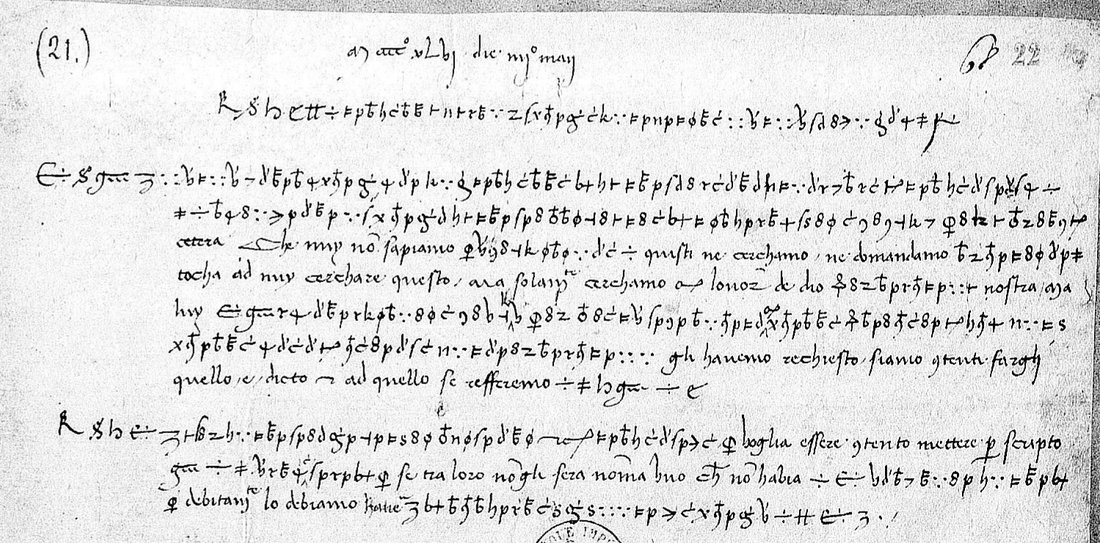
The Paris volumes italien 1583–1593 are part of the Archivio Sforzesco that the Bibliothèque impériale bought in 1867. Mazzatinti’s entry for f. 68 sits under 1446 among letters to Sforza from Angelo Simonetta and Giovanni Stavoli in Venice, and from Foschino degli Attendolo in Cremona and Ancona. That spring Sforza was fighting in the Marche and bargaining with Filippo Maria Visconti, whose court at Milan Maino was reporting on. The slip carries an old number (21.), the folio 68, and the clear date line centred at the head.
The clear text, in Lombard spelling (nuy, havemo, refferemo), holds the frame of the reply:
… cetera. Che nuy no sapiamo [cipher] questi, ne cerchamo ne domandamo [cipher] tocha ad nuy cerchare questo, ma solamente cerchamo con lo nome de dio [cipher] nostra … [cipher] gli havemo rechiesto siano contenti fargli quello e dicto et ad quello se refferemo.
[cipher] voglia essere contento mettere per scripto [cipher] se tra loro no gli sera noma uno che no habia [cipher] debitamente lo debiamo havere [cipher].
The second paragraph asks someone to be content to put something in writing, and argues that if only one of them lacks it, “we ought rightly to have it”. Who and what are in the cipher.
02 The cipher
The cipher is written in invented signs: barred strokes, a barred b, a phi, a barred yogh, a long s, figure 8, a cross-circle and others, some with dots or hooks. Dotted separators (::, .:.) stand between runs, and three paragraphs open with the same three-sign group. With the diacritic variants merged, f. 68 has 404 signs of 26 kinds. Two signs are 12% each, two are 7%, and the rest trail off. Several long runs repeat: an eight-sign group twice, another eight-sign group twice, a four-sign group four times. The cross-circle stands directly before clear clauses several times. In the related key described below it is the word sign for de.
F. 70, Amidani’s letter of the same day, is all cipher: 390 signs of 31 kinds in another hand. It uses the same stock of signs, the phi, the barred b, the barred stroke and the cross-circle among them, but in different proportions. It is not certain that each sign means the same in both hands.
03 What was tried
- Letter substitution by annealing. Both transcriptions were run against the
it-cinquecentomodel with the clear text as context: free homophones, capped homophones, nulls allowed, and strict one-to-one swaps. The solver was first checked on a synthetic 400-letter Italian cipher, which it solved. On the real texts every run gave nonsense or collapsed into runs of one letter. - Word patterns. The repeated eight-sign group fits uisconti (Visconti), but the key that implies breaks the other repeats. It was set aside.
- The Sforza keys on DECODE. All 208 key records from the Archivio di Stato di Milano (Carteggio Sforzesco, cartelle 1591, 1597, 1598) were downloaded and scanned. Cartelle 1591 and 1598 are sixteenth- and seventeenth-century. At the head of 1597 are eighteenth-century copies of fifteenth-century keys, each headed with the correspondent. Number 14, “Angelus cum cifra Vincentij”, was used with “Johannes de Stavolis, Augustinus, Baptista, Matheus, et Vincentius”. It gives two to five signs per letter, a sign for every syllable from ab to uz, word signs (che, per, quale, con, ma, quello, de, perché), names (la S. V., lo Duca de Milano, la Signoria Veneta) and nulls. That is why simple substitution cannot work here. But its letter signs are not the frequent signs of f. 68 or f. 70, so it is a related key. Number 17, the 1447 cipher of Sforza’s envoys to King Alfonso, does not match either. No key names Maino or Amidani.
- Print. Mazzatinti gives only the heading. No edition or decipherment of either slip was found.
04 What would finish it
A system of this kind, 800 signs split across two hands and transcribed from a binarized scan, cannot be broken from the ciphertext alone. Three things would change that. First, the key itself: the 1597 cartella should be searched at full size, and the fifteenth-century keys in Lydia Cerioni’s La diplomazia sforzesca nella seconda metà del Quattrocento e i suoi cifrari segreti (1970) should be checked. Second, a colour scan of italien 1583 ff. 68–70 from the BnF, so that every sign and diacritic can be transcribed exactly. Third, the seventeen other 1446 cipher letters from the same volume on DECODE (R7899–R7915), several from correspondents named on key 14. A decipherment of any of them in that key would show how far the family runs.
05 Sources
- BnF, italien 1583 f. 68: DECODE record R7898 (image by login; not in the public domain). F. 70: photographed on R7899, image 1.
- G. Mazzatinti, “Inventario delle carte dell’Archivio Sforzesco contenute nei codici italiani 1583–1593 della Biblioteca nazionale di Parigi”, Archivio storico lombardo X (1883), 222–326, at 230 (Internet Archive).
- Archivio di Stato di Milano, Carteggio Sforzesco, cart. 1597 nos. 14 and 17, via DECODE key records.
- BnF Archives et manuscrits, italien 1583–1615.
Transcriptions, solver scripts and notes are in the repository folder targets/it1583/.