At a glanceCiphertext-only break · partial (85% of the cipher)
- The letter
- Bartolomeo Tantucci to messer Antonio del Vescovo, rector of the cathedral and member of the Balìa, from Sarteano(?), 25 (or 20) August 1528.
- Where
- Archivio di Stato di Siena, Concistoro 2308, fasc. 2 “Lettere in cifra”, no. 17; DECODE R4805, catalogued “1500–1599” with no status.
- The cipher
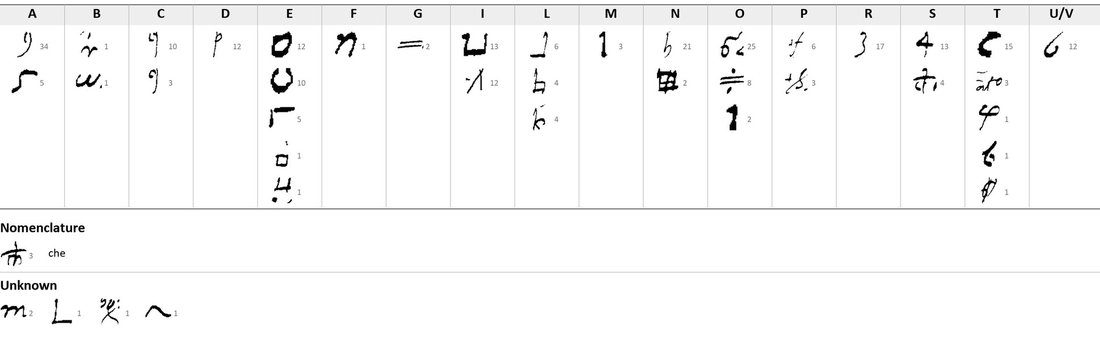
- Homophonic substitution, 41 signs, no word division: up to five signs for each vowel, every double letter written with two different signs, and the ordinary “che” abbreviation used as a sign.
- How it was deciphered
- George Lasry transcribed the cipher in CTTS; Claude recovered the key by frequency and contact analysis, isomorphs and cribs (15–17 October 2026).
- What it says
- Rumoured bishoprics for “the nephews”, the Cardinal of Naples and the affairs of Pitigliano, and a plan to cut off victuals; “parlo breve et in substantia perché la cifra vuol così”.
- Still open
- The opening words of two points and one phrase; “el Mustetto”, the Countess and the “Otto”. With them, Lasry’s reading builds coherent sentences and reads at 94.3% of its words (measured 24 October 2026), under the 95% a complete reading needs.
- Credit
- George Lasry, with CTTS and Claude: transcription, key and reading, sent by email to Daniel Bourdeau on 17 October 2026. This page reports his result.
This letter belongs to the Sienese bundle of cipher letters, in which each letter has its own key. The two other sixteenth-century Sienese pieces in George Lasry’s report, no. 15 (Bandini, 1547) and R4794 (the unnumbered artillery slip), are different ciphers, each with its own page; the bundle is described on its own page.
01The letter and its key
282 cipher signs in eight lines of the first page, inside a clear frame: heading, salutation, the connecting words In prima, Secundo, et, quando, Terzo, closing, signature and the endorsement “questa Cifara [è] quella di Balìa”. The verso carries the address. The key has 41 signs, many of them shaped like digits; four signs remain without a value.
02The decipherment
George Lasry’s reading, unchanged (cipher and clear text together; abbreviations expanded in brackets; (?) and [?] as in his edition):
1528. Molto mag[nifi]co et generoso Cavaliere etc. poi che V.S. è absente al mag[istra]to di Balìa, li comunicamo alcune cose importanti del governo, acciò possa intender cose che occorranno, haver lo intrinsico. In prima qua per molti et quasi publico, non che el Mustetto(?) l’à(?) a certe promessioni di non so che vescovadi per li nipoti; non so se è vero. Secundo [?]o a date(?) vi dà lo Cardinale di Napoli circa le cose di Pitig[l]iano, perché v’à parentado; et anco è stato cosa de la contessa quando erano giovani; pare che aon [con?] essa n’abbi facto lo amore. Terzo Otto(?) volendo lo avere, lco[??]stren[?]niare, non vi vada vittuaria né siano lassate praticare lo nestro [nostro] contado. Parlo breve et in substantia perché la cifra vuol così. M[esser] Bart[olo]meo Lamilucci(?) [Landucci?], quale era segretario da la Pratica, et la potrà leggere agevolmente. Di Sart[ean]o(?) a dì 25(?) di agosto 1528. … Deditissimo Bart[olome]o Tantucci questa Cifara [è] quella di Balìa
His translation: “Since Your Lordship is absent from the magistracy of the Balìa, we communicate to you some important matters of the government … First: here, among many and almost publicly, [it is said] that the Mustetto(?) has(?) certain promises of I know not what bishoprics for the nephews; I do not know whether it is true. Second: the Cardinal of Naples has(?) given and gives [his hand] in the affairs of Pitigliano, because he has kinship there; and it has also been a matter of the Countess, when they were young … Third: the Otto(?), wishing to have it, [in order to] constrain(?) [it] …, let no victuals go there, nor let [anyone] be allowed to deal with our contado. I speak briefly and in substance because the cipher wants it so.” Address: “Al mag[nifi]co et generoso cavaliero M[esser] Ant[oni]o del Vescovo rectore Dig[nissi]mo de la eccl[esi]a cattedrale. Cifara.”
In August 1528 Siena was governed by the Balìa of the popular regime that had expelled the Noveschi in 1524–25; Pitigliano was an Orsini county under Sienese suzerainty, and the “Cardinal of Naples” should be Vincenzo Carafa, created cardinal in November 1527 (George Lasry’s identifications, which he marks as not verified).
03What remains
- The opening words of the second and third points and the phrase “lco[??]stren[?]niare”: uncertain in the reading (about 15% of the signs).
- Unidentified: “el Mustetto”, the Cardinal of Naples (Vincenzo Carafa?), the Countess (of Pitigliano?), the “Otto”, the place Sarteano(?) and the day (25 or 20).
- The project’s own survey of 24 September 2026 had read the docket as a letter to Tantucci on 20 August; George Lasry’s reading of the signature and address is followed here.
Full texts
The transcription and the decryption of every document on this page, so that the reading can be used and checked. Short files are shown here; all are in the repository.
No. 17 (R4805), Bartolomeo Tantucci to Antonio del Vescovo, Sarteano(?), 25 August 1528 (George Lasry) read in part
Bartolomeo Tantucci to messer Antonio del Vescovo, rector of the cathedral, in the cipher of the Balìa, 25 (or 20) August 1528: bishoprics promised to 'the nephews' by 'el Mustetto'(?), the Cardinal of Naples (Vincenzo Carafa?) and Pitigliano, and the 'Otto'(?) wanting to constrain Pitigliano; 'Parlo breve et in substantia perché la cifra vuol così.' Decryption and translation are George Lasry's; the transcription linked is this project's independent one of 24 Sept 2026, on which his key was checked (92.9% agreement), since his CTTS transcription is not in the repository.
Builds coherent sentences, but under the read bar of 95% of words read as sense (94% here); the holes are marked in the reading.
Transcription
No. 17 (ASSi Concistoro 2308, fasc. 2) - DECODE R4805
Images: decode/img/IMG_R4805_I27962_P1.jpg (text side, portrait); _P2.jpg (address side)
Transcriber: agent A, 24 Sept 2026, from the photographs (line crops 2x, doubtful glyphs 3.5-7x, in crops/agentA/)

WHAT IT IS
- Head: "1528." ; salutation "Molto mag(nifi)co et generoso cavaliere etc."
- A Sienese letter to a cavaliere who is away from the magistrato di Balia: "since V.S. is absent from the
  magistrato di Balia, some important matters of the government are communicated so that you may understand
  what happens ...". Clear Italian with cipher runs embedded (m.03-m.10), clear words kept inside the cipher
  (quando, secondo, et, tertio, non so se e vero, and the abbreviation HBAR = che).
- End (clear): "parlo breve e in substantia perche la cifra vuol cosi. m(esse)r Bart(olo)meo T?antucci quale era
  segretario da la S?-/pratica(?) e la po leggere agevolmente. D? Siena(?) alli 2σ di agosto 1528." The day is
  written 2 + a sigma-shaped digit (read 20 in the brief, 25 in NOTES; not settled here). Followed by a monogram.
- Foot of P1: address fragment "...[Ill]ustrissimo Bart(olome)o T?antucci" (?) and the docket
  "questa cifra e quella di balia"; small "Mag(nifi)co" near the fold; pencil "17".
- P2 (address side): "Al mag(nifi)co et generoso cavaliere / M(esser) Ant(oni)o del Vescovo oratore / d(e)l
  Ill(ustrissi)mo ... Car(dina)le ... (last words uncertain)" ; below, "Cifra". Show-through of the P1 text.
  No cipher on P2.

SIGN LEGEND (every cipher glyph; clear text is in [ ])
  0      small round o/zero (letter o and digit 0 cannot be told apart; also inside ". 0 .")
  1      short upright stroke (digit one)
  3      z-shaped 3 with descender (ʒ)
  4      digit 4, closed triangular head, cross-bar, short descender
  4?     (m.09 only) open u-like 4 with a cross-bar, possibly a different sign ("u-bar")
  5      old-style 5: short ſ-like stem with flat flag to the right (as in the date 1528)
  5o     S-shaped stroke rising from lower left and ending in a closed loop at top right (5 with loop);
         distinct from 5.   5o^ = the same with a separate acute tick above (m.09)
  6      cursive 6 (б-like): round bowl with stem rising and curving right (often a wavy top bar)
  SIG    round bowl with a long horizontal top bar ending in a loop above the next sign (m.05, once);
         possibly only a flourished 6
  7      hooked top (arch, no closed bowl) and long tail curving down-left; 7? = could be an open 9
  9      closed round bowl with a tail curving down-left
  y      open, u-like/curl left part and a long straight or curving descender on the right (ɥ / y shape)
  q      closed bowl with a straight vertical stem (m.07 end, once)
  b      tall stem with a SQUARE closed box at the foot (ƀ-like)
  bl     cursive b with looped ascender and round bowl (m.08, once)
  SQ     small square box without stem (m.08, after b)
  BOX    square with a cross inside (⊞)
  c      small c
  e?     small e (m.08, once, uncertain)
  x?     x-shaped crossing descender (m.08; in this hand clear-text r looks like x)
  f      long f with cross-bar and descender
  h      h whose right leg descends below the line; h? = same with a looped/double ascender (m.06)
  k      k
  L      capital L (m.05, once)
  m      three-minim m (m.09, once)
  n      two-minim arched n (m.07)
  N_     n followed by a long flat tail/tilde (m.08, once)
  p      p;  p^? = p with a very faint dot above (m.09; may be a speck)
  r      r-like sign: upright with a flat top bar to the right (Γ)
  r^     the same r with an acute tick above (m.07; tick could be a stray end of the m.06 descender)
  u      u with flat bottom
  w      three-minim w/ω (m.07)
  LAM    lambda-like sign: long hairline rising left-to-right to the top, then a short stroke down (λ / Λ).
         Very often word-final after p ("p LAM"), c, h
  TT     "tt"-like sign: left bowl (like d/c) with upright(s) and a long cross-bar over them
  HBAR   h with cross-bar through the ascender (ħ); identical to the clear-text abbreviation for "che"
         in m.02 ("le cose ħ occorreranno") -> probably plain "che" left in clear inside the cipher
  HL     horizontal base stroke joined to an upright on the right (⅃ / "_l")
  DIV    ÷ : two parallel bars (not one) with a dot/small circle above and below
  EQ     = : two long parallel bars, no dots
  PHI    oval crossed by a vertical or slanting stroke (φ / ø)
  SS     long-tailed 8/ß-like sign: hook top, loop, long tail down-left (in "5 SS 3", "DIV SS 0 3", "SS 3 9")
  DOT    a point on the baseline (m.06 ". 0 ." ; m.09 DOT? before h)

CONVENTIONS: " / " = a clearly wider gap left by the scribe; otherwise signs run on. ? = uncertain reading.

TRANSCRIPTION (m. = manuscript line of P1)

m.00 [1528.]
m.00b [Molto mag(nifi)co et generoso cavaliere etc.]
m.01 [poi che V. S. e absenta al mag(istra)to di balia . si communicano alcune cose importanti del]
m.02 [governo accio possa inte(nde)r(e) le cose che occorreranno havere lo intrinsico supprema(?)]
m.03 [qua p(er) multi et quasi publica non HBAR]  c b 1 6 4 c 0 5o c DIV k 9 5 y 0 3 PHI 5 SS 3 6 1 0
m.04 4 TT u DIV h LAM / p LAM h 5 BOX 4 6 HBAR 6 0 4 y 6 6 9 p LAM / f 0 3 HL u h u f 6 c LAM [no(n) so se e. uero]
m.05 [secondo] L SIG 5 p 9 c 0 6 u / p 9 HL DIV y 5 3 p LAM h 7? k 0 p LAM / h 9 f 6 HL u y u 3 y 9 HL 0 y 6 4 0 p LAM
m.06 f u c LAM / EQ / LAM 9 h DIV SS 0 3 HBAR 6 9 f 5 3 0 h c 9 p 6 [et] 9 h? y 6 DOT 0 DOT 4 c 9 c 6 y 6 4 7 p 0 k 7 y 6 h
m.07 c 0 4 TT 7 [quando] 0 3 y h 6 EQ 1 6 6 y h u f 9? 3 r HBAR 7? DIV h 0 4 TT 9 / h 9 r^ w LAM / n 9 q c?
m.08 DIV b 6 9 1 6 3 r [tertio? (written 'texto'; r like x in this hand)] 1 0 6 1 / 6 DIV b SQ h p 6 HL 6 9 6 0 3 r / k y bl e? x? u N_ / 4 c 3 0 h
m.09 m h u 9 3 r / h 6 BOX 6 u / 6 9 p^? 9 / 6 u c 5o^ 6 9 3 u 9 DOT? h 0 4 u 9 h 6 HL 9 4 TT 9? 5o 4? SS 3 9 c LAM y 5
m.10 3 0 b DIV h 0 4 PHI 3 6 y 6 h c 9 p 6 [. parlo breve e in substantia per che la]
m.11 [cifra vuol cosi m(esse)r Bart(olo)meo T?antucci(?) quale era segretario da la S?-]
m.12 [pratica(?) e la po leggere agevolmente. D(a)? Siena(?) alli 2σ (20 or 25) di agosto]
m.13 [1528 .] (monogram / flourish, no legible name)

NOTES ON THE READING
- m.03-m.10 carry all the cipher; lines m.01-m.02 and m.10 (after "p 6")-m.13 are clear.
- "1 0 6 1" after [tertio] (m.08) is written like a plain number and may be clear (a sum or a date?) rather
  than cipher; counted as cipher tokens here.
- m.06 ". 0 ." : the 0 is set between two points, the medieval way of marking a numeral or a single-letter
  word (could be clear "o" = "or", or a code number).
- m.08 "k y bl e? x? u N_" is written in a more cursive, word-like way than the rest (could even be a clear
  word in the scribe's hand, where r looks like x); readings uncertain.
- The word-final pairs "p LAM", "c LAM", "h LAM" and the gaps after them suggest LAM ends a group.
- Doubtful 9/7/y distinctions: 9 = closed bowl + curved tail; 7 = hooked top, no closed bowl; y = open u-like
  head + long right descender; q = closed bowl + straight stem (1x). Marked "?" where the shape sits between.

COUNTS (cipher tokens only; clear words in [ ] and notes excluded; HBAR in m.03 counted as clear)
Total cipher tokens: 286  (m.03 23, m.04 34, m.05 43, m.06 47, m.07 38, m.08 38, m.09 46, m.10 17)
Distinct sign names: 42
  6 35, 9 27, 0 22, h 21, 3 17, c 15, 4 14, y 14, u 14, LAM 11, p 11, DIV 8, 5 7, 1 6, f 6, HL 6, 7 5,
  b 4, k 4, TT 4, r 4, SS 3, HBAR 3, DOT 3, 5o 2, PHI 2, BOX 2, EQ 2, L 1, SIG 1, r^ 1, w 1, n 1, q 1,
  SQ 1, bl 1, e 1, x 1, N_ 1, m 1, p^ 1, 5o^ 1
  (DOT = the two points of ". 0 ." in m.06 and the DOT? of m.09; not substitution signs.)
Digits 0,1,3,4,5,6,7,9 (no 2 or 8 in the cipher) and letters b,c,e,f,h,k,m,n,p,q,r,u,w,x,y + special signs;
digit signs make 133 of the 286 tokens (46%).
Decryption
# No. 17 (R4805): George Lasry's decipherment, verbatim from his report of 17 Oct 2026 (pp. 25-26).
# Line breaks follow the PDF text layer, not the manuscript.

1528. Molto mag[nifi]co et generoso Cavaliere etc. poi che V.S. è absente al mag[istra]to di Balìa, li
comunicamo alcune cose importanti del governo, acciò possa intender cose che occorranno, haver lo
intrinsico. In prima qua per molti et quasi publico, non che el Mustetto(?) l'à(?) a certe promessioni di non
so che vescovadi per li nipoti; non so se è vero. Secundo [?]o a date(?) vi dà lo Cardinale di Napoli circa le
cose di Pitig[l]iano, perché v'à parentado; et anco è stato cosa de la contessa quando erano giovani; pare
che aon [con?] essa n'abbi facto lo amore. Terzo Otto(?) volendo lo avere, lco[??]stren[?]niare, non vi vada
vittuaria né siano lassate praticare lo nestro [nostro] contado. Parlo breve et in substantia perché la cifra
vuol così. M[esser] Bart[olo]meo Lamilucci(?) [Landucci?], quale era segretario da la Pratica, et la potrà
leggere agevolmente. Di Sart[ean]o(?) a dì 25(?) di agosto 1528. [paraph] [mark] [paraph] Mag[nifi]co
Deditissimo Bart[olome]o Tantucci questa Cifara [è] quella di Balìa
P2 (verso) — address
Al mag[nifi]co et generoso cavaliero M[esser] Ant[oni]o del Vescovo rectore Dig[nissi]mo de la eccl[esi]a
cattedrale Cifara
Decryption
# George Lasry's report: the section on this piece, verbatim

Source: George Lasry, "The cipher documents of Concistoro 2308, fasc. 2" (17 Oct 2026), consolidated report sent by email to Daniel Bourdeau; pp. 25-27. Text extracted from the PDF page by page with PyMuPDF, unchanged (line breaks as in the PDF text layer). The key figure and the manuscript crop are images in the PDF: `key_lasry.jpg` here, `docs/siena17_key.jpg` and `docs/siena17_lead.jpg`. The report has no separate appendix text for this piece beyond what is below (the full decipherment and translation are in the section).

## Entry in the report's contents (p. 2)

```
G. Sixteenth-century Sienese ciphers
• No. 17 = R4805

  — Tantucci, 25 August 1528, "cifra di Balìa", 282 symbols — solved c. 85 % ciphertext-
only by Lasry with CTTS and Claude (15–17 October 2026)
```

## The section

```
[report page 25]

No. 17 (R4805): Bartolomeo Tantucci in the cipher of the Balìa, 25 August
1528
Status. Solved about 85 %: the opening words of two points and one phrase remain uncertain. 15–17
October 2026, by George Lasry with CTTS and Claude: key recovered by Claude (frequency and contact
analysis, isomorphs, cribs).
References
• Archivio di Stato di Siena, Concistoro 2308, fasc. 2 (Lettere in cifra), no. 17
• DECODE record R4805 (Concistoro_2308_59), https://de-crypt.org/decrypt-web/RecordsView/4805
Ciphertext
282 cipher signs in 8 lines (CTTS lines 5 to 12 of P1), set in a clear frame of heading, salutation, connecting
words ('In prima', 'Secundo', 'et', 'quando', 'Terzo'), closing, signature and endorsement.
Key
41 distinct signs. Homophonic substitution without word division: up to five signs for each vowel,
homophones for the frequent consonants, every double letter written with two different signs, and the
ordinary “che” abbreviation used as a cipher sign.
Signs as cut from the manuscript, with their number of occurrences; homophones stand under their letter.
Decryption
Cipher in bold, clear text plain, abbreviations expanded in brackets; (?) and [?] as in the edited reading.
P1


[report page 26]

1528. Molto mag[nifi]co et generoso Cavaliere etc. poi che V.S. è absente al mag[istra]to di Balìa, li
comunicamo alcune cose importanti del governo, acciò possa intender cose che occorranno, haver lo
intrinsico. In prima qua per molti et quasi publico, non che el Mustetto(?) l'à(?) a certe promessioni di non
so che vescovadi per li nipoti; non so se è vero. Secundo [?]o a date(?) vi dà lo Cardinale di Napoli circa le
cose di Pitig[l]iano, perché v'à parentado; et anco è stato cosa de la contessa quando erano giovani; pare
che aon [con?] essa n'abbi facto lo amore. Terzo Otto(?) volendo lo avere, lco[??]stren[?]niare, non vi vada
vittuaria né siano lassate praticare lo nestro [nostro] contado. Parlo breve et in substantia perché la cifra
vuol così. M[esser] Bart[olo]meo Lamilucci(?) [Landucci?], quale era segretario da la Pratica, et la potrà
leggere agevolmente. Di Sart[ean]o(?) a dì 25(?) di agosto 1528. [paraph] [mark] [paraph] Mag[nifi]co
Deditissimo Bart[olome]o Tantucci questa Cifara [è] quella di Balìa
P2 (verso) — address
Al mag[nifi]co et generoso cavaliero M[esser] Ant[oni]o del Vescovo rectore Dig[nissi]mo de la eccl[esi]a
cattedrale Cifara
Letter
1528. Most magnificent and generous Knight etc. Since Your Lordship is absent from the magistracy of the
Balìa, we communicate to you some important matters of the government, so that you may understand the
things that will occur and have the inside knowledge. First: here, among many and almost publicly, [it is said]
that the Mustetto(?) has(?) certain promises of I know not what bishoprics for the nephews; I do not know
whether it is true. Second: the Cardinal of Naples has(?) given and gives [his hand] in the affairs of
Pitigliano, because he has kinship there; and it has also been a matter of the Countess, when they were
young: it seems that he made love with her. Third: the Otto(?), wishing to have it, [in order to] constrain(?)
[it] ..., let no victuals go there, nor let [anyone] be allowed to deal with our contado.
I speak briefly and in substance because the cipher wants it so. Messer Bartolomeo Lamilucci(?) [Landucci?],
who was secretary of the Pratica, [is there] and will be able to read it easily. From Sarteano(?), on the 25th(?)
of August 1528. Most devoted Bartolomeo Tantucci. [Endorsement:] This cipher is that of the Balìa.
Address
To the magnificent and generous knight messer Antonio del Vescovo, most worthy rector of the cathedral
church. Cipher.
Contents
From: Bartolomeo Tantucci
To: messer Antonio del Vescovo, rector of the cathedral, member of the Balìa
Place: Sarteano(?)
Date: 25 (or 20) August 1528 — dated in the clear text
Tantucci writes to messer Antonio del Vescovo, rector of the cathedral, who is away from the Balìa, to give
him 'the inside knowledge' of three matters of government, each put into cipher between clear connecting
words. First, it is said here by many and almost publicly that the 'Mustetto'(?) has(?) certain promises of I
know not what bishoprics for 'the nephews'; he does not know whether it is true. Second, the Cardinal of
Naples has intervened and intervenes in the affairs of Pitigliano, because he has kinship there, and also
because of the Countess, with whom, when they were young, he seems to have had a love affair. Third, the
'Otto'(?), wanting to have Pitigliano, mean to constrain(?) it: no victuals are to go there, and no one is to be
allowed to deal with 'our contado'. He speaks briefly and in substance 'because the cipher wants it so', and
names messer Bartolomeo Lamilucci(?) [Landucci?], formerly secretary of the Pratica, as the man who will be
able to read it easily. The letter is dated from Sarteano(?) on 25(?) August 1528, signed 'Deditissimo
Bartolomeo Tantucci', and endorsed 'questa cifara è quella di Balìa'.
Historical context and dating
In August 1528 Siena was governed by the Balìa of the popular (Libertini) regime that had expelled the
Noveschi in 1524–25 and repulsed the papal–Florentine attack at Porta Camollia on 25 July 1526; the city


[report page 27]

leaned on the Emperor, while the restored Florentine republic (1527–30) was at war with Charles V and the
Pope [Hook, Siena: A City and its History, 1979; Roth, The Last Florentine Republic, 1925; Malavolti,
Dell'historia di Siena, 1599]. Sarteano, in the Val di Chiana on the Florentine border, was a Sienese subject
town. Pitigliano was an Orsini county (Count Ludovico, son of the condottiere Niccolò, then Gian Francesco)
under Sienese suzerainty, a standing object of Florentine and Roman interest [Bruscalupi, Monografia
storica della contea di Pitigliano, 1906]. The 'Cardinal of Naples' of 1528 should be Vincenzo Carafa,
archbishop of Naples from 1505, created cardinal on 21 November 1527 [Eubel, Hierarchia Catholica, III];
this identification, his kinship with the Orsini and the affair with 'the Countess' are not verified here. The
'Otto' are unidentified: Florence's Otto di Pratica had given way to the Dieci di Libertà e Pace in 1527, so a
Sienese body is possible. The 'Pratica' of the former secretary is likewise unidentified.
Open points. Unidentified: “el Mustetto”, the Cardinal of Naples (Vincenzo Carafa?), the Countess (of
Pitigliano?) and the “Otto”.
Sources
Judith Hook, Siena: A City and its History, London 1979
Cecil Roth, The Last Florentine Republic, London 1925
Orlando Malavolti, Dell'historia di Siena, Venice 1599
Giovanni Antonio Pecci, Memorie storico-critiche della città di Siena, Siena 1755–1760
Giuseppe Bruscalupi, Monografia storica della contea di Pitigliano, Florence 1906
Konrad Eubel and Wilhelm van Gulik, Hierarchia Catholica Medii et Recentioris Aevi, vol. III, Münster 1923
Wikipedia,

'Gerolama

Orsini'

(Ludovico

Orsini,

count

of

Pitigliano,

and

Giulia

Conti),
https://en.wikipedia.org/wiki/Gerolama_Orsini
Wikipedia, 'Pitigliano' (the county under Sienese suzerainty), https://en.wikipedia.org/wiki/Pitigliano
```
Translation
# No. 17 (R4805): George Lasry's translation, verbatim from his report of 17 Oct 2026 (pp. 25-26).
# Line breaks follow the PDF text layer, not the manuscript.

1528. Most magnificent and generous Knight etc. Since Your Lordship is absent from the magistracy of the
Balìa, we communicate to you some important matters of the government, so that you may understand the
things that will occur and have the inside knowledge. First: here, among many and almost publicly, [it is said]
that the Mustetto(?) has(?) certain promises of I know not what bishoprics for the nephews; I do not know
whether it is true. Second: the Cardinal of Naples has(?) given and gives [his hand] in the affairs of
Pitigliano, because he has kinship there; and it has also been a matter of the Countess, when they were
young: it seems that he made love with her. Third: the Otto(?), wishing to have it, [in order to] constrain(?)
[it] ..., let no victuals go there, nor let [anyone] be allowed to deal with our contado.
I speak briefly and in substance because the cipher wants it so. Messer Bartolomeo Lamilucci(?) [Landucci?],
who was secretary of the Pratica, [is there] and will be able to read it easily. From Sarteano(?), on the 25th(?)
of August 1528. Most devoted Bartolomeo Tantucci. [Endorsement:] This cipher is that of the Balìa.
Address
To the magnificent and generous knight messer Antonio del Vescovo, most worthy rector of the cathedral
church. Cipher.
Key: key_lasry.jpg, key.md

04Sources
- Archivio di Stato di Siena, Concistoro 2308 fasc. 2 no. 17: DECODE R4805.
- George Lasry, “The cipher documents of Concistoro 2308, fasc. 2”, report of 17 October 2026, pp. 25–27 (sent to Daniel Bourdeau; quoted in the repository folder). His sources: J. Hook, Siena: A City and its History (1979); C. Roth, The Last Florentine Republic (1925); O. Malavolti, Dell’historia di Siena (1599); G. Bruscalupi, Monografia storica della contea di Pitigliano (1906); Eubel, Hierarchia Catholica III.
Manuscript rights: Archivio di Stato di Siena.
Report text, key figure, profile and the project’s earlier transcription: targets/siena17/.