At a glanceCiphertext-only break · none (key obtained, text not read)
- The letter
- Mario Bandini, Sienese orator at the imperial court, to the Signori of Siena, Innsbruck (“Eltspruch”), 4 January 1546 Sienese style, that is 1547.
- Where
- Archivio di Stato di Siena, Concistoro 2308, fasc. 2, no. 15; DECODE R4803, catalogued “1500–1599” with no status.
- The cipher
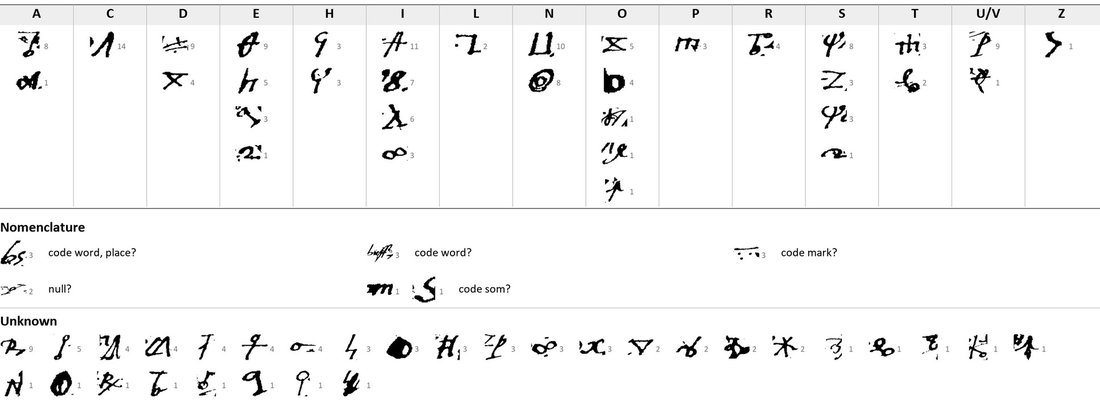
- About 65 signs: a homophonic alphabet of Greek-like and invented signs, probable nulls, no word dividers, and Latin-letter code words (buf, abs, som, Za) each followed by a bar with three dots.
- How it was tried
- George Lasry transcribed the passages in CTTS and, with Claude Opus 5.5, guessed and dragged cribs inside the clear context.
- What it says
- Only fragments: the cipher speaks of an occasion to be used and of discord among the factions; a minister warns that a fire would be kindled in a coded place.
- Still open
- 165 of the 240 cipher signs and the four code words, so the passages are decoded, not read. Checked again on 23 October 2026: all eight DECODE images of R4803 (the eighth is a clear postscript) and the neighbouring records R4802 and R4804 carry no decipherment, and no printed text was found. About 30 sign classes have no value in 240 signs, too few for a rebuild from the ciphertext alone; Lasry’s own CTTS transcription is needed for the next step.
- Credit
- George Lasry, with CTTS and Claude Opus 5.5: transcription and partial decipherment, sent by email to Daniel Bourdeau on 17 October 2026. This page reports his result.
The two other sixteenth-century Sienese pieces of George Lasry’s report, no. 17 (Tantucci, 1528) and R4794 (the unnumbered artillery slip), are different ciphers with their own pages; their key figures were compared sign by sign with this one and every shared shape has another value.
01The letter and its key
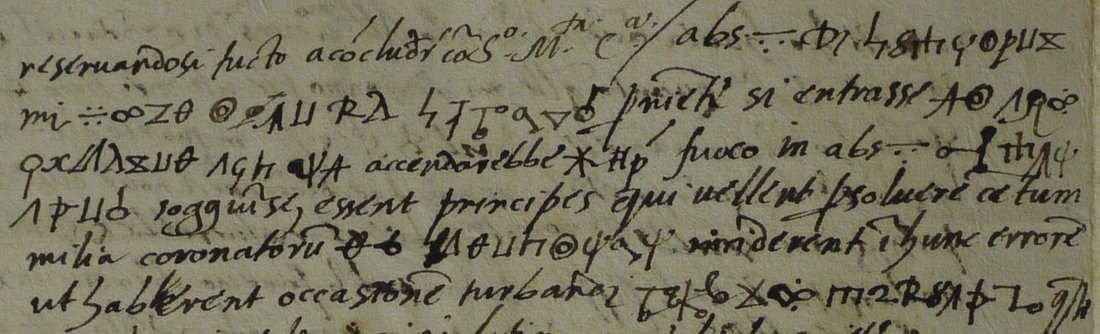
240 cipher signs and three Latin-letter code tokens, in eight lines of the second page and six of the sixth, set as eleven short passages in the clear Italian. Bandini protests that he did not come to Germany to quarrel with Piergiovanni Salvestri, dismisses the “calumnies” that Siena is displeased at the Emperor’s victory, and reports that a minister (Granvelle?) refused the thousand he brought and asked for Sienese vases “all’antica”.
02The partial decipherment
George Lasry’s reading, unchanged (code words in brackets; ? = sign not read):
P2, lines 15–22. prudentia loro — in ?e? se di ?a?i?i ?unc d? [som] n? i? di?a senza de? s? io ?u?in? esse presenti ??d? hanno da servirsi [dell’] occasione e procurar se li potesse intervenir come ?h padri ?e? [buf] in?io?i?? di lo us? che piu ?a discordia tra loro [buf] ? Altro la ? [abs] redusse ale mani d?nds?ri anchiora V. SS.e Ill.me so’ prudenti et dunq[ue] anco da guardar [buf] [?] di ?ci?r? i?ae?u adosso se[Za] su? e?i? — De le calunnie che V. SS.e Ill.me mi significa
P6, lines 1–6. reservandosi tutto a concludere con S. M.ta Ces.a / [abs] sc?it ?uno mi disse n?cn ?i ?rh? perche si entrasse in ???ione che si accenderebbe ?? fuoco in [abs] ?t?s c?n? soggiunse: essent principes qui vellent persolvere centum milia coronatorum ut Senenses viderent hunc errorem ut haberent occasionem turbandi ??t o? pe? iculo? queste
His translation of P6: “reserving everything to be concluded with His Imperial Majesty. [abs] … he told me …, so that one should enter into … [confus]ion(?), which would kindle … fire in [abs] …; he added: there would be princes who would be willing to pay out a hundred thousand crowns, so that the Sienese might see this error, so as to have an occasion of disturbing … peril(?).”
The date: the Emperor’s recent “victory and glory” is the Schmalkaldic campaign of autumn 1546, which fixes 4 January 1546 in the Sienese year (beginning 25 March) as 1547. Siena was then a republic under imperial protection, split between its Monti; in 1547 Charles V put it under Don Diego Hurtado de Mendoza.
03What remains
- 165 of the 240 cipher signs; about 30 signs have no value, and several transcription classes are probably variants of one sign.
- The code words buf (three times), abs (three times), som and Za, and the persons or places behind them; “His Excellency” who spoke in Latin (Granvelle?).
- The filed key “Cifra con m. Bernardino Buoninsegni oratore a S. M.tà” (DECODE R4764), compared with this letter in the project’s survey of 24 September 2026, gave no conclusive match.
Full texts
The transcription and the decryption of every document on this page, so that the reading can be used and checked. Short files are shown here; all are in the repository.
No. 15 (R4803), Mario Bandini to the Signori of Siena, Innsbruck, 4 January 1547 (George Lasry's partial reading) decoded, not read
Mario Bandini, Sienese orator at the imperial court, to the Signori of Siena, Innsbruck, 4 January 1547, after the Schmalkaldic campaign: Piergiovanni Salvestri at Innsbruck with the Florentine orator, an occasion to be used and discord in cipher, a minister (Granvelle?) warning that a fire would be kindled in a coded place, and Sienese vases 'all'antica' for Burgundy via Figueroa. Decryption and translation are George Lasry's (75 of 240 signs); the transcription linked is this project's own of 24 Sept 2026, not used in his reading, since his CTTS transcription is not in the repository.
A mechanical decode with holes in most sentences: shown so that the transcription and the key can be checked and improved, not as a reading.
Transcription
No. 15 (DECODE R4803, ASSi Concistoro 2308 fasc. 2) -- VERIFIED cipher runs, agent L, 24 Sept 2026
===================================================================================================
Checked sign by sign against decode/img/IMG_R4803_I27950_P2.jpg and _P6.jpg (2248x4000).  Every crop was viewed
and displayed: crops/agentL/o15p2.png, o15p6.png (ruled overviews), s15p2_y*.png (2.4x line strips),
z15p2_*.png and z15p6_*.png (2.2-7x zooms of each run).  Pages P1, P3-P5, P7, P8 were not re-checked (agent K
reports no cipher there; the task covered P2 and P6 only).
Base file: transcripts/no15.txt (agent K).  Its legend and context notes are kept; the legend is repeated
below with one added sign.  Changes are marked  <<chg: ...>>.

WHAT IT IS: see no15.txt (Mario Bandini, Sienese orator at Charles V's court, letters of 29 Dec 1546 / 3 Jan
  and 4 Jan 1547 (Sienese style 1546); Italian, clear with cipher runs on P2 and P6).

SIGN LEGEND (ASCII names; plain letters/digits are written as themselves)
-------------------------------------------------------------------------
  8 9 1 2 x s o m q a e h R A L T V X Z N   letter/digit-like signs, as seen (lower-case where written small)
  1      upright with a hooked flag at the top and short foot (ɿ/ʎ-like); distinct from LAM
  O2     double circle / bullseye (◎)
  DOT    solid filled round blob (●)
  OO     two joined circles (∞)
  OO:    ∞ with a dot above and a dot below
  OL     small circle with a horizontal tail to the right (o—), the tail running into the next sign
  OS     small o crossed by a slanting stroke that ends in a hook at top right (ø / "o7")
  OI     circle standing on a descending stem (ꝗ / period form of the digit 4)
  PHI    φ (stem through a circle)            PSI  ψ (fork on a stem)          TH  θ
  LAM    λ (long left leg, foot often drawn out horizontally)
  LV     Λ without crossbar (inverted V, left foot hooked); "A" when a crossbar is present
  MM     two slanted λ/Λ strokes on one base line (cursive M-like, "ᏗA")
  U      two uprights joined at the foot (⊔, "LI")
  H      two short uprights joined by a crossbar (ʜ, "tt")
  #      two uprights crossed by two bars
  M3     horizontal bar over three legs (ᴨ with a third leg, "m" in capitals)
  P      thorn-like p (þ): stem above and below a bowl on the right
  P+     P with a horizontal bar across the descender (ꝑ)
  RHO    ρ with a long descender ending in a horizontal foot stroke
  D      small round bowl with an ascender curving up/left (δ / ∂)
  DF     D with the bowl filled solid
  ST     upright ending in a small loop at the foot (top plain or with a top bar, "ƍ"/"5"-like)
  STB    ST with a heavy blob at the head (usually preceded by OL, "o—¡")
  TB     T whose stem carries a filled wedge/blob (Ŧ)
  TO     T with a small circle (open or filled) at the right end of the bar and a loop at the foot of the stem
  XT     x with a horizontal bar on top (and sometimes at the foot) (⊼ / ⊻)
  Q+     q whose descender is crossed by a horizontal bar
  AMP    "&"/8-like loop with a tail ending in a small o
  GX     g/9-like loop with a crossbar and a curled descender
  K      k-like sign with a looped arm (ꝁ)
  SW     large composite: loop on a stem with a heavy loop/blob at lower right (♀/ȣ-like)
  STAR   asterisk (✱)
  TRI    V/triangle with a bar (∇)
  E?     e-like sign with a long descending tail (could be clear e)
  DIV    ÷-type sign: one or two horizontal bars with 1-3 dots above/below.  Stands at the START of most runs
         (after clear text) and sometimes inside runs; probably a null/marker, kept as a token.
  {dash} short hyphen-like stroke at line start
Tokens separated by spaces; '?' after a token = uncertain; '??' = illegible sign.
NB "abs": the lower-case word "abs" occurs three times right before a cipher run (P2 L20 "la o ST abs reducesse",
  P6 L1 "Ces.a abs DIV", P6 L3 "fuoco in abs DIV"); it may be an abbreviation or a clear-letter code word.
NB "bus"/"buss"/"bos": a short clear-looking word recurs next to runs (P2 L18, L20, L21); reading uncertain
  (abbreviation, e.g. "bisogna"?).

ENTRIES  (L<page>.<line of page>)
LEGEND ADDITIONS / NOTES (agent L)
  LD     new sign: Λ whose left leg descends below the line, crossed at mid-height by a short bar to the left
         (L2.17; agent K had "P+?", but the sign has no bowl)
  XH     new sign: x crossed by a horizontal bar through the middle (star-like, "x+"), L2.21
  XT     as agent K defined it (x with a bar on top and/or at the foot).  Three x's that K left as plain "x"
         (L2.18, L2.19 twice) carry such bars and are now XT; L2.16 "X" has a foot bar only, likewise XT.
         No plain unbarred x remains in the P2/P6 runs.
  q      on P2 L2.18 and P6 L6.3 the q is written open, G-like ("ɢ"); kept as q.
  PSI/PHI: the open fork on a stem (L2.15, L2.19, L2.20, L6.3, L6.5) is PSI; only L2.17 has the closed φ.
         L2.16 "PHI" has near-closed arms: kept PHI but may be PSI.
ENTRIES: clear text in [ ]; tokens separated by spaces (no word division in these runs).

L2.15 [... ma persuadendomi che VV. SS. Ill.me in tutto sieno mossi da / iusti considerationi et facino con
      bon pensiero mi rimetto alla / prudentia loro ———] 8 O2 DOT H LAM Q+ PSI TH DIV A OL ST 4 LAM M3 OO 4 R P U LV
      <<chg: PHI -> PSI (open fork, the same sign as L2.19 "8 PSI 1")>>
L2.16 {dash} I? s o m O2 R 8 x XT LAM Q+ D 2 a Y? U 7? d? DIV TH ?? M3 ?? MM PHI AMP A XT OO: P LAM Q+ A O2 R
      [esse(re) presenti]
      <<chg: "A X" -> "A XT" (x with a bar at the foot)>>
      (the "8 x" is a small 8 and a plain x joined by a hair-line; the first "x" is unbarred here and is kept as x)
L2.17 OL STB ST DIV D [hanno da servirsi ill̄/] LV 1 D PHI 8 LD U TH [e procurar(e) se li potesse inter-]
      <<chg: "P+?" -> "LD" (see legend)>>
L2.18 [-venir come] P R q [padri] DOT Q+ H LAM? [buss] A O2 DOT T LAM o V 8 MM XT R DIV A L o P Z RHO 1 9 TH
      <<chg: "MM x R" -> "MM XT R" (x barred top and foot)>>
L2.19 [più] R D XT 8 PSI 1 XT TO XT LAM DF [tra loro bos q. c'altro la] o ST [abs reducesse ale / mani]
      <<chg: both plain "x" -> XT (first barred top and foot, hourglass-like; second barred on top)>>
L2.20 DIV 9 U XT PSI D TO OO [anchi, VV. SS. Ill.me so prudenti] DOT H DIV RHO U A
      (OO here has its first loop filled)
L2.21 DF O2 1 E? [da guardar bus] DIV OS DIV A N? A # TB TO MM A XH D h SW P+ [addosso se-]
      <<chg: "x" -> "XH" (x crossed by a horizontal bar)>>
L2.22 [-za] OI RHO H OS? R A E? [——— De le calunnie che VV. SS. Ill.me mi significa(no) / no esser date ala citta ...]

L6.1  [reservandosi tutto a concludere con S.a M.ta C(esare)a] abs DIV D? LV 4 8 TB? H q O P+ U XT
L6.2  [mi] DIV OO Z TH O2 OS A? U R LAM 4 TB TO a? TRI ST [per che si entrasse] A O2 1 R OO:
      <<chg: "q" -> "a?" (one bowl, stem on the right slanting down-right, no vertical descender; the same
        shape as the "a" of L2.16)>>
L6.3  OI x MM LV XT U TH 1 q H DOT PSI A [accenderebbe] STAR # RHO [fuoco in abs] DIV OL STB H A PSI
L6.4  LAM P+ U D [soggiunse: essent principes qui vellent persolvere c(en)tum / milia coronatoru(m)]
L6.5  GX D MM? TH U H O2 PSI a? LAM? PSI [(?)nderent in hunc errore(m) / ut haberent occasione(m) turbandi]
L6.6  TO K D XT OO: M3 2 R 8 A P+ L o [q(ue)sti parole mi esplico così in latino come le ho scritte ———]
      (XT here has the foot bar only; the "L o" pair recurs at L2.18 "A L o P Z", so it is cipher, not "Lo")

CHANGE COUNT against no15.txt: 8 tokens changed out of c. 230 (7 substitutions of a sign name, 1 reading
  corrected from "P+?" to a new sign LD); no token added or deleted; the runs' extent is as agent K gave it.
  Verdict: no15.txt is reliable; the corrections are fine distinctions (bars on x, ψ vs φ, a vs q).

CRIB CANDIDATES (clear words touching the runs)
  - L2.15 run follows "mi rimetto alla prudentia loro ———" and is followed on L2.17 by "hanno da servirsi":
    the run probably names who "hanno da servirsi" (subject plural).
  - L2.17-18 "e procurar(e) se li potesse intervenir come P R q padri": the 3 signs before "padri" are
    probably one word (e.g. "santi", "loro", "buoni"): a very short crib.
  - "abs" stands three times immediately before cipher (L2.19 "la o ST abs reducesse", L6.1 "C(esare)a abs DIV",
    L6.3 "fuoco in abs DIV") and "bus/buss/bos" twice (L2.18, L2.21 "da guardar bus DIV"): probably clear
    abbreviations or code words; worth testing as names (e.g. "abs" = a person/state).
  - L6.3 "accenderebbe STAR # RHO fuoco": three signs between "accenderebbe" and "fuoco" (an adjective or
    article-like word, e.g. "gran", "il"); STAR and # are nulls in the candidate key R4764, leaving one sign.
  - L6.4-6.5: the Emperor's words are quoted in Latin: "essent principes qui vellent persolvere centum milia
    coronatorum ... [cipher] ... (?)nderent in hunc errorem ut haberent occasionem turbandi" and L6.6 "questi
    parole mi esplicò così in latino come le ho scritte": the run L6.5 (GX D MM? TH U H O2 PSI a? LAM? PSI,
    between "coronatorum" and "-nderent") sits inside the quoted Latin sentence and is Latin (a verb or
    clause such as "qui ... inciderent"?); L6.4 "LAM P+ U D" before "soggiunse" ends the Italian run of L6.3.
Transcription
No. 15 (DECODE R4803, ASSi Concistoro 2308 fasc. 2) -- cipher runs + cribs, transcription by agent K, 24 Sept 2026
==================================================================================================================
Images: decode/img/IMG_R4803_I27950_P1.jpg ... _P8.jpg (2248x4000 each).  Crops: crops/agentK/p15_*.png (overviews),
  a2L*_k.png / a6L*_k.png (3x line strips, P2 and P6), z*.png (4-6x zooms).  Helper: crops/agentK/ln.py, c.py.

WHAT IT IS: dispatch(es) of the Sienese orator at the court of Charles V, in Italian, mostly clear, with cipher runs
  written in a mixed sign set (Latin capitals and lower-case letters, digits, Greek-letter forms, circles and ties).
  Photographed order is not the text order:
  - P1 = last page of a letter DATED "Di Hellsprunth(?) alli 29 di X.bre MDXLVI" (Heilbronn? 29 Dec 1546), then
    "Poscritta" of 3 Jan: "Poi si e' ritenuta questa perche credevo mandarla per Alisandro Pie|ri fin oggi il di 3
    di Gennaio ... lettere di VV. SS. Ill.me indirizzate insieme a m. Ambrogio [N...] et a me delli 20. 27. 29.
    del passato [interl.: di Novembre / di dicembre] ... ritenuta fino a li XI di dicembre".
  - P2-P7 = a second letter; P7 ends: "... Di Ellspruth(?) a li 4 di Gennaro 1546" (Sienese style = 4 Jan 1547; the
    4 is written as a loop on a stem, the same shape as the cipher sign OI below) -- subscription
    "Ser.or di VV. SS. Ill.me / Mario Bandini(?)" (signature "Mario Bandini", reading of the surname fairly sure).
  - P8 = clear postscript/enclosure note: "Sara con questa la copia d'un capitolo d'una lettera venuta al R.mo
    Nuntio di S.S.ta ... preparationi del Turco ... Mons. di Granvela ... Piero Salvestri ...".  No cipher.
  - Sender: Mario Bandini, Sienese orator.  Recipient: VV. SS. Ill.me (the Balia / Signoria of Siena).
    No address leaf photographed (P8 lower half is bleed-through only).
  Place written "Hellsprunth"/"Ellspruth" (I read it as Heilbronn, where Charles V was Dec 1546 - Jan 1547; unsure).
  Pages P1, P3, P4, P5, P7, P8: checked, no cipher runs.  Numbers in clear text are NOT cipher: P1 "fin 4. o. 5."
  (4 in loop form), P3 "per 8 . o . X di ancora", P7 date.
  Cipher runs: P2 (lines 15-22 of the page) and P6 (lines 1-6).

SIGN LEGEND (ASCII names; plain letters/digits are written as themselves)
-------------------------------------------------------------------------
  8 9 1 2 x s o m q a e h R A L T V X Z N   letter/digit-like signs, as seen (lower-case where written small)
  1      upright with a hooked flag at the top and short foot (ɿ/ʎ-like); distinct from LAM
  O2     double circle / bullseye (◎)
  DOT    solid filled round blob (●)
  OO     two joined circles (∞)
  OO:    ∞ with a dot above and a dot below
  OL     small circle with a horizontal tail to the right (o—), the tail running into the next sign
  OS     small o crossed by a slanting stroke that ends in a hook at top right (ø / "o7")
  OI     circle standing on a descending stem (ꝗ / period form of the digit 4)
  PHI    φ (stem through a circle)            PSI  ψ (fork on a stem)          TH  θ
  LAM    λ (long left leg, foot often drawn out horizontally)
  LV     Λ without crossbar (inverted V, left foot hooked); "A" when a crossbar is present
  MM     two slanted λ/Λ strokes on one base line (cursive M-like, "ᏗA")
  U      two uprights joined at the foot (⊔, "LI")
  H      two short uprights joined by a crossbar (ʜ, "tt")
  #      two uprights crossed by two bars
  M3     horizontal bar over three legs (ᴨ with a third leg, "m" in capitals)
  P      thorn-like p (þ): stem above and below a bowl on the right
  P+     P with a horizontal bar across the descender (ꝑ)
  RHO    ρ with a long descender ending in a horizontal foot stroke
  D      small round bowl with an ascender curving up/left (δ / ∂)
  DF     D with the bowl filled solid
  ST     upright ending in a small loop at the foot (top plain or with a top bar, "ƍ"/"5"-like)
  STB    ST with a heavy blob at the head (usually preceded by OL, "o—¡")
  TB     T whose stem carries a filled wedge/blob (Ŧ)
  TO     T with a small circle (open or filled) at the right end of the bar and a loop at the foot of the stem
  XT     x with a horizontal bar on top (and sometimes at the foot) (⊼ / ⊻)
  Q+     q whose descender is crossed by a horizontal bar
  AMP    "&"/8-like loop with a tail ending in a small o
  GX     g/9-like loop with a crossbar and a curled descender
  K      k-like sign with a looped arm (ꝁ)
  SW     large composite: loop on a stem with a heavy loop/blob at lower right (♀/ȣ-like)
  STAR   asterisk (✱)
  TRI    V/triangle with a bar (∇)
  E?     e-like sign with a long descending tail (could be clear e)
  DIV    ÷-type sign: one or two horizontal bars with 1-3 dots above/below.  Stands at the START of most runs
         (after clear text) and sometimes inside runs; probably a null/marker, kept as a token.
  {dash} short hyphen-like stroke at line start
Tokens separated by spaces; '?' after a token = uncertain; '??' = illegible sign.
NB "abs": the lower-case word "abs" occurs three times right before a cipher run (P2 L20 "la o ST abs reducesse",
  P6 L1 "Ces.a abs DIV", P6 L3 "fuoco in abs DIV"); it may be an abbreviation or a clear-letter code word.
NB "bus"/"buss"/"bos": a short clear-looking word recurs next to runs (P2 L18, L20, L21); reading uncertain
  (abbreviation, e.g. "bisogna"?).

ENTRIES  (L<page>.<line of page>)
-------
L2.15 [... ma persuadendomi che VV. SS. Ill.me in tutto sieno mossi da / iusti considerationi et fa(re) cino (?) con bon pensiero mi rimetto alla / prudentia loro ———] 8 O2 DOT H LAM Q+ PHI TH DIV A OL ST 4 LAM M3 OO 4 R P U LV
L2.16 {dash} I? s o m O2 R 8 x XT LAM Q+ D 2 a Y? U 7? d? DIV TH ?? M3 ?? MM PHI AMP A X OO: P LAM Q+ A O2 R [esse(re) presenti (?)]
      (note: "I?" = upright with top and bottom bars; "a Y?": small a whose tail runs down-right under the line;
       "7?" = r/7-like sign with descender; "d?" = a with tall right stem; "??" after TH and after M3 = faint marks,
       possibly erased strokes; a dot follows MM)
L2.17 OL STB ST DIV D [hanno da servirsi ill̄/ (?)] LV 1 D PHI 8 P+? U TH [e procurar(e) se li potesse inter-]
L2.18 [-venir come] P R q [padri] DOT Q+ H LAM? [buss(?)] A O2 DOT T LAM o V 8 MM x R DIV A L o P Z RHO 1 9 TH
L2.19 [più] R D XT 8 PSI 1 x TO x LAM DF [tra loro bos(?) q.(?) c'altro(?) la] o ST? [abs reducesse ale / mani]
L2.20 DIV 9 U XT PSI D TO OO [anchi(?), VV. SS. Ill.me so prudenti] DOT H DIV RHO U A
L2.21 DF O2 1 E? [da guardar bus(?)] DIV OS DIV A N? A # TB TO MM A x D h SW P+ [addosso se-]
L2.22 [-za] OI RHO H OS? R A E? [——— De le calunnie che VV. SS. Ill.me mi significa(no) / no esser date ala citta ...]
      (L2.21-22: "addosso se|za" = "adosso senza", clear, splits the run in two)

L6.1  [reservandosi tutto a concludere con S.a M.ta C(esare)a] abs DIV D? LV 4 8 TB? H q O P+ U XT
      (note: after DIV a c-like bowl with a long top stroke + Λ, read D? LV; the 8 is overwritten by a vertical
       stroke with a blob, read "8 TB?"; O = plain large circle)
L6.2  [mi] DIV OO Z TH O2 OS A? U R LAM 4 TB TO q TRI ST [per che si entrasse] A O2 1 R OO:
L6.3  OI x MM LV XT U TH 1 q H DOT PSI A [accenderebbe] STAR # RHO [fuoco in abs] DIV OL STB H A PSI
L6.4  LAM P+ U D [soggiunse: essent principes qui vellent persolvere c(en)tum(?) / milia coronatoru(m)]
L6.5  GX D MM? TH U H O2 PSI a? LAM? PSI [rinderent(?) hunc errore(m) / ut haberent occasione(m) turbandi(?)]
      (MM? = blotted sign at the head of the run, could be U)
L6.6  TO K D XT OO: M3 2 R 8 A P+ L o [q(ue)sti(?) parole mi esplico così in latino come le ho scritte ———
      Ho voluto per modo nissuno acceptar li 1000 V. che li portai ...]
      (note: "L o" is written in capitals-style joined; could be clear "Lo" but "lo questi parole" does not parse,
       so kept as cipher)

COUNTS: 14 runs (P2: 9 incl. the split at L2.21/22; P6: 5 + the one-word run L6.3 "STAR # RHO"),
  ~150 sign tokens on P2, ~80 on P6 (about 230 in all).

KEY CANDIDATE IN FASC. 1 (checked by eye, crop crops/agentK/k4764a.png):
  R4764 "Cifra con m. Bernardino Buoninsegni oratore a S. M.ta" (Sienese orator to the Emperor) is written in
  the SAME sign style: alphabet row with a circle-on-stem (= OI), o-o/∞ (= OO/OL), Λ (= LV), γ, ⊓, II, ψ-like,
  θ-like signs; a "Doppie" row whose values are CAPITALS A ɒ G H 8 a 7 Z C E I K l (no. 15 has capitals A Z E H
  K and "a", "8", "7" inside runs); and a "Nulle" row  * ∞ 8 7 # ÷ 3 4 6 8 20 30 40 ...  -- i.e. STAR, OO, 8,
  #, DIV (÷, the run-opening marker here), 4 are all NULLS in R4764.  Strong candidate: test R4764 first.
  Second look: R4765 (Spagna, Imperador ...; nulls 5 8 7 2 # ◎ 4) shares ◎ (= O2) and # as nulls.
Decryption
# No. 15 (R4803): George Lasry's decipherment, verbatim from his report of 17 Oct 2026 (p. 29).
# Line breaks follow the PDF text layer, not the manuscript.

P2 (lines 15–22)
prudentia loro ——— in ?e? se di ?a?i?i ?unc d? [som] n? i? di?a senza de? s? io ?u?in? esse presenti ??d?
hanno da servirsi [dell'] occasione e procurar se li potesse intervenir come ?h padri ?e? [buf] in?io?i?? di lo
us? che piu ?a discordia tra loro [buf] ? Altro la ? [abs] redusse ale mani d?nds?ri anchiora V. SS.e Ill.me so'
prudenti et dunq[ue] anco da guardar [buf] [?] di ?ci?r? i?ae?u adosso se[Za] su? e?i? ——— De le calunnie
che V. SS.e Ill.me mi significa
P6 (lines 1–6)
reservandosi tutto a concludere con S. M.ta Ces.a / [abs] sc?it ?uno mi disse n?cn ?i ?rh? perche si entrasse
in ???ione che si accenderebbe ?? fuoco in [abs] ?t?s c?n? soggiunse: essent principes qui vellent persolvere
centum milia coronatorum ut Senenses viderent hunc errorem ut haberent occasionem turbandi ??t o? pe?
iculo? queste
Decryption
# George Lasry's report: the section on this piece, verbatim

Source: George Lasry, "The cipher documents of Concistoro 2308, fasc. 2" (17 Oct 2026), consolidated report sent by email to Daniel Bourdeau; pp. 28-30. Text extracted from the PDF page by page with PyMuPDF, unchanged (line breaks as in the PDF text layer). The key figure and the manuscript crop are images in the PDF: `key_lasry.jpg` here, `docs/siena15_key.jpg` and `docs/siena15_lead.jpg`. The report has no separate appendix text for this piece beyond what is below (the full decipherment and translation are in the section).

## Entry in the report's contents (p. 2)

```
• No. 15 = R4803

  — Bandini, Innsbruck 4 January 1547, 240 symbols — partially read (75 / 240 signs) by
Lasry with CTTS and Claude Opus 5.5
```

## The section

```
[report page 28]

No. 15 (R4803): Mario Bandini at the imperial court, Innsbruck, 4 January
1547
Status. Partially read (75 / 240 signs), by Lasry with CTTS and Claude Opus 5.5 (crib guessing and dragging).
References
• Archivio di Stato di Siena, Concistoro 2308, fasc. 2 (Lettere in cifra), no. 15
• DECODE record R4803 (Concistoro_2308_57), https://de-crypt.org/decrypt-web/RecordsView/4803
Ciphertext
240 cipher signs, plus three Latin-letter code tokens, in 8 lines of P2 and 6 lines of P6, set as eleven short
passages inside the clear Italian text of an eight-page letter.
Key
About 65 distinct signs (71 transcription classes, several of them probably merged variants of one sign): a
homophonic alphabet of Greek-like and invented signs with two or more signs for e, n, o and i, Latin-letter
nomenclator tokens (buf, abs, som, Za) each followed by a bar with three dots, probable nulls, and no word
dividers.
Signs as cut from the manuscript, with their number of occurrences; homophones stand under their letter.
Decryption


[report page 29]

Cipher in bold, clear text plain; code words in [brackets]; ? = sign not read; readings marked ? are uncertain.
P2 (lines 15–22)
prudentia loro ——— in ?e? se di ?a?i?i ?unc d? [som] n? i? di?a senza de? s? io ?u?in? esse presenti ??d?
hanno da servirsi [dell'] occasione e procurar se li potesse intervenir come ?h padri ?e? [buf] in?io?i?? di lo
us? che piu ?a discordia tra loro [buf] ? Altro la ? [abs] redusse ale mani d?nds?ri anchiora V. SS.e Ill.me so'
prudenti et dunq[ue] anco da guardar [buf] [?] di ?ci?r? i?ae?u adosso se[Za] su? e?i? ——— De le calunnie
che V. SS.e Ill.me mi significa
P6 (lines 1–6)
reservandosi tutto a concludere con S. M.ta Ces.a / [abs] sc?it ?uno mi disse n?cn ?i ?rh? perche si entrasse
in ???ione che si accenderebbe ?? fuoco in [abs] ?t?s c?n? soggiunse: essent principes qui vellent persolvere
centum milia coronatorum ut Senenses viderent hunc errorem ut haberent occasionem turbandi ??t o? pe?
iculo? queste
P2 (lines 15–22)
[I leave it] to their prudence. ——— In ... if of ... [-unc] ... [som] ... ... ... without ... I ... to be present(?); ...
they have to make use of [the] occasion and procure, if it were possible, to intervene, as ... fathers ... [buf] ...
of ... that more ... discord among them. [buf] ... Otherwise the ... [abs] brought [it] back into the hands of ...;
also Your most illustrious Lordships are prudent, and therefore also to guard [against] [buf] ... of ... ... ...
upon [them] se-[Za] ... ... ——— Of the calumnies which Your most illustrious Lordships signify to me
P6 (lines 1–6)
reserving everything to be concluded with His Imperial Majesty. / [abs] ... ... he told me ... ... ... ..., so that
one should enter into ... [confus]ion(?), which would kindle ... fire in [abs] ... ...; he added: there would be
princes who would be willing to pay out a hundred thousand crowns, so that the Sienese might see this error,
so as to have an occasion of disturbing ... ... peril(?). These [words he explained to me in Latin, as I have
written them]
Contents
From: Mario Bandini, Sienese orator at the imperial court
To: the Signori of Siena ('V. SS.e Ill.me')
Place: Innsbruck ('Eltspruch')
Date: 4 January 1546 Sienese style = 1547 — dated in the clear text; the Emperor's recent 'victory and glory'
in Germany is the Schmalkaldic campaign of autumn 1546
Bandini, elected orator to the imperial court by the Signori and confirmed by the Senate, protests that he did
not come to Germany to quarrel with Piergiovanni Salvestri, who has arrived at Innsbruck and is seen
frequenting the Florentine orator and his secretary; it would be beneath the dignity of the republic to argue
with private persons. The Signori have suspended the settlement of the affairs of the order of the Nove until
the Emperor's full resolution; Bandini has always wished every family and every order to hold its due place in
the city, the sooner the better, but leaves it to their prudence. Here the cipher begins: it speaks of an
occasion that must be used and of discord among them (the factions), of someone who brought matters


[report page 30]

back into the hands of a coded party, and of what the Signori must also guard against; the code words buf,
abs, som and Za stand for the persons or places concerned. In clear again he dismisses the 'calumnies' that
Siena is displeased at the Emperor's victory and glory, citing the city's obedience, down to sending the
relegated exiles wherever His Majesty ordered. On P6 a minister ('S. Ex.tia', apparently Granvelle), reserving
everything for the Emperor's decision, told him in words put into cipher that if Siena entered into
[confusion?] a fire would be kindled in a coded place, and added in Latin that there were princes ready to
pay a hundred thousand crowns so that the Sienese should see their error and give them an occasion to stir
up trouble. The same man refused outright the thousand (ducats?) Bandini brought him, saying it would be
talked of ten years hence and that he already knew of it from elsewhere; Bandini will try again and awaits
orders. The minister also asked for Sienese vases 'all'antica', to be sent through the ambassador Figueroa at
Genoa to Lyon and on to Burgundy, and Bandini promised a hundred fine pieces. The bearer is Mattio delle
Poste; Alessandro Pieri(?), who has been unwell, will follow shortly.
Historical context and dating
Siena was a republic under imperial protection, split between its Monti (Nove, Popolo, Riformatori,
Gentiluomini). Charles V's chief minister Nicolas Perrenot de Granvelle, a Burgundian, had imposed a
settlement among them in 1541; new disorders in 1545–46 brought the exile of faction leaders (the 'relegati'
of the clear text) and, in 1547, the Emperor's decision to put Siena under Don Diego Hurtado de Mendoza
with a Spanish garrison, the prelude to the revolt of 1552 [Hook, Siena: A City and its History, 1979;
Cantagalli, La guerra di Siena, 1962]. Bandini wrote from Innsbruck, on the Brenner road to the Emperor's
winter quarters in Swabia, just after Charles V had dispersed the Schmalkaldic League's army (November
1546) [Brandi, The Emperor Charles V, 1939]. The 'victory and glory of His Majesty' in the letter is that
campaign, which fixes the Sienese date 1546 (year beginning 25 March) as 1547.
Open points. The code words buf (three times), abs (three times), som and Za and the persons or places
behind them, 'His Excellency' who spoke in Latin (Granvelle?), the party that 'brought matters back into the
hands' of someone, and Piergiovanni Salvestri's backers are unidentified.
Sources
Judith Hook, Siena: A City and its History, London 1979
Roberto Cantagalli, La guerra di Siena (1552–1559), Siena 1962
Karl Brandi, The Emperor Charles V, transl. C. V. Wedgwood, London 1939
Giovanni Antonio Pecci, Memorie storico-critiche della città di Siena, Siena 1755–1760
```
Translation
# No. 15 (R4803): George Lasry's translation, verbatim from his report of 17 Oct 2026 (p. 29).
# Line breaks follow the PDF text layer, not the manuscript.

P2 (lines 15–22)
[I leave it] to their prudence. ——— In ... if of ... [-unc] ... [som] ... ... ... without ... I ... to be present(?); ...
they have to make use of [the] occasion and procure, if it were possible, to intervene, as ... fathers ... [buf] ...
of ... that more ... discord among them. [buf] ... Otherwise the ... [abs] brought [it] back into the hands of ...;
also Your most illustrious Lordships are prudent, and therefore also to guard [against] [buf] ... of ... ... ...
upon [them] se-[Za] ... ... ——— Of the calumnies which Your most illustrious Lordships signify to me
P6 (lines 1–6)
reserving everything to be concluded with His Imperial Majesty. / [abs] ... ... he told me ... ... ... ..., so that
one should enter into ... [confus]ion(?), which would kindle ... fire in [abs] ... ...; he added: there would be
princes who would be willing to pay out a hundred thousand crowns, so that the Sienese might see this error,
so as to have an occasion of disturbing ... ... peril(?). These [words he explained to me in Latin, as I have
written them]
Key: key_lasry.jpg, key.md

04Sources
- Archivio di Stato di Siena, Concistoro 2308 fasc. 2 no. 15: DECODE R4803.
- George Lasry, “The cipher documents of Concistoro 2308, fasc. 2”, report of 17 October 2026, pp. 28–30. His sources: J. Hook, Siena: A City and its History (1979); R. Cantagalli, La guerra di Siena (1962); K. Brandi, The Emperor Charles V (1939); G. A. Pecci, Memorie storico-critiche della città di Siena (1755–60).
Manuscript rights: Archivio di Stato di Siena.
Report text, key figure, profile and the project’s earlier transcription: targets/siena15/.