01 The letter and the key
Français 3034 is a volume of original letters to Montmorency. No. 68, f. 154, opens with three words in clear, Poco scritti le lre, then runs in cipher for thirty lines on the recto and nine on the verso. The close and date are in clear: pregando n[ost]ro S[ign]or Dio dona a V. S. bona e longa vitta. Da al Campo a Landriano ali XXX d’aust. Landriano, south of Milan, was the camp of the League army in the late summer of 1528, after the collapse of Lautrec’s expedition to Naples.
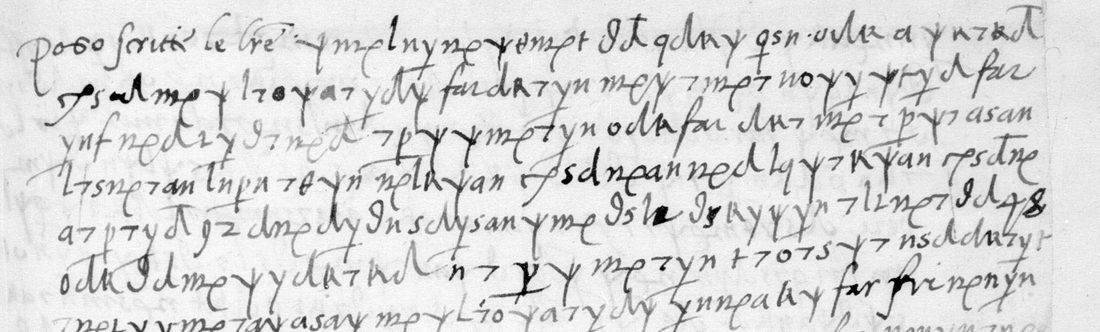
The cipher replaces each letter with an invented sign. The signs include a tau for A, a round d for D, a bold k for R, a psi for I, a sign like ne for S and one like me for L, and a sign written like the word far for CHE. E has three forms and A two. Lasry’s table gave most of the letters. The letter added the values for ne, me, the small y (N, with a bent-arm form for B), θ (G), plain p (M), far and fu, and fixed q as H, or F in Francesco. It also showed that the long thin diagonal strokes under the lines are later word dividers, added by someone who worked on the letter. They are not parts of signs.
02 The decipherment
Final pass. [..] is a sign not deciphered, (?) a decipherment whose sense is not established, [48], [4θ], [4r], [peu] are code groups.
f. 154r
Poco scritti le lre. Il consiglio de heri fu per tirare queli capitanei che erano lì a la opinione che no fuse andase a Milano, perché era la mia(?) tuto causato comtagio. Scrito questo, s’è chiarito questa mane, ha esendo venuto il duca d’Urbino a casa de [48], per deliberare o a Milano o a Pavia. Ove erano asciilati(?) tuti li capitanei o nostri che [..] sono, molti, et a quesi de la Signoria che sono ascicsai pui(?). [qq] uolse(?) [48] che il duca d’Urbino tirase tuti li so[..] da uno canto et lui li lo[..] da uno altro, aciò dito ognuno sua opinione, lui do[..] deliberaseno [..]. E questa fu inventione de Francesco, dita in secreto ha queli de la Signoria, erano tropo, aciò che se vincese la opinione de andare a Milano. Rex. Il che [..] è [..] parso al duca d’Urbino providitore et maiore parte de loro dal canto nostro. Io era solito sempre esere chiamato il primo per aprire il camino ali altri, et questa volta ha comenciato a Francisco, poi ali altri pochi, poi a me [..] acuvante(?) se; dicese nula, [4θ] dise che ere da andare a Pavia. Io comenciai a dire quelo agio scrito de andare a Milano. Pensate che Francesco il primo a interompere, poi qualche uno altro che mi vergogno dirlo, [4r] sapendolo dissimulare. Rex: il fine mi lasoren[o](?) dire cum fatica, s[e] non(?) fisse. Si va a questo modo se harà uno pastone de mala digestione. Io vedo asai cose, ma che è in mia posa [..] a provederli; e sapiate che tuti li
f. 154v
nostri, dico tuti, comenciando al capori, [..] e ga[..] Dio ch’io scriva al [peu] et a vostra S. provedase da li che per me ie sono d[..]cuspaeo(?) n[..]ita(?) [..] celaro(?); però mai de dire il servicio dil [peu], e vaglia quanto potrà. Tuta volta certifico em(?) che havem [..] si ne [..] dito il duca d’Urbino providitore, et a io che se andarà per o s[..]u[..]o(?) a traversat[..] il camino tra Milano e Pavia, e don[..]de i ni spire[..]rà(?) poi il resto,
[clear] che ca fin de questa ma[teria], pregando n[ost]ro S[ign]or Dio dona a V. S. bona e longa vitta. Da al Campo a Landriano ali XXX d’aust.
In English
Visconti writes that the council held the day before was meant to bring the captains present round to the view that the army should not go to Milan. That morning the Duke of Urbino came to the lodging of [48] to decide between Milan and Pavia, with all the captains, many of them, and the officers of the Signoria of Venice. It was arranged that each should give his opinion in turn. This, he says, was a device of Francesco’s, whispered to the Venetian officers, so that the vote would go against Milan, and the Duke of Urbino, the proveditor and most of the captains came down against Milan. Visconti was usually called first, “to open the way for the others”. This time Francesco was called first, then a few others, then Visconti. [4θ] said the army should go to Pavia. When Visconti began to argue for Milan, as he had written, Francesco was the first to interrupt, then others he is ashamed to name, and in the end he was let speak only with difficulty. “If it goes on this way we shall have a stew of bad digestion.” He sees much and can do little to remedy it. He asks Montmorency to see to matters for all the captains, in the service of [peu], perhaps the King. The Duke of Urbino and the proveditor have said that the army will go to cut the road between Milan and Pavia, and he will write the rest later.
“Francesco” may be Francesco Maria Sforza, the League’s duke of Milan, who wanted Pavia. The letter does not say so.
03 Method
The two pages are Gallica views 243 and 244 of btv1b90600370. They were deskewed and cut into line strips at full resolution. The line centres drift by up to 90 pixels across the page, so each strip was placed by measurement. A first rough transcription of 1344 tokens showed at once that Lasry’s table gives Italian. Each line was then transcribed again sign by sign against the table, and every value the table lacked was fixed from words already deciphered. A second pass redid the verso and retried every open spot on the recto.
Two other Visconti letters in the same cipher were then opened: Visconti to Angelo Bolano, Alessandria, 15 October 1528 (fr. 3045 f. 28), and Visconti to Francis I, in campo in la pieve de Loccate, 15 June 1529 (fr. 3096 f. 91). The key decrypts both (“mal tratamento”, “che disperat-”). In both, the crossed sign appears in numeral pairs, 42 and 48, so it is the figure 4. The name groups of this letter are therefore numbered codes, and 48 appears in the letter to the King as well. The groups rr and qq also recur there as units. None of these codes has a value anywhere.
04 What remains
- Numbered codes, no key material: 48 (twice; the host of the council), 4θ (the captain who spoke for Pavia), 4r (before sapendolo dissimulare, and again in v03), rr (r21), qq (r09, before uolse), peu (twice; perhaps the King). Only a surviving nomenclator could fix them.
- The final sign pair of so··, lo··, do·· (r10–12): the same pair each time. The sense suggests soi, loi, doi, one I value for the pair. That is a proposal only (I). It does not occur in the siblings.
- One-off signs: [Y r] in r12, a small sign and a blot in r16, [v b] in r30, Π in v08 and v09. The lines make sense without them, so they may be nulls. That is not proved (M).
- Illegible: only the blotted sign and the flourished ſt ligature in v01. A third pass (22 September 2026) enhanced the other spots on the Gallica native (autocontrast, unsharp mask, threshold, 2×): the middle of v03 is legible, and its ǂ-r pair is the numbered code 4r of r25, so that gap is a code; the r21 rr carries an overbar, so it is the code rr; fuo is Lombard fu, as in the letter to the King. The count is now 1247 of 1337 signs (93.3%).
- Values decrypted, sense open (M): la mia (r03), asciilati (r07), ascicsai pui (r09), acuvante (r21), lasoreno and se non (r26–27, C), and in v03 and v07 the runs marked (?).
05 Sources
- BnF, Français 3034, f. 154r–v, no. 68: Gallica btv1b90600370, views 243–244.
- DECODE record R4223 (“Non-decrypted”, unknown sender).
- George Lasry, key table “BNF Francais 3045f28 and 3034f154 – Italian” (5 Nov 2023), and Satoshi Tomokiyo, “Galeaz Vesconte’s Cipher (1528–1529)”: cryptiana, “George Lasry’s decipherments”.
- Siblings: BnF fr. 3045 f. 28 (Gallica btv1b9060156p, view 54); BnF fr. 3096 f. 91 (Gallica btv1b9060015d, view 94).
Key, transcriptions, decipherments and notes: targets/visconti1528/ in the repository.