At a glanceExisting decipherment · complete
- The letter
- An unsigned adviser in Sieniawski’s camp to Hetman Adam Mikołaj Sieniawski, about 1707 by its content, in Polish with Latin phrases.
- Where
- Archiwum Narodowe w Krakowie, Zbiór Dzieduszyckich 26/32 nr 13 pp. 29–30 (DECODE R7475, catalogued with the Brâncoveanu letters of the same bundle; status N/A).
- The cipher
- Numbers separated by dots, two to four for each letter in alphabetical order (a = 17, 18; b = 20, 21; c = 22, 23 … z = 56, 57; the vowels apart), and one code group, 600 = król szwedzki.
- How it was deciphered
- A second hand wrote the decipherment letter by letter over the numbers. Aligning it with the cipher gives the reading and rebuilds the table.
- What it says
- Do not trust the Warsaw gazettes, the Bishop of Chełmno’s mediation or Stanisław’s treaty offers: “lubo nie wierzam gazetom warszawskim”.
- Still open
- About ten numbers under blots or struck through, and the writer’s name.
DECODE catalogues this record with letters in other keys, which have their own pages (a different cipher in each): Brâncoveanu and Cantacuzino (sieniawski1708), news from Bender (turculet1709), Chomentowski at the Porte (chomentowski1713) and a Vienna agent to Baron Schenck (schenck1706).
01 The letter
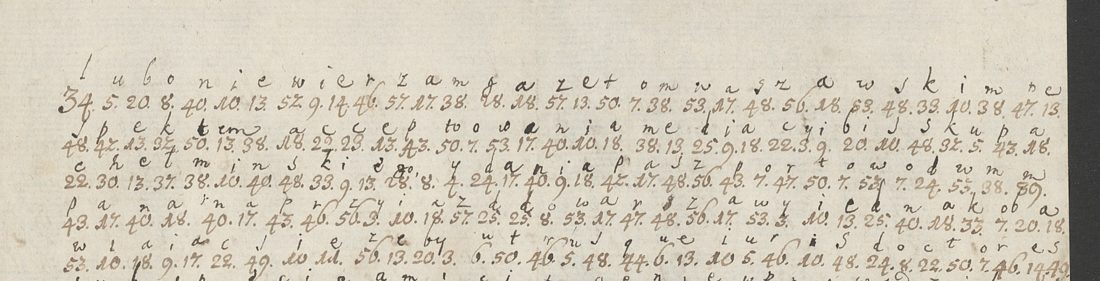
The writer, who does not sign, advises Sieniawski against trusting the mediation of the Bishop of Chełmno (Teodor Potocki) and the treaty offers of King Stanisław: “lubo nie wierzam gazetom warszawskim, nec respektem acceptowania mediacyi biskupa chełmińskiego y dania paszportów od WMM Pana na przyjazd do Warszawy”, and later reports that the King of Sweden will go towards Moscow (“pewną wiadomość że pójdzie król szwedzki na Mos[kwę]”). That places it about 1707, before Charles XII marched on Russia. A few Latin words stand in clear among the numbers (plus quam, cuncta, sine, ante); other Latin phrases, such as sub specie amicitiae, are enciphered with the Polish.
02 The table
Aligned with the gloss, the 2,444 numbers give a homophonic table in alphabetical order, its own and not the Wallachian chancellery’s key A or the Turculeț key B:
l/ł 34–37 · m 38 39 · n 40 41 · o 7 8 · p 42 43 · r 46 47 · s 48 49 · t 50 51 · u 5 6 · w 52 53 55 · y 3 4 · z/ż 56 57
2,434 of the 2,444 numbers carry a legible gloss aligned letter for letter (99.6%). Where gloss and table disagree (50 glossed z seven times against t 76 times; 47 glossed p three times against r 32 times) the cause is most likely the shapes of the figures in this hand (50/56, 47/42, 57/52), not true homophones. The writer’s own spelling slips (waszawskim, chłminskiemu) are kept.
03 What remains
- Ten numbers without an aligned gloss (ink blots, a smudged figure, a few slips of the pen), a struck passage (line 58) and a lone unglossed “1.”.
- The writer is not identified.
Full texts
The transcription and the decryption of every document on this page, so that the reading can be used and checked. Short files are shown here; all are in the repository.
R7475, pp. 29-30, c. 1707
An unsigned, undated Polish letter (with Latin phrases) to Grand Crown Hetman Adam Mikołaj Sieniawski from an adviser in his camp, most likely 1707: he warns against the Bishop of Chełmno's (Teodor Potocki's) mediation and Stanisław Leszczyński's treaty offers, and advises waiting for the outcome of the Swedish march on Moscow and concluding only together with all.
Transcription: R7475.txt
Decryption
Interlinear decipherment of R7475 (contemporary gloss), line by line; copied verbatim from the G: lines of R7475.txt (bracketed notes are the transcriber's). The 'Number table' and 'Summary' sections of R7475.txt are not repeated here.


== p. 29 ==

L1  lubo nie wierzam gazetom warszawskim ne   [cipher has w-a-s-z-a-w-s-k-i-m (10 signs, no r: 53 17 48 56 18 53 48 33 10 38); gloss "ne" over 47 13 = re-, continues "spektem" -> respektem]
L2  spektem acceptowania mediacyi biskupa
L3  chełminskiego y dania pasz portow o d w m m   [= od WMM (Waszmości Mości) Pana]
L4  pana na przyiazd do warszawy iednak oba   [p r z: z over 50 (50 = t elsewhere) - cipher slip or 56 misread]
L5  wlaiac sie zeby utrusque iuris doctores   [gloss "l" over 10 (10 = i everywhere else) - cipher slip or glossator; "z" over 50/56 (stroke unclear); "iuris" over 10 5 46 10 10 48: one 10 superfluous or misread]
L6  sub specie amicitiae nie wprowadzili w   [last three numbers 34. 9. 53 written raised above line end]
L7  mm pana y rempublicam in discrimen ir
L8  reparabile; niektore reflexie ex puro a
L9  more in publicum y ku osobie wmm ana wyrazam   [cipher omits p of "pana": 52 38 39 | 18 40 17]
L10  naprzod bedz wmm pan plus quam certus ze   [cipher spells "bedz" (będzie?) 20 15 24 57]
L11  ten character biskupowi chłminskiemu   [cipher has no e in chełm-: 22 30 37 38]
L12  ukradkiem od stanisława nie tylko sine   [k over 37 (37 = ł elsewhere): cipher slip or 32/33 misread]
L13  beneplacito ale nawet inscio krol szwedzki ie st da   [600 = code group, glossed "krol szwedzki" (first "kro" struck); 10 13 glossed i e]
L14  ny szczegulnie na oszukanie y dementowanie
L15  naszey parthyi a principaliter wmm pana
L16  zeb sub specie tractatow woysko oderwano y   [cipher "zeb" for żeby]
L17  chociazby wmm panu cuncta fauorabilia obie
L18  ciwano w naymnieyszey iednak rzeczy nie   [obie-ciwano = obiecywano; "sz" of naymnieyszey over 48 47 (47 = r elsewhere: cipher wrote "rz"?); last "13" written raised]
L19  dotrzymaia; exemplo xiazat wiszniowi   [x-i-a-z-a-t: 10 glossed a, 15 = ą]
L20  eckich superuenienten a potym krola szwedz   [= superveniente na potym]
L21  skiego reclamatione uigore tractatu war
L22  szawskiego w ktorym per expressum na pi
L23  sano ze zadnego z naszych sine scity iego am   [cipher 57 17 24 40 13 38 6 = zadnemu; glossator wrote "zadnego" over 38 6]
L24  nistya nie ma bydz pozwolona consequen   [p of pozwolona written over a struck letter; z over 50 again]
L25  ten wszytko to in cassum poszło by cokoli   [4th number unclear (57 or 52), glossed w; "l" over 38(?): perhaps 35]
L26  ek concluderemus Z biskupem iako samego   [cokoliek = cokolwiek]
L27  stanisława pleni potentiariusz em y dla   [two 10s under "stani-"; a over 11 (11 glossed e in L5)]
L28  tego pro primo gradu rozumiał byd przedac   [d over 39 (39 = m elsewhere)]
L29  ceptacya mediacyi y daniem paszportow   [przed acceptacyą]
L30  pro liminariter tym zbyc biskupa zeby ante
L31  iustifikował wmm panu per copias inst   [p of copias over a number read 47 (looks like 47; 42 = p) - see note on 47/42]
L32  rumentorum character swoy y pokazał ple
L33  ninotencya ab utroque principalis in   [ple-ni-(41 for p)-otencyą: cipher slip, glossator followed it; p of principalis again over "47"]
L34  secus; na nic by sie nie przydał ten trac
L35  tat chybaby na odrazenie tego ktorego spod
L36  ziewamy sie takze postronnych dworow na   [spod-ziewamy]
L37  disskredit [?] moskwy y naszych przyia   [ink blot over one number after 50 and its gloss (prob. u: "diskreditu")]
L38  ciol ktorzy per ae[m]ulationem in natam na   [blot over the number after 17 (gloss e); read: in na tam na-]
L39  rodowi naszemu zaraz ieden przed d[?]   [last gloss letter unclear ("n"?); cipher 25 47 | 6 28 10 38 = d r | ugim]
L40  ugim starali by sie au[c]?upare t auores   [= aucupare fauores; 4th number from "a u c" smudged; f of fauores glossed over 20 (=b) - "t/f" letter]
L41  u nowe[go] a dworu y ta [k?] pierwey by wmm pana   [18 ringed in ink, "go" written over it; 32 between "ta" and "pierwey" without clear gloss: "tak"]
L42  nie omyl nie wszyscy odstepili nizeli   [15 = ę here]

== p. 30 ==  (top: archive number "N. 127" in a later hand; page no. 30)

L43  traktet skonczył by sie. gdybym widzi   [cipher t-r-a-k-t-e-t; the mark after 11 is a stop sign, glossed "."]
L44  ał wi[e]kszesiły tamtey strony albo saltem   [glossator wrote "a"/"t" over 53 10 12 (w i ę): widział większe siły; "o" written after saltem belongs to next line]
L45  (o) iey przytomnę głowey ieszcze bym ogł by   [z over 50 again; "by m ogł" = by mógł]
L46  dz pozor iaki do acceptowania a tey med   [byd-z: z over 50 again; "a" over 17 is a doubled final a]
L47  iacyi, ale kiedy iest esmy z łaski bozey   [med-iacyi; iesteśmy]
L48  es uiribus o głowie z asich mamy   [Superiores (w)iribus; "z asich" sic (z naszych?); final 3 written raised]
L49  pewną wiadomosc ze poydzie z krol szwedzki na mos   [600 glossed "krol szwedzki"; d over two numbers I read as 22 (prob. 24/25 misread)]
L50  kwe z ako za a ten hazard niebespieczny   [moskwę z(a)ako = iako?; k over a "22", z over second "22", a over 40: readings of these numbers uncertain]
L51  odwazays sie osobliwie ante euentum bath   [odważać się: w over 57, y over 23 as written]
L52  ały i miedzey szwedami a moskwą także   [bathały = batalii]
L53  euecuationem realem nadziei naszey   [cipher e-u-a-c-u-a-t-i-o-n-e-m: glossator wrote e over 18; 9 written over/after 14]
L54  y tak wielu in szych sposobow ktore same   [w over "57" (52?); p of sposobow over "47" (42?)]
L55  koniunktury za czasem przy nie [?][?]mogą   [46 22 before "mogą" unglossed/illegible gloss; read po-mogą? (46 = r)]
L56  [g]dy sz in casu pro parte moskwy fauorabili mo   [first gloss letter struck/unclear; gdysz = gdyż; blot over w-number of moskwy]
L57  głi bysmy bydz nieszęsliwy ucierpiec   [mogli; nieszczęśliwi]
L58  wiele złeg [struck] o [d]aremniy skwapliwo   [złego; o(d) daremney skwapliwości]
L59  sci naszey tak od moskala iako iego kol   [t over 30 (30 = h elsewhere; 50?)]
L60  ligatow ktory za wszez tak wielo mał kon   [koligatów; zawsze z tak wielu mał(o) kon-]
L61  tentow z naydzie swoie sequi to o procz   [kontentów; "sequito"]
L62  naszych osob choćiazby smy wszyscy z
L63  wmm panem zgodzili sie poysc na tam te   [z over 50 again; te over 51 15 = tę]
L64  strone na koniec po przysiegam wmm   [a lone "1." stands before 40, unglossed]
L65  panu we wtym zdaniu moim zadnego nie mam
L66  interessu mego bo primario iestem persua
L67  susze wmm pan nemine excluso musiałby s   [persuasus że]
L68  cicieć ten traktat konkludowac; a   [glossator wrote "i" over 30 (h): s-ćhcieć = s(ię) chcieć]
L69  lubo bysmy y byli ex kludowani ieszcze   [o of -dowani over 4 (4 = y elsewhere)]
L70  non deerunt media ad s[e]luandos priuat   [blot over one number (gloss e/a); u glossed over 53 (w-sign): saluandos]
L71  os kiedy publicum bedzie in securo o co   [y of kiedy over 14 (14 = e elsewhere)]
L72  naybardziey nalezy starac sie mature
L73  (o) y ze wszytkiemy razem a ni poiedynkiem   ["o" written at end of previous gloss line; i of -kiemi glossed y over 13]
L74  rzeczy do konca prowadząc via legiti   [a over 11]
L75  ma & publica non per recessum & canales   [m of recessum over 48 (48 = s elsewhere)]
L76  obliquo r ktore day boze zeby wmm pana   [obliquos: glossator wrote r over 49 (s)]
L77  y nas w labyrinth nie wybrnioni nie   [glossed "s w l a b y r i n t h": y over 5 (u)]
L78  zaprowadził y z ostatnią zgubą oyczyz   [z over 50 again; 16 = ą]
L79  ny   [end of text; no signature, no date, no cipher after this line; p. 30 bottom blank except archive stamp]
Reading
# R7475, pp. 29-30, an adviser to Hetman Adam Mikołaj Sieniawski, c. 1707: the reading

Written 23 Oct 2026 (verification 3) from the contemporary interlinear decipherment as transcribed in
`R7475_decryption.md` (the G: lines of `R7475.txt`) and its line notes. The glossator wrote letter by letter, with
the line breaks of the cipher and few word divisions; here the words are joined across line ends and divided, the
glossator's spelling is kept (*wierzam*, *bedz*, *chłminskiemu*, *odwazays*, *we wtym*), Latin is left as written,
and nothing is modernised. Where the figures and the gloss differ, the figures are followed and the note in
`R7475_decryption.md` names the place (*respektem* l. 1, *obawiaiac* l. 5, *zadnemu* l. 23, *bym* l. 28, *recessus*,
*obliquos* ll. 75-76). `[?word]` = a word the gloss or the figures give only in part, `x[y]` = a letter neither gives,
`[…]` = blotted or unglossed. Code 600 is written *krol szwedzki* as the glossator did. WMM = Waszmość Mości.

## Reading

Lubo nie wierzam gazetom warszawskim respektem acceptowania mediacyi biskupa chełminskiego y dania paszportow od WMM
Pana na przyiazd do Warszawy, iednak obawiaiac sie, zeby utrusque iuris doctores sub specie amicitiae nie wprowadzili
WMM Pana y rempublicam in discrimen irreparabile, niektore reflexie ex puro amore in publicum y ku osobie WMM [p]ana
wyrazam.

Naprzod bedz WMM Pan plus quam certus, ze ten character biskupowi chłminskiemu ukradkiem od Stanisława nie tylko
sine beneplacito ale nawet inscio krol szwedzki iest dany, szczegulnie na oszukanie y dementowanie naszey parthyi a
principaliter WMM Pana, zeb sub specie tractatow woysko oderwano; y chociazby WMM Panu cuncta fauorabilia obieciwano,
w naymnieyszey iednak rzeczy nie dotrzymaia, exemplo xiazat wiszniowieckich superueniente na potym krola
szwedzkiego reclamatione uigore tractatu warszawskiego, w ktorym per expressum napisano, ze zadnemu z naszych sine
scity iego amnistya nie ma bydz pozwolona.

Consequenter wszytko to in cassum poszło by, cokoliek concluderemus z biskupem iako samego Stanisława
plenipotentiariuszem; y dla tego pro primo gradu rozumiał bym przed acceptacya mediacyi y daniem paszportow
preliminariter tym zbyc biskupa, zeby ante iustifikował WMM Panu per copias instrumentorum character swoy y pokazał
pleni[p]otencya ab utroque principalis [?in] [?secus]; na nic by sie nie przydał ten traktat, chybaby na odrazenie
tego, ktorego spodziewamy sie, takze postronnych dworow na diskredit[…] Moskwy y naszych przyiaciol, ktorzy per
aemulationem innatam narodowi naszemu zaraz ieden przed drugim starali by sie au[…]upare fauores u nowego dworu, y
ta[k] pierwey by WMM Pana, nie omyl[?], nie wszyscy odstepili, nizeli traktat skonczył by sie.

Gdybym widział wieksze siły tamtey strony albo saltem o iey przytomne głowe, ieszcze bym mogł bydz pozor iaki do
acceptowania tey mediacyi; ale kiedy iestesmy z łaski bozey […]es uiribus, o głowie z [?asich] mamy pewna wiadomosc,
ze poydzie krol szwedzki na Moskwe; z[?ako] za a ten hazard niebespieczny odwazays sie osobliwie ante euentum
bathały i miedzey Szwedami a Moskwą, także euacuationem realem nadziei naszey y tak wielu innych sposobow, ktore same
koniunktury za czasem przynie[…] mogą. Gdysz in casu pro parte Moskwy fauorabili mogli bysmy bydz nieszesliwy,
ucierpiec wiele złego od daremney skwapliwosci naszey tak od Moskala iako iego koligatow, ktory zawsze z tak wielo
mał[o] kontentow znaydzie swoie sequito, oprocz naszych osob, chociazby smy wszyscy z WMM Panem zgodzili sie poysc
na tamte strone.

Na koniec poprzysiegam WMM Panu, we wtym zdaniu moim zadnego nie mam interessu mego, bo primario iestem persuasus, ze
WMM Pan nemine excluso musiałby s[ię] chciec ten traktat konkludowac; a lubo bysmy y byli exkludowani, ieszcze non
deerunt media ad s[…]luandos priuatos, kiedy publicum bedzie in securo, o co naybardziey nalezy starac sie mature, y
ze wszytkiemy razem, a ni poiedynkiem rzeczy do konca prowadząc via legitima & publica, non per recessus & canales
obliquos, ktore day boze, zeby WMM Pana y nas w labyrinth nie wybrnioni nie zaprowadził y z ostatnią zgubą
oyczyzny.
Translation
<!-- English translation of texts/R7475_reading.md (Claude Opus 5.5, 23 Oct 2026): the reading of the contemporary interlinear decipherment of R7475 pp. 29-30 (Polish with Latin phrases), checked against the figures. Same holes: […] blotted or unglossed, [?word] partly carried. WMM Pan = Your Lordship; "krol szwedzki" (code 600) = the King of Sweden. Latin phrases are translated with the rest. -->

# R7475, pp. 29-30, an adviser to Hetman Adam Mikołaj Sieniawski, c. 1707: English translation

Although I do not believe the Warsaw gazettes regarding the acceptance of the mediation of the Bishop of Chełmno and
the giving of passports by Your Lordship for his coming to Warsaw, nevertheless, fearing that the doctors of both laws
may, under the guise of friendship, lead Your Lordship and the Commonwealth into irreparable danger, I set out some
reflections out of pure love for the public good and for Your Lordship's person.

First, let Your Lordship be more than certain that this character was given to the Bishop of Chełmno by Stanisław in
secret, not only without the approval but even without the knowledge of the King of Sweden, specifically to deceive
and mislead our party, and principally Your Lordship, so that under the guise of negotiations the army may be drawn
away; and even if every favourable thing were promised to Your Lordship, they would not keep to it in the smallest
matter, after the example of the princes Wiśniowiecki, with the King of Sweden's protest coming afterwards by virtue
of the Treaty of Warsaw, in which it is expressly written that amnesty may not be granted to any of ours without his
knowledge.

Consequently, whatever we concluded with the Bishop as plenipotentiary of Stanisław alone would all come to nothing;
and therefore, as a first step, I would think it best, before accepting the mediation and giving passports, to put
the Bishop off preliminarily with this: that he should first justify his character to Your Lordship by copies of the
instruments and show a plenipotentiary power from both principals [?in] [?secus]; this treaty would be of no use,
except to alienate the one we expect, and also foreign courts, to the discredit[…] of Muscovy and of our friends, who,
by the rivalry innate in our nation, would at once strive one ahead of another to […] favours at the new court; and
so Your Lordship would be deserted, [?I am not mistaken], by [?not] all, sooner than the treaty would be concluded.

If I saw greater forces on that side, or at least a head present for it, there might still be some pretext for
accepting this mediation; but since we are, by the grace of God, […] in forces, [and] of the head [?asich] we have
certain news that the King of Sweden will march on Muscovy; [?so] [?za a] you would be risking this dangerous hazard,
particularly before the outcome of the battle between the Swedes and Muscovy, and also the real evacuation of our hope
and of so many other means which the conjunctures themselves may bring in time. For in a case favourable to Muscovy we
could be unfortunate, [and] suffer much harm from our vain haste, both from the Muscovite and from his allies, who
will always find his following among so many malcontents, apart from our own persons, even if we all agreed with Your
Lordship to go over to that side.

Finally, I swear to Your Lordship that in this opinion of mine I have no interest of my own, for I am above all
persuaded that Your Lordship would have to want to conclude this treaty with no one excluded; and even if we were
excluded, means will still not be lacking to [?save] private persons, once the public good is safe, for which one must
strive above all, in good time, and with everyone together, and not singly, carrying things through to the end by
the legitimate and public way, not by recesses and oblique channels; which, God grant, may not lead Your Lordship and
us into a labyrinth with no way out, and to the final ruin of the fatherland.
04 Sources
- Archiwum Narodowe w Krakowie, Zbiór Dzieduszyckich 26/32 nr 13 pp. 29–30: DECODE R7475.
- Not printed by M. W. Kaczka (Danubius XXX, 2012), who edited the Brâncoveanu letters of the same bundle.
Transcription with the gloss and the table are in targets/r7475/.