01 The letter and its copy
Louis Michell was the Prussian secretary of legation in London, in charge of the mission there. The King wrote to him through two channels. One was the departement des affaires étrangères under Podewils, with ministerial rescripts. The other was the Immediaterlass, the King writing directly. Both went by post through the Dutch Republic, where the Stadtholder’s cabinet opened and copied them. The copies of both 28 December letters survive among the papers of William V (inv. 198), and DECODE catalogued them as R1955 and R1957.
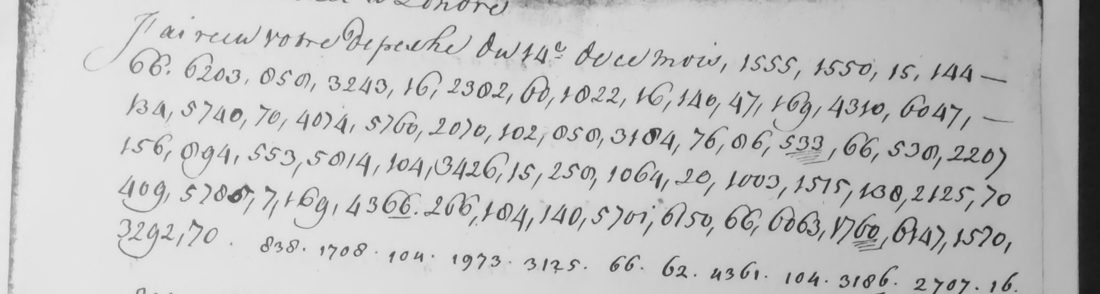
R1957 is two pages. The heading Au Sr Michel à Londres and the opening clause are in clear, then 550 numbers separated by points, then A Berlin ce 28 décembre 1751 and (signé) Féderic. The copyist underlined a few groups with one to three strokes and wrote two corrections above the line. DECODE shows the two pages in reverse order: its P2 is the first page.
02 Why it is Politische Correspondenz no. 5263
Volume 8 of the Politische Correspondenz prints several letters of the King dated Berlin, 28 December 1751. No. 5263, “Au secrétaire Michell à Londres”, begins “J’ai reçu votre dépêche du 14 de ce mois”, the clear opening of the Hague copy. The other Hague letter of that day opens “Toutes vos dépêches m’ont été bien rendues et la dernière est du 14e de ce mois” and uses a different code, with half-groups such as 150½ and 660½. That is the letter DECODE’s note calls “a letter of the same date with different length”.
After the opening, the print has 438 words and the cipher 550 groups, a ratio of 1.26. That is usual for a nomenclator that has code words for common words and names and spells the rest in syllables. The decisive test is order. For every group that occurs three times or more and every word of the print with the same count, the relative positions were compared (anchors.py). Six pairs line up across every occurrence, with the largest gap at most 4.3 % of the text:
| Group | Word | Occurrences | Largest gap |
|---|---|---|---|
| 87 | encore | 3 | 0.017 |
| 1064 | Vienne | 4 | 0.022 |
| 545 | avec | 3 | 0.024 |
| 4364 | faire | 6 | 0.039 |
| 4310 | Sardaigne | 3 | 0.039 |
| 3042 | dessein | 3 | 0.043 |
Local context agrees. …que le roi de Sardaigne entre comme partie contractante… sits at the start as 16 140 47 169 4310, giving 169 = de (the commonest group, 11 times) and 47 = roi. 3279 47 recurs twice later, where the print has le roi d’Angleterre. The first two groups, 1555 1550, stand for et suis. A different text would not put these six words in this order at these places.
03 What the letter says
The text below is as printed from the minute. The letter sent may differ in small points of wording.
J’ai reçu votre dépêche du 14 de ce mois et suis également que vous du sentiment que l’affaire que le roi de Sardaigne entre comme partie contractante dans le traité qui se négocie à Madrid entre les cours de l’Espagne et de Vienne, ne manquera pas, quoique je sois persuadé que le général Wall prédise bien juste là-dessus.
Comme je viens d’être informé en secret d’un projet que les cours de Vienne et de Pétersbourg ont formé, pour faire succéder à la couronne de Pologne le prince Charles de Lorraine, quand elle viendra à vaquer, je présume que c’est dans cette vue que la cour de Vienne a tâché de faire son traité de neutralité pour ses possessions en Italie avec l’Espagne et le roi de Sardaigne, afin d’avoir les bras libres de ce côté-là à poursuivre son dessein sur la Pologne. Ainsi mon intention est que vous devez employer tous vos soins et votre savoir-faire pour approfondir au possible si la cour de Londres est informée de ce dessein-là, ou si peut-être celle de Vienne s’est entendue là-dessus en particulier avec celle de Russie, sans en communiquer avec le roi d’Angleterre, ce que j’ai cependant de la peine à croire; tout au contraire je présume presque que c’est peut-être de l’avis du dernier que la Reine-Impératrice s’est prêtée à faire de nouvelles cessions au roi de Sardaigne, en lui faisant entrevoir que ce serait dans le dessein sur la Pologne qu’elle se verrait indemnisée de ces cessions. […]
Au surplus, marquez-moi encore si vous croyez que le système pacifique d’à présent du ministère d’Angleterre se soutiendra encore et pour combien de temps […]. Faites-moi votre rapport là-dessus, mais observez qu’il faut que vous ne le fassiez sur tout ce que dessus qu’à moi seul immédiatement, sans en faire des doubles au département des affaires étrangères. […]
In short: Frederick agrees that Sardinia will join the Austro-Spanish treaty being negotiated at Madrid. He has learned in secret that Vienna and St Petersburg mean to make Prince Charles of Lorraine the next King of Poland, and he reads Austria’s Italian neutrality as clearing the ground for it. Michell is to find out whether London knows of the plan. The King suspects that Maria Theresa’s new cessions to Sardinia were made on George II’s advice, with Poland as her compensation. Michell is also to judge how long the English ministry’s peaceful course will last if George II lives a few more years. His report is to go to the King alone, not to the department. Last, he is to say whether George II grieved for the Queen of Denmark, who died on 19 December, and whether the Duke of Cumberland’s dangerous illness had troubled him. The order to report to the King alone explains why two letters went to Michell that day. It also shows that the ministerial channel was not the one Frederick trusted with this, though the Dutch copied both.
04 What remains uncertain
- The code is not rebuilt. Aligning all 550 groups with the print would yield most of a Prussian nomenclator of 1751 (numbers up to about 6,500, with several numbers for common words). Only the anchors above are established: 1064, 4310, 3042, 545, 87, 4364 (H, from position across every occurrence), 169 = de and 47 = roi (C, from local context).
- Pologne: 1900 fits by position (three times, largest gap 0.046), but 4366 (four times) also sits near it. Not settled.
- The print follows the minute. Small differences in the letter as sent cannot be seen until the code is rebuilt.
- R1955, the ministerial letter of the same day, is in another code and is not in the Politische Correspondenz, which prints the King’s own letters. It stays unread.
05 Sources
- Koninklijk Huisarchief, The Hague, archive of Prince William V, inv. 198: DECODE R1957 (two images, login) and DECODE R1955.
- Politische Correspondenz Friedrich’s des Grossen, vol. 8 (Berlin: Duncker, 1882), no. 5263, pp. 576–577, “Nach dem Concept”: Internet Archive.
The transcription of the 550 groups, the anchor script and the notes are in the repository folder michell1751/. The DECODE images are not committed.