01 The letters and the two keys
The letters are autograph notes that Charles VI sent through his Oberststallmeister, outside the Chancellery’s ordinary despatches. The family later copied them into a register (book 5 of inv. 5), numbering them No. 1 to No. 7. DECODE has four of them:
| No. | Date | DECODE | Key | Cipher |
|---|---|---|---|---|
| 1 | Vienna, 3 Feb 1720 | R5019 (autograph), R5020 (copy, pp. 401–404) | R5017 | 26 passages, about 190 groups |
| 2 | Vienna, 13 Apr 1720 | R5021 (autograph), R5022 (copy, pp. 404–407) | R5018 | 2 passages |
| 3 | Vienna, 24 Jul 1720 | R5023 (copy, pp. 407–409) | R5018 | 3 passages |
| 6 | Vienna, 11 Apr 1722 | R5024 (copy, pp. 414–416) | R5018 | 4 passages |
R5017 is headed Ziffer Schlüssel mit der geheimen Hof-Canzley. It is the deciphering half of a two-part nomenclator. The numbers 1–400 are a scrambled syllabary of letters, bigrams and a few trigrams (schli, stre, spra), plus nulls (errans), punctuation and the controls annulla praecedentia / sequentia. The numbers 401–977 are words and names in alphabetical order, from Aachen to zu: 458 Cadagan, 513 Duc d’Anjou, 657 Mr. Moroille, 749 D. Orleans, 814 Robethon, 819 Stanhop. R5018 is the new private key, on a single sheet. Each of 24 letters has a number from 10 to 38 and a graphic sign, and the vowels have a second number. About 300 codes follow, as numbers 39–210 or two-letter groups (ab Anjou, fb Spanien, zi Hof, 69 Beretti Landi, 151 Oesterreich, 159 Orleans), and the nulls are 3 4 5 6 7 9. Several names were added later in paler ink, among them Fleury, Walpole and Windischgrätz himself. In the first letter the Emperor writes that “den Ziffer, so ihr mit mir zu brauchen” would follow; the later letters are all in R5018, as Mírka noted.

02 No. 1, 3 February 1720: Alberoni, France and the peace terms
The letter is two-thirds clear German, written in Charles’s own phonetic hand. The cipher sits inside the sentences, as in “absonderlich 89 312 251 65 14 312 20 48 96 genau berichten” = den Pentenrider. The autograph and the copy agree group for group. The 26 passages, in order:
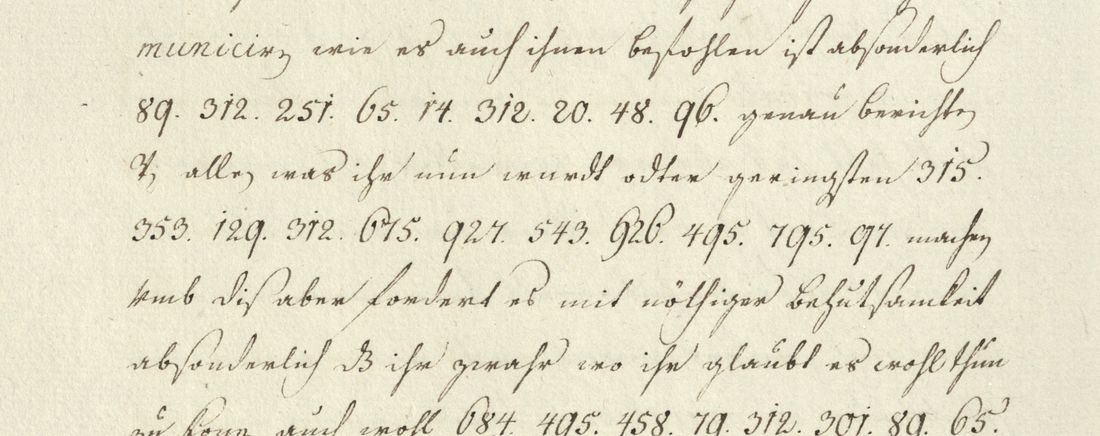
| Clear text before | Cipher reads | |
|---|---|---|
| A | absonderlich | den Pentenrider (genau berichten) |
| B | oder geringsten | Argwohn machen von Frankreich und dem Regenten |
| C | auch wohl | mit dem Cadagan confident eröffnet |
| D | aber auf keine weis | gegen dem Frankreich auch kein geringsten Argwohn |
| E | absonderlich | da nun der Alberoni aus Spannien abgeschafft |
| F | (bracket) | zu fürchten, dass Frankreich vielleicht suche mit Duc d’Anjou ein sonder Frieden zum Mr. Morville |
| G | auf seiner hut, doch | ohne einichen geringsten Argwohn |
| H | gut vernemen und vertrauen | mit dem Graf Daroqui [Tarouca] |
| I | finden wir ohne dem schon | von Portugal aus (sein gute Neigung) |
| J–L | … | sein König … der Allianz · publico kein mehreren darum · (als) seinen König in die Allianz (zu bringen) |
| M | auf das obige aber mich | Portugal denken |
| N | das wird nicht wohl | sein, [eh er] mesuren nimbt und Beytritt [446] ein von Spanien untertruckt |
| O | werdet ihr | Cadogan (auf all weis suchen beyzuhalten) |
| P | Unbilligkeit so wohl als schaden | aller Alliirten, ja Engelländer selbst |
| Q | man | in künfftigen Frieden |
| R | nur das geringste wider | die zwischen uns gemachte Tractat geändert würde |
| S | das under wegen | Sardinien dem Herzog von Lothringen (zu geben ist sehr ideal und nicht wohl thunlich) |
| T | endlich auch | wie der dem guten Glauben der Tractaten |
| U | das sonst | mir das Aequivalent von Montferrat |
| V–W | das in · den | künfftigen Frieden (dieses onus nicht auf mich fall) · dem Duc d’Anjou |
| X | oder dem so | gross zu [638] dem Nutzen |
| Y–Z | ob (wie wohl endlich zu glauben) | D. Orleans … denke mit dem Duc d’Anjou ein particular Frieden zu machen |
So the secret instructions are these. Keep Pentenriedter fully informed, confide in the British envoy Cadogan, and show France and the Regent no mistrust. Watch them all the same: now that Alberoni has fallen, France may look for a separate peace with Philip V (whom Vienna still called only “the Duc d’Anjou”) through Morville, the French minister at The Hague. Find out whether Orléans means to make one. Win over the Portuguese envoy and bring his king into the Alliance. On the peace terms, nothing in the Quadruple Alliance treaty is to change: Sardinia for Lorraine is impracticable, the Montferrat equivalent is owed, and the costs of the coming peace must not fall on the Emperor.
03 Nos. 2, 3 and 6 in the private key
In R5018 the letters are spelt out one symbol at a time, mixing the number and the sign for the same letter freely, and names are given as codes. Read from the register copy:
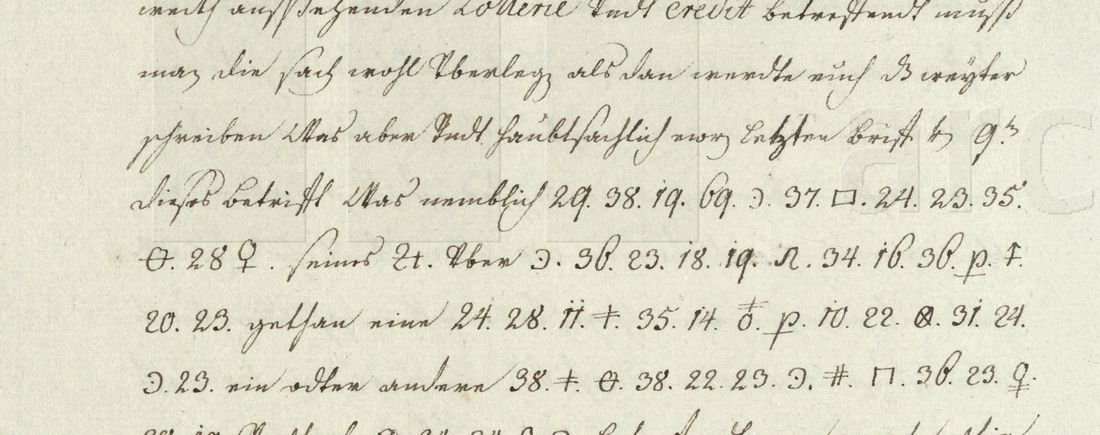
- No. 2, 13 April 1720. “Das ob und Orleans sich endlich wider miteinander verstehen werden, ist schir zu besorgen”; and a project for how one might free oneself entirely “von dem onere der Barriere”, the Emperor’s cost of the Dutch garrisons in the Barrier fortresses.
- No. 3, 24 July 1720. The Spanish envoy Beretti Landi, in the name of his court, has proposed “eine Heyrath zwischen ein oder andern meiner Kinder und Anjou Söhne”. Charles would stay “in guter Verstendnus mit seinen Hof”, but as for die Heyrath, “weren beede so klein” that nothing should yet be made known. His eldest daughter, Maria Theresa, was three.
- No. 6, 11 April 1722, to Windischgrätz as plenipotentiary at Cambrai, opening with the Emperor’s grief at the death of his Oberststallmeister. The cipher covers what he writes “wegen des Beretti”, especially what he discussed “mit Beretti wegen einer Heyrath” between “Spanien und mir”. Beretti is “erbittert wider mich und Oesterreich”, yet it is not bad “sich des Beretti zu gebrauchen” and to show “ihm all Convenienz in utili et honorifico”.
The marriage theme runs from 1720 to 1722, well before the Ripperda negotiations of 1725 that promised the Emperor’s daughters to Philip V’s sons.
04 Method
The records were fetched from DECODE with the project’s logged-in cookie. The R5017 syllabary (1–400) was read column by
column from the full-resolution scan. The nomenclator (401–999) and the whole of R5018 were transcribed from tiled crops, with a
confidence mark on each cell. The ciphertext of No. 1 was taken from the copy, checked against the autograph, and decoded by a short
script (dec.py). The letters in R5018 were decoded by hand, because the copyist’s signs have to be matched to the
key’s drawings. Two slips in the key show up in use. Cell 31 is written “el”, but all three times it occurs it must mean
zu, which is cell 3. Cell 268 is written “em” and must be ein. In R5018 the copyist uses one sign for D and N,
and one sign for Z and G; the numbered letters around each sign decide which is meant.
05 What remains uncertain
- No. 1, passage N: cell 446, whose key entry was read as “Bischoff”, does not fit. The sense of the passage (measures and an accession obstructed by Spain) is C.
- No. 1, passage X: cell 638 is uncertain (“Kommen” or “Kammern” in the key). Reading C.
- No. 1, H: “Daroqui” as Count Tarouca, the Portuguese envoy, is M. The syllables are certain, and the next passage names Portugal.
- No. 2, first passage: the cipher opens with a V-sign, giving “und Orleans”. The subject, Spain, is inferred from the context. M.
- No. 3, “ein Proposition” and “die Heyrath” each contain a copyist’s wrong letter; the words are H.
- All other passages are H. Letters 4, 5 and 7 of the register (book pp. 409–414, 417 onward) are not on DECODE and were not seen. The clear text of Nos. 2, 3 and 6 is summarised here, not edited.
06 Sources
- DECODE (de-crypt.org): R5017 and R5018 (keys); R5019, R5020, R5021, R5022, R5023, R5024 (letters). Originals: Státní oblastní archiv v Plzni, pracoviště Klášter u Nepomuka, RA Windischgrätzů, inv. 694 karton 5, inv. 5 book 5, keys karton 164 inv. 1403 sign. 103.
- Jakub Mírka, “Raně novověká šifrovaná korespondence ve fondech šlechtických rodinných archivů Státního oblastního archivu v Plzni”, Západočeské archivy 2012, pp. 44–72, reprinted in Crypto-World 3–4/2013. He describes the change of key and the two keys (n. 40–41) but gives no plaintext.
Transcriptions of both keys, the ciphertext and the readings are in the repository folder
windischgraetz1720/.