01 The document and the false key
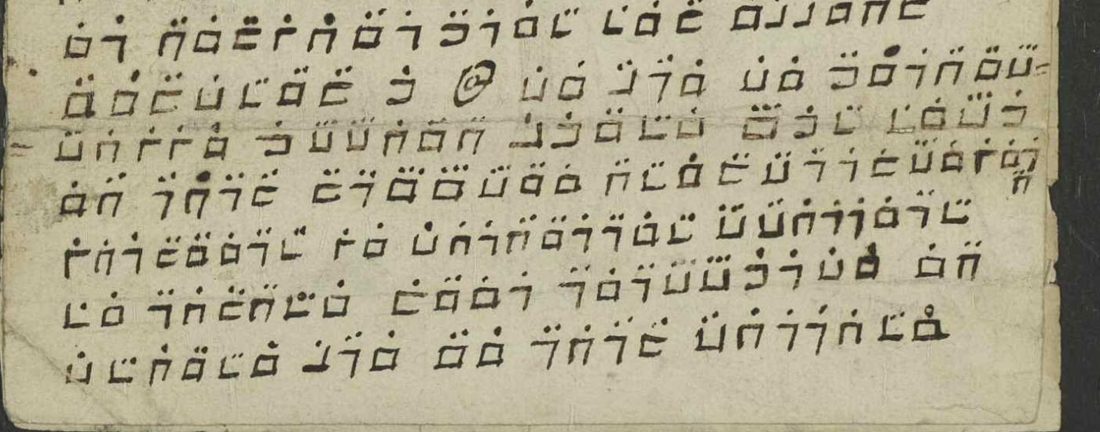
There are three images: f. 241 (the first page), and f. 243 photographed twice, once with a paper flap folded over it and once with the flap lifted. The archive photographed the text sideways. Turned 90° anticlockwise, it runs in horizontal lines with word spaces. The flap carries a pencil grid, the standard dotted pigpen (a–i one dot, k–s two, t–z three). Applied to the letter it gives oeaeydakdorsefekdoi…, with g/q at 16% of the text and t almost absent. None of the 48 rotations, reflections and dot orders, and none of the 9! reassignments of shapes to cells, gives any language.
02 The system
Each sign is one of the nine cell shapes, followed by one, two or (rarely) three dots, and sometimes with an inner stroke. The shape does not fix a group of letters: e is ◻·, ◻ with an inner mark, and one or two rarer forms; s has five or six signs; i three. Working key (shape named by its open side; the digit is the dot count):
a ⊔1   b ⊓1   c ⊏1, ⊏ with bar 1   d Γ1   e ◻1 (+ inner-mark forms)   f/q L1   g ⊔2
h ⊏-bar 2   i ◻2 (+ variants)   l ⊏2, ⊏3   m ¬1   n ⌟1   o ⊐1   p ◻3   q L2
r Γ2, Γ3   s ⊓2 (+ variants)   t ⊐2, ⊔2   u/v ⌟2   y ¬2
L1 serves for both f (affection, effets) and q (que). It is either a true polyphone or a variant not separated in transcription. Two circle or “9”-shaped signs and a few stacked composites are unresolved. They stand where names or abbreviations are expected.
03 The reading of the last page (f. 243)
The raw decipherment, one line per written line (a & is an unresolved special sign):
ieneponunisreceuoid / unennuyplussensible / ayantapidisquedunri / agedecegentillomme /
lequessaluiderviedement / &ndelapartde&monmaio / usauiestreuquelfu / closespreiudice /
dehentiereaffectionse / iayuoueauostreseruice / utesteiersnenei / ipeusseprendreconfia /
nuouseussiescouguupr / luyqueienecledisrien / tantfuetesoccasionsdeutub / entesmoingnerdeseffets /
iescrisa&cequecegentil / lommealloetfaircpardela / etuoussupplietreshunblem / monsieurmecontinuerlloseur /
deuostrebienueuheanceet / croirefueieuoushonnor
Regularised, with the doubtful parts marked:
… je ne pouvois recevoir d’un ennuy plus sensible, ayant appris que du mariage de ce gentilhomme, lequel … [de vie?] … de la part de [&] mon ma[istre?] … vous a esté … quelque … [choses?] … prejudice de l’entiere affection [que] j’ay vouée a vostre service … je puisse prendre confiance … nous eussions … Je ne vous dis rien, tant que les occasions [se presentent] de vous en tesmoigner des effets. J’escris a [&] ce que ce gentilhomme alloit faire par dela, et vous supplie tres humblement, monsieur, me continuer l’honneur de vostre bienveuillance et croire que je vous honnor[e] …
Translation: “… I could not have received a keener sorrow than on learning that, from the marriage of this gentleman, … to the prejudice of the entire affection I have vowed to your service … I say nothing until occasions arise to show you its effects. I am writing to [&] about what this gentleman was going to do over there, and I beg you most humbly, sir, to continue me the honour of your goodwill, and to believe that I honour you …”
04 The first page (f. 241)
This page was segmented automatically, and the classifier often mistakes ⊔ for ◻ here. Only the hand-checked columns read: “… disposer … envoier le …”, “… la santé … la longue maladie qu’il a eue, je m’asseure …”, “… que les personnes …”, “vous aimés, n’en seroint …”, “… mon costé …”, “… mon coeur …”, “… faveur …”. A full hand transcription of this page is the open work.
05 Method
The glyph boxes and dots were segmented automatically, then corrected by eye from enlarged crops. The solver is simulated annealing over a homophonic key, scored by French, English, Latin and nine other quadgram models, with a letter-frequency penalty. It was tested first on synthetic homophonic text, with and without 10% noise. On the automatic transcription every language failed (best −4.5/char, unreadable). On the hand transcription French stood alone (−4.39), and the solver surfaced que dun, de la part de, plus. The key was then fixed from whole words and solved again.
06 What remains uncertain
- Writer, recipient, date and the gentleman whose marriage is mentioned: not named in the parts read. The formulae and spelling point to French of the seventeenth century.
- The special signs (circle/“9” forms, stacked composites): unread, probably names or titles.
- Last page: the closing formulae are secure (H). The middle lines are read with gaps (C), and a few words are conjectural (M).
- First page: fragments only (M/I).
07 Sources
- The National Archives, Kew, SP 106/10 ff. 241–243; images via DECODE, record 927 (login).
- No prior decipherment or published key was found.
Transcription (hand_p3.txt), key (key.json), solver and notes: sp106r927/.