01 What is on the leaves
| Leaf | Content | Omont (BnF catalogue) | Tomokiyo |
|---|---|---|---|
| f. 10 (address leaf f. 11, seal trace) | Letter A, sent original, 13 lines of Cg.13, Dupp.da | folded into no. 4 | no. 5, “in Cg.13, decipher in no. 7” |
| f. 12 (address leaf f. 13) | Letter B, sent original, 22 lines of Cg.13 after two and a half in clear | no. 5, “lettre avec chiffre” | no. 6, “decipher in no. 36” |
| f. 14 (address on the verso) | Decipherer’s copy of A; ten unread groups in the margin | no. 6, “lettre avec chiffre” — catalogue item 32 | no. 7, “decipherment of no. 5” |
| f. 15 | Philip II to Mendoza, 8 September 1589, two-figure blocked-square cipher with interlinear decipherment | no. 7, “déchiffrement de la lettre n° 5” | no. 8 |
| f. 76 (verso blank) | Decipherer’s copy of B; fourteen unread groups in the margin | no. 36, “déchiffrement de la lettre portée au n° 6” | no. 36 |
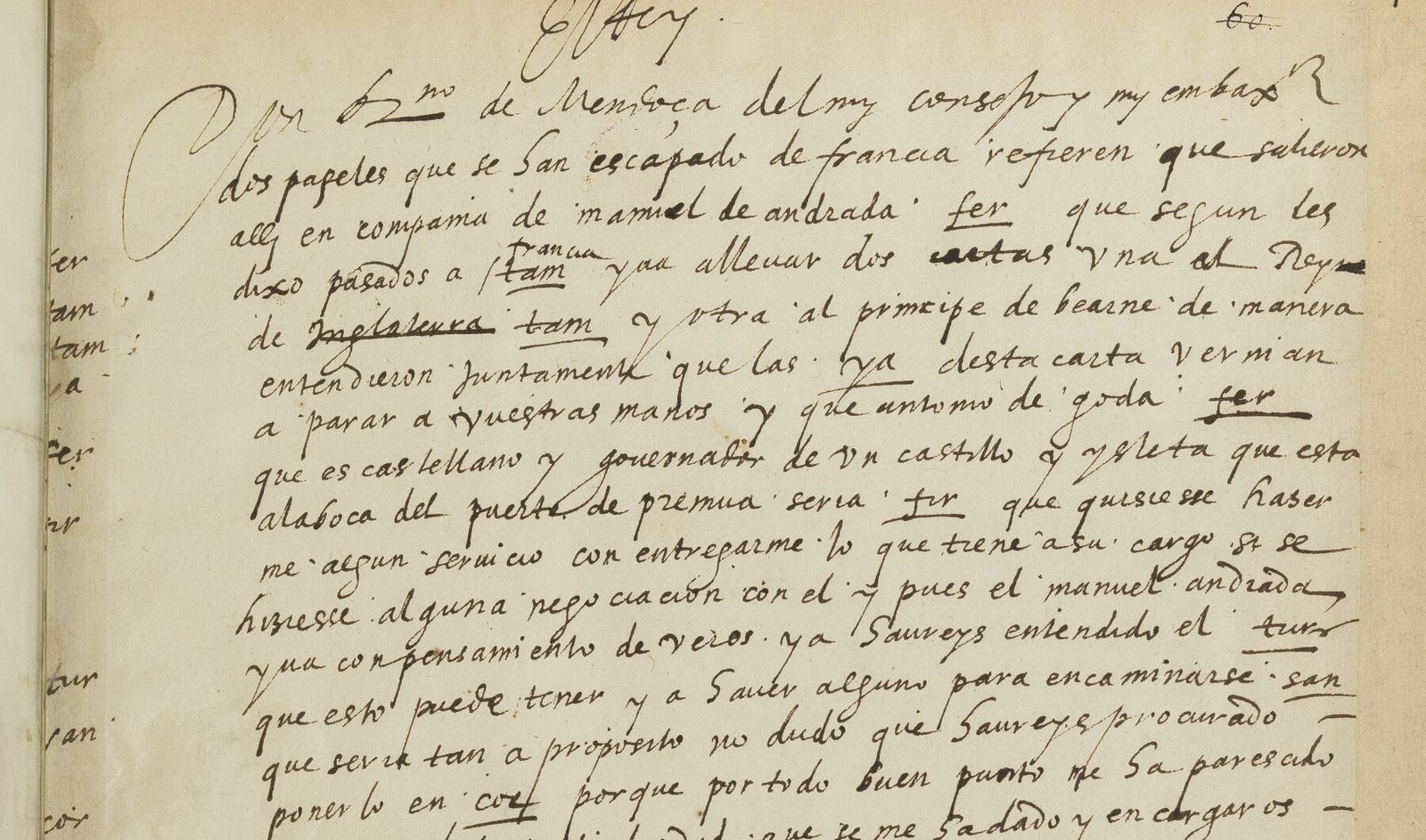
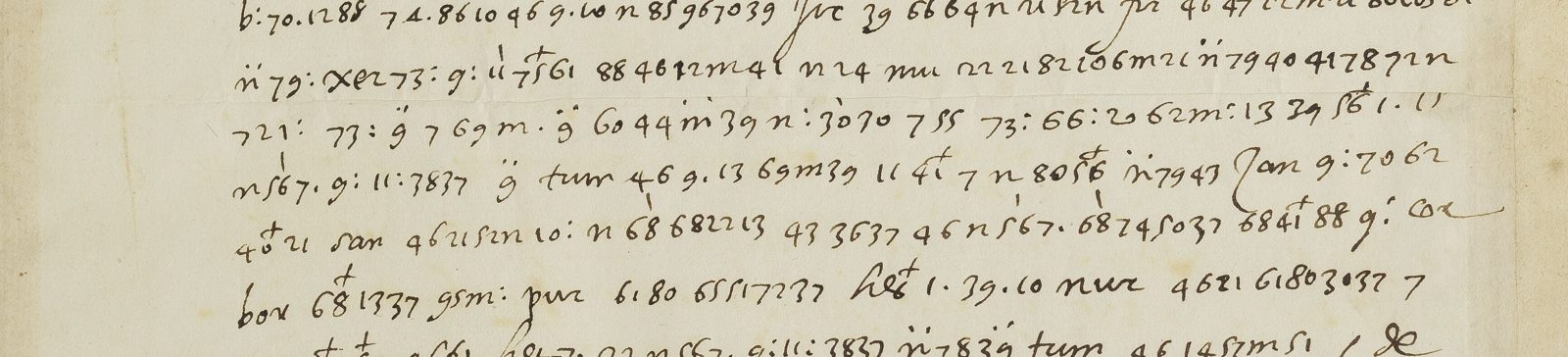
21 80: 9. 70 65 37 39 dun = se han es-ca-pa-do de [dun]; fer 46 21 79: 86. 38 28 65 20 37. n tam = [fer] que se-gun les di-xo pa-sa-dos a [tam].02 The cipher
Cg.13 is the general cipher Devos dates 1587 and Tomokiyo found in use by Philip II, Parma and Mendoza in 1588–89; Viète broke it in France and Phelippes in England, and the copies in this volume are Phelippes’s file. Its letters are single figures or letters (n = a, b = u, m and 9 = e, 1 = o, 7 = y, g = el), its syllables two-figure groups in rows of five in the order a e i o u (ta–tu 10–14, sa–su 20–24, na–nu 40–44, ra– 50–, va–vo 55–58, ma–mu 60–64, pa–pu 65–69, ca–cu 70–74, ga–gu 75–79, ha 80, la–lo 85–88), some rows reversed (bu–ba 95–99, fu–fa 90–94, du–de 36–39), with the qu-row at 45–49 so that 46 is simply que. Three marks after a group add a letter: a colon adds n (10: = tan, 73: = con, 9: = en), a point adds s (85. = las, 37. = dos, 7. = ys), a cross adds r (68+ = por, 56+ = ver); a stroke above inserts r after the consonant (30ʹ = dra) and a bar doubles an l. Words of the nomenclator are two- or three-letter groups (na carta, yu cosa, quer Rey, quor Reyno, Zan para, he aviso), with the same marks for plural and changed endings (na. cartas, he+ avisar, yenc otra). The full table as recovered, with the evidence for each value, is mendoza1589/key_cg13_partial.tsv.
03 The two letters
Letter A (f. 10, copy f. 14). Dos papeles que se han escapado de [Inglaterra*] refieren que salieron de alli en compañia de Manuel de Andrada, [portugués*], que segun les dixo, pasados a [Francia*], y va a llevar dos cartas, una al Reyno de [Francia*] y otra al principe de Bearne; de [quien] entendieron juntamente que las copias desta carta vernian a parar a vuestras manos; y que Antonio de Goda, [portugués*], que es castellano y governador de un castillo y ysleta que esta a la boca del puerto de Premua, seria [fru] que quisiesse hazerme algun servicio con entregarme lo que tiene a su cargo si yo hiziesse alguna negociacion con el. Y pues el Manuel Andrada va con pensamiento de veros, ya avreys entendido el [tum] que esto puede tener, y a haver alguno para encaminar el negocio, que seria tan a proposito, no dudo que avreys procurado ponerlo en [cor], porque por todo buen respeto me ha parescido avisaros desta particularidad que se me ha dado, y encargaros que me aviseys si aveys entendido algo del [tum] que tuviere.
Two papers smuggled out of England report that their writers left in company with Manuel de Andrada, a Portuguese (Dom António’s agent, Walsingham’s informant “David”), who said he had crossed to France carrying letters for the French court and for Navarre, and who expected copies of the present letter to reach Mendoza; and that a Portuguese castellan of an island fort at a harbour mouth might hand it over if the King dealt with him. Andrada means to see Mendoza; the King wants the matter followed and reported.
Letter B (f. 12, copy f. 76). Receipt of Mendoza’s letters of 27 July, 2 and 8 August; the death of el Rey mi hermano (Henry III, 2 August) ha sido cosa de gran lastima ... por todos los respetos que se pueden considerar; with France in such confusion Mendoza is to suspend the leave he has to quit the kingdom, porque siendo tan importante vuestra [gu] en el [bu] para el buen assiento de las cosas, and in no way absent himself without a new order, but attend to los negocios con el cuydado que soleys, steering towards el bien publico, que es solo el fin que yo tengo; news of England is badly wanted, en lo que toca a sus [designios*] y lo que traman y traçan, since the route by which their fleet came home is known from prisoners; Mendoza is to keep his sources going and write often, y de creer es que entre ellos y el de Bearne se deven andar urdiendo malas cosas ... todo importa entenderlo, y en particular sus armaçones.
04 The code words
- Read from the other letter. pur = respeto (por todos los respetos que se pueden considerar; the copyist of A wrote “puerto” for por todo buen respeto). bor, which the copyist of A rendered “porque”, is not: Phelippes reads porque as dur on f. 5, and pero fits both letters. mes = vuestro (A: a vuestras manos; B: glossed vro). san = negocio: B has a la forma que el negocio pidiere and, where the copyist wrote “a lo necessario”, the cipher has a los with a plural mark before san; in A it gives para encaminar el negocio, que seria tan a proposito.
- A miscopy. The copyist’s tur in A does not exist; the cipher has tum in both places (el tum que esto puede tener ... algo del tum que tuviere): one word, perhaps fundamento.
- Two wrong readings. The copyist wrote francia for dun in A and glossed tam as francia in the same letter; two groups cannot both be France. In B, dun is the power whose fleet came back by a route known from prisoners, whose plots run entre ellos y el de Bearne, and whose armaçones matter: England, in the summer the Drake–Norris expedition returned. So dun = Inglaterra* and tam = Francia*, which is where Andrada went and where Mendoza was. The copyist’s struck Inglaterra on f. 14 shows him weighing exactly this. And si se hiziesse alguna negociacion con el stands where the cipher has 18 = yo: the King wrote si yo hiziesse.
- From Phelippes’s own hand. His interlinear decipherment of Parma’s letter of 30 December 1588 (f. 5, same cipher) confirms the syllable values at every overlap and supplies bur persona, dom dicho, dur porque, pen mucho, mis V. M., and the x-row at 25–29.
- From Viète’s papers. fer, qualifying Manuel de Andrada and Antonio de Goda, is the group in the heading of a spy report copied in Cinq Cents de Colbert 33 (f. 113), Avisos que ha venido a dar David, traducidos de [fer]: Portugués*.
- Still open (contextual proposals only, asterisked in the key file): tum, fru, cor in A; hon (copyist: diligencia; the sense wants licencia), bor (pero?), gu, bu, com, ga (armada?), Jam, lo, bem, par in B; and a sixteen-group passage of B that the encipherer struck out and the copyist skipped.
05 Method
- Item 32 traced to the leaf through the BnF Archives et manuscrits notice (folios for Omont’s numbers) and the Gallica IIIF manifest (folio labels); ff. 10–15 and 76–77 fetched at native resolution, with the pacing the server enforces (30 s between requests, two-minute back-offs after 429).
- Both originals transcribed group by group (
f10_cipher.txt,f12_cipher.txt), both copies transcribed with the copyists’ underlinings, glosses, strikings and margin lists (f14_clear.txt,f76_clear.txt). - Alignment by hand, word by word; every syllable value kept only where the copy’s clear text requires it; values confirmed at two or more positions marked as such, and checked against the eleven syllables of Tomokiyo’s published fragment of the table (all agree).
- Nomenclator groups read where the copyist’s clear text stands over them in one letter and the group recurs in the other; the rest given contextual proposals, asterisked, and not counted as readings.
06 Sources
- BnF Français 3641, Gallica btv1b52508089f, ff. 10–15, 76; notice cc500920 (Omont’s item list).
- S. Tomokiyo, Thomas Phelippes’ Deciphering of Spanish Ciphers Found in French Archives (item list of fr. 3641 with first-line transcriptions and glosses); Spanish Ciphers during the Reign of Philip II (Cg.13); Ciphers Broken by François Viète (Cinq Cents de Colbert 33 f. 113).
- J. P. Devos, Les chiffres de Philippe II (1555–1598) et du Despacho universal (Brussels, 1950): prints the Simancas table of Cg.13; not online and not consulted. M. Alcocer, “Criptografía española”, BRAH 105 (1934), 107 (1935): forty Simancas ciphers, not this one.
- De Lamar Jensen, Diplomacy and Dogmatism: Bernardino de Mendoza and the French Catholic League (1964), on Mendoza’s ciphers and on Andrada; not consulted here.
Transcriptions, the partial key with its evidence and the notes are in the repository (mendoza1589/). Readings marked * are inferences from context and are not verified against the Simancas table.