01 The letters
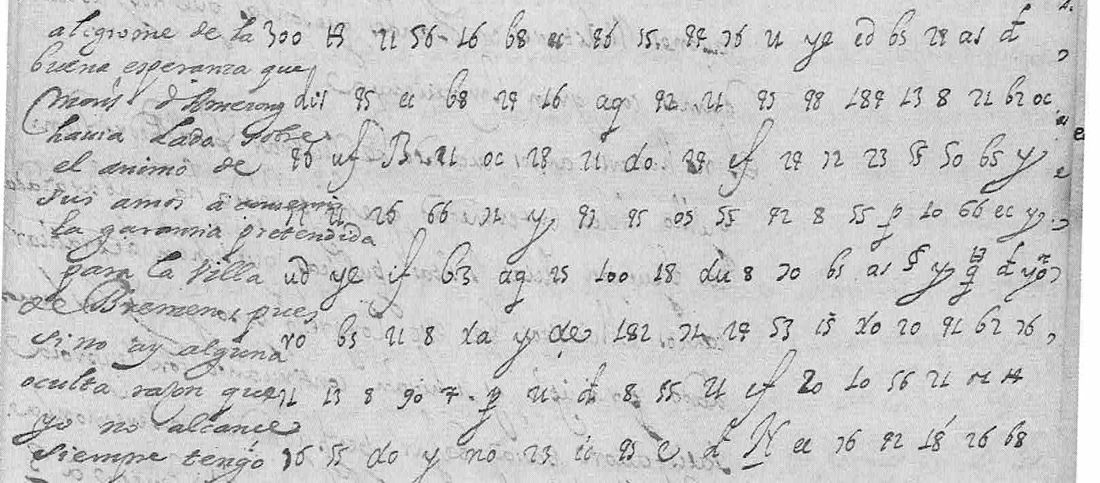
Fourteen letters, all from Nijmegen, dated from the clear parts:
- With a margin decipherment (ten): R988 (29 June 1677), R987 (18 June), R985 (3 August), R986 (28 August), R991 (5 October?), R990 (19 October), R989 (21 December), R993 (28 December 1677), R995 (26 January 1678), R994 (15 February).
- With no decipherment (four): R992 (19 September 1677), R996 (1 March 1678), R997 (8 March), R998 (22 March).
Each letter opens with courtesies in clear, then gives a cipher block. Two letters (R985, R986) enclose a French clear paper on the Lorraine propositions.
02 The key
This is a syllabic nomenclator with homophones. Groups are separated by spaces.
- Letters.
- Vowels: a 21, 3+; e 2+; i 22, 67; o 18.
- Consonants: b 10, n; c 9; d e; f x; g 16; j u+; l 8, 19; n y, 24, 20; p 26; r 23, 31; s 28, B; t 27; y 25; z h.
- The closing consonants s, n and r are the three commonest groups.
- Syllables in numbers.
- de 46, la 55, en 76, ra 65, re 66, te 71, do 48, ta 70, lo 58, no 63, to 73, da 45, ti 72, di 47
- le 56, ni 62, vi 42, ne 61, in 77, ve 41, va 40, na 60, on 78, an 75, li 57, ga 50, go 53, tu 74
- vo 43, ar 80, gu 54, un 79, er 81, du 49, nu 64, ro 68, tr 188
- Letter pairs: a syllable with the vowel kept and the consonant disguised.
- c is written x, d or l: xo, do and lo all read co; the same holds for ci, ca, ce and cu.
- f is written n: no fo, ni fi, ne fe, na fa, nu fu.
- y is written r: ro yo, ra ya.
- Vowel-first pairs: the syllable reversed, with the consonant disguised.
- s is written f: ef se, if si, af sa, of so, uf su. Also ye es, ya as, yo os.
- p is written d: ad pa, ed pe, od po, ud pu.
- m is written c: ac ma, ec me, ic mi, oc mo, uc mu.
- h is written q or g: aq/ag ha, eq/eg he, og ho.
- Others: en em, ot ch, as za.
- Word codes.
- que: d+ (struck d), b+. de: p+, g+.
- V.S.: H. para: 05. por: 15, is. sobre: 184. quando: 148. alguno: 100. congreso: 120.
- ministro: des. materia: dus. duque: ep. embax[ador]: §. -mente: dan. nuestro: fe.
- Flandes: ban. Francia: bef. franceses: bin. Suecia: 163. Dinamarca: or. -bourg: 105.
- Nulls. 13+ and most 13s, 300, 200, 700, 07, 01, 18+, 16+, 35. Many of these mark the start or end of a cipher block.
A few examples:
26 67 y di ed 28= pr·i·n·ci·pe·sxo y no 23 ic 45 e= co·n·fo·r·mi·da·dxo 20 41 62 76= co·n·ve·ni·en[te]
03 The four undeciphered letters
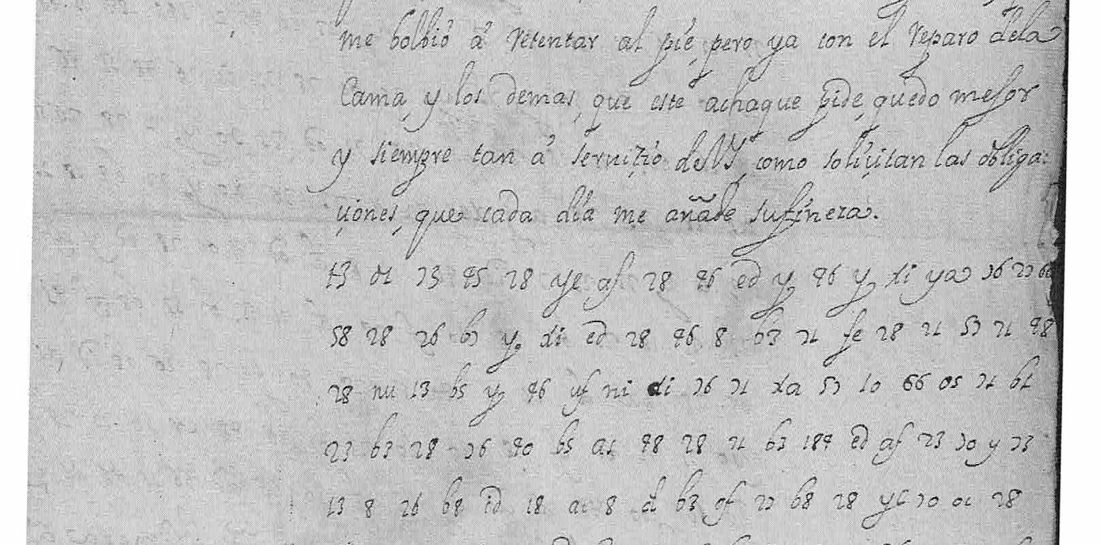
These are machine readings from the key: the groups are decoded one by one and the text is given here in summary. The group-by-group
text is in balbases1677/read/.
- 19 September 1677 (R992).
- Balbases has seen the protest the Imperial ministers published over the dissolution of the Bremen assembly. “De nuestra parte no nos queda que hacer sino es… temer” what the confederates will do.
- After Charleroi they may insist at the union that the conquests be shared out before anything positive is settled.
- A rumour about the Danish chancellor and the Duke of Celle. He gives it no credit, “pues V.S. no lo ha penetrado ni me lo avisa”.
- The claim that the duke would take his share of his father’s conquests, the duchies of Bremen and Verden.
- 1 March 1678 (R996).
- Nothing in Sweden could undo “la desconfianza que arguimos hacia nuestros aliados”. What causes it is “la miserable postura en que permanecen nuestras cosas”.
- The Brunswicks’ proceedings rest on solid suspicions.
- The ministers of the northern princes had thought of writing a protest about treaties of peace that would leave out their participation. He praises Fuenmayor’s diligence in avoiding that step.
- Strasbourg’s lack of constancy.
- A French gentleman has come back from France “satisfecho del Rey Cristianísimo”.
- 8 March 1678 (R997).
- In the business of the Brunswicks’ claim to the treatment of ambassadors, the Danes have conceded nothing. No formal act was made in writing at the first step.
- He comments on the Duke of Hanover and his brothers: “todo me parece muy bien pesado, pero yo creo que nada de estas intrigas llegará a fin”.
- “Los incesantes riesgos en que estamos”, and his growing melancholy.
- 22 March 1678 (R998).
- The dependencies between the princes of the north, “de suficiente calibre para tenernos embarazados”.
- The evils “que nosotros estamos padeciendo”.
- The loss in Flanders: “con la pérdida de Gante estamos temiendo la de otras importantes plazas”. Ghent had fallen to Louis XIV on 9 March.
- They are still waiting on the others’ long delays while “la enfermedad” advances.
04 The ten margined letters
These were read at the time. The key reproduces their margins, which recover illegible margin words and confirm the doubtful ones. Their subjects:
- Amerongen’s hopes for a guarantee to the town of Bremen, 3 August.
- The dissolution of the Bremen conference, 18 June.
- Villahermosa, Temple’s recall and the Danish setback at Malmö.
- The Bishop of Strasbourg’s minister and Orange’s journey to England, 19 October.
- The loss of Saint-Ghislain, December.
- The Brunswick claim to ambassadorial rank, which runs through the winter letters of 1678.
The margin text is transcribed in balbases1677/tx/. It is summarised here, not edited.
05 Method
- The images were fetched from DECODE.
- Two agents transcribed every cipher line and margin line by page into
tx/. They corrected DECODE’s transcriptions, which drop lines, confuse 46/96 and 48/98, and garble the margins. - Repeated n-grams across letters were set against the margin text at the same relative position to find anchors: Brunsuic, principes, conformidad, novedad, conveniente.
- A hard-EM monotone aligner (
align2.py) was seeded with those anchors and ran over the ten margined letters. Each group emits a substring of the margin text, with nulls and skips allowed. - Two rounds brought out the table. A frozen key then decoded all fourteen letters.
06 What remains uncertain
- 3% of groups (243 of 8,150) are unassigned. They are mostly rare 3-digit name codes: 82, 83, 150, 161, 182, 187, 189, 800.
- Several homophones carry a second value. The cause is transcription slips (4/9, in/ot), not the key: 41 reads di beside ve, 77 in beside ot, 61 ne beside ri.
- The summaries of the four unread letters are graded C (probable) where they paraphrase and H (certain) for the quoted phrases. None of the four has a check text.
- R992 is the least certain transcription. Its pages are heavily marked up.
07 Sources
- Archives générales du Royaume, Brussels, Secrétairerie d’État et de Guerre, inv. nr. 2559. Images on DECODE R985–R998 (login).
- Keys of the series checked and found not to fit: DECODE R958–R965 (“chiffres 1647–98”).
- Companion file: Carpio to Fuenmayor, 1677, write-up, a different key.
Transcriptions, key, aligner and readings: balbases1677/ in the repository.