At a glanceExisting decipherment · complete
- The letters
- William Short to Jefferson, The Hague, 26 July 1792 (private); William Carmichael to Jefferson, Madrid, 14 April 1788; Thomas Pinckney to Jefferson, London, 28 August 1793. Each is partly in a numerical code.
- Where
- Library of Congress, Thomas Jefferson Papers, series 1 (Short: microfilm reel 16, frames 998–1009; Carmichael: reel 9, frames 223–230) and National Archives, RG 59, Despatches from US Ministers to Great Britain (microfilm M30 roll 2, frame 140). Catalogue no. 484.
- The cipher
- Three different two-part codes of about 1,700–1,850 numbers for words, syllables and letters, written with dots between the groups; the numbers follow no alphabetical order.
- How it was deciphered
- Jefferson decoded most of Short’s letter between the lines, and the editors of The Papers of Thomas Jefferson decoded the rest and the other two letters. Here every group was transcribed from the originals and checked against values decoded at the time in other letters in the same codes.
- What it says
- Short’s bitterness at being passed over for Paris and his wishes for a post; the ratification of the Constitution in Maryland and Massachusetts; Grey’s expedition preparing for the West Indies.
- Still open
- Nine groups that occur only once in their code: Short’s 401 (twice), 1083 and 359 199 34 724; Pinckney’s 447 (how many regiments); Carmichael’s 597.
- Credit
- The readings were first printed by the editors of The Papers of Thomas Jefferson (vols. 13, 1956; 24, 1990; 26, 1995). Jefferson’s own interlinear decoding and George Taylor Jr.’s decodings of Pinckney’s other letters supplied the values used to check them.
01 Three codes, three letters
As Secretary of State, Jefferson corresponded with his ministers abroad in numerical codes that the editors of his papers number in the order they first appear. Each is a two-part code: some 1,700 to 1,850 numbers, each standing for a word, a syllable or a letter, written with dots between them. The numbers follow no order. On Short’s page, 7 is s, 68 president, 153 al, 224 the, 426 to, 977 no, 1093 in and 1336 be, so an unknown number cannot be placed between its neighbours. No key sheet for these three codes has been found. The editors decoded the letters “using partially reconstructed” keys and named the groups they could not read.
| Letter | Code | Groups | Open or guessed in print |
|---|---|---|---|
| Short to Jefferson, The Hague, 26 July 1792 | No. 10 | 674 | 401, 1083, 401; 359, 199, 34, 724 |
| Carmichael to Jefferson, Madrid, 14 April 1788 | No. 13 | 5 | all five guessed: [Maryland] twice, [Massachusetts], [majority], [you?] |
| Pinckney to Jefferson, London, 28 August 1793 | No. 16 | 58 | “Undeciphered code 497”; [time?], [secret?], [Dunda]s |
02 Pinckney, 28 August 1793: Grey’s expedition
Pinckney’s despatch is on the State Department microfilm of his London letters. Jefferson pencilled “copy so far only” above the coded lines, so the clerks’ copies stop there and no decoding was made at the time. The coded passage is five lines, 58 groups; the first digits of four lines are lost in the binding.
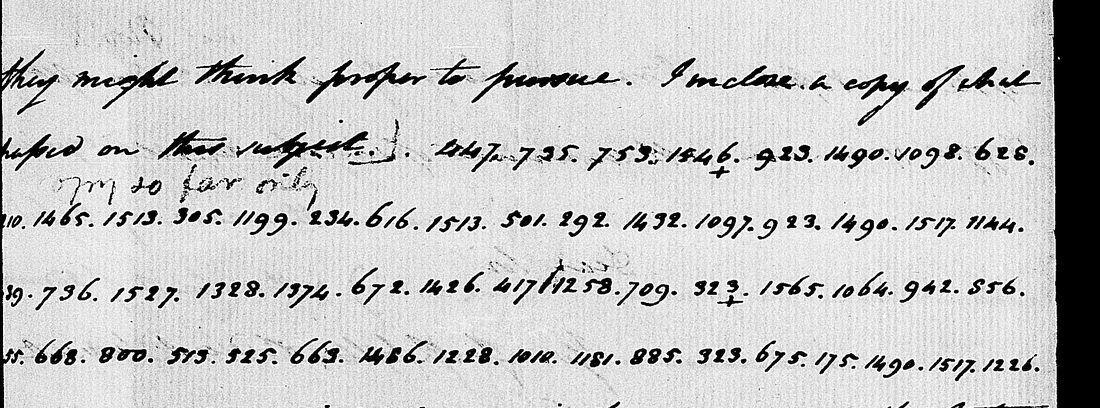
Pinckney wrote six other letters in the same code that George Taylor Jr. decoded between the lines at the State Department (20 June, 25 September, 27 November and 17 December 1793, 28 January and February 1794). He also sent an “Explication of the Cyphers” for his letter of 25 November 1793. All fifteen coded frames of the roll were transcribed (about 2,600 groups), and every value decoded there was set against the 28 August groups. Thirty of the 58 groups are confirmed that way, word for word as the editors had them: 753 i (reg-i-ments), 1490 1517 to be, 709 with, 323+ generals (+ marks a plural), 856 and, 513 525 under him, 1228 … 1181 des-tina-tion, 885 is, 323 675 175 general-ly thought, 1226 for.
447 regiments are to embark in a short [time?] on a [secret?] expedition. They are to be commanded by Sir Charles Grey with Generals Stuart and [Dunda]s under him. Their destination is generally thought to be for the West Indies.
The group the editors printed as 497 is 447 on the original. It occurs nowhere else in Pinckney’s code, and none of the number words decoded elsewhere matches it (6 is 1244, 8 is 531, “nine” is 383 or 6?4), so how many regiments he wrote stays open. The editors’ time (234) and secret (501) also occur only here and remain their guesses. The long letter of 15 August 1793, about a thousand groups with no interlinear decoding, is not open: the State Department made a clear copy of it.
03 Short, 26 July 1792: two holes in a long complaint
Short’s private letter is a long complaint at being passed over for Paris in favour of Gouverneur Morris, and he coded its most personal parts. All 674 code groups were transcribed; Jefferson’s decoding stands over 511 of them, and the editors read the rest. Two places are open.

This would have been putting on my conduct a censure which no place would have induced me to have exposed myself to, if I had not counted enough on the justice of government to have 401 [been?] sure there 1083 [would?] have 401 [been?] no[ne?] of it if my conduct was satisfactory.

The next day Short copied the whole paragraph into a second letter, in the same code and with the same numbers, so the digits are certain. He first wrote 757.1312.687 (salaries) there, struck it out, and wrote 757.427 (salary). But the copy carries no decoding. “Been” is 1700 in this code (Jefferson decoded it in this letter and three others), so if 401 is been, it is a second number for the word. The obvious would is 1192, not 1083. Short’s small caret under 401 also appears under 985 (less), so it does not single out 401. None of the six numbers occurs in the other Code No. 10 letters checked: the editors’ notes on all 39 documents in the code, and the originals of Short’s letters of 26 September and 27 October 1790 and 11 and 13 November 1793, and of Jefferson’s fully coded letter of 31 May 1793 (about 1,100 groups).
04 Carmichael, 14 April 1788: a test of a faulty code
Carmichael could not decode Jefferson’s letters with the code David Franks had left with him, and he used “some phrases of my cypher” so that Jefferson could see whether their codes matched. Five numbers stand in a clear letter:

Had I been in [Maryland] I should in all probability have been of the sentiment of Paca and the other you mention. … [Maryland] has not acceded to the Constitution, [Massachusetts] has. The [majority] seem pleased with it, what says 597?
This is not Code No. 11, the code Carmichael used from May 1788: in the table rebuilt from Jefferson’s decodings (jefferson1787), 597 is freedom and 223 trouble. No other letter in Code No. 13 is known, so only the context reads it. That context is strong for 108, Carmichael’s own state and William Paca’s; Maryland ratified on 28 April 1788, two weeks later. It is also strong for 223, Massachusetts, which had ratified on 6 February. For 597 the editors’ you is a guess, and Virginia, which had not yet voted, fits the sentence as well. It stays open.
05 How it was done
- The three printed texts and notes were taken from Founders Online. The originals came from the Library of Congress (Jefferson Papers master images) and from the National Archives catalogue (M30 roll 2, frames 101–330).
- Every code group of the three letters was transcribed from the images, and all fifteen coded Pinckney frames of 1793–95 with their decodings. Subagents did the long transcriptions; the open groups were re-read at 2× by hand.
- The decoded values of each code were collected in
key.tsv: 171 values of Code No. 10 from Jefferson’s interlinear, 262 of Code No. 16 from Taylor’s decodings and the Explication. Each group of the three letters was then graded: decoded over the group or elsewhere in the same code (H), the editors’ reading only (M), a conjecture by context (I), or open. - Each open group was searched for in every letter of its code that could be reached. Code No. 10 was also checked for alphabetical order, and Code No. 11 was tried on Carmichael’s numbers; neither helps.
| Letter | Groups | H | M | I | Open |
|---|---|---|---|---|---|
| Short 1792 | 674 | 511 | 156 | 0 | 7 |
| Pinckney 1793 | 58 | 30 | 23 | 4 | 1 |
| Carmichael 1788 | 5 | 0 | 0 | 4 | 1 |
| All | 737 | 541 | 179 | 8 | 9 |
06 What remains
- Pinckney 447: before “regiments”; one occurrence, no decoding, not among the code’s known number words. Pinckney’s own press copy, in the Pinckney Family Papers at the South Carolina Historical Society, is not online.
- Pinckney 234 [time?], 501 [secret?], ?55 668 [Dunda-]: single occurrences, grade I. The first digits of ?55 are in the binding.
- Short 401 (twice), 1083, 359 199 34 724: only in this passage and its copy of the next day; no decoding in any Code No. 10 letter reached. Several originals with decodings are outside the Library of Congress series (William & Mary, Princeton, the Short Papers, the State Department copies) and were not seen.
- Carmichael 597, and 108, 223, 273 by context only: Code No. 13 survives in this letter alone, and no key is known.
Full texts
The transcription and the decryption of every document on this page, so that the reading can be used and checked. Short files are shown here; all are in the repository.
William Short to Jefferson, The Hague, 26 Jul 1792 (Code No. 10)
Short's private complaint at being passed over for Paris in favour of Gouverneur Morris: Lafayette's mortification, the French diplomatic committee's wish to refuse Morris, and Short's preferences for a post (the Hague as resident, Spain as plenipotentiary) and for the grades of the American diplomatic establishment.
Transcription
# William Short to Jefferson, The Hague, 26 Jul 1792 (Code No. 10): code groups as transcribed, one line per manuscript line
1184.1093.574.539.1005.
224.834.1343.1409.1700.890.
1480.490.680.
1480.796.
1184.890.224.68.224.834.
224.68.
118?.
?24.68.319.224.344.691.
891.6?7.198.194.
4?2.838.294.162.1?29.1165.319.1065.
294.1534.383.426.478.1093.216.1216.294.741.1070.1093.562.1165.1184.
1460.218.1377.939.7.527.1184.108.327.1236.395.1388.684.
618.287.218.1377.939.633.426.218.831.330.153.1000.1168.
567.1149.306.1283.546.426.421.633.1182.
1101.119.844.893.890.218.1349.376.1464.379.338.
8.1648.109.224.716.1460.190.1149.
294.1282.250.426.1101.660.890.95?.1600.
218.66?.319.426.216.542.9?0.126.977.1259.
1361.1369.294.212.1465.324.441.426.1416.218.1269.534.31.
426.496.1700.1228.239.1369.1361.1093.1450.689.957.158.162.728.1299.294.
819.496.1700.1658.426.218.1407.758.218.
426.306.1283.546.426.1416.
1184.188.1648.218.668.1269.534.31.1570.805.
152.1361.1093.564.
177.1416.?683.1088.169?.383.162.153.218.1173.1302.
1302.890.294.496.1004.1450.958.5?2.426.634.168.1161.531.
791.467.1388.326.1228.
239.1369.1369.218.?093.1621.1149.426.306.1283.
546.426.421.218.1087.885.117.
294.1192.1101.660.154.1332.1291.1165.
1598.1356.294.378.1099.4?2.803.426.1412.1369.
294.819.224.1598.1184.1169.224.53?.1649.1887.
294.482.1396.1259.844.1165.1674.1674.73.1260.
224.121?.341.381.1695.515.426.625.1042.298.565.1109.
985.927.1093.1017.89?.35?.
985.1093.1039.
294.496.1626.871.426.1377.1025.218.1619.1287.1674.1106.12.218.757.
427.
1146.534.218.668.890.421.852.153.371.1093.
1109.1416.1192.1336.117.287.426.1336.113?.1298.1361.319.1101.1341.1460.224.
562.1460.22.1523.294.1282.426.496.224.1619.1287.1460.1?5?.628.1005.
294.819.793.224.1619.1287.12.294.819.
482.1396.1109.1216.1192.1336.1085.1332.153.1192.1336.426.1336.576.1361.198.
494.712.1674.1388.326.1594.1598.1623.241.1369.891.607.198.
494.1076.26?.1450.71?.890.1564.799.9?8.1460.?053.1369.
1093.224.508.300.829.1149.294.819.1099.1336.
14?3.?252.439.133?.899.
1017.1683.351.890.224.1598.1674.1070.985.294.496.
172.689.927.523.294.496.218.716.
426.1134.1648.586.1163.487.1149.793.1075.
634.668.581.426.1618.106.224.509.1416.1460.1146.294.
224.763.7?3.160.
693.606.1257.1562.426.634.
218.1336.1165.196.576.326.1460.246.693.467.
1075.1336.1165.1295.1409.1099.
33?.1486.307.932.1165.360.586.426.
306.1298.8.218.689.1628.1450.?79.1283.
202.426.496.1695.518.218.668.426.793.
294.190.1149.426.496.401.132.
1083.496.401.977.1460.1416.793.218.689.1628.1106.
1460.1184.1330.9?8.566.426.1093.562.1184.1460.218.633.426.218.
668.31.890.294.7?5.1450.
527.712.218.1039.1460.1450.
1349.805.549.1413.379.224.83.1416.730.7.426.202.951.
819.496.1413.1317.890.351.224.1619.1287.1460.443.587.890.73.12.890.
1520.1299.224.1619.1287.1460.73.12.224.757.
1312.687.7.224.826.426.224.543.1000.1149.
68.300.1032.1278.224.757.1312.687.7.1523.
757.427.819.1099.359.199.34.724.153.422.1165.224.68.426.
?94.1671.224.1523.1299.951.1302.
421.633.218.231.527.1184.
1593.1159.1460.1552.786.1165.
1593.1020.1460.38.882.1140.
1593.1020.730.426.
294.1603.689.1018.1330.218.
576.326.1683.1124.188.
1410.188.319.972.766.338.1486.776.1063.
Decryption
# William Short to Jefferson, The Hague, 26 Jul 1792 (Code No. 10): group = reading [grade]; T TJ interlinear, H attested elsewhere, E editors, C conjecture, O open
1184=-[E] 1093=les[T] 574=intriguants[T] 539=(intriguants)[T] 1005=(intriguants)[T]
224=the[T] 834=Mar[T] 1343=fai[T] 1409=had[T] 1700=been[T] 890=and[T]
1480=mor-[T] 490=-ti-[T] 680=-fied[T]
1480=Mor-[T] 796=-ris[T]
1184=you[T] 890=and[T] 224=the[T] 68=Presidt[T] 224=the[T] 834=mar.[T]
224=the[T] 68=Presidt[T]
118?=you[T]
?24=the[T] 68=Presidt[T] 319=on[T] 224=the[T] 344=subject[T] 691=(subject)[T]
891=-[E] 6?7=-[E] 198=-[E] 194=-[E]
4?2=Precarious[T] 838=(Precarious)[T] 294=-[E] 162=-[E] 1?29=footing[T] 1165=-[E] 319=on[T] 1065=which[T]
294=I[T] 1534=stand[T] 383=(stand)[T] 426=to[T] 478=do[T] 1093=in[T] 216=this[T] 1216=that[T] 294=I[T] 741=chuse[T] 1070=(chuse)[T] 1093=in-[T] 562=-forming[T] 1165=(-forming)[T] 1184=you[T]
1460=of[T] 218=my[T] 1377=wishes[T] 939=(wishes)[T] 7=(wishes)[T] 527=that[T] 1184=you[T] 108=may[T] 327=cooperate[T] 1236=(cooperate)[T] 395=(cooperate)[T] 1388=with[T] 684=them[T]
618=namely[T] 287=(namely)[T] 218=my[T] 1377=wishes[T] 939=(wishes)[T] 633=as[T] 426=to[T] 218=my[T] 831=own[T] 330=personal[T] 153=(personal)[T] 1000=advan-[T] 1168=(advan-)[T]
567=-cement[T] 1149=(-cement)[T] 306=-[E] 1283=return[T] 546=-[E] 426=to[T] 421=america[T] 633=as[T] 1182=soon[T]
1101=acquainted[T] 119=(acquainted)[T] 844=(acquainted)[T] 893=-[E] 890=&[T] 218=my[T] 1349=diplomatic[T] 376=(diplomatic)[T] 1464=(diplomatic)[T] 379=-[E] 338=car-[T]
8=-ser[T] 1648=(-ser)[T] 109=my[T] 224=the[T] 716=power[T] 1460=of[T] 190=government[T] 1149=(government)[T]
294=I[T] 1282=am[T] 250=obliged[T] 426=to[T] 1101=accept[T] 660=(accept)[T] 890=and[T] 95?=obey[T] 1600=(obey)[T]
218=my[T] 66?=self[T] 319=on[T] 426=to[T] 216=this[T] 542=situation[T] 9?0=(situation)[T] 126=(situation)[T] 977=no[T] 1259=re-[T]
1361=-medy[T] 1369=(-medy)[T] 294=I[T] 212=must[T] 1465=(must)[T] 324=submit[T] 441=(submit)[T] 426=to[T] 1416=it[T] 218=my[T] 1269=favorable[T] 534=circumstan-[T] 31=(circumstan-)[T]
426=to[T] 496=have[T] 1700=been[T] 1228=employed[T] 239=(employed)[T] 1369=-[E] 1361=-[E] 1093=in[T] 1450=a[T] 689=conspicuous[T] 957=(conspicuous)[T] 158=(conspicuous)[T] 162=station[T] 728=(station)[T] 1299=there[T] 294=I[T]
819=should[T] 496=have[T] 1700=been[T] 1658=known,[T] 426=to[T] 218=my[T] 1407=country[T] 758=by[T] 218=the[T]
426=-[E] 306=return[T] 1283=(return)[T] 546=-[E] 426=to[T] 1416=it[T]
1184=you-[T] 188=-nger[T] 1648=-[E] 218=my[T] 668=self[T] 1269=favorable[T] 534=circumstances,[T] 31=(circumstances)[T] 1570=employed[T] 805=(employed)[T]
152=-[E] 1361=-[E] 1093=in[T] 564=com-[T]
177=-petitors[T] 1416=(-petitors)[T] ?683=-[E] 1088=fallacious,[T] 169?=(fallacious)[T] 383=-[E] 162=-[E] 153=all[T] 218=my[T] 1173=hopes[T] 1302=were[T]
1302=-[E] 890=&[T] 294=I[T] 496=have[T] 1004=had[T] 1450=a[T] 958=dieu[T] 5?2=-[E] 426=to[T] 634=them[T] 168=for[T] 1161=ever.[T] 531=same[T]
791=chance[T] 467=(chance)[T] 1388=without[T] 326=(without)[T] 1228=emp.[T]
239=-l[?]y[T] 1369=-[E] 1369=-[E] 218=my[T] ?093=inducements[T] 1621=(inducements)[T] 1149=(inducements)[T] 426=to[T] 306=return[T] 1283=(return)[T]
546=-[E] 426=to[T] 421=america[T] 218=my[T] 1087=whole[T] 885=heart[T] 117=(heart)[T]
294=I[T] 1192=would[T] 1101=accept[T] 660=(accept)[T] 154=rather[T] 1332=than[T] 1291=nothing[T] 1165=(nothing)[T]
1598=place[T] 1356=[struck][T] 294=but I[T] 378=do[T] 1099=not[T] 4?2=pretend[T] 803=(pretend)[T] 426=to[T] 1412=say[T] 1369=(say)[T]
294=I[T] 819=should[T] 224=the[T] 1598=place[T] 1184=you[T] 1169=Spain[T] 224=the[T] 53?=same[T] 1649=-[E] 1887=grade[T]
294=I[T] 482=prefer[T] 1396=(prefer)[T] 1259=remaining[T] 844=(remaining)[T] 1165=-[E] 1674=here[T] 1674=[?]minister[T] 73=(minister)[T] 1260=of[T]
224=the[T] 121?=third[T] 341=order[T] 381=(order)[T] 1695=are[T] 515=exposed[T] 426=to[T] 625=many[T] 1042=humiliations[T] 298=(humiliations)[T] 565=(humiliations)[T] 1109=Spain[T]
985=less[T] 927=so[T] 1093=in[T] 1017=Paris[T] 89?=and[T] 35?=London[T]
985=less[T] 1093=in[T] 1039=view[T]
294=I[T] 496=have[T] 1626=often[T] 871=reason[T] 426=to[T] 1377=wish[T] 1025=(wish)[T] 218=my[T] 1619=grade[T] 1287=(grade)[T] 1674=here[T] 1106=was[T] 12=plenipotentiary[T] 218=my[T] 757=sal-[T]
427=-ar[?][T]
1146=honourable[T] 534=(honourable)[T] 218=my-[T] 668=-self[T] 890=&[T] 421=america[T] 852=several[T] 153=(several)[T] 371=reasons,[T] 1093=in[T]
1109=Spain[T] 1416=it[T] 1192=would[T] 1336=be[T] 117=particularly[T] 287=(particularly)[T] 426=to[T] 1336=be[T] 113?=desired[T] 1298=(desired)[T] 1361=-[E] 319=on[T] 1101=account[T] 1341=(account)[T] 1460=of[T] 224=the[T]
562=forms[T] 1460=of[T] 22=principal[T] 1523=court[T] 294=I[T] 1282=am[T] 426=to[T] 496=have[T] 224=the[T] 1619=grade[T] 1287=(grade)[T] 1460=of[T] 1?5?=resident[T] 628=(resident)[T] 1005=-[E]
294=I[T] 819=should[T] 793=if[T] 224=the[T] 1619=grade[T] 1287=(grade)[T] 12=Plenipotentiary[T] 294=I[T] 819=should[T]
482=prefer[T] 1396=(prefer)[T] 1109=Spain[T] 1216=that[T] 1192=would[T] 1336=be[T] 1085=worse[T] 1332=than[T] 153=all[T] 1192=would[T] 1336=be[T] 426=to[T] 1336=be[T] 576=turned[T] 1361=(turned)[T] 198=away[T]
494=from[T] 712=(from)[T] 1674=here[T] 1388=without[T] 326=(without)[T] 1594=any[T] 1598=place[T] 1623=laquay[T] 241=(laquay)[T] 1369=-[E] 891=turned[T] 607=(turned)[T] 198=away[T]
494=without[T] 1076=(without)[T] 26?=even[T] 1450=a[T] 71?=certificate[T] 890=(certificate)[T] 1564=(certificate)[T] 799=-[E] 9?8=-[E] 1460=of[T] ?053=honesty[T] 1369=(honesty)[T]
1093=in[T] 224=the[T] 508=late[T] 300=(late)[T] 829=appointments[T] 1149=(appointments)[T] 294=I[T] 819=should[T] 1099=not[T] 1336=be[T]
14?3=at[T] ?252=amsterdam[T] 439=(amsterdam)[T] 133?=(amsterdam)[T] 899=-[E]
1017=Paris[T] 1683=or[T] 351=London[T] 890=&[T] 224=the[T] 1598=place[T] 1674=here[T] 1070=useless[T] 985=(useless)[T] 294=I[T] 496=have[T]
172=one[T] 689=consolation[T] 927=(consolation)[T] 523=(consolation)[T] 294=I[T] 496=have[T] 218=my[T] 716=power[T]
426=to[T] 1134=-[E] 1648=-[E] 586=-[E] 1163=-[E] 487=-[E] 1149=-[E] 793=-[E] 1075=-[E]
634=-[E] 668=-[E] 581=-[E] 426=-[E] 1618=-[E] 106=-[E] 224=-[E] 509=-[E] 1416=-[E] 1460=-[E] 1146=-[E] 294=-[E]
224=the[T] 763=public[T] 7?3=(public)[T] 160=ser-[T]
693=-vices[T] 606=(-vices)[T] 1257=devoted[T] 1562=(devoted)[T] 426=to[T] 634=them[T]
218=-[E] 1336=-[E] 1165=-[E] 196=-[E] 576=-[E] 326=-[E] 1460=-[E] 246=-[E] 693=-[E] 467=-[E]
1075=-[E] 1336=-[E] 1165=-[E] 1295=-[E] 1409=-[E] 1099=-[E]
33?=-[E] 1486=-[E] 307=-[E] 932=-[E] 1165=-[E] 360=-[E] 586=-[E] 426=-[E]
306=-[E] 1298=-[E] 8=-[E] 218=-[E] 689=-[E] 1628=-[E] 1450=-[E] ?79=-[E] 1283=-[E]
202=-[E] 426=-[E] 496=-[E] 1695=-[E] 518=-[E] 218=-[E] 668=-[E] 426=-[E] 793=-[E]
294=-[E] 190=-[E] 1149=-[E] 426=-[E] 496=-[E] 401=-[O] 132=-[E]
1083=-[O] 496=-[E] 401=-[O] 977=-[E] 1460=-[E] 1416=-[E] 793=-[E] 218=-[E] 689=-[E] 1628=-[E] 1106=-[E]
1460=of[T] 1184=your[T] 1330=(your)[T] 9?8=permission[T] 566=(permission)[T] 426=to[T] 1093=inform[T] 562=(inform)[T] 1184=you[T] 1460=of[T] 218=my[T] 633=as[T] 426=to[T] 218=my[T]
668=self[T] 31=circumstances[T] 890=&[T] 294=I[T] 7?5=feel[T] 1450=a[T]
527=that[T] 712=from[T] 218=my[T] 1039=view[T] 1460=of[T] 1450=a[T]
1349=diplomatic[T] 805=(diplomatic)[T] 549=-[E] 1413=-[E] 379=-[E] 224=the[T] 83=U.S.[T] 1416=it[T] 730=seems[T] 7=(seems)[T] 426=to[T] 202=me[T] 951=they[T]
819=should[T] 496=have[T] 1413=at[T] 1317=Paris[T] 890=&[T] 351=London[T] 224=the[T] 1619=grade[T] 1287=(grade)[T] 1460=of[T] 443=an[T] 587=extra[T] 890=&[T] 73=minister[T] 12=Plenty[T] 890=&[T]
1520=elsewhere[T] 1299=(elsewhere)[T] 224=the[T] 1619=grade[T] 1287=(grade)[T] 1460=of[T] 73=minister[T] 12=Plenty[T] 224=the[T] 757=salary[T]
1312=-[E] 687=-[E] 7=-[E] 224=-[E] 826=-[E] 426=-[E] 224=-[E] 543=-[E] 1000=-[E] 1149=-[E]
68=-[E] 300=-[E] 1032=-[E] 1278=-[E] 224=-[E] 757=-[E] 1312=-[E] 687=-[E] 7=-[E] 1523=-[E]
757=-[E] 427=-[E] 819=-[E] 1099=-[E] 359=-[O] 199=-[O] 34=-[O] 724=-[O] 153=-[E] 422=-[E] 1165=-[E] 224=-[E] 68=-[E] 426=-[E]
?94=-[E] 1671=-[E] 224=-[E] 1523=-[E] 1299=-[E] 951=-[E] 1302=-[E]
421=america[T] 633=as[T] 218=my[T] 231=own[T] 527=that[T] 1184=you[T]
1593=your[T] 1159=design[T] 1460=of[T] 1552=retiring[T] 786=(retiring)[T] 1165=-[E]
1593=your[T] 1020=letter[T] 1460=of[T] 38=Jan.[T] 882=28.[T] 1140=(28)[T]
1593=your[T] 1020=letter[T] 730=seem[T] 426=to[T]
294=I[T] 1603=might[T] 689=con-[T] 1018=-sider[T] 1330=-[E] 218=my[T]
576=turned[T] 326=out[T] 1683=or[T] 1124=lingering[T] 188=(lingering)[T]
1410=-[E] 188=-[E] 319=on[T] 972=the[T] 766=poor[T] 338=Carmichael.[T] 1486=(Carmichael)[T] 776=(Carmichael)[T] 1063=(Carmichael)[T]
Reading
# William Short to Thomas Jefferson, The Hague, 26 July 1792 (private), the coded passages (Code No. 10).
# Text of the coded stretches as decoded by Jefferson (interlinear) and the Papers of Thomas Jefferson editors, with
# Short's clear words between code runs (spelling and abbreviations lightly normalized: en extra = envoy extraordinary,
# bad adieu = bid adieu); open groups left as their numbers; [x?] = conjecture by context only.

(f. 016_0999) ... the class of people called les intriguants ...

(f. 016_1001) I mentioned to you in a former letter how much the Mar fai had been and mortified at this circumstance.

(ff. 016_1005-1009) You there are so good as to state to me the precarious footing on which I stand and to desire me to do in this what I chuse, informing you of my wishes that you may cooperate with them. Encouraged by this kind and friendly offer I resume a subject which I had so much repented having formerly importuned you about, namely my wishes as to my own personal advancement. My reasons for not desiring to return to America as yet, and with which you are acquainted, and my being thus launched in the diplomatic career, put me absolutely in the power of government, so that they may do what they please; for the present I am obliged to accept and obey. It has been my misfortune to lead myself on to this situation, but as there is now no remedy I must submit to it. I had hoped from my favorable circumstances to have been employed in a conspicuous station, where I should have been known to my country by my services rendered, and of course have had pleasure and inducements to return to it after so long an absence. I had seen others younger than myself, and under other less favorable circumstances, employed in equal or higher stations from countries where they had many more competitors. The event has shewn me how fallacious all my hopes were, and I have bid adieu to them for ever, being sure the same chance will never occur again. Yet as remaining in Europe without being employed would rather tend to diminish my inducements to return to America, I laid open to you from the beginning my whole heart and shewed you what I would accept rather than nothing. Towards the end I should have thought differently as to such a place, but I do not pretend to say I should refuse the place you talk of in Spain. With the same grade however I prefer infinitely remaining here, although even here ministers of the third order are exposed to many humiliations. It would be still worse in Spain, less so in Paris and London, because there every body and particularly such characters are less in view.

I have often reason to wish my grade here was plenipotentiary even with my salary. I was formerly of a contrary opinion, but experience has convinced me of my error. It would be much more honourable both for myself and America for several reasons. In Spain it would be particularly to be desired on account of the forms of the principal court. If then I am to have the grade of resident I should prefer infinitely remaining here. If the grade is to be plenipotentiary I should prefer Spain. What would be worse than all would be to be turned away from here without any place, as it would be like a laquay turned away without even a certificate of honesty; and yet after what has happened in the late appointments I should not be surprized at it. The machine being now properly mounted at Amsterdam, it may be conducted from Paris or London, and the place here may be thought useless. I have one consolation however, that I have done every thing in my power in this and every other case to deserve better treatment. If others after employing the same time in serving themselves are to reap the benefit of honour I cannot help it. I only wish that in future the public may feel that their services are in like manner solely devoted to them. After being employed in a business of such a nature, my being now turned out of service altogether, after others being called in who had not before been employed, is only saved perhaps by the accident of Carmichael's asking leave to retire. This would have been putting on my conduct a censure which no place would have induced me to have exposed myself to, if I had not counted enough on the justice of government to have 401 [been?] sure there 1083 [would?] have 401 [been?] no[ne?] of it if my conduct was satisfactory.

I have made use of your permission to inform you of my wishes as to myself, as well as I can in my ignorance of future circumstances, and I feel a pleasure in doing it as it reminds me of your friendship, which I prize above all things. If I were allowed to add any thing further, it would be that from my view of a diplomatic establishment for the U.S. it seems to me they should have at Paris and London the grade of envoy extraordinary and minister plenipotentiary, and elsewhere the grade of minister plenipotentiary, even if they would not augment the salaries. They might after appropriating the sum to the foreign establishment let the president apportion the salaries according to the court, or if not, say that the salary should not 359 199 34 724, allowing the president to fix each at what rate he pleases according to the court where they were.

(f. 016_1009) ... as well for the sake of America as my own, that you will be dissuaded from executing your design of retiring as mentioned in your letter of Jan. 28 ...
William Carmichael to Jefferson, Madrid, 14 Apr 1788 (Code No. 13) read in part
A clear letter with five code numbers used as a test of his cypher: Maryland (twice), Massachusetts and the majority on the ratification of the Constitution; the last item (597) stays open.
Builds coherent sentences, but under the read bar of 95% of words read as sense (0% here); the holes are marked in the reading.
Transcription
# William Carmichael to Jefferson, Madrid, 14 Apr 1788 (Code No. 13): code groups as transcribed, one line per manuscript line
108.
108.223.273.597.
Decryption
carmichael_17880414_decryption.txt
# William Carmichael to Jefferson, Madrid, 14 Apr 1788 (Code No. 13): group = reading [grade]; T TJ interlinear, H attested elsewhere, E editors, C conjecture, O open
108=Maryland[C]
108=Maryland[C] 223=Massachusetts[C] 273=majority[C] 597=—[O]
Reading
carmichael_17880414_reading.txt
# William Carmichael to Thomas Jefferson, Madrid, 14 April 1788: the sentences holding his five code numbers (Code No. 13).
# Values by context only (the PTJ editors' conjectures, checked here against the dates of ratification):
# 108 = [Maryland] (twice), 223 = [Massachusetts], 273 = [majority]; 597 open.

Had I been in [Maryland] I should in all probability have been of the sentiment of Paca and the other you mention.
[Maryland] has not acceded to the Constitution, [Massachusetts] has. The [majority] seem pleased with it, what says 597?
Thomas Pinckney to Jefferson, London, 28 Aug 1793 (Code No. 16) read in part
Three coded sentences: regiments are to embark shortly on a secret expedition under Sir Charles Grey with Generals Stuart and Dundas, generally thought to be for the West Indies; the number of regiments (447) stays open.
Builds coherent sentences, but under the read bar of 95% of words read as sense (91% here); the holes are marked in the reading.
Transcription
# Thomas Pinckney to Jefferson, London, 28 Aug 1793 (Code No. 16): code groups as transcribed, one line per manuscript line
447.735.753.1846.923.1490.1098.628.
?10.1465.1513.305.1199.234.616.1513.501.292.1432.1097.923.1490.1517.1144.
?39.736.1527.1328.1374.672.1426.417.1258.709.323+.1565.1064.942.856.
?55.668.800.513.525.663.1486.1228.1010.1181.885.323.675.175.1490.1517.1226.
?3.81.
Decryption
pinckney_17930828_decryption.txt
# Thomas Pinckney to Jefferson, London, 28 Aug 1793 (Code No. 16): group = reading [grade]; T TJ interlinear, H attested elsewhere, E editors, C conjecture, O open
447=—[O] 735=reg-[E] 753=-i-[H] 1846=-ments[E] 923=are[E] 1490=to[H] 1098=em-[E] 628=-bar-[E]
?10=-k[E] 1465=in[H] 1513=a[H] 305=sho-[E] 1199=-rt[E] 234=[time?][C] 616=on[H] 1513=a[H] 501=[secret?][C] 292=expedi-[E] 1432=-tion[H] 1097=they[H] 923=are[E] 1490=to[H] 1517=be[H] 1144=com-[H]
?39=-man-[E] 736=-ded[H] 1527=by[H] 1328=Sir[E] 1374=Char-[E] 672=-les[E] 1426=Gre-[E] 417=-?-[E] 1258=-y[H] 709=with[H] 323+=generals[H] 1565=St-[H] 1064=-ua-[E] 942=-rt[E] 856=and[H]
?55=[Dun-][C] 668=[-da-][C] 800=-s[H] 513=under[H] 525=him[H] 663=the-[H] 1486=-ir[E] 1228=des-[H] 1010=-tina-[E] 1181=-tion[H] 885=is[H] 323=general-[H] 675=-ly[E] 175=thought[H] 1490=to[H] 1517=be[H] 1226=for[H]
?3=the[E] 81=West Indies[E]
Reading
# Thomas Pinckney to Thomas Jefferson, London, 28 August 1793, the coded passage (Code No. 16), NARA M30 roll 2 frame 0140.
# 447 = open (the editors printed 497); [x?] = the editors' conjecture, not attested elsewhere in the code.

447 regiments are to embark in a short [time?] on a [secret?] expedition. They are to be commanded by Sir Charles Grey with Generals Stuart and [Dunda]s under him. Their destination is generally thought to be for the West Indies.
Key: key.tsv
07 Sources
- Library of Congress, Thomas Jefferson Papers, series 1: Short to Jefferson, 26 July 1792; Short to Jefferson, 27 July 1792; Carmichael to Jefferson, 14 April 1788.
- National Archives, RG 59, Despatches from U.S. Ministers to Great Britain, microfilm M30 roll 2 (Thomas Pinckney, 1792–1796), frames 102–317.
- The Papers of Thomas Jefferson, via Founders Online: Short, 26 July 1792 (vol. 24, notes 21 and 23), Short, 27 July 1792, Carmichael, 14 April 1788 (vol. 13), Pinckney, 28 August 1793 (vol. 26), Pinckney, 20 June 1793 (the numbering of Codes 14–16), Pinckney, 15 August 1793.
- Sibling target: Jefferson’s Code No. 11.
Transcriptions, value tables, the graded reading, scripts and the work log: targets/legation1788/.