01 The book
A small paper book, 22.5 by 15.5 cm, written in several Bavarian hands and dated on f. 9r: Das puch ist angehaben ym [tauro] xiiii und xxvj, begun with the sun in Taurus, 1426. Most of the recipes are headed with the name of Niklas Jankowitz. Other names are Michael von Pirpach, over a list of lucky and unlucky days, and Michel Wulfing, over a fever charm. A note on f. 94r records that on the Saturday of Easter week [14]23 “we” gave “our multiplication” to one Frydryce to work, weighed at four pounds less two lot. An address formula to Leonhard, bishop of Passau from 1424, places the circle. The book is sewn into an unexecuted 1413 charter of the Landgraves of Leuchtenberg, counts of Hals, taking the Jew Salman Teublin into their service and binding him to teach them three of his best arts.
The cipher is not a letter but a working notebook’s protection. Recipes are in clear German, and the substance names, quantities and some whole sentences are in signs. A survey of all 85 images, covers included, finds cipher on f. 1r, ff. 5v–7r, 9r–15v, 20r–22r, 44v, 46r–v, 54r–61r, 79ar, 91v and 93r.
02 The crossed-out alphabet on f. 1r
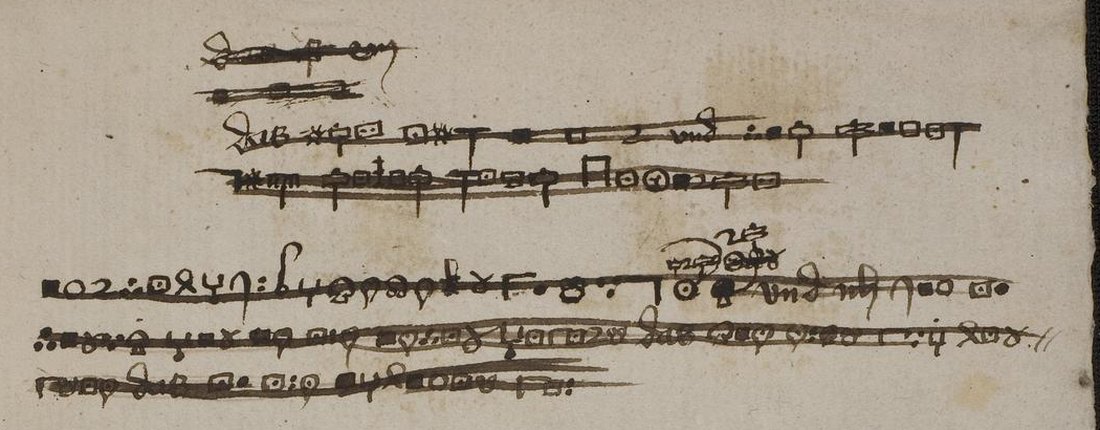
Wattenbach read the leaf in 1869: Das ist ein abc vnd das haben wir selbs neus gemacht, abcdefghiklmnopqrſstuwschch vnd ich hab es darum gar an ein ander gesetzt das man nicht sul versten das es ein alfabet sei — “This is an ABC that we made ourselves, new, and I have set it all together so that no one should understand that it is an alphabet.” The alphabet is written without a break, and the whole leaf is struck through. Wattenbach thought the strike was there because the key was too easy to guess; it is still legible.
With the strike line removed from the image, the run gives twenty-four signs in the order of the alphabet the text names:
| a | b | c | d | e | f | g | h | i | k | l | m |
|---|---|---|---|---|---|---|---|---|---|---|---|
| ▪ | o | 2 | ∴ | ⊡ | 8 | Y | ˥ | : | ɓ | 4 | ꝝ |
| n | o | p | q | r | ſ | s | t | u | w | sch | ch |
| ϙ | 88 | ꝗ | ꝁ | × | F | ● | ◒ | • | T | ⊙ | ♣ |
The signs are rendered with the nearest typographic shape. Two checks in running text:
- Line 3 continues after the clear vnd ich with ˥ ▪ o ⊡ ●, which is hab es, as Wattenbach printed.
- The recipe heading on f. 11r reads ϙ : ɓ 4 ▪ ● · Y ▪ ϙ ɓ ? : 2, niklas gank?icz, with one sign unread. A modern reader had already pencilled “= Niklas Gankwiz” beside it.

The first eleven values, a to l, are clear on the image, and a, b, c, e, g, h, i, k, l and s are checked in running text. The last thirteen are read from the shape of the signs under the heaviest part of the strike, and only a few of them have been met in running text; they are grade C.
03 The second alphabet: the invocation on f. 6v
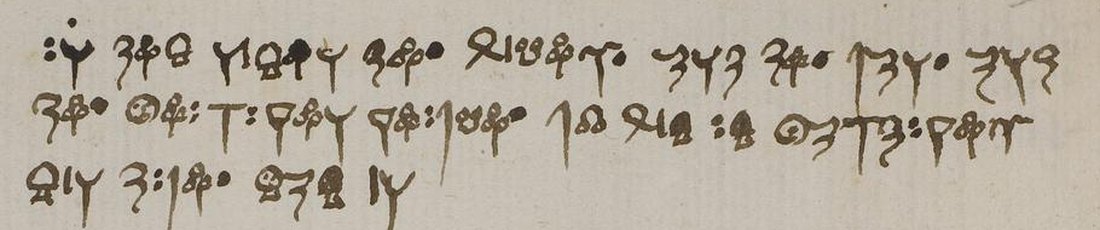
Wattenbach printed f. 6v with its reading: In dem namen des faters vnd des suns vnd des heiligen geistes so fach ich schuldiger man dises buch an, “In the name of the Father and of the Son and of the Holy Ghost I, a guilty man, begin this book.” Segmenting the three lines and laying them against the text gives nineteen values: : i, a hooked Y n, 3 d, a trefoil on a stem e, Ω with an inner triangle m, a stroke a, a tall stroke medial s, a blob final s, a ring with a tail f, a T with a wavy top r, a ring with a dot h, T l, a looped stem g, two loops on a stem t, a ring with a 3-tail sch, an 8 with an inner loop b, a c joined to a 2 for ch, 9 o, and a cup with a 3 for the u of vnd. Every word of the prayer reads with them.

The same set is written out in alphabetical order on f. 91v and crossed out, like the first. Wattenbach did not reproduce that leaf, and the catalogue notes it only as an alphabet.
04 The third set: boxes, stars and T
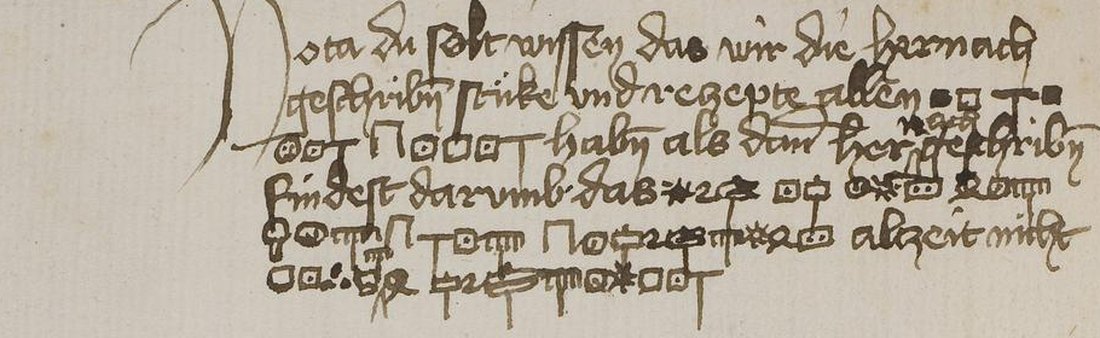
Wattenbach wrote that f. 1r uses “two different systems”. Lines 1–2 of that leaf are in a third set built from boxes with and without dots, stars and T-shapes, which also carries the preface and glossary on ff. 5v–6r and the notes on ff. 44v and 93r. Two printed readings fix part of it:
- f. 1r line 1, Das ist ein abc: Das [✱ 中 ⊡̈] [⊡ ✱ T] [▪ o 2].
- f. 93r, read in the 2014 catalogue as Nota wir haben versucht das [in dem caichen] der [iuncfrawn], “we have tried it in the sign of the Virgin”: [✱ T] [∴ ⊡ ■] [2 ▪ ✱ 2 ⊏ ⊡ T].

Together they give ▪ a, o b, 2 c, ∴ d, ⊡ e, ⊏ h, ✱ i, T n, a filled box m, a box on a stem s and a box with two dots t. The a, b, c, d and e are the signs of the f. 1r alphabet. The i and n are not, and T, which is w in the f. 1r alphabet, is n here. The s and t rest on one word each. The glossary on f. 6r uses further dotted-box variants and has not been read.
05 The recipes and the glossary
The glossary on f. 5v was printed by Wattenbach in its resolved form: aqua fortis is called “the sharp water”, sal ammoniac “sal”, its oil “Nyczadar”, common salt “sal aller”, gold “the yellow earth”, silver “the white earth”, green oil “vitriol”. The cover-names were meant to spare the writers from enciphering every substance, and the recipes still mix them with signs.
In the recipes (ff. 7r–22r, 46r–v, 54r–61r), the signs are mostly those of the f. 1r alphabet, as the name on f. 11r shows, with admixtures from the others; Bischoff noted that the sets are also used mixed. The runs are short, from one to a few words, and recur: the most frequent group appears about a dozen times on ff. 10v–15r. f. 79ar holds a struck table of sign groups, each over a pair of signs, which looks like a list of substances with their symbols.
06 Why it was looked at
The project’s oldest read cipher is from 1497, and a list of earlier candidates was drawn up to try to beat it. This book was on it at 1426 for three reasons: DECODE lists it as non-decrypted, with 85 images; the Handschriftencensus entry cites Bischoff for “S. 12 (Nr. 70–71)”, which was read as cipher on ff. 70–71; and the key was said to be on f. 1r. The first check on any target is for a prior reading. Wattenbach’s 1869 note, with its facsimiles of f. 1r, f. 5v and f. 6v and their plaintexts, settles it. The book is ruled out as a record candidate.
07 What remains open
- A continuous transcription of the enciphered recipe passages, f. 9r lines 7–12, the f. 6r glossary and f. 44v. Eis printed extracts only.
- The last thirteen signs of the f. 1r alphabet (m to ch), grade C until they are met in running text.
- One sign of the name on f. 11r (o or w).
- The third set beyond the eleven letters fixed above, and the table on f. 79ar.
08 Sources
- Heidelberg, Universitätsbibliothek, Cod. Pal. germ. 597, digital facsimile (Public Domain Mark). DECODE record R2876.
- Wilhelm Wattenbach, “Alchymey teuczsch”, Anzeiger für Kunde der deutschen Vorzeit NF 16 (1869), cols. 264–268, with facsimiles of f. 1r, f. 5v and f. 6v. Internet Archive.
- Bernhard Bischoff, “Übersicht über die nichtdiplomatischen Geheimschriften des Mittelalters”, MIÖG 62 (1954), pp. 1–27, items 70–71. MGH library PDF.
- Gerhard Eis, “Alchymey teuczsch”, Ostbairische Grenzmarken 1 (1957), pp. 11–16; reprinted in Medizinische Fachprosa des späten Mittelalters und der frühen Neuzeit (Amsterdam, 1982), pp. 307–315.
- Pamela Kalning, Matthias Miller and Karin Zimmermann, Die Codices Palatini germanici in der Universitätsbibliothek Heidelberg (Cod. Pal. germ. 496–670) (Wiesbaden, 2014), pp. 257–260. Digitised.
- Handschriftencensus 10300.
Notes, key tables and the segmentation scripts are in the repository (heidelberg597/); the page images are not committed. The readings of f. 1r, f. 5v and f. 6v are Wattenbach’s, and that of f. 93r the Heidelberg catalogue’s. The recovery of the sign values from the images is this project’s.