01 The letter
Folio 59r (“LVIIII”) of reg. 3225 carries three items, all dated Valencia, 5 August 1435: a letter to the queen’s procurator at the Roman curia, one to the vice-chancellor and ambassador Jacme Pelegrí, and one to the king. Only the last contains cipher. By the numbering of the series, reg. 3225 is Secretorum locumtenentiae reginae Mariae 4, the queen’s secret register for late 1423 to early 1437. PARES has neither a description nor images of it; DECODE holds this one page, uploaded in February 2026.
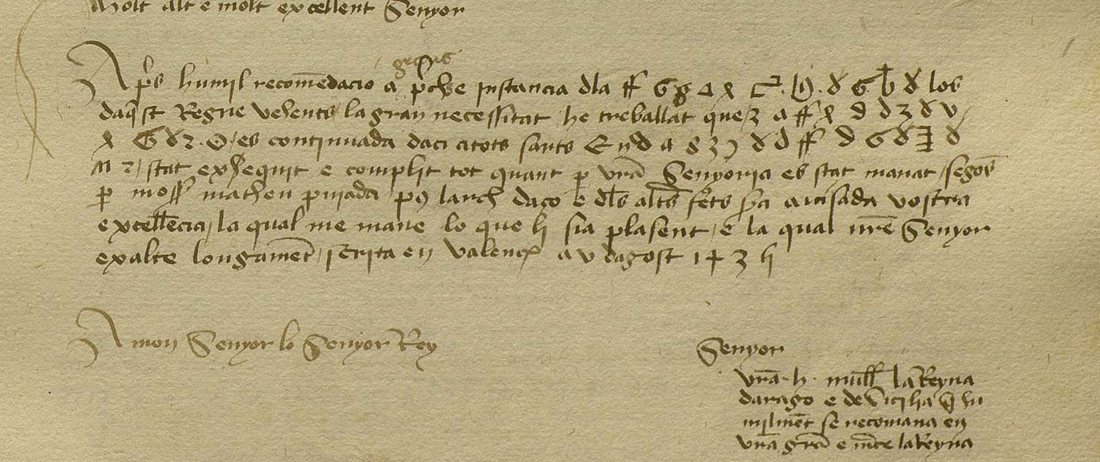
Working reading of the clear text, with the runs in brackets:
Molt alt e molt excellent Senyor. Apres humil recomendacio, a [gran?] instancia dels [run 1] los daquest Regne, veents la gran necessitat, he treballat que [run 2] es continuada daci a tots sants. E [run 3] / stat exseguit e complit tot quant per vostra senyoria es stat manat, segons per mossen Matheu Pujades … daco e dels altres fets ha avisada vostra excellencia, la qual me mane lo que li sia plasent, e la qual nostre Senyor exalte longament. Scripta en Valencia a v dagost 1435. — Senyor, vostra humil muller la Reyna d’Aragó e de Sicília, qui humilment se recomana en vostra gracia e merce. La Reyna.
“Most high and excellent lord. After humble recommendation: at the [great] instance of [run 1] and those of this kingdom, seeing the great need, I have worked so that [run 2] is continued from now until All Saints. And [run 3] has been carried out and fulfilled, everything your lordship ordered, as mossèn Mateu Pujades has informed your excellency of this and the other matters.”
02 The signs
Transcribed sign by sign from 5× to 7× crops. The runs mix digit-like forms (2, 3, 6, 8, 9), letter-like forms (a, d, n, v, M, ȝ, a doubled f with a bar) and figures: a triangle, a square hook, a b in a bracket, a circle with a dot, a cross on a curved foot, two E-shapes. Three of them (the hook, the bracketed b and the dotted circle) are flanked by dots, the usual mark of a nomenclator word. The 8 comes in three forms: plain, with a stroke at the top right, and with a tail at the lower left, and the tailed form follows every 6.
| Run | Clear before | Signs | Clear after |
|---|---|---|---|
| 1 | instancia dels | ff 6 8̣ △ 8 ·⌜· ·b)· 8ʹ 6 † 8ʹ | los daquest Regne |
| 2 | he treballat que | ȝ a ff 8ʹ 9 d 3 8ʹ v 8ʹ 6 8̣ 2 ·⊙· | es continuada daci a tots sants |
| 3 | E | E n 8ʹ a 8 3 2 8ʹ d ff 8 6 8̣ ∃ 8ʹ M ȝ | / stat exseguit e complit |
8ʹ = 8 with a top-right stroke; 8̣ = 8 with a lower-left tail. DECODE’s description counts four runs because run 3 breaks across a line end.
03 The two printed keys
1437, Montcada and Amat. The key of the embassy of Guillem Ramon de Montcada and Antoni Amat to Charles VII, dated 18 March 1437 (ACA, Cartas Reales Alfonso IV, Varios 69; Aragó, Cuadernos de Arqueología e Historia de la Ciudad 12, 1968; DECODE R10183, public; PARES 3205682). Its alphabet is dots, strokes and small hooks, one sign per letter; its nomenclator of about ninety entries uses a triangle for treva and a circle for naus. The alphabet shares nothing with the letter.
1429, the Castile war. The key published by Josepa Cortès Escrivà and Vicent Pons Alós, “Una clau criptogràfica d’Alfons el Magnànim per a la guerra amb Castella (1429)”, Saitabi 36 (1986), pp. 25–36: Biblioteca-Arxiu Històric Maiansià (Col·legi del Corpus Christi, València), ms. 677 f. 435v, headed cum baiulo generali Valencie, the king’s key with his batle general Joan Mercader. It has seventeen consonant signs, three signs for each vowel, nine nulls (nichil importantes), and a nomenclator of persons, places and terms of war drawn for the conflict with Castile.
- Alphabet: no fit. A few shapes recur (a crossed triple stroke for f, 8-like forms among the homophones of a and u, a 2-shaped q, a 3-shaped y), but a reading built on them gives nothing.
- Nomenclator: a plausible fit. The letter’s triangle matches the key’s regne d’Aragó (a triangle on a base); its dotted square hook, the key’s Catalunya (a barred hook); its dotted bracketed b, the key’s rei de Castella (a looped b set between dots); its 6 with a top stroke, the key’s curl for Navarra or naus; and a plain 3 is one of the key’s nulls.
On that reading run 1 would say, roughly, “at the instance of […] Navarre, Aragon and Catalonia, the king of Castile […] and those of this kingdom”, with the plain 8 as e, “and”. That suits a letter about extending a truce among Aragon, Navarre and Castile. It rests on four or five sign matches, and the alphabet signs between the word signs stay unassigned, so it is recorded here as a hypothesis, not a reading. The article also notes a second alphabet in the same volume, “aliud abecedarium in libro intitulato Segon d’estols e armades, cartes CLX–CLXI”, which has not been published.
04 The search for sibling letters
Forty-two signs cannot fix a homophonic alphabet, so the plan was to find more text in the same key. Reg. 3225 is not on PARES (only 460 of the 866 registers of Alfonso IV are described there), so five neighbours were fetched in full and read page by page:
| Register | Series | Span | Images | Cipher |
|---|---|---|---|---|
| 3226 | Secretorum loc. reginae Mariae 5 | Mar 1437 – Apr 1438 | 264 | none |
| 3224 | Secretorum loc. reginae Mariae 3 | Aug 1421 – Nov 1423 | 286 | none |
| 3113 | Comune Sigilli Secreti loc. 6 | June 1432 – 21 June 1435 | 472 | none |
| 2693 | Secretorum 3 (the king) | 1431 – July 1435 | 392 | none |
The queen’s letters to the king in these registers, and her instructions to envoys in Castile, are all in clear. Reg. 3113 stops on 21 June 1435, before the truce expired. The Cartas Reales of Alfonso IV on PARES (3,055 items with images) hold thirteen pieces of 1435, none from the king to the queen and none in cipher.
The king’s register explains the silence. His chancery copied ciphered despatches in clear and marked them fuit expedita in cifra: to his envoys at Rome in 1434, to the bishop of Lleida, to his almoner at Basel, to the archbishop of Zaragoza on 26 July 1435 (“the peace with Castile is signed and to be kept secret”), and to the queen herself on 27 July 1435.
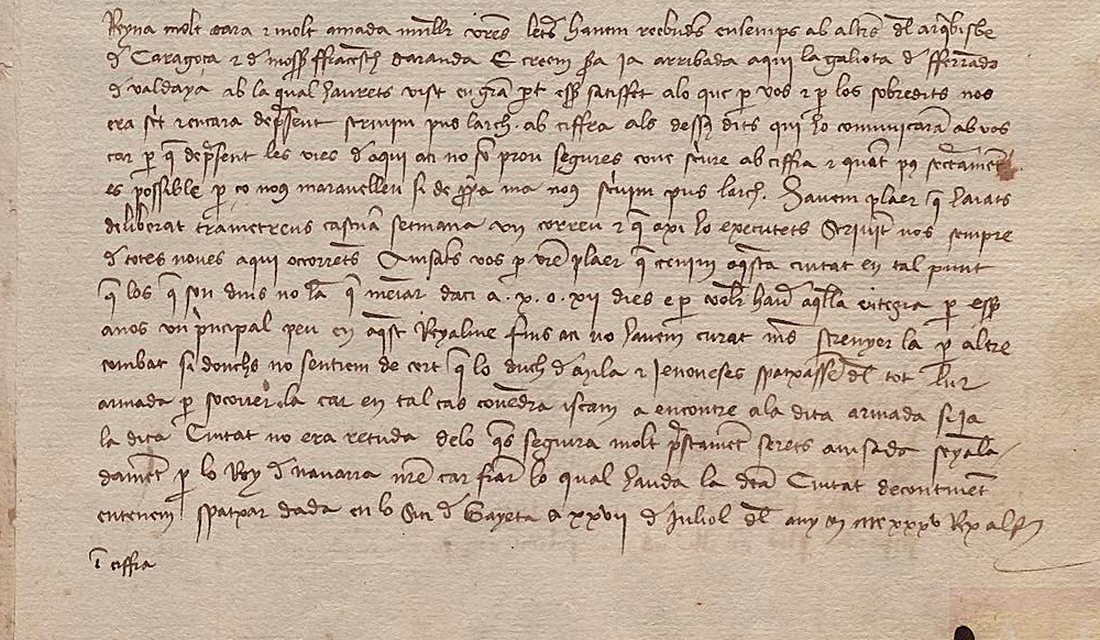
So a king–queen cipher was in use in the very week before her letter. The queen’s secretary copied cipher into the register; the king’s did not. The only place more of her side can survive is reg. 3225 itself, and the only place his ciphered originals can survive is among the letters she received, which on PARES do not include them.
05 The direct attack
A Catalan letter-quadgram model was built from about three million characters of Catalan text, and a simulated annealer searched one-sign-one-letter keys over the three runs, each scored with its clear context on both sides and the dotted signs treated as word boundaries. Without cribs it returns fluent-looking nonsense, as 42 signs must. Every crib is penalised heavily: la treua at the head of run 2 costs 63 log-units against the free optimum, treua at any offset 35 to 90, tregua 61 or more, castella anywhere in run 3 between 50 and 128, and most other offsets are impossible because a repeated sign would have to stand for two letters. With the 1429 nomenclator applied the result is the same. A plain substitution does not carry the expected words, which points to homophones, nulls and word signs, and those cannot be recovered from this little text.
06 What remains open, and what would finish it
- All 42 signs are unread. The nomenclator identifications above are graded M (possible) in the README’s scale; the reading of run 2 as the truce, and of the plain 8 as e, as C (likely) and M.
- ACA reg. 3225, the other folios of 1435 (roughly ff. 50–80), for more letters in the same cipher. It is not digitised; a reproduction request to the ACA is the direct route.
- The second alphabet of B.A.H.M. ms. 677, ff. 160–161, in the Col·legi del Corpus Christi, València, the likeliest printed-adjacent source for a Valencian key of these years.
- A key of the queen’s side at the Arxiu del Regne de València, where the batle general’s papers are kept.
07 Sources
- ACA, Cancillería, reg. 3225 f. 59r: DECODE R10171, de-crypt.org/decrypt-web/RecordsView/10171 (public image).
- ACA, Cancillería, regs. 3224, 3226, 3113 and 2693 on PARES: 3224, 3226, 3113, 2693 (the letter to the queen of 27 July 1435 is image 374).
- The 1437 key: ACA, Cartas Reales Alfonso IV, Varios 69, PARES 3205682, DECODE R10183; A. M. Aragó, “Una clau criptogràfica del segle XV”, Cuadernos de Arqueología e Historia de la Ciudad 12 (1968), pp. 171–176, PDF.
- The 1429 key: J. Cortès Escrivà and V. Pons Alós, “Una clau criptogràfica d’Alfons el Magnànim per a la guerra amb Castella (1429)”, Saitabi 36 (1986), pp. 25–36, Dialnet, full text on RODERIC.
- The truce: Treguas de Majano; M. Gual Camarena, “Las treguas de Majano entre Aragón, Navarra y Castilla (1430)”, Cuadernos de Historia de España 16 (1951), pp. 79–109.
- Context: T. Earenfight, The King’s Other Body: María of Castile and the Crown of Aragon (2010), and her 1997 dissertation on the lieutenancy; E. Sanahuja, Edad Media 21 (2020), n. 54, for the Aragonese keys known before 1440.
Transcription, notes, the solver and the PARES fetcher are in maria1435/. Page images are not in the repository.