
At a glanceExternal key matched · partial (99% of the cipher)
- The letters
- Marie de Médicis, regent after Henri IV’s death, to François Savary de Brèves, ambassador in Rome, 15 September and 10 November 1610, countersigned Brulart. Clear French with a few lines in cipher.
- Where
- BnF Français 3789, stamped ff. 17r and 19r (Gallica btv1b9059628m views 32 and 36). DECODE R2075 and R2076, listed as not deciphered.
- The cipher
- A homophonic alphabet of two to five signs a letter, letters with a comma for short words (a, = ce, y, = et), and plain and overbarred numbers for names and words.
- How it was deciphered
- Brice Dudout found that Henri IV’s 1610 key for Brèves, on BnF fr. 3462 view 112, fits the regent’s passages. Here every glyph was compared with the cell of the key it matches.
- What it says
- That the pope, “recognoissant leurs arogance et sentant sa timidite”, will not be pressed to the point of a humiliating refus; and, in September, that further difficulty would show “their malice and ambition”.
- Still open
- Two signs conflict with the key as it stands on the page, and four barred numbers (six occurrences) are on a part of the key that is not in hand; their values come from Satoshi Tomokiyo and agree with George Lasry’s key.
- Credit
- Decipherment by Brice Dudout, with Claude and Codex (October 2026). Satoshi Tomokiyo identified the key’s shelfmark and corroborated four number values. The key was first broken by George Lasry with Norbert Biermann and Tomokiyo (2021) on Henri IV’s letter, DECODE R2077; Lasry contributed his CTTS key, a second document in the key and his decryption of the November passage (pull request #61, 21 October 2026).
01 The letters
Henri IV was killed on 14 May 1610, and Marie de Médicis governed for the child Louis XIII. Her letters to Brèves in Rome are in BnF Français 3789, a volume of royal and ministerial letters to the ambassador. The BnF notice’s folio numbers run two ahead of the stamped foliation: its no. 11 (“fol. 19”) is stamped f. 17, Gallica view 32, and its no. 12 (“fol. 21 et 23”) is stamped f. 19, view 36. The subject of both is Savoy: in September the journey of the duke’s son to Spain, in November the disarmament after Spain’s refusal. The digits visible on f. 19v are show-through from the recto.
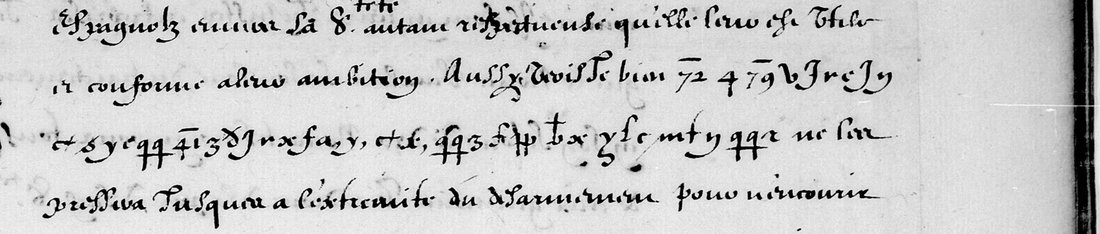
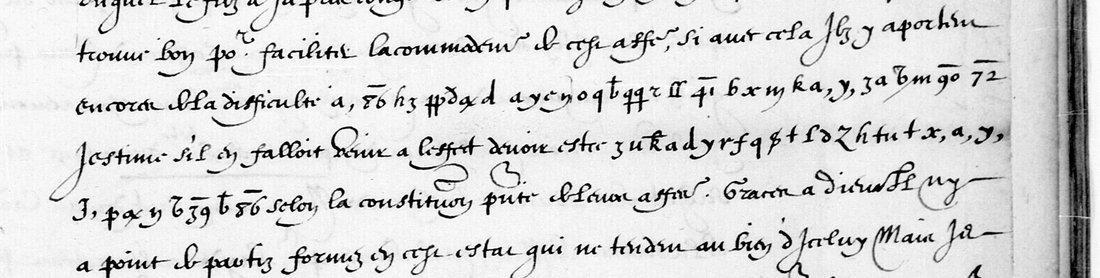
This project transcribed both passages on 21 September 2026 and closed them unread. DECODE’s record of Henri IV’s letter to Brèves of 5 January 1610 (R2077, BnF fr. 3541) said that the key was in “BNF Français 3642”, which is not on Gallica, and that R2075 and R2076 “may be in the same cipher”. The only image of the key here was an 833-pixel photo on that record, and trying its candidate letters for each sign, scored against seventeenth-century French, gave nothing that read.
02 The key in fr. 3462
Brice Dudout looked in BnF Français 3462 instead, a volume of cipher keys, and found the table on Gallica view 112. Satoshi Tomokiyo has since confirmed to him that “3642” on R2077 was a mistyping of 3462 and that this is the Henri IV–Brèves key image he knew. The same volume holds the office’s table for Brèves’s earlier Constantinople cipher (f. 103; see the 1603 letters, a different cipher, with its own page).
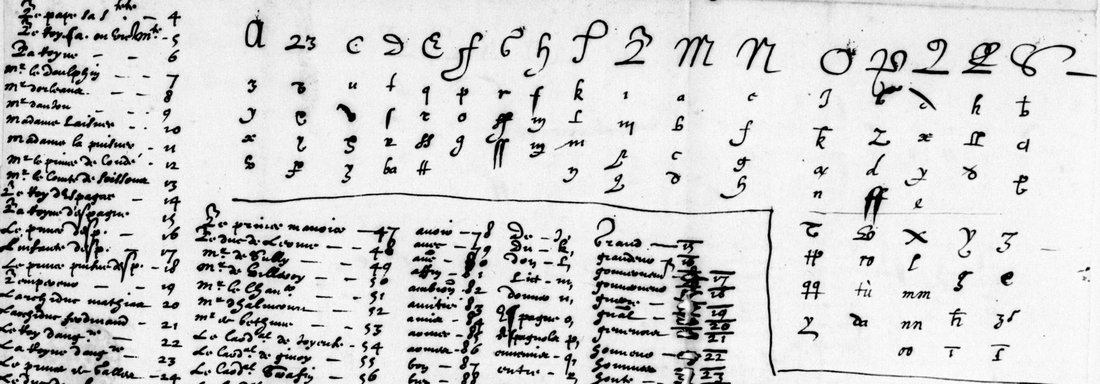
The table gives each letter two to five signs, many of them Latin letters used as signs: under m stand a, b, c and a delta; under n stand c, a hooked f, g and h. A letter followed by a comma is a word: a, ce, x, en, y, et. Plain numbers 4–99 are persons and words from a to c (72 is “le Sr Conchine”, 86 “armee”); overbarred numbers run from 1̄ to 4̄6 across words from f to m (3̄9 le, 4̄1 leurs). The barred numbers above 46 that the regent’s letters use, 7̄2, 7̄9, 8̄6 and 9̄0, belong to a continuation for later letters of the alphabet that is not on view 112. Tomokiyo gave Brice their values: que, re, se, tion.
03 15 September 1610
Two passages on f. 17r, lines 22–24, in Brice Dudout’s reading. The clear text of the letter is in roman, the deciphered words in italics; brackets are his, the notes after them are from the check below.
… si avec cela ilz y apportent encores de la difficulté, ce sera trop manifester leurs malice et ambition que j’estime, s’il en falloit venir a l’effet, devoir estre acompagne[z?] d’imprudence et [de?] foiblesse selon la constitution presente de leurs affaires.
“… if on top of that they still raise difficulty, it will show their malice and ambition too plainly; and that ambition, I think, if it came to action, would be accompanied by imprudence and weakness, given the present state of their affairs.”
- am[b?]ition, foi[b?]lesse: both signs are the first b of the key, a b with a flag. The key settles Brice’s brackets.
- acompagne[z?]: the sign is like a ß with a descender. On view 112 it is either the third e (drawn as ß) or the second z (a 3 joined to a long s). With e the word is acompagnee, agreeing with ambition, which is the better grammar. The images do not settle it.
- [de?]: the sign is J,, which on view 112 stands against an entry that reads De (the first word of its column, before Du and Don). Probable.
- se (twice), tion and que are barred 86, 90 and 72, which are not on view 112.
04 10 November 1610
Two lines on f. 19r, lines 5–7, the passage of catalogue item 25:
Aussi vois-je bien que le pape re[c?]ognoi[s?][s?]ant leurs arogance et [s?]entant sa timidite ne sera pressé jusques a l’extremité du desarmement pour recevoir enfin la honte d’un refus absolu …
“So I see well that the pope, recognising their arrogance and feeling his own timidity, will not be pressed to the extreme of disarmament only to receive in the end the shame of an outright refusal …” Brèves’s reply of 9 December 1610, in his Rome letter-book (BnF Cinq cents de Colbert 351, pp. 724–730), answers the letter on the pope and the Spanish disarmament, in paraphrase. The passage builds coherent sentences but reads at 93.8%, under the 95% bar.
- [s?]entant: the first sign is the looped crossed t that the key gives for s. Settled.
- re[c?]ognoissant: the sign is the flagged b, the same as in ambition; none of the four c signs of view 112 (u, a hook, a 5-shape, a ʒ) looks like it. The word needs c.
- recognoi[s?][s?]ant: the first s is the looped t of s; the second is a small loop with a diagonal stroke that has no cell under s. George Lasry’s key explains it: it is the cipher’s repeat sign, which doubles the letter before it (section 06). Settled.
- leurs: barred 41, whose entry on view 112 reads Leurs to me, with an uncertain ending; Tomokiyo gives leur. It is one code either way, and leur arogance is the more usual grammar.
05 The check
On 20 October Gallica refused image requests from here, so the check used the copies in Brice’s repository: the key at 1800 × 1580 pixels and his line crops of the two folios, both BnF images. Each of the 98 glyphs was set against the cell of view 112 that it matches, one line per glyph in alignment.tsv.
| Glyphs | 15 Sept | 10 Nov | All |
|---|---|---|---|
| In a cell of view 112 that gives Brice’s value | 52 | 34 | 86 |
| Fit an entry whose word is not certain (4̄1, J,) | 2 | 1 | 3 |
| Barred numbers not on view 112, values from Tomokiyo | 4 | 2 | 6 |
| Conflict with the key as it stands | 1 | 2 | 3 |
| Total | 59 | 39 | 98 |
So 89 of 98 glyphs (90.8%) are supported by the page itself and 95 (96.9%) with Tomokiyo’s values; with Lasry’s repeat sign (section 06), 96 (98.0%). The words manifester, malice, d’imprudence, arogance and sentant sa timidite come out of the table letter for letter, which is hard to get by chance from a homophonic key over this many signs. The three conflicting signs fall inside words that the context fixes. They are what Brice calls variants of a “very close” key: either the clerk slipped, or the regent’s table differed from Henri IV’s in a few cells.
The check also showed why the 21 September attempt failed. Our transcription missed the bars over 72 and 79 (plain 72 is “le Sr Conchine”, which sent the first guess wrong), wrote two signs of 10 November as one (3 and a raised crossed delta) and one glyph of 15 September as two (tu, a single sign for u, as Brice found), and gave one letter to shapes that the key keeps apart: our d was the p, m or r of the key, our z its a, p or t. With the 833-pixel photo those shapes could not be told apart.
06 George Lasry’s key
A full key. His key gives every sign of the cipher a value, including a repeat sign that doubles the letter or word before it. That sign is the “second s” of recognoissant above, which no s cell explained: his longer document uses it ten times (l’alarme, intelligence, aage, necessaire, brouillons). His key also gives the four barred numbers Tomokiyo supplied the same values (72̄ que, 79̄ re, 86̄ se, 90̄ tion). His CTTS sign names are labels, not the table’s letters: on view 112 the m column holds signs shaped like a, b, c, d, while his labels b, c, d name other signs.
A second document in the key, two images with 766 cipher signs, three of them unresolved: marriage negotiations carried on under cover names (La Hale, Le Cormier, La Cheville, Pindare, Saint Paul), the alarm they raised, and the need for calm at home and friendship with neighbours, “au grand desplaisir de Sa Sainteté”. Its shelfmark and date are not given; it reads like Henri IV writing to his ambassador in Rome, but it is not identified with R2077 without a matching archival image.
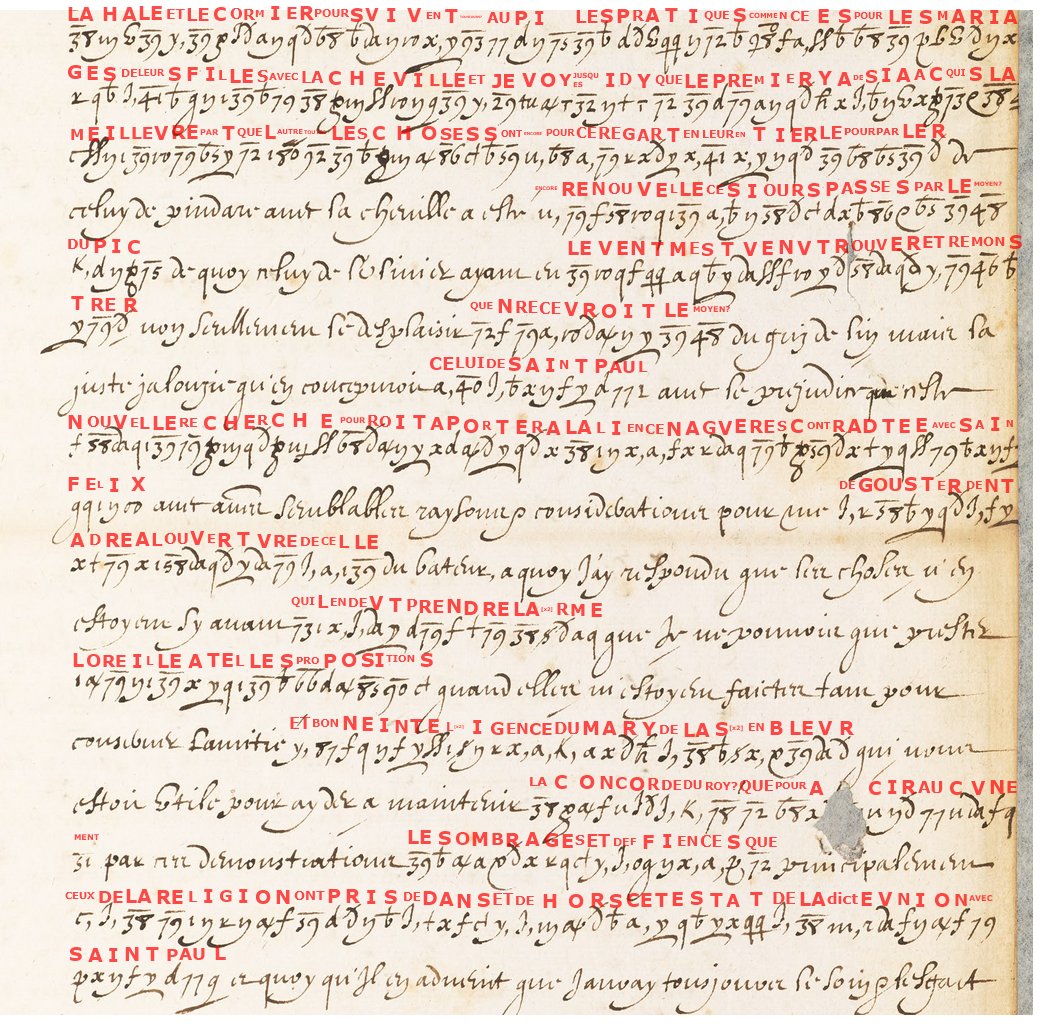
His decryption of the November passage, which agrees with Brice Dudout’s reading word for word.
07 What remains open
- re[c?]ognoissant, one sign: the key gives b. Lasry’s key gives it c, but from this word alone; his longer document does not use the sign. Needs the regent’s own table.
- acompagne[z?] or acompagnee, one sign: the two candidate cells differ by a stroke that the image does not settle.
- Barred 72, 79, 86 and 90, six occurrences: the part of the key with barred numbers above 46 is not in hand; the values are Tomokiyo’s, and each fits its context.
Brice asked whether this project has Lasry’s R2077 decipherment. Lasry has since sent his CTTS work (section 06), including a longer document in the key; whether that document is Henri IV’s letter R2077 is not established.
Full texts
The transcription and the decryption of every document on this page, so that the reading can be used and checked. Short files are shown here; all are in the repository.
15 Sept 1610, f. 17r (R2075), Brice Dudout's reading
Marie de Médicis to Brèves, two ciphered passages on Savoy's son's journey to Spain: their persistence in raising difficulties "will show too plainly their malice and ambition", which she judges would be "accompanied by imprudence and weakness" given the present state of their affairs. Deciphered by Brice Dudout with the Henri IV-Brèves key (BnF fr. 3462 view 112) and checked sign by sign here (alignment.tsv).
Transcription
# 15 Sept 1610, f. 17r, corrected 20 Oct 2026 (bars on 72, tu one glyph); one token per glyph, see alignment.tsv
a, 8̄6 h z ǂǂ ð̄ α d a y c y o q ŧ qq r ll 4̄1 b x m k a, y, 3 a b̄ m 9̄0 7̄2
z u k a d y r f q ß t l ð Z h tu t x, a, y, J, ǂ α y b̄ 3̄9 ŧ 8̄6
Decryption
# Marie de Médicis to Brèves, 1610: the ciphered passages as deciphered by Brice Dudout (Oct 2026), with the
# project's sign-by-sign check (alignment.tsv, 20 Oct 2026). [x?] = Brice's brackets; {..} = clear text of the letter.
# Spelling as the key gives it. Barred 72/79/86/90 are not on view 112; their values are as corroborated by Tomokiyo.

## 15 Sept 1610, f. 17r (R2075)
{si avec cela ilz y apportent encores de la difficulté,} ce se ra trop manifester leurs malice et ambition que
{j'estime, s'il en falloit venir a l'effet, devoir estre} acompagne[z?] d'imprudence et [de?] foiblesse
{selon la constitution presente de leurs affaires.}
# acompagne[z?]: the sign is E3 or Z2 on view 112; E3 gives "acompagnee", agreeing with "ambition".
# am[b]ition, foi[b]lesse: both signs are B1 on view 112 (Brice's brackets resolved).

## 10 Nov 1610, f. 19r (R2076)
{Aussi vois-je bien} que le pape re[c?]ognoi s[s?]ant leurs arogance et sentant sa timidite
{ne se[roit] pressé jusques a l'extremité du desarmement pour recevoir enfin la honte d'un refus absolu}
# re[c?]: the sign is B1 (b) on view 112; c is needed by the word.
# the second s of "recognoissant" has no S cell on view 112 (closest A4).
# [s]entant: S1 on view 112 (Brice's bracket resolved).
# leurs: barred 41 = "Leurs" on view 112 as read here; Tomokiyo gives "leur".
Reading
# Marie de Médicis to Brèves, 15 Sept 1610, f. 17r (R2075): reading

Rests on: Brice Dudout's decipherment (Oct 2026) with the Henri IV-Brèves key (BnF fr. 3462 view 112), checked sign by
sign here (`alignment.tsv`, 20 Oct 2026); copied from `reading.txt`, which holds both passages with comments. The
sentence is given whole: the clear words of the letter around the cipher are part of it (cipher: "ce sera trop
manifester leurs malice et ambition" and "acompagne[?e] d'imprudence et [?de] foiblesse"). "acompagne[?e]": the sign is
E3 or Z2 on view 112 (look-alike), E3 giving the feminine; "[?de]" is Brice's bracket. Written for the v3
verification, 23 Oct 2026.

## Reading

Si avec cela ilz y apportent encores de la difficulté, ce sera trop manifester leurs malice et ambition, que j'estime,
s'il en falloit venir a l'effet, devoir estre acompagne[?e] d'imprudence et [?de] foiblesse, selon la constitution
presente de leurs affaires.
Translation
<!-- English translation of 15sept1610_reading.md (Claude Opus 5.5, 23 Oct 2026), with the same holes. The sentence is given whole, clear words included; the cipher parts are "it will be showing too plainly their malice and ambition" and "accompanied by imprudence and [?by] weakness". -->

# Marie de Médicis to Brèves, 15 September 1610, f. 17r (R2075): English translation

If on top of that they still raise difficulties about it, it will be showing too plainly their malice and ambition,
which I judge, should it come to action, must be accompanied by imprudence and [?by] weakness, given the present state
of their affairs.
10 Nov 1610, f. 19r (R2076), Brice Dudout's reading read in part
In mid-sentence, on Savoy's disarmament after Henri IV's death and Spain's refusal: "the pope, recognising their arrogance and sensing his own timidity", would not press Spain to the point of disarmament only to receive the shame of a flat refusal. Brice Dudout's reading, checked sign by sign here (alignment.tsv).
Builds coherent sentences, but under the read bar of 95% of words read as sense (94% here); the holes are marked in the reading.
Transcription
# 10 Nov 1610, f. 19r, corrected 20 Oct 2026 (bars on 72 and 79, 3ᵈ = 3 + raised crossed delta); one token per glyph, see alignment.tsv
7̄2 4 7̄9 b J r c J y
ŧ ȣ y c qq 4̄1 3 ð̄ J r x f a, y, ŧ x, qq 3 s ǂǂ ŧ x ʒ l c m t y qq r
Decryption
# Marie de Médicis to Brèves, 1610: the ciphered passages as deciphered by Brice Dudout (Oct 2026), with the
# project's sign-by-sign check (alignment.tsv, 20 Oct 2026). [x?] = Brice's brackets; {..} = clear text of the letter.
# Spelling as the key gives it. Barred 72/79/86/90 are not on view 112; their values are as corroborated by Tomokiyo.

## 15 Sept 1610, f. 17r (R2075)
{si avec cela ilz y apportent encores de la difficulté,} ce se ra trop manifester leurs malice et ambition que
{j'estime, s'il en falloit venir a l'effet, devoir estre} acompagne[z?] d'imprudence et [de?] foiblesse
{selon la constitution presente de leurs affaires.}
# acompagne[z?]: the sign is E3 or Z2 on view 112; E3 gives "acompagnee", agreeing with "ambition".
# am[b]ition, foi[b]lesse: both signs are B1 on view 112 (Brice's brackets resolved).

## 10 Nov 1610, f. 19r (R2076)
{Aussi vois-je bien} que le pape re[c?]ognoi s[s?]ant leurs arogance et sentant sa timidite
{ne se[roit] pressé jusques a l'extremité du desarmement pour recevoir enfin la honte d'un refus absolu}
# re[c?]: the sign is B1 (b) on view 112; c is needed by the word.
# the second s of "recognoissant" has no S cell on view 112 (closest A4).
# [s]entant: S1 on view 112 (Brice's bracket resolved).
# leurs: barred 41 = "Leurs" on view 112 as read here; Tomokiyo gives "leur".
Reading
# Marie de Médicis to Brèves, 10 Nov 1610, f. 19r (R2076): reading

Rests on: Brice Dudout's decipherment (Oct 2026) with the Henri IV-Brèves key (BnF fr. 3462 view 112), checked sign by
sign here (`alignment.tsv`); copied from `reading.txt`. The sentence is given whole with the clear words of the letter
around it (cipher: "que le pape recognoissant leurs arogance et sentant sa timidite"; 4 = "le pape" in the
nomenclator). Holes: re[?c]ognoissant (the sign is B1, b, on view 112; the word needs c), and se[roit] in the clear
text (Brice's supplied letters). George Lasry's CTTS decipherment of the same passage agrees
(`10nov1610_lasry_reading.md`). Written for the v3 verification, 23 Oct 2026.

## Reading

Aussi vois-je bien que le pape re[?c]ognoissant leurs arogance et sentant sa timidite ne se[roit] pressé jusques a
l'extremité du desarmement pour recevoir enfin la honte d'un refus absolu.
Translation
<!-- English translation of 10nov1610_reading.md (Claude Opus 5.5, 23 Oct 2026), with the same holes; the cipher part is "the Pope, recognising their arrogance and feeling his own timidity". -->

# Marie de Médicis to Brèves, 10 November 1610, f. 19r (R2076): English translation

So I see clearly that the Pope, [?recognising] their arrogance and feeling his own timidity, [would] not be pressed to
the extremity of disarmament only to receive in the end the shame of an absolute refusal.
10 Nov 1610, image 3, George Lasry's CTTS transcription and decryption
George Lasry's CTTS decipherment of the same passage (2022, improved with Opus 5.5 in Oct 2026, PR #61): mechanical CTTS decryption and his edited text. It agrees with Dudout's reading word for word and shows the second s of recognoissant as the key's repeat sign.
Transcription
# 3.jpg
72_;4;79_;b;j;r2;c2;j;ny;
ct;s-;y2;c2;qq=;41_;3;d-;j;v;x;f;a,;y,;ct;x,;qq=;3;f;tp;b-;x;y;l2;e;m;t;ny;qq=;r;
Decryption
# 3.jpg
que sa saintete re c o g n o i
s s a n t leur a r o g a n ce et s en t a n t s a t i m i d i t e
Decryption
1|… Aussy vois je bien que Sa Sainteté, recognoi-
2|ssant leur arogance et sentant sa timidité, ne leur pressera jusques a l'extremité du desarmement …
Reading
# Marie de Médicis to Brèves, 10 Nov 1610, image 3: George Lasry's CTTS reading

Rests on: George Lasry's CTTS transcription and decryption (2022; `lasry2022/ctts/decryption/3.txt`) and his edited
text (`lasry2022/ctts/edited/3_edits.txt`), joined here into running text (the line break in "recognoi-ssant" closed).
His "…" at both ends marks that the excerpt starts and ends inside the letter; they are not gaps in the cipher and are
left out. Cipher part: "sa saintete recognoissant leur arogance et sentant sa timidite"; the rest is the clear text
around it as he gives it. Written for the v3 verification, 23 Oct 2026.

## Reading

Aussy vois je bien que Sa Sainteté, recognoissant leur arogance et sentant sa timidité, ne leur pressera jusques a
l'extremité du desarmement.
Translation
<!-- English translation of 10nov1610_lasry_reading.md (Claude Opus 5.5, 23 Oct 2026): George Lasry's CTTS reading of the same passage, an excerpt inside the letter. -->

# Marie de Médicis to Brèves, 10 November 1610, image 3: English translation of George Lasry's CTTS reading

So I see clearly that His Holiness, recognising their arrogance and feeling his own timidity, will not press them to the
extremity of disarmament.
Additional document, image b1 (George Lasry's CTTS files)
A letter in the same key, read by George Lasry (CTTS, 2022; improved with Opus 5.5, Oct 2026): marriage negotiations under aliases (La Hale, Le Cormier, La Cheville, Pindare, Saint Paul). Shelfmark and date not established; it may be Henri IV to Brèves (R2077), but Lasry asks that it not be identified with R2077 without a matching archival image.
Transcription
# b1.bmp
38_;my;E;39_;y,;39_;G+;J;d-;a;ny;q;d-;68_;b-;da;ny;vo;x,;y;93_;77;d;ny;75_;39_;b-;d;d-;E;qq=;ny;72_;b-;q=;f;a,;h;b-;68_;39_;Z;l;E;d-;ny;x;
k;q;b-;j,;41_;b-;g2;ny;i;39_;b-;79;38_;G+;my;h;vo;ny;g;39_;y,;29_;tu;a+;T;32_;ny;t;T;72_;39_;d;79_;a;ny;q;d-;h-;x;j,;b-;ny;E;x;G+;73_;c;38_;
e;h;ny;i;39_;vo;79_;65_;y;72_;i;80;92_;39_;b-;G+;my;a+;86_;ct;b-;59_;u,;68_;a,;79_;k;x;d-;y;x,;41_;x,;y;ny;q;d-;39_;68_;65_;39_;d-;PLAINTEXT;
PLAINTEXT;u,;79_;f;58_;vo;q;i;39_;a,;b-;ny;58_;d-;ct;d;x;b-;86_;c;65_;39_;48_;
k,;d;ny;G+;75_;PLAINTEXT;39_;vo;q;f;qq=;a;q;b-;y;da;h;f;vo;y;d-;58_;da;q;d-;y,;79_;46_;b-;
y;79_;d-;PLAINTEXT;72_;f;79_;a,;vo;d-;a+;ny;y;39_;48_;PLAINTEXT;
PLAINTEXT;a,;40_;j,;b-;x;ny;f;y;d;77;i;PLAINTEXT;
f;58_;da;q;i;39_;79_;G+;my;q;d-;G+;my;h;68_;d-;a+;ny;y;x;d;a+;d-;y;q;d-;x;38_;i;ny;x,;a,;f;x;k;da;q;79_;b-;G+;59_;d-;x;t;y;q;h;79;b-;x;ny;f;
g2;q;i;ny;oo;PLAINTEXT;j,;k;58_;b-;y;q;d-;j,;f;y;
x;t;79_;x;i;58_;da;q;d-;y;da;79_;j,;a,;i;39_;PLAINTEXT;
PLAINTEXT;73_;i;x,;j,;da;y;d;79_;f;t;79_;38_;s-;d-;a;q;PLAINTEXT;
i;a+;79_;ny;i;39_;x;y;q;i;39_;b-;66_;d;a+;85_;90_;ct;PLAINTEXT;
PLAINTEXT;y,;87;f;q;ny;f;y;h;i;s-;ny;k;x,;a,;k,;a;x;d-;h-;j,;38_;b-;s-;x,;co;39_;da;d-;PLAINTEXT;
PLAINTEXT;38_;G+;a+;f;u;J;d-;j,;k,;78_;72_;68_;x;PLAINTEXT;u;ny;d-;77;u;da;f;q;
51_;PLAINTEXT;39_;b-;a+;a;co;d-;x;k;q;ct;y,;j,;o;g2;ny;x,;a,;Z;72_;PLAINTEXT;
e,;j,;38_;79_;i;ny;k;ny;a+;f;59_;d;d-;ny;b-;j,;t;x;f;ct;y,;j,;my;a+;d-;b-;a,;y;q;b-;y;x;qq=;j,;38_;m,;r;da;f;ny;a+;f;79;
Z;x;ny;f;y;d;77;g;PLAINTEXT;
Decryption
# b1.bmp
la h a le et le c o r m i e r pour s v i v en t tousiours? au p i <75_> le s p r a t i que s comme n ce e s pour le s m a r i a
g e s de leur s f i l le s avec la c h e v i l le et je v o y jusques i d y que le p re m i e r y a de s i a a c qui s la
m e i l le v re par t que l autre toutes le s c h o se s s ont encore pour ce re g a r t en leur en t i e r le pour par le r <plaintext>
<plaintext> encore re n ou v e l le ce s i ou r s p a s se s par le moyen?
du p i c <75_> <plaintext> le v e n t m e s t v e n v t r ou v e r et re mon s
t re r <plaintext> que n re ce v r o i t le moyen? <plaintext>
<plaintext> ce lui de s a i n t p au l <plaintext>
n ou v e l le re c h e r c h e pour r o i t a p o r t e r a la l i en ce n a g v e re s c ont r a d t e e avec s a i n
f e l i x <plaintext> de g ou s t e r de n t
a d re a l ou v e r t v re de ce l le <plaintext>
<plaintext> qui l en de v t p re n d re la la r m e <plaintext>
l o re i l le a t e l le s pro p o si tion s <plaintext>
<plaintext> et bon n e i n t e l l i g en ce du m a r y de la s s en b le v r <plaintext>
<plaintext> la c o n c o r de du roy? que pour a <plaintext> c i r au c v n e
ment <plaintext> le s o m b r a g e s et de f f i en ce s que <plaintext>
ceux de la re l i g i o n ont p r i s de d a n s et de h o r s ce t e s t a t de la dict e v n i o n avec
s a i n t p au l <plaintext>
Decryption
1|la Hale et le Cormier poursuivent tousjours? au Pi[75̄?] les pratiques commencées pour les maria-
2|ges de leurs filles avec la Cheville, et je voy jusques icy que le premier y a desja acquis la
3|meilleure part que l'autre; toutes les choses sont encore pour ce regard en leur entier. Le pourparler de
4|celuy de Vendosme? avec la Cheville a esté rompu, encore renouvellé ces jours passés par le moyen?
5|du Pic[75̄?], de quoy [M. de …?] ayant eu le vent m'est venu trouver et remons-
6|trer non seullement le desplaisir que n'en recevroit le moyen? du [Duc de …?], mais la
7|juste jalousie qu'en concevroit celuy de Saint Paul, avec le prejudice qu'une
8|nouvelle recherche pourroit apporter a l'alliance n'agueres contractée avec Saint
9|Felix, avec aussi semblables raysons et considerations pour me desgouster et de n'enten-
10|dre a l'ouverture de celle du Bateur?, a quoy j'ay respondu que ces choses n'e-
11|stoyent si avant qu'il en deust prendre l'alarme, que je ne pouvois que rejetter?
12|l'oreille a telles propositions, et quand elles m'estoyent faictes tant pour
13|conserver l'amitié et bonne intelligence du Mary de l'assembleur qui nous
14|estoit utile pour ayder a maintenir la concorde du Roy? que pour adoucir aucune-
15|ment par ces demonstrations les ombrages et deffiences que principalemen-
16|t ceux de la religion ont pris dedans et hors cest estat de la dicte union avec
17|Saint Paul, a quoy qu'il y adjoint que j'auray tousjours le soing de scavoir? …
Reading
<!-- Additional document in the Henri IV-Brèves key, image b1. Running text built 23 Oct 2026 (Claude Opus 5.5, verification 5) from lasry2022/reading_fr.txt, the edition of George Lasry's CTTS decryption (2022, improved with Opus 5.5) with Codex's image checks (PR #61): line numbers cut, words broken at a line end rejoined; brackets and spelling as in the edition. [?word] / [word?] = uncertain, [74̄]-type = unassigned code, [suite hors image] = the image ends. -->

# Additional document, image b1 (George Lasry's CTTS decryption, edited)

## Reading

La Hale et le Cormier poursuivent [tousjours?] au Pi[75̄] les pratiques commencées pour les mariages de leurs filles avec la Cheville, et je voy jusques icy que le premier y a desja acquis la meilleure part que l’autre. Toutes les choses sont encore pour ce regard en leur entier. Le pourparler de celuy de Pindare avec la Cheville a esté encore renouvellé ces jours passés par le [moyen?; 48̄] du Pic[75̄], de quoy celuy de [l’Olivier?] ayant eu le vent m’est venu trouver et remonstrer non seullement le desplaisir qu’en recevroit le [moyen?; 48̄] du Gris de Lin, mais la juste jalousie qu’en concevroit celuy de Saint Paul, avec le prejudice que ceste nouvelle recherche pourroit apporter à l’alliance naguères contractée avec Saint Felix, avec autres semblables raysons et considerations pour me desgouster d’entendre à l’ouverture de celle du Bateur, à quoy j’ay respondu que les choses n’en estoyent si avant qu’il en deust prendre l’alarme, que je ne pouvois que prester l’oreille à telles propositions quand elles m’estoyent faictes, tant pour conserver l’amitié et bonne intelligence du mary de l’Assembleur, qui nous estoit utile pour ayder à maintenir la concorde du [Roy?; 78̄], que pour a[dou]cir aucunement par ces demonstrations les ombrages et deffiences que principalement ceux de la religion ont pris dedans et dehors cest estat de la dicte union avec Saint Paul ; et quoy qu’il en advient, que j’auray tousjours le soing et l’effect [suite hors image].
Translation
<!-- English translation of lasry2022/b1_reading.md (Claude Opus 5.5, 23 Oct 2026), with the same holes and marks: [word?] uncertain, [75̄]-type unassigned codes kept; the cover names of the code (la Hale, le Cormier, la Cheville, Pindare, Saint Paul, Saint Felix, le Bateur, le Gris de Lin, l'Assembleur ...) are kept as in the original. -->

# Additional document in the Henri IV-Brèves key, image b1 (George Lasry's CTTS decryption, edited): English translation

La Hale and le Cormier are [still?] pursuing at Pi[75̄] the negotiations begun for the marriages of their daughters
with la Cheville, and I see so far that the first has already gained the better part over the other. Everything in
this regard is still intact. The talk of that of Pindare with la Cheville was renewed again these past days by the
[means?; 48̄] of Pic[75̄]; of which the one of [l'Olivier?], having got wind of it, came to find me and point out not
only the displeasure that the [means?; 48̄] of le Gris de Lin would feel at it, but the just jealousy that the one of
Saint Paul would conceive of it, with the prejudice that this new suit might bring to the alliance lately contracted
with Saint Felix, with other similar reasons and considerations, to put me off listening to the overture of that of le
Bateur. To which I answered that matters were not so far advanced that he should take alarm at it; that I could not
but lend an ear to such proposals when they were made to me, both to preserve the friendship and good understanding of
the husband of l'Assembleur, who was useful to us in helping to maintain the concord of the [King?; 78̄], and to soften
somewhat by these demonstrations the suspicions and distrust that those of the Religion above all have conceived,
inside and outside this state, at the said union with Saint Paul; and whatever comes of it, that I shall always have the
care and the effect [continues beyond the image].
Additional document, image b2 (George Lasry's CTTS files)
Second image of the same document (Lasry's CTTS files): the reaction to an alliance, calm at home and friendship with neighbours, "au grand desplaisir de Sa Sainteté"; barred 74 and 75 unresolved.
Transcription
# b2.bmp
PLAINTEXT;
PLAINTEXT;38_;m,;q;u;my;r;da;ny;i;39_;y,;72_;41_;b-;x,;g2;x;f;ct;s-;59_;x,;x;s-;k;q;69_;66_;d;79_;y,;b-;a+;d-;y;x;co;39_;E;a,;5_;72_;
38_;86_;da;d-;d;vo;ny;ct;f;q;s-;j,;ct;E;i;da;b-;y;r;72_;68_;a;q;f;x;k;r;d-;39_;79_;d;a+;c;j,;39_;b-;y;E;qq=;30_;q;b-;y;q;oo;d;r;t;
ny;x,;y;da;a+;ny;79_;f;r;a,;b-;s-;E;ny;79_;j,;a;r;f;x;k;q;d-;65_;q;ny;i;39_;51_;i;83;j,;Z;da;J;ny;85_;f;Z;72_;85_;38_;9_;E;33_;q;da;
co;q;b-;a+;ny;f;j,;38_;d;d-;x;y;ny;72_;j,;a,;d;79_;a,;d;qq=;q;a,;b-;y;77;ny;58_;d-;t;my;da;h-;72_;i;39_;q;b-;qq=;f;r;a,;b-;s-;x;ny;79_;
65_;a;h-;38_;a;da;i;y;ny;qq=;vo;j,;s-;ct;r;b-;d;d-;ny;tp;c;g2;E;u;y;ny;q;da;oo;y,;co;d-;58_;ny;i;s-;a+;f;ct;j,;i;da;f;q;y;g;80;79_;
g;m;k;ny;a+;f;73_;86_;79_;qq=;d-;58_;vo;x,;y;x;ny;a,;i;39_;77;j,;b-;86_;ny;f;PLAINTEXT;
PLAINTEXT;
65_;i;x,;da;h-;q;j,;ct;da;a+;m;85_;f;Z;PLAINTEXT;g2;a+;a;x,;y;r;j,;74_;38_;79_;i;ny;k;m;a+;f;y,;39_;b-;
y;x;qq=;d;x;y;m;d-;a+;h-;x,;y;x,;b-;x,;co;39_;56_;a;q;t;ny;a+;u;79_;51_;PLAINTEXT;
Decryption
# b2.bmp
<plaintext>
<plaintext> la dict e c h e v i l le et que leur s en f a n s s ont en a a g e plus pro p re et s o r t a b le a ce faire? que
la se v r p v i s n e e de s a l v s t e que pour m e n a g e r le re p o s de le s t a t il e s t e x p e d
i en t v o i re n e ce s s a i re de m e n a g e r par e i l le ment l amitie de s v o i si n s que si la france a jamais e v
b e s o i n de la p r a t i que de ce p re ce p t e ce s t au i ou r d h v y que l le e s t n e ce s s a i re
par m y la m v l t i t v de de s e s p r i t s f a c t i e v x et b r ou i l l o n s de l v n e t l autre re
l i g i o n qui se re t r ou v en t a i ce l le au de s se i n <plaintext>
<plaintext>
par l en v y e de s v o i si n s <plaintext> f o m en t e de <74_> la re l i g i o n et le s
t a t p a t i r o y en t en s en b le non m e d i o c re ment <plaintext>
Decryption
1|l'accompagnent de dire que la Hale et le Cormier sollicitent tousjours vivement
2|pour [?] la dicte Cheville, et que leurs enfans sont en aage plus propre et sortable a ce faire? que
3|la seur puisnée de Saluste. Que pour menager le repos de l'estat il est exped-
4|ient, voire necessaire, de menager pareillement l'amitié des voisins; que si la France a jamais eu
5|besoin de la pratique de ce precepte, c'est aujourd'huy qu'elle est necessaire
6|parmy la multitude des esprits factieux et brouillons de l'un et l'autre re-
7|ligion qui se retrouvent a icelle au dessein de Lesdiguieres?; rien ne peust
8|estre opposé de plus puissant que le calme du Royaume, car le trouble
9|par l'envie des voisins si bon aussy tost fomenté de [74̄] la religion et l'es-
10|tat patiroyent ensemble non mediocrement, au grand desplaisir de Sa Sainteté.
Reading
<!-- Additional document in the Henri IV-Brèves key, image b2. Running text built 23 Oct 2026 (Claude Opus 5.5, verification 5) from lasry2022/reading_fr.txt, the edition of George Lasry's CTTS decryption (2022, improved with Opus 5.5) with Codex's image checks (PR #61): line numbers cut, words broken at a line end rejoined; brackets and spelling as in the edition. [?word] / [word?] = uncertain, [74̄]-type = unassigned code, [suite hors image] = the image ends. -->

# Additional document, image b2 (George Lasry's CTTS decryption, edited)

## Reading

L’accompagnant de dire que la Halle et le Cormier sollicitent tousjours vivement pour eux la dicte Cheville, et que leurs enfans sont en aage plus propre et sortable à ce [faire?] que la sœur puisnée de Saluste ; que pour mesnager le repos de l’estat il est expedient, voire necessaire, de mesnager pareillement l’amitié des voisins ; que si la France a jamais eu besoin de la pratique de ce precepte, c’est aujourd’huy qu’elle est necessaire parmy la multitude des esprits factieux et brouillons de l’une et l’autre religion qui se retrouvent à icelle, au dessein desquels rien ne peust estre opposé de plus puissant que le calme du royaume, car le trouble par l’envie des voisins si bon [aussytost?] fomenté de [74̄], la religion et l’estat patiroyent ensemble non mediocrement, au grand desplaisir de Sa Sainteté. [Suite hors image.]
Translation
<!-- English translation of lasry2022/b2_reading.md (Claude Opus 5.5, 23 Oct 2026), with the same holes and marks; the code's cover names (la Halle, le Cormier, la Cheville, Saluste) are kept. -->

# Additional document in the Henri IV-Brèves key, image b2 (George Lasry's CTTS decryption, edited): English translation

Adding that la Halle and le Cormier still press keenly for themselves for the said Cheville, and that their children
are of an age more suitable and fitting for this [doing?] than the younger sister of Saluste; that to manage the peace
of the state it is expedient, indeed necessary, to manage likewise the friendship of the neighbours; that if France
has ever needed to practise this precept, it is today that it is necessary, amid the multitude of factious and
trouble-making spirits of both religions who are found in it, against whose designs nothing more powerful can be set
than the calm of the kingdom; for, the trouble [?being at once] fomented by the envy of the neighbours of [74̄],
religion and the state would suffer together not a little, to the great displeasure of His Holiness. [Continues beyond
the image.]
Additional document and 10 Nov excerpt, edited reading with Codex's image checks (PR #61)
The edition prepared by Codex in the contribution, taking Lasry's CTTS key and reading as its base and departing from his edited export where the images support it (Pindare not Vendosme?, prester l'oreille not rejetter?, desquels not de Lesdiguières?, rompu omitted). Lasry's own edited text is in ctts/edited/, unchanged, for comparison.
Transcription
# b1.bmp
38_;my;E;39_;y,;39_;G+;J;d-;a;ny;q;d-;68_;b-;da;ny;vo;x,;y;93_;77;d;ny;75_;39_;b-;d;d-;E;qq=;ny;72_;b-;q=;f;a,;h;b-;68_;39_;Z;l;E;d-;ny;x;
k;q;b-;j,;41_;b-;g2;ny;i;39_;b-;79;38_;G+;my;h;vo;ny;g;39_;y,;29_;tu;a+;T;32_;ny;t;T;72_;39_;d;79_;a;ny;q;d-;h-;x;j,;b-;ny;E;x;G+;73_;c;38_;
e;h;ny;i;39_;vo;79_;65_;y;72_;i;80;92_;39_;b-;G+;my;a+;86_;ct;b-;59_;u,;68_;a,;79_;k;x;d-;y;x,;41_;x,;y;ny;q;d-;39_;68_;65_;39_;d-;PLAINTEXT;
PLAINTEXT;u,;79_;f;58_;vo;q;i;39_;a,;b-;ny;58_;d-;ct;d;x;b-;86_;c;65_;39_;48_;
k,;d;ny;G+;75_;PLAINTEXT;39_;vo;q;f;qq=;a;q;b-;y;da;h;f;vo;y;d-;58_;da;q;d-;y,;79_;46_;b-;
y;79_;d-;PLAINTEXT;72_;f;79_;a,;vo;d-;a+;ny;y;39_;48_;PLAINTEXT;
PLAINTEXT;a,;40_;j,;b-;x;ny;f;y;d;77;i;PLAINTEXT;
f;58_;da;q;i;39_;79_;G+;my;q;d-;G+;my;h;68_;d-;a+;ny;y;x;d;a+;d-;y;q;d-;x;38_;i;ny;x,;a,;f;x;k;da;q;79_;b-;G+;59_;d-;x;t;y;q;h;79;b-;x;ny;f;
g2;q;i;ny;oo;PLAINTEXT;j,;k;58_;b-;y;q;d-;j,;f;y;
x;t;79_;x;i;58_;da;q;d-;y;da;79_;j,;a,;i;39_;PLAINTEXT;
PLAINTEXT;73_;i;x,;j,;da;y;d;79_;f;t;79_;38_;s-;d-;a;q;PLAINTEXT;
i;a+;79_;ny;i;39_;x;y;q;i;39_;b-;66_;d;a+;85_;90_;ct;PLAINTEXT;
PLAINTEXT;y,;87;f;q;ny;f;y;h;i;s-;ny;k;x,;a,;k,;a;x;d-;h-;j,;38_;b-;s-;x,;co;39_;da;d-;PLAINTEXT;
PLAINTEXT;38_;G+;a+;f;u;J;d-;j,;k,;78_;72_;68_;x;PLAINTEXT;u;ny;d-;77;u;da;f;q;
51_;PLAINTEXT;39_;b-;a+;a;co;d-;x;k;q;ct;y,;j,;o;g2;ny;x,;a,;Z;72_;PLAINTEXT;
e,;j,;38_;79_;i;ny;k;ny;a+;f;59_;d;d-;ny;b-;j,;t;x;f;ct;y,;j,;my;a+;d-;b-;a,;y;q;b-;y;x;qq=;j,;38_;m,;r;da;f;ny;a+;f;79;
Z;x;ny;f;y;d;77;g;PLAINTEXT;
Transcription
# b2.bmp
PLAINTEXT;
PLAINTEXT;38_;m,;q;u;my;r;da;ny;i;39_;y,;72_;41_;b-;x,;g2;x;f;ct;s-;59_;x,;x;s-;k;q;69_;66_;d;79_;y,;b-;a+;d-;y;x;co;39_;E;a,;5_;72_;
38_;86_;da;d-;d;vo;ny;ct;f;q;s-;j,;ct;E;i;da;b-;y;r;72_;68_;a;q;f;x;k;r;d-;39_;79_;d;a+;c;j,;39_;b-;y;E;qq=;30_;q;b-;y;q;oo;d;r;t;
ny;x,;y;da;a+;ny;79_;f;r;a,;b-;s-;E;ny;79_;j,;a;r;f;x;k;q;d-;65_;q;ny;i;39_;51_;i;83;j,;Z;da;J;ny;85_;f;Z;72_;85_;38_;9_;E;33_;q;da;
co;q;b-;a+;ny;f;j,;38_;d;d-;x;y;ny;72_;j,;a,;d;79_;a,;d;qq=;q;a,;b-;y;77;ny;58_;d-;t;my;da;h-;72_;i;39_;q;b-;qq=;f;r;a,;b-;s-;x;ny;79_;
65_;a;h-;38_;a;da;i;y;ny;qq=;vo;j,;s-;ct;r;b-;d;d-;ny;tp;c;g2;E;u;y;ny;q;da;oo;y,;co;d-;58_;ny;i;s-;a+;f;ct;j,;i;da;f;q;y;g;80;79_;
g;m;k;ny;a+;f;73_;86_;79_;qq=;d-;58_;vo;x,;y;x;ny;a,;i;39_;77;j,;b-;86_;ny;f;PLAINTEXT;
PLAINTEXT;
65_;i;x,;da;h-;q;j,;ct;da;a+;m;85_;f;Z;PLAINTEXT;g2;a+;a;x,;y;r;j,;74_;38_;79_;i;ny;k;m;a+;f;y,;39_;b-;
y;x;qq=;d;x;y;m;d-;a+;h-;x,;y;x,;b-;x,;co;39_;56_;a;q;t;ny;a+;u;79_;51_;PLAINTEXT;
Transcription
# 3.jpg
72_;4;79_;b;j;r2;c2;j;ny;
ct;s-;y2;c2;qq=;41_;3;d-;j;v;x;f;a,;y,;ct;x,;qq=;3;f;tp;b-;x;y;l2;e;m;t;ny;qq=;r;
Decryption
French edited reading
Scope: only the portions visible in the three supplied images. Brackets mark uncertainty or loss.

The additional document · image 1
Supplied image b1.bmp; 17 visible manuscript lines. The crop has no heading, date, address or signature. Its precise shelfmark and date have not been established here.

01  La Hale et le Cormier poursuivent [tousjours?] au Pi[75̄] les pratiques commencées pour les maria-
02  ges de leurs filles avec la Cheville, et je voy jusques icy que le premier y a desja acquis la
03  meilleure part que l’autre. Toutes les choses sont encore pour ce regard en leur entier. Le pourparler de
04  celuy de Pindare avec la Cheville a esté encore renouvellé ces jours passés par le [moyen?; 48̄]
05  du Pic[75̄], de quoy celuy de [l’Olivier?] ayant eu le vent m’est venu trouver et remons-
06  trer non seullement le desplaisir qu’en recevroit le [moyen?; 48̄] du Gris de Lin, mais la
07  juste jalousie qu’en concevroit celuy de Saint Paul, avec le prejudice que ceste
08  nouvelle recherche pourroit apporter à l’alliance naguères contractée avec Saint
09  Felix, avec autres semblables raysons et considerations pour me desgouster d’enten-
10  dre à l’ouverture de celle du Bateur, à quoy j’ay respondu que les choses n’en
11  estoyent si avant qu’il en deust prendre l’alarme, que je ne pouvois que prester
12  l’oreille à telles propositions quand elles m’estoyent faictes, tant pour
13  conserver l’amitié et bonne intelligence du mary de l’Assembleur, qui nous
14  estoit utile pour ayder à maintenir la concorde du [Roy?; 78̄], que pour a[dou]cir aucune-
15  ment par ces demonstrations les ombrages et deffiences que principalemen-
16  t ceux de la religion ont pris dedans et dehors cest estat de la dicte union avec
17  Saint Paul ; et quoy qu’il en advient, que j’auray tousjours le soing et l’effect [suite hors image].

Notes:
La Hale, Le Cormier, La Cheville, Pindare, Gris de Lin, Saint Paul, Saint Félix, Le Bateur and L’Assembleur are retained as written names or apparent aliases; no historical identities are asserted.
The cleartext reads Pindare, a esté and prester; Vendosme?, rompu and rejetter? in the supplied edited export are not adopted. The source CTTS edited file is preserved unchanged.
Word division, accents and punctuation are editorial. Icy normalizes the literal idy; alliance / contractée / entendre normalize imperfect cipher spelling or transcription. The visible damage after a- is supplied as [dou] in a[dou]cir.
48̄ and 78̄ remain provisional; 75̄ is unresolved. “Those of the Religion” preserves the historical expression without identifying particular people.

The additional document · image 2
Supplied image b2.bmp; 10 visible manuscript lines. Treated, at the contributor’s direction, as a second image of the same additional document. The intervening text is not supplied.

01  L’accompagnant de dire que la Halle et le Cormier sollicitent tousjours vivement
02  pour eux la dicte Cheville, et que leurs enfans sont en aage plus propre et sortable à ce [faire?] que
03  la sœur puisnée de Saluste ; que pour mesnager le repos de l’estat il est exped-
04  ient, voire necessaire, de mesnager pareillement l’amitié des voisins ; que si la France a jamais eu
05  besoin de la pratique de ce precepte, c’est aujourd’huy qu’elle est necessaire
06  parmy la multitude des esprits factieux et brouillons de l’une et l’autre re-
07  ligion qui se retrouvent à icelle, au dessein desquels rien ne peust
08  estre opposé de plus puissant que le calme du royaume, car le trouble
09  par l’envie des voisins si bon [aussytost?] fomenté de [74̄], la religion et l’es-
10  tat patiroyent ensemble non mediocrement, au grand desplaisir de Sa Sainteté. [Suite hors image.]

Notes:
Desquels is visible cleartext: the supplied suggestion “de Lesdiguières?” is not adopted. Likewise pour eux is readable at the beginning of line 2.
The syntax around “si bon aussytost” in line 9 is uncertain; no fluent French restoration is presented as cipher output. 74̄ is unassigned, and the English marks the interrupted syntax.
The repeat sign appears after single letters and after DE. In multitude des esprits, DE + repeat supplies DE DE, which crosses the word boundary.

Marie de Médicis to Savary de Brèves
BnF Français 3789, stamped f. 19r (Gallica view 36); DECODE R2076. The supplied 3.jpg is an excerpt, with two cipher lines amid clear French. The September letter R2075 is outside this contribution.

01  J’ay receu […] et vostre […] me confirme en la-
02  [creance?] que j’ay cy devant conceue par experience de la conduitte des
03  Espagnolz envers Sa Sainteté, autant respectueuse qu’elle leur est utile
04  et conforme à leur ambition. Aussy vois-je bien que Sa Sainteté, recognoi-
05  ssant leur arogance et sentant sa timidité, ne les
06  pressera jusques à l’extremité du desarmement pour recevoir
07  enfin la honte d’un refus absolu, qui luy est faict neantmoins par [suite hors image].

Notes:
The French word arogance (modern French arrogance) is essentially the same reading as Dudout’s. The current CTTS glyph labels are 3 d- j v x f a, → A R O G A N CE.
The two cipher lines read literally: QUE SA SAINTETE RE C O G N O I / S [repeat S] A N T LEUR A R O G A N CE ET S EN T A N T S A T I M I D I T E. Punctuation and word boundaries are editorial.
The glyph-attribution improvement is the repeat sign: the second s of recognoissant is an operator, supported by the longer document’s l’alarme, intelligence, aage, puisnée, necessaire and brouillons. It need not occupy an S cell in the archive alphabet.
The C assigned to CTTS b in recognoissant is retained from Lasry’s supplied key. That label occurs only in this excerpt; the two longer images do not independently settle Bourdeau’s B/C key-table conflict.
His Holiness renders bare 4, whose archive-key wording is “Le pape Sa Sainteté”. LEUR is the supplied value of 41̄; Dudout printed leurs. The cleartext continuation is read ne les pressera, rather than the supplied edit ne leur pressera.
The first two cleartext lines remain partly uncertain. They are marked rather than reconstructed from unseen text.
Reading
<!-- Additional document in the Henri IV-Brèves key, images b1 and b2 (the text between them is not supplied); the 10 Nov 1610 excerpt of the same edition is read in ../10nov1610_lasry_reading.md. Running text built 23 Oct 2026 (Claude Opus 5.5, verification 5) from lasry2022/reading_fr.txt, the edition of George Lasry's CTTS decryption (2022, improved with Opus 5.5) with Codex's image checks (PR #61): line numbers cut, words broken at a line end rejoined; brackets and spelling as in the edition. [?word] / [word?] = uncertain, [74̄]-type = unassigned code, [suite hors image] = the image ends. -->

# Additional document, images b1 and b2 (George Lasry's CTTS decryption, edited)

## Reading

La Hale et le Cormier poursuivent [tousjours?] au Pi[75̄] les pratiques commencées pour les mariages de leurs filles avec la Cheville, et je voy jusques icy que le premier y a desja acquis la meilleure part que l’autre. Toutes les choses sont encore pour ce regard en leur entier. Le pourparler de celuy de Pindare avec la Cheville a esté encore renouvellé ces jours passés par le [moyen?; 48̄] du Pic[75̄], de quoy celuy de [l’Olivier?] ayant eu le vent m’est venu trouver et remonstrer non seullement le desplaisir qu’en recevroit le [moyen?; 48̄] du Gris de Lin, mais la juste jalousie qu’en concevroit celuy de Saint Paul, avec le prejudice que ceste nouvelle recherche pourroit apporter à l’alliance naguères contractée avec Saint Felix, avec autres semblables raysons et considerations pour me desgouster d’entendre à l’ouverture de celle du Bateur, à quoy j’ay respondu que les choses n’en estoyent si avant qu’il en deust prendre l’alarme, que je ne pouvois que prester l’oreille à telles propositions quand elles m’estoyent faictes, tant pour conserver l’amitié et bonne intelligence du mary de l’Assembleur, qui nous estoit utile pour ayder à maintenir la concorde du [Roy?; 78̄], que pour a[dou]cir aucunement par ces demonstrations les ombrages et deffiences que principalement ceux de la religion ont pris dedans et dehors cest estat de la dicte union avec Saint Paul ; et quoy qu’il en advient, que j’auray tousjours le soing et l’effect [suite hors image].

[…]

L’accompagnant de dire que la Halle et le Cormier sollicitent tousjours vivement pour eux la dicte Cheville, et que leurs enfans sont en aage plus propre et sortable à ce [faire?] que la sœur puisnée de Saluste ; que pour mesnager le repos de l’estat il est expedient, voire necessaire, de mesnager pareillement l’amitié des voisins ; que si la France a jamais eu besoin de la pratique de ce precepte, c’est aujourd’huy qu’elle est necessaire parmy la multitude des esprits factieux et brouillons de l’une et l’autre religion qui se retrouvent à icelle, au dessein desquels rien ne peust estre opposé de plus puissant que le calme du royaume, car le trouble par l’envie des voisins si bon [aussytost?] fomenté de [74̄], la religion et l’estat patiroyent ensemble non mediocrement, au grand desplaisir de Sa Sainteté. [Suite hors image.]
Translation
English translation
Scope: only the portions visible in the three supplied images. Brackets mark uncertainty or loss.

The additional document · image 1
Supplied image b1.bmp; 17 visible manuscript lines. The crop has no heading, date, address or signature. Its precise shelfmark and date have not been established here.

01  La Hale and Le Cormier are [still?] pursuing, with Pi[75̄], the negotiations begun for the marri-
02  ages of their daughters to La Cheville; and so far I see that the former has already gained
03  the better share over the other. In this respect everything is still undecided. The negotiations concerning
04  the person called Pindare and La Cheville have been renewed in recent days through the [means?; 48̄]
05  of Pic[75̄]. Having got wind of this, the person called [L’Olivier?] came to see me and point
06  out not only the displeasure it would cause the [unresolved 48̄] of Gris de Lin, but also
07  the justified jealousy it would arouse in the person called Saint Paul, and the harm this
08  new proposal might do to the alliance recently contracted with Saint
09  Félix. He added other similar reasons and considerations to dissuade me from listening
10  to the proposal concerning Le Bateur. I replied that matters had not
11  gone so far that he should take alarm, and that I could only lend
12  an ear to such proposals when they were made to me, both to
13  preserve the friendship and good understanding of the husband of L’Assembleur, who
14  was useful to us in helping maintain the concord of the [king?; 78̄], and to soften, to some
15  extent, through these demonstrations, the suspicions and distrust that especially
16  those of the Religion have felt, within and outside this state, concerning the said union with
17  Saint Paul; and whatever comes of it, I shall always take care and act [continuation outside the image].

Notes:
La Hale, Le Cormier, La Cheville, Pindare, Gris de Lin, Saint Paul, Saint Félix, Le Bateur and L’Assembleur are retained as written names or apparent aliases; no historical identities are asserted.
The cleartext reads Pindare, a esté and prester; Vendosme?, rompu and rejetter? in the supplied edited export are not adopted. The source CTTS edited file is preserved unchanged.
Word division, accents and punctuation are editorial. Icy normalizes the literal idy; alliance / contractée / entendre normalize imperfect cipher spelling or transcription. The visible damage after a- is supplied as [dou] in a[dou]cir.
48̄ and 78̄ remain provisional; 75̄ is unresolved. “Those of the Religion” preserves the historical expression without identifying particular people.

The additional document · image 2
Supplied image b2.bmp; 10 visible manuscript lines. Treated, at the contributor’s direction, as a second image of the same additional document. The intervening text is not supplied.

01  Adding that La Halle and Le Cormier are still pressing vigorously
02  on their own behalf for the said La Cheville, and that their children are of an age more suitable and fitting for this [marriage?] than
03  Saluste’s younger sister; that to preserve the peace of the state it is exped-
04  ient, indeed necessary, likewise to cultivate friendship with its neighbours; and that if France has ever
05  needed to put this precept into practice, it is today that it is necessary,
06  amid the multitude of factious and turbulent spirits of both reli-
07  gions found within it. Against their designs nothing can
08  be set that is stronger than the tranquillity of the kingdom; for, if disorder
09  were [the connecting wording is uncertain] fostered by the neighbours’ envy [unresolved 74̄], religion and the
10  state would both suffer considerably, to His Holiness’s great displeasure. [Continuation outside the image.]

Notes:
Desquels is visible cleartext: the supplied suggestion “de Lesdiguières?” is not adopted. Likewise pour eux is readable at the beginning of line 2.
The syntax around “si bon aussytost” in line 9 is uncertain; no fluent French restoration is presented as cipher output. 74̄ is unassigned, and the English marks the interrupted syntax.
The repeat sign appears after single letters and after DE. In multitude des esprits, DE + repeat supplies DE DE, which crosses the word boundary.

Marie de Médicis to Savary de Brèves
BnF Français 3789, stamped f. 19r (Gallica view 36); DECODE R2076. The supplied 3.jpg is an excerpt, with two cipher lines amid clear French. The September letter R2075 is outside this contribution.

01  I have received […] and your […] confirms me in the—
02  [belief?] that I previously formed from experience of the conduct of the
03  Spaniards towards His Holiness, which is as respectful as it is useful to them
04  and consonant with their ambition. I also clearly see that His Holiness, recogni-
05  zing their arrogance and sensing his own timidity, will not
06  press them to the utmost over disarmament, only to receive
07  in the end the humiliation of an outright refusal, which is nevertheless conveyed to him by [continuation outside the image].

Notes:
The French word arogance (modern French arrogance) is essentially the same reading as Dudout’s. The current CTTS glyph labels are 3 d- j v x f a, → A R O G A N CE.
The two cipher lines read literally: QUE SA SAINTETE RE C O G N O I / S [repeat S] A N T LEUR A R O G A N CE ET S EN T A N T S A T I M I D I T E. Punctuation and word boundaries are editorial.
The glyph-attribution improvement is the repeat sign: the second s of recognoissant is an operator, supported by the longer document’s l’alarme, intelligence, aage, puisnée, necessaire and brouillons. It need not occupy an S cell in the archive alphabet.
The C assigned to CTTS b in recognoissant is retained from Lasry’s supplied key. That label occurs only in this excerpt; the two longer images do not independently settle Bourdeau’s B/C key-table conflict.
His Holiness renders bare 4, whose archive-key wording is “Le pape Sa Sainteté”. LEUR is the supplied value of 41̄; Dudout printed leurs. The cleartext continuation is read ne les pressera, rather than the supplied edit ne leur pressera.
The first two cleartext lines remain partly uncertain. They are marked rather than reconstructed from unseen text.
08 Sources
- BnF Français 3789, ff. 17r and 19r: Gallica view 32, view 36. DECODE R2075 (15 Sept) and R2076 (10 Nov).
- BnF Français 3462, the key: Gallica btv1b9058227h view 112. DECODE R2077 (Henri IV to Brèves, 5 January 1610, BnF fr. 3541 ff. 4–7), broken by George Lasry with Norbert Biermann and Satoshi Tomokiyo in 2021; its note gives the shelfmark as 3642.
- Brice Dudout, “Marie de’ Medici: two letters to Rome, 1610”, Ciphered Europe (CC BY 4.0; repository), and his emails of 16 and 19 October 2026.
- Satoshi Tomokiyo, Cryptiana, ciphers of Louis XIII, and his feedback to Brice Dudout, 17 October 2026.
- Brèves’s reply of 9 December 1610: BnF Cinq cents de Colbert 351 (Gallica btv1b10033961z), pp. 724–730.
Decipherment by Brice Dudout (with Claude and Codex), cross-posted with his permission; the sign-by-sign check, transcriptions and notes are in targets/breves1610/. Manuscript images: Bibliothèque nationale de France, fr. 3789 and fr. 3462, via Gallica.