01 The letters
François Savary de Brèves was Henri IV’s ambassador at the Porte from 1591 to 1605. In 1604 he negotiated the renewal of the Capitulations. The BnF notice for fr. 3541 lists the King’s letters to him, several marked “avec chiffre”. For 1603 there are twelve. Berger de Xivrey’s source lines give the folios.
| 1603 | Written at | Fol. | In Berger, Lettres missives VI |
|---|---|---|---|
| 18 February | Paris | 60 | full text, pp. 31–32 |
| 31 March | Metz | 63 | full text, pp. 63–65 |
| 17 April | Fontainebleau | 66 | full text, pp. 76–78 |
| 1 May | Fontainebleau | 69 | summary, p. 668 |
| 13 May | Fontainebleau | 72 | summary, pp. 669–70 |
| 22 June | Paris | 75 | summary, pp. 670–71 |
| 22 July | Nanteuil | 78 | summary, p. 672 |
| 6 August | Saint-Germain | 81 | summary, p. 673 |
| 15 September | Caen | 84 | summary, pp. 676–77 |
| 15 October | Fontainebleau | 104 | summary, p. 678 (“chiffré à moitié”) |
| 9 November | Fontainebleau | 87 | summary, pp. 678–79 |
| 23 December | Paris | 90 | summary, p. 680 (the BnF notice has the 24th) |
The letter usually cited as f. 63 of “1 March” is the Metz letter of 31 March, le dernier jour de mars. The same volume also has a fully ciphered letter of 5 January 1610 (f. 8) and a Puisieux letter with cipher (f. 39). Both date from Brèves’s later embassy in Rome and probably use another key. They were not examined.
02 The key
Tomokiyo rebuilt this cipher from Brèves’s letters to the King in BnF fr. 16144, and then noticed that the original is in fr. 3462, a volume of keys and jargons. The leaf is f. 103 (Gallica canvas 109). The next leaf, f. 104, is not the same key. It is the “Chiffre reformé pour Levant”, sent to Brèves in April 1604, after these letters.
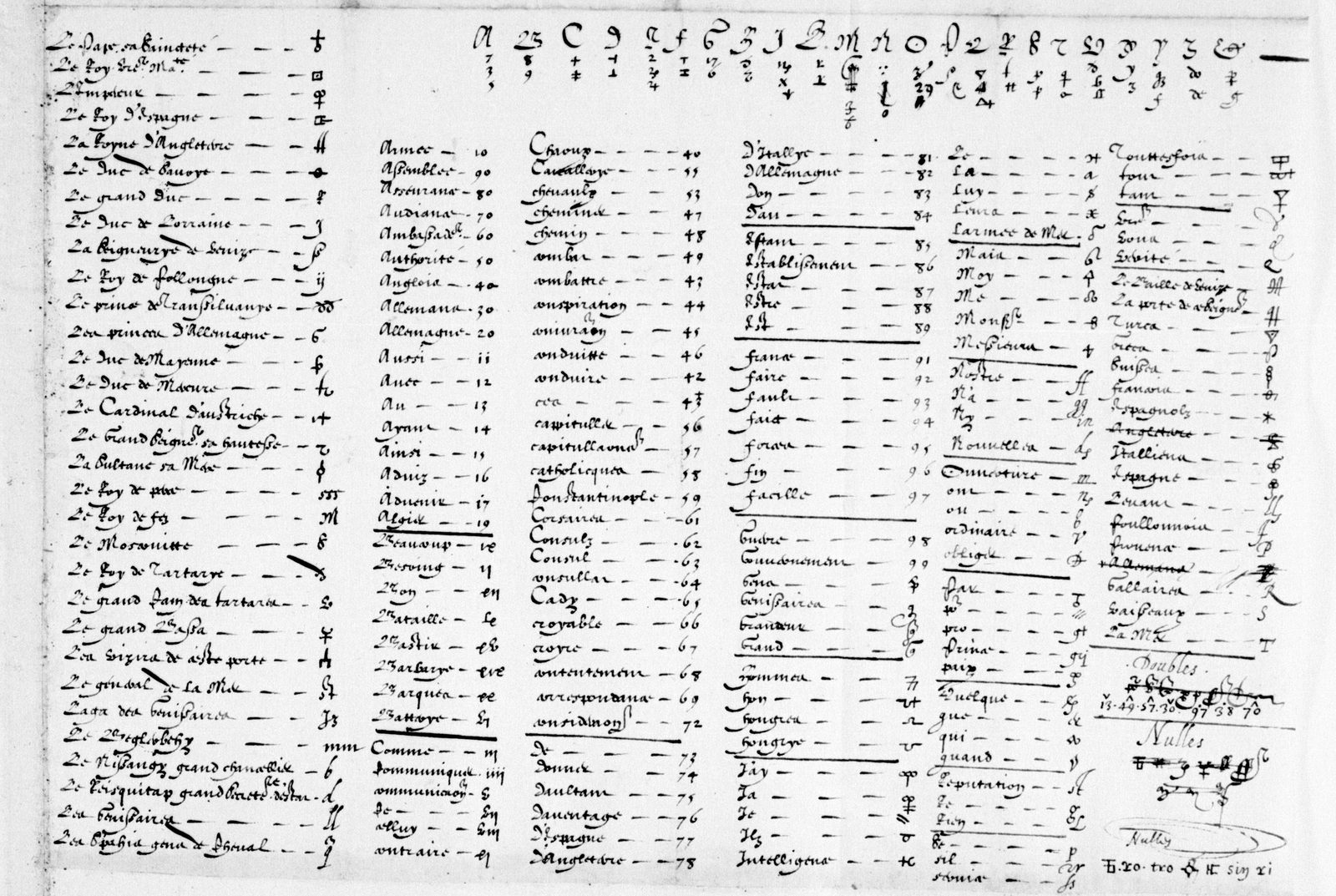

The table has five parts:
- An alphabet of homophones, figures and signs.
- A nomenclator in initial-letter blocks, numbered 10–99 for words in a–g (aussi 11, avec 12, capitullations 57, Constantinople 59, corsaires 61, faire 92, fault 93, guerre 98), with signs for the rest (le, que, qui, pour, vous, Turcs, galleres, vaisseaux, la mer).
- A column of persons, each a single sign: the Pope, the King, the Emperor, the kings of Spain, Poland, Persia, Fez and Tartary, the Grand Seigneur, the Sultana his mother, the grand bassa, the viziers, the general of the sea, the aga of the janissaries, the beglerbey, the nissangi, the tesquitar and the spahis.
- Doubles, the figures 13, 49, 57, 30, 97, 38 and 70 marked with a caret.
- Two lists of nulls.
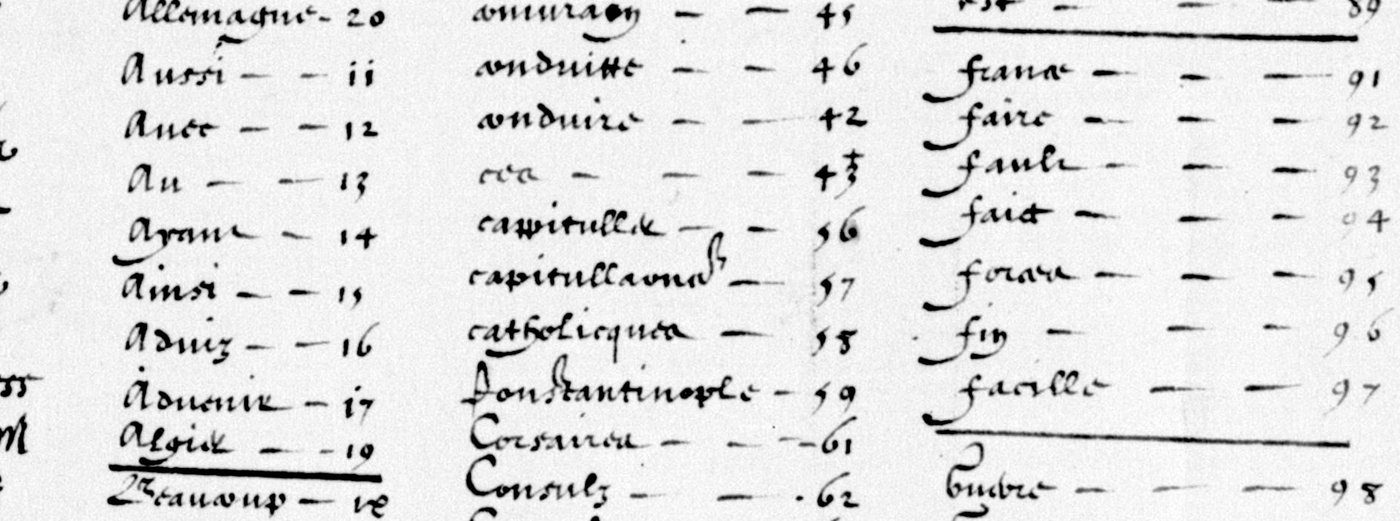
The figures agree with the values Tomokiyo recovered from the ciphertext (aussi 11, avec 12, faire 92, fault 93, a = 7/3/5), which confirms that this is the key of the letters. A transcription is in breves1603/key.md. Its numeric entries are firm. Its names for the signs are provisional until they can be checked against the ciphertext.
03 The text in print
Berger de Xivrey’s sixth volume of the Recueil des lettres missives de Henri IV (1853) cites each of these letters as “Orig. — B. N. Fonds Béthune, Ms. 9021, fol. …”, with a second source: “Cop. — Biblioth. de M. Monmerqué, Ms. intitulé Lettres à l’ambassadeur du Levant”. That copy was in clear, and Berger printed from it. He gives the February, March and April letters whole. He lists the other nine in the table of unprinted letters at the end of the volume, each marked “(En chiffres)” and summarised. The Monmerqué manuscript has not been traced. It was probably dispersed with his library.
The OCR of the 17 April letter garbles exactly those passages Berger seems to have set in italic, which may be how he marked what was in cipher. This is not checked against the printed page.
04 Tomokiyo’s reading checked
Tomokiyo overlaid a preliminary letter-by-letter reading of f. 60 and the opening of f. 63 from his reconstructed key. Almost all of it stands. Where it does not, the cause is a sign read to the wrong homophone or a word boundary in the wrong place:
| Tomokiyo’s overlay | Berger 1853 |
|---|---|
| la juste jalousie que j’ay de mesuois*ns | de mes voisins |
| soit pour tomber et fault nau*ra *sitost que vous le ap*e | soit pour tomber ou faire naufrage si tost que vous l’apprehendés |
| ** roibuent plus craindre les armes du revolt eul dasie | mais ils doivent plustost craindre les armes du revolteur d’Asie |
| quel en sera le congres | quel en sera le progrés |
| entre les contestans et catholicques de la germanie | entre les protestants et catholiques de la Germanie |
| les armes estans ja pripes de *t et daultre | les armes estans jà prestes d’une part et d’aultre |
| (f. 63) quelle era este lissueduremument c?omance a la porte | quelle aura esté l’isseue du remuement commencé à la Porte |
“Contestans” for protestans is probably a single sign: the key has a syllable sign for pro in the P block, and it may have been taken for con. Only the ciphertext can confirm this.
05 What the letters say
Berger’s text of 18 February, from “que les desordres”, the stretch Tomokiyo’s overlay covers
… les desordres de l’empire de ce Seigneur vont continuant et augmentant, à sa honte et au grand prejudice d’iceluy, et ay bien consideré et pris le conseil que vous me donnés sur cela, duquel je me serviray le mieux qu’il me sera possible ; mais la juste jalousie que j’ay de mes voisins ne me permet de faire pour ce regard tout ce que je desirerois et seroit necessaire. Je ne me puis persuader que cest empire soit pour tomber ou faire naufrage si tost que vous l’apprehendés, joinct que j’ay l’opinion, s’il y avoit du changement, que ce sera sur la personne du prince plustost qu’en autre chose ; car les ennemys du dict empire ne sont mieux conseillez et servys que luy, et ont des incommoditez qui les combattent, qui ne sont de petite importance ; mais ils doivent plustost craindre les armes du revolteur d’Asie que celles des autres.
February. Brèves had written that the Ottoman empire might collapse. The King does not believe it: if anything changes, it will be the person of the sultan, not the empire. Its Christian enemies are no better led than it is, and the real danger is the rebel in Asia, the Celali rising. France is at peace. Bouillon has had to withdraw to Germany, finding no Protestant willing to rise for him. The King is leaving for Metz, where war threatens between the Protestants and Catholics of Germany over the bishopric of Strasbourg, disputed between Brandenburg and Lorraine.
March, from Metz. He wants to know how the remuement at the Porte has ended, “car il en succedera un grand bien ou un grand mal” to the sultan and his empire. The Emperor is recruiting Frenchmen: Nevers, wounded at the assault on Buda, has vowed to go back. The King will not be drawn into mediating a peace between the Emperor and the sultan. He has ordered his subjects in the Levant to sail armed against English pirates. He reports that Elizabeth is gravely ill.
April. The revolt of Mamoucte Bassa and the spahis against the sultan and his first vizier has been put down. The King regrets the fall of the mufti and his brother. Brèves is to congratulate the sultan, but not to ask for an Ottoman fleet, and to get out of the peace negotiation gently. The Emperor will not hear of peace, and the King of Spain is urging him against it so as to have a free hand at Algiers. Elizabeth is dead, and James has been proclaimed without opposition.
May to December, from Berger’s summaries:
- the war in Hungary and Transylvania, with Moses Székely driving out Basta;
- the King’s wish that the Frenchmen serving the sultan withdraw, quietly and in Brèves’s own name;
- Spain’s enterprise on Algiers, taken up, dropped and taken up again;
- a treaty with James I disowning his subjects’ piracy, and Marseille ships to be armed against Barbary and English corsairs;
- the sultan’s chiaoux waiting at Marseille for a royal journey to Provence that did not happen that year;
- in August, surprise at the execution of the sultan’s son on a mere suspicion;
- in December, unease at “certain changement survenu à la Porte”, which the King fears favours the house of Austria.
Mehmed III died on 22 December 1603, the day before the last of these letters was written. The renewal of the Capitulations in May 1604 falls after the series.
06 What remains
- The ciphertext. Fr. 3541 is not on Gallica: there are no records under its shelfmark or its old Béthune number, and the BnF notice has no link to a digital copy. Desenclos 2018 has no plates, and Tomokiyo does not say where his images came from. A reproduction of ff. 60–104 would let the nine summarised letters be read in full with the key. The three printed letters give about two pages of known plaintext to settle the key’s signs first.
- The full texts are at the BnF. Fr. 4029 (anc. 8962(3), olim Supplément français 500), a 17th-century “Recueil de copies de lettres”, holds 158 letters of Henri IV to Brèves from 1592 to 1608. Its nos. 131–142 are this series, from 18 February to 23 December 1603, one folio each on ff. 118–128. No. 130 is a letter of 6 January 1603 that has no ciphered original in fr. 3541. The volume is not on Gallica. Eleven folios of it would give the full text of the nine summarised letters, and a reproduction order for them is the cheapest way to finish this series. The Monmerqué copy that Berger used, Lettres à l’ambassadeur du Levant, is not needed. Guadet’s supplement (t. VIII–IX, 1872–76) does not print the nine in full.
- Checking the key’s signs. Brèves’s own letters to the King in the same cipher are online. Fr. 15578 f. 185 (Gallica canvas 196) is fully ciphered, with the recipient’s decipherment written between the lines (“Je n’adjousteray a ma derniere … que la mort du grand …”). That makes it known plaintext for settling the provisional sign names in
key.mdbefore any images of fr. 3541 are obtained. It has not been transcribed yet. - A loose end in Berger. His table (p. 667) also lists a “dépêche entièrement chiffrée” to Brèves of 17 April, “fol. 60”, with no copy cited. It is either a second April dispatch or a misprint. Only the manuscript can say which.
07 Sources
- BnF, Français 3541 (anc. 9021), notice: archivesetmanuscrits cc49988x. Not digitised.
- BnF, Français 4029, copies of Henri IV’s letters to Brèves 1592–1608, nos. 131–142 (ff. 118–128), notice: archivesetmanuscrits cc50451m. Not digitised.
- BnF, Français 3462, f. 103 (the key) and f. 104 (the 1604 Levant key): Gallica btv1b9058227h, canvas 109.
- J. Berger de Xivrey, Recueil des lettres missives de Henri IV, t. VI (Paris, 1853), pp. 31–32, 63–65, 76–78 and 667–680: Gallica bpt6k203966b; OCR on Wikisource (printed page = djvu page − 12).
- S. Tomokiyo, “French Ciphers during the Reign of Henry IV”, cryptiana: the reconstructed key, the preliminary reading, and the pointer to fr. 3462.
- C. Desenclos, “Unsealing the Secret: Rebuilding the Renaissance French Cryptographic Sources (1530–1630)”, HistoCrypt 2018, n. 6: PDF.
The key images and transcription, Berger’s three texts and summaries, the BnF notice and the notes are in the repository (breves1603/). The plaintext is Berger’s, from the Monmerqué copy. The key and the comparison are this project’s.