
At a glanceExisting decipherment · complete
- The letter
- Francisco de Vargas, Charles V's ambassador at Venice, to the Emperor, 25 August 1552: fourteen pages, most of them in cipher, with a postscript of the same day.
- Where
- Archivo General de Simancas, Estado leg. 1320 ff. 35–38; DECODE R9967 (16 images), listed with no decryption attached; catalogue item 197.
- The cipher
- The Imperial Cipher of 1544–1554 (Tomokiyo): letter symbols and code groups such as
agercardenal andpollopapa, with some clear words left in the cipher lines. - How it was deciphered
- At the time: a second hand wrote the decipherment in the left margins, at the page feet and between the lines, as one continuous text. It was transcribed from the DECODE images on 23 Oct 2026 and checked against the clear words in the cipher lines (ten places agree) and five recurring code groups.
- What it says
- Cardinal Sant'Angelo coming to Venice on French business; the Pope no anda limpio over Siena and his legate there may be a cover for taking the city; the Duke of Florence at risk of being deceived; the Duke of Urbino's request to Venice.
- Still open
- Eight words of the marginal hand, among them the legate's name (Mignanelli?), not made out at DECODE's resolution; the spelled cipher runs were not checked symbol by symbol, since the key is not in the repository.
- Credit
- Satoshi Tomokiyo (cryptiana) recorded the marginal decipherment and identified the cipher as the Imperial Cipher of 1544–1554.
01 The letter and its decipherment
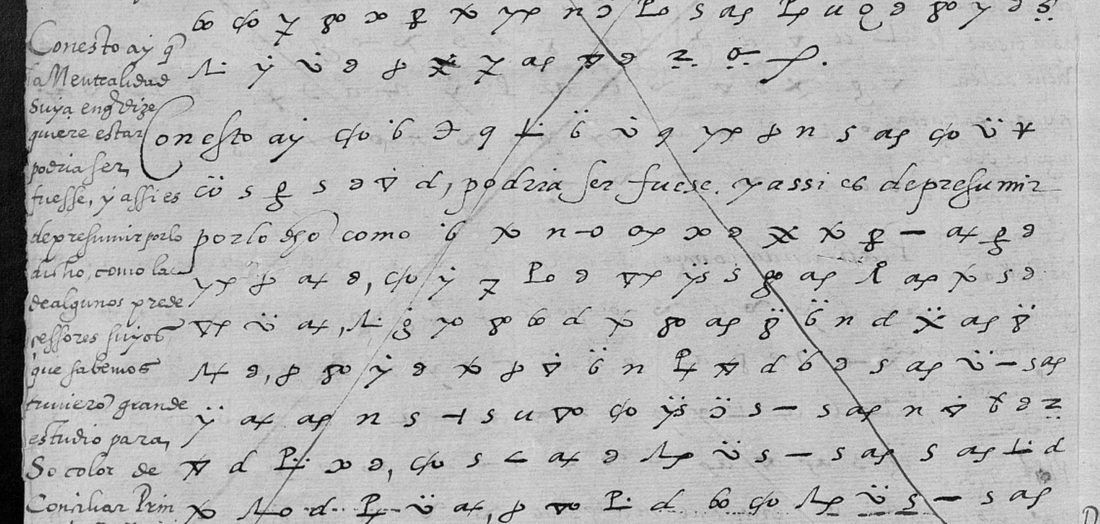
DECODE imaged the four leaves as sixteen pictures whose own numbers are out of order; the archive's numbers in the image headers (0001–0016) give the order of the pages. The letter opens in clear (“En xvij del presente screvi a vuestra magestad”), runs in cipher from page 0001 to page 0011, each block struck through with a saltire once deciphered, returns to clear for the conde de Pitigliano's business, Piedmont and don Fernando de Gonzaga with three shorter cipher runs, and ends De Venecia xxv de Agosto MDLij, a postscript and the signature Fran.co de Vargas.
The decipherment is in a second hand, written beside and under the cipher it renders, so that the foot of one page and the top of the next carry the text of the cipher lines that follow. It was transcribed in full, marked margin, foot, top, interlinear and clear (R9967_decipherment.txt), and the letter was written out from it with the clear paragraphs from the original (R9967_reading.md, English R9967_en.md).
02 Checking the decipherment against the cipher
The key is not in the repository, so the cipher was not decoded symbol by symbol. Two checks were made instead (R9967_code_check.tsv):
- Clear words in the cipher lines. Vargas left short phrases in clear inside his cipher, and they agree with the decipherment word for word at every place they occur, ten in all: Tengo aviso de buen lugar que (0001), dixo en secreto aun confidente suyo (de do lo he entendido) que (0002), De aqui vengo a concluir (sino me engaño) que (0006) and others.
- Code groups.
ageris rendered cardenal three times,pollopapa five times, and the short groupss-o,x-o,n-oel, del, al; once (0005) the decipherer wrote su Santidad fors-o pollo.
Every unbracketed word of the reading is in the decipherment or in the clear text; one word, [parte], is supplied where the margin breaks off.
03 What the letter says
Tengo aviso de buen lugar que el cardenal Santangel, hermano de Fernesio, so color de lo que aqui tiene, se viene a esta ciudad para tratar negocios del Rey de Francia ... el papa no anda limpio en estas materias.
“I have word from a good source that Cardinal Sant'Angelo, Farnese's brother, under colour of what he holds here, is coming to this city to deal in the King of France's business ... the Pope is not acting cleanly in these matters.” A secretary of the Pope close to the nuncio told him so, and a member of the Pregadi had heard from the Venetian ambassador in Rome that the Pope told the French ambassador he would be glad to see the King set foot in Italy over Siena. Vargas recalls a letter of Cardinal Ridolfi to the Bishop of Fiesole at the first session of Trent, which he saw in the original. He suspects that the legate sent to Siena is a cover for taking the city, as the Popes took Bologna under the name of protection; that the Duke of Florence may be deceived a second time; and that any settlement over Siena with France or the Pope would harm the Emperor, so that both must be kept out. The Duke of Urbino's request to Venice to be named captain general or released, and his ambassador's instructions not to press for an answer, he reads as a plan concerted with the French against the kingdom of Naples.
04 What remains open
- Eight words of the marginal hand, marked [?word] or […] in the reading, and the legate's name, [?Mignanelo]: the small hand at DECODE's 1850 × 2600 pixels; only the originals at Simancas would settle them (blocker: illegible).
- A symbol-by-symbol check of the spelled cipher runs, which needs the key (Tomokiyo's reconstruction of the Imperial Cipher of 1544–1554 is not in the repository; blocker: no key material here).
Full texts
The transcription and the decryption of every document on this page, so that the reading can be used and checked. Short files are shown here; all are in the repository.
R9967, Venice, 25 Aug 1552
Francisco de Vargas at Venice to Charles V, 25 August 1552: the Pope is suspected of double dealing over Siena (Cardinal Sant'Angelo coming to Venice for France; the legate sent to Siena to take it under papal protection, as the popes took Bologna); the Duke of Florence may be deceived again; the Duke of Urbino's request to Venice for the generalship or leave read as a plan to join France for the Naples enterprise; the conde de Pitigliano's son gone over to France; Serri, a French secretary carrying despatches from Termes to Brissac, to be seized; postscript on the Prince of Salerno's French and Turkish galleys at Porto Ercole.
Transcription: R9967_decipherment.txt
Transcription
image	line_approx	cipher_labels	decipherment	note
0001 (P1)	1	que s-o ager	que el Car.l [Santangel]	clear "Tengo aviso de buen lugar que" before it, as in the decipherment
0001 (P1)	9	x-o pollo	del papa	"secretario del papa"
0001 (P1)	16	x-o 8 ager	del Car.l	"esta venida del Car.l"
0003 (P4)	20	s-o pollo n-o ager	el papa al Car.l	"que embiar el papa al Car.l [?Mignanelo]"
0004 (P2)	22	s-o pollo	el papa [Paulo]	"como el papa Paulo en lo de Parma"
0005 (P5)	9	verdad que s-o pollo	es verdad que su Sand.t	the decipherer writes su Santidad for the papa group
0002 (P3)	2-3	dixo en secreto aun confidente suyo (de do lo he entendido) que	dixo en secreto a un confidente suyo de do lo he entendido que	clear words in the cipher lines = decipherment
0004 (P2)	20-22	Y tambien podra ser que se ay persuadido ... porque aunque mas sea fuera de proposito, nunca faltan	same words	clear words in the cipher lines = decipherment
0012 (P11)	1-3	y si se quiere guardar [cipher] no erraria mucho por ser [cipher] como a V. Mag.d he scripto	interlinear del Embax.or de Urbino / tan frances	clear frame agrees
Transcription: 9967
Decryption: R9967_reading.md
Reading: R9967_reading.md
Translation
# R9967: Francisco de Vargas to Charles V, Venice, 25 August 1552, English

Translation of `R9967_reading.md` (23 Oct 2026, Claude Opus 5.5, batch b36), modern English, same holes.

## Reading

On the 17th of this month I wrote to Your Majesty. In this I will say what is happening and some things that occur to
me, which seem important in the present state of affairs.

I have word from a good source that Cardinal Sant'Angelo, Farnese's brother, under colour of what he holds here, is
coming to this city to deal in the King of France's business, and that he will leave Rome soon unless the Farnese change
their mind or something happens to prevent it. Talking with me, the man who gave me this news, who is a secretary of the
Pope and a close confidant of the nuncio resident here, told me what I have in some measure understood by other ways:
that the Pope is not acting cleanly in these matters, so that this coming of the cardinal and other things being done
may be with some intention of his. With this agrees that a gentleman of the Council of the Pregadi told a confidant of
his in secret, from whom I learned it, that this Signory had word from its ambassador in Rome that the Pope, speaking
with the French ambassador about this business of Siena, told him he would be glad if the King set foot in Italy in this
way, and that he would be ready to help him as far as he reasonably could so that he should hold as much in it as Your
Majesty. This is not very hard to believe, given his nature, his little vigour and inconstancy, and what is known of his
mind in many past and present matters. With this, the neutrality in which he says he wishes to stay may be what it was,
and so it is to be presumed from what has been said, like that of some of his predecessors, who we know took great pains,
under colour of reconciling princes and the affairs of Italy, to set them at odds so that things should come to such a
pass that they could step in and take what they could, always seeking to extend their temporal lordship in Italy, unable
to bear the name of emperor or the Spaniards, and trying by many ways to throw them out of it; on which much could be
said were it not so well known, for it is the old aim.

On this point I remember that when I was at Trent for the first session of the Council, Cardinal Ridolfi, who died at
the last election, wrote a letter to the Bishop of Fiesole, an honourable prelate who always voted with great freedom
and Christian spirit, in which, as regards the Pope, perhaps with his approval, wanting to frighten him and draw him back
from the good zeal and freedom that all the fathers ought to have, he rebuked him severely, saying quite unworthy things
against Your Majesty, concluding in effect that what Your Majesty was doing came from not being able to bear the majesty
and power of His Holiness in Italy, being very envious of it. I saw that letter in the original, because the bishop
showed it to me, much distressed and weighing how the affairs of the Church stood and [?what] was going on in Rome; I gave
word of it at the time to the proper person, and I believe it was written to Your Majesty.

From these things I have come to suspect, and I believe I am not much mistaken, that the Pope's sending Cardinal
[?Mignanelli] as legate to Siena, he being a native of it and so astute and so close to him, named in camera outside the
consistory and outside the custom observed in such cases, has been with another intention than the one announced: to
weave something under cover, so that, seeming to mediate and to make some agreement, he may divert Your Majesty and the
King of France from Siena and take hold of it as best he can, under colour of taking up the protection the Sienese sent
to beg of him, and so go on gaining ground this way, which is the very way by which the popes have seized some lands in
Italy, among them Bologna, where, under title of the commendation and protection they had, saying that they left the
Bolognese their liberty, they have for some time now made themselves masters and lords of it, as is known, leaving the
citizens nothing but the name and some traces of the liberty they claimed. It may also be that he has been persuaded,
like Pope Paul in the matter of Parma and Piacenza, to want to make his house in this business of Siena, for however
far-fetched it is, flatterers are never lacking, and seeing himself so exalted one sometimes persuades oneself one can
carry such things off, unless holiness and zeal for the common good hold one back; and finally the French and the
Farnese may have put some such idea into his head to do their own business, for they will not lack tricks and plots, as
they attend to nothing else. And since it is true, as he says, that His Holiness is raising troops in Bologna, it can be
presumed to be for the said purpose.

This being so, one may fear with reason, in my judgement, that the Duke of Florence will easily be deceived again in this
business of Siena, to his great loss and Your Majesty's disservice, because, the Pope having the said intention and the
Duke trusting him so much, as is well known, he will think he is ridding himself of the French and that his state is
safe by taking some settlement His Holiness makes; and perhaps the second error will be worse than the first, though
that was so great and done with such haste as was seen [?at once]; and now much more so, granted that the Duke's
intention is to be believed good, which, with everything else touching the Duke, I always defend in public and
[anywhere] anyone speaks to me, for the sake of Your Majesty's service and because of the French effort to separate him
from Your Majesty and make him distrustful. In this, and in all the talks touching the said Duke or other powers, I am
not [?careless], nor will they [?trust] me, according to [...].

From this I conclude, unless I am mistaken, that any course taken in this business of Siena with the French or with the
Pope will be extremely harmful and a great disservice to Your Majesty, unless it were so evidently good that it could not
be denied; but I do not see at present how that [?can be done]. So what matters is to exclude the Pope from there
entirely, as well as the French, and that if he wants to and does intervene, it be to this end, without leaving a legate
there; for he could certainly go on day by day doing what has been said, in which the Sienese would easily be deceived,
or, even if they understood it, they would soon let themselves be led to be free of Your Majesty and of the King's
tyranny, seeing that this would leave them more liberty.

Of this Signory I say what I have said before: it is prudent and knows very well how to govern itself, and all the more
for that it will know how to do what suits it when it sees the occasion, and times and things come to be very troubled,
without seeming to depart from the friendship and regard it has for Your Majesty or to ally with the French. On this,
and on the Duke of Urbino's going, I refer to what I wrote to Your Majesty some days ago, in which I am confirmed more
every day; and lately there is a strong argument: not many days ago the Duke sent word to this Signory by his ambassador
asking them to do him the favour of naming him their captain general on this occasion or to give him leave, saying it
was against his honour to remain as he was. The Signory answered that it would consider it and give the answer later;
after which the said ambassador, discussing the matter with a confidant of his who was blaming the Duke for wanting to
leave this Signory so lightly, told him by way of excuse that the Duke had written to him not to press or hurry for the
answer but to keep the matter in hand until he wrote again. From all this one may well infer the following: first, that
the Duke's going, as they say, has been with the intention of these lords, and if not of all, of those who matter, to
keep the business more secret, which must have been discussed and agreed when the Duke was here in April; next, that if
it were not so, the times being what they are and things so unsettled, this Signory would not have overlooked so long an
absence of the Duke, knowing he is not ill, nor ever [...] to be absent; next, that if it were not so, the Signory would
not have suffered the Duke to send it the threat I have described, nor afterwards have overlooked it, nor would it have
been left to the said ambassador whether the Signory answered or not. Given which, and putting together everything in
this article, one may presume what I have said: that the request for the generalship or else leave, about having to
[...] under cover and to temporise, presupposed giving him leave when they saw the affairs of the Kingdom [of Naples] so
unsettled that they thought they could get the places and strongholds they claim in the Kingdom. Thus the Duke, who is
as French as is understood, publicly disgruntled, would join the King on his own and not as a matter of this Signory to
carry out the plan, without this Signory committing itself to him or seeming to act against Your Majesty, and whether
the thing were concluded or not, they would take him back afterwards, not having left him out of the secret. And if the
Duke asked for leave, it was, I believe, because at that moment the enterprise of the Kingdom was well under way by the
French; and if the Signory has not given it him so far, and he has held back, ordering his ambassador not to press for
it, it is because of their doubt about the enterprise, the season being so far advanced, and because of what is thought
of the Turkish fleet, that it is heading back towards the Levant as usual, this business of Siena and the other
difficulties that arise; and until one sees what the French and the outlaws are planning to do, and so from what the
Duke of Urbino does, and from his staying away or coming back here, there will be a conjecture, and no small one, in my
view, of what the French intend about making the enterprise of the Kingdom or leaving it; for it seems to me that this
Signory will always want to remain in the regard and friendship it has with Your Majesty, as it has declared, while
aiming [?at the gains] when such an occasion came, to keep what is its own, by itself and by the means it would think to
have with Your Majesty and with the King, for this is the neutrality practised in Italy.

Although I am sure that in all this I tell Your Majesty nothing new, who knows so well and sees so deeply into
everyone's minds and doings, it has seemed right to me to set these things before Your Majesty, to do my duty and what
Your Majesty has commanded me, and because it seems to me that things are coming to a head and have reached such a
point that there is danger in many ways unless provision is made at once; and there can be no rashness in judging this
outcome, especially with so many reasons; and so I hope Your Majesty will have ordered provision to be made and will
apply the remedy in everything as is fitting.

On the matter of the Count of Pitigliano, I have already written to Your Majesty and await an answer. He thought fit
afterwards that I should send Your Majesty the original letters of Farnese and the others, and so I do. He sent me word
at the same time of his grief that Orso, his second son, the one he kept with him and for whom he wants the succession,
had been drawn away by the Farnese and had gone to serve the King of France on promises they must have made him; and
that he was firmer than ever in what he had offered, to serve Your Majesty, both because of the impiety of his son
Niccolò and because the King had abandoned him in exchange for him, and from understanding the mind of those who wrote to
him, and because this was his wish. Whether this business of the son is only his youth or a device of the father on the
advice of the ambassador of Urbino, his friend, who makes a great profession of such things, according to the Italian
custom of dividing themselves so that the son goes to the King and he himself serves Your Majesty, I do not know. It is
true that the father laments it greatly, saying they have deceived him and that he thinks they will kill him. He has
written me another letter, which I send Your Majesty, showing how he presses for the answer and that he wants no one
but himself to learn of it. And if he wishes to beware of the ambassador of Urbino, so French, he would not be much
wrong, he being as French as I have written to Your Majesty; and so I believe that it was through the information he gave
the French that the Farnese and the others wrote to the Count so insistently.

From what happens every day in Piedmont, the continual reinforcing of the French army, what is seen at Siena and what
is stirring everywhere, there is cause for fear in all those places, and that they may want to attempt something here
beyond what they let be understood. They tell those they trust that within a very few days something great will be seen
in Italy, greater than Siena. I never fail to inform the ministers of everything that comes to me, and what I think of
this I wrote to Your Majesty days ago.

I have written today in haste to Don Ferrante Gonzaga to try to lay hands on Serri, secretary of the King of France, who
was commissary of munitions in the Parma affair, who is to go now from Ferrara with important despatches from M. de
Termes to M. de Brissac, disguised as the servant of two Ferrarese, servants of the Duke of Ferrara's eldest son, who
wants to go to France through the Milanese, through Alfonso Trotti, the said Duke's ambassador with Don Ferrante. This
secretary left here yesterday for Ferrara for that purpose; I had word of it that same night, and of the [?doings], from
a person who goes about with these Frenchmen and is well placed to know. And I certainly believe that if this secretary
and the others with him are taken, it will be of great importance and much will be learned from them.

They tell me that Cardinal de Tournon, after leaving Este for France, has gone back there to speak again with the
Cardinal of Ferrara. May Our Lord guard and prosper Your Majesty's imperial person and state for long years with the
increase of more kingdoms and lordships. From Venice, 25 August 1552.

Today, the 25th, some gentlemen have made it public that this Signory has letters from Rome of the 22nd, by a courier
who came last night, saying that the Prince of Salerno had arrived at Porto Ercole with 26 French galleys, 12 of Salah
Rais and 20 ships with 2,000 Gascons and other troops, and that he was taking the troops the French had raised in Siena to
go on the enterprise of the Kingdom, and that they had sent some frigates to summon the Turkish fleet. I do not affirm
this beyond what I have said; the truth will soon be known. The news I had yesterday from Rome of the 20th says that the
enterprise of the Kingdom was given up for this year, it being late and the fleet having gone off towards the Levant.
We shall soon see what it is, and whether it is for another purpose, as is also suspected, and how the Siena business
will end; where, it seems to me, according to what the Duke of Florence writes to his secretary here, 2,000 soldiers
were staying in the city for the French, after the rest had gone against Orbetello and other garrisons, and the legate
was working on a way for them all to leave, an Italian garrison remaining in the city for the city and with a commander
of their own; which increases the suspicion mentioned above. I may be mistaken in this and in the rest.

Sacred Caesarean Catholic Majesty, Your Majesty's servant who kisses your royal feet and hands, Francisco de Vargas.
05 Sources
- Archivo General de Simancas, Estado leg. 1320 ff. 35–38, via DECODE R9967 (16 images, fetched 23 Oct 2026).
- Satoshi Tomokiyo, page on the Spanish ciphers of Charles V, cryptiana (cached in the repository as
targets/vasto1527/prior/spanish2C_now.htm): “Deciphered in the margin”, and the identification of the Imperial Cipher of 1544–1554, also used by Juan de Vega (DECODE R9964).
The transcription of the decipherment, the code check, the reading and its translation are in targets/vargas1552/.