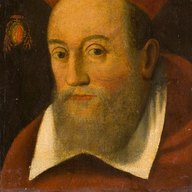
01 The documents
The five records are leaves from Santa Croce's first French nunciature. In each, a letter in clear Italian moves into figures for its sensitive passages.
| DECODE | Folio | Letter | In Lestocquoy 1972 |
|---|---|---|---|
| R6 | 117r–v | Poissy, 26 March 1553; decipherment fol. 118v | no. 67, p. 157 |
| R7 | 128r–v | Poissy, 5 April 1553; decipherment fol. 129–130v | no. 71, pp. 162–163 |
| R8 | 230r | Abbaye d’Ourscamp, 28 September 1553 | no. 112, p. 218 |
| R9 | 248r (stamped 256) | Paris, 14 December 1553 (the edition gives fol. 254–258v, another foliation) | no. 124, p. 240; the cancelled cipher is not printed |
| R10 | 263r | Paris, second letter of 23 December 1553 | pp. 243–244 |
02 The cipher
Lasry's reconstruction, as filed on the records, is a homophonic alphabet of one- and two-digit elements: a = 28, 38 or 8; e = 24, 34 or 4; i = 2, 22 or 32; o = 26, 36 or 6; t = 07, 76 or 86; u = 02, 04, 06 or 08; r = 03 or 56; s = 05 or 66; and single values for the other letters (b 48, c 58, d 68, f 44, g 54, h 64, l 42, m 52, n 62, p 46, z 96). The digit 1 is a null that mostly falls between words. Code groups for names and common words begin with a dotted digit. Element boundaries are not marked, so a run like 2 2 8 can be split in several ways. The decoder in the repository resolves the splits with a sixteenth-century Italian language model.
03 The printed letters, checked
For R6, R7, R8 and R10 the text is Lestocquoy's, and the decrypts confirm it. For example, R6 decrypts to "ci è maneggio stretto col [duca di Ferrara], non so se sia per haver denari con promesse di mercanti et avvantaggio d’esso Duca o pur per qualche lega o per haver artigliaria con la scusa che ha usato il [duca di Firenze] a Siena". That is the text on p. 157, word for word. R8's "Il Re Chr.mo resta mal contento dell’impresa di Corsica … credo che si risolverà di mantenerla" agrees both with p. 218 and with the interlinear decipherment on the leaf. R7 (Ferrara as "generale supremo di Italia con vinti mila scudi", the Naples enterprise) and R10 ("Molti persuadeno S.M. di havere a far guerra in Italia") match pp. 162–163 and 244.
04 R9: the cancelled postscript
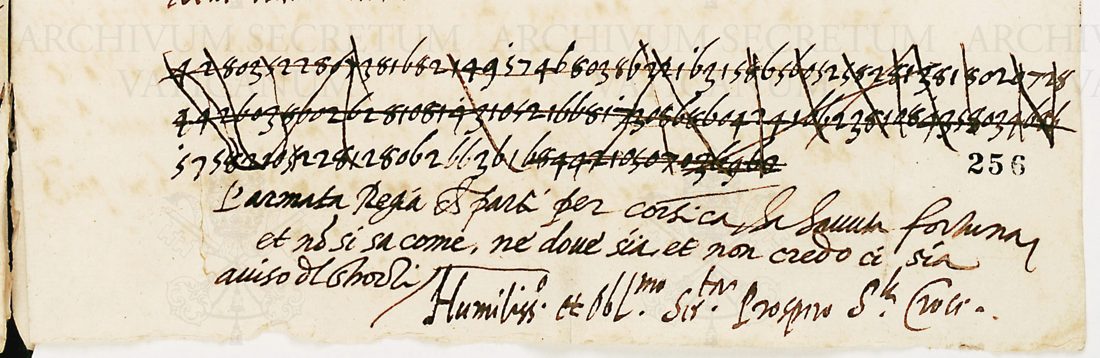
Lestocquoy prints the letter of 14 December and its clear postscript (p. 240) but not the struck-through figures above the postscript. The figures were transcribed through the cancellation strokes and decrypted with the key. Long stretches match the postscript:
- line 1:
46 6 03 86= port…, and58 6 56 05 2 … 58 28= Corsi…ca - line 2:
44 26 03 [07] 02 62 8= fortuna;58 6 52 4 62 4= come ne;68 6 02 4= dove - line 3:
28 06 2 66 36= auiso;68 4 42= del;05 07 03 6 96 96 2= strozzi
So the cancelled cipher is the postscript itself: l’armata regia che partì per Corsica ha havuto fortuna et non si sa come né dove sia et non credo che ci sia aviso del Strozzi. In English: the royal fleet that left for Corsica has met a storm, no one knows how or where it is, and I do not think there is any news of Strozzi. The secretary began to encipher it, gave up, struck the figures out and wrote the sentence in clear.
05 What remains uncertain
- The code groups (dotted elements such as [57], [43], [63], [99]) were not given values. The print supplies the words, so nothing depends on them.
- In R9, a few digits between the aligned stretches are illegible under the strokes. The alignment rests on the stretches listed above (grade C for the passage as a whole, H for the aligned words).
- The volunteer transcriptions have gaps (underlined figures untranscribed, a few doubtful digits), so the decrypts are imperfect in places. The printed text is the authority.
06 Sources
- DECODE records R6, R7, R8, R9, R10: images, 2016 volunteer transcriptions, and George Lasry’s reconstructed key (24 October 2020).
- J. Lestocquoy (ed.), introduction by F. Giannetto, Correspondance du nonce en France Prospero Santa Croce (1552–1554), Acta Nuntiaturae Gallicae 9 (Rome and Paris, 1972). A scan is attached to the DECODE records.
- Archivio Apostolico Vaticano, Segreteria di Stato, Nunziatura di Francia 3.
Notes, decoder and the R9 decryption: santacroce1552/.