At a glanceExisting decipherment · complete
- The letters
- Marcolino Barbavara, ducal secretary, from Rimini and Rome (13 February – 4 May 1447), and Pietro Pusterla, the Duke of Milan’s procurator, from Gualdo, Ferrara and Milan (21 January – 10 March 1447), to Francesco Sforza.
- Where
- Bibliothèque nationale de France, italien 1584 (Archivio Sforzesco papers of 1447), on Gallica. Leads 1313 and 1314 of the catalogue sweep, now closed.
- The cipher
- One key for both men, copied in the Milan archive: a homophonic alphabet, signs for vowel–consonant syllables, signs for common words, nulls and a dozen code signs for names (DECODE R1857).
- How the text was obtained
- Every cipher letter has a decipherment: a later clear copy filed beside it (fourteen letters), or fifteenth-century glosses. The copies were transcribed and translated, checked against the key, and their blanks filled.
- What it says
- The money for Sforza’s condotta, the death of Eugenius IV and the election of Nicholas V, King Alfonso’s 94,000 ducats, and the Venetian army at Cremona. The King says priests are “homini da bastonate, non da pregare”.
- Still open
- Five cipher runs of the 4 May letter, which have no gloss and fall in blotted cells of the key. Five rare code signs, each used once to three times; a sixth, read as Micheletto Attendolo, rests on context. The cipher original of 6 February is not on the film.
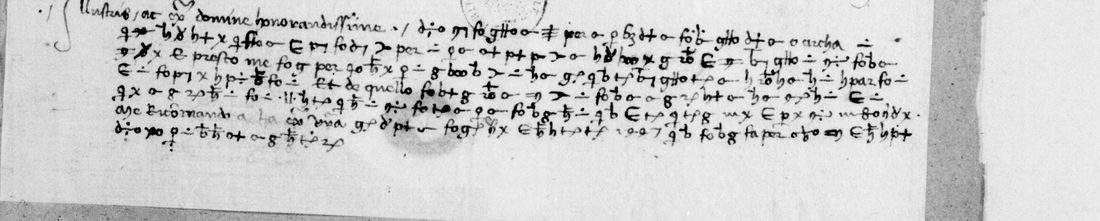
d÷o 97 fo gtto o- ≢ per o- = in questa hora, the opening of the announcement that a pope had been proclaimed. Image: Bibliothèque nationale de France, italien 1584 f. 69, via Gallica.01 The letters
In the winter of 1447 Francesco Sforza, at Pesaro, was being drawn back into the service of his father-in-law Filippo Maria Visconti, Duke of Milan, against Venice. Pietro Pusterla negotiated and sealed the capitoli in January and then chased the money for Sforza’s condotta between Milan and Ferrara. Marcolino Barbavara, a ducal secretary, went to Rome and to King Alfonso of Aragon for the same money. He arrived as Eugenius IV died and stayed through the conclave that elected Nicholas V on 6 March. Both wrote to Sforza in cipher, in the same key.
BnF italien 1584 is one of the volumes of the Sforza papers in Paris. Mazzatinti’s inventory of 1887 marks the letters “in cifre” and notes a translation for only two of them. The project’s sweep of the volume turned them into two leads: Barbavara’s six letters (1314) and Pusterla’s eight (1313).
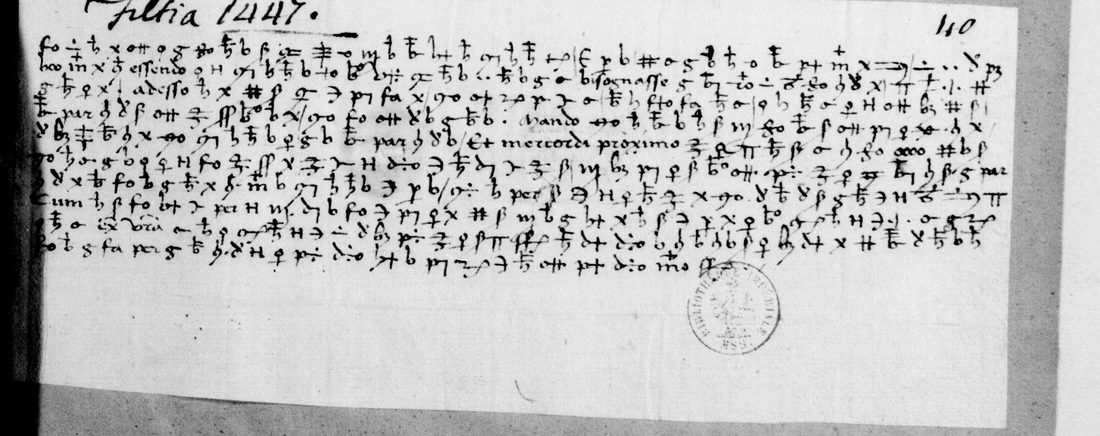
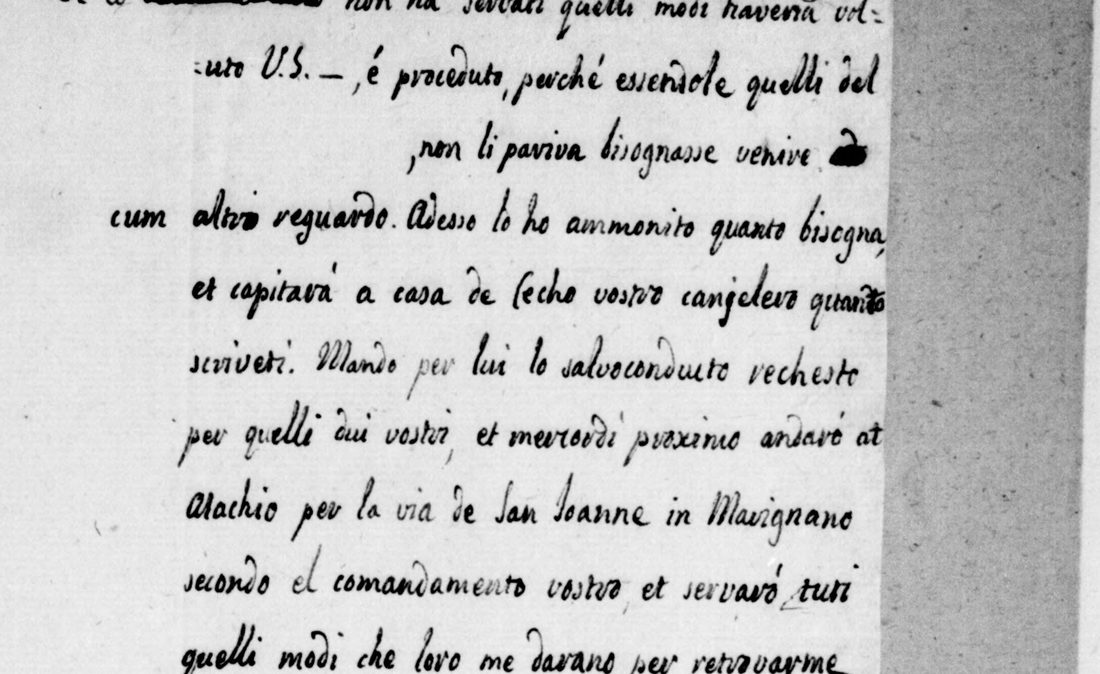
Opening every leaf showed what the inventory does not say. Beside each cipher letter a later archive hand, in a regular italic that looks eighteenth-century, filed a complete clear copy, usually on the leaf before it. Every letter is covered this way or by a decipherment of the time:
| Writer | Date, place | Cipher | Decipherment |
|---|---|---|---|
| Pusterla | 21 Jan, Gualdo | f. 13 | f. 14 |
| Pusterla | 6 Feb, Ferrara | not on the film | f. 27 |
| Pusterla | 10 Feb, Ferrara | f. 32 | f. 33 |
| Barbavara | 13 Feb, Rimini | f. 40 | f. 39 |
| Pusterla | 14 Feb, Milan | f. 42 | f. 41; and f. 43, of the time |
| Barbavara | 27 Feb, Rome | f. 49 | f. 48 |
| Barbavara | 3 Mar, Rome | f. 56 | ff. 55, 57 |
| Barbavara | 4 Mar, Rome | f. 62 | f. 61 |
| Barbavara | 6 Mar, Rome | f. 69 | f. 68 |
| Pusterla | 6 Mar, Ferrara | f. 67 | f. 66 |
| Pusterla | 7 Mar, Ferrara | f. 71 | f. 70 |
| Barbavara | 8 Mar, Rome | f. 75 | f. 74 |
| Pusterla | 8 Mar, Ferrara | f. 77 | f. 76 |
| Pusterla | 10 Mar, Ferrara | f. 81 | f. 80 |
| Barbavara | undated | f. 135 (mostly clear) | glosses of the time, in part |
| Barbavara and Arrigoni | 4 May, Rome | f. 143 (mostly clear) | glosses of the time, in part |
Mazzatinti’s inventory needs three corrections. Barbavara’s “Traduzione” is f. 48, filed before the cipher on f. 49, not f. 50. Pusterla’s Milan letter is dated 14 February in its copy, not 16. And f. 27 is the copy of the 6 February letter, not its cipher, which is not on the microfilm.
02 The key
The key is in Milan, in an eighteenth-century copy among the Archivio di Stato’s Potenze sovrane cipher sheets. DECODE has it as record R1857, image 11, under the heading “Marcolinus de Barbavara et Symon Arrigonus — Petrus de Pusterla”. Satoshi Tomokiyo noted in 2024 that it is the key of the f. 69 letter. It has these parts:
- an alphabet of two to four signs for each letter (
o-,—ofor a;fo,ɱfor s); - a table of signs for vowel–consonant syllables, ab to uz (
peris or,d÷ois in); - signs for common words: che, con, per, non, qua, quando, que, perché, quanto, se, ciò, come;
- nulls (“insignificanti”);
- code signs for the Signori Malatesti, the King, money, the Count of Urbino, the Duca di Ferrara, V.S., the Pope, the Camerlengo, the Duke, the Venetians and qui.
Several cells are blotted, and three code signs carry no label.
Spot checks against the cipher agree with the copies. The first line of f. 69 decodes in questa hora (the copy: “In questa hora decima septima”). The first line of f. 40 decodes se lo c… (“Se lo cavalario”). The clear words left in the cipher of f. 75 recur in the same order in its copy. The copied letters were not transcribed sign by sign: the copies are complete texts. The project’s table of the code signs is key_R1857_codes.tsv; the key image itself is the archive’s and is not reproduced.
03 The copyist’s blanks
Where the later copyist met a code sign his key did not explain, he left a blank in the line and drew the sign in the margin. Read against R1857 and the sentences around them, most of these blanks can now be filled.
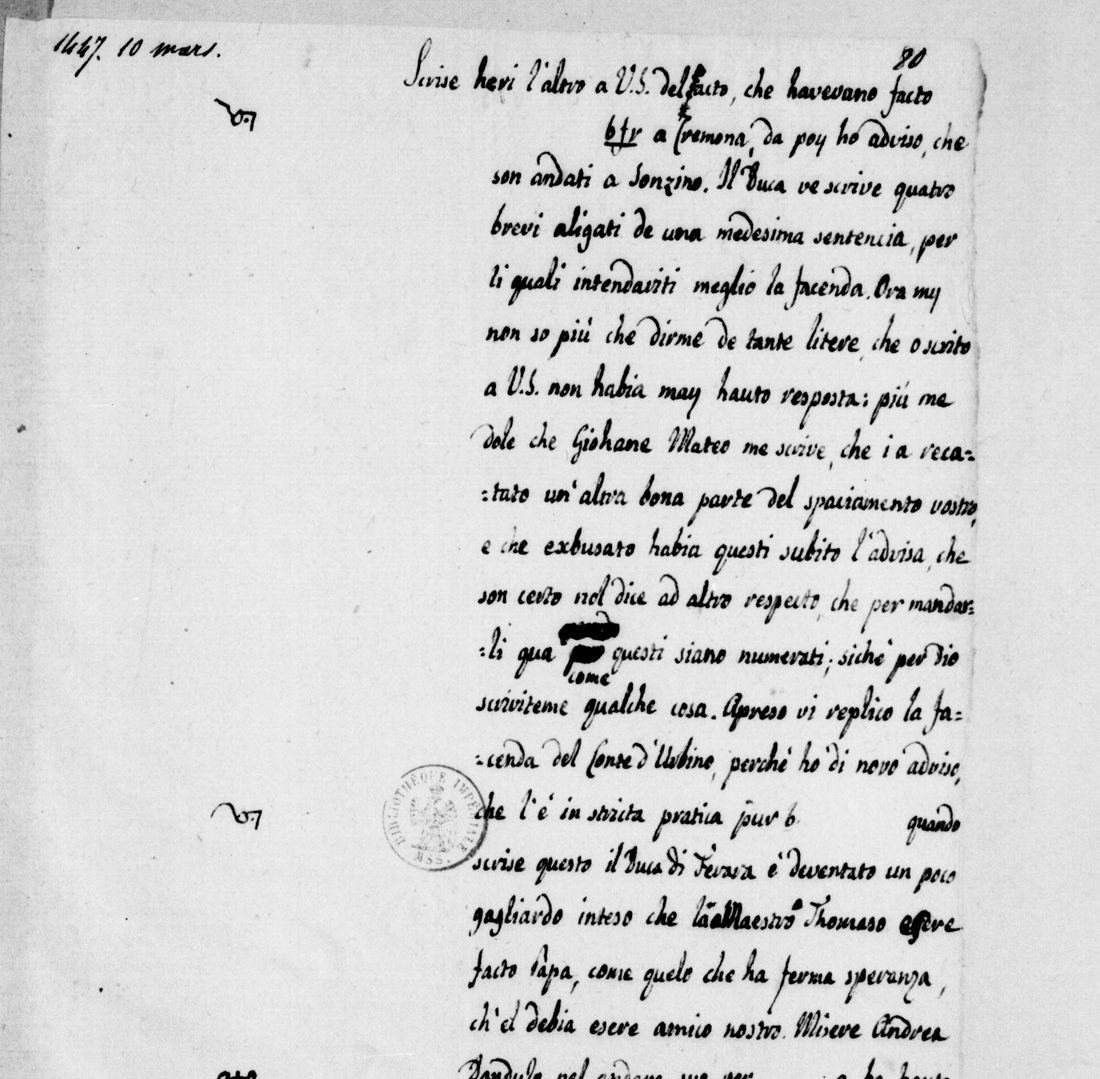
ꝺ.7 twice (the Venetians), 9+o (qui) and the Z-like sign (probably Micheletto Attendolo), each beside a blank in the text. Image: Bibliothèque nationale de France, italien 1584 f. 80, via Gallica.| Sign | Value | Evidence |
|---|---|---|
ꝺ+÷ | the Duca di Ferrara (in 1447 Leonello d’Este, still Marquis) | R1857 writes “Duca di Ferrara” over the sign. It fits all five blanks. Pusterla, just arrived at Ferrara, writes “subito fui col ___”. Barbavara’s King will make “him” pay “li xx m del ___”. |
ꝺ.7 | Veneziani | R1857 label. “che havevano facto ___ a Cremona … son andati a Sonzino”. |
9+o | qui | R1857 label. “Misere Andrea Dandulo nel andare suo per ___”. |
| Z-like sign | Micheletto Attendolo, the Venetian captain-general [?] | Context only: “il ___ vene con tuto l’exercito de’ Venetiani a Cremona”, and “uno Capo di Squadra del ___ quale è suo parente”. Micheletto was Sforza’s cousin. |
∠ | open | Three blanks (“venire a le cumclusione cum ___ presto”; “per la via del ___”). On f. 41 the sign stands in the margin beside “il Sig. de Faenza”, written out, which may point to the lord of Faenza. |
A, and three signs on f. 41 | open | One context each. |
One more slip is the copyist’s own. f. 68 announces the new pope as “Monsignore da Cologna”. Tommaso Parentucelli, elected as Nicholas V, was cardinal-bishop of Bologna, so the copy has C for B. The cipher at that word was not compared.
04 What the letters say
Pusterla. On 21 January he is at Gualdo, waiting for word where to meet Sforza. At Ferrara on 6 February the Duca di Ferrara is suspicious for lack of news. Pusterla gives Barbavara, who is going to the Pope and the King about the money and has no cipher, “la copia de la mia”. In Milan on 14 February the Duke receives him gladly but will not let him go back without money. Back at Ferrara (6–10 March) he presses the Duca di Ferrara to pay, in vain. He has 20,000 ducats waiting for a messenger who never comes, and reports the Venetian army at Cremona crying “viva San Marco”, the move on Soncino and the Count of Urbino’s negotiations.
Barbavara. From Rimini (13 February) he arranges a safe-conduct and his road. In Rome (27 February) he finds Eugenius IV dead. The Camerlengo will wait for the next pope, and Capua and Fermo are tipped. On 3 March he reports that King Alfonso will pay Sforza’s condotta, 94,000 ducats a year for two years, on a schedule that counts 20,000 from the Duca di Ferrara. On 4 March the cardinals go into conclave. On 6 March he writes:
In questa hora decima septima, o circha, è publicato Papa Monsignore da Cologna. Credo firmamente che serà amico…
At this seventeenth hour or about, Monsignor of “Cologna” has been proclaimed Pope. I firmly believe he will be a friend…
On 8 March Barbavara has been at the new pope’s feet. The pope sends the Camerlengo and the Vice-Chancellor to Alfonso to talk of peace, and the King answers that unless they first provide money and troops, he will make them pay: priests are “homini da bastonate, non da pregare”. Every letter, in Italian and in English, is under Full texts below.
05 The two glossed letters
Barbavara’s undated f. 135 and his letter of 4 May with Simone Arrigoni (f. 143), whose names head the key, are written mostly in clear with runs of cipher. A fifteenth-century hand wrote decipherments above the runs, but only in part: words such as “li S. Malatesti”, “la Maiestà”, “del Re”, “con loro”. The runs are deciphered here with the key, the glosses serving as a check.
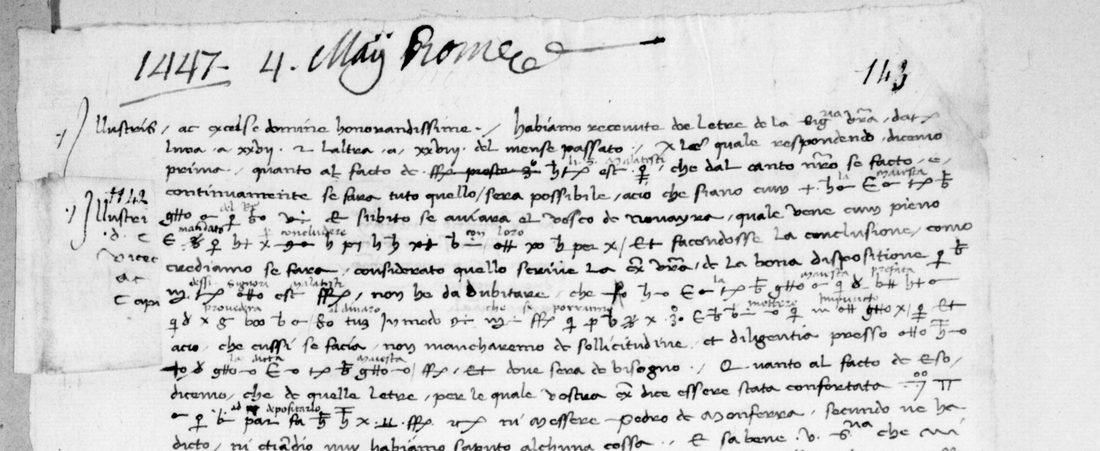
est in the third line). Image: Bibliothèque nationale de France, italien 1584 f. 143, via Gallica.f. 135 (undated, late April) has four runs. All read in sense: Barbavara, having heard what the Duke writes “circha li facti de Roberto da Montalboddo” and what the King said, thinks his “restare de qua” is no longer needed and asks to be told at once. f. 143 (4 May, Barbavara and Arrigoni) has 51 runs, on the Malatesta coming over to the King, the bulls for their vicariates, the new pope stalling, and 4,000 ducats agreed with the Count of Urbino’s ambassadors:
- 9 runs come out of the key alone and agree with the gloss.
- 31 are read from key and gloss together.
- 6 rest on the gloss alone.
- 5 are unread: they have no gloss and their signs fall in blotted cells of the key copy.
The glosses give some values the late key copy does not, among them ϵg = s and fto = ap (in papa), and a few signs read as nulls. These are a first pass, to be checked sign by sign before they are used to correct the key.
06 What remains open
- Five runs of f. 143 (143.17, .31, .35, .46, .51) and words inside two others: no gloss, and blotted cells on the only key copy.
- Code signs:
∠(three blanks),A(one), and three signs on f. 41 (one each). They are unlabelled on R1857 or absent from it. - The Z-like sign as Micheletto Attendolo rests on context in three places.
- “Cologna” on f. 68 is not compared with the cipher.
- The cipher original of 6 February (copy f. 27) is not on the microfilm. The f. 33 copy has no date line; its date comes from a later margin note.
Full texts
The transcription and the decryption of every document on this page, so that the reading can be used and checked. Short files are shown here; all are in the repository.
Pietro Pusterla, Gualdo Tadino, 21 Jan 1447 (cipher f. 13; copy f. 14)
Pusterla tells Sforza he has reached Gualdo and will wait at Montefiascone or Monte Guiduzo for word where to join him, with Antonio da Trezzo, and asks for a guide.
Transcription: none of the cipher. The cipher leaf was not transcribed sign by sign: the late clear copy filed with it is a complete text (spot checks with the R1857 key agree).
Decryption
# Pusterla to Francesco Sforza, 1447: late clear copies in BnF italien 1584 (set a)

Transcribed from the Gallica microfilm half-canvas crops in `img/pages/`. Conventions: spelling as written; [word?]
uncertain, [?] illegible, [gap] a blank left by the copyist, {…} interlinear additions and strike-outs. The place
names marked "heavier ink" are written in a darker, bolder stroke than the surrounding text (as if filled in
separately).

## f. 14 = clear copy of f. 13 (Gualdo, 21 Jan 1447)
Folio checked: "14" stamped/written top right; f014.jpg also shows the small cipher original (f. 13) above it on the same canvas. Left margin in a later hand: "1447. 21 janvier".

Illustris Princeps ac Excelse Domine, humili et devota recomendatione. Per satisfare a ciò me comise V.S. a la partita mia, l'adviso che hogi son gionto qua, e domane me aviarò verso Montefi[a?]scono {Monte written in heavier ink; the letters after "fi" overwritten/blotted}, e li atenderò fin a Mercore matina essere chiarito da V.S. di {sio struck out; suo interlined} suo habitare, e dove ho a venire; non havendo Mercore matina altro di quelo, me aviarò ver Monte guiduzo {Monte in heavier ink}, e da li non me partirò mentre non sia advisato da V.S. di ciò abia a fare, la quale ben prego le piacia mandarme una guida che me abia a guidare al modo suo. Apreso adviso V.S. che Antonio da Trezo è cum mi in compagnia, sichè piaciali ora ad fiarne [fidarne?], se la vole, che vegniamo insema, o divisi, perchè servaremo tuti l'ordine serà dato per V.S. a la quale humilmente sempre me recomando.

Datum Gua[l?]di die 21 Januarij 1447.

E. S. D. V. humilis servitor P. de Pusterla

Illustri [D.?] Francisco Sfortie &c.

## f. 27 = clear copy (Ferrara, 6 Feb 1447; cipher original not located)
Folio checked: "27" top right of f027r.jpg. f027v.jpg is blank on the dark side: it shows only the mirrored show-through of f. 27r, so the whole copy (text, date, signature and the address "a tergo") is on f. 27r. Left margin in a later hand: "1447 6 février". A small ink blot (not a sign) in the left margin beside "grande fondamento / alcune ambasiate".

Illustri ac excelse D. D. {= Domine?} humili et devota recomendatione. Ista mane giongsi [gionsi] qua, e subito fui col [gap; margin sign like a hooked stroke ending in "ꝺ+÷" (ɗ+÷)] quale trová {a word blotted out} non senza umbreia per non havere sentito più di pasati da neuno loco a che termine stiano i facti nostri &c. Io li usá tute quele bone parole m'è stato posibile per levarli il suspecto, non li palegiando però cosa neuna facta, ma certificatelo de la vostra bona dispositione, e confortatelo a volere venire a le cumclusione cum [gap; margin sign ∠] presto, mediante la quale cumclusione, ogni volta l'havese loco, me rendeva certo, V.S. condesenderiate {last letters blotted out, "e" interlined} tuto quelo che piacese, Mio Signore, e quelo fuse utile ad eso [gap; margin sign like ꝺ+÷], e così suspicava, imo me rendeva certo, se la Signoria Sua non provedeva {a word blotted out} a dito [gap; margin sign ∠], la cosa esere a termine non bono, e in periculo che V.S. non se despitase da la pratica &c. {sign like ∫∫.} Il me rispose bone parole asai, quale non son però di{a letter blotted} tale efecto, che se li posa fare suso grande fondamento; pur il m'a comiso, che facia alcune ambasiate al Duca per sua parte monstrando d'esere ben disposito. Non so ora che efecto ne segirà, ma de tuto ne advisarò V.S.. Marcolino Barbavara va da la Santità del Papa, e si a la Majestà del Ré per la facienda del dinaro &c. {sign like ∫∫}, e per{letters blotted; perchè?} colà fare circa questo, ciò li serà imposto per V.S., e non sapendo elo in che modo scriverli, non havendo zifra, gli ó data la copia de la mia, aciò che lui posa scrivere, e che scandalo non intervegna. Domane me aviarò ver Milano, e studiarò cum ogni diligencia satisfare a ciò m'a comiso V.S. a la quale sempre me recomando.

Dat. Ferrarie die 6ta Februarij 1447.

Humilis servitor Petrus de Pusterla

a tergo: Illustri ac excelso domino domino comiti Francisco Sfortie Vicecomiti Cremone domino &c. domino suo singularissimo &c.

## f. 33 = clear copy of f. 32 (Ferrara, 10 Feb 1447, per the margin note)
Folio checked: "33" top right of f033r.jpg. f033v.jpg is blank on the dark side: only the mirrored show-through of f. 33r. The copy has no dating line, signature or address; place and date come only from the later note in the left margin: "di Piero da Pusterla / c. 10 = febb.o 1447 da Ferrara". No blanks and no margin signs. (It opens "S. Conte" without a salutation formula: possibly a cedola or postscript.)

S. Conte. Dapoyche son qui non ó sentito cosa neuna del V.S., né inteso anche a che termine stiano le cose. Io son qua, e dove me sia, voglio V.S. sia certa, son Piero usato e più servitore e volenteroxo di fare cosa piacia a quela, che a tu{a letter blotted}to il resto del mondo, e così parendoli abia a venire qua più una via che un'altra advisamene, che farò ogni cosa che V.S. me comanderà. Pregola ben la voglia intendere i facti soi, mentre il tempo ce basta. Et piaciali qualche volta scriverme qualche cosa, e signiarme quelo li pare facia e dicha.

## f. 41r-v = clear copy of f. 42 (Milan, 14 Feb 1447; Mazzatinti 16 Feb)
Folio checked: "41" top right of f041r.jpg; the copy runs on to f. 41v (f041v.jpg, upright text in the upper right quarter, with mirrored show-through of 41r beside it, ignored). Date correction: the copy's dating line reads "die 14 Februarij 1447", and the later note in the left margin of 41r reads "1447. 14 février", not 16 Feb.

Illustris D. {Domine; abbreviation like "J̃."} Io son gionto qua, ed {"at" struck through; "da lo" interlined above} [gap; margin sign like ƺ (a z with a looped descender) in the left margin beside the first line] ilustrisimo nostro Signore ultra modo veduto voluntera, e referito a la sua Signoria integramente ciò me cometesti, e si chiaritolo de la vostra vera bona dispositione, de la quale il m'è remasto tanto lieto e contento, che non credo la Soa Signoria sapese mai che fuse contenteza, se non hora, e così acertodene V.S. ch'el non è homo al mondo meglio disposito, né più inclinato a vivere secondo la voglia de un altro, che eso mio Signore verso l'V.S., come più largamente la farò intendere a la mia venuta, la quale serà senza neuna dimora, e già seria partito, ma non è parso a eso mio Signore, che venga senz'una bona parte del dinaro, e da Ferara advisarò V.S. del dì che la doverà mandare Ferara per dicti dinari. Apreso, perchè il Signore vole che facia ogni prova de indure il Duca di Ferara a pagare la spesa d'il Sig. de Faenza {margin sign ∠ beside the lines "dure il Duca di Ferara a pagare la spesa d'il / Sig. de Faenza"; no blank left: the name is written out}, e circa ciò me ne dà comisione amplisima, ma perchè io son informato, che 'l Duca di Ferara a pagare {a letter blotted} dicta spesa vorà promisa de havere qualche cosa de quelo che tengono l'inimici, e il Signore non vole che neuna promisa se li facia de neuna cosa che tegano dicti inimici, se non quanto parerà a V.S., [gap; margin sign like ⁊9 (a short horizontal stroke joined to a 9)] prego piaciali advisarme di trat' a Ferara del parere suo circa ciò per avanzare più tempo, ricordando bene a V.S. che so [lo?] dicto Duca di Ferara ha molti logio{a letter blotted} a Verona — [gap; margin sign like εo (a reversed c / epsilon with a small o)] e oferendoli quela credo il se faria fare ogni gran salto, ma il Signore non dispone che neuna cosa se li prometa, se non come e quando piace a V.S. a la quale {"s n p v" underlined, i.e. marked for deletion or left undeciphered} sempre me recomando.

Dat. Mediolani die 14 Februarij 1447.

E. S. D. V. {read "E. S. C. V."?} Humilis servitor Petrus de Pusterla

Illustri D. Francisco Sfortie &c.
Translation
# Pusterla to Francesco Sforza, 1447: English translation of the clear copies (set a)

Translation of `pusterla_copies_a.md`. [gap] = blank left by the copyist (margin signs given in the transcription).
Uncertain readings carry over with "?".

## f. 14 = clear copy of f. 13 (Gualdo, 21 Jan 1447)
Most illustrious Prince and excellent Lord, humble and devout recommendation. To carry out what Your Lordship charged me with at my departure, I inform you that today I arrived here, and tomorrow I shall set out towards Montefiascone [?], and there I shall wait until Wednesday morning to be informed by Your Lordship of your whereabouts, and where I am to come; not having anything else by Wednesday morning, I shall set out towards Monte Guiduzo, and from there I shall not leave until I am advised by Your Lordship of what I am to do; and I earnestly beg you to be pleased to send me a guide who is to guide me in your way. Further, I inform Your Lordship that Antonio da Trezzo is in company with me, so may it please you now to trust us [?], if you wish, that we come together or separately, because we shall all keep the order that will be given by Your Lordship, to whom I always humbly commend myself.

Given at Gualdo, 21 January 1447.

Of Your Excellent Lordship the humble servant P. de Pusterla

To the illustrious Lord Francesco Sforza, etc.

## f. 27 = clear copy (Ferrara, 6 Feb 1447; cipher original not located)
Illustrious and excellent Lord, humble and devout recommendation. This morning I arrived here, and at once I was with [gap], whom I found not without suspicion, for not having heard for days past from anywhere at what stage our affairs stand, etc. I used with him all the good words that were possible for me to remove his suspicion, without however revealing to him anything done, but I assured him of your good disposition, and urged him to be willing to come to the conclusion with [gap] soon; by means of which conclusion, whenever it should take place, I was certain Your Lordship would agree to everything that would please my lord, and what would be useful to the same [gap]; and so he suspected, indeed he was certain, that if His Lordship did not provide for the said [gap], the matter would come to no good end, and to the danger that Your Lordship might become vexed with the negotiation, etc. He answered me plenty of good words, which however are not of such effect that one can build great foundations on them; still he has charged me to carry some messages to the Duke on his behalf, showing himself well disposed. I do not know now what effect will follow, but I shall inform Your Lordship of everything. Marcolino Barbavara is going to His Holiness the Pope, and also to His Majesty the King, for the money business, etc., and because [?] what he is to do there about this will be laid on him by Your Lordship, and he not knowing how to write to you, having no cipher, I have given him the copy of mine, so that he can write, and so that no scandal may arise. Tomorrow I shall set out towards Milan, and I shall strive with all diligence to carry out what Your Lordship has charged me with, to whom I always commend myself.

Given at Ferrara, 6 February 1447.

Humble servant Pietro de Pusterla

On the back: To the illustrious and excellent lord, lord Count Francesco Sforza Visconti, lord of Cremona etc., his most singular lord, etc.

## f. 33 = clear copy of f. 32 (Ferrara, 10 Feb 1447, per the margin note)
Lord Count. Since I have been here I have heard nothing from Your Lordship, nor learned either at what stage things stand. I am here, and wherever I may be, I want Your Lordship to be certain that I am the usual Piero, and more a servant and more willing to do something that pleases you than for all the rest of the world; and so, if it seems to you that I should come here [there?] by one route rather than another, let me know, for I shall do everything that Your Lordship commands me. I beg you to be pleased to attend to your affairs while the time allows us. And may it please you sometimes to write me something, and to indicate to me what it seems to you I should do and say.

## f. 41r-v = clear copy of f. 42 (Milan, 14 Feb 1447; Mazzatinti 16 Feb)
Illustrious Lord. I have arrived here, and by the [gap] our most illustrious Lord I was seen exceedingly willingly, and I reported to His Lordship in full what you charged me with, and so assured him of your true good disposition, at which he has remained so glad and content that I do not believe His Lordship ever knew what contentment was until now; and so I assure Your Lordship of it, that there is no man in the world better disposed, nor more inclined to live according to the will of another, than my said Lord towards Your Lordship, as I shall make you understand more fully on my arrival, which will be without any delay; and I would already have left, but it did not seem right to my said Lord that I should come without a good part of the money; and from Ferrara I shall inform Your Lordship of the day on which you are to send to Ferrara for the said money. Further, because the Lord wants me to make every attempt to induce the Duke of Ferrara to pay the expense of the Lord of Faenza, and about this he gives me the fullest commission, but because I am informed that the Duke of Ferrara, to pay the said expense, will want a promise of having something of what the enemies hold, and the Lord does not want any promise to be made to him of anything that the said enemies hold, except as far as shall seem good to Your Lordship, [gap] I beg you to be pleased to inform me straight away at Ferrara of your opinion about this, to gain more time, reminding Your Lordship well that the [?] said Duke of Ferrara has many lodgings [?] at Verona — [gap] and by offering him that, I believe he would make every great leap; but the Lord does not intend that anything be promised him, except as and when it pleases Your Lordship, to whom I always commend myself.

Given at Milan, 14 February 1447.

Of Your Excellent Lordship the humble servant Pietro de Pusterla

To the illustrious Lord Francesco Sforza, etc.
Pietro Pusterla, Ferrara, 6 Feb 1447 (cipher f. 27 (copy; the cipher original not located); copy f. 27)
At Ferrara the Duca di Ferrara is suspicious for lack of news; Pusterla reassures him and urges a quick conclusion; Barbavara, going to the Pope and the King about the money, takes a copy of Pusterla's cipher.
Transcription: none of the cipher. The cipher leaf was not transcribed sign by sign: the late clear copy filed with it is a complete text (spot checks with the R1857 key agree).
Decryption
# Pusterla to Francesco Sforza, 1447: late clear copies in BnF italien 1584 (set a)

Transcribed from the Gallica microfilm half-canvas crops in `img/pages/`. Conventions: spelling as written; [word?]
uncertain, [?] illegible, [gap] a blank left by the copyist, {…} interlinear additions and strike-outs. The place
names marked "heavier ink" are written in a darker, bolder stroke than the surrounding text (as if filled in
separately).

## f. 14 = clear copy of f. 13 (Gualdo, 21 Jan 1447)
Folio checked: "14" stamped/written top right; f014.jpg also shows the small cipher original (f. 13) above it on the same canvas. Left margin in a later hand: "1447. 21 janvier".

Illustris Princeps ac Excelse Domine, humili et devota recomendatione. Per satisfare a ciò me comise V.S. a la partita mia, l'adviso che hogi son gionto qua, e domane me aviarò verso Montefi[a?]scono {Monte written in heavier ink; the letters after "fi" overwritten/blotted}, e li atenderò fin a Mercore matina essere chiarito da V.S. di {sio struck out; suo interlined} suo habitare, e dove ho a venire; non havendo Mercore matina altro di quelo, me aviarò ver Monte guiduzo {Monte in heavier ink}, e da li non me partirò mentre non sia advisato da V.S. di ciò abia a fare, la quale ben prego le piacia mandarme una guida che me abia a guidare al modo suo. Apreso adviso V.S. che Antonio da Trezo è cum mi in compagnia, sichè piaciali ora ad fiarne [fidarne?], se la vole, che vegniamo insema, o divisi, perchè servaremo tuti l'ordine serà dato per V.S. a la quale humilmente sempre me recomando.

Datum Gua[l?]di die 21 Januarij 1447.

E. S. D. V. humilis servitor P. de Pusterla

Illustri [D.?] Francisco Sfortie &c.

## f. 27 = clear copy (Ferrara, 6 Feb 1447; cipher original not located)
Folio checked: "27" top right of f027r.jpg. f027v.jpg is blank on the dark side: it shows only the mirrored show-through of f. 27r, so the whole copy (text, date, signature and the address "a tergo") is on f. 27r. Left margin in a later hand: "1447 6 février". A small ink blot (not a sign) in the left margin beside "grande fondamento / alcune ambasiate".

Illustri ac excelse D. D. {= Domine?} humili et devota recomendatione. Ista mane giongsi [gionsi] qua, e subito fui col [gap; margin sign like a hooked stroke ending in "ꝺ+÷" (ɗ+÷)] quale trová {a word blotted out} non senza umbreia per non havere sentito più di pasati da neuno loco a che termine stiano i facti nostri &c. Io li usá tute quele bone parole m'è stato posibile per levarli il suspecto, non li palegiando però cosa neuna facta, ma certificatelo de la vostra bona dispositione, e confortatelo a volere venire a le cumclusione cum [gap; margin sign ∠] presto, mediante la quale cumclusione, ogni volta l'havese loco, me rendeva certo, V.S. condesenderiate {last letters blotted out, "e" interlined} tuto quelo che piacese, Mio Signore, e quelo fuse utile ad eso [gap; margin sign like ꝺ+÷], e così suspicava, imo me rendeva certo, se la Signoria Sua non provedeva {a word blotted out} a dito [gap; margin sign ∠], la cosa esere a termine non bono, e in periculo che V.S. non se despitase da la pratica &c. {sign like ∫∫.} Il me rispose bone parole asai, quale non son però di{a letter blotted} tale efecto, che se li posa fare suso grande fondamento; pur il m'a comiso, che facia alcune ambasiate al Duca per sua parte monstrando d'esere ben disposito. Non so ora che efecto ne segirà, ma de tuto ne advisarò V.S.. Marcolino Barbavara va da la Santità del Papa, e si a la Majestà del Ré per la facienda del dinaro &c. {sign like ∫∫}, e per{letters blotted; perchè?} colà fare circa questo, ciò li serà imposto per V.S., e non sapendo elo in che modo scriverli, non havendo zifra, gli ó data la copia de la mia, aciò che lui posa scrivere, e che scandalo non intervegna. Domane me aviarò ver Milano, e studiarò cum ogni diligencia satisfare a ciò m'a comiso V.S. a la quale sempre me recomando.

Dat. Ferrarie die 6ta Februarij 1447.

Humilis servitor Petrus de Pusterla

a tergo: Illustri ac excelso domino domino comiti Francisco Sfortie Vicecomiti Cremone domino &c. domino suo singularissimo &c.

## f. 33 = clear copy of f. 32 (Ferrara, 10 Feb 1447, per the margin note)
Folio checked: "33" top right of f033r.jpg. f033v.jpg is blank on the dark side: only the mirrored show-through of f. 33r. The copy has no dating line, signature or address; place and date come only from the later note in the left margin: "di Piero da Pusterla / c. 10 = febb.o 1447 da Ferrara". No blanks and no margin signs. (It opens "S. Conte" without a salutation formula: possibly a cedola or postscript.)

S. Conte. Dapoyche son qui non ó sentito cosa neuna del V.S., né inteso anche a che termine stiano le cose. Io son qua, e dove me sia, voglio V.S. sia certa, son Piero usato e più servitore e volenteroxo di fare cosa piacia a quela, che a tu{a letter blotted}to il resto del mondo, e così parendoli abia a venire qua più una via che un'altra advisamene, che farò ogni cosa che V.S. me comanderà. Pregola ben la voglia intendere i facti soi, mentre il tempo ce basta. Et piaciali qualche volta scriverme qualche cosa, e signiarme quelo li pare facia e dicha.

## f. 41r-v = clear copy of f. 42 (Milan, 14 Feb 1447; Mazzatinti 16 Feb)
Folio checked: "41" top right of f041r.jpg; the copy runs on to f. 41v (f041v.jpg, upright text in the upper right quarter, with mirrored show-through of 41r beside it, ignored). Date correction: the copy's dating line reads "die 14 Februarij 1447", and the later note in the left margin of 41r reads "1447. 14 février", not 16 Feb.

Illustris D. {Domine; abbreviation like "J̃."} Io son gionto qua, ed {"at" struck through; "da lo" interlined above} [gap; margin sign like ƺ (a z with a looped descender) in the left margin beside the first line] ilustrisimo nostro Signore ultra modo veduto voluntera, e referito a la sua Signoria integramente ciò me cometesti, e si chiaritolo de la vostra vera bona dispositione, de la quale il m'è remasto tanto lieto e contento, che non credo la Soa Signoria sapese mai che fuse contenteza, se non hora, e così acertodene V.S. ch'el non è homo al mondo meglio disposito, né più inclinato a vivere secondo la voglia de un altro, che eso mio Signore verso l'V.S., come più largamente la farò intendere a la mia venuta, la quale serà senza neuna dimora, e già seria partito, ma non è parso a eso mio Signore, che venga senz'una bona parte del dinaro, e da Ferara advisarò V.S. del dì che la doverà mandare Ferara per dicti dinari. Apreso, perchè il Signore vole che facia ogni prova de indure il Duca di Ferara a pagare la spesa d'il Sig. de Faenza {margin sign ∠ beside the lines "dure il Duca di Ferara a pagare la spesa d'il / Sig. de Faenza"; no blank left: the name is written out}, e circa ciò me ne dà comisione amplisima, ma perchè io son informato, che 'l Duca di Ferara a pagare {a letter blotted} dicta spesa vorà promisa de havere qualche cosa de quelo che tengono l'inimici, e il Signore non vole che neuna promisa se li facia de neuna cosa che tegano dicti inimici, se non quanto parerà a V.S., [gap; margin sign like ⁊9 (a short horizontal stroke joined to a 9)] prego piaciali advisarme di trat' a Ferara del parere suo circa ciò per avanzare più tempo, ricordando bene a V.S. che so [lo?] dicto Duca di Ferara ha molti logio{a letter blotted} a Verona — [gap; margin sign like εo (a reversed c / epsilon with a small o)] e oferendoli quela credo il se faria fare ogni gran salto, ma il Signore non dispone che neuna cosa se li prometa, se non come e quando piace a V.S. a la quale {"s n p v" underlined, i.e. marked for deletion or left undeciphered} sempre me recomando.

Dat. Mediolani die 14 Februarij 1447.

E. S. D. V. {read "E. S. C. V."?} Humilis servitor Petrus de Pusterla

Illustri D. Francisco Sfortie &c.
Translation
# Pusterla to Francesco Sforza, 1447: English translation of the clear copies (set a)

Translation of `pusterla_copies_a.md`. [gap] = blank left by the copyist (margin signs given in the transcription).
Uncertain readings carry over with "?".

## f. 14 = clear copy of f. 13 (Gualdo, 21 Jan 1447)
Most illustrious Prince and excellent Lord, humble and devout recommendation. To carry out what Your Lordship charged me with at my departure, I inform you that today I arrived here, and tomorrow I shall set out towards Montefiascone [?], and there I shall wait until Wednesday morning to be informed by Your Lordship of your whereabouts, and where I am to come; not having anything else by Wednesday morning, I shall set out towards Monte Guiduzo, and from there I shall not leave until I am advised by Your Lordship of what I am to do; and I earnestly beg you to be pleased to send me a guide who is to guide me in your way. Further, I inform Your Lordship that Antonio da Trezzo is in company with me, so may it please you now to trust us [?], if you wish, that we come together or separately, because we shall all keep the order that will be given by Your Lordship, to whom I always humbly commend myself.

Given at Gualdo, 21 January 1447.

Of Your Excellent Lordship the humble servant P. de Pusterla

To the illustrious Lord Francesco Sforza, etc.

## f. 27 = clear copy (Ferrara, 6 Feb 1447; cipher original not located)
Illustrious and excellent Lord, humble and devout recommendation. This morning I arrived here, and at once I was with [gap], whom I found not without suspicion, for not having heard for days past from anywhere at what stage our affairs stand, etc. I used with him all the good words that were possible for me to remove his suspicion, without however revealing to him anything done, but I assured him of your good disposition, and urged him to be willing to come to the conclusion with [gap] soon; by means of which conclusion, whenever it should take place, I was certain Your Lordship would agree to everything that would please my lord, and what would be useful to the same [gap]; and so he suspected, indeed he was certain, that if His Lordship did not provide for the said [gap], the matter would come to no good end, and to the danger that Your Lordship might become vexed with the negotiation, etc. He answered me plenty of good words, which however are not of such effect that one can build great foundations on them; still he has charged me to carry some messages to the Duke on his behalf, showing himself well disposed. I do not know now what effect will follow, but I shall inform Your Lordship of everything. Marcolino Barbavara is going to His Holiness the Pope, and also to His Majesty the King, for the money business, etc., and because [?] what he is to do there about this will be laid on him by Your Lordship, and he not knowing how to write to you, having no cipher, I have given him the copy of mine, so that he can write, and so that no scandal may arise. Tomorrow I shall set out towards Milan, and I shall strive with all diligence to carry out what Your Lordship has charged me with, to whom I always commend myself.

Given at Ferrara, 6 February 1447.

Humble servant Pietro de Pusterla

On the back: To the illustrious and excellent lord, lord Count Francesco Sforza Visconti, lord of Cremona etc., his most singular lord, etc.

## f. 33 = clear copy of f. 32 (Ferrara, 10 Feb 1447, per the margin note)
Lord Count. Since I have been here I have heard nothing from Your Lordship, nor learned either at what stage things stand. I am here, and wherever I may be, I want Your Lordship to be certain that I am the usual Piero, and more a servant and more willing to do something that pleases you than for all the rest of the world; and so, if it seems to you that I should come here [there?] by one route rather than another, let me know, for I shall do everything that Your Lordship commands me. I beg you to be pleased to attend to your affairs while the time allows us. And may it please you sometimes to write me something, and to indicate to me what it seems to you I should do and say.

## f. 41r-v = clear copy of f. 42 (Milan, 14 Feb 1447; Mazzatinti 16 Feb)
Illustrious Lord. I have arrived here, and by the [gap] our most illustrious Lord I was seen exceedingly willingly, and I reported to His Lordship in full what you charged me with, and so assured him of your true good disposition, at which he has remained so glad and content that I do not believe His Lordship ever knew what contentment was until now; and so I assure Your Lordship of it, that there is no man in the world better disposed, nor more inclined to live according to the will of another, than my said Lord towards Your Lordship, as I shall make you understand more fully on my arrival, which will be without any delay; and I would already have left, but it did not seem right to my said Lord that I should come without a good part of the money; and from Ferrara I shall inform Your Lordship of the day on which you are to send to Ferrara for the said money. Further, because the Lord wants me to make every attempt to induce the Duke of Ferrara to pay the expense of the Lord of Faenza, and about this he gives me the fullest commission, but because I am informed that the Duke of Ferrara, to pay the said expense, will want a promise of having something of what the enemies hold, and the Lord does not want any promise to be made to him of anything that the said enemies hold, except as far as shall seem good to Your Lordship, [gap] I beg you to be pleased to inform me straight away at Ferrara of your opinion about this, to gain more time, reminding Your Lordship well that the [?] said Duke of Ferrara has many lodgings [?] at Verona — [gap] and by offering him that, I believe he would make every great leap; but the Lord does not intend that anything be promised him, except as and when it pleases Your Lordship, to whom I always commend myself.

Given at Milan, 14 February 1447.

Of Your Excellent Lordship the humble servant Pietro de Pusterla

To the illustrious Lord Francesco Sforza, etc.
Pietro Pusterla, Ferrara, 10 Feb 1447 (cipher f. 32; copy f. 33)
A short note to the Count: no news from Sforza; Pusterla protests his loyalty and asks for instructions.
Transcription: none of the cipher. The cipher leaf was not transcribed sign by sign: the late clear copy filed with it is a complete text (spot checks with the R1857 key agree).
Decryption
# Pusterla to Francesco Sforza, 1447: late clear copies in BnF italien 1584 (set a)

Transcribed from the Gallica microfilm half-canvas crops in `img/pages/`. Conventions: spelling as written; [word?]
uncertain, [?] illegible, [gap] a blank left by the copyist, {…} interlinear additions and strike-outs. The place
names marked "heavier ink" are written in a darker, bolder stroke than the surrounding text (as if filled in
separately).

## f. 14 = clear copy of f. 13 (Gualdo, 21 Jan 1447)
Folio checked: "14" stamped/written top right; f014.jpg also shows the small cipher original (f. 13) above it on the same canvas. Left margin in a later hand: "1447. 21 janvier".

Illustris Princeps ac Excelse Domine, humili et devota recomendatione. Per satisfare a ciò me comise V.S. a la partita mia, l'adviso che hogi son gionto qua, e domane me aviarò verso Montefi[a?]scono {Monte written in heavier ink; the letters after "fi" overwritten/blotted}, e li atenderò fin a Mercore matina essere chiarito da V.S. di {sio struck out; suo interlined} suo habitare, e dove ho a venire; non havendo Mercore matina altro di quelo, me aviarò ver Monte guiduzo {Monte in heavier ink}, e da li non me partirò mentre non sia advisato da V.S. di ciò abia a fare, la quale ben prego le piacia mandarme una guida che me abia a guidare al modo suo. Apreso adviso V.S. che Antonio da Trezo è cum mi in compagnia, sichè piaciali ora ad fiarne [fidarne?], se la vole, che vegniamo insema, o divisi, perchè servaremo tuti l'ordine serà dato per V.S. a la quale humilmente sempre me recomando.

Datum Gua[l?]di die 21 Januarij 1447.

E. S. D. V. humilis servitor P. de Pusterla

Illustri [D.?] Francisco Sfortie &c.

## f. 27 = clear copy (Ferrara, 6 Feb 1447; cipher original not located)
Folio checked: "27" top right of f027r.jpg. f027v.jpg is blank on the dark side: it shows only the mirrored show-through of f. 27r, so the whole copy (text, date, signature and the address "a tergo") is on f. 27r. Left margin in a later hand: "1447 6 février". A small ink blot (not a sign) in the left margin beside "grande fondamento / alcune ambasiate".

Illustri ac excelse D. D. {= Domine?} humili et devota recomendatione. Ista mane giongsi [gionsi] qua, e subito fui col [gap; margin sign like a hooked stroke ending in "ꝺ+÷" (ɗ+÷)] quale trová {a word blotted out} non senza umbreia per non havere sentito più di pasati da neuno loco a che termine stiano i facti nostri &c. Io li usá tute quele bone parole m'è stato posibile per levarli il suspecto, non li palegiando però cosa neuna facta, ma certificatelo de la vostra bona dispositione, e confortatelo a volere venire a le cumclusione cum [gap; margin sign ∠] presto, mediante la quale cumclusione, ogni volta l'havese loco, me rendeva certo, V.S. condesenderiate {last letters blotted out, "e" interlined} tuto quelo che piacese, Mio Signore, e quelo fuse utile ad eso [gap; margin sign like ꝺ+÷], e così suspicava, imo me rendeva certo, se la Signoria Sua non provedeva {a word blotted out} a dito [gap; margin sign ∠], la cosa esere a termine non bono, e in periculo che V.S. non se despitase da la pratica &c. {sign like ∫∫.} Il me rispose bone parole asai, quale non son però di{a letter blotted} tale efecto, che se li posa fare suso grande fondamento; pur il m'a comiso, che facia alcune ambasiate al Duca per sua parte monstrando d'esere ben disposito. Non so ora che efecto ne segirà, ma de tuto ne advisarò V.S.. Marcolino Barbavara va da la Santità del Papa, e si a la Majestà del Ré per la facienda del dinaro &c. {sign like ∫∫}, e per{letters blotted; perchè?} colà fare circa questo, ciò li serà imposto per V.S., e non sapendo elo in che modo scriverli, non havendo zifra, gli ó data la copia de la mia, aciò che lui posa scrivere, e che scandalo non intervegna. Domane me aviarò ver Milano, e studiarò cum ogni diligencia satisfare a ciò m'a comiso V.S. a la quale sempre me recomando.

Dat. Ferrarie die 6ta Februarij 1447.

Humilis servitor Petrus de Pusterla

a tergo: Illustri ac excelso domino domino comiti Francisco Sfortie Vicecomiti Cremone domino &c. domino suo singularissimo &c.

## f. 33 = clear copy of f. 32 (Ferrara, 10 Feb 1447, per the margin note)
Folio checked: "33" top right of f033r.jpg. f033v.jpg is blank on the dark side: only the mirrored show-through of f. 33r. The copy has no dating line, signature or address; place and date come only from the later note in the left margin: "di Piero da Pusterla / c. 10 = febb.o 1447 da Ferrara". No blanks and no margin signs. (It opens "S. Conte" without a salutation formula: possibly a cedola or postscript.)

S. Conte. Dapoyche son qui non ó sentito cosa neuna del V.S., né inteso anche a che termine stiano le cose. Io son qua, e dove me sia, voglio V.S. sia certa, son Piero usato e più servitore e volenteroxo di fare cosa piacia a quela, che a tu{a letter blotted}to il resto del mondo, e così parendoli abia a venire qua più una via che un'altra advisamene, che farò ogni cosa che V.S. me comanderà. Pregola ben la voglia intendere i facti soi, mentre il tempo ce basta. Et piaciali qualche volta scriverme qualche cosa, e signiarme quelo li pare facia e dicha.

## f. 41r-v = clear copy of f. 42 (Milan, 14 Feb 1447; Mazzatinti 16 Feb)
Folio checked: "41" top right of f041r.jpg; the copy runs on to f. 41v (f041v.jpg, upright text in the upper right quarter, with mirrored show-through of 41r beside it, ignored). Date correction: the copy's dating line reads "die 14 Februarij 1447", and the later note in the left margin of 41r reads "1447. 14 février", not 16 Feb.

Illustris D. {Domine; abbreviation like "J̃."} Io son gionto qua, ed {"at" struck through; "da lo" interlined above} [gap; margin sign like ƺ (a z with a looped descender) in the left margin beside the first line] ilustrisimo nostro Signore ultra modo veduto voluntera, e referito a la sua Signoria integramente ciò me cometesti, e si chiaritolo de la vostra vera bona dispositione, de la quale il m'è remasto tanto lieto e contento, che non credo la Soa Signoria sapese mai che fuse contenteza, se non hora, e così acertodene V.S. ch'el non è homo al mondo meglio disposito, né più inclinato a vivere secondo la voglia de un altro, che eso mio Signore verso l'V.S., come più largamente la farò intendere a la mia venuta, la quale serà senza neuna dimora, e già seria partito, ma non è parso a eso mio Signore, che venga senz'una bona parte del dinaro, e da Ferara advisarò V.S. del dì che la doverà mandare Ferara per dicti dinari. Apreso, perchè il Signore vole che facia ogni prova de indure il Duca di Ferara a pagare la spesa d'il Sig. de Faenza {margin sign ∠ beside the lines "dure il Duca di Ferara a pagare la spesa d'il / Sig. de Faenza"; no blank left: the name is written out}, e circa ciò me ne dà comisione amplisima, ma perchè io son informato, che 'l Duca di Ferara a pagare {a letter blotted} dicta spesa vorà promisa de havere qualche cosa de quelo che tengono l'inimici, e il Signore non vole che neuna promisa se li facia de neuna cosa che tegano dicti inimici, se non quanto parerà a V.S., [gap; margin sign like ⁊9 (a short horizontal stroke joined to a 9)] prego piaciali advisarme di trat' a Ferara del parere suo circa ciò per avanzare più tempo, ricordando bene a V.S. che so [lo?] dicto Duca di Ferara ha molti logio{a letter blotted} a Verona — [gap; margin sign like εo (a reversed c / epsilon with a small o)] e oferendoli quela credo il se faria fare ogni gran salto, ma il Signore non dispone che neuna cosa se li prometa, se non come e quando piace a V.S. a la quale {"s n p v" underlined, i.e. marked for deletion or left undeciphered} sempre me recomando.

Dat. Mediolani die 14 Februarij 1447.

E. S. D. V. {read "E. S. C. V."?} Humilis servitor Petrus de Pusterla

Illustri D. Francisco Sfortie &c.
Translation
# Pusterla to Francesco Sforza, 1447: English translation of the clear copies (set a)

Translation of `pusterla_copies_a.md`. [gap] = blank left by the copyist (margin signs given in the transcription).
Uncertain readings carry over with "?".

## f. 14 = clear copy of f. 13 (Gualdo, 21 Jan 1447)
Most illustrious Prince and excellent Lord, humble and devout recommendation. To carry out what Your Lordship charged me with at my departure, I inform you that today I arrived here, and tomorrow I shall set out towards Montefiascone [?], and there I shall wait until Wednesday morning to be informed by Your Lordship of your whereabouts, and where I am to come; not having anything else by Wednesday morning, I shall set out towards Monte Guiduzo, and from there I shall not leave until I am advised by Your Lordship of what I am to do; and I earnestly beg you to be pleased to send me a guide who is to guide me in your way. Further, I inform Your Lordship that Antonio da Trezzo is in company with me, so may it please you now to trust us [?], if you wish, that we come together or separately, because we shall all keep the order that will be given by Your Lordship, to whom I always humbly commend myself.

Given at Gualdo, 21 January 1447.

Of Your Excellent Lordship the humble servant P. de Pusterla

To the illustrious Lord Francesco Sforza, etc.

## f. 27 = clear copy (Ferrara, 6 Feb 1447; cipher original not located)
Illustrious and excellent Lord, humble and devout recommendation. This morning I arrived here, and at once I was with [gap], whom I found not without suspicion, for not having heard for days past from anywhere at what stage our affairs stand, etc. I used with him all the good words that were possible for me to remove his suspicion, without however revealing to him anything done, but I assured him of your good disposition, and urged him to be willing to come to the conclusion with [gap] soon; by means of which conclusion, whenever it should take place, I was certain Your Lordship would agree to everything that would please my lord, and what would be useful to the same [gap]; and so he suspected, indeed he was certain, that if His Lordship did not provide for the said [gap], the matter would come to no good end, and to the danger that Your Lordship might become vexed with the negotiation, etc. He answered me plenty of good words, which however are not of such effect that one can build great foundations on them; still he has charged me to carry some messages to the Duke on his behalf, showing himself well disposed. I do not know now what effect will follow, but I shall inform Your Lordship of everything. Marcolino Barbavara is going to His Holiness the Pope, and also to His Majesty the King, for the money business, etc., and because [?] what he is to do there about this will be laid on him by Your Lordship, and he not knowing how to write to you, having no cipher, I have given him the copy of mine, so that he can write, and so that no scandal may arise. Tomorrow I shall set out towards Milan, and I shall strive with all diligence to carry out what Your Lordship has charged me with, to whom I always commend myself.

Given at Ferrara, 6 February 1447.

Humble servant Pietro de Pusterla

On the back: To the illustrious and excellent lord, lord Count Francesco Sforza Visconti, lord of Cremona etc., his most singular lord, etc.

## f. 33 = clear copy of f. 32 (Ferrara, 10 Feb 1447, per the margin note)
Lord Count. Since I have been here I have heard nothing from Your Lordship, nor learned either at what stage things stand. I am here, and wherever I may be, I want Your Lordship to be certain that I am the usual Piero, and more a servant and more willing to do something that pleases you than for all the rest of the world; and so, if it seems to you that I should come here [there?] by one route rather than another, let me know, for I shall do everything that Your Lordship commands me. I beg you to be pleased to attend to your affairs while the time allows us. And may it please you sometimes to write me something, and to indicate to me what it seems to you I should do and say.

## f. 41r-v = clear copy of f. 42 (Milan, 14 Feb 1447; Mazzatinti 16 Feb)
Illustrious Lord. I have arrived here, and by the [gap] our most illustrious Lord I was seen exceedingly willingly, and I reported to His Lordship in full what you charged me with, and so assured him of your true good disposition, at which he has remained so glad and content that I do not believe His Lordship ever knew what contentment was until now; and so I assure Your Lordship of it, that there is no man in the world better disposed, nor more inclined to live according to the will of another, than my said Lord towards Your Lordship, as I shall make you understand more fully on my arrival, which will be without any delay; and I would already have left, but it did not seem right to my said Lord that I should come without a good part of the money; and from Ferrara I shall inform Your Lordship of the day on which you are to send to Ferrara for the said money. Further, because the Lord wants me to make every attempt to induce the Duke of Ferrara to pay the expense of the Lord of Faenza, and about this he gives me the fullest commission, but because I am informed that the Duke of Ferrara, to pay the said expense, will want a promise of having something of what the enemies hold, and the Lord does not want any promise to be made to him of anything that the said enemies hold, except as far as shall seem good to Your Lordship, [gap] I beg you to be pleased to inform me straight away at Ferrara of your opinion about this, to gain more time, reminding Your Lordship well that the [?] said Duke of Ferrara has many lodgings [?] at Verona — [gap] and by offering him that, I believe he would make every great leap; but the Lord does not intend that anything be promised him, except as and when it pleases Your Lordship, to whom I always commend myself.

Given at Milan, 14 February 1447.

Of Your Excellent Lordship the humble servant Pietro de Pusterla

To the illustrious Lord Francesco Sforza, etc.
Marcolino Barbavara, Rimini, 13 Feb 1447 (cipher f. 40; copy f. 39)
From Rimini: the courier is warned, a safe-conduct is sent for two of Sforza's men, and Barbavara will set out by San Giovanni in Marignano; he has dealt with Sigismondo Malatesta as instructed.
Transcription: none of the cipher. The cipher leaf was not transcribed sign by sign: the late clear copy filed with it is a complete text (spot checks with the R1857 key agree).
Decryption
# The filed clear copies (decipherments) of Barbavara's cipher letters, BnF italien 1584

Transcribed 28 Oct 2026 from the Gallica microfilm (ark btv1b100373864; canvas numbers in brackets) by Claude Opus 5.5.
The copies are in one late, regular italic hand (eighteenth century to judge by the script; not dated), each on its own leaf filed before or around the cipher original. Spelling as written;
line breaks not kept. `[gap]` = a blank the copyist left; `[?]` = my uncertain reading; `{...}` = my note.

## f. 39 = decipherment of f. 40 (Rimini, 13 Feb 1447) [canvas 36]

Se lo cavalario {written above a word struck through} non ha servati quelli modi haveria voluto V.S. — {dash in the
copy}, é proceduto, perché essendole quelli del [gap], non li pariva bisognasse venire [blot] cum altro reguardo.
Adesso lo ho ammonito quanto bisogna, et capitarà a casa de Cecho vostro canzelero quanto scriveti. Mando per lui lo
salvoconducto richesto per quelli dui vostri, et mercordì proximo andarò a [Atachio?] per la via de San Joanne in
Marignano secondo el comandamento vostro, et servarò tutti quelli modi che loro me darano per retrovarme cum V.S.
Cum lo Segnore Sigismondo ho servato lo modo del quale me avisa la Excellentia vostra, a la quale me recomando.
Arimini tertiodecimo Februarij. Servitor vestre Dominationis Marcolinus.
{Address:} Illustri domino Francisco Sfortie etc.

## f. 48r-v = decipherment of f. 49 (Rome, 27 Feb 1447) [canvases 45 right, 46 left]

Illustris et excelse domine honorandissime. Essendo zonto qua ho trovato el Papa essere passato de questa vita come
haveriti inteso, et ha pur voluto fare come diceva la S.V., cioè morire per fare male non solamente vivendo, ma
etiandio morendo. Sono stato cum lo Camerlengo — {dash in the copy} lo quale intesa la casone de la mia venuta dice
[blot] effecto essere necessario expectare la elecion d'un altro Papa, et per tractare la cossa cum la soa Sanctità,
et che fra questo mezo posso andare da la Majestà del Re per strenzere la cossa cum si, et cussì farò, et de quello
seguirà la S.V. ne serà avisata. Ha havuto el dicto Camerlengo molto grato et accepto quanto li ho dicto per vostra
parte, et per le parole ha usato cum mi me pare essere molto volunteroso de havere et servare bona amicitia cum la
S.V., et me ha commesso ve scriva che siati de bona voglia, perché qualuncha sia electo al papato voluntera farà de le
cosse ve piaceranno. Dice etiandio ch'el serà amico el Segnore vostro padre, o almancho non li serà inimico, ma più
crede che li serà amico e favorevele, et dio voglia che cussì sia. Se ha opinione che la elecione debia tocare o a
Monsignore de Capua, o a Monsignore de Fermo, pur poteria essere che tocaria ad altri, perché me pare che sempre tochi
a quello del quale comunamente non s'è facto pensiero. Se la Excellentia vostra facesse qualche vista et
demostracione de volerse fare inance ne la Marcha, o altrove, siché qua ne venisse novelle, credo seria assay utile a
rescaldare li animi de questi preti, et a farli più caldi al contribuire a la spesa vostra; et questo dico perché se
[ha?] facto fondamento quasi certo che la S.V. ad ogni modo andarà a li favori et subsidii del {struck: del} a el
prefato Signore vostro padre. La quale opinione però me sono sforzato de cavarli de la testa, et dicto che tale
fondamento è vano, et che bene siati ben disposito bisogna che questa bona disposizione sia aiutata altramente che
cum parole, cioè cum dinari. Ma per levargela ancora [gap?] {line ends with a flourish}
Ex Roma vigesimo septimo Februarij. Vestre Excelencie Servulus Marcolinus.
{Address:} Illustri domino Francisco Sfortie etc.

## f. 55r-v, 57r = decipherment of f. 56 (Rome, 3 Mar 1447) [canvases 53 right, 54 left, 55 right]

Illustris ac excellens domine honorandissime. Sono stato da la Majestà del Re, et cum quelle rasone me sono acadute a
la mente lo confortata et pregata a nome del mio Signore a prendere tanto majore cura et caricho de contribuire a la
spesa vostra, quanto el bisogno è majore per la morte del Papa, dal quale non è più da expectare subventione alcuna.
In effecto la soa Serenità è restata contenta non solamente de pagare quelo devia pagare el Papa, ma etiandio de
contribuire de majore quantità non era stato rasonato da prima, cioè de ducati novantaquatro milia d'oro et in oro
ogni anno et per dui anni come ha scripto el prefato Signore che'l restava contento de dui anni, et vole pagare li
dicti dinari in questo modo, cioè vintimilia ducati nel mese presente, et altri xx m nel mese d'Aprile sequente al
più tardi, et lo resto per la mità al fine de li sei mesi dal dì de la ferma vostra, et l'altra mità al fine del
ano, et questo per lo primo anno: ma per respecto al secondo anno resta contento per tuto Martio del dicto anno de
pagare quarantamilia ducati, et li altri LIIII m de sei mesi in sei mesi come è dicto de sopra, et cussì ha promesso
la soa Serenità per capituli firmati et conclusi cum si et sigilati del suo sigillo, et ancora sotoscriti de soa
propria mano: et debbe fare exbursare li dicti dinari a li tempi a qualuncha messo del prefato Signore, o vostro
havendo expediente mandato a ciò. Per parte del Signore li è promesso, che non fareti contrasini contra li suoi,
immo che bisognando mandarà el prefato Signore in suo aiuto, o tanti de li vostri, o de le altre gente ducale quante
monta la spesa quale el fa per la conducta vostra, et ancora li è promesso, che quello pagherà el Papa serà electo
debia pervenire in la soa Majestà. Per tanto de tuto aviso la Excelentia vostra acciò sapia quello è facto, et a bona
fede doe cosse recordo. La prima che, o la Excelentia del Signore, o vui provediati de uno, quale habia mandato
expediente a recevere el dinaro, et a confessare de haverlo recevuto, et ancora possa solicitarlo presso la Majestà
del Re, perché sapeti bene, che dove va el dinaro non se po usare troppo diligentia. La secunda, che'l me pare
necessario chiarire la prefata Majestà quanto più presto se po, come la conclusione è facta cum lui, aciò non se
possa excusare, che per non essere chiarita non habia facta provisione al dinaro. Io li ho ben dato bona speranza de
la conclusione secundo quello me dixe V.S., ma questo non credo che basti, et da mi non procederia a farli altra
chiarezza, non havendo altro, o dal Signore, o da V.S., la quale me poterà scrivere la intentione soa circha de ciò
{ciò written above a blotted word}, et io senza expectare altro la exequirò. Aviso ancora la excelentia vostra, che
la Majestà del Re intende che in la dicta summa de novantaquatro milia ducati, quali debe pagare, se includano li xx m
del [gap; the copyist drew the cipher sign ꝺ+÷ in the margin]: Ma lui prende el caricho de fare che li pagli, e
presto. Et per questo subito mandarà uno de li suoy, et pagandoli non se computavano in la quantità de li dicti xl m
ducati se debeno pagare in Marcio et Aprile, ma in li altri se debeno pagare de sei mesi in sei mesi, et quando
etiandio el [gap; ꝺ+÷ in the margin] non ne pagasse alcuna parte, resta però obligata la Majestà del Re a pagare la
dicta summa de novantaquatro milia ducati ogni anno. Se havesse possuto fare meglio, al che me sono sforzato quanto
m'è stato possibile, lo haveria facto voluntera, ma non possendo ho acceptato quello ho possuto obtenere. Quanto a la
elecione del Papa ve ho scripto per altre quello haveva inteso, adesso non me occorre altro, excepto che tutto se farà
per haverne uno che sia amico, et non volendo esserlo se haverano de li modi da farlo pentire. Me recomando a V.S. et
etiandio a la illustre Madona Bianca.
Ex Roma tertio Marcij. Servitor devotus Marcolinus.
{Address:} Illustri domino Francisco Sfortie etc.

## f. 61r = decipherment of f. 62 (Rome, 4 Mar 1447) [canvas 58 right]

Illustris ac excelse domine honorandissime. Respondendo brevemente a quello me scrive la Excellentia Vostra per
letre date a vintasete dal passato, dico che'l correro ducale, quale havite fato accompagnare, non me ha portato altra
letra cha la vostra; sento bene che ne ha portate de le altre al Vescovo de Novara et a Misere Petro de Monferrato, et
anchora a Simone Henrigono famiglo dal Signore vostro Padre, quale za molti meyse per la Signoria {"per la Signoria"
underlined, "-ria" above} soa fa dimora in questo lito. Dico etiamdio che per tre meie {blot in the margin} ho avisato
V.S. ____ de la morte dal Papa ____ {two underlined blanks} et de quanto me acadeva circha de ciò, ni da poy s'è
innovato altro, excepto che li Cardinali questa sira sono intrati in conclave, et sperasse che assay tosto elezerano
un altro Papa, et molto sono le opinione diverse a chi debia tocare la ellectione: Dio vegla che bona sia.
Simelmente ho avisato per altre letre de la conclusione facta cum la Majestà dal Re. Et cussì le prime, como le
segonde letre ho mandate a le mane de la Magnifica Madona Aura secondo me disse V.S., et per messi certi, e debeno le
dicte letre esser zonte a salvamento. Da mo innance drizarò simile letre a Misser Angelo in Urbino como scriviti. Et
continuamente avisarò V.S. de le cosse come passarano. Adesso ve mando alligate a le presenti certe letre de la
Majestà dal Re, per le quale intenderite la bona dispositione soa, avisando V.S. che la intesso molto voluntera quello
li ho dicto per vostra parte, et maxime ha gustato quello dicesti de havere alienato l'animo da le cosse del reame, et
demonstrato una bona voluntà de volerve havere per tuto suo. Me recommando a la S.V.
Ex Roma die quarto Martii 1447. per V.S. servitorem devotum Marcolinum de Barbavariis.
{Address:} Illustri domino Francisco Sfortie etc.

## f. 68 = decipherment of f. 69 (Rome, 6 Mar 1447) [canvas 65, upper leaf]

Illustris ac excellens domine honorandissime. In questa hora decima septima, o circha, è publicato Papa Monsignore da
Cologna {so in the copy: Tommaso Parentucelli, elected as Nicholas V on 6 March 1447, was cardinal-bishop of Bologna;
the cipher was not checked at this word}. Credo firmamente che serà amico, e presto me sforzarò de vederne la
experientia circa le cosse me sono comesse. Et de quello seguirà V.S. ne serà avisata, la quale me po avisare, se gli
pare che sia da servare per mi più uno modo che un altro. Me ricommando a la Excelencia vostra.
Ex Roma sexto Marcij 1447. Per Servitorem V.V. Marcolinum de Barbavariis.
{Address:} Illustri domino Francischo Sfortie etc.

## f. 74r-v = decipherment of f. 75 (Rome, 8 Mar 1447) [canvases 71 right, 72 left]

Illustris ac excelse domine honorandissime. Da poi ve scripsi la ellectione del novo Papa sono stato quello dì de la
ellectione per non perdere tempo a li pedi de la soa Beatitudine, et da poy alchune parole generale dicte
reallegrandome a nome del Duca de la ellectione soa toccai etiandio el facto del dinaro per V.S.; in effecto me pare
che la Sanctità soa insieme cum li Cardinali habia presso deliberatione de procurare pace in Italia, et de mandare per
questa caxone el Camerlengo et lo Vicecanciellero insieme da la Majestà del Re, quale sono partiti questo dì, ma no
li reusirano li pensieri, perché lo Re, dal quale sono stato per questa casone un'altra volta, delibera de darli molto
bene ad intendere, et specialmente al Camerlengo, perché l'altro è Veneciano, che queste parole de pace non gli
piaceno, excepto se non fano prima la provisione del dinaro per V.S., et de le gente per mandare insieme cum la soa
Majestà, a ciò che cum questa via sia proveduto a la securezza del stato del prefato Duca, et li inimici temendo le
provisione se reducano a meglore condictione de pace, o non volendola per amore se gli possa redure cum la forcia.
Delibera etiandio la soa Majestà, se questo parlare non moverà el Papa et li Cardinali a fare altra deliberatione
meglore et più grata de aprirli come essa Majestà intende tore in si el carrego de pagare la spesa vostra, et dire
che siano certi ge la farà pagare tuta a loro, et se anchora questo non aiutarà, mostra de volere usare altro che
parole, cioè venire a li facti dicendo, che li preti sono homini da bastonate, non da pregare. Non so quello seguirà,
pur non sono anchora sanza speranza, che'l Papa et li Cardinali intendando el malcontentamento del Re se debiano
movere a piglare meglore deliberatione; de quello seguirà V.S. ne sarà avisata; et forse como per altre ho scripto
non serà altro, che bene che V.S. facia de le demonstratione per timorezare anchora più la brigata et redurla a quello
desideramo. Ho recordato anchora a la Majestà del Re el facto de li dinari per V.S., et me ha resposto che sanza
fallo li meterà tale ordine non vi mancharano a li termini, et simelmente ha dicto che in questa septimana aviarà el
suo, quale el manda dal Signore [gap; the copyist drew ꝺ+÷ in the margin] per quelli vinti millia ducati. Me
ricommando a la Excellentia Vostra, et maraviglo che da si non habia mai havuto ni letra ni risposta.
Ex Roma die octavo Marcij 1447. per Servitorem devotum Marcolinum de Barbavariis.
{Address:} Illustri domino Francisco Sfortie etc.
Translation
# English translation of the clear copies of Barbavara's cipher letters (BnF italien 1584)

Translated 28 Oct 2026 by Claude Opus 5.5 from `decipherments_18c.md`. [gap] = a blank left by the copyist; [?] = uncertain.

## f. 39 = f. 40 (Rimini, 13 Feb 1447)

If the courier has not kept the ways Your Lordship would have wished, it came about because, those of the [gap] being
his, it did not seem to him that he needed to come with any other caution. Now I have warned him as much as is needed,
and he will call at the house of Cecco, your chancellor, as you write. I send by him the safe-conduct requested for
those two men of yours, and next Wednesday I shall go to [Atachio?] by way of San Giovanni in Marignano, according to
your command, and I shall keep all the ways they give me for finding myself with Your Lordship. With Lord Sigismondo I
have kept the manner Your Excellency advises me of; to whom I commend myself. Rimini, 13 February. Your Lordship's
servant, Marcolino. To the illustrious lord Francesco Sforza.

## f. 48r-v = f. 49 (Rome, 27 Feb 1447)

Illustrious and excellent, most honoured lord. Having arrived here I found the Pope had passed from this life, as you
will have heard, and he has indeed wished to do as Your Lordship used to say: to die so as to do harm not only living
but also dying. I have been with the Camerlengo, who, having heard the reason for my coming, says that in effect it is
necessary to wait for the election of another Pope and to treat the matter with His Holiness, and that meanwhile I can
go to His Majesty the King to tighten the matter with him; and so I shall do, and Your Lordship will be told what
follows. The said Camerlengo received very gratefully all I told him on your behalf, and from the words he used with
me he seems to me very willing to have and keep good friendship with Your Lordship. He charged me to write to you to be
of good heart, because whoever is elected to the papacy will gladly do things that please you. He says too that he will
be a friend of the lord your father, or at least not his enemy, but rather believes he will be his friend and
favourable, and God grant it be so. It is thought that the election must fall either to Monsignor of Capua or to
Monsignor of Fermo; yet it could be that it falls to others, because it seems to me it always falls to the one no one
has commonly thought of. If Your Excellency made some show and demonstration of wanting to advance into the Marche or
elsewhere, so that news of it came here, I believe it would be very useful to warm the minds of these priests and make
them hotter to contribute to your expenses; and I say this because they have built an almost certain foundation that
Your Lordship will in any case go to the favour and help of the said lord your father. That opinion, however, I have
striven to get out of their heads, and said that such a foundation is vain, and that, though you are well disposed, this
good disposition must be helped otherwise than with words, that is with money. But to take it from them still [gap?].
Rome, 27 February. Your Excellency's little servant, Marcolino. To the illustrious lord Francesco Sforza.

## ff. 55r-v, 57r = f. 56 (Rome, 3 Mar 1447)

Illustrious and excellent, most honoured lord. I have been to His Majesty the King, and with such reasons as came to
mind I urged and begged him, in the name of my lord, to take all the greater care and burden of contributing to your
expenses as the need is greater through the death of the Pope, from whom no subsidy is to be expected any more. In
effect His Serenity has been content not only to pay what the Pope was to pay, but also to contribute a greater sum
than had first been discussed, namely ninety-four thousand ducats of gold, in gold, every year and for two years, as
the said lord wrote that he was content with two years. He will pay the said money in this way: twenty thousand ducats
this month, and another twenty thousand in the coming month of April at the latest, and the rest half at the end of six
months from the day of your engagement and the other half at the end of the year, and this for the first year; but for
the second year he is content to pay forty thousand ducats by the whole of March of that year, and the other 54
thousand from six months to six months as said above. And so His Serenity has promised, by articles signed and
concluded with him, sealed with his seal and also signed in his own hand; and he is to have the said money paid out at
the due times to whatever messenger of the said lord, or of yours, holds a sufficient mandate for it. On the lord's
part he has been promised that you will make no attacks on his men; rather, if need be, the said lord will send to his
aid either as many of your men, or of the other ducal troops, as amounts to the expense he bears for your condotta; and
he has also been promised that what the Pope pays, once he is elected, shall come to His Majesty. Of all this I inform
Your Excellency so that you know what has been done, and in good faith I recall two things. The first: that either His
Excellency the lord or you provide someone with a sufficient mandate to receive the money and to acknowledge receiving
it, and also to press for it with His Majesty the King, because you know well that where money is concerned one cannot
use too much diligence. The second: it seems to me necessary to make clear to His Majesty as soon as possible that the
conclusion has been made with him, so that he cannot excuse himself that, not having been made certain, he has not
provided the money. I have indeed given him good hope of the conclusion according to what Your Lordship told me, but I
do not think that is enough, and from my side I would not go on to give him any other assurance, having nothing else
either from the lord or from Your Lordship, who may write to me your intention about this, and I shall carry it out
without waiting for anything else. I inform Your Excellency also that His Majesty the King understands that in the said
sum of ninety-four thousand ducats which he is to pay are included the 20 thousand of the [gap: the lord of Ferrara?];
but he takes on himself the burden of making him pay them, and soon. For this he will at once send one of his men, and
when they are paid they will not be counted in the said 40 thousand ducats to be paid in March and April, but in the
others to be paid from six months to six months; and even if the [gap: lord of Ferrara?] paid no part of them, His
Majesty the King remains bound to pay the said sum of ninety-four thousand ducats every year. Had I been able to do
better, which I strove for as far as was possible, I would gladly have done it; but not being able, I accepted what I
could obtain. As for the election of the Pope, I wrote to you in other letters what I had heard; now I have nothing
else to add, except that everything will be done to have one who is a friend, and if he will not be, they will have
ways to make him repent. I commend myself to Your Lordship and also to the illustrious Madonna Bianca. Rome, 3 March.
Devoted servant, Marcolino. To the illustrious lord Francesco Sforza.

## f. 61r = f. 62 (Rome, 4 Mar 1447)

Illustrious and excellent, most honoured lord. Replying briefly to what Your Excellency writes to me in letters of the
twenty-seventh of last month, I say that the ducal courier whom you had escorted brought me no letter but yours; I hear
indeed that he brought others to the Bishop of Novara and to Messer Pietro of Monferrato, and also to Simone Arrigoni,
servant of the lord your father, who has stayed in this place many months for His Lordship. I say also that by three
letters of mine I have informed Your Lordship of the death of the Pope and of what happened to me about it; nor has
anything new happened since, except that the cardinals entered the conclave this evening, and it is hoped they will
very soon elect another Pope, and opinions are very divided as to whom the election should fall to: God grant it be a
good one. Likewise I informed you by other letters of the conclusion made with His Majesty the King. Both the first and
the second letters I sent into the hands of the Magnificent Madonna Aura, as Your Lordship told me, and by sure
messengers, and the said letters should have arrived safely. From now on I shall direct such letters to Messer Angelo
in Urbino, as you write. And I shall continually inform Your Lordship of things as they happen. Now I send you, enclosed
with these, certain letters of His Majesty the King, by which you will understand his good disposition; informing Your
Lordship that he heard very gladly what I told him on your behalf, and above all he relished what you said of having
turned your mind from the affairs of the Kingdom, and showed a good will to have you wholly his. I commend myself to
Your Lordship. Rome, 4 March 1447, by Your Lordship's devoted servant Marcolino de Barbavara. To the illustrious lord
Francesco Sforza.

## f. 68 = f. 69 (Rome, 6 Mar 1447)

Illustrious and excellent, most honoured lord. At this seventeenth hour or about, Monsignor of "Cologna" [so the copy;
Tommaso Parentucelli, cardinal of Bologna] has been proclaimed Pope. I firmly believe he will be a friend, and I shall
soon strive to see proof of it in the matters entrusted to me. Of what follows Your Lordship will be informed; and you
may tell me whether it seems to you that one way rather than another should be kept by me. I commend myself to Your
Excellency. Rome, 6 March 1447, by Your Lordship's servant Marcolino de Barbavara. To the illustrious lord Francesco
Sforza.

## f. 74r-v = f. 75 (Rome, 8 Mar 1447)

Illustrious and excellent, most honoured lord. Since I wrote to you of the election of the new Pope, I was, on the very
day of the election, so as to lose no time, at the feet of His Holiness, and after some general words rejoicing in the
name of the Duke at his election I touched also on the matter of money for Your Lordship. In effect it seems to me that
His Holiness together with the cardinals has resolved to procure peace in Italy, and for this reason to send the
Camerlengo and the Vice-Chancellor together to His Majesty the King; they left today, but their plans will not succeed,
because the King, whom I have seen again for this reason, means to make them understand very well, and especially the
Camerlengo (because the other is a Venetian), that these words of peace do not please him unless they first make
provision of money for Your Lordship, and of troops to send together with His Majesty, so that by this way the
security of the state of the said Duke is provided for, and the enemies, fearing the provisions, are brought to better
terms of peace, or, not wanting it out of love, can be brought to it by force. His Majesty resolves also, if this
speech does not move the Pope and the cardinals to some better and more agreeable resolution, to declare to them that
His Majesty means to take on himself the burden of paying your expenses, and to tell them to be sure he will make them
pay it all, and if even this does not help, he shows he will use other than words, that is, come to deeds, saying that
priests are men to be beaten, not begged. I do not know what will follow; still I am not yet without hope that the Pope
and the cardinals, understanding the King's discontent, may be moved to take a better resolution; of what follows Your
Lordship will be informed. And perhaps, as I have written elsewhere, nothing else will do but that Your Lordship make
some demonstrations, to frighten the company still more and bring it to what we desire. I reminded His Majesty the King
again of the matter of the money for Your Lordship, and he answered that without fail he will give such orders that it
will not fail you at the terms, and likewise he said that this week he will send his man, whom he is sending to the lord
[gap: of Ferrara?] for those twenty thousand ducats. I commend myself to Your Excellency, and I marvel that I have
never had from you either letter or answer. Rome, 8 March 1447, by your devoted servant Marcolino de Barbavara. To the
illustrious lord Francesco Sforza.
Pietro Pusterla, Milan, 14 Feb 1447 (cipher f. 42; copy f. 41r-v)
In Milan the Duke receives Pusterla gladly and is delighted with Sforza's disposition, but will not send him back without a good part of the money, to be collected at Ferrara.
Transcription: none of the cipher. The cipher leaf was not transcribed sign by sign: the late clear copy filed with it is a complete text (spot checks with the R1857 key agree).
Decryption
# Pusterla to Francesco Sforza, 1447: late clear copies in BnF italien 1584 (set a)

Transcribed from the Gallica microfilm half-canvas crops in `img/pages/`. Conventions: spelling as written; [word?]
uncertain, [?] illegible, [gap] a blank left by the copyist, {…} interlinear additions and strike-outs. The place
names marked "heavier ink" are written in a darker, bolder stroke than the surrounding text (as if filled in
separately).

## f. 14 = clear copy of f. 13 (Gualdo, 21 Jan 1447)
Folio checked: "14" stamped/written top right; f014.jpg also shows the small cipher original (f. 13) above it on the same canvas. Left margin in a later hand: "1447. 21 janvier".

Illustris Princeps ac Excelse Domine, humili et devota recomendatione. Per satisfare a ciò me comise V.S. a la partita mia, l'adviso che hogi son gionto qua, e domane me aviarò verso Montefi[a?]scono {Monte written in heavier ink; the letters after "fi" overwritten/blotted}, e li atenderò fin a Mercore matina essere chiarito da V.S. di {sio struck out; suo interlined} suo habitare, e dove ho a venire; non havendo Mercore matina altro di quelo, me aviarò ver Monte guiduzo {Monte in heavier ink}, e da li non me partirò mentre non sia advisato da V.S. di ciò abia a fare, la quale ben prego le piacia mandarme una guida che me abia a guidare al modo suo. Apreso adviso V.S. che Antonio da Trezo è cum mi in compagnia, sichè piaciali ora ad fiarne [fidarne?], se la vole, che vegniamo insema, o divisi, perchè servaremo tuti l'ordine serà dato per V.S. a la quale humilmente sempre me recomando.

Datum Gua[l?]di die 21 Januarij 1447.

E. S. D. V. humilis servitor P. de Pusterla

Illustri [D.?] Francisco Sfortie &c.

## f. 27 = clear copy (Ferrara, 6 Feb 1447; cipher original not located)
Folio checked: "27" top right of f027r.jpg. f027v.jpg is blank on the dark side: it shows only the mirrored show-through of f. 27r, so the whole copy (text, date, signature and the address "a tergo") is on f. 27r. Left margin in a later hand: "1447 6 février". A small ink blot (not a sign) in the left margin beside "grande fondamento / alcune ambasiate".

Illustri ac excelse D. D. {= Domine?} humili et devota recomendatione. Ista mane giongsi [gionsi] qua, e subito fui col [gap; margin sign like a hooked stroke ending in "ꝺ+÷" (ɗ+÷)] quale trová {a word blotted out} non senza umbreia per non havere sentito più di pasati da neuno loco a che termine stiano i facti nostri &c. Io li usá tute quele bone parole m'è stato posibile per levarli il suspecto, non li palegiando però cosa neuna facta, ma certificatelo de la vostra bona dispositione, e confortatelo a volere venire a le cumclusione cum [gap; margin sign ∠] presto, mediante la quale cumclusione, ogni volta l'havese loco, me rendeva certo, V.S. condesenderiate {last letters blotted out, "e" interlined} tuto quelo che piacese, Mio Signore, e quelo fuse utile ad eso [gap; margin sign like ꝺ+÷], e così suspicava, imo me rendeva certo, se la Signoria Sua non provedeva {a word blotted out} a dito [gap; margin sign ∠], la cosa esere a termine non bono, e in periculo che V.S. non se despitase da la pratica &c. {sign like ∫∫.} Il me rispose bone parole asai, quale non son però di{a letter blotted} tale efecto, che se li posa fare suso grande fondamento; pur il m'a comiso, che facia alcune ambasiate al Duca per sua parte monstrando d'esere ben disposito. Non so ora che efecto ne segirà, ma de tuto ne advisarò V.S.. Marcolino Barbavara va da la Santità del Papa, e si a la Majestà del Ré per la facienda del dinaro &c. {sign like ∫∫}, e per{letters blotted; perchè?} colà fare circa questo, ciò li serà imposto per V.S., e non sapendo elo in che modo scriverli, non havendo zifra, gli ó data la copia de la mia, aciò che lui posa scrivere, e che scandalo non intervegna. Domane me aviarò ver Milano, e studiarò cum ogni diligencia satisfare a ciò m'a comiso V.S. a la quale sempre me recomando.

Dat. Ferrarie die 6ta Februarij 1447.

Humilis servitor Petrus de Pusterla

a tergo: Illustri ac excelso domino domino comiti Francisco Sfortie Vicecomiti Cremone domino &c. domino suo singularissimo &c.

## f. 33 = clear copy of f. 32 (Ferrara, 10 Feb 1447, per the margin note)
Folio checked: "33" top right of f033r.jpg. f033v.jpg is blank on the dark side: only the mirrored show-through of f. 33r. The copy has no dating line, signature or address; place and date come only from the later note in the left margin: "di Piero da Pusterla / c. 10 = febb.o 1447 da Ferrara". No blanks and no margin signs. (It opens "S. Conte" without a salutation formula: possibly a cedola or postscript.)

S. Conte. Dapoyche son qui non ó sentito cosa neuna del V.S., né inteso anche a che termine stiano le cose. Io son qua, e dove me sia, voglio V.S. sia certa, son Piero usato e più servitore e volenteroxo di fare cosa piacia a quela, che a tu{a letter blotted}to il resto del mondo, e così parendoli abia a venire qua più una via che un'altra advisamene, che farò ogni cosa che V.S. me comanderà. Pregola ben la voglia intendere i facti soi, mentre il tempo ce basta. Et piaciali qualche volta scriverme qualche cosa, e signiarme quelo li pare facia e dicha.

## f. 41r-v = clear copy of f. 42 (Milan, 14 Feb 1447; Mazzatinti 16 Feb)
Folio checked: "41" top right of f041r.jpg; the copy runs on to f. 41v (f041v.jpg, upright text in the upper right quarter, with mirrored show-through of 41r beside it, ignored). Date correction: the copy's dating line reads "die 14 Februarij 1447", and the later note in the left margin of 41r reads "1447. 14 février", not 16 Feb.

Illustris D. {Domine; abbreviation like "J̃."} Io son gionto qua, ed {"at" struck through; "da lo" interlined above} [gap; margin sign like ƺ (a z with a looped descender) in the left margin beside the first line] ilustrisimo nostro Signore ultra modo veduto voluntera, e referito a la sua Signoria integramente ciò me cometesti, e si chiaritolo de la vostra vera bona dispositione, de la quale il m'è remasto tanto lieto e contento, che non credo la Soa Signoria sapese mai che fuse contenteza, se non hora, e così acertodene V.S. ch'el non è homo al mondo meglio disposito, né più inclinato a vivere secondo la voglia de un altro, che eso mio Signore verso l'V.S., come più largamente la farò intendere a la mia venuta, la quale serà senza neuna dimora, e già seria partito, ma non è parso a eso mio Signore, che venga senz'una bona parte del dinaro, e da Ferara advisarò V.S. del dì che la doverà mandare Ferara per dicti dinari. Apreso, perchè il Signore vole che facia ogni prova de indure il Duca di Ferara a pagare la spesa d'il Sig. de Faenza {margin sign ∠ beside the lines "dure il Duca di Ferara a pagare la spesa d'il / Sig. de Faenza"; no blank left: the name is written out}, e circa ciò me ne dà comisione amplisima, ma perchè io son informato, che 'l Duca di Ferara a pagare {a letter blotted} dicta spesa vorà promisa de havere qualche cosa de quelo che tengono l'inimici, e il Signore non vole che neuna promisa se li facia de neuna cosa che tegano dicti inimici, se non quanto parerà a V.S., [gap; margin sign like ⁊9 (a short horizontal stroke joined to a 9)] prego piaciali advisarme di trat' a Ferara del parere suo circa ciò per avanzare più tempo, ricordando bene a V.S. che so [lo?] dicto Duca di Ferara ha molti logio{a letter blotted} a Verona — [gap; margin sign like εo (a reversed c / epsilon with a small o)] e oferendoli quela credo il se faria fare ogni gran salto, ma il Signore non dispone che neuna cosa se li prometa, se non come e quando piace a V.S. a la quale {"s n p v" underlined, i.e. marked for deletion or left undeciphered} sempre me recomando.

Dat. Mediolani die 14 Februarij 1447.

E. S. D. V. {read "E. S. C. V."?} Humilis servitor Petrus de Pusterla

Illustri D. Francisco Sfortie &c.
Translation
# Pusterla to Francesco Sforza, 1447: English translation of the clear copies (set a)

Translation of `pusterla_copies_a.md`. [gap] = blank left by the copyist (margin signs given in the transcription).
Uncertain readings carry over with "?".

## f. 14 = clear copy of f. 13 (Gualdo, 21 Jan 1447)
Most illustrious Prince and excellent Lord, humble and devout recommendation. To carry out what Your Lordship charged me with at my departure, I inform you that today I arrived here, and tomorrow I shall set out towards Montefiascone [?], and there I shall wait until Wednesday morning to be informed by Your Lordship of your whereabouts, and where I am to come; not having anything else by Wednesday morning, I shall set out towards Monte Guiduzo, and from there I shall not leave until I am advised by Your Lordship of what I am to do; and I earnestly beg you to be pleased to send me a guide who is to guide me in your way. Further, I inform Your Lordship that Antonio da Trezzo is in company with me, so may it please you now to trust us [?], if you wish, that we come together or separately, because we shall all keep the order that will be given by Your Lordship, to whom I always humbly commend myself.

Given at Gualdo, 21 January 1447.

Of Your Excellent Lordship the humble servant P. de Pusterla

To the illustrious Lord Francesco Sforza, etc.

## f. 27 = clear copy (Ferrara, 6 Feb 1447; cipher original not located)
Illustrious and excellent Lord, humble and devout recommendation. This morning I arrived here, and at once I was with [gap], whom I found not without suspicion, for not having heard for days past from anywhere at what stage our affairs stand, etc. I used with him all the good words that were possible for me to remove his suspicion, without however revealing to him anything done, but I assured him of your good disposition, and urged him to be willing to come to the conclusion with [gap] soon; by means of which conclusion, whenever it should take place, I was certain Your Lordship would agree to everything that would please my lord, and what would be useful to the same [gap]; and so he suspected, indeed he was certain, that if His Lordship did not provide for the said [gap], the matter would come to no good end, and to the danger that Your Lordship might become vexed with the negotiation, etc. He answered me plenty of good words, which however are not of such effect that one can build great foundations on them; still he has charged me to carry some messages to the Duke on his behalf, showing himself well disposed. I do not know now what effect will follow, but I shall inform Your Lordship of everything. Marcolino Barbavara is going to His Holiness the Pope, and also to His Majesty the King, for the money business, etc., and because [?] what he is to do there about this will be laid on him by Your Lordship, and he not knowing how to write to you, having no cipher, I have given him the copy of mine, so that he can write, and so that no scandal may arise. Tomorrow I shall set out towards Milan, and I shall strive with all diligence to carry out what Your Lordship has charged me with, to whom I always commend myself.

Given at Ferrara, 6 February 1447.

Humble servant Pietro de Pusterla

On the back: To the illustrious and excellent lord, lord Count Francesco Sforza Visconti, lord of Cremona etc., his most singular lord, etc.

## f. 33 = clear copy of f. 32 (Ferrara, 10 Feb 1447, per the margin note)
Lord Count. Since I have been here I have heard nothing from Your Lordship, nor learned either at what stage things stand. I am here, and wherever I may be, I want Your Lordship to be certain that I am the usual Piero, and more a servant and more willing to do something that pleases you than for all the rest of the world; and so, if it seems to you that I should come here [there?] by one route rather than another, let me know, for I shall do everything that Your Lordship commands me. I beg you to be pleased to attend to your affairs while the time allows us. And may it please you sometimes to write me something, and to indicate to me what it seems to you I should do and say.

## f. 41r-v = clear copy of f. 42 (Milan, 14 Feb 1447; Mazzatinti 16 Feb)
Illustrious Lord. I have arrived here, and by the [gap] our most illustrious Lord I was seen exceedingly willingly, and I reported to His Lordship in full what you charged me with, and so assured him of your true good disposition, at which he has remained so glad and content that I do not believe His Lordship ever knew what contentment was until now; and so I assure Your Lordship of it, that there is no man in the world better disposed, nor more inclined to live according to the will of another, than my said Lord towards Your Lordship, as I shall make you understand more fully on my arrival, which will be without any delay; and I would already have left, but it did not seem right to my said Lord that I should come without a good part of the money; and from Ferrara I shall inform Your Lordship of the day on which you are to send to Ferrara for the said money. Further, because the Lord wants me to make every attempt to induce the Duke of Ferrara to pay the expense of the Lord of Faenza, and about this he gives me the fullest commission, but because I am informed that the Duke of Ferrara, to pay the said expense, will want a promise of having something of what the enemies hold, and the Lord does not want any promise to be made to him of anything that the said enemies hold, except as far as shall seem good to Your Lordship, [gap] I beg you to be pleased to inform me straight away at Ferrara of your opinion about this, to gain more time, reminding Your Lordship well that the [?] said Duke of Ferrara has many lodgings [?] at Verona — [gap] and by offering him that, I believe he would make every great leap; but the Lord does not intend that anything be promised him, except as and when it pleases Your Lordship, to whom I always commend myself.

Given at Milan, 14 February 1447.

Of Your Excellent Lordship the humble servant Pietro de Pusterla

To the illustrious Lord Francesco Sforza, etc.
Marcolino Barbavara, Rome, 27 Feb 1447 (cipher f. 49; copy f. 48r-v)
In Rome Barbavara finds Eugenius IV dead; the Camerlengo will wait for the new pope and is friendly; Capua and Fermo are tipped; a show of force in the Marche would loosen the cardinals' purses.
Transcription: none of the cipher. The cipher leaf was not transcribed sign by sign: the late clear copy filed with it is a complete text (spot checks with the R1857 key agree).
Decryption
# The filed clear copies (decipherments) of Barbavara's cipher letters, BnF italien 1584

Transcribed 28 Oct 2026 from the Gallica microfilm (ark btv1b100373864; canvas numbers in brackets) by Claude Opus 5.5.
The copies are in one late, regular italic hand (eighteenth century to judge by the script; not dated), each on its own leaf filed before or around the cipher original. Spelling as written;
line breaks not kept. `[gap]` = a blank the copyist left; `[?]` = my uncertain reading; `{...}` = my note.

## f. 39 = decipherment of f. 40 (Rimini, 13 Feb 1447) [canvas 36]

Se lo cavalario {written above a word struck through} non ha servati quelli modi haveria voluto V.S. — {dash in the
copy}, é proceduto, perché essendole quelli del [gap], non li pariva bisognasse venire [blot] cum altro reguardo.
Adesso lo ho ammonito quanto bisogna, et capitarà a casa de Cecho vostro canzelero quanto scriveti. Mando per lui lo
salvoconducto richesto per quelli dui vostri, et mercordì proximo andarò a [Atachio?] per la via de San Joanne in
Marignano secondo el comandamento vostro, et servarò tutti quelli modi che loro me darano per retrovarme cum V.S.
Cum lo Segnore Sigismondo ho servato lo modo del quale me avisa la Excellentia vostra, a la quale me recomando.
Arimini tertiodecimo Februarij. Servitor vestre Dominationis Marcolinus.
{Address:} Illustri domino Francisco Sfortie etc.

## f. 48r-v = decipherment of f. 49 (Rome, 27 Feb 1447) [canvases 45 right, 46 left]

Illustris et excelse domine honorandissime. Essendo zonto qua ho trovato el Papa essere passato de questa vita come
haveriti inteso, et ha pur voluto fare come diceva la S.V., cioè morire per fare male non solamente vivendo, ma
etiandio morendo. Sono stato cum lo Camerlengo — {dash in the copy} lo quale intesa la casone de la mia venuta dice
[blot] effecto essere necessario expectare la elecion d'un altro Papa, et per tractare la cossa cum la soa Sanctità,
et che fra questo mezo posso andare da la Majestà del Re per strenzere la cossa cum si, et cussì farò, et de quello
seguirà la S.V. ne serà avisata. Ha havuto el dicto Camerlengo molto grato et accepto quanto li ho dicto per vostra
parte, et per le parole ha usato cum mi me pare essere molto volunteroso de havere et servare bona amicitia cum la
S.V., et me ha commesso ve scriva che siati de bona voglia, perché qualuncha sia electo al papato voluntera farà de le
cosse ve piaceranno. Dice etiandio ch'el serà amico el Segnore vostro padre, o almancho non li serà inimico, ma più
crede che li serà amico e favorevele, et dio voglia che cussì sia. Se ha opinione che la elecione debia tocare o a
Monsignore de Capua, o a Monsignore de Fermo, pur poteria essere che tocaria ad altri, perché me pare che sempre tochi
a quello del quale comunamente non s'è facto pensiero. Se la Excellentia vostra facesse qualche vista et
demostracione de volerse fare inance ne la Marcha, o altrove, siché qua ne venisse novelle, credo seria assay utile a
rescaldare li animi de questi preti, et a farli più caldi al contribuire a la spesa vostra; et questo dico perché se
[ha?] facto fondamento quasi certo che la S.V. ad ogni modo andarà a li favori et subsidii del {struck: del} a el
prefato Signore vostro padre. La quale opinione però me sono sforzato de cavarli de la testa, et dicto che tale
fondamento è vano, et che bene siati ben disposito bisogna che questa bona disposizione sia aiutata altramente che
cum parole, cioè cum dinari. Ma per levargela ancora [gap?] {line ends with a flourish}
Ex Roma vigesimo septimo Februarij. Vestre Excelencie Servulus Marcolinus.
{Address:} Illustri domino Francisco Sfortie etc.

## f. 55r-v, 57r = decipherment of f. 56 (Rome, 3 Mar 1447) [canvases 53 right, 54 left, 55 right]

Illustris ac excellens domine honorandissime. Sono stato da la Majestà del Re, et cum quelle rasone me sono acadute a
la mente lo confortata et pregata a nome del mio Signore a prendere tanto majore cura et caricho de contribuire a la
spesa vostra, quanto el bisogno è majore per la morte del Papa, dal quale non è più da expectare subventione alcuna.
In effecto la soa Serenità è restata contenta non solamente de pagare quelo devia pagare el Papa, ma etiandio de
contribuire de majore quantità non era stato rasonato da prima, cioè de ducati novantaquatro milia d'oro et in oro
ogni anno et per dui anni come ha scripto el prefato Signore che'l restava contento de dui anni, et vole pagare li
dicti dinari in questo modo, cioè vintimilia ducati nel mese presente, et altri xx m nel mese d'Aprile sequente al
più tardi, et lo resto per la mità al fine de li sei mesi dal dì de la ferma vostra, et l'altra mità al fine del
ano, et questo per lo primo anno: ma per respecto al secondo anno resta contento per tuto Martio del dicto anno de
pagare quarantamilia ducati, et li altri LIIII m de sei mesi in sei mesi come è dicto de sopra, et cussì ha promesso
la soa Serenità per capituli firmati et conclusi cum si et sigilati del suo sigillo, et ancora sotoscriti de soa
propria mano: et debbe fare exbursare li dicti dinari a li tempi a qualuncha messo del prefato Signore, o vostro
havendo expediente mandato a ciò. Per parte del Signore li è promesso, che non fareti contrasini contra li suoi,
immo che bisognando mandarà el prefato Signore in suo aiuto, o tanti de li vostri, o de le altre gente ducale quante
monta la spesa quale el fa per la conducta vostra, et ancora li è promesso, che quello pagherà el Papa serà electo
debia pervenire in la soa Majestà. Per tanto de tuto aviso la Excelentia vostra acciò sapia quello è facto, et a bona
fede doe cosse recordo. La prima che, o la Excelentia del Signore, o vui provediati de uno, quale habia mandato
expediente a recevere el dinaro, et a confessare de haverlo recevuto, et ancora possa solicitarlo presso la Majestà
del Re, perché sapeti bene, che dove va el dinaro non se po usare troppo diligentia. La secunda, che'l me pare
necessario chiarire la prefata Majestà quanto più presto se po, come la conclusione è facta cum lui, aciò non se
possa excusare, che per non essere chiarita non habia facta provisione al dinaro. Io li ho ben dato bona speranza de
la conclusione secundo quello me dixe V.S., ma questo non credo che basti, et da mi non procederia a farli altra
chiarezza, non havendo altro, o dal Signore, o da V.S., la quale me poterà scrivere la intentione soa circha de ciò
{ciò written above a blotted word}, et io senza expectare altro la exequirò. Aviso ancora la excelentia vostra, che
la Majestà del Re intende che in la dicta summa de novantaquatro milia ducati, quali debe pagare, se includano li xx m
del [gap; the copyist drew the cipher sign ꝺ+÷ in the margin]: Ma lui prende el caricho de fare che li pagli, e
presto. Et per questo subito mandarà uno de li suoy, et pagandoli non se computavano in la quantità de li dicti xl m
ducati se debeno pagare in Marcio et Aprile, ma in li altri se debeno pagare de sei mesi in sei mesi, et quando
etiandio el [gap; ꝺ+÷ in the margin] non ne pagasse alcuna parte, resta però obligata la Majestà del Re a pagare la
dicta summa de novantaquatro milia ducati ogni anno. Se havesse possuto fare meglio, al che me sono sforzato quanto
m'è stato possibile, lo haveria facto voluntera, ma non possendo ho acceptato quello ho possuto obtenere. Quanto a la
elecione del Papa ve ho scripto per altre quello haveva inteso, adesso non me occorre altro, excepto che tutto se farà
per haverne uno che sia amico, et non volendo esserlo se haverano de li modi da farlo pentire. Me recomando a V.S. et
etiandio a la illustre Madona Bianca.
Ex Roma tertio Marcij. Servitor devotus Marcolinus.
{Address:} Illustri domino Francisco Sfortie etc.

## f. 61r = decipherment of f. 62 (Rome, 4 Mar 1447) [canvas 58 right]

Illustris ac excelse domine honorandissime. Respondendo brevemente a quello me scrive la Excellentia Vostra per
letre date a vintasete dal passato, dico che'l correro ducale, quale havite fato accompagnare, non me ha portato altra
letra cha la vostra; sento bene che ne ha portate de le altre al Vescovo de Novara et a Misere Petro de Monferrato, et
anchora a Simone Henrigono famiglo dal Signore vostro Padre, quale za molti meyse per la Signoria {"per la Signoria"
underlined, "-ria" above} soa fa dimora in questo lito. Dico etiamdio che per tre meie {blot in the margin} ho avisato
V.S. ____ de la morte dal Papa ____ {two underlined blanks} et de quanto me acadeva circha de ciò, ni da poy s'è
innovato altro, excepto che li Cardinali questa sira sono intrati in conclave, et sperasse che assay tosto elezerano
un altro Papa, et molto sono le opinione diverse a chi debia tocare la ellectione: Dio vegla che bona sia.
Simelmente ho avisato per altre letre de la conclusione facta cum la Majestà dal Re. Et cussì le prime, como le
segonde letre ho mandate a le mane de la Magnifica Madona Aura secondo me disse V.S., et per messi certi, e debeno le
dicte letre esser zonte a salvamento. Da mo innance drizarò simile letre a Misser Angelo in Urbino como scriviti. Et
continuamente avisarò V.S. de le cosse come passarano. Adesso ve mando alligate a le presenti certe letre de la
Majestà dal Re, per le quale intenderite la bona dispositione soa, avisando V.S. che la intesso molto voluntera quello
li ho dicto per vostra parte, et maxime ha gustato quello dicesti de havere alienato l'animo da le cosse del reame, et
demonstrato una bona voluntà de volerve havere per tuto suo. Me recommando a la S.V.
Ex Roma die quarto Martii 1447. per V.S. servitorem devotum Marcolinum de Barbavariis.
{Address:} Illustri domino Francisco Sfortie etc.

## f. 68 = decipherment of f. 69 (Rome, 6 Mar 1447) [canvas 65, upper leaf]

Illustris ac excellens domine honorandissime. In questa hora decima septima, o circha, è publicato Papa Monsignore da
Cologna {so in the copy: Tommaso Parentucelli, elected as Nicholas V on 6 March 1447, was cardinal-bishop of Bologna;
the cipher was not checked at this word}. Credo firmamente che serà amico, e presto me sforzarò de vederne la
experientia circa le cosse me sono comesse. Et de quello seguirà V.S. ne serà avisata, la quale me po avisare, se gli
pare che sia da servare per mi più uno modo che un altro. Me ricommando a la Excelencia vostra.
Ex Roma sexto Marcij 1447. Per Servitorem V.V. Marcolinum de Barbavariis.
{Address:} Illustri domino Francischo Sfortie etc.

## f. 74r-v = decipherment of f. 75 (Rome, 8 Mar 1447) [canvases 71 right, 72 left]

Illustris ac excelse domine honorandissime. Da poi ve scripsi la ellectione del novo Papa sono stato quello dì de la
ellectione per non perdere tempo a li pedi de la soa Beatitudine, et da poy alchune parole generale dicte
reallegrandome a nome del Duca de la ellectione soa toccai etiandio el facto del dinaro per V.S.; in effecto me pare
che la Sanctità soa insieme cum li Cardinali habia presso deliberatione de procurare pace in Italia, et de mandare per
questa caxone el Camerlengo et lo Vicecanciellero insieme da la Majestà del Re, quale sono partiti questo dì, ma no
li reusirano li pensieri, perché lo Re, dal quale sono stato per questa casone un'altra volta, delibera de darli molto
bene ad intendere, et specialmente al Camerlengo, perché l'altro è Veneciano, che queste parole de pace non gli
piaceno, excepto se non fano prima la provisione del dinaro per V.S., et de le gente per mandare insieme cum la soa
Majestà, a ciò che cum questa via sia proveduto a la securezza del stato del prefato Duca, et li inimici temendo le
provisione se reducano a meglore condictione de pace, o non volendola per amore se gli possa redure cum la forcia.
Delibera etiandio la soa Majestà, se questo parlare non moverà el Papa et li Cardinali a fare altra deliberatione
meglore et più grata de aprirli come essa Majestà intende tore in si el carrego de pagare la spesa vostra, et dire
che siano certi ge la farà pagare tuta a loro, et se anchora questo non aiutarà, mostra de volere usare altro che
parole, cioè venire a li facti dicendo, che li preti sono homini da bastonate, non da pregare. Non so quello seguirà,
pur non sono anchora sanza speranza, che'l Papa et li Cardinali intendando el malcontentamento del Re se debiano
movere a piglare meglore deliberatione; de quello seguirà V.S. ne sarà avisata; et forse como per altre ho scripto
non serà altro, che bene che V.S. facia de le demonstratione per timorezare anchora più la brigata et redurla a quello
desideramo. Ho recordato anchora a la Majestà del Re el facto de li dinari per V.S., et me ha resposto che sanza
fallo li meterà tale ordine non vi mancharano a li termini, et simelmente ha dicto che in questa septimana aviarà el
suo, quale el manda dal Signore [gap; the copyist drew ꝺ+÷ in the margin] per quelli vinti millia ducati. Me
ricommando a la Excellentia Vostra, et maraviglo che da si non habia mai havuto ni letra ni risposta.
Ex Roma die octavo Marcij 1447. per Servitorem devotum Marcolinum de Barbavariis.
{Address:} Illustri domino Francisco Sfortie etc.
Translation
# English translation of the clear copies of Barbavara's cipher letters (BnF italien 1584)

Translated 28 Oct 2026 by Claude Opus 5.5 from `decipherments_18c.md`. [gap] = a blank left by the copyist; [?] = uncertain.

## f. 39 = f. 40 (Rimini, 13 Feb 1447)

If the courier has not kept the ways Your Lordship would have wished, it came about because, those of the [gap] being
his, it did not seem to him that he needed to come with any other caution. Now I have warned him as much as is needed,
and he will call at the house of Cecco, your chancellor, as you write. I send by him the safe-conduct requested for
those two men of yours, and next Wednesday I shall go to [Atachio?] by way of San Giovanni in Marignano, according to
your command, and I shall keep all the ways they give me for finding myself with Your Lordship. With Lord Sigismondo I
have kept the manner Your Excellency advises me of; to whom I commend myself. Rimini, 13 February. Your Lordship's
servant, Marcolino. To the illustrious lord Francesco Sforza.

## f. 48r-v = f. 49 (Rome, 27 Feb 1447)

Illustrious and excellent, most honoured lord. Having arrived here I found the Pope had passed from this life, as you
will have heard, and he has indeed wished to do as Your Lordship used to say: to die so as to do harm not only living
but also dying. I have been with the Camerlengo, who, having heard the reason for my coming, says that in effect it is
necessary to wait for the election of another Pope and to treat the matter with His Holiness, and that meanwhile I can
go to His Majesty the King to tighten the matter with him; and so I shall do, and Your Lordship will be told what
follows. The said Camerlengo received very gratefully all I told him on your behalf, and from the words he used with
me he seems to me very willing to have and keep good friendship with Your Lordship. He charged me to write to you to be
of good heart, because whoever is elected to the papacy will gladly do things that please you. He says too that he will
be a friend of the lord your father, or at least not his enemy, but rather believes he will be his friend and
favourable, and God grant it be so. It is thought that the election must fall either to Monsignor of Capua or to
Monsignor of Fermo; yet it could be that it falls to others, because it seems to me it always falls to the one no one
has commonly thought of. If Your Excellency made some show and demonstration of wanting to advance into the Marche or
elsewhere, so that news of it came here, I believe it would be very useful to warm the minds of these priests and make
them hotter to contribute to your expenses; and I say this because they have built an almost certain foundation that
Your Lordship will in any case go to the favour and help of the said lord your father. That opinion, however, I have
striven to get out of their heads, and said that such a foundation is vain, and that, though you are well disposed, this
good disposition must be helped otherwise than with words, that is with money. But to take it from them still [gap?].
Rome, 27 February. Your Excellency's little servant, Marcolino. To the illustrious lord Francesco Sforza.

## ff. 55r-v, 57r = f. 56 (Rome, 3 Mar 1447)

Illustrious and excellent, most honoured lord. I have been to His Majesty the King, and with such reasons as came to
mind I urged and begged him, in the name of my lord, to take all the greater care and burden of contributing to your
expenses as the need is greater through the death of the Pope, from whom no subsidy is to be expected any more. In
effect His Serenity has been content not only to pay what the Pope was to pay, but also to contribute a greater sum
than had first been discussed, namely ninety-four thousand ducats of gold, in gold, every year and for two years, as
the said lord wrote that he was content with two years. He will pay the said money in this way: twenty thousand ducats
this month, and another twenty thousand in the coming month of April at the latest, and the rest half at the end of six
months from the day of your engagement and the other half at the end of the year, and this for the first year; but for
the second year he is content to pay forty thousand ducats by the whole of March of that year, and the other 54
thousand from six months to six months as said above. And so His Serenity has promised, by articles signed and
concluded with him, sealed with his seal and also signed in his own hand; and he is to have the said money paid out at
the due times to whatever messenger of the said lord, or of yours, holds a sufficient mandate for it. On the lord's
part he has been promised that you will make no attacks on his men; rather, if need be, the said lord will send to his
aid either as many of your men, or of the other ducal troops, as amounts to the expense he bears for your condotta; and
he has also been promised that what the Pope pays, once he is elected, shall come to His Majesty. Of all this I inform
Your Excellency so that you know what has been done, and in good faith I recall two things. The first: that either His
Excellency the lord or you provide someone with a sufficient mandate to receive the money and to acknowledge receiving
it, and also to press for it with His Majesty the King, because you know well that where money is concerned one cannot
use too much diligence. The second: it seems to me necessary to make clear to His Majesty as soon as possible that the
conclusion has been made with him, so that he cannot excuse himself that, not having been made certain, he has not
provided the money. I have indeed given him good hope of the conclusion according to what Your Lordship told me, but I
do not think that is enough, and from my side I would not go on to give him any other assurance, having nothing else
either from the lord or from Your Lordship, who may write to me your intention about this, and I shall carry it out
without waiting for anything else. I inform Your Excellency also that His Majesty the King understands that in the said
sum of ninety-four thousand ducats which he is to pay are included the 20 thousand of the [gap: the lord of Ferrara?];
but he takes on himself the burden of making him pay them, and soon. For this he will at once send one of his men, and
when they are paid they will not be counted in the said 40 thousand ducats to be paid in March and April, but in the
others to be paid from six months to six months; and even if the [gap: lord of Ferrara?] paid no part of them, His
Majesty the King remains bound to pay the said sum of ninety-four thousand ducats every year. Had I been able to do
better, which I strove for as far as was possible, I would gladly have done it; but not being able, I accepted what I
could obtain. As for the election of the Pope, I wrote to you in other letters what I had heard; now I have nothing
else to add, except that everything will be done to have one who is a friend, and if he will not be, they will have
ways to make him repent. I commend myself to Your Lordship and also to the illustrious Madonna Bianca. Rome, 3 March.
Devoted servant, Marcolino. To the illustrious lord Francesco Sforza.

## f. 61r = f. 62 (Rome, 4 Mar 1447)

Illustrious and excellent, most honoured lord. Replying briefly to what Your Excellency writes to me in letters of the
twenty-seventh of last month, I say that the ducal courier whom you had escorted brought me no letter but yours; I hear
indeed that he brought others to the Bishop of Novara and to Messer Pietro of Monferrato, and also to Simone Arrigoni,
servant of the lord your father, who has stayed in this place many months for His Lordship. I say also that by three
letters of mine I have informed Your Lordship of the death of the Pope and of what happened to me about it; nor has
anything new happened since, except that the cardinals entered the conclave this evening, and it is hoped they will
very soon elect another Pope, and opinions are very divided as to whom the election should fall to: God grant it be a
good one. Likewise I informed you by other letters of the conclusion made with His Majesty the King. Both the first and
the second letters I sent into the hands of the Magnificent Madonna Aura, as Your Lordship told me, and by sure
messengers, and the said letters should have arrived safely. From now on I shall direct such letters to Messer Angelo
in Urbino, as you write. And I shall continually inform Your Lordship of things as they happen. Now I send you, enclosed
with these, certain letters of His Majesty the King, by which you will understand his good disposition; informing Your
Lordship that he heard very gladly what I told him on your behalf, and above all he relished what you said of having
turned your mind from the affairs of the Kingdom, and showed a good will to have you wholly his. I commend myself to
Your Lordship. Rome, 4 March 1447, by Your Lordship's devoted servant Marcolino de Barbavara. To the illustrious lord
Francesco Sforza.

## f. 68 = f. 69 (Rome, 6 Mar 1447)

Illustrious and excellent, most honoured lord. At this seventeenth hour or about, Monsignor of "Cologna" [so the copy;
Tommaso Parentucelli, cardinal of Bologna] has been proclaimed Pope. I firmly believe he will be a friend, and I shall
soon strive to see proof of it in the matters entrusted to me. Of what follows Your Lordship will be informed; and you
may tell me whether it seems to you that one way rather than another should be kept by me. I commend myself to Your
Excellency. Rome, 6 March 1447, by Your Lordship's servant Marcolino de Barbavara. To the illustrious lord Francesco
Sforza.

## f. 74r-v = f. 75 (Rome, 8 Mar 1447)

Illustrious and excellent, most honoured lord. Since I wrote to you of the election of the new Pope, I was, on the very
day of the election, so as to lose no time, at the feet of His Holiness, and after some general words rejoicing in the
name of the Duke at his election I touched also on the matter of money for Your Lordship. In effect it seems to me that
His Holiness together with the cardinals has resolved to procure peace in Italy, and for this reason to send the
Camerlengo and the Vice-Chancellor together to His Majesty the King; they left today, but their plans will not succeed,
because the King, whom I have seen again for this reason, means to make them understand very well, and especially the
Camerlengo (because the other is a Venetian), that these words of peace do not please him unless they first make
provision of money for Your Lordship, and of troops to send together with His Majesty, so that by this way the
security of the state of the said Duke is provided for, and the enemies, fearing the provisions, are brought to better
terms of peace, or, not wanting it out of love, can be brought to it by force. His Majesty resolves also, if this
speech does not move the Pope and the cardinals to some better and more agreeable resolution, to declare to them that
His Majesty means to take on himself the burden of paying your expenses, and to tell them to be sure he will make them
pay it all, and if even this does not help, he shows he will use other than words, that is, come to deeds, saying that
priests are men to be beaten, not begged. I do not know what will follow; still I am not yet without hope that the Pope
and the cardinals, understanding the King's discontent, may be moved to take a better resolution; of what follows Your
Lordship will be informed. And perhaps, as I have written elsewhere, nothing else will do but that Your Lordship make
some demonstrations, to frighten the company still more and bring it to what we desire. I reminded His Majesty the King
again of the matter of the money for Your Lordship, and he answered that without fail he will give such orders that it
will not fail you at the terms, and likewise he said that this week he will send his man, whom he is sending to the lord
[gap: of Ferrara?] for those twenty thousand ducats. I commend myself to Your Excellency, and I marvel that I have
never had from you either letter or answer. Rome, 8 March 1447, by your devoted servant Marcolino de Barbavara. To the
illustrious lord Francesco Sforza.
Marcolino Barbavara, Rome, 3 Mar 1447 (cipher f. 56; copy ff. 55r-v, 57r)
King Alfonso agrees to pay Sforza's condotta, 94,000 ducats a year for two years, on a schedule that includes 20,000 owed by the Duca di Ferrara, which the King will make him pay.
Transcription: none of the cipher. The cipher leaf was not transcribed sign by sign: the late clear copy filed with it is a complete text (spot checks with the R1857 key agree).
Decryption
# The filed clear copies (decipherments) of Barbavara's cipher letters, BnF italien 1584

Transcribed 28 Oct 2026 from the Gallica microfilm (ark btv1b100373864; canvas numbers in brackets) by Claude Opus 5.5.
The copies are in one late, regular italic hand (eighteenth century to judge by the script; not dated), each on its own leaf filed before or around the cipher original. Spelling as written;
line breaks not kept. `[gap]` = a blank the copyist left; `[?]` = my uncertain reading; `{...}` = my note.

## f. 39 = decipherment of f. 40 (Rimini, 13 Feb 1447) [canvas 36]

Se lo cavalario {written above a word struck through} non ha servati quelli modi haveria voluto V.S. — {dash in the
copy}, é proceduto, perché essendole quelli del [gap], non li pariva bisognasse venire [blot] cum altro reguardo.
Adesso lo ho ammonito quanto bisogna, et capitarà a casa de Cecho vostro canzelero quanto scriveti. Mando per lui lo
salvoconducto richesto per quelli dui vostri, et mercordì proximo andarò a [Atachio?] per la via de San Joanne in
Marignano secondo el comandamento vostro, et servarò tutti quelli modi che loro me darano per retrovarme cum V.S.
Cum lo Segnore Sigismondo ho servato lo modo del quale me avisa la Excellentia vostra, a la quale me recomando.
Arimini tertiodecimo Februarij. Servitor vestre Dominationis Marcolinus.
{Address:} Illustri domino Francisco Sfortie etc.

## f. 48r-v = decipherment of f. 49 (Rome, 27 Feb 1447) [canvases 45 right, 46 left]

Illustris et excelse domine honorandissime. Essendo zonto qua ho trovato el Papa essere passato de questa vita come
haveriti inteso, et ha pur voluto fare come diceva la S.V., cioè morire per fare male non solamente vivendo, ma
etiandio morendo. Sono stato cum lo Camerlengo — {dash in the copy} lo quale intesa la casone de la mia venuta dice
[blot] effecto essere necessario expectare la elecion d'un altro Papa, et per tractare la cossa cum la soa Sanctità,
et che fra questo mezo posso andare da la Majestà del Re per strenzere la cossa cum si, et cussì farò, et de quello
seguirà la S.V. ne serà avisata. Ha havuto el dicto Camerlengo molto grato et accepto quanto li ho dicto per vostra
parte, et per le parole ha usato cum mi me pare essere molto volunteroso de havere et servare bona amicitia cum la
S.V., et me ha commesso ve scriva che siati de bona voglia, perché qualuncha sia electo al papato voluntera farà de le
cosse ve piaceranno. Dice etiandio ch'el serà amico el Segnore vostro padre, o almancho non li serà inimico, ma più
crede che li serà amico e favorevele, et dio voglia che cussì sia. Se ha opinione che la elecione debia tocare o a
Monsignore de Capua, o a Monsignore de Fermo, pur poteria essere che tocaria ad altri, perché me pare che sempre tochi
a quello del quale comunamente non s'è facto pensiero. Se la Excellentia vostra facesse qualche vista et
demostracione de volerse fare inance ne la Marcha, o altrove, siché qua ne venisse novelle, credo seria assay utile a
rescaldare li animi de questi preti, et a farli più caldi al contribuire a la spesa vostra; et questo dico perché se
[ha?] facto fondamento quasi certo che la S.V. ad ogni modo andarà a li favori et subsidii del {struck: del} a el
prefato Signore vostro padre. La quale opinione però me sono sforzato de cavarli de la testa, et dicto che tale
fondamento è vano, et che bene siati ben disposito bisogna che questa bona disposizione sia aiutata altramente che
cum parole, cioè cum dinari. Ma per levargela ancora [gap?] {line ends with a flourish}
Ex Roma vigesimo septimo Februarij. Vestre Excelencie Servulus Marcolinus.
{Address:} Illustri domino Francisco Sfortie etc.

## f. 55r-v, 57r = decipherment of f. 56 (Rome, 3 Mar 1447) [canvases 53 right, 54 left, 55 right]

Illustris ac excellens domine honorandissime. Sono stato da la Majestà del Re, et cum quelle rasone me sono acadute a
la mente lo confortata et pregata a nome del mio Signore a prendere tanto majore cura et caricho de contribuire a la
spesa vostra, quanto el bisogno è majore per la morte del Papa, dal quale non è più da expectare subventione alcuna.
In effecto la soa Serenità è restata contenta non solamente de pagare quelo devia pagare el Papa, ma etiandio de
contribuire de majore quantità non era stato rasonato da prima, cioè de ducati novantaquatro milia d'oro et in oro
ogni anno et per dui anni come ha scripto el prefato Signore che'l restava contento de dui anni, et vole pagare li
dicti dinari in questo modo, cioè vintimilia ducati nel mese presente, et altri xx m nel mese d'Aprile sequente al
più tardi, et lo resto per la mità al fine de li sei mesi dal dì de la ferma vostra, et l'altra mità al fine del
ano, et questo per lo primo anno: ma per respecto al secondo anno resta contento per tuto Martio del dicto anno de
pagare quarantamilia ducati, et li altri LIIII m de sei mesi in sei mesi come è dicto de sopra, et cussì ha promesso
la soa Serenità per capituli firmati et conclusi cum si et sigilati del suo sigillo, et ancora sotoscriti de soa
propria mano: et debbe fare exbursare li dicti dinari a li tempi a qualuncha messo del prefato Signore, o vostro
havendo expediente mandato a ciò. Per parte del Signore li è promesso, che non fareti contrasini contra li suoi,
immo che bisognando mandarà el prefato Signore in suo aiuto, o tanti de li vostri, o de le altre gente ducale quante
monta la spesa quale el fa per la conducta vostra, et ancora li è promesso, che quello pagherà el Papa serà electo
debia pervenire in la soa Majestà. Per tanto de tuto aviso la Excelentia vostra acciò sapia quello è facto, et a bona
fede doe cosse recordo. La prima che, o la Excelentia del Signore, o vui provediati de uno, quale habia mandato
expediente a recevere el dinaro, et a confessare de haverlo recevuto, et ancora possa solicitarlo presso la Majestà
del Re, perché sapeti bene, che dove va el dinaro non se po usare troppo diligentia. La secunda, che'l me pare
necessario chiarire la prefata Majestà quanto più presto se po, come la conclusione è facta cum lui, aciò non se
possa excusare, che per non essere chiarita non habia facta provisione al dinaro. Io li ho ben dato bona speranza de
la conclusione secundo quello me dixe V.S., ma questo non credo che basti, et da mi non procederia a farli altra
chiarezza, non havendo altro, o dal Signore, o da V.S., la quale me poterà scrivere la intentione soa circha de ciò
{ciò written above a blotted word}, et io senza expectare altro la exequirò. Aviso ancora la excelentia vostra, che
la Majestà del Re intende che in la dicta summa de novantaquatro milia ducati, quali debe pagare, se includano li xx m
del [gap; the copyist drew the cipher sign ꝺ+÷ in the margin]: Ma lui prende el caricho de fare che li pagli, e
presto. Et per questo subito mandarà uno de li suoy, et pagandoli non se computavano in la quantità de li dicti xl m
ducati se debeno pagare in Marcio et Aprile, ma in li altri se debeno pagare de sei mesi in sei mesi, et quando
etiandio el [gap; ꝺ+÷ in the margin] non ne pagasse alcuna parte, resta però obligata la Majestà del Re a pagare la
dicta summa de novantaquatro milia ducati ogni anno. Se havesse possuto fare meglio, al che me sono sforzato quanto
m'è stato possibile, lo haveria facto voluntera, ma non possendo ho acceptato quello ho possuto obtenere. Quanto a la
elecione del Papa ve ho scripto per altre quello haveva inteso, adesso non me occorre altro, excepto che tutto se farà
per haverne uno che sia amico, et non volendo esserlo se haverano de li modi da farlo pentire. Me recomando a V.S. et
etiandio a la illustre Madona Bianca.
Ex Roma tertio Marcij. Servitor devotus Marcolinus.
{Address:} Illustri domino Francisco Sfortie etc.

## f. 61r = decipherment of f. 62 (Rome, 4 Mar 1447) [canvas 58 right]

Illustris ac excelse domine honorandissime. Respondendo brevemente a quello me scrive la Excellentia Vostra per
letre date a vintasete dal passato, dico che'l correro ducale, quale havite fato accompagnare, non me ha portato altra
letra cha la vostra; sento bene che ne ha portate de le altre al Vescovo de Novara et a Misere Petro de Monferrato, et
anchora a Simone Henrigono famiglo dal Signore vostro Padre, quale za molti meyse per la Signoria {"per la Signoria"
underlined, "-ria" above} soa fa dimora in questo lito. Dico etiamdio che per tre meie {blot in the margin} ho avisato
V.S. ____ de la morte dal Papa ____ {two underlined blanks} et de quanto me acadeva circha de ciò, ni da poy s'è
innovato altro, excepto che li Cardinali questa sira sono intrati in conclave, et sperasse che assay tosto elezerano
un altro Papa, et molto sono le opinione diverse a chi debia tocare la ellectione: Dio vegla che bona sia.
Simelmente ho avisato per altre letre de la conclusione facta cum la Majestà dal Re. Et cussì le prime, como le
segonde letre ho mandate a le mane de la Magnifica Madona Aura secondo me disse V.S., et per messi certi, e debeno le
dicte letre esser zonte a salvamento. Da mo innance drizarò simile letre a Misser Angelo in Urbino como scriviti. Et
continuamente avisarò V.S. de le cosse come passarano. Adesso ve mando alligate a le presenti certe letre de la
Majestà dal Re, per le quale intenderite la bona dispositione soa, avisando V.S. che la intesso molto voluntera quello
li ho dicto per vostra parte, et maxime ha gustato quello dicesti de havere alienato l'animo da le cosse del reame, et
demonstrato una bona voluntà de volerve havere per tuto suo. Me recommando a la S.V.
Ex Roma die quarto Martii 1447. per V.S. servitorem devotum Marcolinum de Barbavariis.
{Address:} Illustri domino Francisco Sfortie etc.

## f. 68 = decipherment of f. 69 (Rome, 6 Mar 1447) [canvas 65, upper leaf]

Illustris ac excellens domine honorandissime. In questa hora decima septima, o circha, è publicato Papa Monsignore da
Cologna {so in the copy: Tommaso Parentucelli, elected as Nicholas V on 6 March 1447, was cardinal-bishop of Bologna;
the cipher was not checked at this word}. Credo firmamente che serà amico, e presto me sforzarò de vederne la
experientia circa le cosse me sono comesse. Et de quello seguirà V.S. ne serà avisata, la quale me po avisare, se gli
pare che sia da servare per mi più uno modo che un altro. Me ricommando a la Excelencia vostra.
Ex Roma sexto Marcij 1447. Per Servitorem V.V. Marcolinum de Barbavariis.
{Address:} Illustri domino Francischo Sfortie etc.

## f. 74r-v = decipherment of f. 75 (Rome, 8 Mar 1447) [canvases 71 right, 72 left]

Illustris ac excelse domine honorandissime. Da poi ve scripsi la ellectione del novo Papa sono stato quello dì de la
ellectione per non perdere tempo a li pedi de la soa Beatitudine, et da poy alchune parole generale dicte
reallegrandome a nome del Duca de la ellectione soa toccai etiandio el facto del dinaro per V.S.; in effecto me pare
che la Sanctità soa insieme cum li Cardinali habia presso deliberatione de procurare pace in Italia, et de mandare per
questa caxone el Camerlengo et lo Vicecanciellero insieme da la Majestà del Re, quale sono partiti questo dì, ma no
li reusirano li pensieri, perché lo Re, dal quale sono stato per questa casone un'altra volta, delibera de darli molto
bene ad intendere, et specialmente al Camerlengo, perché l'altro è Veneciano, che queste parole de pace non gli
piaceno, excepto se non fano prima la provisione del dinaro per V.S., et de le gente per mandare insieme cum la soa
Majestà, a ciò che cum questa via sia proveduto a la securezza del stato del prefato Duca, et li inimici temendo le
provisione se reducano a meglore condictione de pace, o non volendola per amore se gli possa redure cum la forcia.
Delibera etiandio la soa Majestà, se questo parlare non moverà el Papa et li Cardinali a fare altra deliberatione
meglore et più grata de aprirli come essa Majestà intende tore in si el carrego de pagare la spesa vostra, et dire
che siano certi ge la farà pagare tuta a loro, et se anchora questo non aiutarà, mostra de volere usare altro che
parole, cioè venire a li facti dicendo, che li preti sono homini da bastonate, non da pregare. Non so quello seguirà,
pur non sono anchora sanza speranza, che'l Papa et li Cardinali intendando el malcontentamento del Re se debiano
movere a piglare meglore deliberatione; de quello seguirà V.S. ne sarà avisata; et forse como per altre ho scripto
non serà altro, che bene che V.S. facia de le demonstratione per timorezare anchora più la brigata et redurla a quello
desideramo. Ho recordato anchora a la Majestà del Re el facto de li dinari per V.S., et me ha resposto che sanza
fallo li meterà tale ordine non vi mancharano a li termini, et simelmente ha dicto che in questa septimana aviarà el
suo, quale el manda dal Signore [gap; the copyist drew ꝺ+÷ in the margin] per quelli vinti millia ducati. Me
ricommando a la Excellentia Vostra, et maraviglo che da si non habia mai havuto ni letra ni risposta.
Ex Roma die octavo Marcij 1447. per Servitorem devotum Marcolinum de Barbavariis.
{Address:} Illustri domino Francisco Sfortie etc.
Translation
# English translation of the clear copies of Barbavara's cipher letters (BnF italien 1584)

Translated 28 Oct 2026 by Claude Opus 5.5 from `decipherments_18c.md`. [gap] = a blank left by the copyist; [?] = uncertain.

## f. 39 = f. 40 (Rimini, 13 Feb 1447)

If the courier has not kept the ways Your Lordship would have wished, it came about because, those of the [gap] being
his, it did not seem to him that he needed to come with any other caution. Now I have warned him as much as is needed,
and he will call at the house of Cecco, your chancellor, as you write. I send by him the safe-conduct requested for
those two men of yours, and next Wednesday I shall go to [Atachio?] by way of San Giovanni in Marignano, according to
your command, and I shall keep all the ways they give me for finding myself with Your Lordship. With Lord Sigismondo I
have kept the manner Your Excellency advises me of; to whom I commend myself. Rimini, 13 February. Your Lordship's
servant, Marcolino. To the illustrious lord Francesco Sforza.

## f. 48r-v = f. 49 (Rome, 27 Feb 1447)

Illustrious and excellent, most honoured lord. Having arrived here I found the Pope had passed from this life, as you
will have heard, and he has indeed wished to do as Your Lordship used to say: to die so as to do harm not only living
but also dying. I have been with the Camerlengo, who, having heard the reason for my coming, says that in effect it is
necessary to wait for the election of another Pope and to treat the matter with His Holiness, and that meanwhile I can
go to His Majesty the King to tighten the matter with him; and so I shall do, and Your Lordship will be told what
follows. The said Camerlengo received very gratefully all I told him on your behalf, and from the words he used with
me he seems to me very willing to have and keep good friendship with Your Lordship. He charged me to write to you to be
of good heart, because whoever is elected to the papacy will gladly do things that please you. He says too that he will
be a friend of the lord your father, or at least not his enemy, but rather believes he will be his friend and
favourable, and God grant it be so. It is thought that the election must fall either to Monsignor of Capua or to
Monsignor of Fermo; yet it could be that it falls to others, because it seems to me it always falls to the one no one
has commonly thought of. If Your Excellency made some show and demonstration of wanting to advance into the Marche or
elsewhere, so that news of it came here, I believe it would be very useful to warm the minds of these priests and make
them hotter to contribute to your expenses; and I say this because they have built an almost certain foundation that
Your Lordship will in any case go to the favour and help of the said lord your father. That opinion, however, I have
striven to get out of their heads, and said that such a foundation is vain, and that, though you are well disposed, this
good disposition must be helped otherwise than with words, that is with money. But to take it from them still [gap?].
Rome, 27 February. Your Excellency's little servant, Marcolino. To the illustrious lord Francesco Sforza.

## ff. 55r-v, 57r = f. 56 (Rome, 3 Mar 1447)

Illustrious and excellent, most honoured lord. I have been to His Majesty the King, and with such reasons as came to
mind I urged and begged him, in the name of my lord, to take all the greater care and burden of contributing to your
expenses as the need is greater through the death of the Pope, from whom no subsidy is to be expected any more. In
effect His Serenity has been content not only to pay what the Pope was to pay, but also to contribute a greater sum
than had first been discussed, namely ninety-four thousand ducats of gold, in gold, every year and for two years, as
the said lord wrote that he was content with two years. He will pay the said money in this way: twenty thousand ducats
this month, and another twenty thousand in the coming month of April at the latest, and the rest half at the end of six
months from the day of your engagement and the other half at the end of the year, and this for the first year; but for
the second year he is content to pay forty thousand ducats by the whole of March of that year, and the other 54
thousand from six months to six months as said above. And so His Serenity has promised, by articles signed and
concluded with him, sealed with his seal and also signed in his own hand; and he is to have the said money paid out at
the due times to whatever messenger of the said lord, or of yours, holds a sufficient mandate for it. On the lord's
part he has been promised that you will make no attacks on his men; rather, if need be, the said lord will send to his
aid either as many of your men, or of the other ducal troops, as amounts to the expense he bears for your condotta; and
he has also been promised that what the Pope pays, once he is elected, shall come to His Majesty. Of all this I inform
Your Excellency so that you know what has been done, and in good faith I recall two things. The first: that either His
Excellency the lord or you provide someone with a sufficient mandate to receive the money and to acknowledge receiving
it, and also to press for it with His Majesty the King, because you know well that where money is concerned one cannot
use too much diligence. The second: it seems to me necessary to make clear to His Majesty as soon as possible that the
conclusion has been made with him, so that he cannot excuse himself that, not having been made certain, he has not
provided the money. I have indeed given him good hope of the conclusion according to what Your Lordship told me, but I
do not think that is enough, and from my side I would not go on to give him any other assurance, having nothing else
either from the lord or from Your Lordship, who may write to me your intention about this, and I shall carry it out
without waiting for anything else. I inform Your Excellency also that His Majesty the King understands that in the said
sum of ninety-four thousand ducats which he is to pay are included the 20 thousand of the [gap: the lord of Ferrara?];
but he takes on himself the burden of making him pay them, and soon. For this he will at once send one of his men, and
when they are paid they will not be counted in the said 40 thousand ducats to be paid in March and April, but in the
others to be paid from six months to six months; and even if the [gap: lord of Ferrara?] paid no part of them, His
Majesty the King remains bound to pay the said sum of ninety-four thousand ducats every year. Had I been able to do
better, which I strove for as far as was possible, I would gladly have done it; but not being able, I accepted what I
could obtain. As for the election of the Pope, I wrote to you in other letters what I had heard; now I have nothing
else to add, except that everything will be done to have one who is a friend, and if he will not be, they will have
ways to make him repent. I commend myself to Your Lordship and also to the illustrious Madonna Bianca. Rome, 3 March.
Devoted servant, Marcolino. To the illustrious lord Francesco Sforza.

## f. 61r = f. 62 (Rome, 4 Mar 1447)

Illustrious and excellent, most honoured lord. Replying briefly to what Your Excellency writes to me in letters of the
twenty-seventh of last month, I say that the ducal courier whom you had escorted brought me no letter but yours; I hear
indeed that he brought others to the Bishop of Novara and to Messer Pietro of Monferrato, and also to Simone Arrigoni,
servant of the lord your father, who has stayed in this place many months for His Lordship. I say also that by three
letters of mine I have informed Your Lordship of the death of the Pope and of what happened to me about it; nor has
anything new happened since, except that the cardinals entered the conclave this evening, and it is hoped they will
very soon elect another Pope, and opinions are very divided as to whom the election should fall to: God grant it be a
good one. Likewise I informed you by other letters of the conclusion made with His Majesty the King. Both the first and
the second letters I sent into the hands of the Magnificent Madonna Aura, as Your Lordship told me, and by sure
messengers, and the said letters should have arrived safely. From now on I shall direct such letters to Messer Angelo
in Urbino, as you write. And I shall continually inform Your Lordship of things as they happen. Now I send you, enclosed
with these, certain letters of His Majesty the King, by which you will understand his good disposition; informing Your
Lordship that he heard very gladly what I told him on your behalf, and above all he relished what you said of having
turned your mind from the affairs of the Kingdom, and showed a good will to have you wholly his. I commend myself to
Your Lordship. Rome, 4 March 1447, by Your Lordship's devoted servant Marcolino de Barbavara. To the illustrious lord
Francesco Sforza.

## f. 68 = f. 69 (Rome, 6 Mar 1447)

Illustrious and excellent, most honoured lord. At this seventeenth hour or about, Monsignor of "Cologna" [so the copy;
Tommaso Parentucelli, cardinal of Bologna] has been proclaimed Pope. I firmly believe he will be a friend, and I shall
soon strive to see proof of it in the matters entrusted to me. Of what follows Your Lordship will be informed; and you
may tell me whether it seems to you that one way rather than another should be kept by me. I commend myself to Your
Excellency. Rome, 6 March 1447, by Your Lordship's servant Marcolino de Barbavara. To the illustrious lord Francesco
Sforza.

## f. 74r-v = f. 75 (Rome, 8 Mar 1447)

Illustrious and excellent, most honoured lord. Since I wrote to you of the election of the new Pope, I was, on the very
day of the election, so as to lose no time, at the feet of His Holiness, and after some general words rejoicing in the
name of the Duke at his election I touched also on the matter of money for Your Lordship. In effect it seems to me that
His Holiness together with the cardinals has resolved to procure peace in Italy, and for this reason to send the
Camerlengo and the Vice-Chancellor together to His Majesty the King; they left today, but their plans will not succeed,
because the King, whom I have seen again for this reason, means to make them understand very well, and especially the
Camerlengo (because the other is a Venetian), that these words of peace do not please him unless they first make
provision of money for Your Lordship, and of troops to send together with His Majesty, so that by this way the
security of the state of the said Duke is provided for, and the enemies, fearing the provisions, are brought to better
terms of peace, or, not wanting it out of love, can be brought to it by force. His Majesty resolves also, if this
speech does not move the Pope and the cardinals to some better and more agreeable resolution, to declare to them that
His Majesty means to take on himself the burden of paying your expenses, and to tell them to be sure he will make them
pay it all, and if even this does not help, he shows he will use other than words, that is, come to deeds, saying that
priests are men to be beaten, not begged. I do not know what will follow; still I am not yet without hope that the Pope
and the cardinals, understanding the King's discontent, may be moved to take a better resolution; of what follows Your
Lordship will be informed. And perhaps, as I have written elsewhere, nothing else will do but that Your Lordship make
some demonstrations, to frighten the company still more and bring it to what we desire. I reminded His Majesty the King
again of the matter of the money for Your Lordship, and he answered that without fail he will give such orders that it
will not fail you at the terms, and likewise he said that this week he will send his man, whom he is sending to the lord
[gap: of Ferrara?] for those twenty thousand ducats. I commend myself to Your Excellency, and I marvel that I have
never had from you either letter or answer. Rome, 8 March 1447, by your devoted servant Marcolino de Barbavara. To the
illustrious lord Francesco Sforza.
Marcolino Barbavara, Rome, 4 Mar 1447 (cipher f. 62; copy f. 61r)
The cardinals have entered the conclave; letters go by Madonna Aura and Messer Angelo in Urbino; Alfonso's letters enclosed, the King pleased that Sforza has turned from the Kingdom.
Transcription: none of the cipher. The cipher leaf was not transcribed sign by sign: the late clear copy filed with it is a complete text (spot checks with the R1857 key agree).
Decryption
# The filed clear copies (decipherments) of Barbavara's cipher letters, BnF italien 1584

Transcribed 28 Oct 2026 from the Gallica microfilm (ark btv1b100373864; canvas numbers in brackets) by Claude Opus 5.5.
The copies are in one late, regular italic hand (eighteenth century to judge by the script; not dated), each on its own leaf filed before or around the cipher original. Spelling as written;
line breaks not kept. `[gap]` = a blank the copyist left; `[?]` = my uncertain reading; `{...}` = my note.

## f. 39 = decipherment of f. 40 (Rimini, 13 Feb 1447) [canvas 36]

Se lo cavalario {written above a word struck through} non ha servati quelli modi haveria voluto V.S. — {dash in the
copy}, é proceduto, perché essendole quelli del [gap], non li pariva bisognasse venire [blot] cum altro reguardo.
Adesso lo ho ammonito quanto bisogna, et capitarà a casa de Cecho vostro canzelero quanto scriveti. Mando per lui lo
salvoconducto richesto per quelli dui vostri, et mercordì proximo andarò a [Atachio?] per la via de San Joanne in
Marignano secondo el comandamento vostro, et servarò tutti quelli modi che loro me darano per retrovarme cum V.S.
Cum lo Segnore Sigismondo ho servato lo modo del quale me avisa la Excellentia vostra, a la quale me recomando.
Arimini tertiodecimo Februarij. Servitor vestre Dominationis Marcolinus.
{Address:} Illustri domino Francisco Sfortie etc.

## f. 48r-v = decipherment of f. 49 (Rome, 27 Feb 1447) [canvases 45 right, 46 left]

Illustris et excelse domine honorandissime. Essendo zonto qua ho trovato el Papa essere passato de questa vita come
haveriti inteso, et ha pur voluto fare come diceva la S.V., cioè morire per fare male non solamente vivendo, ma
etiandio morendo. Sono stato cum lo Camerlengo — {dash in the copy} lo quale intesa la casone de la mia venuta dice
[blot] effecto essere necessario expectare la elecion d'un altro Papa, et per tractare la cossa cum la soa Sanctità,
et che fra questo mezo posso andare da la Majestà del Re per strenzere la cossa cum si, et cussì farò, et de quello
seguirà la S.V. ne serà avisata. Ha havuto el dicto Camerlengo molto grato et accepto quanto li ho dicto per vostra
parte, et per le parole ha usato cum mi me pare essere molto volunteroso de havere et servare bona amicitia cum la
S.V., et me ha commesso ve scriva che siati de bona voglia, perché qualuncha sia electo al papato voluntera farà de le
cosse ve piaceranno. Dice etiandio ch'el serà amico el Segnore vostro padre, o almancho non li serà inimico, ma più
crede che li serà amico e favorevele, et dio voglia che cussì sia. Se ha opinione che la elecione debia tocare o a
Monsignore de Capua, o a Monsignore de Fermo, pur poteria essere che tocaria ad altri, perché me pare che sempre tochi
a quello del quale comunamente non s'è facto pensiero. Se la Excellentia vostra facesse qualche vista et
demostracione de volerse fare inance ne la Marcha, o altrove, siché qua ne venisse novelle, credo seria assay utile a
rescaldare li animi de questi preti, et a farli più caldi al contribuire a la spesa vostra; et questo dico perché se
[ha?] facto fondamento quasi certo che la S.V. ad ogni modo andarà a li favori et subsidii del {struck: del} a el
prefato Signore vostro padre. La quale opinione però me sono sforzato de cavarli de la testa, et dicto che tale
fondamento è vano, et che bene siati ben disposito bisogna che questa bona disposizione sia aiutata altramente che
cum parole, cioè cum dinari. Ma per levargela ancora [gap?] {line ends with a flourish}
Ex Roma vigesimo septimo Februarij. Vestre Excelencie Servulus Marcolinus.
{Address:} Illustri domino Francisco Sfortie etc.

## f. 55r-v, 57r = decipherment of f. 56 (Rome, 3 Mar 1447) [canvases 53 right, 54 left, 55 right]

Illustris ac excellens domine honorandissime. Sono stato da la Majestà del Re, et cum quelle rasone me sono acadute a
la mente lo confortata et pregata a nome del mio Signore a prendere tanto majore cura et caricho de contribuire a la
spesa vostra, quanto el bisogno è majore per la morte del Papa, dal quale non è più da expectare subventione alcuna.
In effecto la soa Serenità è restata contenta non solamente de pagare quelo devia pagare el Papa, ma etiandio de
contribuire de majore quantità non era stato rasonato da prima, cioè de ducati novantaquatro milia d'oro et in oro
ogni anno et per dui anni come ha scripto el prefato Signore che'l restava contento de dui anni, et vole pagare li
dicti dinari in questo modo, cioè vintimilia ducati nel mese presente, et altri xx m nel mese d'Aprile sequente al
più tardi, et lo resto per la mità al fine de li sei mesi dal dì de la ferma vostra, et l'altra mità al fine del
ano, et questo per lo primo anno: ma per respecto al secondo anno resta contento per tuto Martio del dicto anno de
pagare quarantamilia ducati, et li altri LIIII m de sei mesi in sei mesi come è dicto de sopra, et cussì ha promesso
la soa Serenità per capituli firmati et conclusi cum si et sigilati del suo sigillo, et ancora sotoscriti de soa
propria mano: et debbe fare exbursare li dicti dinari a li tempi a qualuncha messo del prefato Signore, o vostro
havendo expediente mandato a ciò. Per parte del Signore li è promesso, che non fareti contrasini contra li suoi,
immo che bisognando mandarà el prefato Signore in suo aiuto, o tanti de li vostri, o de le altre gente ducale quante
monta la spesa quale el fa per la conducta vostra, et ancora li è promesso, che quello pagherà el Papa serà electo
debia pervenire in la soa Majestà. Per tanto de tuto aviso la Excelentia vostra acciò sapia quello è facto, et a bona
fede doe cosse recordo. La prima che, o la Excelentia del Signore, o vui provediati de uno, quale habia mandato
expediente a recevere el dinaro, et a confessare de haverlo recevuto, et ancora possa solicitarlo presso la Majestà
del Re, perché sapeti bene, che dove va el dinaro non se po usare troppo diligentia. La secunda, che'l me pare
necessario chiarire la prefata Majestà quanto più presto se po, come la conclusione è facta cum lui, aciò non se
possa excusare, che per non essere chiarita non habia facta provisione al dinaro. Io li ho ben dato bona speranza de
la conclusione secundo quello me dixe V.S., ma questo non credo che basti, et da mi non procederia a farli altra
chiarezza, non havendo altro, o dal Signore, o da V.S., la quale me poterà scrivere la intentione soa circha de ciò
{ciò written above a blotted word}, et io senza expectare altro la exequirò. Aviso ancora la excelentia vostra, che
la Majestà del Re intende che in la dicta summa de novantaquatro milia ducati, quali debe pagare, se includano li xx m
del [gap; the copyist drew the cipher sign ꝺ+÷ in the margin]: Ma lui prende el caricho de fare che li pagli, e
presto. Et per questo subito mandarà uno de li suoy, et pagandoli non se computavano in la quantità de li dicti xl m
ducati se debeno pagare in Marcio et Aprile, ma in li altri se debeno pagare de sei mesi in sei mesi, et quando
etiandio el [gap; ꝺ+÷ in the margin] non ne pagasse alcuna parte, resta però obligata la Majestà del Re a pagare la
dicta summa de novantaquatro milia ducati ogni anno. Se havesse possuto fare meglio, al che me sono sforzato quanto
m'è stato possibile, lo haveria facto voluntera, ma non possendo ho acceptato quello ho possuto obtenere. Quanto a la
elecione del Papa ve ho scripto per altre quello haveva inteso, adesso non me occorre altro, excepto che tutto se farà
per haverne uno che sia amico, et non volendo esserlo se haverano de li modi da farlo pentire. Me recomando a V.S. et
etiandio a la illustre Madona Bianca.
Ex Roma tertio Marcij. Servitor devotus Marcolinus.
{Address:} Illustri domino Francisco Sfortie etc.

## f. 61r = decipherment of f. 62 (Rome, 4 Mar 1447) [canvas 58 right]

Illustris ac excelse domine honorandissime. Respondendo brevemente a quello me scrive la Excellentia Vostra per
letre date a vintasete dal passato, dico che'l correro ducale, quale havite fato accompagnare, non me ha portato altra
letra cha la vostra; sento bene che ne ha portate de le altre al Vescovo de Novara et a Misere Petro de Monferrato, et
anchora a Simone Henrigono famiglo dal Signore vostro Padre, quale za molti meyse per la Signoria {"per la Signoria"
underlined, "-ria" above} soa fa dimora in questo lito. Dico etiamdio che per tre meie {blot in the margin} ho avisato
V.S. ____ de la morte dal Papa ____ {two underlined blanks} et de quanto me acadeva circha de ciò, ni da poy s'è
innovato altro, excepto che li Cardinali questa sira sono intrati in conclave, et sperasse che assay tosto elezerano
un altro Papa, et molto sono le opinione diverse a chi debia tocare la ellectione: Dio vegla che bona sia.
Simelmente ho avisato per altre letre de la conclusione facta cum la Majestà dal Re. Et cussì le prime, como le
segonde letre ho mandate a le mane de la Magnifica Madona Aura secondo me disse V.S., et per messi certi, e debeno le
dicte letre esser zonte a salvamento. Da mo innance drizarò simile letre a Misser Angelo in Urbino como scriviti. Et
continuamente avisarò V.S. de le cosse come passarano. Adesso ve mando alligate a le presenti certe letre de la
Majestà dal Re, per le quale intenderite la bona dispositione soa, avisando V.S. che la intesso molto voluntera quello
li ho dicto per vostra parte, et maxime ha gustato quello dicesti de havere alienato l'animo da le cosse del reame, et
demonstrato una bona voluntà de volerve havere per tuto suo. Me recommando a la S.V.
Ex Roma die quarto Martii 1447. per V.S. servitorem devotum Marcolinum de Barbavariis.
{Address:} Illustri domino Francisco Sfortie etc.

## f. 68 = decipherment of f. 69 (Rome, 6 Mar 1447) [canvas 65, upper leaf]

Illustris ac excellens domine honorandissime. In questa hora decima septima, o circha, è publicato Papa Monsignore da
Cologna {so in the copy: Tommaso Parentucelli, elected as Nicholas V on 6 March 1447, was cardinal-bishop of Bologna;
the cipher was not checked at this word}. Credo firmamente che serà amico, e presto me sforzarò de vederne la
experientia circa le cosse me sono comesse. Et de quello seguirà V.S. ne serà avisata, la quale me po avisare, se gli
pare che sia da servare per mi più uno modo che un altro. Me ricommando a la Excelencia vostra.
Ex Roma sexto Marcij 1447. Per Servitorem V.V. Marcolinum de Barbavariis.
{Address:} Illustri domino Francischo Sfortie etc.

## f. 74r-v = decipherment of f. 75 (Rome, 8 Mar 1447) [canvases 71 right, 72 left]

Illustris ac excelse domine honorandissime. Da poi ve scripsi la ellectione del novo Papa sono stato quello dì de la
ellectione per non perdere tempo a li pedi de la soa Beatitudine, et da poy alchune parole generale dicte
reallegrandome a nome del Duca de la ellectione soa toccai etiandio el facto del dinaro per V.S.; in effecto me pare
che la Sanctità soa insieme cum li Cardinali habia presso deliberatione de procurare pace in Italia, et de mandare per
questa caxone el Camerlengo et lo Vicecanciellero insieme da la Majestà del Re, quale sono partiti questo dì, ma no
li reusirano li pensieri, perché lo Re, dal quale sono stato per questa casone un'altra volta, delibera de darli molto
bene ad intendere, et specialmente al Camerlengo, perché l'altro è Veneciano, che queste parole de pace non gli
piaceno, excepto se non fano prima la provisione del dinaro per V.S., et de le gente per mandare insieme cum la soa
Majestà, a ciò che cum questa via sia proveduto a la securezza del stato del prefato Duca, et li inimici temendo le
provisione se reducano a meglore condictione de pace, o non volendola per amore se gli possa redure cum la forcia.
Delibera etiandio la soa Majestà, se questo parlare non moverà el Papa et li Cardinali a fare altra deliberatione
meglore et più grata de aprirli come essa Majestà intende tore in si el carrego de pagare la spesa vostra, et dire
che siano certi ge la farà pagare tuta a loro, et se anchora questo non aiutarà, mostra de volere usare altro che
parole, cioè venire a li facti dicendo, che li preti sono homini da bastonate, non da pregare. Non so quello seguirà,
pur non sono anchora sanza speranza, che'l Papa et li Cardinali intendando el malcontentamento del Re se debiano
movere a piglare meglore deliberatione; de quello seguirà V.S. ne sarà avisata; et forse como per altre ho scripto
non serà altro, che bene che V.S. facia de le demonstratione per timorezare anchora più la brigata et redurla a quello
desideramo. Ho recordato anchora a la Majestà del Re el facto de li dinari per V.S., et me ha resposto che sanza
fallo li meterà tale ordine non vi mancharano a li termini, et simelmente ha dicto che in questa septimana aviarà el
suo, quale el manda dal Signore [gap; the copyist drew ꝺ+÷ in the margin] per quelli vinti millia ducati. Me
ricommando a la Excellentia Vostra, et maraviglo che da si non habia mai havuto ni letra ni risposta.
Ex Roma die octavo Marcij 1447. per Servitorem devotum Marcolinum de Barbavariis.
{Address:} Illustri domino Francisco Sfortie etc.
Translation
# English translation of the clear copies of Barbavara's cipher letters (BnF italien 1584)

Translated 28 Oct 2026 by Claude Opus 5.5 from `decipherments_18c.md`. [gap] = a blank left by the copyist; [?] = uncertain.

## f. 39 = f. 40 (Rimini, 13 Feb 1447)

If the courier has not kept the ways Your Lordship would have wished, it came about because, those of the [gap] being
his, it did not seem to him that he needed to come with any other caution. Now I have warned him as much as is needed,
and he will call at the house of Cecco, your chancellor, as you write. I send by him the safe-conduct requested for
those two men of yours, and next Wednesday I shall go to [Atachio?] by way of San Giovanni in Marignano, according to
your command, and I shall keep all the ways they give me for finding myself with Your Lordship. With Lord Sigismondo I
have kept the manner Your Excellency advises me of; to whom I commend myself. Rimini, 13 February. Your Lordship's
servant, Marcolino. To the illustrious lord Francesco Sforza.

## f. 48r-v = f. 49 (Rome, 27 Feb 1447)

Illustrious and excellent, most honoured lord. Having arrived here I found the Pope had passed from this life, as you
will have heard, and he has indeed wished to do as Your Lordship used to say: to die so as to do harm not only living
but also dying. I have been with the Camerlengo, who, having heard the reason for my coming, says that in effect it is
necessary to wait for the election of another Pope and to treat the matter with His Holiness, and that meanwhile I can
go to His Majesty the King to tighten the matter with him; and so I shall do, and Your Lordship will be told what
follows. The said Camerlengo received very gratefully all I told him on your behalf, and from the words he used with
me he seems to me very willing to have and keep good friendship with Your Lordship. He charged me to write to you to be
of good heart, because whoever is elected to the papacy will gladly do things that please you. He says too that he will
be a friend of the lord your father, or at least not his enemy, but rather believes he will be his friend and
favourable, and God grant it be so. It is thought that the election must fall either to Monsignor of Capua or to
Monsignor of Fermo; yet it could be that it falls to others, because it seems to me it always falls to the one no one
has commonly thought of. If Your Excellency made some show and demonstration of wanting to advance into the Marche or
elsewhere, so that news of it came here, I believe it would be very useful to warm the minds of these priests and make
them hotter to contribute to your expenses; and I say this because they have built an almost certain foundation that
Your Lordship will in any case go to the favour and help of the said lord your father. That opinion, however, I have
striven to get out of their heads, and said that such a foundation is vain, and that, though you are well disposed, this
good disposition must be helped otherwise than with words, that is with money. But to take it from them still [gap?].
Rome, 27 February. Your Excellency's little servant, Marcolino. To the illustrious lord Francesco Sforza.

## ff. 55r-v, 57r = f. 56 (Rome, 3 Mar 1447)

Illustrious and excellent, most honoured lord. I have been to His Majesty the King, and with such reasons as came to
mind I urged and begged him, in the name of my lord, to take all the greater care and burden of contributing to your
expenses as the need is greater through the death of the Pope, from whom no subsidy is to be expected any more. In
effect His Serenity has been content not only to pay what the Pope was to pay, but also to contribute a greater sum
than had first been discussed, namely ninety-four thousand ducats of gold, in gold, every year and for two years, as
the said lord wrote that he was content with two years. He will pay the said money in this way: twenty thousand ducats
this month, and another twenty thousand in the coming month of April at the latest, and the rest half at the end of six
months from the day of your engagement and the other half at the end of the year, and this for the first year; but for
the second year he is content to pay forty thousand ducats by the whole of March of that year, and the other 54
thousand from six months to six months as said above. And so His Serenity has promised, by articles signed and
concluded with him, sealed with his seal and also signed in his own hand; and he is to have the said money paid out at
the due times to whatever messenger of the said lord, or of yours, holds a sufficient mandate for it. On the lord's
part he has been promised that you will make no attacks on his men; rather, if need be, the said lord will send to his
aid either as many of your men, or of the other ducal troops, as amounts to the expense he bears for your condotta; and
he has also been promised that what the Pope pays, once he is elected, shall come to His Majesty. Of all this I inform
Your Excellency so that you know what has been done, and in good faith I recall two things. The first: that either His
Excellency the lord or you provide someone with a sufficient mandate to receive the money and to acknowledge receiving
it, and also to press for it with His Majesty the King, because you know well that where money is concerned one cannot
use too much diligence. The second: it seems to me necessary to make clear to His Majesty as soon as possible that the
conclusion has been made with him, so that he cannot excuse himself that, not having been made certain, he has not
provided the money. I have indeed given him good hope of the conclusion according to what Your Lordship told me, but I
do not think that is enough, and from my side I would not go on to give him any other assurance, having nothing else
either from the lord or from Your Lordship, who may write to me your intention about this, and I shall carry it out
without waiting for anything else. I inform Your Excellency also that His Majesty the King understands that in the said
sum of ninety-four thousand ducats which he is to pay are included the 20 thousand of the [gap: the lord of Ferrara?];
but he takes on himself the burden of making him pay them, and soon. For this he will at once send one of his men, and
when they are paid they will not be counted in the said 40 thousand ducats to be paid in March and April, but in the
others to be paid from six months to six months; and even if the [gap: lord of Ferrara?] paid no part of them, His
Majesty the King remains bound to pay the said sum of ninety-four thousand ducats every year. Had I been able to do
better, which I strove for as far as was possible, I would gladly have done it; but not being able, I accepted what I
could obtain. As for the election of the Pope, I wrote to you in other letters what I had heard; now I have nothing
else to add, except that everything will be done to have one who is a friend, and if he will not be, they will have
ways to make him repent. I commend myself to Your Lordship and also to the illustrious Madonna Bianca. Rome, 3 March.
Devoted servant, Marcolino. To the illustrious lord Francesco Sforza.

## f. 61r = f. 62 (Rome, 4 Mar 1447)

Illustrious and excellent, most honoured lord. Replying briefly to what Your Excellency writes to me in letters of the
twenty-seventh of last month, I say that the ducal courier whom you had escorted brought me no letter but yours; I hear
indeed that he brought others to the Bishop of Novara and to Messer Pietro of Monferrato, and also to Simone Arrigoni,
servant of the lord your father, who has stayed in this place many months for His Lordship. I say also that by three
letters of mine I have informed Your Lordship of the death of the Pope and of what happened to me about it; nor has
anything new happened since, except that the cardinals entered the conclave this evening, and it is hoped they will
very soon elect another Pope, and opinions are very divided as to whom the election should fall to: God grant it be a
good one. Likewise I informed you by other letters of the conclusion made with His Majesty the King. Both the first and
the second letters I sent into the hands of the Magnificent Madonna Aura, as Your Lordship told me, and by sure
messengers, and the said letters should have arrived safely. From now on I shall direct such letters to Messer Angelo
in Urbino, as you write. And I shall continually inform Your Lordship of things as they happen. Now I send you, enclosed
with these, certain letters of His Majesty the King, by which you will understand his good disposition; informing Your
Lordship that he heard very gladly what I told him on your behalf, and above all he relished what you said of having
turned your mind from the affairs of the Kingdom, and showed a good will to have you wholly his. I commend myself to
Your Lordship. Rome, 4 March 1447, by Your Lordship's devoted servant Marcolino de Barbavara. To the illustrious lord
Francesco Sforza.

## f. 68 = f. 69 (Rome, 6 Mar 1447)

Illustrious and excellent, most honoured lord. At this seventeenth hour or about, Monsignor of "Cologna" [so the copy;
Tommaso Parentucelli, cardinal of Bologna] has been proclaimed Pope. I firmly believe he will be a friend, and I shall
soon strive to see proof of it in the matters entrusted to me. Of what follows Your Lordship will be informed; and you
may tell me whether it seems to you that one way rather than another should be kept by me. I commend myself to Your
Excellency. Rome, 6 March 1447, by Your Lordship's servant Marcolino de Barbavara. To the illustrious lord Francesco
Sforza.

## f. 74r-v = f. 75 (Rome, 8 Mar 1447)

Illustrious and excellent, most honoured lord. Since I wrote to you of the election of the new Pope, I was, on the very
day of the election, so as to lose no time, at the feet of His Holiness, and after some general words rejoicing in the
name of the Duke at his election I touched also on the matter of money for Your Lordship. In effect it seems to me that
His Holiness together with the cardinals has resolved to procure peace in Italy, and for this reason to send the
Camerlengo and the Vice-Chancellor together to His Majesty the King; they left today, but their plans will not succeed,
because the King, whom I have seen again for this reason, means to make them understand very well, and especially the
Camerlengo (because the other is a Venetian), that these words of peace do not please him unless they first make
provision of money for Your Lordship, and of troops to send together with His Majesty, so that by this way the
security of the state of the said Duke is provided for, and the enemies, fearing the provisions, are brought to better
terms of peace, or, not wanting it out of love, can be brought to it by force. His Majesty resolves also, if this
speech does not move the Pope and the cardinals to some better and more agreeable resolution, to declare to them that
His Majesty means to take on himself the burden of paying your expenses, and to tell them to be sure he will make them
pay it all, and if even this does not help, he shows he will use other than words, that is, come to deeds, saying that
priests are men to be beaten, not begged. I do not know what will follow; still I am not yet without hope that the Pope
and the cardinals, understanding the King's discontent, may be moved to take a better resolution; of what follows Your
Lordship will be informed. And perhaps, as I have written elsewhere, nothing else will do but that Your Lordship make
some demonstrations, to frighten the company still more and bring it to what we desire. I reminded His Majesty the King
again of the matter of the money for Your Lordship, and he answered that without fail he will give such orders that it
will not fail you at the terms, and likewise he said that this week he will send his man, whom he is sending to the lord
[gap: of Ferrara?] for those twenty thousand ducats. I commend myself to Your Excellency, and I marvel that I have
never had from you either letter or answer. Rome, 8 March 1447, by your devoted servant Marcolino de Barbavara. To the
illustrious lord Francesco Sforza.
Marcolino Barbavara, Rome, 6 Mar 1447 (cipher f. 69; copy f. 68)
The new pope is proclaimed at about the seventeenth hour: Tommaso Parentucelli, Nicholas V ("Monsignore da Cologna" in the copy, for Bologna).
Transcription: none of the cipher. The cipher leaf was not transcribed sign by sign: the late clear copy filed with it is a complete text (spot checks with the R1857 key agree).
Decryption
# The filed clear copies (decipherments) of Barbavara's cipher letters, BnF italien 1584

Transcribed 28 Oct 2026 from the Gallica microfilm (ark btv1b100373864; canvas numbers in brackets) by Claude Opus 5.5.
The copies are in one late, regular italic hand (eighteenth century to judge by the script; not dated), each on its own leaf filed before or around the cipher original. Spelling as written;
line breaks not kept. `[gap]` = a blank the copyist left; `[?]` = my uncertain reading; `{...}` = my note.

## f. 39 = decipherment of f. 40 (Rimini, 13 Feb 1447) [canvas 36]

Se lo cavalario {written above a word struck through} non ha servati quelli modi haveria voluto V.S. — {dash in the
copy}, é proceduto, perché essendole quelli del [gap], non li pariva bisognasse venire [blot] cum altro reguardo.
Adesso lo ho ammonito quanto bisogna, et capitarà a casa de Cecho vostro canzelero quanto scriveti. Mando per lui lo
salvoconducto richesto per quelli dui vostri, et mercordì proximo andarò a [Atachio?] per la via de San Joanne in
Marignano secondo el comandamento vostro, et servarò tutti quelli modi che loro me darano per retrovarme cum V.S.
Cum lo Segnore Sigismondo ho servato lo modo del quale me avisa la Excellentia vostra, a la quale me recomando.
Arimini tertiodecimo Februarij. Servitor vestre Dominationis Marcolinus.
{Address:} Illustri domino Francisco Sfortie etc.

## f. 48r-v = decipherment of f. 49 (Rome, 27 Feb 1447) [canvases 45 right, 46 left]

Illustris et excelse domine honorandissime. Essendo zonto qua ho trovato el Papa essere passato de questa vita come
haveriti inteso, et ha pur voluto fare come diceva la S.V., cioè morire per fare male non solamente vivendo, ma
etiandio morendo. Sono stato cum lo Camerlengo — {dash in the copy} lo quale intesa la casone de la mia venuta dice
[blot] effecto essere necessario expectare la elecion d'un altro Papa, et per tractare la cossa cum la soa Sanctità,
et che fra questo mezo posso andare da la Majestà del Re per strenzere la cossa cum si, et cussì farò, et de quello
seguirà la S.V. ne serà avisata. Ha havuto el dicto Camerlengo molto grato et accepto quanto li ho dicto per vostra
parte, et per le parole ha usato cum mi me pare essere molto volunteroso de havere et servare bona amicitia cum la
S.V., et me ha commesso ve scriva che siati de bona voglia, perché qualuncha sia electo al papato voluntera farà de le
cosse ve piaceranno. Dice etiandio ch'el serà amico el Segnore vostro padre, o almancho non li serà inimico, ma più
crede che li serà amico e favorevele, et dio voglia che cussì sia. Se ha opinione che la elecione debia tocare o a
Monsignore de Capua, o a Monsignore de Fermo, pur poteria essere che tocaria ad altri, perché me pare che sempre tochi
a quello del quale comunamente non s'è facto pensiero. Se la Excellentia vostra facesse qualche vista et
demostracione de volerse fare inance ne la Marcha, o altrove, siché qua ne venisse novelle, credo seria assay utile a
rescaldare li animi de questi preti, et a farli più caldi al contribuire a la spesa vostra; et questo dico perché se
[ha?] facto fondamento quasi certo che la S.V. ad ogni modo andarà a li favori et subsidii del {struck: del} a el
prefato Signore vostro padre. La quale opinione però me sono sforzato de cavarli de la testa, et dicto che tale
fondamento è vano, et che bene siati ben disposito bisogna che questa bona disposizione sia aiutata altramente che
cum parole, cioè cum dinari. Ma per levargela ancora [gap?] {line ends with a flourish}
Ex Roma vigesimo septimo Februarij. Vestre Excelencie Servulus Marcolinus.
{Address:} Illustri domino Francisco Sfortie etc.

## f. 55r-v, 57r = decipherment of f. 56 (Rome, 3 Mar 1447) [canvases 53 right, 54 left, 55 right]

Illustris ac excellens domine honorandissime. Sono stato da la Majestà del Re, et cum quelle rasone me sono acadute a
la mente lo confortata et pregata a nome del mio Signore a prendere tanto majore cura et caricho de contribuire a la
spesa vostra, quanto el bisogno è majore per la morte del Papa, dal quale non è più da expectare subventione alcuna.
In effecto la soa Serenità è restata contenta non solamente de pagare quelo devia pagare el Papa, ma etiandio de
contribuire de majore quantità non era stato rasonato da prima, cioè de ducati novantaquatro milia d'oro et in oro
ogni anno et per dui anni come ha scripto el prefato Signore che'l restava contento de dui anni, et vole pagare li
dicti dinari in questo modo, cioè vintimilia ducati nel mese presente, et altri xx m nel mese d'Aprile sequente al
più tardi, et lo resto per la mità al fine de li sei mesi dal dì de la ferma vostra, et l'altra mità al fine del
ano, et questo per lo primo anno: ma per respecto al secondo anno resta contento per tuto Martio del dicto anno de
pagare quarantamilia ducati, et li altri LIIII m de sei mesi in sei mesi come è dicto de sopra, et cussì ha promesso
la soa Serenità per capituli firmati et conclusi cum si et sigilati del suo sigillo, et ancora sotoscriti de soa
propria mano: et debbe fare exbursare li dicti dinari a li tempi a qualuncha messo del prefato Signore, o vostro
havendo expediente mandato a ciò. Per parte del Signore li è promesso, che non fareti contrasini contra li suoi,
immo che bisognando mandarà el prefato Signore in suo aiuto, o tanti de li vostri, o de le altre gente ducale quante
monta la spesa quale el fa per la conducta vostra, et ancora li è promesso, che quello pagherà el Papa serà electo
debia pervenire in la soa Majestà. Per tanto de tuto aviso la Excelentia vostra acciò sapia quello è facto, et a bona
fede doe cosse recordo. La prima che, o la Excelentia del Signore, o vui provediati de uno, quale habia mandato
expediente a recevere el dinaro, et a confessare de haverlo recevuto, et ancora possa solicitarlo presso la Majestà
del Re, perché sapeti bene, che dove va el dinaro non se po usare troppo diligentia. La secunda, che'l me pare
necessario chiarire la prefata Majestà quanto più presto se po, come la conclusione è facta cum lui, aciò non se
possa excusare, che per non essere chiarita non habia facta provisione al dinaro. Io li ho ben dato bona speranza de
la conclusione secundo quello me dixe V.S., ma questo non credo che basti, et da mi non procederia a farli altra
chiarezza, non havendo altro, o dal Signore, o da V.S., la quale me poterà scrivere la intentione soa circha de ciò
{ciò written above a blotted word}, et io senza expectare altro la exequirò. Aviso ancora la excelentia vostra, che
la Majestà del Re intende che in la dicta summa de novantaquatro milia ducati, quali debe pagare, se includano li xx m
del [gap; the copyist drew the cipher sign ꝺ+÷ in the margin]: Ma lui prende el caricho de fare che li pagli, e
presto. Et per questo subito mandarà uno de li suoy, et pagandoli non se computavano in la quantità de li dicti xl m
ducati se debeno pagare in Marcio et Aprile, ma in li altri se debeno pagare de sei mesi in sei mesi, et quando
etiandio el [gap; ꝺ+÷ in the margin] non ne pagasse alcuna parte, resta però obligata la Majestà del Re a pagare la
dicta summa de novantaquatro milia ducati ogni anno. Se havesse possuto fare meglio, al che me sono sforzato quanto
m'è stato possibile, lo haveria facto voluntera, ma non possendo ho acceptato quello ho possuto obtenere. Quanto a la
elecione del Papa ve ho scripto per altre quello haveva inteso, adesso non me occorre altro, excepto che tutto se farà
per haverne uno che sia amico, et non volendo esserlo se haverano de li modi da farlo pentire. Me recomando a V.S. et
etiandio a la illustre Madona Bianca.
Ex Roma tertio Marcij. Servitor devotus Marcolinus.
{Address:} Illustri domino Francisco Sfortie etc.

## f. 61r = decipherment of f. 62 (Rome, 4 Mar 1447) [canvas 58 right]

Illustris ac excelse domine honorandissime. Respondendo brevemente a quello me scrive la Excellentia Vostra per
letre date a vintasete dal passato, dico che'l correro ducale, quale havite fato accompagnare, non me ha portato altra
letra cha la vostra; sento bene che ne ha portate de le altre al Vescovo de Novara et a Misere Petro de Monferrato, et
anchora a Simone Henrigono famiglo dal Signore vostro Padre, quale za molti meyse per la Signoria {"per la Signoria"
underlined, "-ria" above} soa fa dimora in questo lito. Dico etiamdio che per tre meie {blot in the margin} ho avisato
V.S. ____ de la morte dal Papa ____ {two underlined blanks} et de quanto me acadeva circha de ciò, ni da poy s'è
innovato altro, excepto che li Cardinali questa sira sono intrati in conclave, et sperasse che assay tosto elezerano
un altro Papa, et molto sono le opinione diverse a chi debia tocare la ellectione: Dio vegla che bona sia.
Simelmente ho avisato per altre letre de la conclusione facta cum la Majestà dal Re. Et cussì le prime, como le
segonde letre ho mandate a le mane de la Magnifica Madona Aura secondo me disse V.S., et per messi certi, e debeno le
dicte letre esser zonte a salvamento. Da mo innance drizarò simile letre a Misser Angelo in Urbino como scriviti. Et
continuamente avisarò V.S. de le cosse come passarano. Adesso ve mando alligate a le presenti certe letre de la
Majestà dal Re, per le quale intenderite la bona dispositione soa, avisando V.S. che la intesso molto voluntera quello
li ho dicto per vostra parte, et maxime ha gustato quello dicesti de havere alienato l'animo da le cosse del reame, et
demonstrato una bona voluntà de volerve havere per tuto suo. Me recommando a la S.V.
Ex Roma die quarto Martii 1447. per V.S. servitorem devotum Marcolinum de Barbavariis.
{Address:} Illustri domino Francisco Sfortie etc.

## f. 68 = decipherment of f. 69 (Rome, 6 Mar 1447) [canvas 65, upper leaf]

Illustris ac excellens domine honorandissime. In questa hora decima septima, o circha, è publicato Papa Monsignore da
Cologna {so in the copy: Tommaso Parentucelli, elected as Nicholas V on 6 March 1447, was cardinal-bishop of Bologna;
the cipher was not checked at this word}. Credo firmamente che serà amico, e presto me sforzarò de vederne la
experientia circa le cosse me sono comesse. Et de quello seguirà V.S. ne serà avisata, la quale me po avisare, se gli
pare che sia da servare per mi più uno modo che un altro. Me ricommando a la Excelencia vostra.
Ex Roma sexto Marcij 1447. Per Servitorem V.V. Marcolinum de Barbavariis.
{Address:} Illustri domino Francischo Sfortie etc.

## f. 74r-v = decipherment of f. 75 (Rome, 8 Mar 1447) [canvases 71 right, 72 left]

Illustris ac excelse domine honorandissime. Da poi ve scripsi la ellectione del novo Papa sono stato quello dì de la
ellectione per non perdere tempo a li pedi de la soa Beatitudine, et da poy alchune parole generale dicte
reallegrandome a nome del Duca de la ellectione soa toccai etiandio el facto del dinaro per V.S.; in effecto me pare
che la Sanctità soa insieme cum li Cardinali habia presso deliberatione de procurare pace in Italia, et de mandare per
questa caxone el Camerlengo et lo Vicecanciellero insieme da la Majestà del Re, quale sono partiti questo dì, ma no
li reusirano li pensieri, perché lo Re, dal quale sono stato per questa casone un'altra volta, delibera de darli molto
bene ad intendere, et specialmente al Camerlengo, perché l'altro è Veneciano, che queste parole de pace non gli
piaceno, excepto se non fano prima la provisione del dinaro per V.S., et de le gente per mandare insieme cum la soa
Majestà, a ciò che cum questa via sia proveduto a la securezza del stato del prefato Duca, et li inimici temendo le
provisione se reducano a meglore condictione de pace, o non volendola per amore se gli possa redure cum la forcia.
Delibera etiandio la soa Majestà, se questo parlare non moverà el Papa et li Cardinali a fare altra deliberatione
meglore et più grata de aprirli come essa Majestà intende tore in si el carrego de pagare la spesa vostra, et dire
che siano certi ge la farà pagare tuta a loro, et se anchora questo non aiutarà, mostra de volere usare altro che
parole, cioè venire a li facti dicendo, che li preti sono homini da bastonate, non da pregare. Non so quello seguirà,
pur non sono anchora sanza speranza, che'l Papa et li Cardinali intendando el malcontentamento del Re se debiano
movere a piglare meglore deliberatione; de quello seguirà V.S. ne sarà avisata; et forse como per altre ho scripto
non serà altro, che bene che V.S. facia de le demonstratione per timorezare anchora più la brigata et redurla a quello
desideramo. Ho recordato anchora a la Majestà del Re el facto de li dinari per V.S., et me ha resposto che sanza
fallo li meterà tale ordine non vi mancharano a li termini, et simelmente ha dicto che in questa septimana aviarà el
suo, quale el manda dal Signore [gap; the copyist drew ꝺ+÷ in the margin] per quelli vinti millia ducati. Me
ricommando a la Excellentia Vostra, et maraviglo che da si non habia mai havuto ni letra ni risposta.
Ex Roma die octavo Marcij 1447. per Servitorem devotum Marcolinum de Barbavariis.
{Address:} Illustri domino Francisco Sfortie etc.
Translation
# English translation of the clear copies of Barbavara's cipher letters (BnF italien 1584)

Translated 28 Oct 2026 by Claude Opus 5.5 from `decipherments_18c.md`. [gap] = a blank left by the copyist; [?] = uncertain.

## f. 39 = f. 40 (Rimini, 13 Feb 1447)

If the courier has not kept the ways Your Lordship would have wished, it came about because, those of the [gap] being
his, it did not seem to him that he needed to come with any other caution. Now I have warned him as much as is needed,
and he will call at the house of Cecco, your chancellor, as you write. I send by him the safe-conduct requested for
those two men of yours, and next Wednesday I shall go to [Atachio?] by way of San Giovanni in Marignano, according to
your command, and I shall keep all the ways they give me for finding myself with Your Lordship. With Lord Sigismondo I
have kept the manner Your Excellency advises me of; to whom I commend myself. Rimini, 13 February. Your Lordship's
servant, Marcolino. To the illustrious lord Francesco Sforza.

## f. 48r-v = f. 49 (Rome, 27 Feb 1447)

Illustrious and excellent, most honoured lord. Having arrived here I found the Pope had passed from this life, as you
will have heard, and he has indeed wished to do as Your Lordship used to say: to die so as to do harm not only living
but also dying. I have been with the Camerlengo, who, having heard the reason for my coming, says that in effect it is
necessary to wait for the election of another Pope and to treat the matter with His Holiness, and that meanwhile I can
go to His Majesty the King to tighten the matter with him; and so I shall do, and Your Lordship will be told what
follows. The said Camerlengo received very gratefully all I told him on your behalf, and from the words he used with
me he seems to me very willing to have and keep good friendship with Your Lordship. He charged me to write to you to be
of good heart, because whoever is elected to the papacy will gladly do things that please you. He says too that he will
be a friend of the lord your father, or at least not his enemy, but rather believes he will be his friend and
favourable, and God grant it be so. It is thought that the election must fall either to Monsignor of Capua or to
Monsignor of Fermo; yet it could be that it falls to others, because it seems to me it always falls to the one no one
has commonly thought of. If Your Excellency made some show and demonstration of wanting to advance into the Marche or
elsewhere, so that news of it came here, I believe it would be very useful to warm the minds of these priests and make
them hotter to contribute to your expenses; and I say this because they have built an almost certain foundation that
Your Lordship will in any case go to the favour and help of the said lord your father. That opinion, however, I have
striven to get out of their heads, and said that such a foundation is vain, and that, though you are well disposed, this
good disposition must be helped otherwise than with words, that is with money. But to take it from them still [gap?].
Rome, 27 February. Your Excellency's little servant, Marcolino. To the illustrious lord Francesco Sforza.

## ff. 55r-v, 57r = f. 56 (Rome, 3 Mar 1447)

Illustrious and excellent, most honoured lord. I have been to His Majesty the King, and with such reasons as came to
mind I urged and begged him, in the name of my lord, to take all the greater care and burden of contributing to your
expenses as the need is greater through the death of the Pope, from whom no subsidy is to be expected any more. In
effect His Serenity has been content not only to pay what the Pope was to pay, but also to contribute a greater sum
than had first been discussed, namely ninety-four thousand ducats of gold, in gold, every year and for two years, as
the said lord wrote that he was content with two years. He will pay the said money in this way: twenty thousand ducats
this month, and another twenty thousand in the coming month of April at the latest, and the rest half at the end of six
months from the day of your engagement and the other half at the end of the year, and this for the first year; but for
the second year he is content to pay forty thousand ducats by the whole of March of that year, and the other 54
thousand from six months to six months as said above. And so His Serenity has promised, by articles signed and
concluded with him, sealed with his seal and also signed in his own hand; and he is to have the said money paid out at
the due times to whatever messenger of the said lord, or of yours, holds a sufficient mandate for it. On the lord's
part he has been promised that you will make no attacks on his men; rather, if need be, the said lord will send to his
aid either as many of your men, or of the other ducal troops, as amounts to the expense he bears for your condotta; and
he has also been promised that what the Pope pays, once he is elected, shall come to His Majesty. Of all this I inform
Your Excellency so that you know what has been done, and in good faith I recall two things. The first: that either His
Excellency the lord or you provide someone with a sufficient mandate to receive the money and to acknowledge receiving
it, and also to press for it with His Majesty the King, because you know well that where money is concerned one cannot
use too much diligence. The second: it seems to me necessary to make clear to His Majesty as soon as possible that the
conclusion has been made with him, so that he cannot excuse himself that, not having been made certain, he has not
provided the money. I have indeed given him good hope of the conclusion according to what Your Lordship told me, but I
do not think that is enough, and from my side I would not go on to give him any other assurance, having nothing else
either from the lord or from Your Lordship, who may write to me your intention about this, and I shall carry it out
without waiting for anything else. I inform Your Excellency also that His Majesty the King understands that in the said
sum of ninety-four thousand ducats which he is to pay are included the 20 thousand of the [gap: the lord of Ferrara?];
but he takes on himself the burden of making him pay them, and soon. For this he will at once send one of his men, and
when they are paid they will not be counted in the said 40 thousand ducats to be paid in March and April, but in the
others to be paid from six months to six months; and even if the [gap: lord of Ferrara?] paid no part of them, His
Majesty the King remains bound to pay the said sum of ninety-four thousand ducats every year. Had I been able to do
better, which I strove for as far as was possible, I would gladly have done it; but not being able, I accepted what I
could obtain. As for the election of the Pope, I wrote to you in other letters what I had heard; now I have nothing
else to add, except that everything will be done to have one who is a friend, and if he will not be, they will have
ways to make him repent. I commend myself to Your Lordship and also to the illustrious Madonna Bianca. Rome, 3 March.
Devoted servant, Marcolino. To the illustrious lord Francesco Sforza.

## f. 61r = f. 62 (Rome, 4 Mar 1447)

Illustrious and excellent, most honoured lord. Replying briefly to what Your Excellency writes to me in letters of the
twenty-seventh of last month, I say that the ducal courier whom you had escorted brought me no letter but yours; I hear
indeed that he brought others to the Bishop of Novara and to Messer Pietro of Monferrato, and also to Simone Arrigoni,
servant of the lord your father, who has stayed in this place many months for His Lordship. I say also that by three
letters of mine I have informed Your Lordship of the death of the Pope and of what happened to me about it; nor has
anything new happened since, except that the cardinals entered the conclave this evening, and it is hoped they will
very soon elect another Pope, and opinions are very divided as to whom the election should fall to: God grant it be a
good one. Likewise I informed you by other letters of the conclusion made with His Majesty the King. Both the first and
the second letters I sent into the hands of the Magnificent Madonna Aura, as Your Lordship told me, and by sure
messengers, and the said letters should have arrived safely. From now on I shall direct such letters to Messer Angelo
in Urbino, as you write. And I shall continually inform Your Lordship of things as they happen. Now I send you, enclosed
with these, certain letters of His Majesty the King, by which you will understand his good disposition; informing Your
Lordship that he heard very gladly what I told him on your behalf, and above all he relished what you said of having
turned your mind from the affairs of the Kingdom, and showed a good will to have you wholly his. I commend myself to
Your Lordship. Rome, 4 March 1447, by Your Lordship's devoted servant Marcolino de Barbavara. To the illustrious lord
Francesco Sforza.

## f. 68 = f. 69 (Rome, 6 Mar 1447)

Illustrious and excellent, most honoured lord. At this seventeenth hour or about, Monsignor of "Cologna" [so the copy;
Tommaso Parentucelli, cardinal of Bologna] has been proclaimed Pope. I firmly believe he will be a friend, and I shall
soon strive to see proof of it in the matters entrusted to me. Of what follows Your Lordship will be informed; and you
may tell me whether it seems to you that one way rather than another should be kept by me. I commend myself to Your
Excellency. Rome, 6 March 1447, by Your Lordship's servant Marcolino de Barbavara. To the illustrious lord Francesco
Sforza.

## f. 74r-v = f. 75 (Rome, 8 Mar 1447)

Illustrious and excellent, most honoured lord. Since I wrote to you of the election of the new Pope, I was, on the very
day of the election, so as to lose no time, at the feet of His Holiness, and after some general words rejoicing in the
name of the Duke at his election I touched also on the matter of money for Your Lordship. In effect it seems to me that
His Holiness together with the cardinals has resolved to procure peace in Italy, and for this reason to send the
Camerlengo and the Vice-Chancellor together to His Majesty the King; they left today, but their plans will not succeed,
because the King, whom I have seen again for this reason, means to make them understand very well, and especially the
Camerlengo (because the other is a Venetian), that these words of peace do not please him unless they first make
provision of money for Your Lordship, and of troops to send together with His Majesty, so that by this way the
security of the state of the said Duke is provided for, and the enemies, fearing the provisions, are brought to better
terms of peace, or, not wanting it out of love, can be brought to it by force. His Majesty resolves also, if this
speech does not move the Pope and the cardinals to some better and more agreeable resolution, to declare to them that
His Majesty means to take on himself the burden of paying your expenses, and to tell them to be sure he will make them
pay it all, and if even this does not help, he shows he will use other than words, that is, come to deeds, saying that
priests are men to be beaten, not begged. I do not know what will follow; still I am not yet without hope that the Pope
and the cardinals, understanding the King's discontent, may be moved to take a better resolution; of what follows Your
Lordship will be informed. And perhaps, as I have written elsewhere, nothing else will do but that Your Lordship make
some demonstrations, to frighten the company still more and bring it to what we desire. I reminded His Majesty the King
again of the matter of the money for Your Lordship, and he answered that without fail he will give such orders that it
will not fail you at the terms, and likewise he said that this week he will send his man, whom he is sending to the lord
[gap: of Ferrara?] for those twenty thousand ducats. I commend myself to Your Excellency, and I marvel that I have
never had from you either letter or answer. Rome, 8 March 1447, by your devoted servant Marcolino de Barbavara. To the
illustrious lord Francesco Sforza.
Pietro Pusterla, Ferrara, 6 Mar 1447 (cipher f. 67; copy f. 66r-v)
Pusterla presses the Duca di Ferrara to help the Duke of Milan, with little hope, and complains of no answers since Reggio.
Transcription: none of the cipher. The cipher leaf was not transcribed sign by sign: the late clear copy filed with it is a complete text (spot checks with the R1857 key agree).
Decryption
# Pusterla to Sforza, 1447: late clear copies in BnF italien 1584 (batch b)

Conventions: line-end word divisions (marked by the copyist with ":") are joined. The sign transcribed "ꝺ." is a
looped letter-like sign followed by a point, written by the copyist inside the running text (it looks like a
cursive d or f with a back loop; possibly a section or stop mark). The same sign appears as the third letter of the
subscription "C. S. ꝺ. V.".

## f. 66r-v = clear copy of f. 67 (Ferrara, 6 Mar 1447)
Folio checked: stamped "66" at top right of the recto; f066v.jpg is the verso of the same leaf (copy continues, ends with date, signature and address). Left margin of the recto carries the date "1447. 6 marzo".

1447. 6 marzo.

O veduto quanto me scrive V.S. per sue date a quatro del presente, e le chiareze la me fa circa l'oferire del esere del'inimici a questo Duca di Ferara ꝺ. che ogni cosa o facto per indurlo ad adjutare lo Illustrissimo nostro Signore a questo suo bisogno, che suspico però non farà cosa neuna, quantunche il dica parole generale, e che altre volte me habia dicto de le particulare, cognosco bene ch'el m'a tolto suspecto, et certo a torto, ma la simplicità de Giuhane del Maino vi è stata casone, che li facto dire del suspecto che haveva V.S. e mi del adviso che l'aveva dato a [gap; margin sign A] ꝺ. Pur io solicitarò et importunarò quanto so e poso per indurglielo, che poca speranza gli o. Apreso me maraveglio molto che da Regio advisai V.S. ai vintiquatro del pasato, che veneva qua, pregandola che la mandase presto uno suo, che li exbursaria vinti milia ducati, et che'l resto se aparechiava tutavia, e mai non o avuto resposta, e si pregava V.S. me scrivese de la via e modo li pareva avese a tenire al venire a quela per dirli quanto el Duca m'a comiso, e mai non o avuto risposta, per la quale cosa o deliberato scriverli questa dubitando che l'altra non sia mal capitata, e si prego che suito la me voglia adovisare, aciò posa satisfare ai comandamenti del mio Signore. Mando aligati certi brevi a V.S. quali eso mio Signore me a mandato dreto, che vedriza [ve driza?].

Datum Ferarie die 6.to Martij.

C. S. ꝺ. V.

Humilis Servitor Petrus de Pusterla.

[Address:] Illustris.mo D.no Francisco Sfortie &c. {flourish}

## f. 70r-v = clear copy of f. 71 (Ferrara, 7 Mar 1447)
Folio checked: stamped "70" at top right of the recto; f070v.jpg is the verso of the same leaf (copy continues, ends with date, signature, postscript and address). Left margin of the recto carries the date "1447. 7 marzo". The opening words "O veduto il Duca di Ferara." are written slightly smaller and start left of the text block, with the first letter blotted.

1447. 7 marzo.

[O?] veduto il Duca di Ferara. La Excelencia Vostra me scrive per sue date a tri del presente stringendome fare ogni prova per indurre questo Se. Duca di Ferara a pagare la speza del Mag. Se. Guidemo ꝺ. I'o usato ogni arte et ingegnio posibile usandoli anche grande liberalitade, quelo de' l'inimici che, tamen non m'è stato posibile farlo fare quelo desiderava, perché hogi il m'a resposo havere voluto vedere le sue intrate, e a cognosuto non potere fare dicta speza; nondimanco dice ch'el [dicesch'el?] vole esere bon figliolo del Duca, et etiam venire a questa impreza contra Venetiani con questo chè lo se remete a una pratica facta altre volte con la Se. Sua, dove la gli oferiva dargli ad eso quaranta milia ducati l'anno, et ultra d'esere a dicta impreza tante et tale cose che con la mità senz lui se vinceria el mondo del tuto. O' advisatolo il mio Se., e si a boca farò sentire ogni cosa a la Ex. Vostra, de la quale me maraveglio grandemente non havere hauta resposta de letere li scrise a la mia venuta qua, et de li dinari che havevale, quale letere mandai de quatro dì prima de quela che scrise al Se. di Favenza, et per quanto me respose Belino scrise havergliele mandate per meso proprio. Prego instantisimament la Ex. Vostra, se la non me ha resposo, vogliame respondere e mandare per dicti dinari, aciochè io posa presto venire a quela a fare quanto me a comiso il Segnore, el quale suspico non remeta {interlined above the end of "remeta": era} qua altri dinari, mentre il non sapia da mi che abia numerato questi, per non metere tanta suma a uno trato qua. Se non fuse li dinari me seria aviato verso la Ex. Vostra, come il Se. me comanda; perchè la pratica a che se remete il Duca di Ferara è cosa, prima de non fare molta estima, si etiam la fu praticata per altri che per mi, che l'haverano a seguère suitisimamente. Conforto [Confesto?] e prego la V.S. a stringere caldamente la pratica comenzata con Bolognesi, perché infalanter la ve reusirà, e al Se. piace grandamente, et io ne ho tale notitia, che se Vui la stringeti bene la vi venerà facta: mediante la quale anche serà casone di pre fare la voglia nostra a costui, ultra li altri beni che ne seguirano ꝺ. I non scrivo tropo particularmente, perché pur spero de hora in hora aviarme verso la Ex. Vostra, a la quale sempre me recomando.

Datum Ferarie die septima Martij.

E. S. ꝺ. V.

Humilis Servitor Petrus de Pusterla.

Mandovi aligati tri brevi che m'a mandato hogi il Segnore.

[Address:] Illustris.mo D.no Francisco Sfortie &c. {flourish; an ink blot over "Francisco"}

## f. 76r-v = clear copy of f. 77 (Ferrara, 8 Mar 1447)
Folio checked: stamped "76" at top right of the recto; f076v.jpg is the verso of the same leaf (copy continues on its upper part, ends with date, signature and address). Left margin of the recto carries the date "8 mars. [1447]" (the year in square brackets as written). This copy has three blanks in the text, each with a sign in the left margin level with its line. Underlined words with a word written above them are the copyist's corrections (the interlined word replaces the underlined one).

8 mars. [1447]

Hogi son undece dì che gionsi qua, e prima et dapoi più volte o scripto a V.S. che mandase qua uno de' soi, che'l daria vinti milia ducati, e mai non ho havuto resposta, di che ne son in grandisimo fano. Suspico che i messi non siano mal capitati. Questa o duplicata, e mandata per la via del [gap; margin sign ∠ (an angle open to the right)], l'altra per la via d'Epelino, aciochè una ne gionga a V.S., la quale adviso per quanto sento da questo Segnore Duca di Ferara, che domenicha il [gap; margin sign like a Z with a hooked top stroke, ᘔ] vene con tuto l'exercito de' Venetiani a Cremona cridando viva San Marco, e che subito i Gibelini {letters after "Gibelin" blotted} e i Maltraversi fureno insema con le gente d'arme de V.S. e mostravono tale animosità e fideltà vers quela, che neuno de' Guelfi fu ardito {dimorarse underlined; moverse written above} e, veduto il [gap; margin sign like a Z with a hooked top stroke, ᘔ, same as the previous], che {per underlined; non written above} gli era dato altra audientia se n'è tornato adietro. Per quelo che ha il Duca di Ferara {so aviati underlined; son tornati written above} verso Bordolano, e Gioane {"hane" or "ane" written above "Gio"} Filipo pare che sia andato da egli. Quelo sentirò più ultra ne advisarò V.S., la quale prego, se non ha mandato a tore i dinari che o qua, la gli manda, e si me advisa del modo ho a tenire nel mio venire a quela, perchè posa venire ad exequire quanto mia comiso {lo il mio se. underlined: "lo", "il", "mio", "se." each underlined} se. Apreso come vero servitore de V.S. la conforto a volerse asicurare {e, with et written above} chiarirse col Conte d'Urbino, e questo dico, perchè ho da persona degna, che l'è in stricta pratica cum Venetiani e indispositione de non venire in Lombardia con V.S. Per altro mi {avio underlined; a vi ho written above} scrito pregandove {a written above} caldamente {stringere underlined} et seguire la pratica di Bologna, perché vi venerà facta, {e, with et written above} così vi replico de novo, et a Lode[?] {word runs to the edge of the image} vi coca tal ovo, che viene {a, underlined, with al written above} V.S., cavezandolo ben[e] {word runs to the edge of the image} me rendo certo farà quanto quela vorà.

Datum Ferarie die octava Martij.

E. M. E. V. [C. M. E. V.?]

Humilis Servitor Petrus de Pusterla.

[Address:] Illustris.mo D.no Francisco Sfortie &c.

## f. 80 = clear copy of f. 81 (Ferrara, 10 Mar 1447)
Folio checked: stamped "80" at top right of the recto. The copy ends on this page with date and signature; no address is written on it (no verso image was supplied). Left margin carries the date "1447. 10 mars." This copy has four blanks, each with a sign in the left margin level with its line.

1447. 10 mars.

Scrise heri l'altro a V.S. del facto, che havevano facto [gap; margin sign like ꝺ7 (a looped d-like sign followed by 7)] {6tr, underlined, with a small mark above it} a Cremona, da poy ho adviso, che son andati a Sonzino. Il Duca ve scrive quatro brevi aligati de una medesima sentencia, per li quali intendariti meglio la facenda. Ora my non so più che dirme de tante litere, che o scrito a V.S. non habia may hauto resposta: più me dole che Giohane Mateo me scrive, che i a recatato un'altra bona parte del spazamento vostro, e che exbusato habia questi subito l'advisa, che son certo nol dice ad altro respecto, che per mandarli qua {a word blotted out; come written below it} questi siano numerati; sichè per Dio scriviteme qualche cosa. Apreso vi replico la facenda del Conte d'Urbino, perchè ho di novo advise, che l'è in stricta pratica pur 6 [fuv 6?] [gap; margin sign like ꝺ7, same as the first] quando scrise questo il Duca di Ferara è deventato un poco gagliardo inteso che {la, overwritten by} Maestro Thomaso {esere, written over another word} facto Papa, come quele che ha ferma speranza, ch'el debia esere amico nostro. Misere Andrea Dandule nel andare suo per [gap; margin sign 9+o (like "9" joined by a cross to "o")] a ha hauto a dire a uno suo fidato, che la speranza che la Signoria haveva di tore Cremona {gagliela, first letters overwritten} dava uno Capo di Squadra del [gap; margin sign like a Z with a hooked top stroke, ᘔ] quale è suo parente, sichè n'o voluto advisese V.S., a la quale sempre me recomando.

Datum Ferarie. Die 10 Martij 1447—

Petrus de Pusterla
Translation
# Pusterla to Sforza, 1447: English translation of the late clear copies (batch b)

Translations of `pusterla_copies_b.md`. [gap] marks the copyist's blanks; the marginal signs are given in the
transcription. "ꝺ." is the copyist's sign in the running text (see the transcription file); it is kept as is.
Uncertain renderings are in [square brackets with ?].

## f. 66r-v = clear copy of f. 67 (Ferrara, 6 Mar 1447)

1447, 6 March.

I have seen what Your Lordship writes to me in yours dated the fourth of this month, and the explanations you give me about the enemies' offer to this Duke of Ferrara ꝺ. I have done everything to induce him to help the Most Illustrious our Lord in this need of his, but I suspect he will do nothing at all, although he speaks general words, and at other times has spoken to me of particular ones. I know well that he has taken suspicion of me, and certainly wrongly, but the simplicity of Giovanni del Maino was the cause of it, having had him told of the suspicion Your Lordship had, and of me for the warning I had given to [gap] ꝺ. Still I shall solicit and importune as much as I know and can to induce him to it, though I have little hope of it. Further, I am much astonished that, having informed Your Lordship from Reggio on the twenty-fourth of last month that I was coming here, begging you to send one of your men soon, to whom I would pay out twenty thousand ducats, and that the rest was still being got ready, I have never had a reply; and I also begged Your Lordship to write to me about the way and manner you thought I should take in coming to you, to tell you what the Duke has charged me with, and I have never had an answer. For which reason I have decided to write you this one, fearing that the other has gone astray, and so I pray that you will inform me at once, so that I may satisfy the commands of my Lord. I send enclosed to Your Lordship certain briefs, which my said Lord has sent after me, which he addresses to you [?].

Given at Ferrara, the 6th of March.

C. S. ꝺ. V.

Humble servant, Pietro da Pusterla.

[Address:] To the Most Illustrious Lord Francesco Sforza, etc.

## f. 70r-v = clear copy of f. 71 (Ferrara, 7 Mar 1447)

1447, 7 March.

[I have?] seen the Duke of Ferrara. Your Excellency writes to me in yours dated the third of this month, pressing me to make every effort to induce this Lord Duke of Ferrara to pay the expense of the Magnificent Lord Guidemo ꝺ. I have used every art and ingenuity possible, using even great liberality, that of the enemies, which, however, it has not been possible for me to make him do what I wished, because today he answered me that he had wanted to see his revenues, and has recognised that he cannot meet that expense; nevertheless he says he wants to be a good son of the Duke, and also to come into this enterprise against the Venetians, on condition that he is referred back to a proposal made at other times with His Lordship, in which he offered to give him forty thousand ducats a year, and besides, to be in that enterprise, so many and such things that with half of them, without him, the world would be won entirely. I have informed my Lord of it, and I shall also let Your Excellency hear everything by word of mouth. I am greatly astonished not to have had an answer from you to the letters I wrote on my arrival here, and about the money I had for you; I sent those letters four days before the one I wrote to the Lord of Faenza, and according to what Belino answered me, he wrote that he had sent them to you by a messenger of his own. I beg Your Excellency most urgently, if you have not answered me, to be pleased to answer me and to send for the said money, so that I may soon come to you to do what the Lord has charged me with; he, I suspect, will not send {"remeta", with "era" interlined to give "remetera"} more money here until he knows from me that I have counted out this, so as not to put so large a sum here at one stroke. If it were not for the money I would have set out towards Your Excellency, as the Lord commands me; for the proposal to which the Duke of Ferrara refers is a thing, first, not to be greatly esteemed, even if it was negotiated by others than me, who will have to pursue it most promptly [?]. I urge and pray Your Lordship to press warmly the negotiation begun with the Bolognese, because it will infallibly succeed for you, and the Lord is greatly pleased with it, and I have such knowledge of it that if you press it well it will be accomplished for you: by means of which there will also be occasion to do our will on this man, besides the other benefits that will follow from it ꝺ. I do not write in too much detail, because I still hope from hour to hour to set out towards Your Excellency, to whom I always commend myself.

Given at Ferrara, the seventh day of March.

E. S. ꝺ. V.

Humble servant, Pietro da Pusterla.

I send you enclosed three briefs which the Lord sent me today.

[Address:] To the Most Illustrious Lord Francesco Sforza, etc.

## f. 76r-v = clear copy of f. 77 (Ferrara, 8 Mar 1447)

8 March [1447].

Today it is eleven days since I arrived here, and before and since I have written several times to Your Lordship to send one of your men here, to whom I would give twenty thousand ducats, and I have never had an answer, at which I am in very great distress. I suspect the messengers have gone astray. I have made this one in duplicate, and sent it by way of the [gap], the other by way of Epelino, so that one of them reaches Your Lordship, whom I inform, from what I hear from this Lord Duke of Ferrara, that on Sunday the [gap] came with the whole army of the Venetians to Cremona crying "Long live Saint Mark", and that at once the Ghibellines and the Maltraversi were together with Your Lordship's men-at-arms and showed such spirit and loyalty towards you that none of the Guelphs dared to stir {corrected from: to stay}, and the [gap], seeing that he was given no {corrected from: by} further hearing, has turned back. From what the Duke of Ferrara has, they have returned {corrected from: they have set out} towards Bordolano, and Giovanni Filippo seems to have gone to them. What I hear further I shall report to Your Lordship, whom I pray, if you have not sent to collect the money that I have here, to send for it, and also to inform me of the manner I am to take in coming to you, so that I may come to carry out what my Lord has charged me with. Further, as a true servant of Your Lordship, I urge you to make sure of and come to a clear understanding with the Count of Urbino; and I say this because I have it from a worthy person that he is in close negotiation with the Venetians, and disposed not to come into Lombardy with Your Lordship. Otherwise, I have written to you {corrected from: avio}, begging you warmly to press and pursue the negotiation of Bologna, because it will be accomplished for you, and so I repeat it to you anew; and at Lodi [?] such an egg is cooking for you, which comes to Your Lordship; keeping him well in hand [?], I am certain he will do what you wish.

Given at Ferrara, the eighth day of March.

E. M. E. V. [C. M. E. V.?]

Humble servant, Pietro da Pusterla.

[Address:] To the Most Illustrious Lord Francesco Sforza, etc.

## f. 80 = clear copy of f. 81 (Ferrara, 10 Mar 1447)

1447, 10 March.

The day before yesterday I wrote to Your Lordship about the deed which they had done [gap] {6tr} at Cremona; since then I have word that they have gone to Soncino. The Duke writes you four briefs, enclosed, all of the same content, from which you will better understand the matter. Now I no longer know what to say to myself about so many letters that I have written to Your Lordship without ever having had an answer: it grieves me more that Giovanni Matteo writes to me that he has recovered [?] another good part of your dispatch, and that once these are paid out, he will inform you at once; which I am certain he says for no other reason than to send them here as soon as these are counted out; so for God's sake write me something. Further, I repeat to you the matter of the Count of Urbino, because I have fresh news that he is in close negotiation, still 6 [?] [gap], when this was written. The Duke of Ferrara has become somewhat bold, having heard that Master Tommaso has been made Pope, as one who has firm hope that he must be our friend. Messer Andrea Dandolo, on his way to [gap], happened to say to a trusted man of his that the hope the Signoria had of taking Cremona was given them by a squadron captain of the [gap], who is his kinsman; so I wished to inform Your Lordship of it, to whom I always commend myself.

Given at Ferrara, the 10th day of March 1447.

Pietro da Pusterla
Pietro Pusterla, Ferrara, 7 Mar 1447 (cipher f. 71; copy f. 70r-v)
The Duca di Ferrara says his revenues cannot bear the cost of lord Guidemo's troops, but offers to join the war against Venice on terms he once proposed; three briefs enclosed.
Transcription: none of the cipher. The cipher leaf was not transcribed sign by sign: the late clear copy filed with it is a complete text (spot checks with the R1857 key agree).
Decryption
# Pusterla to Sforza, 1447: late clear copies in BnF italien 1584 (batch b)

Conventions: line-end word divisions (marked by the copyist with ":") are joined. The sign transcribed "ꝺ." is a
looped letter-like sign followed by a point, written by the copyist inside the running text (it looks like a
cursive d or f with a back loop; possibly a section or stop mark). The same sign appears as the third letter of the
subscription "C. S. ꝺ. V.".

## f. 66r-v = clear copy of f. 67 (Ferrara, 6 Mar 1447)
Folio checked: stamped "66" at top right of the recto; f066v.jpg is the verso of the same leaf (copy continues, ends with date, signature and address). Left margin of the recto carries the date "1447. 6 marzo".

1447. 6 marzo.

O veduto quanto me scrive V.S. per sue date a quatro del presente, e le chiareze la me fa circa l'oferire del esere del'inimici a questo Duca di Ferara ꝺ. che ogni cosa o facto per indurlo ad adjutare lo Illustrissimo nostro Signore a questo suo bisogno, che suspico però non farà cosa neuna, quantunche il dica parole generale, e che altre volte me habia dicto de le particulare, cognosco bene ch'el m'a tolto suspecto, et certo a torto, ma la simplicità de Giuhane del Maino vi è stata casone, che li facto dire del suspecto che haveva V.S. e mi del adviso che l'aveva dato a [gap; margin sign A] ꝺ. Pur io solicitarò et importunarò quanto so e poso per indurglielo, che poca speranza gli o. Apreso me maraveglio molto che da Regio advisai V.S. ai vintiquatro del pasato, che veneva qua, pregandola che la mandase presto uno suo, che li exbursaria vinti milia ducati, et che'l resto se aparechiava tutavia, e mai non o avuto resposta, e si pregava V.S. me scrivese de la via e modo li pareva avese a tenire al venire a quela per dirli quanto el Duca m'a comiso, e mai non o avuto risposta, per la quale cosa o deliberato scriverli questa dubitando che l'altra non sia mal capitata, e si prego che suito la me voglia adovisare, aciò posa satisfare ai comandamenti del mio Signore. Mando aligati certi brevi a V.S. quali eso mio Signore me a mandato dreto, che vedriza [ve driza?].

Datum Ferarie die 6.to Martij.

C. S. ꝺ. V.

Humilis Servitor Petrus de Pusterla.

[Address:] Illustris.mo D.no Francisco Sfortie &c. {flourish}

## f. 70r-v = clear copy of f. 71 (Ferrara, 7 Mar 1447)
Folio checked: stamped "70" at top right of the recto; f070v.jpg is the verso of the same leaf (copy continues, ends with date, signature, postscript and address). Left margin of the recto carries the date "1447. 7 marzo". The opening words "O veduto il Duca di Ferara." are written slightly smaller and start left of the text block, with the first letter blotted.

1447. 7 marzo.

[O?] veduto il Duca di Ferara. La Excelencia Vostra me scrive per sue date a tri del presente stringendome fare ogni prova per indurre questo Se. Duca di Ferara a pagare la speza del Mag. Se. Guidemo ꝺ. I'o usato ogni arte et ingegnio posibile usandoli anche grande liberalitade, quelo de' l'inimici che, tamen non m'è stato posibile farlo fare quelo desiderava, perché hogi il m'a resposo havere voluto vedere le sue intrate, e a cognosuto non potere fare dicta speza; nondimanco dice ch'el [dicesch'el?] vole esere bon figliolo del Duca, et etiam venire a questa impreza contra Venetiani con questo chè lo se remete a una pratica facta altre volte con la Se. Sua, dove la gli oferiva dargli ad eso quaranta milia ducati l'anno, et ultra d'esere a dicta impreza tante et tale cose che con la mità senz lui se vinceria el mondo del tuto. O' advisatolo il mio Se., e si a boca farò sentire ogni cosa a la Ex. Vostra, de la quale me maraveglio grandemente non havere hauta resposta de letere li scrise a la mia venuta qua, et de li dinari che havevale, quale letere mandai de quatro dì prima de quela che scrise al Se. di Favenza, et per quanto me respose Belino scrise havergliele mandate per meso proprio. Prego instantisimament la Ex. Vostra, se la non me ha resposo, vogliame respondere e mandare per dicti dinari, aciochè io posa presto venire a quela a fare quanto me a comiso il Segnore, el quale suspico non remeta {interlined above the end of "remeta": era} qua altri dinari, mentre il non sapia da mi che abia numerato questi, per non metere tanta suma a uno trato qua. Se non fuse li dinari me seria aviato verso la Ex. Vostra, come il Se. me comanda; perchè la pratica a che se remete il Duca di Ferara è cosa, prima de non fare molta estima, si etiam la fu praticata per altri che per mi, che l'haverano a seguère suitisimamente. Conforto [Confesto?] e prego la V.S. a stringere caldamente la pratica comenzata con Bolognesi, perché infalanter la ve reusirà, e al Se. piace grandamente, et io ne ho tale notitia, che se Vui la stringeti bene la vi venerà facta: mediante la quale anche serà casone di pre fare la voglia nostra a costui, ultra li altri beni che ne seguirano ꝺ. I non scrivo tropo particularmente, perché pur spero de hora in hora aviarme verso la Ex. Vostra, a la quale sempre me recomando.

Datum Ferarie die septima Martij.

E. S. ꝺ. V.

Humilis Servitor Petrus de Pusterla.

Mandovi aligati tri brevi che m'a mandato hogi il Segnore.

[Address:] Illustris.mo D.no Francisco Sfortie &c. {flourish; an ink blot over "Francisco"}

## f. 76r-v = clear copy of f. 77 (Ferrara, 8 Mar 1447)
Folio checked: stamped "76" at top right of the recto; f076v.jpg is the verso of the same leaf (copy continues on its upper part, ends with date, signature and address). Left margin of the recto carries the date "8 mars. [1447]" (the year in square brackets as written). This copy has three blanks in the text, each with a sign in the left margin level with its line. Underlined words with a word written above them are the copyist's corrections (the interlined word replaces the underlined one).

8 mars. [1447]

Hogi son undece dì che gionsi qua, e prima et dapoi più volte o scripto a V.S. che mandase qua uno de' soi, che'l daria vinti milia ducati, e mai non ho havuto resposta, di che ne son in grandisimo fano. Suspico che i messi non siano mal capitati. Questa o duplicata, e mandata per la via del [gap; margin sign ∠ (an angle open to the right)], l'altra per la via d'Epelino, aciochè una ne gionga a V.S., la quale adviso per quanto sento da questo Segnore Duca di Ferara, che domenicha il [gap; margin sign like a Z with a hooked top stroke, ᘔ] vene con tuto l'exercito de' Venetiani a Cremona cridando viva San Marco, e che subito i Gibelini {letters after "Gibelin" blotted} e i Maltraversi fureno insema con le gente d'arme de V.S. e mostravono tale animosità e fideltà vers quela, che neuno de' Guelfi fu ardito {dimorarse underlined; moverse written above} e, veduto il [gap; margin sign like a Z with a hooked top stroke, ᘔ, same as the previous], che {per underlined; non written above} gli era dato altra audientia se n'è tornato adietro. Per quelo che ha il Duca di Ferara {so aviati underlined; son tornati written above} verso Bordolano, e Gioane {"hane" or "ane" written above "Gio"} Filipo pare che sia andato da egli. Quelo sentirò più ultra ne advisarò V.S., la quale prego, se non ha mandato a tore i dinari che o qua, la gli manda, e si me advisa del modo ho a tenire nel mio venire a quela, perchè posa venire ad exequire quanto mia comiso {lo il mio se. underlined: "lo", "il", "mio", "se." each underlined} se. Apreso come vero servitore de V.S. la conforto a volerse asicurare {e, with et written above} chiarirse col Conte d'Urbino, e questo dico, perchè ho da persona degna, che l'è in stricta pratica cum Venetiani e indispositione de non venire in Lombardia con V.S. Per altro mi {avio underlined; a vi ho written above} scrito pregandove {a written above} caldamente {stringere underlined} et seguire la pratica di Bologna, perché vi venerà facta, {e, with et written above} così vi replico de novo, et a Lode[?] {word runs to the edge of the image} vi coca tal ovo, che viene {a, underlined, with al written above} V.S., cavezandolo ben[e] {word runs to the edge of the image} me rendo certo farà quanto quela vorà.

Datum Ferarie die octava Martij.

E. M. E. V. [C. M. E. V.?]

Humilis Servitor Petrus de Pusterla.

[Address:] Illustris.mo D.no Francisco Sfortie &c.

## f. 80 = clear copy of f. 81 (Ferrara, 10 Mar 1447)
Folio checked: stamped "80" at top right of the recto. The copy ends on this page with date and signature; no address is written on it (no verso image was supplied). Left margin carries the date "1447. 10 mars." This copy has four blanks, each with a sign in the left margin level with its line.

1447. 10 mars.

Scrise heri l'altro a V.S. del facto, che havevano facto [gap; margin sign like ꝺ7 (a looped d-like sign followed by 7)] {6tr, underlined, with a small mark above it} a Cremona, da poy ho adviso, che son andati a Sonzino. Il Duca ve scrive quatro brevi aligati de una medesima sentencia, per li quali intendariti meglio la facenda. Ora my non so più che dirme de tante litere, che o scrito a V.S. non habia may hauto resposta: più me dole che Giohane Mateo me scrive, che i a recatato un'altra bona parte del spazamento vostro, e che exbusato habia questi subito l'advisa, che son certo nol dice ad altro respecto, che per mandarli qua {a word blotted out; come written below it} questi siano numerati; sichè per Dio scriviteme qualche cosa. Apreso vi replico la facenda del Conte d'Urbino, perchè ho di novo advise, che l'è in stricta pratica pur 6 [fuv 6?] [gap; margin sign like ꝺ7, same as the first] quando scrise questo il Duca di Ferara è deventato un poco gagliardo inteso che {la, overwritten by} Maestro Thomaso {esere, written over another word} facto Papa, come quele che ha ferma speranza, ch'el debia esere amico nostro. Misere Andrea Dandule nel andare suo per [gap; margin sign 9+o (like "9" joined by a cross to "o")] a ha hauto a dire a uno suo fidato, che la speranza che la Signoria haveva di tore Cremona {gagliela, first letters overwritten} dava uno Capo di Squadra del [gap; margin sign like a Z with a hooked top stroke, ᘔ] quale è suo parente, sichè n'o voluto advisese V.S., a la quale sempre me recomando.

Datum Ferarie. Die 10 Martij 1447—

Petrus de Pusterla
Translation
# Pusterla to Sforza, 1447: English translation of the late clear copies (batch b)

Translations of `pusterla_copies_b.md`. [gap] marks the copyist's blanks; the marginal signs are given in the
transcription. "ꝺ." is the copyist's sign in the running text (see the transcription file); it is kept as is.
Uncertain renderings are in [square brackets with ?].

## f. 66r-v = clear copy of f. 67 (Ferrara, 6 Mar 1447)

1447, 6 March.

I have seen what Your Lordship writes to me in yours dated the fourth of this month, and the explanations you give me about the enemies' offer to this Duke of Ferrara ꝺ. I have done everything to induce him to help the Most Illustrious our Lord in this need of his, but I suspect he will do nothing at all, although he speaks general words, and at other times has spoken to me of particular ones. I know well that he has taken suspicion of me, and certainly wrongly, but the simplicity of Giovanni del Maino was the cause of it, having had him told of the suspicion Your Lordship had, and of me for the warning I had given to [gap] ꝺ. Still I shall solicit and importune as much as I know and can to induce him to it, though I have little hope of it. Further, I am much astonished that, having informed Your Lordship from Reggio on the twenty-fourth of last month that I was coming here, begging you to send one of your men soon, to whom I would pay out twenty thousand ducats, and that the rest was still being got ready, I have never had a reply; and I also begged Your Lordship to write to me about the way and manner you thought I should take in coming to you, to tell you what the Duke has charged me with, and I have never had an answer. For which reason I have decided to write you this one, fearing that the other has gone astray, and so I pray that you will inform me at once, so that I may satisfy the commands of my Lord. I send enclosed to Your Lordship certain briefs, which my said Lord has sent after me, which he addresses to you [?].

Given at Ferrara, the 6th of March.

C. S. ꝺ. V.

Humble servant, Pietro da Pusterla.

[Address:] To the Most Illustrious Lord Francesco Sforza, etc.

## f. 70r-v = clear copy of f. 71 (Ferrara, 7 Mar 1447)

1447, 7 March.

[I have?] seen the Duke of Ferrara. Your Excellency writes to me in yours dated the third of this month, pressing me to make every effort to induce this Lord Duke of Ferrara to pay the expense of the Magnificent Lord Guidemo ꝺ. I have used every art and ingenuity possible, using even great liberality, that of the enemies, which, however, it has not been possible for me to make him do what I wished, because today he answered me that he had wanted to see his revenues, and has recognised that he cannot meet that expense; nevertheless he says he wants to be a good son of the Duke, and also to come into this enterprise against the Venetians, on condition that he is referred back to a proposal made at other times with His Lordship, in which he offered to give him forty thousand ducats a year, and besides, to be in that enterprise, so many and such things that with half of them, without him, the world would be won entirely. I have informed my Lord of it, and I shall also let Your Excellency hear everything by word of mouth. I am greatly astonished not to have had an answer from you to the letters I wrote on my arrival here, and about the money I had for you; I sent those letters four days before the one I wrote to the Lord of Faenza, and according to what Belino answered me, he wrote that he had sent them to you by a messenger of his own. I beg Your Excellency most urgently, if you have not answered me, to be pleased to answer me and to send for the said money, so that I may soon come to you to do what the Lord has charged me with; he, I suspect, will not send {"remeta", with "era" interlined to give "remetera"} more money here until he knows from me that I have counted out this, so as not to put so large a sum here at one stroke. If it were not for the money I would have set out towards Your Excellency, as the Lord commands me; for the proposal to which the Duke of Ferrara refers is a thing, first, not to be greatly esteemed, even if it was negotiated by others than me, who will have to pursue it most promptly [?]. I urge and pray Your Lordship to press warmly the negotiation begun with the Bolognese, because it will infallibly succeed for you, and the Lord is greatly pleased with it, and I have such knowledge of it that if you press it well it will be accomplished for you: by means of which there will also be occasion to do our will on this man, besides the other benefits that will follow from it ꝺ. I do not write in too much detail, because I still hope from hour to hour to set out towards Your Excellency, to whom I always commend myself.

Given at Ferrara, the seventh day of March.

E. S. ꝺ. V.

Humble servant, Pietro da Pusterla.

I send you enclosed three briefs which the Lord sent me today.

[Address:] To the Most Illustrious Lord Francesco Sforza, etc.

## f. 76r-v = clear copy of f. 77 (Ferrara, 8 Mar 1447)

8 March [1447].

Today it is eleven days since I arrived here, and before and since I have written several times to Your Lordship to send one of your men here, to whom I would give twenty thousand ducats, and I have never had an answer, at which I am in very great distress. I suspect the messengers have gone astray. I have made this one in duplicate, and sent it by way of the [gap], the other by way of Epelino, so that one of them reaches Your Lordship, whom I inform, from what I hear from this Lord Duke of Ferrara, that on Sunday the [gap] came with the whole army of the Venetians to Cremona crying "Long live Saint Mark", and that at once the Ghibellines and the Maltraversi were together with Your Lordship's men-at-arms and showed such spirit and loyalty towards you that none of the Guelphs dared to stir {corrected from: to stay}, and the [gap], seeing that he was given no {corrected from: by} further hearing, has turned back. From what the Duke of Ferrara has, they have returned {corrected from: they have set out} towards Bordolano, and Giovanni Filippo seems to have gone to them. What I hear further I shall report to Your Lordship, whom I pray, if you have not sent to collect the money that I have here, to send for it, and also to inform me of the manner I am to take in coming to you, so that I may come to carry out what my Lord has charged me with. Further, as a true servant of Your Lordship, I urge you to make sure of and come to a clear understanding with the Count of Urbino; and I say this because I have it from a worthy person that he is in close negotiation with the Venetians, and disposed not to come into Lombardy with Your Lordship. Otherwise, I have written to you {corrected from: avio}, begging you warmly to press and pursue the negotiation of Bologna, because it will be accomplished for you, and so I repeat it to you anew; and at Lodi [?] such an egg is cooking for you, which comes to Your Lordship; keeping him well in hand [?], I am certain he will do what you wish.

Given at Ferrara, the eighth day of March.

E. M. E. V. [C. M. E. V.?]

Humble servant, Pietro da Pusterla.

[Address:] To the Most Illustrious Lord Francesco Sforza, etc.

## f. 80 = clear copy of f. 81 (Ferrara, 10 Mar 1447)

1447, 10 March.

The day before yesterday I wrote to Your Lordship about the deed which they had done [gap] {6tr} at Cremona; since then I have word that they have gone to Soncino. The Duke writes you four briefs, enclosed, all of the same content, from which you will better understand the matter. Now I no longer know what to say to myself about so many letters that I have written to Your Lordship without ever having had an answer: it grieves me more that Giovanni Matteo writes to me that he has recovered [?] another good part of your dispatch, and that once these are paid out, he will inform you at once; which I am certain he says for no other reason than to send them here as soon as these are counted out; so for God's sake write me something. Further, I repeat to you the matter of the Count of Urbino, because I have fresh news that he is in close negotiation, still 6 [?] [gap], when this was written. The Duke of Ferrara has become somewhat bold, having heard that Master Tommaso has been made Pope, as one who has firm hope that he must be our friend. Messer Andrea Dandolo, on his way to [gap], happened to say to a trusted man of his that the hope the Signoria had of taking Cremona was given them by a squadron captain of the [gap], who is his kinsman; so I wished to inform Your Lordship of it, to whom I always commend myself.

Given at Ferrara, the 10th day of March 1447.

Pietro da Pusterla
Marcolino Barbavara, Rome, 8 Mar 1447 (cipher f. 75; copy f. 74r-v)
Barbavara at the new pope's feet; the pope sends the Camerlengo and the Vice-Chancellor to Alfonso about peace in Italy; the King says priests are men "da bastonate, non da pregare".
Transcription: none of the cipher. The cipher leaf was not transcribed sign by sign: the late clear copy filed with it is a complete text (spot checks with the R1857 key agree).
Decryption
# The filed clear copies (decipherments) of Barbavara's cipher letters, BnF italien 1584

Transcribed 28 Oct 2026 from the Gallica microfilm (ark btv1b100373864; canvas numbers in brackets) by Claude Opus 5.5.
The copies are in one late, regular italic hand (eighteenth century to judge by the script; not dated), each on its own leaf filed before or around the cipher original. Spelling as written;
line breaks not kept. `[gap]` = a blank the copyist left; `[?]` = my uncertain reading; `{...}` = my note.

## f. 39 = decipherment of f. 40 (Rimini, 13 Feb 1447) [canvas 36]

Se lo cavalario {written above a word struck through} non ha servati quelli modi haveria voluto V.S. — {dash in the
copy}, é proceduto, perché essendole quelli del [gap], non li pariva bisognasse venire [blot] cum altro reguardo.
Adesso lo ho ammonito quanto bisogna, et capitarà a casa de Cecho vostro canzelero quanto scriveti. Mando per lui lo
salvoconducto richesto per quelli dui vostri, et mercordì proximo andarò a [Atachio?] per la via de San Joanne in
Marignano secondo el comandamento vostro, et servarò tutti quelli modi che loro me darano per retrovarme cum V.S.
Cum lo Segnore Sigismondo ho servato lo modo del quale me avisa la Excellentia vostra, a la quale me recomando.
Arimini tertiodecimo Februarij. Servitor vestre Dominationis Marcolinus.
{Address:} Illustri domino Francisco Sfortie etc.

## f. 48r-v = decipherment of f. 49 (Rome, 27 Feb 1447) [canvases 45 right, 46 left]

Illustris et excelse domine honorandissime. Essendo zonto qua ho trovato el Papa essere passato de questa vita come
haveriti inteso, et ha pur voluto fare come diceva la S.V., cioè morire per fare male non solamente vivendo, ma
etiandio morendo. Sono stato cum lo Camerlengo — {dash in the copy} lo quale intesa la casone de la mia venuta dice
[blot] effecto essere necessario expectare la elecion d'un altro Papa, et per tractare la cossa cum la soa Sanctità,
et che fra questo mezo posso andare da la Majestà del Re per strenzere la cossa cum si, et cussì farò, et de quello
seguirà la S.V. ne serà avisata. Ha havuto el dicto Camerlengo molto grato et accepto quanto li ho dicto per vostra
parte, et per le parole ha usato cum mi me pare essere molto volunteroso de havere et servare bona amicitia cum la
S.V., et me ha commesso ve scriva che siati de bona voglia, perché qualuncha sia electo al papato voluntera farà de le
cosse ve piaceranno. Dice etiandio ch'el serà amico el Segnore vostro padre, o almancho non li serà inimico, ma più
crede che li serà amico e favorevele, et dio voglia che cussì sia. Se ha opinione che la elecione debia tocare o a
Monsignore de Capua, o a Monsignore de Fermo, pur poteria essere che tocaria ad altri, perché me pare che sempre tochi
a quello del quale comunamente non s'è facto pensiero. Se la Excellentia vostra facesse qualche vista et
demostracione de volerse fare inance ne la Marcha, o altrove, siché qua ne venisse novelle, credo seria assay utile a
rescaldare li animi de questi preti, et a farli più caldi al contribuire a la spesa vostra; et questo dico perché se
[ha?] facto fondamento quasi certo che la S.V. ad ogni modo andarà a li favori et subsidii del {struck: del} a el
prefato Signore vostro padre. La quale opinione però me sono sforzato de cavarli de la testa, et dicto che tale
fondamento è vano, et che bene siati ben disposito bisogna che questa bona disposizione sia aiutata altramente che
cum parole, cioè cum dinari. Ma per levargela ancora [gap?] {line ends with a flourish}
Ex Roma vigesimo septimo Februarij. Vestre Excelencie Servulus Marcolinus.
{Address:} Illustri domino Francisco Sfortie etc.

## f. 55r-v, 57r = decipherment of f. 56 (Rome, 3 Mar 1447) [canvases 53 right, 54 left, 55 right]

Illustris ac excellens domine honorandissime. Sono stato da la Majestà del Re, et cum quelle rasone me sono acadute a
la mente lo confortata et pregata a nome del mio Signore a prendere tanto majore cura et caricho de contribuire a la
spesa vostra, quanto el bisogno è majore per la morte del Papa, dal quale non è più da expectare subventione alcuna.
In effecto la soa Serenità è restata contenta non solamente de pagare quelo devia pagare el Papa, ma etiandio de
contribuire de majore quantità non era stato rasonato da prima, cioè de ducati novantaquatro milia d'oro et in oro
ogni anno et per dui anni come ha scripto el prefato Signore che'l restava contento de dui anni, et vole pagare li
dicti dinari in questo modo, cioè vintimilia ducati nel mese presente, et altri xx m nel mese d'Aprile sequente al
più tardi, et lo resto per la mità al fine de li sei mesi dal dì de la ferma vostra, et l'altra mità al fine del
ano, et questo per lo primo anno: ma per respecto al secondo anno resta contento per tuto Martio del dicto anno de
pagare quarantamilia ducati, et li altri LIIII m de sei mesi in sei mesi come è dicto de sopra, et cussì ha promesso
la soa Serenità per capituli firmati et conclusi cum si et sigilati del suo sigillo, et ancora sotoscriti de soa
propria mano: et debbe fare exbursare li dicti dinari a li tempi a qualuncha messo del prefato Signore, o vostro
havendo expediente mandato a ciò. Per parte del Signore li è promesso, che non fareti contrasini contra li suoi,
immo che bisognando mandarà el prefato Signore in suo aiuto, o tanti de li vostri, o de le altre gente ducale quante
monta la spesa quale el fa per la conducta vostra, et ancora li è promesso, che quello pagherà el Papa serà electo
debia pervenire in la soa Majestà. Per tanto de tuto aviso la Excelentia vostra acciò sapia quello è facto, et a bona
fede doe cosse recordo. La prima che, o la Excelentia del Signore, o vui provediati de uno, quale habia mandato
expediente a recevere el dinaro, et a confessare de haverlo recevuto, et ancora possa solicitarlo presso la Majestà
del Re, perché sapeti bene, che dove va el dinaro non se po usare troppo diligentia. La secunda, che'l me pare
necessario chiarire la prefata Majestà quanto più presto se po, come la conclusione è facta cum lui, aciò non se
possa excusare, che per non essere chiarita non habia facta provisione al dinaro. Io li ho ben dato bona speranza de
la conclusione secundo quello me dixe V.S., ma questo non credo che basti, et da mi non procederia a farli altra
chiarezza, non havendo altro, o dal Signore, o da V.S., la quale me poterà scrivere la intentione soa circha de ciò
{ciò written above a blotted word}, et io senza expectare altro la exequirò. Aviso ancora la excelentia vostra, che
la Majestà del Re intende che in la dicta summa de novantaquatro milia ducati, quali debe pagare, se includano li xx m
del [gap; the copyist drew the cipher sign ꝺ+÷ in the margin]: Ma lui prende el caricho de fare che li pagli, e
presto. Et per questo subito mandarà uno de li suoy, et pagandoli non se computavano in la quantità de li dicti xl m
ducati se debeno pagare in Marcio et Aprile, ma in li altri se debeno pagare de sei mesi in sei mesi, et quando
etiandio el [gap; ꝺ+÷ in the margin] non ne pagasse alcuna parte, resta però obligata la Majestà del Re a pagare la
dicta summa de novantaquatro milia ducati ogni anno. Se havesse possuto fare meglio, al che me sono sforzato quanto
m'è stato possibile, lo haveria facto voluntera, ma non possendo ho acceptato quello ho possuto obtenere. Quanto a la
elecione del Papa ve ho scripto per altre quello haveva inteso, adesso non me occorre altro, excepto che tutto se farà
per haverne uno che sia amico, et non volendo esserlo se haverano de li modi da farlo pentire. Me recomando a V.S. et
etiandio a la illustre Madona Bianca.
Ex Roma tertio Marcij. Servitor devotus Marcolinus.
{Address:} Illustri domino Francisco Sfortie etc.

## f. 61r = decipherment of f. 62 (Rome, 4 Mar 1447) [canvas 58 right]

Illustris ac excelse domine honorandissime. Respondendo brevemente a quello me scrive la Excellentia Vostra per
letre date a vintasete dal passato, dico che'l correro ducale, quale havite fato accompagnare, non me ha portato altra
letra cha la vostra; sento bene che ne ha portate de le altre al Vescovo de Novara et a Misere Petro de Monferrato, et
anchora a Simone Henrigono famiglo dal Signore vostro Padre, quale za molti meyse per la Signoria {"per la Signoria"
underlined, "-ria" above} soa fa dimora in questo lito. Dico etiamdio che per tre meie {blot in the margin} ho avisato
V.S. ____ de la morte dal Papa ____ {two underlined blanks} et de quanto me acadeva circha de ciò, ni da poy s'è
innovato altro, excepto che li Cardinali questa sira sono intrati in conclave, et sperasse che assay tosto elezerano
un altro Papa, et molto sono le opinione diverse a chi debia tocare la ellectione: Dio vegla che bona sia.
Simelmente ho avisato per altre letre de la conclusione facta cum la Majestà dal Re. Et cussì le prime, como le
segonde letre ho mandate a le mane de la Magnifica Madona Aura secondo me disse V.S., et per messi certi, e debeno le
dicte letre esser zonte a salvamento. Da mo innance drizarò simile letre a Misser Angelo in Urbino como scriviti. Et
continuamente avisarò V.S. de le cosse come passarano. Adesso ve mando alligate a le presenti certe letre de la
Majestà dal Re, per le quale intenderite la bona dispositione soa, avisando V.S. che la intesso molto voluntera quello
li ho dicto per vostra parte, et maxime ha gustato quello dicesti de havere alienato l'animo da le cosse del reame, et
demonstrato una bona voluntà de volerve havere per tuto suo. Me recommando a la S.V.
Ex Roma die quarto Martii 1447. per V.S. servitorem devotum Marcolinum de Barbavariis.
{Address:} Illustri domino Francisco Sfortie etc.

## f. 68 = decipherment of f. 69 (Rome, 6 Mar 1447) [canvas 65, upper leaf]

Illustris ac excellens domine honorandissime. In questa hora decima septima, o circha, è publicato Papa Monsignore da
Cologna {so in the copy: Tommaso Parentucelli, elected as Nicholas V on 6 March 1447, was cardinal-bishop of Bologna;
the cipher was not checked at this word}. Credo firmamente che serà amico, e presto me sforzarò de vederne la
experientia circa le cosse me sono comesse. Et de quello seguirà V.S. ne serà avisata, la quale me po avisare, se gli
pare che sia da servare per mi più uno modo che un altro. Me ricommando a la Excelencia vostra.
Ex Roma sexto Marcij 1447. Per Servitorem V.V. Marcolinum de Barbavariis.
{Address:} Illustri domino Francischo Sfortie etc.

## f. 74r-v = decipherment of f. 75 (Rome, 8 Mar 1447) [canvases 71 right, 72 left]

Illustris ac excelse domine honorandissime. Da poi ve scripsi la ellectione del novo Papa sono stato quello dì de la
ellectione per non perdere tempo a li pedi de la soa Beatitudine, et da poy alchune parole generale dicte
reallegrandome a nome del Duca de la ellectione soa toccai etiandio el facto del dinaro per V.S.; in effecto me pare
che la Sanctità soa insieme cum li Cardinali habia presso deliberatione de procurare pace in Italia, et de mandare per
questa caxone el Camerlengo et lo Vicecanciellero insieme da la Majestà del Re, quale sono partiti questo dì, ma no
li reusirano li pensieri, perché lo Re, dal quale sono stato per questa casone un'altra volta, delibera de darli molto
bene ad intendere, et specialmente al Camerlengo, perché l'altro è Veneciano, che queste parole de pace non gli
piaceno, excepto se non fano prima la provisione del dinaro per V.S., et de le gente per mandare insieme cum la soa
Majestà, a ciò che cum questa via sia proveduto a la securezza del stato del prefato Duca, et li inimici temendo le
provisione se reducano a meglore condictione de pace, o non volendola per amore se gli possa redure cum la forcia.
Delibera etiandio la soa Majestà, se questo parlare non moverà el Papa et li Cardinali a fare altra deliberatione
meglore et più grata de aprirli come essa Majestà intende tore in si el carrego de pagare la spesa vostra, et dire
che siano certi ge la farà pagare tuta a loro, et se anchora questo non aiutarà, mostra de volere usare altro che
parole, cioè venire a li facti dicendo, che li preti sono homini da bastonate, non da pregare. Non so quello seguirà,
pur non sono anchora sanza speranza, che'l Papa et li Cardinali intendando el malcontentamento del Re se debiano
movere a piglare meglore deliberatione; de quello seguirà V.S. ne sarà avisata; et forse como per altre ho scripto
non serà altro, che bene che V.S. facia de le demonstratione per timorezare anchora più la brigata et redurla a quello
desideramo. Ho recordato anchora a la Majestà del Re el facto de li dinari per V.S., et me ha resposto che sanza
fallo li meterà tale ordine non vi mancharano a li termini, et simelmente ha dicto che in questa septimana aviarà el
suo, quale el manda dal Signore [gap; the copyist drew ꝺ+÷ in the margin] per quelli vinti millia ducati. Me
ricommando a la Excellentia Vostra, et maraviglo che da si non habia mai havuto ni letra ni risposta.
Ex Roma die octavo Marcij 1447. per Servitorem devotum Marcolinum de Barbavariis.
{Address:} Illustri domino Francisco Sfortie etc.
Translation
# English translation of the clear copies of Barbavara's cipher letters (BnF italien 1584)

Translated 28 Oct 2026 by Claude Opus 5.5 from `decipherments_18c.md`. [gap] = a blank left by the copyist; [?] = uncertain.

## f. 39 = f. 40 (Rimini, 13 Feb 1447)

If the courier has not kept the ways Your Lordship would have wished, it came about because, those of the [gap] being
his, it did not seem to him that he needed to come with any other caution. Now I have warned him as much as is needed,
and he will call at the house of Cecco, your chancellor, as you write. I send by him the safe-conduct requested for
those two men of yours, and next Wednesday I shall go to [Atachio?] by way of San Giovanni in Marignano, according to
your command, and I shall keep all the ways they give me for finding myself with Your Lordship. With Lord Sigismondo I
have kept the manner Your Excellency advises me of; to whom I commend myself. Rimini, 13 February. Your Lordship's
servant, Marcolino. To the illustrious lord Francesco Sforza.

## f. 48r-v = f. 49 (Rome, 27 Feb 1447)

Illustrious and excellent, most honoured lord. Having arrived here I found the Pope had passed from this life, as you
will have heard, and he has indeed wished to do as Your Lordship used to say: to die so as to do harm not only living
but also dying. I have been with the Camerlengo, who, having heard the reason for my coming, says that in effect it is
necessary to wait for the election of another Pope and to treat the matter with His Holiness, and that meanwhile I can
go to His Majesty the King to tighten the matter with him; and so I shall do, and Your Lordship will be told what
follows. The said Camerlengo received very gratefully all I told him on your behalf, and from the words he used with
me he seems to me very willing to have and keep good friendship with Your Lordship. He charged me to write to you to be
of good heart, because whoever is elected to the papacy will gladly do things that please you. He says too that he will
be a friend of the lord your father, or at least not his enemy, but rather believes he will be his friend and
favourable, and God grant it be so. It is thought that the election must fall either to Monsignor of Capua or to
Monsignor of Fermo; yet it could be that it falls to others, because it seems to me it always falls to the one no one
has commonly thought of. If Your Excellency made some show and demonstration of wanting to advance into the Marche or
elsewhere, so that news of it came here, I believe it would be very useful to warm the minds of these priests and make
them hotter to contribute to your expenses; and I say this because they have built an almost certain foundation that
Your Lordship will in any case go to the favour and help of the said lord your father. That opinion, however, I have
striven to get out of their heads, and said that such a foundation is vain, and that, though you are well disposed, this
good disposition must be helped otherwise than with words, that is with money. But to take it from them still [gap?].
Rome, 27 February. Your Excellency's little servant, Marcolino. To the illustrious lord Francesco Sforza.

## ff. 55r-v, 57r = f. 56 (Rome, 3 Mar 1447)

Illustrious and excellent, most honoured lord. I have been to His Majesty the King, and with such reasons as came to
mind I urged and begged him, in the name of my lord, to take all the greater care and burden of contributing to your
expenses as the need is greater through the death of the Pope, from whom no subsidy is to be expected any more. In
effect His Serenity has been content not only to pay what the Pope was to pay, but also to contribute a greater sum
than had first been discussed, namely ninety-four thousand ducats of gold, in gold, every year and for two years, as
the said lord wrote that he was content with two years. He will pay the said money in this way: twenty thousand ducats
this month, and another twenty thousand in the coming month of April at the latest, and the rest half at the end of six
months from the day of your engagement and the other half at the end of the year, and this for the first year; but for
the second year he is content to pay forty thousand ducats by the whole of March of that year, and the other 54
thousand from six months to six months as said above. And so His Serenity has promised, by articles signed and
concluded with him, sealed with his seal and also signed in his own hand; and he is to have the said money paid out at
the due times to whatever messenger of the said lord, or of yours, holds a sufficient mandate for it. On the lord's
part he has been promised that you will make no attacks on his men; rather, if need be, the said lord will send to his
aid either as many of your men, or of the other ducal troops, as amounts to the expense he bears for your condotta; and
he has also been promised that what the Pope pays, once he is elected, shall come to His Majesty. Of all this I inform
Your Excellency so that you know what has been done, and in good faith I recall two things. The first: that either His
Excellency the lord or you provide someone with a sufficient mandate to receive the money and to acknowledge receiving
it, and also to press for it with His Majesty the King, because you know well that where money is concerned one cannot
use too much diligence. The second: it seems to me necessary to make clear to His Majesty as soon as possible that the
conclusion has been made with him, so that he cannot excuse himself that, not having been made certain, he has not
provided the money. I have indeed given him good hope of the conclusion according to what Your Lordship told me, but I
do not think that is enough, and from my side I would not go on to give him any other assurance, having nothing else
either from the lord or from Your Lordship, who may write to me your intention about this, and I shall carry it out
without waiting for anything else. I inform Your Excellency also that His Majesty the King understands that in the said
sum of ninety-four thousand ducats which he is to pay are included the 20 thousand of the [gap: the lord of Ferrara?];
but he takes on himself the burden of making him pay them, and soon. For this he will at once send one of his men, and
when they are paid they will not be counted in the said 40 thousand ducats to be paid in March and April, but in the
others to be paid from six months to six months; and even if the [gap: lord of Ferrara?] paid no part of them, His
Majesty the King remains bound to pay the said sum of ninety-four thousand ducats every year. Had I been able to do
better, which I strove for as far as was possible, I would gladly have done it; but not being able, I accepted what I
could obtain. As for the election of the Pope, I wrote to you in other letters what I had heard; now I have nothing
else to add, except that everything will be done to have one who is a friend, and if he will not be, they will have
ways to make him repent. I commend myself to Your Lordship and also to the illustrious Madonna Bianca. Rome, 3 March.
Devoted servant, Marcolino. To the illustrious lord Francesco Sforza.

## f. 61r = f. 62 (Rome, 4 Mar 1447)

Illustrious and excellent, most honoured lord. Replying briefly to what Your Excellency writes to me in letters of the
twenty-seventh of last month, I say that the ducal courier whom you had escorted brought me no letter but yours; I hear
indeed that he brought others to the Bishop of Novara and to Messer Pietro of Monferrato, and also to Simone Arrigoni,
servant of the lord your father, who has stayed in this place many months for His Lordship. I say also that by three
letters of mine I have informed Your Lordship of the death of the Pope and of what happened to me about it; nor has
anything new happened since, except that the cardinals entered the conclave this evening, and it is hoped they will
very soon elect another Pope, and opinions are very divided as to whom the election should fall to: God grant it be a
good one. Likewise I informed you by other letters of the conclusion made with His Majesty the King. Both the first and
the second letters I sent into the hands of the Magnificent Madonna Aura, as Your Lordship told me, and by sure
messengers, and the said letters should have arrived safely. From now on I shall direct such letters to Messer Angelo
in Urbino, as you write. And I shall continually inform Your Lordship of things as they happen. Now I send you, enclosed
with these, certain letters of His Majesty the King, by which you will understand his good disposition; informing Your
Lordship that he heard very gladly what I told him on your behalf, and above all he relished what you said of having
turned your mind from the affairs of the Kingdom, and showed a good will to have you wholly his. I commend myself to
Your Lordship. Rome, 4 March 1447, by Your Lordship's devoted servant Marcolino de Barbavara. To the illustrious lord
Francesco Sforza.

## f. 68 = f. 69 (Rome, 6 Mar 1447)

Illustrious and excellent, most honoured lord. At this seventeenth hour or about, Monsignor of "Cologna" [so the copy;
Tommaso Parentucelli, cardinal of Bologna] has been proclaimed Pope. I firmly believe he will be a friend, and I shall
soon strive to see proof of it in the matters entrusted to me. Of what follows Your Lordship will be informed; and you
may tell me whether it seems to you that one way rather than another should be kept by me. I commend myself to Your
Excellency. Rome, 6 March 1447, by Your Lordship's servant Marcolino de Barbavara. To the illustrious lord Francesco
Sforza.

## f. 74r-v = f. 75 (Rome, 8 Mar 1447)

Illustrious and excellent, most honoured lord. Since I wrote to you of the election of the new Pope, I was, on the very
day of the election, so as to lose no time, at the feet of His Holiness, and after some general words rejoicing in the
name of the Duke at his election I touched also on the matter of money for Your Lordship. In effect it seems to me that
His Holiness together with the cardinals has resolved to procure peace in Italy, and for this reason to send the
Camerlengo and the Vice-Chancellor together to His Majesty the King; they left today, but their plans will not succeed,
because the King, whom I have seen again for this reason, means to make them understand very well, and especially the
Camerlengo (because the other is a Venetian), that these words of peace do not please him unless they first make
provision of money for Your Lordship, and of troops to send together with His Majesty, so that by this way the
security of the state of the said Duke is provided for, and the enemies, fearing the provisions, are brought to better
terms of peace, or, not wanting it out of love, can be brought to it by force. His Majesty resolves also, if this
speech does not move the Pope and the cardinals to some better and more agreeable resolution, to declare to them that
His Majesty means to take on himself the burden of paying your expenses, and to tell them to be sure he will make them
pay it all, and if even this does not help, he shows he will use other than words, that is, come to deeds, saying that
priests are men to be beaten, not begged. I do not know what will follow; still I am not yet without hope that the Pope
and the cardinals, understanding the King's discontent, may be moved to take a better resolution; of what follows Your
Lordship will be informed. And perhaps, as I have written elsewhere, nothing else will do but that Your Lordship make
some demonstrations, to frighten the company still more and bring it to what we desire. I reminded His Majesty the King
again of the matter of the money for Your Lordship, and he answered that without fail he will give such orders that it
will not fail you at the terms, and likewise he said that this week he will send his man, whom he is sending to the lord
[gap: of Ferrara?] for those twenty thousand ducats. I commend myself to Your Excellency, and I marvel that I have
never had from you either letter or answer. Rome, 8 March 1447, by your devoted servant Marcolino de Barbavara. To the
illustrious lord Francesco Sforza.
Pietro Pusterla, Ferrara, 8 Mar 1447 (cipher f. 77; copy f. 76r-v)
Twenty thousand ducats wait at Ferrara for Sforza's messenger; the Venetian army came to Cremona crying "viva San Marco", but the town held for Sforza.
Transcription: none of the cipher. The cipher leaf was not transcribed sign by sign: the late clear copy filed with it is a complete text (spot checks with the R1857 key agree).
Decryption
# Pusterla to Sforza, 1447: late clear copies in BnF italien 1584 (batch b)

Conventions: line-end word divisions (marked by the copyist with ":") are joined. The sign transcribed "ꝺ." is a
looped letter-like sign followed by a point, written by the copyist inside the running text (it looks like a
cursive d or f with a back loop; possibly a section or stop mark). The same sign appears as the third letter of the
subscription "C. S. ꝺ. V.".

## f. 66r-v = clear copy of f. 67 (Ferrara, 6 Mar 1447)
Folio checked: stamped "66" at top right of the recto; f066v.jpg is the verso of the same leaf (copy continues, ends with date, signature and address). Left margin of the recto carries the date "1447. 6 marzo".

1447. 6 marzo.

O veduto quanto me scrive V.S. per sue date a quatro del presente, e le chiareze la me fa circa l'oferire del esere del'inimici a questo Duca di Ferara ꝺ. che ogni cosa o facto per indurlo ad adjutare lo Illustrissimo nostro Signore a questo suo bisogno, che suspico però non farà cosa neuna, quantunche il dica parole generale, e che altre volte me habia dicto de le particulare, cognosco bene ch'el m'a tolto suspecto, et certo a torto, ma la simplicità de Giuhane del Maino vi è stata casone, che li facto dire del suspecto che haveva V.S. e mi del adviso che l'aveva dato a [gap; margin sign A] ꝺ. Pur io solicitarò et importunarò quanto so e poso per indurglielo, che poca speranza gli o. Apreso me maraveglio molto che da Regio advisai V.S. ai vintiquatro del pasato, che veneva qua, pregandola che la mandase presto uno suo, che li exbursaria vinti milia ducati, et che'l resto se aparechiava tutavia, e mai non o avuto resposta, e si pregava V.S. me scrivese de la via e modo li pareva avese a tenire al venire a quela per dirli quanto el Duca m'a comiso, e mai non o avuto risposta, per la quale cosa o deliberato scriverli questa dubitando che l'altra non sia mal capitata, e si prego che suito la me voglia adovisare, aciò posa satisfare ai comandamenti del mio Signore. Mando aligati certi brevi a V.S. quali eso mio Signore me a mandato dreto, che vedriza [ve driza?].

Datum Ferarie die 6.to Martij.

C. S. ꝺ. V.

Humilis Servitor Petrus de Pusterla.

[Address:] Illustris.mo D.no Francisco Sfortie &c. {flourish}

## f. 70r-v = clear copy of f. 71 (Ferrara, 7 Mar 1447)
Folio checked: stamped "70" at top right of the recto; f070v.jpg is the verso of the same leaf (copy continues, ends with date, signature, postscript and address). Left margin of the recto carries the date "1447. 7 marzo". The opening words "O veduto il Duca di Ferara." are written slightly smaller and start left of the text block, with the first letter blotted.

1447. 7 marzo.

[O?] veduto il Duca di Ferara. La Excelencia Vostra me scrive per sue date a tri del presente stringendome fare ogni prova per indurre questo Se. Duca di Ferara a pagare la speza del Mag. Se. Guidemo ꝺ. I'o usato ogni arte et ingegnio posibile usandoli anche grande liberalitade, quelo de' l'inimici che, tamen non m'è stato posibile farlo fare quelo desiderava, perché hogi il m'a resposo havere voluto vedere le sue intrate, e a cognosuto non potere fare dicta speza; nondimanco dice ch'el [dicesch'el?] vole esere bon figliolo del Duca, et etiam venire a questa impreza contra Venetiani con questo chè lo se remete a una pratica facta altre volte con la Se. Sua, dove la gli oferiva dargli ad eso quaranta milia ducati l'anno, et ultra d'esere a dicta impreza tante et tale cose che con la mità senz lui se vinceria el mondo del tuto. O' advisatolo il mio Se., e si a boca farò sentire ogni cosa a la Ex. Vostra, de la quale me maraveglio grandemente non havere hauta resposta de letere li scrise a la mia venuta qua, et de li dinari che havevale, quale letere mandai de quatro dì prima de quela che scrise al Se. di Favenza, et per quanto me respose Belino scrise havergliele mandate per meso proprio. Prego instantisimament la Ex. Vostra, se la non me ha resposo, vogliame respondere e mandare per dicti dinari, aciochè io posa presto venire a quela a fare quanto me a comiso il Segnore, el quale suspico non remeta {interlined above the end of "remeta": era} qua altri dinari, mentre il non sapia da mi che abia numerato questi, per non metere tanta suma a uno trato qua. Se non fuse li dinari me seria aviato verso la Ex. Vostra, come il Se. me comanda; perchè la pratica a che se remete il Duca di Ferara è cosa, prima de non fare molta estima, si etiam la fu praticata per altri che per mi, che l'haverano a seguère suitisimamente. Conforto [Confesto?] e prego la V.S. a stringere caldamente la pratica comenzata con Bolognesi, perché infalanter la ve reusirà, e al Se. piace grandamente, et io ne ho tale notitia, che se Vui la stringeti bene la vi venerà facta: mediante la quale anche serà casone di pre fare la voglia nostra a costui, ultra li altri beni che ne seguirano ꝺ. I non scrivo tropo particularmente, perché pur spero de hora in hora aviarme verso la Ex. Vostra, a la quale sempre me recomando.

Datum Ferarie die septima Martij.

E. S. ꝺ. V.

Humilis Servitor Petrus de Pusterla.

Mandovi aligati tri brevi che m'a mandato hogi il Segnore.

[Address:] Illustris.mo D.no Francisco Sfortie &c. {flourish; an ink blot over "Francisco"}

## f. 76r-v = clear copy of f. 77 (Ferrara, 8 Mar 1447)
Folio checked: stamped "76" at top right of the recto; f076v.jpg is the verso of the same leaf (copy continues on its upper part, ends with date, signature and address). Left margin of the recto carries the date "8 mars. [1447]" (the year in square brackets as written). This copy has three blanks in the text, each with a sign in the left margin level with its line. Underlined words with a word written above them are the copyist's corrections (the interlined word replaces the underlined one).

8 mars. [1447]

Hogi son undece dì che gionsi qua, e prima et dapoi più volte o scripto a V.S. che mandase qua uno de' soi, che'l daria vinti milia ducati, e mai non ho havuto resposta, di che ne son in grandisimo fano. Suspico che i messi non siano mal capitati. Questa o duplicata, e mandata per la via del [gap; margin sign ∠ (an angle open to the right)], l'altra per la via d'Epelino, aciochè una ne gionga a V.S., la quale adviso per quanto sento da questo Segnore Duca di Ferara, che domenicha il [gap; margin sign like a Z with a hooked top stroke, ᘔ] vene con tuto l'exercito de' Venetiani a Cremona cridando viva San Marco, e che subito i Gibelini {letters after "Gibelin" blotted} e i Maltraversi fureno insema con le gente d'arme de V.S. e mostravono tale animosità e fideltà vers quela, che neuno de' Guelfi fu ardito {dimorarse underlined; moverse written above} e, veduto il [gap; margin sign like a Z with a hooked top stroke, ᘔ, same as the previous], che {per underlined; non written above} gli era dato altra audientia se n'è tornato adietro. Per quelo che ha il Duca di Ferara {so aviati underlined; son tornati written above} verso Bordolano, e Gioane {"hane" or "ane" written above "Gio"} Filipo pare che sia andato da egli. Quelo sentirò più ultra ne advisarò V.S., la quale prego, se non ha mandato a tore i dinari che o qua, la gli manda, e si me advisa del modo ho a tenire nel mio venire a quela, perchè posa venire ad exequire quanto mia comiso {lo il mio se. underlined: "lo", "il", "mio", "se." each underlined} se. Apreso come vero servitore de V.S. la conforto a volerse asicurare {e, with et written above} chiarirse col Conte d'Urbino, e questo dico, perchè ho da persona degna, che l'è in stricta pratica cum Venetiani e indispositione de non venire in Lombardia con V.S. Per altro mi {avio underlined; a vi ho written above} scrito pregandove {a written above} caldamente {stringere underlined} et seguire la pratica di Bologna, perché vi venerà facta, {e, with et written above} così vi replico de novo, et a Lode[?] {word runs to the edge of the image} vi coca tal ovo, che viene {a, underlined, with al written above} V.S., cavezandolo ben[e] {word runs to the edge of the image} me rendo certo farà quanto quela vorà.

Datum Ferarie die octava Martij.

E. M. E. V. [C. M. E. V.?]

Humilis Servitor Petrus de Pusterla.

[Address:] Illustris.mo D.no Francisco Sfortie &c.

## f. 80 = clear copy of f. 81 (Ferrara, 10 Mar 1447)
Folio checked: stamped "80" at top right of the recto. The copy ends on this page with date and signature; no address is written on it (no verso image was supplied). Left margin carries the date "1447. 10 mars." This copy has four blanks, each with a sign in the left margin level with its line.

1447. 10 mars.

Scrise heri l'altro a V.S. del facto, che havevano facto [gap; margin sign like ꝺ7 (a looped d-like sign followed by 7)] {6tr, underlined, with a small mark above it} a Cremona, da poy ho adviso, che son andati a Sonzino. Il Duca ve scrive quatro brevi aligati de una medesima sentencia, per li quali intendariti meglio la facenda. Ora my non so più che dirme de tante litere, che o scrito a V.S. non habia may hauto resposta: più me dole che Giohane Mateo me scrive, che i a recatato un'altra bona parte del spazamento vostro, e che exbusato habia questi subito l'advisa, che son certo nol dice ad altro respecto, che per mandarli qua {a word blotted out; come written below it} questi siano numerati; sichè per Dio scriviteme qualche cosa. Apreso vi replico la facenda del Conte d'Urbino, perchè ho di novo advise, che l'è in stricta pratica pur 6 [fuv 6?] [gap; margin sign like ꝺ7, same as the first] quando scrise questo il Duca di Ferara è deventato un poco gagliardo inteso che {la, overwritten by} Maestro Thomaso {esere, written over another word} facto Papa, come quele che ha ferma speranza, ch'el debia esere amico nostro. Misere Andrea Dandule nel andare suo per [gap; margin sign 9+o (like "9" joined by a cross to "o")] a ha hauto a dire a uno suo fidato, che la speranza che la Signoria haveva di tore Cremona {gagliela, first letters overwritten} dava uno Capo di Squadra del [gap; margin sign like a Z with a hooked top stroke, ᘔ] quale è suo parente, sichè n'o voluto advisese V.S., a la quale sempre me recomando.

Datum Ferarie. Die 10 Martij 1447—

Petrus de Pusterla
Translation
# Pusterla to Sforza, 1447: English translation of the late clear copies (batch b)

Translations of `pusterla_copies_b.md`. [gap] marks the copyist's blanks; the marginal signs are given in the
transcription. "ꝺ." is the copyist's sign in the running text (see the transcription file); it is kept as is.
Uncertain renderings are in [square brackets with ?].

## f. 66r-v = clear copy of f. 67 (Ferrara, 6 Mar 1447)

1447, 6 March.

I have seen what Your Lordship writes to me in yours dated the fourth of this month, and the explanations you give me about the enemies' offer to this Duke of Ferrara ꝺ. I have done everything to induce him to help the Most Illustrious our Lord in this need of his, but I suspect he will do nothing at all, although he speaks general words, and at other times has spoken to me of particular ones. I know well that he has taken suspicion of me, and certainly wrongly, but the simplicity of Giovanni del Maino was the cause of it, having had him told of the suspicion Your Lordship had, and of me for the warning I had given to [gap] ꝺ. Still I shall solicit and importune as much as I know and can to induce him to it, though I have little hope of it. Further, I am much astonished that, having informed Your Lordship from Reggio on the twenty-fourth of last month that I was coming here, begging you to send one of your men soon, to whom I would pay out twenty thousand ducats, and that the rest was still being got ready, I have never had a reply; and I also begged Your Lordship to write to me about the way and manner you thought I should take in coming to you, to tell you what the Duke has charged me with, and I have never had an answer. For which reason I have decided to write you this one, fearing that the other has gone astray, and so I pray that you will inform me at once, so that I may satisfy the commands of my Lord. I send enclosed to Your Lordship certain briefs, which my said Lord has sent after me, which he addresses to you [?].

Given at Ferrara, the 6th of March.

C. S. ꝺ. V.

Humble servant, Pietro da Pusterla.

[Address:] To the Most Illustrious Lord Francesco Sforza, etc.

## f. 70r-v = clear copy of f. 71 (Ferrara, 7 Mar 1447)

1447, 7 March.

[I have?] seen the Duke of Ferrara. Your Excellency writes to me in yours dated the third of this month, pressing me to make every effort to induce this Lord Duke of Ferrara to pay the expense of the Magnificent Lord Guidemo ꝺ. I have used every art and ingenuity possible, using even great liberality, that of the enemies, which, however, it has not been possible for me to make him do what I wished, because today he answered me that he had wanted to see his revenues, and has recognised that he cannot meet that expense; nevertheless he says he wants to be a good son of the Duke, and also to come into this enterprise against the Venetians, on condition that he is referred back to a proposal made at other times with His Lordship, in which he offered to give him forty thousand ducats a year, and besides, to be in that enterprise, so many and such things that with half of them, without him, the world would be won entirely. I have informed my Lord of it, and I shall also let Your Excellency hear everything by word of mouth. I am greatly astonished not to have had an answer from you to the letters I wrote on my arrival here, and about the money I had for you; I sent those letters four days before the one I wrote to the Lord of Faenza, and according to what Belino answered me, he wrote that he had sent them to you by a messenger of his own. I beg Your Excellency most urgently, if you have not answered me, to be pleased to answer me and to send for the said money, so that I may soon come to you to do what the Lord has charged me with; he, I suspect, will not send {"remeta", with "era" interlined to give "remetera"} more money here until he knows from me that I have counted out this, so as not to put so large a sum here at one stroke. If it were not for the money I would have set out towards Your Excellency, as the Lord commands me; for the proposal to which the Duke of Ferrara refers is a thing, first, not to be greatly esteemed, even if it was negotiated by others than me, who will have to pursue it most promptly [?]. I urge and pray Your Lordship to press warmly the negotiation begun with the Bolognese, because it will infallibly succeed for you, and the Lord is greatly pleased with it, and I have such knowledge of it that if you press it well it will be accomplished for you: by means of which there will also be occasion to do our will on this man, besides the other benefits that will follow from it ꝺ. I do not write in too much detail, because I still hope from hour to hour to set out towards Your Excellency, to whom I always commend myself.

Given at Ferrara, the seventh day of March.

E. S. ꝺ. V.

Humble servant, Pietro da Pusterla.

I send you enclosed three briefs which the Lord sent me today.

[Address:] To the Most Illustrious Lord Francesco Sforza, etc.

## f. 76r-v = clear copy of f. 77 (Ferrara, 8 Mar 1447)

8 March [1447].

Today it is eleven days since I arrived here, and before and since I have written several times to Your Lordship to send one of your men here, to whom I would give twenty thousand ducats, and I have never had an answer, at which I am in very great distress. I suspect the messengers have gone astray. I have made this one in duplicate, and sent it by way of the [gap], the other by way of Epelino, so that one of them reaches Your Lordship, whom I inform, from what I hear from this Lord Duke of Ferrara, that on Sunday the [gap] came with the whole army of the Venetians to Cremona crying "Long live Saint Mark", and that at once the Ghibellines and the Maltraversi were together with Your Lordship's men-at-arms and showed such spirit and loyalty towards you that none of the Guelphs dared to stir {corrected from: to stay}, and the [gap], seeing that he was given no {corrected from: by} further hearing, has turned back. From what the Duke of Ferrara has, they have returned {corrected from: they have set out} towards Bordolano, and Giovanni Filippo seems to have gone to them. What I hear further I shall report to Your Lordship, whom I pray, if you have not sent to collect the money that I have here, to send for it, and also to inform me of the manner I am to take in coming to you, so that I may come to carry out what my Lord has charged me with. Further, as a true servant of Your Lordship, I urge you to make sure of and come to a clear understanding with the Count of Urbino; and I say this because I have it from a worthy person that he is in close negotiation with the Venetians, and disposed not to come into Lombardy with Your Lordship. Otherwise, I have written to you {corrected from: avio}, begging you warmly to press and pursue the negotiation of Bologna, because it will be accomplished for you, and so I repeat it to you anew; and at Lodi [?] such an egg is cooking for you, which comes to Your Lordship; keeping him well in hand [?], I am certain he will do what you wish.

Given at Ferrara, the eighth day of March.

E. M. E. V. [C. M. E. V.?]

Humble servant, Pietro da Pusterla.

[Address:] To the Most Illustrious Lord Francesco Sforza, etc.

## f. 80 = clear copy of f. 81 (Ferrara, 10 Mar 1447)

1447, 10 March.

The day before yesterday I wrote to Your Lordship about the deed which they had done [gap] {6tr} at Cremona; since then I have word that they have gone to Soncino. The Duke writes you four briefs, enclosed, all of the same content, from which you will better understand the matter. Now I no longer know what to say to myself about so many letters that I have written to Your Lordship without ever having had an answer: it grieves me more that Giovanni Matteo writes to me that he has recovered [?] another good part of your dispatch, and that once these are paid out, he will inform you at once; which I am certain he says for no other reason than to send them here as soon as these are counted out; so for God's sake write me something. Further, I repeat to you the matter of the Count of Urbino, because I have fresh news that he is in close negotiation, still 6 [?] [gap], when this was written. The Duke of Ferrara has become somewhat bold, having heard that Master Tommaso has been made Pope, as one who has firm hope that he must be our friend. Messer Andrea Dandolo, on his way to [gap], happened to say to a trusted man of his that the hope the Signoria had of taking Cremona was given them by a squadron captain of the [gap], who is his kinsman; so I wished to inform Your Lordship of it, to whom I always commend myself.

Given at Ferrara, the 10th day of March 1447.

Pietro da Pusterla
Pietro Pusterla, Ferrara, 10 Mar 1447 (cipher f. 81; copy f. 80)
The Venetians have moved on Soncino; the Count of Urbino is negotiating; the Duca di Ferrara is heartened by Nicholas V's election; a Venetian hope of Cremona through a squad captain.
Transcription: none of the cipher. The cipher leaf was not transcribed sign by sign: the late clear copy filed with it is a complete text (spot checks with the R1857 key agree).
Decryption
# Pusterla to Sforza, 1447: late clear copies in BnF italien 1584 (batch b)

Conventions: line-end word divisions (marked by the copyist with ":") are joined. The sign transcribed "ꝺ." is a
looped letter-like sign followed by a point, written by the copyist inside the running text (it looks like a
cursive d or f with a back loop; possibly a section or stop mark). The same sign appears as the third letter of the
subscription "C. S. ꝺ. V.".

## f. 66r-v = clear copy of f. 67 (Ferrara, 6 Mar 1447)
Folio checked: stamped "66" at top right of the recto; f066v.jpg is the verso of the same leaf (copy continues, ends with date, signature and address). Left margin of the recto carries the date "1447. 6 marzo".

1447. 6 marzo.

O veduto quanto me scrive V.S. per sue date a quatro del presente, e le chiareze la me fa circa l'oferire del esere del'inimici a questo Duca di Ferara ꝺ. che ogni cosa o facto per indurlo ad adjutare lo Illustrissimo nostro Signore a questo suo bisogno, che suspico però non farà cosa neuna, quantunche il dica parole generale, e che altre volte me habia dicto de le particulare, cognosco bene ch'el m'a tolto suspecto, et certo a torto, ma la simplicità de Giuhane del Maino vi è stata casone, che li facto dire del suspecto che haveva V.S. e mi del adviso che l'aveva dato a [gap; margin sign A] ꝺ. Pur io solicitarò et importunarò quanto so e poso per indurglielo, che poca speranza gli o. Apreso me maraveglio molto che da Regio advisai V.S. ai vintiquatro del pasato, che veneva qua, pregandola che la mandase presto uno suo, che li exbursaria vinti milia ducati, et che'l resto se aparechiava tutavia, e mai non o avuto resposta, e si pregava V.S. me scrivese de la via e modo li pareva avese a tenire al venire a quela per dirli quanto el Duca m'a comiso, e mai non o avuto risposta, per la quale cosa o deliberato scriverli questa dubitando che l'altra non sia mal capitata, e si prego che suito la me voglia adovisare, aciò posa satisfare ai comandamenti del mio Signore. Mando aligati certi brevi a V.S. quali eso mio Signore me a mandato dreto, che vedriza [ve driza?].

Datum Ferarie die 6.to Martij.

C. S. ꝺ. V.

Humilis Servitor Petrus de Pusterla.

[Address:] Illustris.mo D.no Francisco Sfortie &c. {flourish}

## f. 70r-v = clear copy of f. 71 (Ferrara, 7 Mar 1447)
Folio checked: stamped "70" at top right of the recto; f070v.jpg is the verso of the same leaf (copy continues, ends with date, signature, postscript and address). Left margin of the recto carries the date "1447. 7 marzo". The opening words "O veduto il Duca di Ferara." are written slightly smaller and start left of the text block, with the first letter blotted.

1447. 7 marzo.

[O?] veduto il Duca di Ferara. La Excelencia Vostra me scrive per sue date a tri del presente stringendome fare ogni prova per indurre questo Se. Duca di Ferara a pagare la speza del Mag. Se. Guidemo ꝺ. I'o usato ogni arte et ingegnio posibile usandoli anche grande liberalitade, quelo de' l'inimici che, tamen non m'è stato posibile farlo fare quelo desiderava, perché hogi il m'a resposo havere voluto vedere le sue intrate, e a cognosuto non potere fare dicta speza; nondimanco dice ch'el [dicesch'el?] vole esere bon figliolo del Duca, et etiam venire a questa impreza contra Venetiani con questo chè lo se remete a una pratica facta altre volte con la Se. Sua, dove la gli oferiva dargli ad eso quaranta milia ducati l'anno, et ultra d'esere a dicta impreza tante et tale cose che con la mità senz lui se vinceria el mondo del tuto. O' advisatolo il mio Se., e si a boca farò sentire ogni cosa a la Ex. Vostra, de la quale me maraveglio grandemente non havere hauta resposta de letere li scrise a la mia venuta qua, et de li dinari che havevale, quale letere mandai de quatro dì prima de quela che scrise al Se. di Favenza, et per quanto me respose Belino scrise havergliele mandate per meso proprio. Prego instantisimament la Ex. Vostra, se la non me ha resposo, vogliame respondere e mandare per dicti dinari, aciochè io posa presto venire a quela a fare quanto me a comiso il Segnore, el quale suspico non remeta {interlined above the end of "remeta": era} qua altri dinari, mentre il non sapia da mi che abia numerato questi, per non metere tanta suma a uno trato qua. Se non fuse li dinari me seria aviato verso la Ex. Vostra, come il Se. me comanda; perchè la pratica a che se remete il Duca di Ferara è cosa, prima de non fare molta estima, si etiam la fu praticata per altri che per mi, che l'haverano a seguère suitisimamente. Conforto [Confesto?] e prego la V.S. a stringere caldamente la pratica comenzata con Bolognesi, perché infalanter la ve reusirà, e al Se. piace grandamente, et io ne ho tale notitia, che se Vui la stringeti bene la vi venerà facta: mediante la quale anche serà casone di pre fare la voglia nostra a costui, ultra li altri beni che ne seguirano ꝺ. I non scrivo tropo particularmente, perché pur spero de hora in hora aviarme verso la Ex. Vostra, a la quale sempre me recomando.

Datum Ferarie die septima Martij.

E. S. ꝺ. V.

Humilis Servitor Petrus de Pusterla.

Mandovi aligati tri brevi che m'a mandato hogi il Segnore.

[Address:] Illustris.mo D.no Francisco Sfortie &c. {flourish; an ink blot over "Francisco"}

## f. 76r-v = clear copy of f. 77 (Ferrara, 8 Mar 1447)
Folio checked: stamped "76" at top right of the recto; f076v.jpg is the verso of the same leaf (copy continues on its upper part, ends with date, signature and address). Left margin of the recto carries the date "8 mars. [1447]" (the year in square brackets as written). This copy has three blanks in the text, each with a sign in the left margin level with its line. Underlined words with a word written above them are the copyist's corrections (the interlined word replaces the underlined one).

8 mars. [1447]

Hogi son undece dì che gionsi qua, e prima et dapoi più volte o scripto a V.S. che mandase qua uno de' soi, che'l daria vinti milia ducati, e mai non ho havuto resposta, di che ne son in grandisimo fano. Suspico che i messi non siano mal capitati. Questa o duplicata, e mandata per la via del [gap; margin sign ∠ (an angle open to the right)], l'altra per la via d'Epelino, aciochè una ne gionga a V.S., la quale adviso per quanto sento da questo Segnore Duca di Ferara, che domenicha il [gap; margin sign like a Z with a hooked top stroke, ᘔ] vene con tuto l'exercito de' Venetiani a Cremona cridando viva San Marco, e che subito i Gibelini {letters after "Gibelin" blotted} e i Maltraversi fureno insema con le gente d'arme de V.S. e mostravono tale animosità e fideltà vers quela, che neuno de' Guelfi fu ardito {dimorarse underlined; moverse written above} e, veduto il [gap; margin sign like a Z with a hooked top stroke, ᘔ, same as the previous], che {per underlined; non written above} gli era dato altra audientia se n'è tornato adietro. Per quelo che ha il Duca di Ferara {so aviati underlined; son tornati written above} verso Bordolano, e Gioane {"hane" or "ane" written above "Gio"} Filipo pare che sia andato da egli. Quelo sentirò più ultra ne advisarò V.S., la quale prego, se non ha mandato a tore i dinari che o qua, la gli manda, e si me advisa del modo ho a tenire nel mio venire a quela, perchè posa venire ad exequire quanto mia comiso {lo il mio se. underlined: "lo", "il", "mio", "se." each underlined} se. Apreso come vero servitore de V.S. la conforto a volerse asicurare {e, with et written above} chiarirse col Conte d'Urbino, e questo dico, perchè ho da persona degna, che l'è in stricta pratica cum Venetiani e indispositione de non venire in Lombardia con V.S. Per altro mi {avio underlined; a vi ho written above} scrito pregandove {a written above} caldamente {stringere underlined} et seguire la pratica di Bologna, perché vi venerà facta, {e, with et written above} così vi replico de novo, et a Lode[?] {word runs to the edge of the image} vi coca tal ovo, che viene {a, underlined, with al written above} V.S., cavezandolo ben[e] {word runs to the edge of the image} me rendo certo farà quanto quela vorà.

Datum Ferarie die octava Martij.

E. M. E. V. [C. M. E. V.?]

Humilis Servitor Petrus de Pusterla.

[Address:] Illustris.mo D.no Francisco Sfortie &c.

## f. 80 = clear copy of f. 81 (Ferrara, 10 Mar 1447)
Folio checked: stamped "80" at top right of the recto. The copy ends on this page with date and signature; no address is written on it (no verso image was supplied). Left margin carries the date "1447. 10 mars." This copy has four blanks, each with a sign in the left margin level with its line.

1447. 10 mars.

Scrise heri l'altro a V.S. del facto, che havevano facto [gap; margin sign like ꝺ7 (a looped d-like sign followed by 7)] {6tr, underlined, with a small mark above it} a Cremona, da poy ho adviso, che son andati a Sonzino. Il Duca ve scrive quatro brevi aligati de una medesima sentencia, per li quali intendariti meglio la facenda. Ora my non so più che dirme de tante litere, che o scrito a V.S. non habia may hauto resposta: più me dole che Giohane Mateo me scrive, che i a recatato un'altra bona parte del spazamento vostro, e che exbusato habia questi subito l'advisa, che son certo nol dice ad altro respecto, che per mandarli qua {a word blotted out; come written below it} questi siano numerati; sichè per Dio scriviteme qualche cosa. Apreso vi replico la facenda del Conte d'Urbino, perchè ho di novo advise, che l'è in stricta pratica pur 6 [fuv 6?] [gap; margin sign like ꝺ7, same as the first] quando scrise questo il Duca di Ferara è deventato un poco gagliardo inteso che {la, overwritten by} Maestro Thomaso {esere, written over another word} facto Papa, come quele che ha ferma speranza, ch'el debia esere amico nostro. Misere Andrea Dandule nel andare suo per [gap; margin sign 9+o (like "9" joined by a cross to "o")] a ha hauto a dire a uno suo fidato, che la speranza che la Signoria haveva di tore Cremona {gagliela, first letters overwritten} dava uno Capo di Squadra del [gap; margin sign like a Z with a hooked top stroke, ᘔ] quale è suo parente, sichè n'o voluto advisese V.S., a la quale sempre me recomando.

Datum Ferarie. Die 10 Martij 1447—

Petrus de Pusterla
Translation
# Pusterla to Sforza, 1447: English translation of the late clear copies (batch b)

Translations of `pusterla_copies_b.md`. [gap] marks the copyist's blanks; the marginal signs are given in the
transcription. "ꝺ." is the copyist's sign in the running text (see the transcription file); it is kept as is.
Uncertain renderings are in [square brackets with ?].

## f. 66r-v = clear copy of f. 67 (Ferrara, 6 Mar 1447)

1447, 6 March.

I have seen what Your Lordship writes to me in yours dated the fourth of this month, and the explanations you give me about the enemies' offer to this Duke of Ferrara ꝺ. I have done everything to induce him to help the Most Illustrious our Lord in this need of his, but I suspect he will do nothing at all, although he speaks general words, and at other times has spoken to me of particular ones. I know well that he has taken suspicion of me, and certainly wrongly, but the simplicity of Giovanni del Maino was the cause of it, having had him told of the suspicion Your Lordship had, and of me for the warning I had given to [gap] ꝺ. Still I shall solicit and importune as much as I know and can to induce him to it, though I have little hope of it. Further, I am much astonished that, having informed Your Lordship from Reggio on the twenty-fourth of last month that I was coming here, begging you to send one of your men soon, to whom I would pay out twenty thousand ducats, and that the rest was still being got ready, I have never had a reply; and I also begged Your Lordship to write to me about the way and manner you thought I should take in coming to you, to tell you what the Duke has charged me with, and I have never had an answer. For which reason I have decided to write you this one, fearing that the other has gone astray, and so I pray that you will inform me at once, so that I may satisfy the commands of my Lord. I send enclosed to Your Lordship certain briefs, which my said Lord has sent after me, which he addresses to you [?].

Given at Ferrara, the 6th of March.

C. S. ꝺ. V.

Humble servant, Pietro da Pusterla.

[Address:] To the Most Illustrious Lord Francesco Sforza, etc.

## f. 70r-v = clear copy of f. 71 (Ferrara, 7 Mar 1447)

1447, 7 March.

[I have?] seen the Duke of Ferrara. Your Excellency writes to me in yours dated the third of this month, pressing me to make every effort to induce this Lord Duke of Ferrara to pay the expense of the Magnificent Lord Guidemo ꝺ. I have used every art and ingenuity possible, using even great liberality, that of the enemies, which, however, it has not been possible for me to make him do what I wished, because today he answered me that he had wanted to see his revenues, and has recognised that he cannot meet that expense; nevertheless he says he wants to be a good son of the Duke, and also to come into this enterprise against the Venetians, on condition that he is referred back to a proposal made at other times with His Lordship, in which he offered to give him forty thousand ducats a year, and besides, to be in that enterprise, so many and such things that with half of them, without him, the world would be won entirely. I have informed my Lord of it, and I shall also let Your Excellency hear everything by word of mouth. I am greatly astonished not to have had an answer from you to the letters I wrote on my arrival here, and about the money I had for you; I sent those letters four days before the one I wrote to the Lord of Faenza, and according to what Belino answered me, he wrote that he had sent them to you by a messenger of his own. I beg Your Excellency most urgently, if you have not answered me, to be pleased to answer me and to send for the said money, so that I may soon come to you to do what the Lord has charged me with; he, I suspect, will not send {"remeta", with "era" interlined to give "remetera"} more money here until he knows from me that I have counted out this, so as not to put so large a sum here at one stroke. If it were not for the money I would have set out towards Your Excellency, as the Lord commands me; for the proposal to which the Duke of Ferrara refers is a thing, first, not to be greatly esteemed, even if it was negotiated by others than me, who will have to pursue it most promptly [?]. I urge and pray Your Lordship to press warmly the negotiation begun with the Bolognese, because it will infallibly succeed for you, and the Lord is greatly pleased with it, and I have such knowledge of it that if you press it well it will be accomplished for you: by means of which there will also be occasion to do our will on this man, besides the other benefits that will follow from it ꝺ. I do not write in too much detail, because I still hope from hour to hour to set out towards Your Excellency, to whom I always commend myself.

Given at Ferrara, the seventh day of March.

E. S. ꝺ. V.

Humble servant, Pietro da Pusterla.

I send you enclosed three briefs which the Lord sent me today.

[Address:] To the Most Illustrious Lord Francesco Sforza, etc.

## f. 76r-v = clear copy of f. 77 (Ferrara, 8 Mar 1447)

8 March [1447].

Today it is eleven days since I arrived here, and before and since I have written several times to Your Lordship to send one of your men here, to whom I would give twenty thousand ducats, and I have never had an answer, at which I am in very great distress. I suspect the messengers have gone astray. I have made this one in duplicate, and sent it by way of the [gap], the other by way of Epelino, so that one of them reaches Your Lordship, whom I inform, from what I hear from this Lord Duke of Ferrara, that on Sunday the [gap] came with the whole army of the Venetians to Cremona crying "Long live Saint Mark", and that at once the Ghibellines and the Maltraversi were together with Your Lordship's men-at-arms and showed such spirit and loyalty towards you that none of the Guelphs dared to stir {corrected from: to stay}, and the [gap], seeing that he was given no {corrected from: by} further hearing, has turned back. From what the Duke of Ferrara has, they have returned {corrected from: they have set out} towards Bordolano, and Giovanni Filippo seems to have gone to them. What I hear further I shall report to Your Lordship, whom I pray, if you have not sent to collect the money that I have here, to send for it, and also to inform me of the manner I am to take in coming to you, so that I may come to carry out what my Lord has charged me with. Further, as a true servant of Your Lordship, I urge you to make sure of and come to a clear understanding with the Count of Urbino; and I say this because I have it from a worthy person that he is in close negotiation with the Venetians, and disposed not to come into Lombardy with Your Lordship. Otherwise, I have written to you {corrected from: avio}, begging you warmly to press and pursue the negotiation of Bologna, because it will be accomplished for you, and so I repeat it to you anew; and at Lodi [?] such an egg is cooking for you, which comes to Your Lordship; keeping him well in hand [?], I am certain he will do what you wish.

Given at Ferrara, the eighth day of March.

E. M. E. V. [C. M. E. V.?]

Humble servant, Pietro da Pusterla.

[Address:] To the Most Illustrious Lord Francesco Sforza, etc.

## f. 80 = clear copy of f. 81 (Ferrara, 10 Mar 1447)

1447, 10 March.

The day before yesterday I wrote to Your Lordship about the deed which they had done [gap] {6tr} at Cremona; since then I have word that they have gone to Soncino. The Duke writes you four briefs, enclosed, all of the same content, from which you will better understand the matter. Now I no longer know what to say to myself about so many letters that I have written to Your Lordship without ever having had an answer: it grieves me more that Giovanni Matteo writes to me that he has recovered [?] another good part of your dispatch, and that once these are paid out, he will inform you at once; which I am certain he says for no other reason than to send them here as soon as these are counted out; so for God's sake write me something. Further, I repeat to you the matter of the Count of Urbino, because I have fresh news that he is in close negotiation, still 6 [?] [gap], when this was written. The Duke of Ferrara has become somewhat bold, having heard that Master Tommaso has been made Pope, as one who has firm hope that he must be our friend. Messer Andrea Dandolo, on his way to [gap], happened to say to a trusted man of his that the hope the Signoria had of taking Cremona was given them by a squadron captain of the [gap], who is his kinsman; so I wished to inform Your Lordship of it, to whom I always commend myself.

Given at Ferrara, the 10th day of March 1447.

Pietro da Pusterla
Marcolino Barbavara, Rome, undated (late April 1447), f. 135, mostly clear with 4 cipher runs
From what the Duke writes about Roberto da Montalboddo and what he has heard from the King, Barbavara thinks his staying in Rome is no longer needed, and asks Sforza to say so at once.
Transcription
# Cipher runs of BnF italien 1584 ff. 135 and 143 as written (sign names approximate); glosses and readings in glossed_letters.md
run	where	signs
135.1	l. 1 end - l. 2 start	h- +zo ott # -o · 3 b · 9-tailed(barred) oooo h/ hf · +o ÷ · ± p b gtto x · ♀ -o · ∋ p7 h/ So(barred) o+ ꝑ-crossed ʃ
135.2	l. 2 end	ꝺ÷ (heavily inked, partly smudged)
135.3	l. 3 - l. 4 start	bo ∋ 5-barred x · d- b- 3 5- H · ♀ ·ı· · (qua sign, curled) · b b-(crossed) b · S oooo h/ hf · Ⱦ (tall gate-shaped sign) · H b= x
135.4	l. 4 - l. 5	ꝗ ꝺ7 b' o- d- H · ♀ ÷ · 5- H · So(barred) 3 d- H · gtto b d- H · ott ≢ o- · ꝗ · 5- 5= fo 5- H · b= x
143.1	l. 3	h+ t-o · est · ♀
143.2	l. 4	+ ho Є o- t-o b
143.3	l. 5	gtto o- · ♀ bo ꝺ÷ · b-
143.4	l. 6	Є ʒ= ♀ h+ x · ꝺ-o h p7 · h ħ x÷ ħ ÷ · ott xo ħ per x
143.5	l. 8	ϵg t-o · otto · est · Ap-o
143.6	l. 8-9	ħ-o Є-o t-o b gtto o- ♀ ꝺ b# h+ o-
143.7	l. 9	♀ ꝺ x 8 boo b o-
143.8	l. 9	So tug
143.9	l. 9	ꝺ÷ ϵg ÷ Ap ♀ p b ʒ= x
143.10	l. 9	Є b b ÷ -o ♀ m ott gtto x
143.11	l. 10-11	otto ħ-o fo ꝺ gtto o- Є o- t-o b gtto -o
143.12	l. 13	o- ♀ b'(blotted)
143.13	l. 13	par fa h= h x ·ll·
143.14	l. 17-18	So ꝗ fto o-
143.15	l. 18	h= ÷ b pt h ÷ ♀ ·l·
143.16	l. 18	h t-o 8 ꝺ h t-o h+ t-o
143.17	l. 18	ϵg fo t-o ♀ ÷
143.18	l. 19	h= fo
143.19	l. 20	So · Ap + · ♀ fto o-
143.20	l. 20	h= o- h t-o ott h · ♀ ꝺ÷o So h t-o
143.21	l. 23	ꝺ b= ꝺ x 8 t-o ꝕ x
143.22	l. 23	bo- · h par ϵg o- · ♀ t-o 8 · ♀ x/ -o
143.23	l. 23	ꝕ · ϵg pt x · ꝺ- b= · [blot] b= ♀ b3 gtto x
143.24	l. 24	♀ fto o- · Є o- · b= t-o ʒ= ♀ t-o x ꝺ-o · ꝺ b= ♀ b3 gtto x So · ꝺ÷ fo
143.25	l. 26	oooo ott per ♀ h+ x · -o
143.26	l. 27	ꝗ' 9# h= ÷ · ♀ x- h+ t-o
143.27	l. 27	gtto [blot] gtto ꝗ x Є dan h t-o-o
143.28	l. 27	h= h t-o · TT= b h= … · ϵg t-o h+ per t-o · ꝗ bo e
143.29	l. 28	ϵg t-o ʒ= x oooo h per · -o ♀ h+ t-o
143.30	l. 28	o- ꝗ 9# h= ÷ ꝗ 8 p b3 t-o
143.31	l. 28	Є dan h t-o-o
143.32	l. 29	ꝗ ♀ t-o 8 dan b+ t-o · h= h per x
143.33	l. 29	bo · ꝗ fto o-
143.34	l. 30, 35	h= x
143.35	l. 33	b= ϵg x Ap
143.36	l. 34	ꝗ fto o- · h t-o 8 ♀ b= · b= t-o b+ t-o (struck)
143.37	l. 34	♀ h+ · ꝕ fo · F h t-o ≢o
143.38	l. 35	8 pt m x 8 h= ÷
143.39	l. 35	ott xoo tug
143.40	l. 36-37	♀ ꝺ p b gtto x · ♀ o- · Є p7 gtto ÷ So b ꝗ x
143.41	l. 38	bo ꝗ fto o- · ott xoo · h ÷ h= · Є ÷ ꝺ÷o · Є ʒ= x ÷ 9
143.42	l. 39	ϵg ÷ gtto obo b7
143.43	l. 39	♀ x ♀ ÷ ♀ 9+ x
143.44	l. 39	♀ ÷ 8 b7 gtto h= t-o b
143.45	l. 39	♀ t-o oooo ÷ 8 pt ÷
143.46	l. 42	♀ ·l· b= x b=
143.47	l. 42-43	(9-o struck) h ÷ ♀ ꝺ gtto ÷ ott p7 h b · ϵg t-o ꝕ ÷
143.48	l. 45	So ꝗ fto o- · b= o- · ho- · Є o- t-o b= gtto o- · ♀ bo ꝺ÷ fo
143.49	l. 48	So 8 b= · ott x ♀ ÷ · ꝕ x 8 h= · t-o-o fo ʒo · b F h/
143.50	l. 49	♀ b= ꝗ b3 gtto · F · ϵg ꝕ x · ϵg gtto h+ ÷ · Є ꝕ ϵg gtto ♀ h+ h+ ÷ · h= ÷ 8 par …
143.51	l. 50-51	♀ ≢ o- 8 b ꝕ ÷ fo ott · ♀ fa ÷
Decipherment of the time: glossed_letters.md
Decryption: glossed_letters.md
Translation
# Barbavara, BnF italien 1584 f. 135 and f. 143: English translation

Translated from `glossed_letters.md`. Deciphered runs are in {braces}; [?] marks a word not read, [word?] an
uncertain one. Cipher signs read as nulls are left out.

## f. 135 (undated, late April 1447?)

Illustrious lord. From what your Lordship writes that you have from Milan {about the affairs of Roberto da
Montalboddo}, and also from some other words I have heard at the court of His Majesty the {King}, I have come to
think that there is no further need {for me to stay here for the affairs of the [said?] [?] and this}; rather,
one should attend {to taking the other towns than [to?] leaving this}. And so, if it is as I think, and your
Lordship has any news of it, I pray you to be pleased to let me know at once, so that I do not waste time here
without bearing any fruit. Given as in the brief.

The same servant, Marcolinus.

## f. 143 (Rome, 4 May 1447)

Illustrious and most excellent lord, most honoured lord. We have received two letters from your Lordship, dated
the one the 27th and the other the 28th of last month. Replying to them, we say first, as to the matter of {the
Lords Malatesta}, that on our side everything possible has been done and will continually be done so that they
are with {His Majesty the King}; [and?] the bishop of Romagna[?] will be told at once, who with full [?] and
{mandate [?] to conclude with them}. And if the agreement is made, as we believe it will be, given what your
Excellency writes about the good disposition {of these Lords Malatesta}, you need not doubt that {His said
Majesty} {will provide} {the money} so that {[they too will be able?]} {to make ready}. And so that it is done,
we will not fail in care and diligence with {the said Majesty}, and wherever it is needed.

As for the matter of it[?], we say that of that letter by which your Excellency says you were urged {to [?]}
{deposit it}, I, Messer Pedro de Monferera, as he has told us, nor we either, have learnt anything; and your
Lordship knows well that I, Marcolino, was on the road in those days coming to you, which is why I cannot have
had news of that letter. But as to the parts by which your Lordship charges your Messer Pedro and [?] to press
again with {the Pope}, so that you may have {the bulls} {for the vicariates} {?} {an outcome}, as with the
others [?], we pray your Lordship to be certain and clear on this: that with {the Pope} {and the cardinals}
everything that can be done about it has been done; and if it comes to nothing but words, let your Lordship
take it as certain that we will change every opinion [?], for the more we look into this matter, the more {we
find the road harder, not only on account of the Pope, but also on account of the King}, as I have written to
you at length another time and have now said again, I, Marcolino.

And your Lordship will hear from Messer Alessandro that, although {it is agreed to pay four thousand ducats,
and the ambassadors of the Count of Urbino} {?} {are agreed to pay me [12?]} {?}, they have not been able to
obtain {their first-fruits[?]}, {the Pope} saying that he first means the matter of {the outcome} to be
settled, and that this is the way and the door to settling the other things; nor could anything else be
obtained from him about it, although everything needful has been said to him. Also, since I, Marcolino, came
back from your Lordship, by which [?] dukedom your Lordship can well understand how {?} {the Pope} should
agree to grant {the vicariates} {are} {when we} {[?] the will to do it} {with the money}, unless the matter of
{the outcome} is settled first, we could well offer[?] that, if your Lordship carries through the matter of
{Roberto da Montalboddo}, on which you have been fully answered by letter, Messer Alessandro[?] should have
sent.

And seeing {the Pope with the [?] [?] and perhaps} because {fearing worse} {would become} {[dangerous?]}, but
from the words we can say to him, we are sure he will hold firm in his opinion. And so, for the enclosed
letters, we are answering the lord your father, who wrote to us, that we pressed again with {the Pope} for the
matter {of [?]} {and for the other agreements}, praying your Excellency to be pleased to send them to his
Lordship by the first courier you happen to have. And because you write that you have from the lord Count that
he has sent and written on these matters {to the Pope and to His Majesty the King}, we tell you that we have
nothing else from his Lordship, as said. It may well be that Messer Pietro has had something on account of His
Majesty the King, and if so, we doubt he will tell your Excellency {to the bishop of Novara [for?] goodness}.
{In this respect, your letters have not been shown}; so we pray your Excellency to make no show of it at all
{?}. To whom we commend ourselves. Given at Rome, 4 May 1447.

Your Excellency's devoted servants, Marcolinus de Barbavara and Symon Arrigonus.
Marcolino Barbavara and Simone Arrigoni, Rome, 4 May 1447, f. 143, mostly clear with 51 cipher runs read in part
The Malatesta coming over to the King, the bulls for their vicariates, the new pope stalling until the outcome is settled, and 4,000 ducats agreed with the Count of Urbino's ambassadors.
Builds coherent sentences, but under the read bar of 95% of words read as sense (90% here); the holes are marked in the reading.
Transcription
# Cipher runs of BnF italien 1584 ff. 135 and 143 as written (sign names approximate); glosses and readings in glossed_letters.md
run	where	signs
135.1	l. 1 end - l. 2 start	h- +zo ott # -o · 3 b · 9-tailed(barred) oooo h/ hf · +o ÷ · ± p b gtto x · ♀ -o · ∋ p7 h/ So(barred) o+ ꝑ-crossed ʃ
135.2	l. 2 end	ꝺ÷ (heavily inked, partly smudged)
135.3	l. 3 - l. 4 start	bo ∋ 5-barred x · d- b- 3 5- H · ♀ ·ı· · (qua sign, curled) · b b-(crossed) b · S oooo h/ hf · Ⱦ (tall gate-shaped sign) · H b= x
135.4	l. 4 - l. 5	ꝗ ꝺ7 b' o- d- H · ♀ ÷ · 5- H · So(barred) 3 d- H · gtto b d- H · ott ≢ o- · ꝗ · 5- 5= fo 5- H · b= x
143.1	l. 3	h+ t-o · est · ♀
143.2	l. 4	+ ho Є o- t-o b
143.3	l. 5	gtto o- · ♀ bo ꝺ÷ · b-
143.4	l. 6	Є ʒ= ♀ h+ x · ꝺ-o h p7 · h ħ x÷ ħ ÷ · ott xo ħ per x
143.5	l. 8	ϵg t-o · otto · est · Ap-o
143.6	l. 8-9	ħ-o Є-o t-o b gtto o- ♀ ꝺ b# h+ o-
143.7	l. 9	♀ ꝺ x 8 boo b o-
143.8	l. 9	So tug
143.9	l. 9	ꝺ÷ ϵg ÷ Ap ♀ p b ʒ= x
143.10	l. 9	Є b b ÷ -o ♀ m ott gtto x
143.11	l. 10-11	otto ħ-o fo ꝺ gtto o- Є o- t-o b gtto -o
143.12	l. 13	o- ♀ b'(blotted)
143.13	l. 13	par fa h= h x ·ll·
143.14	l. 17-18	So ꝗ fto o-
143.15	l. 18	h= ÷ b pt h ÷ ♀ ·l·
143.16	l. 18	h t-o 8 ꝺ h t-o h+ t-o
143.17	l. 18	ϵg fo t-o ♀ ÷
143.18	l. 19	h= fo
143.19	l. 20	So · Ap + · ♀ fto o-
143.20	l. 20	h= o- h t-o ott h · ♀ ꝺ÷o So h t-o
143.21	l. 23	ꝺ b= ꝺ x 8 t-o ꝕ x
143.22	l. 23	bo- · h par ϵg o- · ♀ t-o 8 · ♀ x/ -o
143.23	l. 23	ꝕ · ϵg pt x · ꝺ- b= · [blot] b= ♀ b3 gtto x
143.24	l. 24	♀ fto o- · Є o- · b= t-o ʒ= ♀ t-o x ꝺ-o · ꝺ b= ♀ b3 gtto x So · ꝺ÷ fo
143.25	l. 26	oooo ott per ♀ h+ x · -o
143.26	l. 27	ꝗ' 9# h= ÷ · ♀ x- h+ t-o
143.27	l. 27	gtto [blot] gtto ꝗ x Є dan h t-o-o
143.28	l. 27	h= h t-o · TT= b h= … · ϵg t-o h+ per t-o · ꝗ bo e
143.29	l. 28	ϵg t-o ʒ= x oooo h per · -o ♀ h+ t-o
143.30	l. 28	o- ꝗ 9# h= ÷ ꝗ 8 p b3 t-o
143.31	l. 28	Є dan h t-o-o
143.32	l. 29	ꝗ ♀ t-o 8 dan b+ t-o · h= h per x
143.33	l. 29	bo · ꝗ fto o-
143.34	l. 30, 35	h= x
143.35	l. 33	b= ϵg x Ap
143.36	l. 34	ꝗ fto o- · h t-o 8 ♀ b= · b= t-o b+ t-o (struck)
143.37	l. 34	♀ h+ · ꝕ fo · F h t-o ≢o
143.38	l. 35	8 pt m x 8 h= ÷
143.39	l. 35	ott xoo tug
143.40	l. 36-37	♀ ꝺ p b gtto x · ♀ o- · Є p7 gtto ÷ So b ꝗ x
143.41	l. 38	bo ꝗ fto o- · ott xoo · h ÷ h= · Є ÷ ꝺ÷o · Є ʒ= x ÷ 9
143.42	l. 39	ϵg ÷ gtto obo b7
143.43	l. 39	♀ x ♀ ÷ ♀ 9+ x
143.44	l. 39	♀ ÷ 8 b7 gtto h= t-o b
143.45	l. 39	♀ t-o oooo ÷ 8 pt ÷
143.46	l. 42	♀ ·l· b= x b=
143.47	l. 42-43	(9-o struck) h ÷ ♀ ꝺ gtto ÷ ott p7 h b · ϵg t-o ꝕ ÷
143.48	l. 45	So ꝗ fto o- · b= o- · ho- · Є o- t-o b= gtto o- · ♀ bo ꝺ÷ fo
143.49	l. 48	So 8 b= · ott x ♀ ÷ · ꝕ x 8 h= · t-o-o fo ʒo · b F h/
143.50	l. 49	♀ b= ꝗ b3 gtto · F · ϵg ꝕ x · ϵg gtto h+ ÷ · Є ꝕ ϵg gtto ♀ h+ h+ ÷ · h= ÷ 8 par …
143.51	l. 50-51	♀ ≢ o- 8 b ꝕ ÷ fo ott · ♀ fa ÷
Decipherment of the time: glossed_letters.md
Decryption: glossed_letters.md
Translation
# Barbavara, BnF italien 1584 f. 135 and f. 143: English translation

Translated from `glossed_letters.md`. Deciphered runs are in {braces}; [?] marks a word not read, [word?] an
uncertain one. Cipher signs read as nulls are left out.

## f. 135 (undated, late April 1447?)

Illustrious lord. From what your Lordship writes that you have from Milan {about the affairs of Roberto da
Montalboddo}, and also from some other words I have heard at the court of His Majesty the {King}, I have come to
think that there is no further need {for me to stay here for the affairs of the [said?] [?] and this}; rather,
one should attend {to taking the other towns than [to?] leaving this}. And so, if it is as I think, and your
Lordship has any news of it, I pray you to be pleased to let me know at once, so that I do not waste time here
without bearing any fruit. Given as in the brief.

The same servant, Marcolinus.

## f. 143 (Rome, 4 May 1447)

Illustrious and most excellent lord, most honoured lord. We have received two letters from your Lordship, dated
the one the 27th and the other the 28th of last month. Replying to them, we say first, as to the matter of {the
Lords Malatesta}, that on our side everything possible has been done and will continually be done so that they
are with {His Majesty the King}; [and?] the bishop of Romagna[?] will be told at once, who with full [?] and
{mandate [?] to conclude with them}. And if the agreement is made, as we believe it will be, given what your
Excellency writes about the good disposition {of these Lords Malatesta}, you need not doubt that {His said
Majesty} {will provide} {the money} so that {[they too will be able?]} {to make ready}. And so that it is done,
we will not fail in care and diligence with {the said Majesty}, and wherever it is needed.

As for the matter of it[?], we say that of that letter by which your Excellency says you were urged {to [?]}
{deposit it}, I, Messer Pedro de Monferera, as he has told us, nor we either, have learnt anything; and your
Lordship knows well that I, Marcolino, was on the road in those days coming to you, which is why I cannot have
had news of that letter. But as to the parts by which your Lordship charges your Messer Pedro and [?] to press
again with {the Pope}, so that you may have {the bulls} {for the vicariates} {?} {an outcome}, as with the
others [?], we pray your Lordship to be certain and clear on this: that with {the Pope} {and the cardinals}
everything that can be done about it has been done; and if it comes to nothing but words, let your Lordship
take it as certain that we will change every opinion [?], for the more we look into this matter, the more {we
find the road harder, not only on account of the Pope, but also on account of the King}, as I have written to
you at length another time and have now said again, I, Marcolino.

And your Lordship will hear from Messer Alessandro that, although {it is agreed to pay four thousand ducats,
and the ambassadors of the Count of Urbino} {?} {are agreed to pay me [12?]} {?}, they have not been able to
obtain {their first-fruits[?]}, {the Pope} saying that he first means the matter of {the outcome} to be
settled, and that this is the way and the door to settling the other things; nor could anything else be
obtained from him about it, although everything needful has been said to him. Also, since I, Marcolino, came
back from your Lordship, by which [?] dukedom your Lordship can well understand how {?} {the Pope} should
agree to grant {the vicariates} {are} {when we} {[?] the will to do it} {with the money}, unless the matter of
{the outcome} is settled first, we could well offer[?] that, if your Lordship carries through the matter of
{Roberto da Montalboddo}, on which you have been fully answered by letter, Messer Alessandro[?] should have
sent.

And seeing {the Pope with the [?] [?] and perhaps} because {fearing worse} {would become} {[dangerous?]}, but
from the words we can say to him, we are sure he will hold firm in his opinion. And so, for the enclosed
letters, we are answering the lord your father, who wrote to us, that we pressed again with {the Pope} for the
matter {of [?]} {and for the other agreements}, praying your Excellency to be pleased to send them to his
Lordship by the first courier you happen to have. And because you write that you have from the lord Count that
he has sent and written on these matters {to the Pope and to His Majesty the King}, we tell you that we have
nothing else from his Lordship, as said. It may well be that Messer Pietro has had something on account of His
Majesty the King, and if so, we doubt he will tell your Excellency {to the bishop of Novara [for?] goodness}.
{In this respect, your letters have not been shown}; so we pray your Excellency to make no show of it at all
{?}. To whom we commend ourselves. Given at Rome, 4 May 1447.

Your Excellency's devoted servants, Marcolinus de Barbavara and Symon Arrigonus.
Key: key_R1857_codes.tsv
07 Sources
- Bibliothèque nationale de France, italien 1584, Gallica btv1b100373864. The Gallica views cited are the canvas numbers of this scan: f. 39–40 on view 36, f. 48–49 on 45–46, f. 55–57 on 53–55, f. 61–62 on 58–59, f. 68–69 on 65, f. 74–75 on 71–72, f. 13–14 on 15–16, f. 27 on 27, f. 32–33 on 30–31, f. 41–43 on 38–40, f. 66–67 on 63–64, f. 70–71 on 67–68, f. 76–77 on 73–74, f. 80–81 on 77–78, f. 135 on 129, f. 143 on 136.
- The key: Archivio di Stato di Milano, Potenze sovrane 1592 Cifrari, DECODE R1857 image 11, with Satoshi Tomokiyo’s note on the record.
- G. Mazzatinti, Inventario dei manoscritti italiani delle biblioteche di Francia II (1887), the inventory of italien 1584 (Internet Archive).
Notes, transcriptions, translations, the code-sign table and the profile are in targets/barbavara1447/.